
Hoi An Travel Guide: Old Town, Beaches and Countryside
Choose your base around the evenings you want, then leave space for gardens, waterways and the coast.
AI-generated editorial illustration inspired by Hoi An’s historic waterfront.
This Hoi An travel guide starts with a choice that shapes the whole stay: will you spend most evenings in the Old Town, or most free hours near the sea? Hoi An’s historic core preserves the streets and buildings of a trading port that flourished between the fifteenth and nineteenth centuries. Chinese, Japanese and European connections helped shape its architecture. [1]
The practical attraction is the variety within a modest local area. Give the heritage streets an unhurried morning, choose one countryside experience, and keep a weather-dependent afternoon for the coast. A compact plan leaves more room for the town itself than a succession of regional day trips.
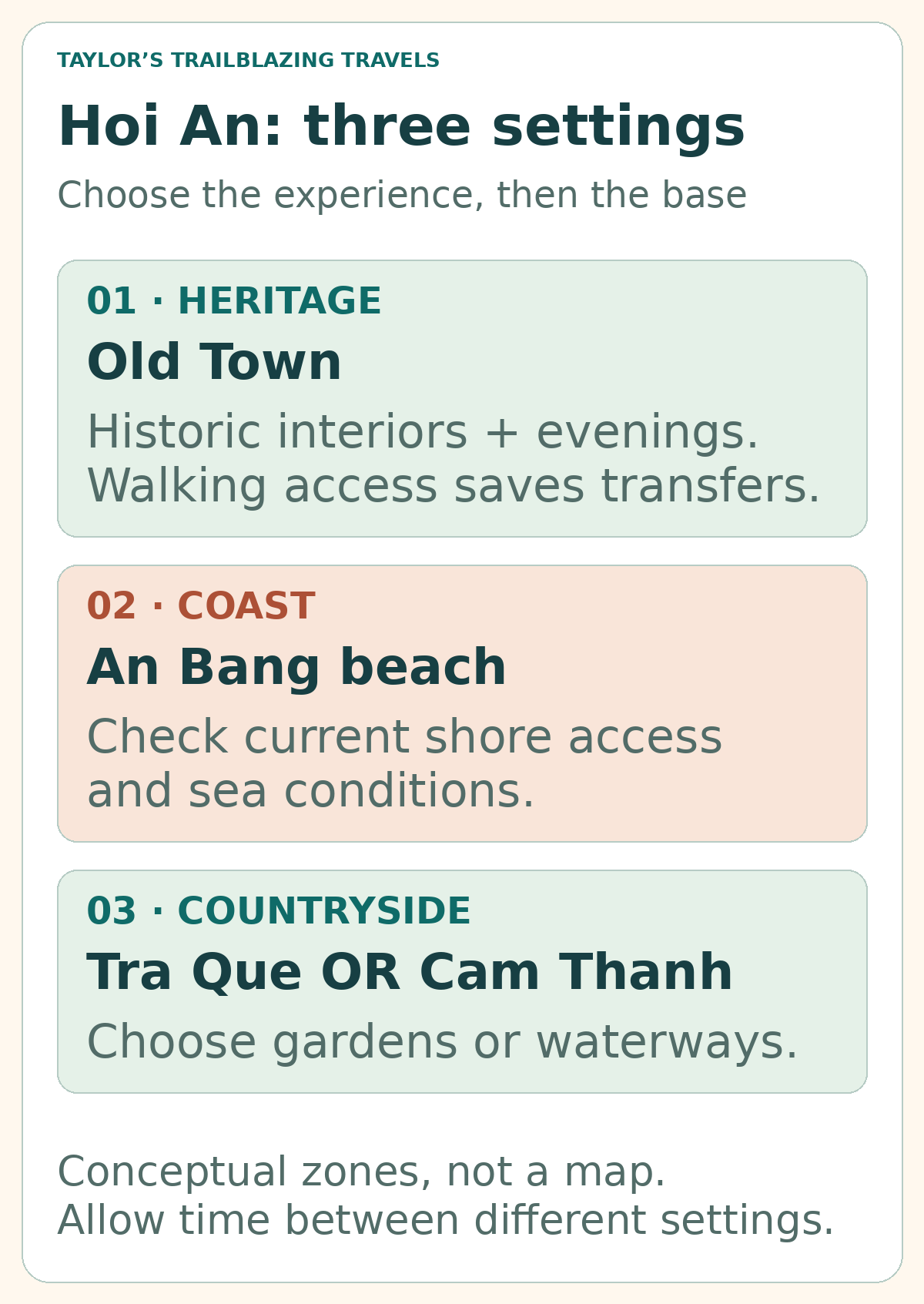
An Old Town-edge address suits repeated heritage walks and dinners.
Choose An Bang for coast time; verify current beach access before booking.
Use one full day for heritage, then choose Tra Que or Cam Thanh.
The January 2026 heritage policy offers different monument combinations; choose at the official desk.
Your Hoi An travel guide: dates, nights and priorities
Three nights work well when they provide two full days. With two nights, concentrate on heritage streets, food and one short outing. Add a fourth night for a proper beach day, tailoring appointments or a separate excursion; adding attractions to the same two days does not create a slower trip.
For a first visit, March and April are a reasonable starting point when choosing dates. The local tourism authority describes the coast’s broadly drier period as January to August, with early-year drizzle and increasing summer heat; September to December is wetter. This is a seasonal pattern, not a forecast for your beach days. [2]
For autumn travel, keep outdoor bookings flexible. Severe weather can disrupt roads and flights, so check forecasts and transport notices before committing to a tightly timed onward connection. [3] A rainy afternoon can suit a short indoor heritage visit or a long lunch; active flood warnings require a change of plan.
Choose accommodation by its map pin. Following the 2025 merger of Da Nang and Quang Nam, Hoi An addresses may now include Da Nang. That administrative label does not mean the property is in Da Nang’s urban beach districts. [4]
Back to top ↑Where to stay: Old Town, An Bang or countryside
Use the table as an editorial choice guide rather than a ranking of hotels. “Near Hoi An” is too broad to answer the useful question: can you comfortably reach your preferred breakfast, activity and dinner without arranging another ride?
| Base | Best fit | Trade-off to check |
|---|---|---|
| Old Town edge | A first visit centred on heritage and evening meals | Check the actual walking route, room noise and vehicle drop-off point. |
| An Bang | A beach-led stay with occasional trips into town | Town visits require transport; ask about present shore access and nearby works. |
| Cam Chau | A base near the countryside and rice fields described by Vietnam Tourism [17] | Check the exact setting: a rice-field view does not prove an easy walk to dinner. |
| Cam Thanh | A countryside-oriented stay with planned activities | Check evening transport and restaurant access rather than assuming everything is walkable. |
An Bang lies around five kilometres from the Old Town; Tra Que’s vegetable gardens are nearer the town, while Cam Thanh’s coconut waterways form a separate outing. These are different settings, even when a booking site groups them under one destination. [5] [6] [7]
A useful three-night rule is to count your intended evenings. If two or three end in the Old Town, give walking access priority. If the holiday revolves around beach mornings and pool afternoons, accept the occasional ride to the centre. For a short stay, changing hotels usually costs more usable time than this distance justifies.
Compare Hoi An stays on Booking.com for a city-wide search, or search Agoda stays near Hoi An Ancient Town. Enter your dates, then check the map, cancellation terms, recent noise reports and the final total. Use each map to compare the setting as well as the room.
Make the Old Town more than an evening photograph
Start with the buildings as well as the streets. A merchant house, an assembly hall and a museum reveal different sides of the port’s history; the narrow street network and timber architecture are central to UNESCO’s description of the town. [1] Choose a small number of interiors and leave time to look closely.
Understand the current heritage ticket
The conservation centre’s 28 January 2026 notice asks visitors to buy a ticket before entering the Ancient Town. Its VND 120,000 option includes the general landscape, either the Japanese Covered Bridge or Quan Cong Temple, one museum and three other eligible monuments. A VND 80,000 option includes the landscape, either the bridge or temple, and two other eligible monuments. [8]
The notice says a ticket covers the stay for up to three days; keep the stub after using its monument admissions. It also sets walking and cycling periods in the centre, so a car may need to leave you outside the pedestrian area. Confirm the eligible sights, any concessions and that day’s access when buying. [8]
Ticket details checked 23 October 2026 against the conservation centre’s current notice. This supersedes older advice describing a 24-hour ticket.
Build a short route around your interests
Tan Ky Old House and Phuc Kien Assembly Hall are useful candidates from the national tourism board’s heritage selection. [17] At the ticket desk, ask which house, assembly hall and museum are open and fit your chosen ticket. Put those stops in walking order, with the bridge area at one end rather than repeatedly crossing the centre. Allow an unhurried morning as a planning estimate; the number of admissions is not a challenge to finish them all.
Return after dinner for a different atmosphere, keeping the next morning free if you want quieter streets. A boat ride, lantern purchase or performance should be a deliberate extra. Ask for the total price and what it includes before agreeing, and do not assume every paid activity is part of the heritage ticket.
Back to top ↑Choose your countryside half-day: Tra Que or Cam Thanh
Tra Que for gardens and cooking
Tra Que is a working vegetable village roughly three kilometres from the Old Town. Its appeal is the connection between cultivated herbs, local cooking and the garden landscape; visits and classes can include time in the growing plots. [6]
Choose it if you want a hands-on session or a gentle rural outing. Compare how much of a class is actual cooking, whether a market visit is included, and how the operator accommodates dietary needs. A long list of stops can leave surprisingly little time at the stove.
Compare Hoi An cooking classes on GetYourGuide, checking the exact village and pickup area. If cycling is the main interest, compare Hoi An cycling routes by distance, road exposure, bike fit and support arrangements.
Cam Thanh for coconut waterways
Cam Thanh’s Bay Mau water-coconut landscape is associated with basket-boat outings, including trips with staged spinning demonstrations. [7] Ask whether your booking is a quiet paddle, a performance-led outing or a combined cooking programme; those are different experiences.
Check lifejackets, boarding assistance, group size and the weather policy. Families should ask how children are seated and supervised. If neither gardens nor boats particularly interests you, keep the half-day free. Countryside scenery is a reason to slow down, not an obligation to buy a packaged activity.
Back to top ↑An Bang and the coast: plan for the actual beach
An Bang offers cafés, restaurants and places to settle near the sand, making it the clearest beach-base choice for this guide. [5] For a town-based stay, consider an afternoon there when conditions suit, with a return ride arranged or an agreed pickup point saved.
Beach access deserves a current check. A Da Nang city report dated 18 September 2026 described continuing coastal-protection work beside An Bang, with completion of that section planned before 30 November. It does not establish the condition of every stretch today. Ask the accommodation for recent photographs of its nearest access and whether construction affects the route or outlook. [9]
Apply the same practical test to a Cua Dai beachfront listing: which part of the shore can you actually use, and how do you reach it? A sea view, a pool and direct access to usable sand are three separate amenities. Decide which one matters before paying a premium.
Swimming is a daily decision. Follow beach warnings and lifeguard instructions, and stay out when swimming is prohibited or conditions are rough. The local beach-management advice specifically stresses designated bathing areas and supervised swimming. [10] A clear-looking morning is not proof of safe water.
Back to top ↑Food, classes and tailoring without a rushed checklist
Start with cao lau, the town’s chewy rice noodles traditionally served with pork and greens. Com ga is the local chicken-rice option; white rose dumplings and mi Quang add different textures and flavours. Fillings, broth, garnishes and dipping sauces can contain ingredients that are not obvious from the English dish name. [11]
For three nights, assign meals different roles: one straightforward bowl or plate, one exploratory dinner with several small dishes, and a class only if learning to cook interests you. Ask about ingredients directly if you have an allergy or dietary restriction. A food tour is most useful when you want explanations and help ordering, rather than simply transport between famous queues.
For tailoring, choose the shop early enough to allow a fitting and a correction before departure. Agree the fabric, construction details, price, deposit and collection time in writing. Photograph the agreed design and try the finished item while you can still request changes. The sensible purchase is something you have time to assess; a fast turnaround promise is not a substitute for that time.
Leave shopping until after the first orientation walk unless an appointment needs arranging. It is easier to judge whether an item matters to you once the whole visit is no longer competing for the same afternoon.
Back to top ↑Getting to Hoi An and moving around locally
From Da Nang airport
Da Nang airport to Hoi An is a road transfer. The 12Go route page lists shared services and cars, with its overall journey estimates around one to two hours depending on the service. Add arrival formalities, luggage collection and any wait for a shared departure; the advertised driving time is not your flight-to-hotel time. [12]
Compare Da Nang airport–Hoi An transfers on 12Go. Check whether pickup follows your flight or a fixed timetable, where the vehicle leaves you, luggage limits and the cancellation terms. A private quote is particularly worth comparing for several travellers, a late arrival or a child-seat requirement.
Give the driver the hotel’s map pin and contact details. For a central address, ask the hotel where vehicles can stop during pedestrian hours and whether staff can assist with the final stretch. This is more useful than relying on an address labelled simply “Old Town”.
Between the town, countryside and beach
Walk within the heritage core and use a car for longer trips if traffic, heat or cycling confidence makes the route unsuitable. Use reputable transport or the genuine booking app, and check that the arriving vehicle matches the booking. FCDO advice warns about transport scams and impersonators. [13]
For public transport, DanaBus’s notice effective 28 August 2026 places route 02 between Da Nang Central Bus Station and Hoi An’s Hai Ba Trung parking area. Verify stops and the last return before using it; it is not a direct airport-to-hotel service. [14]
Save an offline map and hotel details. For mobile data, browse Airalo eSIM options, then select Vietnam. Check device compatibility, activation rules and included services before purchase. This is a general catalogue link; Airalo lists Vietnam plans separately. [15]
Back to top ↑A three-night stay, grouped around two full days
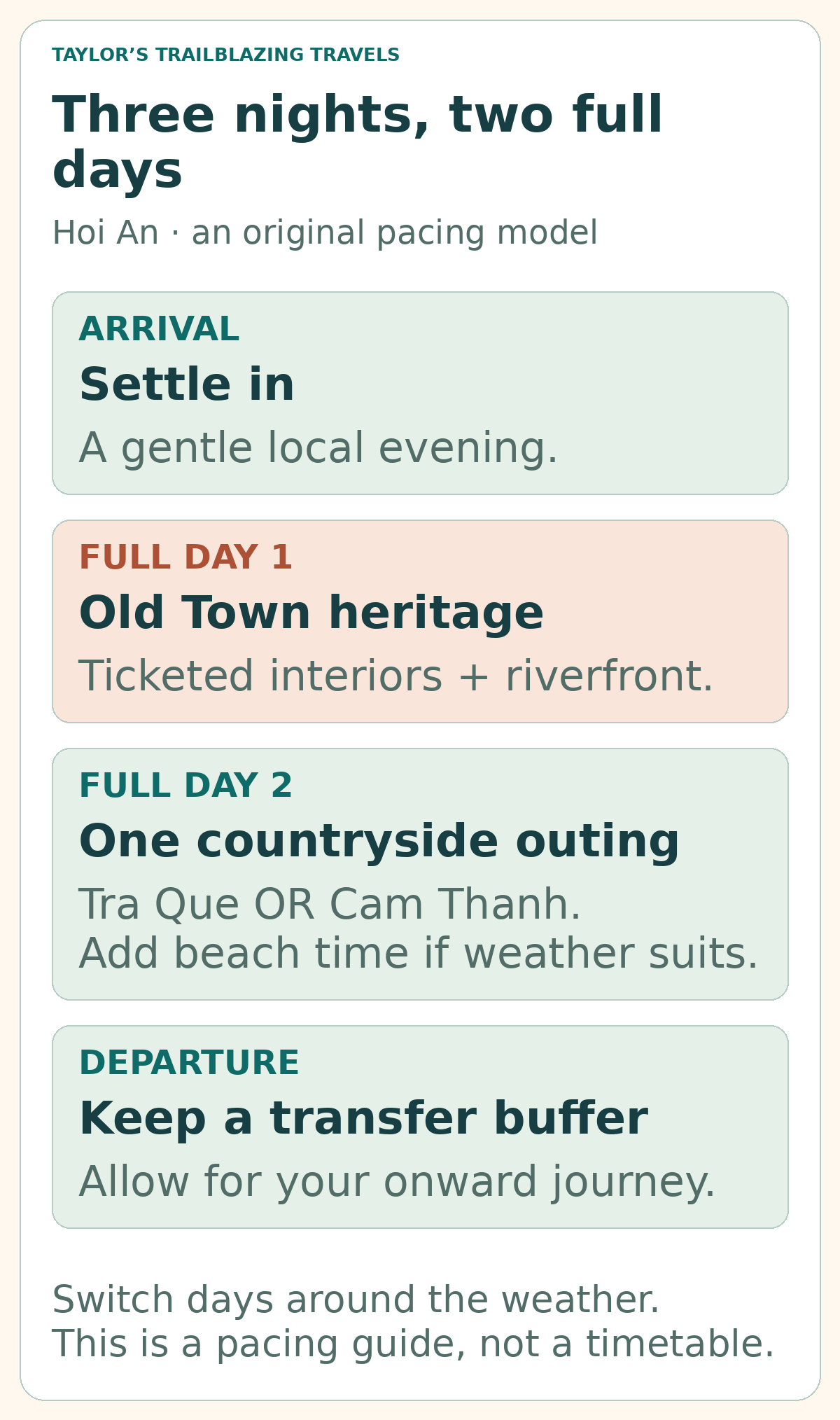
This is an original pacing plan for a traveller who wants heritage, food and one contrasting landscape. It assumes an afternoon or evening arrival and a departure after the second full day. Move the outdoor half-day to the better forecast.
| When | Main plan | Keep flexible |
|---|---|---|
| Arrival evening | Settle in, eat near the room and orient yourself. | Save the heritage interiors for a rested morning. |
| First full day | Choose heritage interiors and a short Old Town route; take a proper midday break. | Return for dinner and an evening walk if energy and conditions suit. |
| Second full day | Choose Tra Que gardens or Cam Thanh waterways. | Add An Bang only if the outing leaves comfortable time and the weather is suitable. |
| Departure day | Leave space for breakfast, a final collection or a short walk. | Protect the transfer buffer rather than adding a distant sight. |
With another full day, choose between genuine beach time and My Son. My Son’s surviving tower-temples belong to the Cham religious landscape, giving it a different historical focus from Hoi An’s merchant town. [16] It deserves a separate excursion if that history appeals; it need not displace the two local days that make a Hoi An stay worthwhile.
Build the budget around your base and booked extras
Accommodation position, airport transfers and paid outings are the useful costs to compare before booking. A cheaper room can lose its advantage if every meal requires a car. Conversely, a beach stay may justify a higher room cost when it replaces several organised excursions.
For two adults sharing one room for three nights, build each person’s budget as: half of the three-night room total, half of shared transfers, your own food and local-travel allowance, the selected heritage ticket and any activity fees. Use the final checkout total rather than the headline nightly rate. For example, a room difference of VND 400,000 per night changes each person’s three-night total by VND 600,000; that is arithmetic, not a claim about local hotel prices.
Reserve the room and arrival transfer first if timing or accessibility makes them critical. Book a class once you know where you are staying, then check pickup and dietary arrangements. Leave a weather-sensitive boat or beach outing flexible where the cancellation terms allow.
Before paying, check four details: the map pin, the full cost for your party, cancellation deadlines in local time, and what happens if conditions prevent the activity. For mobility needs, ask about the actual entrance, steps and bathroom, with photographs if needed; an area name or general “accessible” label cannot answer those questions.
Back to top ↑Frequently asked questions
Should I visit Hoi An as a day trip or stay overnight?
A day trip suits a traveller based elsewhere who wants a brief introduction. Stay overnight if you want both an unhurried heritage morning and time after dinner without a return transfer. For a first visit with countryside included, the three-night plan above makes better use of the setting.
Should a family with young children stay near the Old Town or the beach?
Choose the place where the family expects to spend its least flexible hours. If naps, pool time and early dinners dominate, prioritise a suitable room and nearby food. If short heritage walks are the priority, an Old Town-edge property can reduce transfers. Confirm child seating, room layout and the real walking route before booking.
Does “beachfront” guarantee direct access to usable sand?
No. Ask how the property reaches the shore, whether there are steps or a road, and for a recent view of that access. Current works or changing conditions can matter more than the booking label. Keep the distinction between a sea view, a swimming pool and beach access clear.
Can I add tailoring to a short visit?
Only if the shop can provide a realistic fitting schedule that leaves time for changes before departure. Bring the intended shoes or other relevant items for the fitting, agree details in writing and avoid making final collection depend on the last hour before your transfer.
Choose the plan that suits your visit
For a first visit, choose three nights near the Old Town if most evenings will be spent there. Give one day to heritage interiors and food, then choose one countryside experience with a flexible beach window. Choose An Bang instead when the coast is the holiday’s main purpose, after checking present access. The best Hoi An plan leaves time to enjoy the base you have chosen.
Back to top ↑Sources and methodology
Researched and editorially reviewed on 23 October 2026. Official tourism, attraction and transport sources support the destination facts. Suggested bases, day groupings and budget examples are editorial planning models; they are not reports of personal visits or live booking quotes. Recheck dated prices, access and operating details before travelling.
- UNESCO World Heritage Centre — Hoi An Ancient Town
- Da Nang Tourism Promotion Centre — Weather Da Nang
- Smartraveller — Vietnam
- Da Nang Tourism Promotion Centre — About Da Nang City
- Da Nang Tourism Promotion Centre — An Bang Beach
- Vietnam Tourism — Tra Que Vegetable Village in Hoi An
- Da Nang Tourism Promotion Centre — Bay Mau coconut forest
- Hoi An World Cultural Heritage Conservation Center — Visiting announcement
- Da Nang City portal, republished by Vietnam.vn — Progress of public investment works
- Báo Văn Hóa — Da Nang beach-safety advice for the low season
- Vietnam Tourism — Explore the food of Hoi An
- 12Go — Da Nang airport to Hoi An
- FCDO — Vietnam: safety and security
- DanaBus — Electric operation on routes 02, 13 and 21
- Airalo — Vietnam eSIM catalogue
- UNESCO World Heritage Centre — My Son Sanctuary
- Vietnam Tourism — Ten essential things to do in Hoi An
Illustrations in this article were created for Taylor’s Trailblazing Travels. Third-party photographs, where used, are credited beside the image or in the source list.