Furano and Biei Travel Guide: Scenic Hokkaido and Farm Country
Choose the season and transport first; the flower fields and country roads make more sense afterwards.
- Season-led planning
- Two countryside days
- Farm access matters
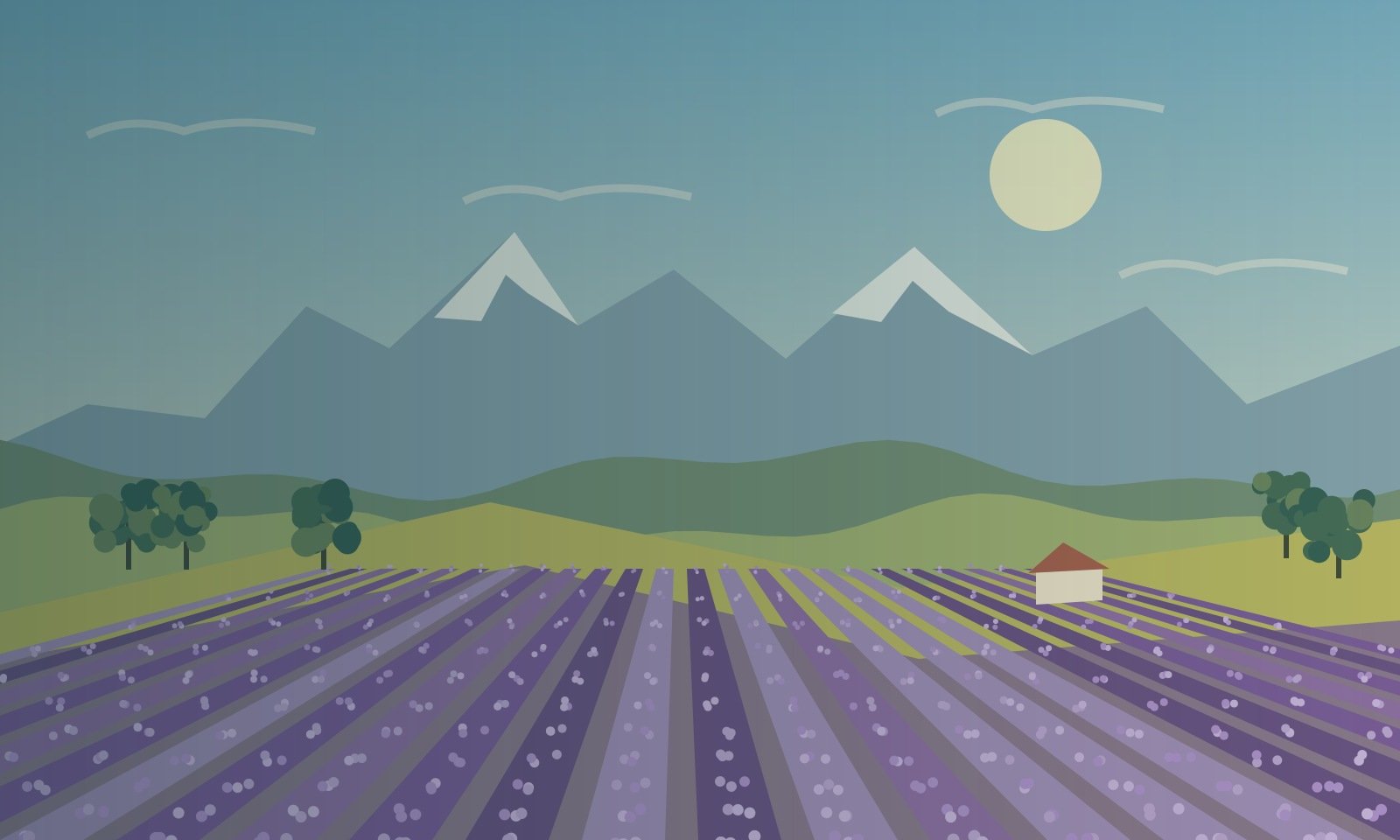
Furano–Biei-inspired landscape illustration; not a current flower report or a photograph of a particular farm.
Furano and Biei are not one compact attraction. This is a landscape of separate towns, cultivated hills, flower gardens and the Shirogane area, with travel between them. A rewarding visit starts with the season and the way you will move around—not with an attempt to reproduce every photograph in one day. [1][2]
This Furano and Biei travel guide separates sightseeing areas, compares a rural stay with a day tour and gives you an original two-day framework. The route and budget examples are transparent planning models, not a claim that a particular car, room or excursion is available.
This article contains affiliate links. Taylor’s Trailblazing Travels may earn a commission if you book or buy through them, at no extra cost to you.
Season first
Lavender, autumn farmland and snow are different trips, not interchangeable backdrops.
Local time
Two full countryside days offer more freedom than a long Sapporo return.
Transport
A rail connection to town does not take you to every field or viewpoint.
Respect the farms
Stay on permitted paths and use legal parking; fields are working land.
Choose the scenery you actually want to see
Lavender is a specific seasonal objective, not a promise attached to the place name. Farm Tomita’s Traditional Lavender Field guide gives late June to late July as its usual flowering season and early to mid-July as the best viewing period. That guidance concerns this particular field, and weather can shift the result. [3]
| Your priority | Planning approach | Important trade-off |
|---|---|---|
| Outdoor lavender | Use the grower’s field-specific summer guidance. | Reserve suitable rooms and transport, but do not expect a guaranteed peak on a precise date. |
| Other flower displays | Check the current planting and bloom information at each garden. | Different species have different periods; an August photograph is not necessarily lavender. [6] |
| Autumn farmland | Prioritise landscape, changing colours and open food or craft stops. | Allow for harvesting and shorter usable visiting hours. [1] |
| Snow scenery | Design a winter itinerary from the beginning. | Flower gardens become a different experience, with snow activities depending on conditions. [6] |
The Blue Pond also changes with conditions. The tourism association explains that snowmelt or heavy rain can alter its appearance, and winter snow can obscure the blue water. A photograph from another season is not evidence of what you will find. [7]
Before reserving a specialist tour, check which version operates on your travel date. A summer flower itinerary and a winter zoo-and-snow itinerary may share a regional label while providing quite different days.
Planning Furano and Biei as part of a longer journey? Return to our Japan travel hub to compare the wider country itinerary before committing to another transfer day.
Where to stay: choose the part of the route you repeat
| Base | Best fit | Question to settle first |
|---|---|---|
| Furano / Nakafurano | Flower-field priorities and food or craft stops towards Furano. | Is the property near town, the ski area or a rural road? How will you reach dinner? |
| Biei | The hills and a visit towards Shirogane. | Can you arrange the final leg from the station and a usable return? |
| Asahikawa | A wider route where airport or rail connections matter. | Will repeated countryside travel cost more time than the convenient arrival saves? |
| Sapporo | A single organised excursion when you cannot move bases. | Are you comfortable spending a large share of the day travelling? |
Town names are search starting points, not proof of a convenient location. A rural property may be ideal with a car and awkward without one. Check the arrival instructions, meal availability and collection arrangements before making a non-refundable booking.
For two full sightseeing days, three nights avoids relying on a partial arrival or departure day. Two nights can still work if you arrive early and leave late, but write those transfers into the plan rather than quietly treating them as spare sightseeing time.
Four different sightseeing areas
Nakafurano: Farm Tomita
Farm Tomita is in Nakafurano, not at Furano Station. Its own access guide puts Nakafurano Station about a twenty-five-minute walk away. That final walk matters with luggage, in rain or when timing the last connection. Check the farm’s daily opening information before planning an early photograph; entry outside opening hours is not permitted. [5][4]
Biei hills: scenic farmland and Shikisai-no-oka
Shikisai-no-oka is a managed flower-garden visit rather than unrestricted access to surrounding farms. The operator’s English page lists adult admission of ¥800 during July–September, with rides and the alpaca facility charged separately. Its tractor attraction also uses the name Norokko; it should not be confused with JR’s retired sightseeing train. [6]
Shirogane: Blue Pond and a waterfall-side visit
Treat the Shirogane area as a separate leg from central Biei. The local tourism association describes bus access towards Blue Pond and Shirogane Hot Spring, and notes that the Biei departure stop is on the main street in front of Asahikawa Bank. Confirm the actual stop and current return timetable locally. [9]
The Blue Pond’s current ordinary-car parking charge is ¥1,000 per visit from 1 July 2026. An older English tourism page still shows ¥500; the newer dated notice is the relevant source for this figure. Parking is a vehicle charge, not an admission price per person. [8][7]
Furano: add a food stop with a purpose
The local tourism association lists the Furano Ice Milk Factory in Nakagoku as a place for dairy-based products and seasonal flavours. It can provide a useful contrast to flower displays; check the current hours and transport before making it a fixed lunch or dessert stop. [12]
Car, local transport or an organised day?
A car buys flexibility, not unlimited daylight
A car can make separate rural stops easier to combine, particularly for two or more people. It also adds collection, return, navigation, parking and fuel tasks. Check licence requirements and the rental agreement before booking, and use a route appropriate to your experience and the season. Snow and ice are not conditions in which to learn unfamiliar winter driving.
Public transport works best with fewer, planned stops
There are regular railway and bus options, but the final connection to a farm or viewpoint needs separate planning. Biei’s tourism association lists the Biei View Bus, Furano Bus and Dohoku Bus services; the operating periods, reservations and actual stops differ. A train ticket to Biei does not include transport around its countryside. [9]
A Sapporo tour is useful when time or driving is the constraint
For a non-driver with one spare day in Sapporo, an organised excursion can avoid stitching together several rural connections. The compromise is time at stops and less freedom to wait for light or weather. Compare the actual dated itinerary, pickup location, language, meal arrangements and admission inclusions. [13]
A two-day warm-season framework
Arrival: set up the following days
Collect transport where appropriate, buy any provisions you need and confirm dinner arrangements. Do not make the whole first evening depend on a remote shop still being open when your flight or train arrives.
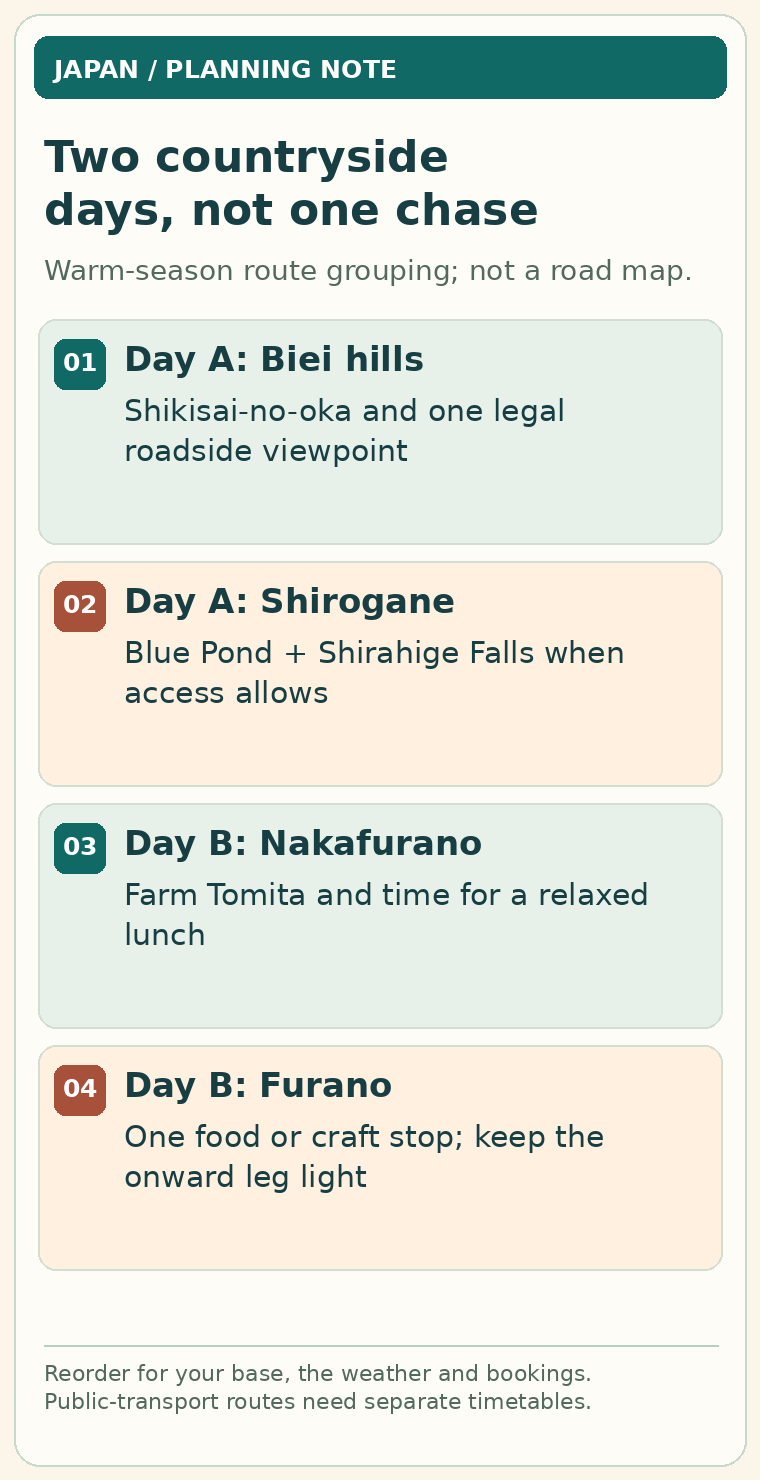
Day A: Biei hills and the Shirogane direction
Choose Shikisai-no-oka or a short permitted hills route as the main first element. Then, if the day and transport support it, visit Blue Pond and a Shirogane-area stop such as Shirahige Falls. Allow a genuine lunch break and parking or bus margins. Reverse the order when the pond is your priority and an earlier visit better suits the conditions. [1][7][9]
Day B: Nakafurano and Furano
Give Farm Tomita enough time for the particular fields open and in season, rather than assuming every area looks like the familiar lavender photograph. Add a relaxed meal and one Furano food or craft stop. Leave late-afternoon space for an onward connection or simply the changing light. [4][12]
For a public-transport version, choose the booked bus or tour first and build the day around its confirmed departure. Do not copy the car sequence stop for stop. If the return bus prevents one attraction, remove that attraction rather than leaving the way home unresolved.
For winter, replace the flower-based plan completely. Choose verified winter activities and daylight travel, with an indoor or shorter alternative when conditions deteriorate. This summer framework is not a snow-driving recommendation.
Compare the full transport cost
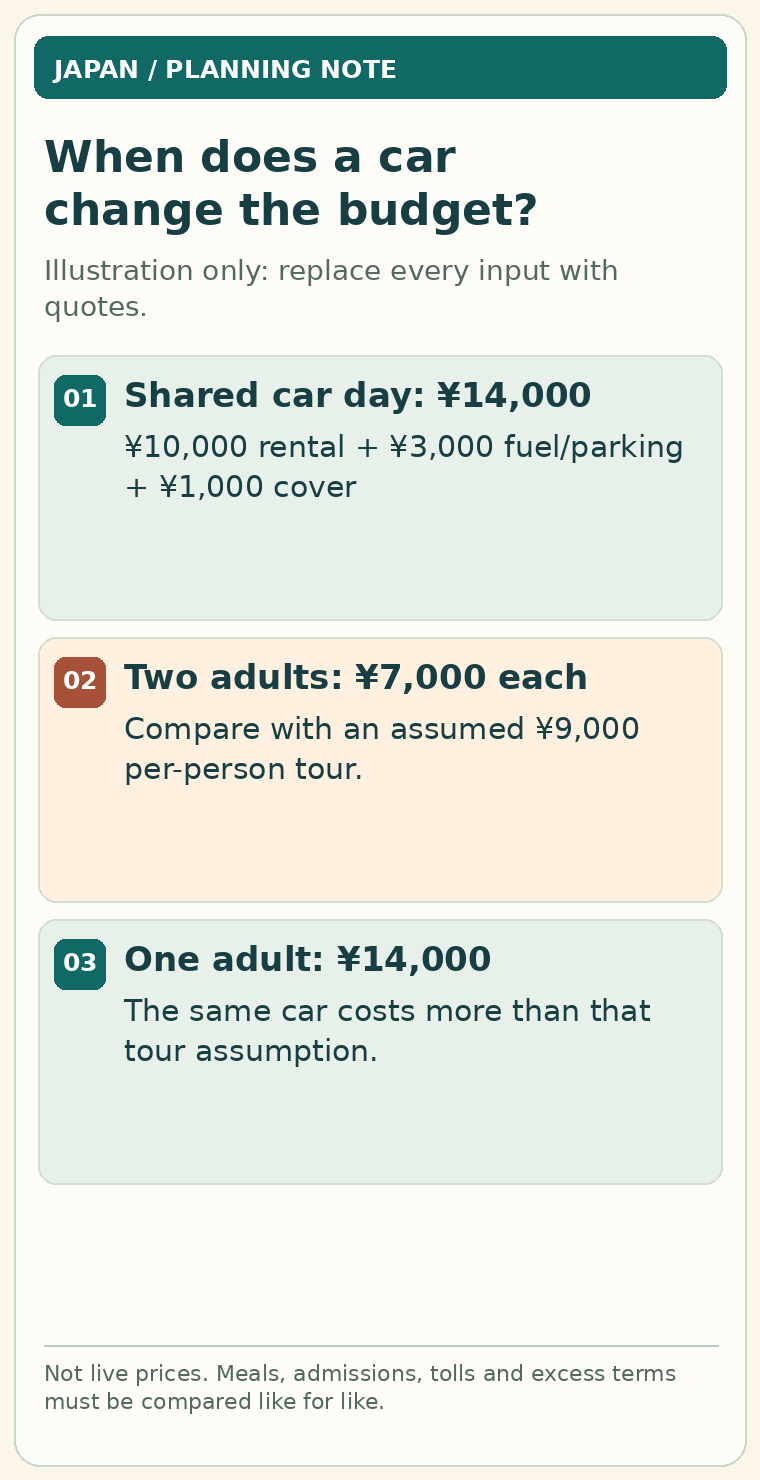
The following model is illustrative, not a price survey or live quote. It shows why the answer can differ between a solo traveller and a couple. Replace every input with the actual rental and excursion offers available for your dates.
| Input | Assumption |
|---|---|
| Car rental | ¥10,000 for the day |
| Fuel and parking together | ¥3,000 |
| Selected additional cover | ¥1,000 |
| Total vehicle-day cost | ¥14,000 |
| Alternative organised tour | ¥9,000 per adult |
For one adult, the car costs ¥14,000 against the assumed ¥9,000 tour. For two adults, sharing the car gives ¥7,000 each against ¥9,000 each on the tour: a ¥4,000 difference in total. That saving is only meaningful when the two options cover comparable sightseeing and costs.
Add anything omitted from either side: meals, tolls, admission, parking outside the allowance, one-way drop-off, extra drivers or equipment. Read the insurance excess and exclusions rather than treating a line labelled “cover” as protection against every cost. A cheaper car can still be the wrong choice when none of the party is comfortable driving the route.
For accommodation, compare actual nightly quotes and ask about separately collected taxes. Do not copy the combined Sapporo tax amount into another municipality without checking that property’s applicable charges.
Respect the working landscape
Biei’s tourism association asks visitors not to enter farmland without permission. Cultivated fields, even when they look empty or are covered by snow, are not open-access photography sets. Stay on authorised paths and viewing areas rather than stepping between rows for a cleaner composition. [11]
A clear view from a narrow road does not make it a safe parking place. Use designated parking, keep farm entrances clear and move on when there is no lawful place to stop. Farm Tomita also specifically asks visitors not to park on public roads or in its tour-bus parking areas. [5]
Weather and farm work can change the appearance of a landscape. Treat that variability as part of visiting the countryside rather than searching for access that a landowner has not granted. You can often make a better photograph from a permitted viewpoint by giving it time instead of crossing a boundary.
Questions that prevent disappointing bookings
Can I visit without seeing lavender?
Yes, if the trip is about broader farm scenery, other gardens, food or winter landscapes. Do not pay for a lavender-focused expectation outside the grower’s published field season. Different flowers and different seasons deserve their own plan. [3][6]
Is a day trip from Sapporo enough?
It can be enough for a curated introduction. Farm Tomita estimates about 2½ hours by car from central Sapporo, before visits and delays. An independent same-day return to that area starts with roughly five hours of driving under that published estimate. A local stay buys more flexibility; a tour buys simpler logistics. [5]
Can I rely on a seasonal sightseeing train next summer?
Only after the operator publishes the relevant year’s service. In particular, do not assume the Norokko train will return: JR identifies September 2026 as the end of its operations. Current regular rail services and any future replacement announcement must be checked separately. [10]
Is the Blue Pond always bright blue?
No. The tourism association explains that conditions including snowmelt, rain and winter snow change the appearance. Keep another reason for the day beyond reproducing one image. [7]
Can I fit every famous tree into the drive?
That is not the aim of the proposed route. Choose a short, legal hills circuit or one permitted viewpoint. A long series of roadside stops can add risk and nuisance while leaving less time at the places you most wanted to visit. [11]
The countryside rewards a smaller plan
Choose the season first, then the base and transport. Two full local days with a few well-matched stops are a better starting point than trying to combine every field, tree, waterfall and farm shop with a Sapporo return.
Book help where it solves a genuine problem, leave room for changing conditions and respect the people working the land. The best route is the one you can enjoy without rushing—or trespassing—to make the photograph match an expectation.
Sources and further checks
Sources consulted for the editorial review on 17 October 2026. Where an older page conflicts with a newer dated notice, the relevant correction is identified in the text.
- Biei Tourism Association: exploring the cultivated hills
- Furano Tourism Association: regional access and summer journey estimates
- Farm Tomita: Traditional Lavender Field flowering guide
- Farm Tomita: current opening information and notices
- Farm Tomita: access, station walks and road-parking guidance
- Shikisai-no-oka: seasonal activities, opening information and admission
- Biei Tourism Association: Blue Pond, seasonal appearance and access
- Biei Tourism Association: parking price change from 1 July 2026 (Japanese)
- Biei Tourism Association: sightseeing and local buses
- JR Hokkaido: Furano–Biei Norokko final operating day, 23 September 2026 (Japanese)
- Biei Tourism Association: requests to visitors and farmland protection
- Furano Tourism Association: local ice-milk stop
- GetYourGuide: Sapporo departures including Furano and Biei tours
Illustrations in this article were created for Taylor’s Trailblazing Travels. Third-party photographs, where used, are credited beside the image or in the source list.