
Japan Holiday Planning Timeline: What to Book and When
Put the essential decisions first, then give each booking its own release date and cancellation reminder.
- Official release examples
- Worked May 2027 calendar
- Final-week checklist
AI-generated editorial illustration of an imagined Japanese station and journey; no particular service, timetable or reservation is depicted.
A useful Japan holiday planning timeline keeps three different dates separate: when you want to travel, when a supplier starts selling, and when changing your mind begins to cost money. Confusing them can leave you booking too early, checking too late or holding accommodation you meant to cancel.
Use the suggested lead times below as an organising framework. They are not claims about the cheapest day to buy flights, and they do not replace the exact booking rules of your hotel, attraction or train operator.
Before you commit
Resolve the eligibility, access and essential-experience questions.
Dates and stays
Compare the complete route and read the cancellation terms.
Supplier releases
Record the actual opening date, time zone and purchase route.
Before departure
Recheck documents, bookings, access and transport conditions.
Keep three dates for every important booking
For each paid booking, record the visit date, the sales-opening date if there is one, and the last cancellation or change deadline you are willing to rely on. Add the supplier, amount, confirmation reference and the exact terms you accepted. If a date has not been announced, mark it as unknown and set a reminder to check again.
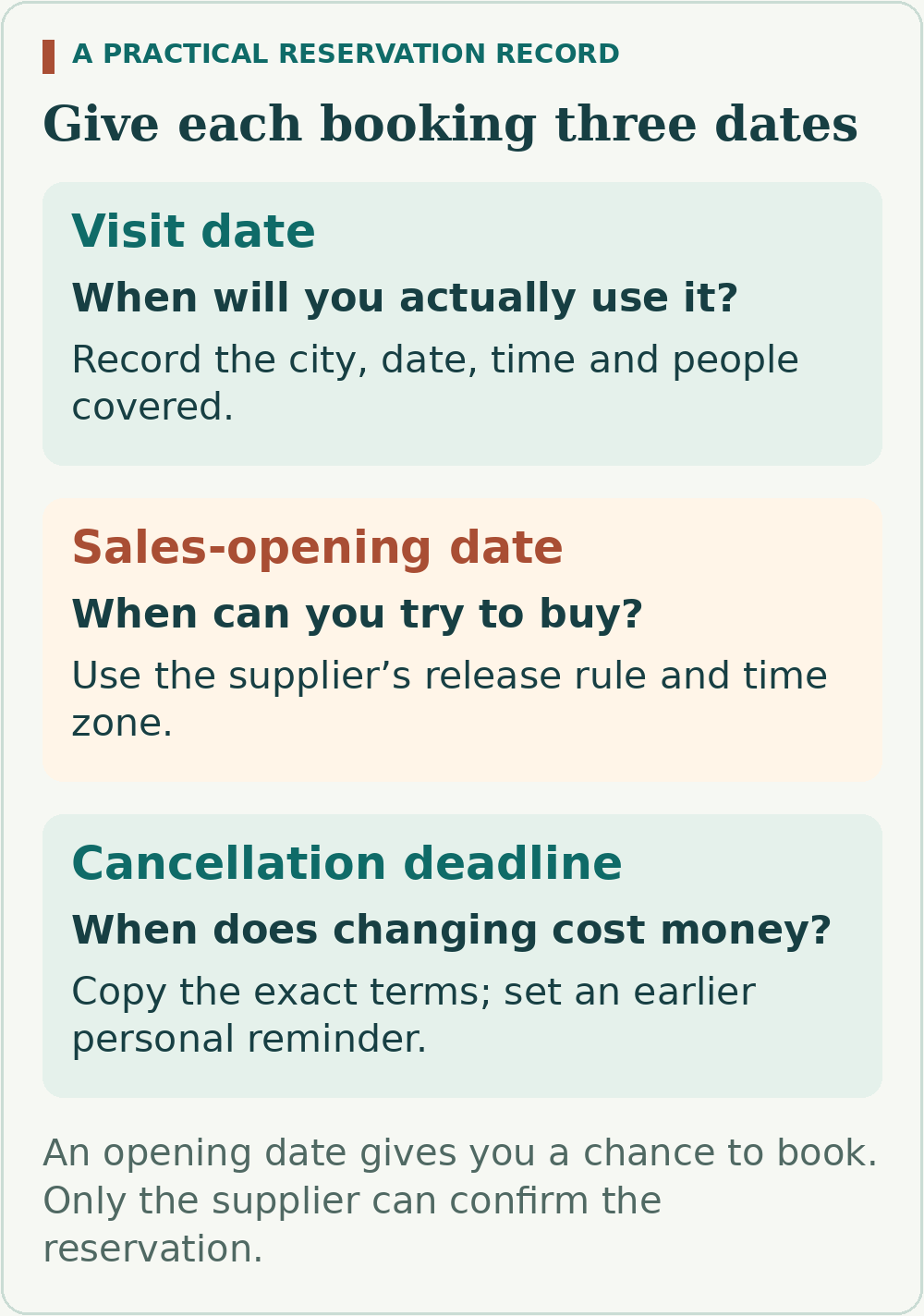
This is particularly useful when hotel rooms are on sale before an essential attraction opens its ticket calendar. A room with suitable cancellation terms can preserve a possible route, but it does not reserve attraction entry. If the whole holiday depends on one hard-to-obtain experience, decide in advance whether you would keep the trip if that ticket were unavailable.
Use a personal reminder before the actual deadline
Put your own decision reminder earlier than the supplier’s cut-off. Record the time zone shown in the terms. A deadline expressed in Japan time can arrive much earlier in the UK day than you expect; use a calendar that displays the date in both locations.
Use lead times to organise the work
The following timetable is an editorial planning framework for an independent UK-to-Japan holiday. Begin earlier when school dates, an accessible room, a particular ryokan or a major seasonal event leaves few acceptable alternatives. If you have less time, work through the same order and simplify what remains uncertain.
| When | Main task | What should be settled |
|---|---|---|
| About 6–12 months ahead, or as soon as the idea is serious | Check documents and essential needs; choose possible dates, trip length and a provisional route. | You know what could prevent or materially change the holiday. |
| About 3–6 months ahead | Compare complete flight-and-stay combinations; secure suitable bookings when available and acceptable. Arrange health advice at least eight weeks before travel. [2] | The main route works, and you understand the financial commitment. |
| About 1–3 months ahead | Follow attraction and transport release calendars; refine the days around confirmed reservations. | Timed experiences and important journeys have their own reminders or confirmations. |
| Final month and week | Check deadlines, access, payment arrangements, arrival information and current travel advice. | You can find and use the documents and bookings you need. |
These ranges deliberately overlap. You may book an important stay earlier, leave ordinary meals open, or reserve a qualifying SmartEX journey well before the last three months. A lead-time row is a prompt to work on the decision, not an instruction to wait until that point. [8]
Golden Week, Obon and New Year deserve an earlier look at the route and accommodation because domestic travel peaks or closures can affect the choices. Check the actual dates and operating notices for your travel year. [3]
Resolve the questions that can change the whole trip
Documents, medicines and practical needs
Check the rules for each traveller’s actual passport, purpose and stay length before making non-refundable commitments. The FCDO’s Japan entry page is written for British citizens travelling from the UK; it is not a substitute for checking a different passport or purpose. [1]
Use the Japan entry requirements guide to organise the passport, medicine and arrival checks. Resolve medicine restrictions early enough to seek the appropriate official advice. If someone needs a particular room layout, bathroom, transport assistance or dietary arrangement, confirm what the supplier can provide before relying on a general description.
The experience your route depends on
Identify one or two genuinely essential experiences. Check their official operating calendars, booking methods and cancellation conditions. Keep alternatives where possible. Planning around the hope of a future ticket is a different commitment from planning around a confirmed reservation.
A festival date, seasonal route or special stay can determine the order of cities. A museum with a late ticket release usually calls for a flexible day inside an already sensible city stay. Avoid letting every attractive activity become an immovable constraint.
Enough days and a complete budget
Count nights in Japan separately from UK departure and return dates. Compare arrival and departure airports, then allow time for hotel changes and transport. The Japan trip-length guide helps test the pace before you start paying for it.
Book flights and stays as one route
Compare the whole combination before choosing a fare: flights, bags, arrival time, the first transfer, every hotel night and the journey to the departure airport. Arriving in Tokyo and leaving from Kansai may reduce retracing for a suitable route, but compare the total cost and timings against a return flight to the same city.
For accommodation, read the actual room and rate terms. Check occupancy, beds, meal inclusions, arrival cut-offs, payment date and cancellation charges. A room described as refundable may have a cut-off; a pay-later rate can still carry a cancellation obligation. Save the terms shown when you book rather than assuming every rate at the property behaves the same way.
Consider securing the least replaceable stay first while checking that flights and the surrounding nights remain workable. Keep unnecessary duplicate reservations to a minimum, and cancel discarded options promptly within their terms.
Arrange appropriate travel insurance when you book. Check the cover, exclusions and any cancellation protection you need, including planned activities and declared medical circumstances; the existence of a policy does not mean every change of plan is covered. [2][9]
There is no universal flight-buying month that this guide can promise will be cheapest. Decide what complete trip you can afford and what flexibility is worth to you, then book when a suitable option meets those requirements.
Give each supplier its own release reminder
The rules below were checked on 17 October 2026. Reopen the official source before a later purchase: ticket systems, eligible products and calendars can change. A sales-opening date is an opportunity to try, not a reservation or an availability guarantee.
| Booking | Rule checked for this guide | What to put in your calendar |
|---|---|---|
| Tokyo Disneyland or Tokyo DisneySea dated park ticket | Daily sales from 14:00 Japan time for the same date two months later. Special handling applies when the corresponding date does not exist in the earlier month. | The exact release date, intended park and visit date; recheck the official calendar. |
| Ghibli Museum overseas online ticket | The museum’s English guidance gives 10:00 Japan time on the 10th of each month for the following month’s admission. | The monthly release, acceptable dates and entry times, and the official overseas purchase link. |
| Tickets through JR-EAST Train Reservation | JR East states sales begin at 10:00 Japan time one month before the boarding date for tickets covered by its service. | The date for each journey; check that the route and product are sold by that service. |
| Eligible basic SmartEX reservations | Some can be purchased from 05:30 Japan time one year before travel. Earlier bookings use a provisional schedule; final train, time and seat details are confirmed one month before travel. | The purchase terms, the later confirmation check and any deadline for a change. |
The park-ticket, museum, JR East and SmartEX rows refer to their respective official guidance. “One month” and “two months” mean calendar-month rules, not a blanket 30 or 60 days. [4][5][7][8][10]
Two details that are easy to miss
Ghibli Museum’s Japanese-language notice announced a ticket-system change for November 2026 admissions. Overseas visitors should follow the museum’s English page and its current purchase and delivery instructions. Do not assume the notice describes every overseas checkout route. There are no walk-up tickets. [5][6] The museum’s 6 October 2026 notice also introduced a ¥110 system charge per ticket for admissions from November 2026; verify the charge and fulfilment method at official checkout. [6]
SmartEX’s one-year option is not a rule for every Japanese train or fare. Its guidance excludes certain products and seat types, including Hayatoku products and oversized-baggage seats, from that early window. Its official English pages also give different confirmation times on the one-month date, so rely on the reservation notification for the confirmed train and seat rather than an exact confirmation hour in a generic guide. Payment is taken when the reservation is made. [8][10]
Book restaurants, guided activities or other timed visits according to their own terms once the base city and surrounding day are secure. Keep ordinary sightseeing and some meals flexible so one unavailable booking does not force an unnecessary hotel change.
Build a worked calendar from the travel dates
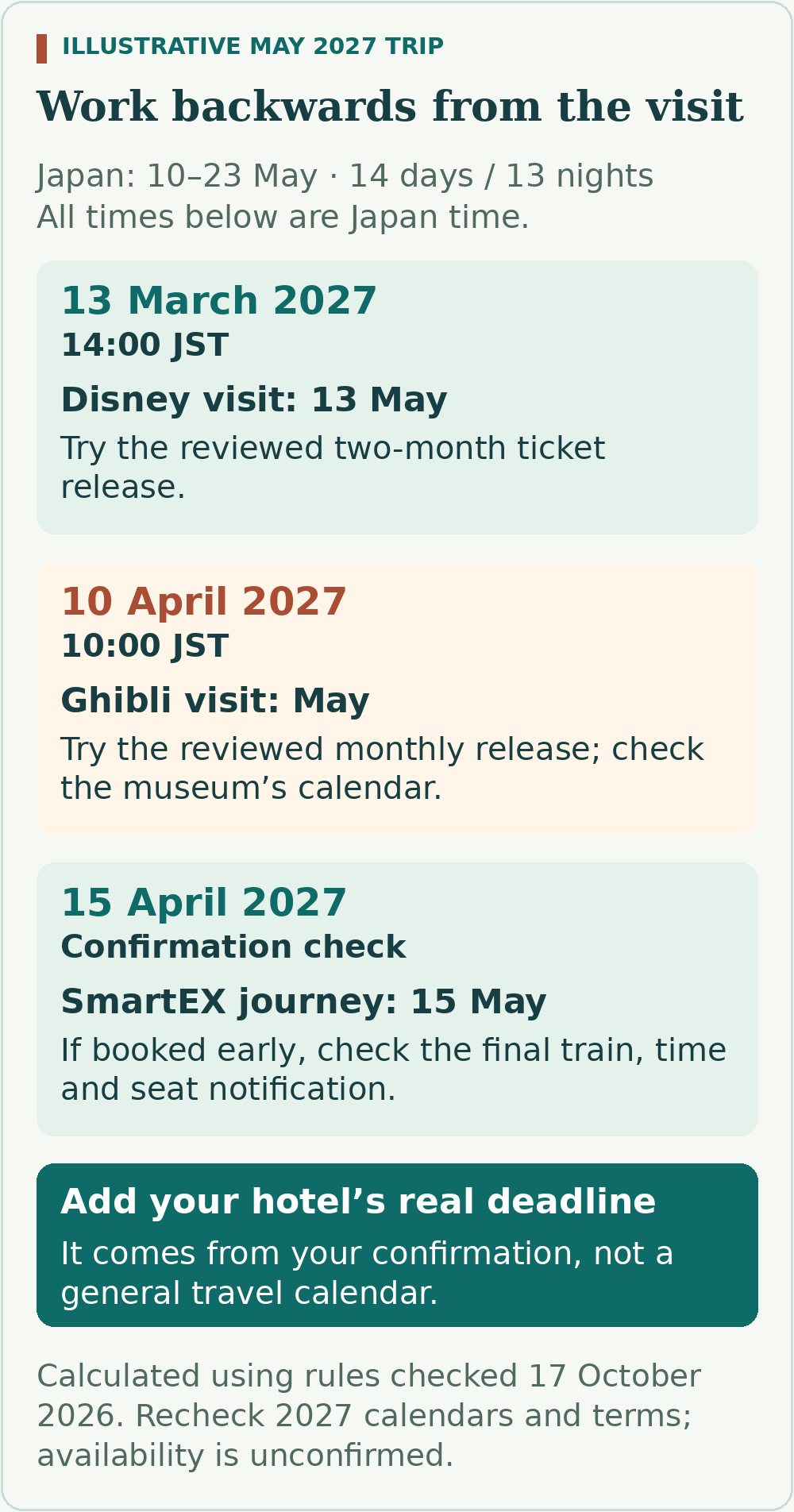
Suppose two adults plan to be in Japan from 10 to 23 May 2027: 14 calendar days and 13 nights. They hope to visit Ghibli Museum on 12 May, a Tokyo Disney park on 13 May and take a Tokyo–Kyoto SmartEX journey on 15 May. These are illustrative preferences, not confirmed opening dates, tickets or transport availability.
Applying the supplier rules reviewed above produces the calendar below. Recheck the 2027 calendars before relying on it, and keep alternatives for either attraction.
| Reminder | Action | What it establishes |
|---|---|---|
| 13 March 2027, 14:00 | Try for the chosen Disney park on 13 May, if the reviewed two-month rule still applies. | Successful payment and confirmation are needed; the reminder alone holds nothing. |
| 10 April 2027, 10:00 | Try for the intended Ghibli Museum date in May through the museum’s overseas ticket link. | Check the operating calendar and acceptable alternatives before the sale. |
| 15 April 2027 | If the 15 May SmartEX journey was booked through its early window, check the final train, time and seat notification. | A confirmation check, not a claim that every rail ticket first goes on sale that day. |
| Before the hotel’s actual cancellation deadline | Review the final route and cancel any discarded room within its terms. | The date must come from the real reservation, not from a general travel timeline. |
If you are setting these reminders in the UK, 13 March at 14:00 JST is 05:00 GMT; 10 April at 10:00 JST is 02:00 BST. UK clocks go forward on 28 March 2027, so the two reminders use different offsets. [11]
The March and April dates are calculated examples based on the Disney, museum and SmartEX rules, not newly announced 2027 sales notices. [4][5][8][10]
Add the deadline that only your reservation can supply
For example, suppose a hypothetical hotel confirmation allows free cancellation until 18:00 Japan time on 7 May, equivalent to 10:00 BST in the UK. A personal review reminder on 6 May gives you time to decide. This invented deadline illustrates the method only: copy the exact date, time zone and conditions from your own booking.
The Trip Itinerary Planner can help organise the sequence of stays and nights. Keep the supplier reminders in your calendar as well; the planner does not confirm ticket availability, operating dates or reservation terms.
Finish with access and arrival checks
At least eight weeks before travel
Review health precautions and any vaccination advice with the appropriate professional or official travel-health guidance. The FCDO’s checklist recommends allowing at least eight weeks for this check. If the trip is closer, seek advice promptly rather than assuming it is too late to ask. [2]
During the final month
- Reconcile all hotel nights with arrival and departure dates.
- Check timed tickets against transfer days and allow room for delays.
- Verify baggage, accessibility and collection or boarding instructions with the actual operator.
- Confirm how each ticket is accessed: an app, account, email, collection reference or other required method.
- Review remaining cancellation and payment deadlines.
During the final week, then again when relevant
Reopen official entry guidance and your airline’s instructions, check transport notices, and review weather conditions for any outdoor or island plans. Keep a way to access essential flight, hotel and insurance details if your phone is lost or unavailable. [1][2]
Prepare the first arrival journey and accommodation address. Test that you can sign in to the accounts holding your reservations. If using an eSIM, follow that provider’s installation and validity-start instructions; do not assume buying, installing and activating are the same event. Keep a workable payment backup and enough time to resolve a failed login or card check before departure.
If you are starting with only a few weeks left
Work through the same dependencies quickly: documents and practical needs, a feasible route, flights and rooms, then optional timed experiences. Before paying for the main trip, look at whether your essential attraction or stay is actually obtainable for the remaining dates.
If one popular ticket is unavailable, choose another experience inside the same city rather than rebuilding the whole holiday reflexively. Fewer bases, more ordinary sightseeing and flexible meals can make a late-planned trip easier to organise.
Do not treat a third-party listing as proof of official availability. Check what is being sold, the date and entry conditions, the cancellation terms and whether it is an admission ticket, a tour or another service. For Ghibli Museum, use the museum’s own linked purchase routes and heed its prohibition on resale. [5]
Questions that can change your plan
Should I buy a rail pass before arranging the route?
Choose the route first. Then compare the eligible journeys and reservation conditions with the pass price and individual tickets. Buying a pass to create an itinerary around it can lead to unnecessary journeys. Check which booking service covers the trains you intend to use; JR-EAST Train Reservation and SmartEX do not cover the same routes or products. [7][10]
Does a reservation request mean my booking is confirmed?
Read the status shown by the supplier. A request, lottery entry, waiting-list place or payment attempt may need another step before you have a confirmed booking. With an eligible early SmartEX reservation, payment and a reservation result can precede the later confirmation of the precise train and seat. Save the confirmation and recheck the details at the specified stage. [8][10]
Do I need to reserve every meal and every sightseeing stop?
No. Reserve experiences with a genuine capacity, timing or personal-need constraint. Leave space for weather changes, rest and neighbourhood exploration. The aim is a trip with its essential pieces secured, rather than a calendar so full that one delay disrupts the day.
Make the decision that fits your trip
Start with the decisions that could change whether, when or where you travel. Once the route is sound, secure suitable flights and stays, record each supplier’s release rule, and set your own reminders before cancellation deadlines.
Your next step is to make one list of essential bookings with three dates for each: the visit, the sales opening and the cancellation cut-off. Unknown dates belong on the list too, with a reminder to verify them. That gives the holiday a workable structure while leaving room to enjoy it.
How this guide was researched
The suggested lead times are an original organising framework. Supplier examples were checked against current official guidance on 17 October 2026; the worked March and April 2027 reminders are calendar calculations under those reviewed rules, with later operating dates and availability unconfirmed. The hotel deadline is explicitly hypothetical. No purchase, reservation or cheapest-fare outcome is claimed.
Sources
Official guidance and operator information reviewed on 17 October 2026. Recheck time-sensitive details for your own travel dates.
- FCDO — Japan entry requirements
- FCDO — Foreign travel checklist
- Japan National Tourism Organization — Business hours and holidays
- Tokyo Disney Resort — Park tickets and sales schedule
- Ghibli Museum — Overseas ticket guidance and museum calendar
- Ghibli Museum — Ticket-system change announced 6 October 2026 (Japanese)
- JR East — Ticket and reservation FAQ
- SmartEX — Reception times and reservation periods
- FCDO — Foreign travel insurance
- SmartEX — Basic service, eligible lines and early-reservation conditions
- GOV.UK — When do the clocks change?
Illustrations in this article were created for Taylor’s Trailblazing Travels. Third-party photographs, where used, are credited beside the image or in the source list.