Thailand itineraries
Northern days, then time to settle into Samui.
A fourteen-day city-to-island route that makes the flight connection and Gulf weather part of the plan.
A Bangkok, Chiang Mai and Koh Samui 2-Week Itinerary offers three distinct settings, but the island connection deserves attention before the hotel search. Flying to Samui and flying to the mainland are not interchangeable purchases. Likewise, the Gulf coast needs its own weather assessment rather than a seasonal rule borrowed from Phuket.
This plan uses three Bangkok nights, four Chiang Mai nights, five Samui nights and one final Bangkok night. It gives the island enough time for local beach days, a short road outing and one optional marine experience without requiring a second island hotel. Travel dates remain visible inside the fourteen-day window.
The recommendations are based on research and practical route design, not claimed personal stays. Use the framework to compare the complete journey, the actual hotel address and the conditions for outdoor activities. Once those decisions are sound, the northern and island days can be rearranged to suit energy, weather and the experiences you most want.
Island access
Check USM vs URT
A mainland arrival adds road and ferry travel.
Weather decision
The Gulf calendar
Assess Samui separately from northern Thailand and Phuket.
Base strategy
One Samui hotel
Choose an address that makes food and daily beach time practical.
Sea day
Optional Ang Thong
Check current park access, conditions and personal suitability.
A workable Bangkok, Chiang Mai and Koh Samui 2-Week Itinerary
Give the island five nights rather than five travel days
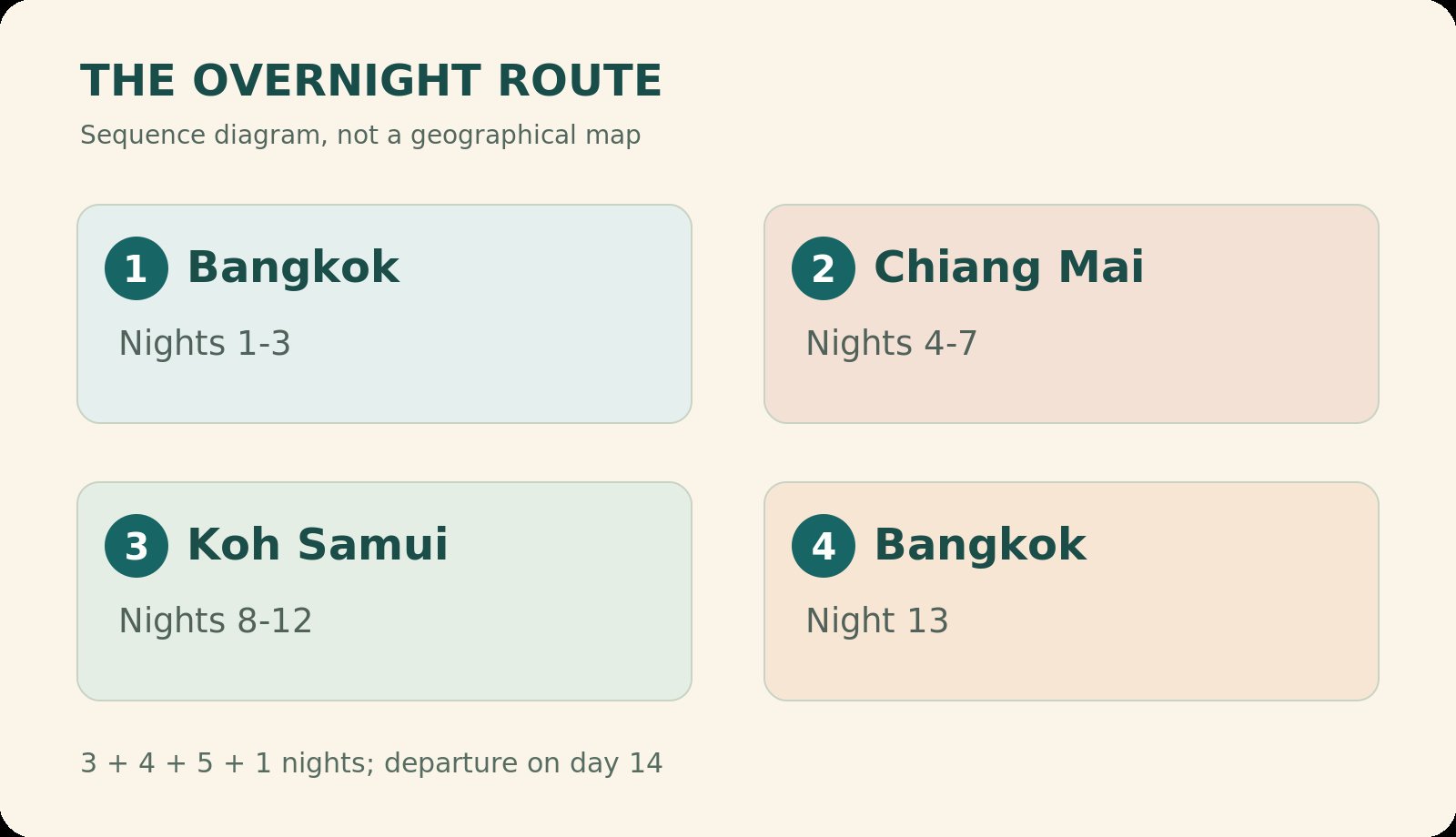
Use Bangkok for nights 1 to 3, Chiang Mai for nights 4 to 7, Koh Samui for nights 8 to 12 and Bangkok again for night 13. Departure is on day 14. The sequence leaves three complete northern days and four complete island days, while keeping the journey back to Bangkok away from the date of an independently booked international flight.
The appeal is variety without changing beach hotels or adding another island. Bangkok supplies the urban introduction, Chiang Mai changes the cultural and geographical setting, and Samui becomes a proper place to stay rather than a pier passed through on the way elsewhere. The route is selected by transfer practicality and contrasting experiences, not a points-based ranking of destinations.
| Days | Overnight base | Nights | Purpose |
|---|---|---|---|
| 1-3 | Bangkok | 3 | Arrival and two different city days. |
| 4-7 | Chiang Mai | 4 | Travel north; city, temple and hands-on choices. |
| 8-12 | Koh Samui | 5 | Reach the island; beach, road and optional marine days. |
| 13 | Bangkok | 1 | Return before the international flight date. |
| 14 | Departure | 0 | Leave from Bangkok under the standard plan. |
The flight to the island shapes the middle of the trip
Confirm Chiang Mai to Samui before paying for fixed hotel dates. Bangkok Airways markets the journey, but a general route page does not establish that the exact date has a suitable nonstop departure. Check the individual flight details, and compare a properly ticketed Bangkok connection when necessary. [1]
This guide assumes arrival at Samui Airport, code USM, for the simplest version. A cheaper flight to Surat Thani, code URT, ends on the mainland and introduces road and ferry travel. Those are different itineraries with different time, weather and luggage demands, not two names for the same airport transfer.
Do not borrow Phuket's weather calendar for Samui
Three regions need three checks
The north, Bangkok and the Gulf coast do not share one convenient weather pattern. In particular, the Thai Meteorological Department's seasonal material distinguishes the southern east coast's later-year rainfall from improving conditions farther north. That makes a generic claim that November is dry in Thailand an unreliable basis for choosing Samui. [2]
For a beach-led trip, investigate the actual Gulf conditions for your intended month and keep the hotel choice resilient to rain. The island should still offer a comfortable stay when swimming or a boat day is unsuitable. A room beside appealing restaurants and a useful pool may matter more than a photogenic but isolated location.
Keep northern air quality separate from the forecast
Before the Chiang Mai section, consult Air4Thai and look at the date of the local readings. A sunny weather forecast does not answer an air-quality question. This is particularly relevant when the planned day involves climbing, hiking or extended outdoor exertion; personal medical concerns need individual professional advice. [3]
The practical consequence is simple: make the mountain visit and the marine excursion adjustable, while keeping the intercity transport clearly confirmed. A route with movable activities is easier to manage than one that depends on a single perfect morning in each region.
USM or Surat Thani: compare the complete journey
Flying to Samui is the straightforward version
With a suitable flight into USM, the remaining journey is an island road transfer to your hotel. Search the actual origin, destination, operator and baggage conditions; where a connection is involved, confirm airport and baggage arrangements. Do not assume that two flights sold together by a search website necessarily provide the same protection as a through-ticket issued by an airline.
Reserve day 8 for travel even if the flight looks short. A direct service may make the move relatively tidy, while a connection consumes more time. For diary planning, allow roughly six to nine hours door to door and refine it from the actual ticket; this is an editorial allowance rather than a published timetable.
The mainland route is a separate budget calculation
A journey through Surat Thani requires a ground connection to the relevant pier, the ferry crossing and transport after arrival on Samui. Compare a clearly described combined ticket with separate bookings, checking what happens when an earlier stage is delayed. The official Lomprayah and Raja Ferry sites are starting points for current routes and operating information. [5] [6]
Include luggage, waiting, meals during the transfer and any extra accommodation needed after a late arrival. An apparent airfare saving can become less compelling once those items are added. With only five island nights, I would prioritise USM when the price difference is manageable, rather than pretending the longer route has no holiday-time cost.
Choose rooms for the way the days are organised
Bangkok and Chiang Mai need convenient addresses
For Bangkok's first three nights, focus on an address that makes the planned old-city and neighbourhood visits straightforward. Check the walking route to useful transport and the availability of ordinary meals nearby. The final Bangkok hotel is a different decision and should serve the day 14 airport journey.
In Chiang Mai, an Old City or eastern-edge location is a useful starting point for a short first stay. A comfortable room away from a noisy frontage can be preferable to a famous hotel address. Compare recent comments, actual room categories and pickup coverage before paying.
On Samui, select a daily routine before a beach name
Bophut is worth considering when evening dining and the Fisherman's Village area appeal. Choeng Mon may suit someone comparing smaller-bay stays, while Chaweng or Lamai can provide a different mix of beach and services. TAT's Samui overview identifies a broad range of beaches and activities; none of those descriptions replaces checking a specific property's access and surroundings. [7]
| Area to investigate | Planning emphasis | Check before booking |
|---|---|---|
| Bophut | Compare a dining-led evening base | Check the walk to food and assess the specific waterfront. |
| Choeng Mon | Investigate a smaller-bay hotel stay | Confirm actual beach access and room approach. |
| Chaweng | Compare beach and service convenience | Check the precise street and night-time noise. |
| Lamai | Consider a different coastal routine | Map the room, food options and planned pickups. |
| Hillside or secluded villa | Prioritise views and time at the property | Budget transport and check steps, gradients and shuttle hours. |
Ask whether reaching the beach requires steps, a busy road or a shuttle. For a hillside villa, clarify how you return after dinner and whether transport runs when you need it. A dramatic sea view does not guarantee an easy walk or suitable swimming immediately below the property.
Day 1: arrive in Bangkok without a second deadline
Keep the first appointment flexible
Go from the airport to the hotel, settle in when the room is available and eat close by. A late flight, queue or slow road journey should not trigger the loss of an expensive evening reservation. Leave the first substantial sightseeing commitment until tomorrow.
Choose airport transport from the official information and your actual arrival circumstances. Suvarnabhumi offers rail and road choices, but the best option depends on the last stage to the room as well as the first stage out of the terminal. A luggage-heavy family and a solo traveller with a small bag may sensibly make different decisions. [8]
Make the next morning easy
Prepare suitable temple clothing, save the hotel address offline and verify the attraction's own visitor information. Ask the room staff about breakfast timing if an early start is planned. Then allow the evening to remain ordinary.
For a morning arrival, arrange early room access explicitly if it is essential. A booking for that night's stay does not automatically provide a room at dawn. Clear expectations are especially valuable when travelling with someone who needs rest before a hot-weather city outing.
Days 2 and 3: build contrast into the city opening
Day 2 concentrates on the old city
Choose one principal temple visit and a nearby lunch. The Grand Palace and Wat Phra Kaew make a substantial morning; Wat Pho can be a separate priority or an optional addition. Use the official visitor pages for clothing and admission details instead of assuming that every temple applies identical arrangements. [9] [10]
A guide may help with context, but ask what the booking includes and where it begins. Keep any river travel conditional on the day's operating conditions. A short itinerary does not benefit from adding a complex transfer solely because it looks attractive in a promotional photograph.
Day 3 makes room for a different interest
Choose a food-focused neighbourhood walk, a museum or a more contemporary area according to the group. The purpose is to avoid two near-identical sightseeing days. For a museum option, Jim Thompson House's own information explains the guided visit and stairs in the main house; check suitability rather than treating it as a universal wet-weather solution. [11]
Keep part of the afternoon for laundry, packing or an unhurried meal. That practical space becomes useful when the itinerary includes a northern flight the following day. A final Bangkok evening close to the hotel is easier to manage than a long outing whose return depends on several connections.
Day 4: travel to Chiang Mai and change pace
Check the airport code before the fare
Book the northern flight with the departure airport and baggage details visible. Bangkok can mean BKK or DMK, and the ground journey may materially affect the choice. Compare the total cost of reaching Chiang Mai rather than the first fare shown in a search result.
Keep the arrival afternoon light. Airport travel, baggage and room access are part of the day even when the flight itself is brief. A walk near the hotel and a northern dinner are enough to establish a sense of place without another appointment.
The sleeper version uses a different night
A train can replace the flight when the journey is part of the appeal. The practical adaptation is a sleeper on night 3, replacing that Bangkok hotel night, then Chiang Mai arrival on day 4. Confirm the station, service and berth arrangements through railway information and the issued ticket. [12]
Avoid a fixed morning tour after the train. A delayed arrival or a poor night's sleep can turn it into an expensive obligation. Keep the remaining four Chiang Mai nights unchanged unless you deliberately redesign the whole middle block.
Day 5: a small Old City route and a good meal
Start with a place you want to understand
Choose an Old City temple such as Wat Phra Singh and allow time to look at the buildings rather than immediately moving on. TAT describes its northern architectural and artistic features. Add a second nearby stop only when the group is still interested and comfortable. [13]
Plan a proper lunch break between morning and afternoon activity. A shaded pause can make the second half of the day more enjoyable than pushing through a continuous walking circuit. Follow local rules on shoes and photography, and remember that a working temple is not primarily a visitor attraction.
Let the evening be local rather than compulsory
A neighbourhood meal, a small market visit or a quiet cafe can all fit. Check the actual day and current operation of any walking street you intend to see. Do not confuse a recurring weekend event with an attraction guaranteed to be available on day 5 of every holiday.
Use the evening to choose the order of days 6 and 7. Mountain conditions, class availability and energy can determine which comes first. The overnight base remains the same, so there is no reason to let an arbitrary itinerary number dictate the better arrangement.
Day 6: Doi Suthep without an overfilled road tour
Agree what the outing actually includes
The temple of Wat Phra That Doi Suthep is above Chiang Mai and involves a road journey followed by access to the complex. Check current arrangements for stairs or alternative access when mobility matters. A driver or guide should confirm the return plan, waiting time and any additional stops before departure. [14]
A short, focused visit can be enough. Avoid an itinerary that promises several distant attractions simply because they all appear north or west of the city on a map. Travellers who are uncomfortable on winding roads should discuss that before joining a fixed group schedule.
Treat a clear panorama as a possibility
Cloud or haze can obscure the outlook, and the temple should remain worthwhile without a perfect view. Check current weather and air information, carry practical shoes and use local advice when conditions deteriorate.
Back in town, keep the afternoon free for a different neighbourhood, a craft shop or rest. The island segment is still several days away, so there is no need to exhaust the group in the north and then expect a flight to restore everyone's energy.
Day 7: a hands-on northern experience
Choose a class that earns the time it takes
A cooking class can explain ingredients and techniques while giving the morning a clear focus. Compare the amount of hands-on work, the menu, dietary flexibility and the transfer distance. A session outside town may be enjoyable, but include the travel in the day's plan rather than counting only the time at the stove.
Confirm whether the meal replaces lunch and whether each participant cooks independently. For serious dietary requirements, ask about sauces, stock and shared equipment, not just the presence of a vegetarian dish on the menu. Save the operator's answer with the booking.
Keep the afternoon useful and unhurried
Browse a craft area, revisit a favourite temple or take a quiet break. Check tomorrow's Samui ticket and confirm whether it is nonstop or connects. A general expectation of flying south is not enough to arrange a hotel pickup; the operating details need to be settled.
A longer countryside trip can replace the class when that is your priority, but avoid adding it on top. Four northern nights provide three full days, and the city deserves some of that time. Leave the last evening relaxed enough to pack properly and begin the transfer without a rushed start.

Day 8: reach Samui, then stay near the hotel
Check the last connection as carefully as the first
For USM arrival, confirm the hotel transfer and the driver's meeting instructions. With a mainland-and-ferry route, verify the pier, ferry operator and onward island transport separately or obtain a clear combined itinerary. A destination named Samui can conceal a substantial final road journey after the boat.
Keep food and essentials accessible during the move. Do not rely on a specific meal being available between tightly spaced connections, and carry enough flexibility in the schedule to pause where needed. This is particularly useful for families and anyone with dietary requirements.
Make the first island evening a local introduction
Walk the surroundings, identify dinner and ask about current beach conditions. The goal is to arrive comfortably, not immediately take another excursion. A delayed flight should change only the size of the evening walk, not cause the loss of a prepaid experience.
Before booking an island activity, check where it departs relative to the hotel. A short time at sea or at an attraction may hide a long shared pickup circuit. The first evening is a good moment to compare those practical details while there are still several possible activity dates.
Day 9: enjoy the island base instead of leaving it immediately
Start with a simple beach-and-pool day
Use the first full Samui day to settle into the area you selected. Have breakfast without a departure deadline, walk a manageable stretch and find a convenient lunch. This ordinary time is particularly valuable after the city and northern segments.
Swimming depends on the actual sea, beach and local advice. Follow flags and warnings rather than relying on the reputation of a particular bay. The FCDO's water-safety guidance is clear about respecting red flags and local instructions. A pool or land-based activity is the better option when conditions are unsuitable. [15]
Choose an evening area deliberately
Fisherman's Village at Bophut is one option for dining and browsing; TAT notes the area's converted shophouses within its Samui overview. Arrange the journey back when staying elsewhere, and check the timing of any specific market event rather than assuming it occurs every evening. [7]
The aim is one pleasant evening, not a full island circuit after a beach day. Travellers staying near convenient food may simply remain local. A holiday does not become less authentic because dinner is close enough to reach without another taxi.
Day 10: Ang Thong only when access and conditions support it
Understand the type of day being offered
Mu Ko Ang Thong is a marine national park reached on organised boat outings from the area. Its appeal includes island scenery and viewpoints, but individual programmes vary substantially in vessel, walking, swimming and kayaking. TAT's overview is a starting point for the landscape, not confirmation that every activity or landing is open on your travel date. [16]
Ask about current park access and any seasonal or weather closure before paying. Compare the time afloat, hotel pickup coverage, meal arrangements, park charges and physical demands. A viewpoint walk with steep sections should not be described as an effortless addition for every traveller.
Keep a real fallback inside the island stay
Day 10 can move to day 11 or 12 when the operator, weather and your other bookings allow. If the trip is unavailable, keep the island day rather than adding a speculative last-minute ferry journey somewhere else. A cooking session or short road outing can preserve variety without a marine connection.
Anyone with health or mobility concerns should seek the relevant advice and ask the operator about restrictions. Do not interpret a general family-friendly label as confirmation that the boat and activities suit every age or circumstance.
Day 11: a short road outing and a different meal
Visit a few places rather than circling the island
Choose a compact route around the area you most want to explore. A temple, a viewpoint that is suitable in current conditions and a meal can be sufficient. Ask a driver to propose a sensible sequence and state clearly that shopping stops are not required unless you genuinely want them.
Check clothing for religious sites and verify whether the planned walking involves steps. If a stop is closed or unsuitable, replace it with something nearby rather than driving much farther to preserve the same number of attractions. The day should remain a manageable contrast to the beach, not a long vehicle tour.
Make transport terms explicit
Agree the duration, waiting time, return location and any charges outside the quoted service. For a group, clarify vehicle size and seat arrangements. A private outing is useful because it can match your priorities; it loses that advantage when the details are left vague.
Back near the hotel, try an ordinary local meal or return to a restaurant you enjoyed. The route already contains several cultural and scenic experiences, so there is no pressure to make every dinner a special event with another advance payment.
Day 12: protect one unscheduled island day
Give yourselves permission to repeat something
Spend the morning at the beach or pool, revisit a favourite cafe or move the marine outing here when appropriate. This day is intentionally available for the experience that turns out to matter most, rather than the one that looked most impressive before departure.
A cooking class can be a good alternative when the group wants another hands-on activity. Choose it for the menu and format, not merely because there is space in the diary. Compare transfer time and dietary arrangements just as carefully as you did in Chiang Mai.
Close the island stay before the evening becomes busy
Confirm the next day's airport or combined transfer, check luggage and settle any hotel extras. Keep the travel documents where both travellers can reach them. That preparation makes a final relaxed dinner possible without leaving practical decisions until late at night.
Avoid an overnight trip to another island at this point. It would introduce a new room, a ferry and an additional return journey immediately before the route's departure stage. Save that extension for a longer Gulf itinerary in which it can have the time and buffer it needs.
Days 13 and 14: return before the international departure
Day 13 gets you back to Bangkok
For the standard route, travel to Bangkok on day 13 and stay overnight. Choose the domestic flight with the whole departure plan in mind, not simply the latest possible time off Samui. If using a mainland connection, account for the extra weather-sensitive and road stages when deciding whether an even earlier return is appropriate.
An airport-area hotel can be useful before an early international flight, provided it serves the correct airport and has workable transport. A central property may be more enjoyable before a later departure. Ask about shuttle reservations, operating times and luggage rather than assuming the service fits every flight.
Day 14 is not another island transfer date
Have breakfast when the schedule allows, then travel to the airport with the carrier's required time and a sensible local margin. Any small final activity must fit around the departure, not the other way round.
A properly ticketed international journey beginning at Samui may support a different plan, but read the connection and baggage terms carefully. The extra Bangkok night is a planning tool for the stated route, not a rule that overrides every possible airline itinerary. What matters is understanding the actual ticket you buy.
Budget for the island access as well as the room
A route-specific model
This constructed example was prepared on 5 October 2026 for one adult sharing a double or twin room. It uses thirteen hotel nights, fourteen calendar days of food, three domestic journey allowances and selected activities. The flight-first model assumes Samui Airport rather than a cheaper mainland fare with uncounted ferries. International airfare, insurance, any visa costs, alcohol, major purchases and exceptional disruption are excluded.
| Cost assumption | Economical example | Comfort example | Upgraded example |
|---|---|---|---|
| Bangkok: room / night (4 nights) | 1,300 | 2,800 | 5,000 |
| Chiang Mai: room / night (4 nights) | 1,100 | 2,400 | 4,200 |
| Koh Samui: room / night (5 nights) | 1,800 | 4,000 | 8,000 |
| Accommodation total (one adult sharing a room) | 9,300 | 20,400 | 38,400 |
| Food assumption / person / day | 550 | 1,100 | 1,800 |
| Food total (14 days; 1 adult) | 7,700 | 15,400 | 25,200 |
| Domestic flight allowance | 8,000 | 13,500 | 22,000 |
| Local / island transport allowance | 3,000 | 5,500 | 9,000 |
| Selected activity allowance | 3,500 | 6,500 | 11,000 |
| MODEL TOTAL before contingency | 31,500 | 61,300 | 105,600 |
| Illustrative 15% contingency, rounded up to THB 100 | 4,800 | 9,200 | 15,900 |
| MODEL + contingency | 36,300 | 70,500 | 121,500 |
Do not compare its transport line with a bare Chiang Mai-to-Surat Thani fare. Add the mainland transfer, ferry, island road journey, waiting time and any necessary extra night to that alternative. A meaningful comparison uses the same endpoint: ready to check into the Samui hotel.
Prioritise the address and cancellation conditions
A lower room price can be offset by daily vehicles to meals or the beach. Conversely, a walkable area with a modest room may leave more money for one worthwhile excursion. Consider both morning access and the journey back after dinner.
Keep a separate contingency and check what happens when a marine trip is cancelled. Refunding an activity does not automatically refund a related transfer or solve a missed flight. Save the individual booking conditions, because several purchases made on the same day are not necessarily one protected holiday arrangement.
Small preparations for a three-region trip
Documents and health questions come first
Confirm the entry requirements for your own passport and circumstances, then complete any required arrival formalities through official channels. The Thailand Digital Arrival Card is not a visa. A fourteen-day itinerary still needs the appropriate permission to enter and any other applicable requirements. [17] [18]
Discuss relevant health questions with a qualified professional before travel, particularly when boat trips, heat or strenuous walks are planned. Check insurance for the actual activities rather than assuming every excursion sold to tourists is included. Keep essential medication and documents in hand luggage. [19]
Use connectivity as a convenience, not a single point of failure
Compare a compatible eSIM with your current mobile arrangement on data, validity and coverage. Save hotel addresses, flight details and transfer contacts offline even when the plan includes plenty of data. Keep a way to contact the provider that does not depend on opening a long email thread while standing at a pier.
Pack clothing that works in temples as well as on the coast, a light layer for air conditioning and northern outings, and practical walking shoes. A small waterproof pouch is useful on a boat, but it should supplement careful storage rather than become the sole protection for passports and electronics.
When to change the itinerary rather than force it
A difficult middle flight is a reason to revisit the dates
If the Chiang Mai-to-Samui journey is expensive or awkward, try moving the northern block before cutting the final buffer. A one-day shift may improve the transport pattern. Compare the complete hotel and flight total rather than treating every original date as fixed.
For a smaller budget or a slower pace, remove Chiang Mai and build a Bangkok-and-Samui holiday instead. That eliminates one destination change and gives both remaining places more room. It is often a better answer than retaining three regions while choosing the longest possible transfer at every stage.
A beach-focused traveller may choose a different coast
When the Gulf conditions are a poor match for the intended holiday, investigate an Andaman alternative rather than relying on optimism. The correct choice depends on the specific month and current information, not a universal claim that one island is better.
Likewise, a traveller who wants several Gulf islands should allow more time or simplify the northern section. Koh Phangan and Koh Tao deserve their own hotel and ferry planning. They should not be added as consecutive day trips merely because they appear close together on a national map.
Make the Samui stay work without a rental vehicle
Choose the evening walk before the scenic drive
For five island nights, the repeated journey to food matters more than one optional sightseeing circuit. Before booking, trace the route from the hotel entrance to a few realistic meal options. Check whether it involves a steep access road, an exposed roadside walk or a shuttle that finishes before you expect to return.
Where walking is impractical, ask the property how transport is arranged and whether a return pickup can be booked. Keep those costs in the accommodation comparison. A beautiful room can still be a good choice, but only when the daily routine it creates is understood.
Keep each outing geographically contained
For an island road day, agree a small cluster of stops and a clear finish time. A route that repeatedly crosses the island is not necessarily more comprehensive; it may simply leave less time outside the vehicle. Ask the driver which sequence is sensible in current traffic and conditions, then remove a stop when necessary rather than rushing through all of them.
An evening visit elsewhere needs the same return plan. Save a practical pickup point, especially near a busy market, and keep the driver's details accessible. Do not assume that an app showing an outward fare proves that an equivalent return ride will be available at the exact moment you want it.
A pool afternoon is part of the plan
Staying close to the hotel on some days reduces both transport costs and decision-making. That is one reason this itinerary keeps a single Samui base. You can enjoy the island without touring it continuously, and you do not need to rent a scooter to make the five-night stay feel complete.
The strengths and limits of ending on Samui
What works particularly well
The route delivers a clear change of setting without requiring a beach-hotel move. Five nights on Samui allow time to settle in, choose one excursion and retain a fallback day. The northern city break adds variety for travellers who would find a two-week beach-only stay too repetitive.
Using Samui Airport can keep island access straightforward, and the final Bangkok night makes the departure sequence easy to understand. Each major move has its own place in the calendar rather than being hidden before an ambitious sightseeing day.
What needs careful thought
The north-to-island flight can shape both the budget and the dates. Replacing it with a mainland route adds logistics, while the Gulf weather needs a separate assessment from Bangkok and Chiang Mai. These are meaningful trade-offs, not small footnotes.
The itinerary does not include a wider northern circuit or a multi-island Gulf adventure. Someone who wants either should change the allocation deliberately. Trying to keep all three regions while adding every nearby destination would remove the downtime that makes the island finish worthwhile.
Avoid these Samui-specific planning errors
Searching only for the cheapest southern airport
USM and URT are not interchangeable endpoints. Calculate the journey to the hotel, including the ferry where relevant. A cheap flight that lands too late for the intended connection may require another night and a substantially different schedule.
Assuming the airline route page proves a nonstop flight
Read the dated itinerary, number of sectors and airport codes. A marketed city pair can involve a connection, and availability can change. Arrange the hotel transfer from the issued ticket, not from a remembered timetable or a general route description.
Treating marine-park access as guaranteed
Check current opening status, operating conditions and the exact excursion programme. A park overview explains the destination, not tomorrow's access. Leave room for a land-based alternative and do not pay for a boat format that does not suit the group simply to keep the original date.
Choosing a villa only from the balcony photograph
Investigate the approach road, stairs, evening transport and access to food. A spectacular outlook may come with practical compromises. Those can be acceptable when chosen knowingly, but frustrating when the plan assumed effortless walks to the beach and dinner.
Bangkok, Chiang Mai and Koh Samui FAQs
Does this route really fit into fourteen days?
Yes, with thirteen nights and a selective daily programme. It includes arrival, three intercity travel dates and departure rather than counting them as extra sightseeing days. The route is most comfortable when Samui access is reasonably straightforward and optional outings are not booked into every remaining gap.
Is there always a direct Chiang Mai-to-Samui flight?
Do not assume that. Bangkok Airways markets the journey, but you must check the exact date and flight details to establish whether the available itinerary is nonstop or connecting. Confirm it before paying for non-refundable middle-section hotels, and keep day 8 available for the full transfer. [1]
Is flying to Surat Thani a sensible saving?
It can be, particularly when the complete combined journey is well timed and the saving remains meaningful after all transfers. However, it adds road and ferry stages that the USM version avoids. Compare ready-to-enter-the-hotel time and total cost, not just the flight fare.
Should I stay in Bophut or Chaweng?
Use the room address and your daily priorities to decide. Bophut may appeal for a dining-led evening routine, while a Chaweng stay can suit someone who prefers its beach-and-service mix. Investigate the specific street, recent noise comments and beach access; neighbourhood names are only the beginning of the comparison.
Can I add Koh Phangan for one night?
Technically a revised route can include it, but this version deliberately avoids another hotel and ferry sequence. With only five Samui nights, the move would reduce time available for the island and introduce a new return dependency. Choose a longer Gulf-focused holiday when an overnight extension is important.
Is Ang Thong a compulsory highlight?
No. It is an optional marine day that depends on access, weather and personal suitability. The itinerary still works with an island road outing, cooking session or additional beach time. A famous excursion is not worth making the holiday uncomfortable or ignoring operational restrictions.
What is the easiest version for a family?
Keep the same hotel sequence, favour suitable flights to USM, choose convenient rooms and reduce organised activities. Confirm vehicle and room capacity, child-seat needs and boat restrictions in advance. A predictable evening near the hotel can be more valuable than an additional attraction after a long transfer.
Can I fly home from Samui without the Bangkok night?
A suitably ticketed international itinerary beginning at USM may make that possible. Check the actual connection, baggage and disruption arrangements with the airline. Do not remove the buffer solely because two unrelated flights happen to appear close together in a search result.
Make island access the first practical decision
Start with the thirteen-night allocation, then solve the Chiang Mai-to-Samui journey and the final international departure. Those decisions have more influence on the trip than choosing the most photographed room or reserving a second marine excursion.
Keep the northern stay focused and the island finish flexible. A useful Samui hotel, one carefully selected outing and several ordinary mornings can provide a better holiday than a schedule that leaves the island every day.
Before paying, check the airport codes, count every overnight date, understand the marine cancellation terms and make sure the chosen season matches the coastal experience you expect. Once those details are sound, the three-region route offers variety without requiring you to spend the final week constantly moving.
Sources and fact-checking notes
The route and recommendations are research-led planning judgements. Public sources below were checked for this editorial review on 05 October 2026. Transport availability, admission arrangements, park access and local conditions can change. Budget figures are constructed examples with explicit assumptions, not live quotes or guaranteed costs. The original scene illustrations are conceptual rather than documentary location photographs.
- Bangkok Airways: Chiang Mai-Samui route search A marketed city pair is not confirmation of a nonstop service or fare on a particular date.
- Thai Meteorological Department: October-December 2026 outlook Regional seasonal context, including the southern east coast; forecast issued 25 September 2026.
- Pollution Control Department: Air4Thai Check the location and timestamp of air-quality observations.
- FCDO: Thailand warnings and insurance Current travel warnings; check again before travel.
- Lomprayah: official ferry booking and route information Check the actual pier, combined-ticket inclusions and operating notices.
- Raja Ferry: official operator information Mainland-island ferry information; current sailing details remain date-specific.
- Tourism Authority of Thailand: Ko Samui Island beaches, activities and Bophut context; not a property-quality assessment.
- Airports of Thailand: Suvarnabhumi ground transport Official airport transport choices; confirm current services and meeting points.
- Grand Palace: official practical information Visitor arrangements, dress restrictions and direct admission information.
- Wat Pho: official contact and visitor information Check current temple access directly before a visit.
- Jim Thompson House: official visitor information Guided main-house visits and published access limitations.
- State Railway of Thailand: official D-Ticket search Check the dated service, station and final issued ticket; no fixed train schedule is promised here.
- Tourism Authority of Thailand: Wat Phra Singh Northern religious art and architecture; check current local access.
- Tourism Authority of Thailand: Wat Phra That Doi Suthep Temple setting and access overview; operational details should be reconfirmed.
- FCDO: Thailand safety and security Water-safety guidance and other current precautions.
- Tourism Authority of Thailand: Mu Ko Ang Thong Marine-park landscape and activity context; contact the park/operator for access, closures and charges.
- FCDO: Thailand entry requirements British-passport guidance; other nationalities must check their own applicable conditions.
- Thai Immigration Bureau: Digital Arrival Card instructions Official arrival-form guidance; the form is not visa permission.
- FCDO: Thailand health guidance Travel-health preparation and links to specialist advice.
Illustrations in this article were created for Taylor’s Trailblazing Travels. Third-party photographs, where used, are credited beside the image or in the source list.