Healthy travel / Before and during your trip
Thailand Health Guide: Vaccines, Mosquitoes, Heat and Medical Care
Prepare the ordinary details, understand the warning signs and know when a clinician needs to take over.
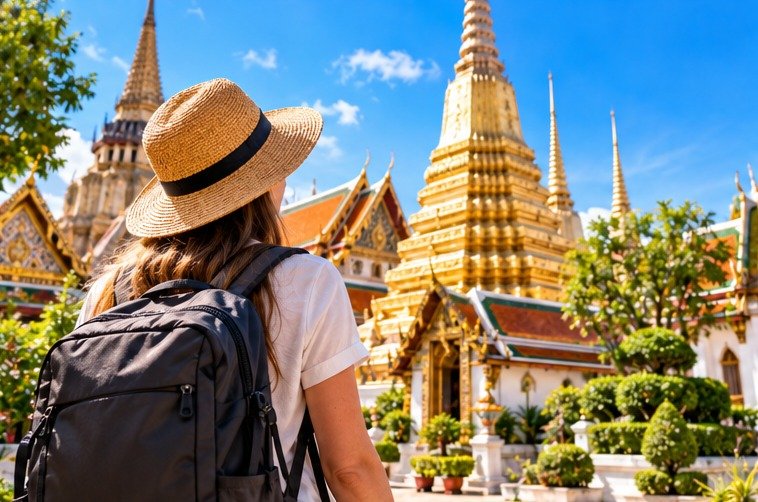
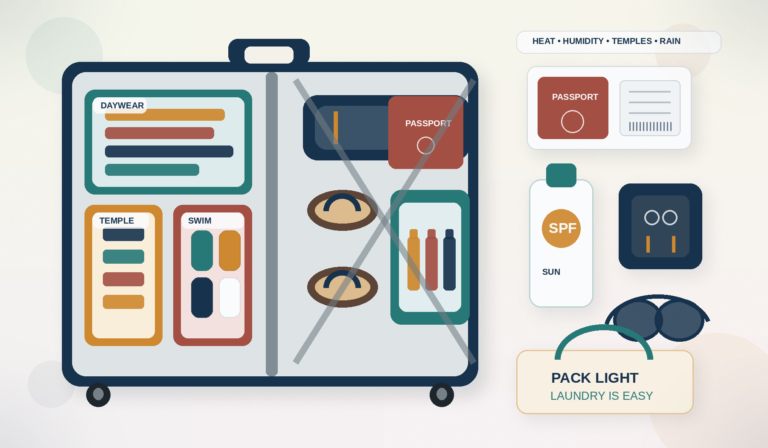
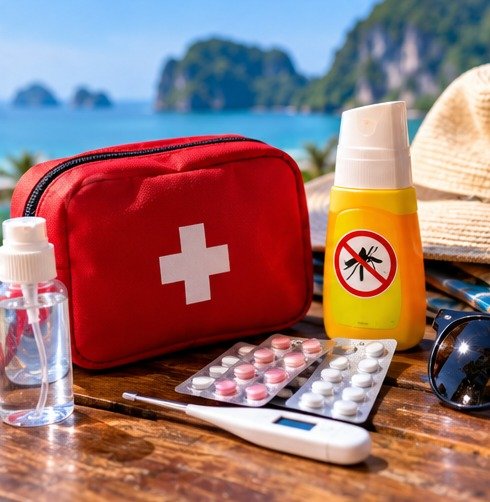
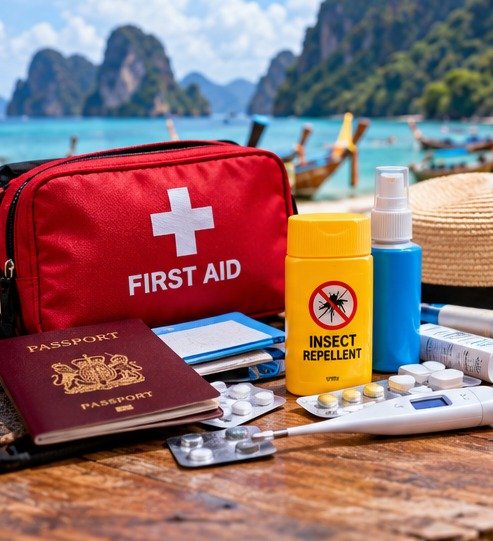
Original health-preparation illustration. The pictured items are conceptual props, not a prescribed medical kit or an endorsement of a medicine.
This Thailand health guide is designed to help you prepare for a travel-health appointment and organise the practical side of staying well. It is general information, not a diagnosis, vaccine prescription or substitute for a qualified clinician who knows your health history. A two-week city-and-beach holiday and a month of rural fieldwork do not call for an identical plan.
The most useful preparation combines several ordinary habits: bring the right documents and medicines, prevent mosquito bites, avoid overexertion in heat and know how to reach medical help. Vaccines are one part of that picture, not a shield against every illness or accident. Equally, a list of tropical diseases is less useful than understanding when a symptom should change your itinerary.
The sections below follow the order in which you can act: consultation, personalised protection, daily routines, medical access and what to do after returning home. This is an editorial planning sequence, not a ranking of disease likelihood. UK NaTHNaC and NHS advice forms the main framework, with Thai official requirements and clearly identified international sources where relevant. No clinic or hospital has been personally inspected or recommended on commission.
Before you travel
A personal assessment
Take the route, dates, activities, vaccine record and medicine list to a qualified clinician.
Every day
Prevent mosquito bites
Protection is useful by day and night, even where malaria risk is low or absent.
During hot weather
Reduce the workload
Plan shade, cooling and rest; serious heat symptoms need urgent action.
When unwell
Do not guess the cause
Fever, dehydration or unusual symptoms may need assessment rather than a cancelled-tour workaround.
Thailand health guide: start with your actual itinerary
Bring details a clinician can use
Book a travel-health appointment as early as practical, ideally around six to eight weeks before departure. If the trip is sooner, still ask for advice rather than assuming it is too late to do anything useful. Some protection and planning can be addressed close to travel, while other courses need more time. [1]
Take the dates, destinations, accommodation types and activities, together with your vaccine record and medicine list. Mention rural nights, trekking, cycling, animal contact, healthcare work and any possibility of changing the route. A plan described only as Thailand gives the clinician less to assess than a real sequence of places and activities.
Make your personal circumstances visible
Discuss pregnancy or plans for pregnancy, immune suppression, significant ongoing conditions, allergies and previous vaccine reactions. Include medicines bought without prescription and supplements, not only repeat prescriptions. Do not assume a clinician can infer these from the holiday booking or a short online questionnaire.
Leave the appointment with a written understanding of what was recommended, what remains to be done and when to seek care. A useful plan is something you can follow abroad, not just a receipt for injections.
Review routine vaccines before adding travel vaccines
Your existing record matters
The consultation is an opportunity to check routine protection such as measles-containing and tetanus-containing vaccines, as appropriate to your age and history. Do not restart or repeat courses simply because a travel website lists the disease. A clinician should interpret your record and the current schedule. [3]
If records are missing, say so early and ask your GP or previous provider for available information. A remembered injection before an old holiday is not enough to identify which vaccine it was, how many doses you received or whether anything further is needed.
Separate health recommendations from entry paperwork
A vaccine recommended for your health is not necessarily required at the border. Conversely, an entry certificate may depend on where you have travelled or transited rather than the health risk within Thailand itself. Yellow-fever certificate rules are an example of why the full route matters. Check the current official entry requirements and discuss relevant transit details. [4]
Keep certificates and clinical advice together in a travel document organiser if that makes them easier to retrieve. The organiser is optional; the essential part is having legible records and knowing which originals, copies or permits your journey requires.
Discuss hepatitis A, tetanus and typhoid in context
Avoid a universal injection checklist
NaTHNaC’s Thailand page recommends hepatitis A vaccination for previously unvaccinated travellers and includes tetanus assessment in its guidance. Typhoid vaccination is considered for people whose activities increase exposure, such as travel where food hygiene and sanitation are poor. These categories are not a prescription for every reader to obtain the same injections. [3]
Ask how your previous vaccinations, health history and trip change the recommendation. A resort stay does not make food hygiene irrelevant, while a short duration does not automatically remove all exposure. Equally, buying every available vaccine without a risk assessment is not a substitute for an informed consultation.
Keep behaviour and vaccination separate
Vaccination does not make unsafe food or water safe, and protection may not be complete. Continue to choose sensible food and drinks and practise hand hygiene. Treat the vaccine plan as one layer of protection, not permission to abandon the ordinary precautions that apply throughout the trip.
If you are unsure why a vaccine was suggested, ask the clinician to explain the exposure it addresses and the timing required. That conversation is more useful than comparing somebody else’s holiday injections without knowing their itinerary or medical background.
Consider additional vaccines according to exposure
Japanese encephalitis and hepatitis B
Japanese encephalitis risk is generally very low for many short urban visits, but longer stays and particular rural or outdoor exposure can change the assessment. Discuss rice-growing areas, camping and evening activities rather than deciding from the trip length alone. NaTHNaC identifies an effective vaccine for travellers at increased risk. [5]
Hepatitis B is associated with infected blood and body fluids. The assessment may consider sexual exposure, medical treatment, work and longer stays, among other factors. Avoid assuming that it is relevant only to one type of traveller, and discuss any existing vaccination record before deciding what is needed. [6]
Ask about rabies and newer recommendations
Pre-exposure rabies vaccination deserves discussion when activities or remoteness increase the difficulty of obtaining prompt care. It does not remove the need for treatment after a possible exposure. For dengue or other vaccines, eligibility and recommendations are more specialised than a simple destination checklist; ask a travel-health professional rather than arranging them from a blog. [3]
| Question for the consultation | Detail to bring | Why it changes the discussion |
|---|---|---|
| Which vaccines are relevant? | Previous doses and medical history | Existing protection and contraindications matter |
| Are rural exposures planned? | Locations, nights and activities | Risk varies within a country |
| Could urgent care be distant? | Remote stays and transport plans | Access affects prevention and contingency planning |
| Are pregnancy or immune issues relevant? | Personal circumstances and medicines | Advice may need specialist input |
This is a consultation aid, not a vaccination schedule.
Get geographically specific malaria advice
Do not treat all of Thailand as one risk zone
UK NaTHNaC guidance distinguishes rural forested border areas, other regions and places with no identified malaria risk. The final decision about preventive medicine depends on the actual route and individual vulnerability. It is not sound advice to say that every visitor needs tablets, or that no visitor ever does. [3]
The US CDC recommends chemoprophylaxis for certain risk areas using its own framework. UK and US guidance should not be blended into a single universal instruction. Take your itinerary to the professional responsible for your care and ask which current national guidance they are applying. [7]
Prevention and later diagnosis are separate tasks
Even when tablets are not recommended for a particular itinerary, mosquito precautions remain useful because other infections can be transmitted. If medication is prescribed, follow the specific instructions, including any period before or after the trip. Do not borrow a companion’s tablets or choose a drug solely because a shop stocks it.
If fever develops during travel or after visiting a malaria-risk area, tell a clinician promptly about the route and dates. A later illness may still need the travel history; do not assume returning home closes the question. Clinical assessment, not an app or a remembered bite, determines the next step. [8]
Build mosquito protection into the whole day
Protect exposed skin and reduce access indoors
Use an effective insect repellent according to the product instructions and professional advice for your age and circumstances. Combine it with suitable clothing and accommodation measures. Mosquitoes associated with different infections can bite at different times, so an evening-only routine is incomplete. [9]
A lightweight long-sleeved travel shirt can make covering up more comfortable, but clothing choice does not remove the need to protect other exposed areas. Consider the fit, fabric and the conditions in which you will actually wear it rather than relying on a vague travel label.
Check the sleeping arrangement
Look for effective screens, closed doors or appropriate air-conditioned accommodation, while remembering that these do not guarantee a mosquito-free room. Where needed, consider a suitable mosquito net and learn how to fit it properly before the trip. Check for gaps and damage rather than assuming a net hanging above a bed is functioning as intended. [9]
Ask accommodation providers about the actual room arrangement, especially for open-sided or remote stays. A photograph of a breezy bungalow may look appealing but should prompt a practical question about how you will manage insects overnight.
Recognise that fever needs assessment, not a guess
Dengue is not diagnosed by remembering a mosquito
Fever, headache, body pain or rash can have several causes. Do not diagnose dengue, malaria or food poisoning from one symptom or from whether you noticed a bite. Seek medical advice, explain where you have been and describe the timing. A thermometer reading can help communicate the problem but cannot identify its cause. [10]
If dengue is suspected, CDC advises avoiding aspirin and ibuprofen because of bleeding risk. Ask a clinician or pharmacist about suitable symptom relief rather than self-selecting medicines. Do not stop a prescribed long-term medicine without professional advice; contact the treating clinician promptly for instructions. [10]
A falling temperature is not always the all-clear
Dengue warning signs can appear as fever subsides. Severe abdominal pain, persistent vomiting, bleeding, marked drowsiness or breathing difficulty warrant urgent care. A person who seems unusually weak or worse despite a lower temperature should not be sent on a long transfer to protect the itinerary. [10]
A digital body thermometer is an optional practical tool for a travel kit. Use it according to its instructions and share the reading with a professional when needed. Avoid repeatedly measuring while delaying help for symptoms that are already concerning.
Avoid animal exposure and act quickly after a bite
A small scratch can still matter
Keep your distance from unfamiliar dogs, cats, monkeys and other mammals. Do not feed or handle them for photographs, and explain the rule clearly to children. A friendly animal or a wound that looks minor does not settle the rabies question. Children may also fail to mention a scratch unless asked. [11]
After a possible rabies exposure, wash the wound thoroughly with soap and running water for at least 15 minutes and obtain urgent medical assessment. WHO emphasises prompt wound washing and post-exposure prevention. Do not wait for symptoms or for the animal to appear ill. [12]
Vaccinated travellers still need care
Pre-travel vaccination changes the treatment needed after an exposure but does not mean the incident can be ignored. Tell the clinician exactly which doses you have received and provide records if available. Do not decide that a booster can wait until the end of a holiday because your itinerary is inconvenient. [11]
If appropriate treatment is not available locally, ask the clinician and insurer about reaching a facility that can provide it. A photograph of the animal may help the history, but do not approach or capture it and risk another exposure.
Plan for heat before you feel exhausted
Change the workload, not just the water bottle
Put strenuous sightseeing early or later in the day, include shaded or cooled breaks and allow time to adapt. A long walk through exposed streets can be demanding even when you would manage the distance comfortably at home. Do not use a full itinerary as evidence that you should continue despite feeling unwell. [13]
A wide-brimmed hat and appropriate sunscreen can support sun protection, but neither prevents heat illness on its own. Check product suitability and application instructions. The most effective planning decision may be shortening the outdoor period rather than buying another accessory.
Make cooling practical
Ask whether your room has functioning air conditioning or another suitable cooling arrangement before booking. When comparing Bangkok accommodation, check recent comments and confirm essential needs directly with the property. A filter label is not proof of the actual room conditions.
Keep drinks accessible and take regular breaks. People with fluid restrictions or medical conditions affecting hydration should obtain individual advice rather than following a generic instruction to drink large quantities. Never change a prescribed treatment or fluid plan simply because a travel article suggests a routine for healthy adults.
Distinguish heat exhaustion from an emergency
Act early when symptoms start
If someone feels overheated, weak or dizzy, stop the activity, move to a cooler place and begin cooling. Loosen unnecessary clothing and offer fluids only if the person is fully alert and can swallow safely. Seek professional advice if symptoms are concerning or do not improve promptly. [13]
Do not leave an unwell person alone in a room while the group continues sightseeing. A companion can observe changes, help communicate and arrange transport. The practical question is whether the person is improving, not whether the next activity has already been paid for.
Confusion or collapse needs immediate help
Confusion, seizures, collapse, loss of consciousness or severe breathing difficulty in a hot setting can indicate a medical emergency. Call 1669 and continue cooling while following the emergency operator’s instructions. Do not wait through a trial period when serious warning signs are present. [13] [2]
Heatstroke can occur with profuse sweating as well as dry skin. Do not use the presence of sweat to rule it out, and do not give drinks to someone who is confused or unable to swallow safely. This distinction matters more than trying to assign an exact label before calling for help. [14]
Keep hydration and stomach illness in proportion
Use safe fluids and a manageable routine
Carry water from a source known to be safe and make time to drink during the day. An easy-clean water bottle can be useful, but it does not purify its contents. Clean it appropriately and avoid topping it up from an uncertain source just because the container looks familiar. [15]
If diarrhoea or vomiting develops, dehydration can become the immediate problem. A pharmacist or clinician can advise on oral rehydration solution and when assessment is needed. Mix any sachet using the precise amount of safe water stated in its instructions; stronger is not better. [16]
Escalate rather than forcing the next journey
Inability to keep fluids down, very little urine, faintness, confusion, blood in the stool or significant deterioration deserves medical advice or urgent care depending on severity. Young children, older people and those with underlying conditions may need earlier assessment. Do not treat a long transfer as a way to postpone the decision. [17]
Avoid automatically starting antibiotics or borrowing anti-diarrhoeal medicines. The appropriate response depends on symptoms, age, health and the cause. This guide deliberately does not provide a self-prescribed antibiotic regimen. A clinician should decide whether medication, testing or another intervention is appropriate. [18]
Check medicines and Thai import rules early
The active ingredient is the important detail
Look up every medicine you need to carry using its generic ingredient, not just a brand name. Thai restrictions and permit requirements depend on the substance and quantity. A prescription from home or an ordinary pharmacy label does not automatically satisfy Thai import rules. Use the official Thai FDA traveller system and ask for clarification when necessary. [19]
Do not rely on a blanket claim that all medicines are permitted for a set number of days. Controlled narcotic and psychotropic medicines can have different requirements. Check the current application lead time and documents for your exact medicine before booking travel that leaves no time to obtain permission.
Keep treatment continuous without improvisation
Carry medicines in original pharmacy packaging with a prescription copy and an appropriate prescriber letter. Discuss enough supply for delays and how to handle time-zone changes. Essential treatment should not depend on finding an identical product after arrival, particularly when brand names or formulations differ. [20]
Ask the pharmacist about temperature limits and transport arrangements. Do not leave medicines in a hot vehicle or assume a hotel minibar is suitable for a temperature-sensitive product. If refrigeration is required, obtain specific advice and confirm a workable arrangement before departure.
Prepare for ongoing conditions and accessibility needs
Build the medical requirements into the booking
If you need reliable power for equipment, accessible facilities, a particular diet or proximity to medical care, make those requirements explicit. Ask for the specific arrangement rather than relying on an accessibility or wellness label. A written response gives you something concrete to check when you arrive.
For a northern stay, compare Chiang Mai accommodation options and contact the property about the room and access you need. This is a logistics search, not a claim that a hotel can provide clinical support. A room near a hospital also does not establish that the hospital offers your required specialty.
Make a short clinical summary
Discuss a concise summary with your clinician: relevant conditions, medicines, allergies, devices and emergency instructions. Include generic medicine names and an appropriate contact. Keep it available to a companion when needed without sharing more personal information publicly than necessary.
Plan how to obtain advice if the condition changes during travel. Your usual treatment plan, travel insurer and local medical services may each play different roles. Do not assume that a remote consultation replaces an examination when new or severe symptoms need in-person assessment.
Discuss pregnancy and plans for pregnancy separately
Zika requires an individual conversation
NaTHNaC identifies Zika risk in Thailand and advises pregnant travellers to discuss the suitability of travel with their healthcare provider. The issue includes pregnancy outcomes and sexual transmission, not only whether a mosquito bite produces obvious symptoms. Couples planning pregnancy should seek current advice before travelling or making assumptions about timing afterwards. [21]
Do not use the absence of recent news about an outbreak as proof that the relevant risk has disappeared. A clinician can explain the current recommendations, your personal circumstances and any precautions or waiting periods that apply to both partners.
Plan access and insurance around the pregnancy
Check the airline’s requirements, the insurer’s pregnancy conditions and the availability of appropriate care at each destination. An uncomplicated city stay and a remote island stay can have very different practical implications if assessment becomes necessary. Confirm the actual services rather than using the word hospital as a guarantee of every capability.
If symptoms occur during or after travel, tell the maternity team about the dates and destinations. This guide does not determine whether a pregnancy should proceed with travel or whether testing is indicated. Those are clinical decisions that deserve a private, individual assessment.
Adapt the plan for children and older travellers
Make prevention easy for the person who needs it
Children may not recognise overheating, dehydration or an animal exposure in the same way an adult would. Keep the routine simple: supervised rest, safe drinks, age-appropriate bite protection and a clear rule about not handling animals. Ask a professional about product suitability rather than using an adult medicine or repellent by guesswork. [22]
For older travellers or anyone with complex conditions, allow more time for recovery between travel days. The aim is not to make assumptions about ability, but to design the itinerary around the actual person. A slower schedule can preserve energy for the activities that matter most.
Reduce stressful transfers
Consider a pre-arranged airport car transfer when it resolves luggage, heat or accessibility difficulties. Confirm restraints and the actual vehicle before travelling. A paid transfer is not medical transport and should not be used as a substitute for an ambulance in an emergency.
For longer moves, compare Bangkok-Chiang Mai transport with toilets, boarding, luggage and arrival time in mind. Check the individual service rather than assuming one mode automatically suits every health or mobility requirement.
Treat air quality as a daily planning factor
Look at conditions, not only the season label
Smoke and other air pollution can affect people differently, particularly those with heart or lung conditions. Discuss your travel plans with your clinician when this is relevant, carry the treatment you normally need and monitor local advice. A calendar month is not an air-quality measurement. [3]
When checking an app, read the location, time and index scale. A reassuring reading far from your accommodation may not describe the air where you are exercising. Avoid making a difficult outdoor excursion depend on a single screenshot taken the previous day.
Have a lower-exposure alternative
A room with suitable indoor conditions, a shorter outdoor plan or a change of destination can be more useful than trying to push through symptoms. Ask about the actual accommodation setup rather than assuming that closed windows alone solve the issue.
Do not present a simple surgical mask or a fashionable face covering as guaranteed protection from smoke. People with breathing conditions should discuss suitable measures with a professional. The practical priority is reducing exposure and responding to symptoms, not relying on an accessory to make every activity acceptable.
Use a small kit you understand
Pack for ordinary needs, not imagined expertise
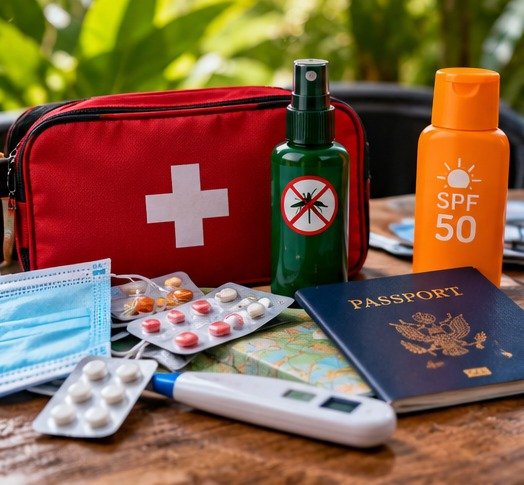
Choose supplies after the travel-health discussion: your own medicines, relevant documents and simple items you know how to use. An empty first-aid pouch can organise them without forcing you to buy a large kit containing unfamiliar products. Keep the contents labelled and accessible to the person who may need them.
A travel soap case is a simple way to support handwashing where suitable water is available. It is not a substitute for knowing how to obtain safe drinking water or for cleaning a wound appropriately. Practical, familiar items are often more useful than an elaborate collection bought without a plan.
Do not confuse possession with capability
Owning a thermometer, dressing or medicine does not mean every symptom can be managed independently. Know the circumstances in which the kit supports professional care rather than replaces it. For a remote trip, seek specific advice about training, communication and access before deciding what equipment is appropriate.
Check expiry dates and storage instructions before departure, and review the kit after using it. A half-empty or heat-damaged supply should not be relied on for the rest of the trip simply because it remains inside the original pouch.
Find medical care before you urgently need it
Identify suitable services, not just nearby buildings
Ask your insurer how it helps locate appropriate care and which contact to use outside office hours. Save the accommodation address and note a practical route to a suitable medical facility for non-emergency needs. The nearest map result may be a small clinic rather than a service capable of treating the problem.
FCDO notes that standards and access vary and that private treatment can be expensive. Do not assume that a familiar-looking international hospital brand, a hotel recommendation or an online review establishes suitability for every condition. Contact the provider and insurer about the service you actually need. [23]
Keep communication and payment workable
A travel-data plan can help with maps and messages, but confirm whether calls are included and keep another way to ask for assistance. A data-only eSIM is not a complete emergency communication plan. Reception staff or a nearby person may be able to make a call when you cannot.
Keep policy details and payment access available without carrying every card together. Ask about payment and direct-billing arrangements for non-urgent care, but do not delay emergency help while trying to optimise the billing process. Clinical urgency and financial administration are different questions.
Understand what insurance does and does not do
Declare the information the insurer asks for
Read the medical declarations, activity conditions, exclusions, excess and assistance procedure before departure. Answer questions accurately and tell the insurer about relevant changes. Do not assume that a condition is irrelevant because it is stable or because you are only travelling for a short period. [24]
Check activities as well as diagnoses. Motorcycle riding, diving, trekking or other plans can have specific conditions. A broad phrase such as adventure cover is not enough to establish the limits. Obtain clarification in writing when the answer affects whether you can reasonably undertake the activity.
Keep access separate from reimbursement
Insurance may help coordinate care and meet covered costs, but it cannot guarantee that a specialist is immediately available on a remote island. Nor does a policy make an unsuitable activity medically appropriate. The itinerary still needs to reflect your health and the practical distance to help.
Do not assume a UK GHIC or EHIC provides routine entitlement to care in Thailand. Use appropriate travel insurance and verify the arrangements for your circumstances. In an emergency, obtain help first and contact the insurer as soon as practical rather than waiting for a perfect administrative sequence. [23]
Make urgent symptoms change the itinerary
Know the emergency threshold
Severe breathing difficulty, loss of consciousness, seizures, serious injury or a suspected severe allergic reaction requires urgent assistance. Call 1669 in Thailand. Give the location first, describe the problem and follow the operator’s instructions. Do not attempt to manage a life-threatening situation through a booking company’s customer-support chat. [2] [25]
For someone with a prescribed adrenaline auto-injector, follow their emergency plan and the device instructions if anaphylaxis is suspected, then obtain emergency help. NHS guidance advises carrying two prescribed injectors and not standing or walking during anaphylaxis. The emergency number in Thailand is 1669, not the UK number on the NHS page. [25]
Seek timely assessment for less dramatic deterioration
Not every important illness begins with collapse. Persistent fever, repeated vomiting, worsening dehydration or a wound after animal contact can need prompt assessment while the person is still able to walk and talk. Tell a professional about the trip rather than waiting until symptoms fit a dramatic description.
If somebody is unwell, simplify the day: stop the activity, arrange appropriate care and tell onward providers that plans may change. A hotel checkout or tour deadline is an administrative issue, not a clinical reason to continue travelling.
Keep a clear record during illness and after treatment
Give the clinician a useful timeline
Note when symptoms began, where you have travelled, any animal exposure and medicines already taken. Include allergies and ongoing conditions. A concise factual history is more helpful than a list of diagnoses suggested by friends or internet searches.
Ask what the working diagnosis is, which warning signs require return, how to use any prescribed treatment and whether the next journey is appropriate. If language is a barrier, request an interpreter or a written explanation. Do not sign consent you cannot understand without asking for help, while recognising that emergency treatment may require rapid decisions.
Leave with documents you can use later
Keep discharge information, test results, prescriptions and receipts. Ask for generic medicine names and a legible treatment summary, especially if follow-up will happen at home. Tell the insurer about significant developments and follow its process for covered claims.
After an animal exposure, retain the exact vaccine or treatment record and dates. After any substantial illness, ask whether further assessment or restrictions apply before flying, diving or returning to strenuous activity. This guide cannot make a fitness-to-travel decision on your behalf.
Remember the travel history after you return home
Do not dismiss a later fever
If you become unwell after travel, tell the clinician where you went and when, including rural or border stays. Some travel-related infections can appear after the holiday has ended. In particular, a possible malaria exposure remains relevant to later fever and should be mentioned promptly. [8]
The same principle applies to persistent diarrhoea, unusual skin problems or an animal exposure that was not fully assessed. Do not assume that a symptom is unrelated because it started after landing in the UK. The clinician needs the history to decide whether travel changes the investigation.
Complete the follow-up plan
Finish any prescribed course as directed and attend advised follow-up appointments. If instructions from different providers appear to conflict, ask a clinician or pharmacist to reconcile them rather than choosing whichever is easier. Keep records from Thailand available for that conversation.
Review what made the illness difficult to manage: missing documents, inaccessible medication, a tight schedule or uncertainty about contacts. Use that experience to improve practical preparation for a future trip without turning one episode into a claim that an entire country or food type is unsafe.
Consider freshwater and other personal exposures
Do not treat a river as a swimming pool
Freshwater and wet soil can carry infections, including leptospirosis where contaminated by animal urine. Flooding and activities such as outdoor swimming can create exposure. Avoid floodwater and discuss planned freshwater activities with your travel-health adviser, especially when wounds or other vulnerabilities are relevant. Clear water and an attractive photograph cannot establish biological safety. [26]
If you become unwell after such an activity, tell the clinician where and when it happened. Do not assume that every fever is mosquito-related or that a small cut was irrelevant. A specific exposure history helps a professional decide what needs investigating; it is not an invitation to diagnose the infection yourself.
Keep sexual-health preparation private and practical
Sexually transmitted infections are a worldwide concern, not a judgment about a destination or its people. Use reliable condoms correctly and seek confidential professional advice after a possible exposure, even when there are no symptoms. Some preventive treatments are time-sensitive, so do not wait until the flight home to ask whether care is needed. [27]
Discuss any relevant vaccination or ongoing prevention with a clinician before travel. Do not share another person’s prescription or assume an app’s symptom checklist can rule out infection. If sexual contact was unwanted or coerced, seek medical support and use the FCDO’s Thailand-specific survivor information for help with available options. [28]
Make elective procedures a separate decision
Tattooing, piercing and non-urgent medical or dental procedures introduce questions about hygiene, consent, follow-up and insurance. Do not make the decision solely on a holiday discount or a social-media photograph. Ask about the provider’s qualifications and arrangements for complications, and obtain suitable professional advice before proceeding.
A procedure that needs follow-up should not be treated as an activity with no consequences after checkout. The practical plan must include where further care would happen, how records would be transferred and whether your cover applies. Where these answers remain unclear, postponing the procedure is a reasonable choice.
Benefits and limits of a well-prepared health plan
What preparation can make easier
A personalised plan helps you understand which protection is relevant, how to carry treatment and where to obtain care. It can also reduce anxiety by replacing a vague fear of tropical illness with a manageable routine. The aim is not to monitor every sensation but to recognise meaningful changes and respond appropriately.
Planning can support a more enjoyable itinerary. A shaded break, a well-located room or a less demanding transfer may preserve energy for the experience you came for. Those choices are part of good travel design, not evidence that somebody is too cautious to enjoy an independent holiday.
What it cannot guarantee
No vaccine, repellent, insurance policy or hotel feature eliminates every risk. Advice also changes, and an editorial review is not a clinical examination. The guide therefore leaves individual treatment decisions with qualified professionals and avoids promises about particular facilities or products.
The cost and effort of preparation should be proportionate to the actual trip. Ask why each recommendation is relevant rather than buying a long list out of fear. A smaller plan you understand and can follow is preferable to a complicated collection of supplies without a clear purpose.
Common health-planning mistakes
Treating a destination checklist as a prescription
Do not copy another traveller’s vaccine or malaria plan without understanding their route, health and prior protection. A different age, pregnancy, immune condition or rural stay can change the advice. Bring the exact itinerary to a professional rather than trying to resolve the question through a vote in a social-media group.
Another mistake is preparing vaccines carefully while ignoring ordinary hazards such as heat, dehydration and road travel. Health preparation should include how you move, rest and obtain help, not only what appears on an immunisation record.
Delaying care to protect the holiday schedule
Do not mask concerning symptoms merely to board a long transfer or complete an excursion. Seek advice and let the clinical situation determine what happens next. A delay is easier to manage when you have insurer contacts, accessible records and some flexibility in the itinerary.
Finally, avoid buying unfamiliar medicines from an informal source or taking a companion’s prescription. A familiar brand name can conceal a different formulation, and a medicine suitable for one person may be inappropriate for another. Use a qualified pharmacist or clinician and keep the packaging. [20]
Frequently asked questions
Do all visitors need the same vaccinations for Thailand?
No. Your previous protection, health, route, duration and activities affect the recommendation. Routine vaccines should be reviewed, and additional protection considered where relevant. A qualified travel-health professional should make the individual assessment. A list on a travel website is a prompt for that discussion, not an instruction to obtain every vaccine shown.
Is a last-minute consultation still worthwhile?
Yes. Seek advice even when departure is close. A clinician can explain what can still be done, what may need later completion and which practical precautions matter. Do not assume that missing an ideal lead time makes all preparation pointless. Bring the actual itinerary and any vaccine records so the limited time can be used effectively. [1]
Do I need malaria tablets for Bangkok and the islands?
Do not use a broad city-and-island label as a prescription decision. UK guidance distinguishes specific risk areas and individual circumstances, while US recommendations may differ. Tell the clinician the exact places and any rural excursions. Mosquito precautions remain relevant even where malaria tablets are not advised, because malaria is not the only mosquito-borne infection.
Can I ignore a bite if I have had rabies vaccination?
No. Pre-exposure vaccination does not remove the need for urgent assessment after a possible exposure. Wash the wound thoroughly and seek care promptly, bringing your vaccination record. The clinician will determine the appropriate post-exposure treatment. Do not wait until you return home or until the animal develops symptoms. [12]
Does sweating mean someone cannot have heatstroke?
No. Heatstroke can involve profuse sweating as well as dry skin. Confusion, collapse, seizures or other severe symptoms in heat require emergency help and cooling. Call 1669 in Thailand and follow the operator’s instructions. Do not wait for a particular skin appearance before acting. [14]
Can I bring my usual prescription medicines?
Often this can be arranged, but the answer depends on the ingredients, quantity and Thai rules. Check the official Thai FDA traveller information early and obtain any required permit. Keep medicines in original packaging with suitable documents. A prescription issued at home does not automatically override another country’s import requirements. [19]
Should I buy antibiotics before the trip just in case?
Do not self-prescribe. A travel-health professional may recommend specific standby treatment for particular circumstances, but that requires instructions and an assessment of suitability. Most travellers should not treat an unexplained illness with borrowed or informally purchased antibiotics. Seek advice about symptoms and use prescribed medicines exactly as directed. [18]
How do I find a hospital when I am unwell?
For non-emergency needs, ask your insurer to help identify an appropriate service and confirm the facility’s capabilities. For a serious emergency, call 1669 rather than spending time comparing reviews. Keep the accommodation address, policy details and a clinical summary accessible. A hotel or booking platform can help with logistics but cannot diagnose the problem.
Final recommendation: prepare the questions, not your own diagnosis
Arrange a personalised consultation, carry the medicines and documents you genuinely need, and build bite protection, cooling and safe food and water into ordinary days. Know how to contact medical help and the insurer without depending on one phone or one organiser.
During the trip, let symptoms change the plan. A professional assessment is more useful than trying to prove that an illness is minor so an excursion can go ahead. After returning home, keep the travel history available when seeking care.
A well-prepared Thailand holiday does not require constant worry or a suitcase full of unfamiliar treatments. It needs a practical routine, clear limits on self-care and the confidence to ask a qualified professional when the question becomes medical rather than logistical.
Sources and fact-checking notes
Editorial review: 05 October 2026. This article has not received an independent clinical review and is not individual medical advice. Vaccine choices, malaria prevention and medicine decisions require a qualified professional. UK and US malaria recommendations can differ; this guide identifies that difference rather than combining them into a universal rule. No medicine dose, clinic price or insurance promise is supplied. Any urgent-care guidance uses Thailand’s ambulance number rather than the UK emergency numbers in NHS source pages.
- NHS: Travel vaccinations
Timing and access to a personalised pre-travel vaccination assessment. Reviewed 05 October 2026.
- FCDO: Getting help in Thailand
Emergency and consular contact routes. Reviewed 05 October 2026.
- NaTHNaC: Thailand country guidance
UK travel-health assessment, vaccine categories and geographically specific malaria advice. Reviewed 05 October 2026.
- FCDO: Thailand entry requirements
Current passport, entry and vaccination-certificate requirements. Reviewed 05 October 2026.
- NaTHNaC: Japanese encephalitis
Risk-based consideration of vaccination, including rural and prolonged exposure. Reviewed 05 October 2026.
- NaTHNaC: Hepatitis B
Exposure routes and risk-based prevention. Reviewed 05 October 2026.
- CDC: Thailand traveller guidance
US travel-health guidance; malaria recommendations are not identical to UK advice. Reviewed 05 October 2026.
- NaTHNaC: Malaria
Personal risk assessment, prevention and the importance of prompt diagnosis after travel. Reviewed 05 October 2026.
- NaTHNaC: Insect and tick bite avoidance
Repellents, clothing, nets and day-and-night bite prevention. Reviewed 05 October 2026.
- CDC: Manage dengue
Medical assessment, warning signs and medicines to avoid when dengue is suspected. Reviewed 05 October 2026.
- NHS: Rabies
Animal exposure, vaccination and immediate post-exposure assessment. Reviewed 05 October 2026.
- WHO: Rabies
Immediate wound washing and urgent post-exposure prevention. Reviewed 05 October 2026.
- NHS: Heat exhaustion and heatstroke
Cooling, symptoms and urgent-care triggers; Thailand uses 1669 for an ambulance. Reviewed 05 October 2026.
- CDC: Heat-related illnesses
Heatstroke can involve dry skin or profuse sweating. Reviewed 05 October 2026.
- NaTHNaC: Food and water hygiene
Safer drinks, cooking, water treatment and higher-risk food choices. Reviewed 05 October 2026.
- NHS: Dehydration
Signs of dehydration and circumstances requiring medical care. Reviewed 05 October 2026.
- NHS: Food poisoning
Symptom management and warning signs requiring medical advice. Reviewed 05 October 2026.
- CDC Yellow Book: Travellers' diarrhoea
Rehydration and limits of self-treatment and preventive medicines. Reviewed 05 October 2026.
- Thai Food and Drug Administration: Medicines for travellers
Official drug checker and permit process; restrictions depend on the ingredient and quantity. Reviewed 05 October 2026.
- NaTHNaC: Medicines and travel
Original packaging, prescription documentation and transport planning. Reviewed 05 October 2026.
- NaTHNaC: Zika risk assessment
Pregnancy, sexual transmission and individual travel advice. Reviewed 05 October 2026.
- NHS Derbyshire: Travelling with a baby
Planning feeding, safe water, sun protection and restraints abroad. Reviewed 05 October 2026.
- FCDO: Thailand health
Medical access, payment, insurance and medicine guidance. Reviewed 05 October 2026.
- FCDO: Foreign travel insurance
Choosing cover and understanding exclusions; not an insurer recommendation. Reviewed 05 October 2026.
- NHS: Anaphylaxis
Adrenaline auto-injectors, positioning and emergency escalation. Reviewed 05 October 2026.
- NaTHNaC: Leptospirosis (Weil's disease)
Exposure through contaminated freshwater, wet soil or animal fluids and prevention advice. Reviewed 05 October 2026.
- NaTHNaC: Sex and travel
Condoms, confidential testing and timely professional care after a possible exposure. Reviewed 05 October 2026.
- FCDO: Support after sexual assault in Thailand
Medical, reporting and support options for survivors. Reviewed 05 October 2026.
Illustrations in this article were created for Taylor’s Trailblazing Travels. Third-party photographs, where used, are credited beside the image or in the source list.