Getting around / Road safety
Thailand Road Safety Guide
A safer journey starts with the route, the vehicle and the arrangements at both ends.
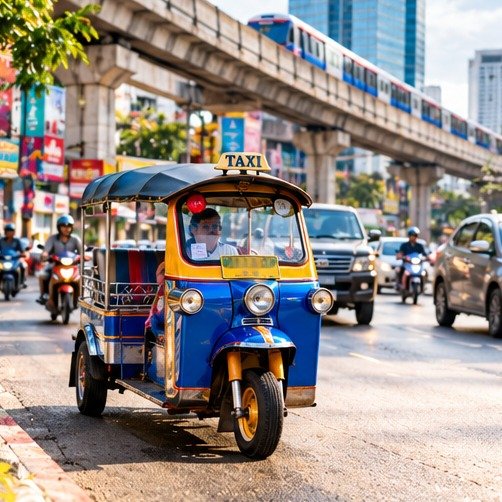
Original Thai-inspired urban transport illustration, not an inspection of a vehicle, road or transport operator.
A Thailand road safety guide should help passengers as much as people planning to drive. You may never rent a car and still spend hours on roads: reaching the airport, crossing a street for dinner, joining a minivan or transferring from a pier. The most useful questions concern those ordinary movements, not only the dramatic mountain drive on a holiday wishlist.
This guide compares arrangements by practical criteria: occupant protection, identifiable operators, manageable timing, the ability to decline and access to help. It does not rank every transport company or claim a precise risk percentage for a particular journey. An expensive vehicle can be poorly managed, while a well-organised shared service may answer your questions clearly.
The goal is to make the whole trip workable, including the last kilometre and the return after dark. You will find separate checks for walking, taxis, buses, families, private drivers and self-driving, followed by examples of how to build a less pressured itinerary. This is general research-led planning advice, not a driving lesson, legal opinion or certification of any operator.
Best first question
Where does the journey end?
Include the station, pier or roadside drop-off and the transfer to your actual room.
Best passenger habit
Check your restraint
Have a usable seat belt or suitable child restraint before the vehicle moves.
Most useful flexibility
Leave time to change
A fallback is more valuable when missing one service does not strand the whole party.
Important distinction
Mode is not a guarantee
A private car, coach or booking app still needs an operator and vehicle you can assess.
Thailand road safety guide: use the statistics correctly
Understand what the national figures describe
WHO’s Thailand road-safety page reports an estimated 18,218 road deaths in 2021 and a rate of 25.4 per 100,000 population, drawing on the 2023 global assessment. It also identifies motorcyclists as a major share of fatalities. These are historical population-level figures, not the probability that a tourist taking one taxi will be injured. [3]
They justify taking transport decisions seriously, but they cannot tell you that a particular coach, island or driver is safe. Avoid turning a national statistic into a precise personal forecast. Your itinerary, vehicle, restraint use and conditions are the practical factors you can examine.
Focus on the decisions within your control
You can decide not to ride a motorcycle, insist on a usable seat belt, choose another departure or stay overnight instead of continuing exhausted. You cannot control every other road user. That distinction keeps the planning realistic: reduce exposure and improve protection without demanding a guarantee that no transport provider can honestly give.
Treat the following sections as a sequence of questions, not a scorecard. A good answer about price does not compensate for a missing child restraint. Likewise, a helpful booking agent cannot substitute for checking the actual vehicle when it arrives.
Plan the whole door-to-door chain
A destination label can hide several transfers
Break a journey into its components: hotel to station, main service, arrival point and final transfer. Identify who operates each leg and what happens if the first one is delayed. A combined ticket may simplify payment without creating the same protection as a single coordinated service; read the actual terms rather than inferring them from the checkout screen.
For a northbound trip, compare Bangkok-Chiang Mai options and check the station or airport named on the result. For the south, compare Bangkok-Surat Thani services with the onward connection in mind. Do not treat a town name as confirmation that you will arrive at the pier or hotel you need.
Work backwards from the difficult part
The last leg often deserves the most attention. If arrival is late, ask whether taxis, hotel reception and the connecting service will still be available. If a person in your party needs assistance, establish who helps at the handover rather than assuming one operator’s staff follow you through the entire chain.
A more generous schedule can be simpler than a faster one. The relevant comparison is not only advertised duration but also the number of points at which a delay creates pressure to make a poor choice.
Choose transport by features, not labels
Private does not automatically mean safer
A private vehicle can offer control over stops and departure times, but its safety still depends on the driver, condition, restraints and management. A shared coach may have clear operating arrangements, while a private car may not. Ask the same essential questions whichever category appears on the booking page.
| Arrangement | Useful feature to verify | Question before booking |
|---|---|---|
| Private car | Restraints, luggage space and agreed stops | Which vehicle and who operates it? |
| Shared minivan | Passenger limit and a seat belt for every occupied seat | Are pickup time and drop-off location clear? |
| Coach | Identifiable operator, boarding point and usable restraints | What happens after a delayed arrival? |
| Rail plus transfer | Reduced time on the main road leg | How will you reach the final accommodation? |
| Walking | A practical pedestrian route | Are the crossings and surfaces suitable? |
This comparison uses planning features, not a statistical ranking of transport modes.
Keep a reason to decline separate from a refund question
If the arriving vehicle is overcrowded or cannot provide essential restraints, ask for a suitable alternative before boarding. You can discuss refund rights through the booking channel afterwards. The money already paid is not evidence that the replacement vehicle is appropriate.
Keep the operator’s contact and booking details accessible so you can explain the problem clearly. A photograph of the vehicle or missing arrangement can support the conversation when it is safe and lawful to take one, but do not create a roadside conflict to obtain proof.
Make seat belts a departure check
Check the seat you will actually use
A statement that a car has seat belts does not tell you whether yours is working, accessible and compatible with the seat. Find the buckle before the vehicle moves. Ask the driver to expose a belt hidden beneath a seat cover rather than assuming it cannot be used.
Use the restraint throughout the journey, including short airport, hotel and restaurant transfers. CDC guidance recommends seat belts, including in rear seats, and choosing vehicles with them. A short distance or slow-looking traffic is not a reason to remove that protection. [4]
Avoid improvised substitutes
Do not share one belt between two people or accept an arrangement that prevents a suitable restraint being used. If luggage has taken the passenger space needed for a proper seating position, the vehicle may be too small for the party. Solve that before leaving, not after the car has joined traffic.
Make the request calmly and specifically: this seat needs a working belt before we travel. A clear standard is easier to act on than a general conversation about whether the journey is safe. When the standard cannot be met, ask for another vehicle or choose another service.
Arrange child restraints in advance
Match the seat to the child and vehicle
Provide the child’s age, height and weight when booking, then ask which restraint will be supplied. A message that says child seat available is only a starting point. You need to know whether it is appropriate, how it will be installed and whether there is enough space for the other passengers and luggage.
CDC recommends taking a child or booster seat when suitable availability and quality cannot be assured at the destination. Follow the restraint manufacturer’s instructions and check vehicle compatibility. Do not treat a legal exemption or a driver’s reassurance as equivalent to appropriate protection for your child. [1]
Confirm the arrangement again on arrival
A booking note does not prevent a last-minute vehicle change. Check the actual seat before loading bags and keep the supplier’s written confirmation handy. If the promised arrangement is absent, pause the journey and contact the operator rather than letting the waiting driver turn the decision into a rush.
You can compare Krabi private-transfer listings as a starting point, but send the restraint questions before payment. A booking filter cannot verify the condition or fit of the seat that will arrive. Build enough time into the journey for a correction if the first vehicle is unsuitable.
Use taxis and ride-hailing with a clear pickup plan
Match the vehicle to the booking
Use the official booking or dispatch channel and check that the vehicle and driver correspond to the details provided. Do not substitute an unsolicited offer because someone knows the name of your destination. If the arrangement changes, confirm it through the original channel rather than relying on a conversation at the kerb.
Choose a pickup point where the driver can stop without leaving you and your luggage in moving traffic. A pin placed on the wrong side of a divided road may create an awkward crossing. It is often better to walk within a staffed property to an agreed entrance than to chase a vehicle along a road.
Keep the destination and payment understandable
Have the address ready in Thai and English, and confirm the destination before departure. Understand whether the service uses a meter, a quoted fare or an app price and which extras are included. This is about avoiding confusion, not assuming that every difference is a scam.
A working connection can help you confirm details. Compare travel-data plans only after checking device compatibility and whether ordinary calls are included. Save the address offline too, because the ability to reach your room should not disappear with a weak signal or a flat phone.
Assess buses and minivans at the point of travel
Read beyond the advertised journey time
Look for the operating company, actual boarding point, arrival location, luggage arrangements and whether pickup involves several hotel stops. A short displayed duration may refer to the main road leg rather than the complete service. Ask for the operator’s current instructions rather than treating a route-search estimate as a promise.
For Chiang Mai-Chiang Rai services, compare the vehicle type and timetable, then plan how you will reach and leave the terminal. The useful choice is the one whose details you can understand and whose timing fits the rest of your day, not simply the first result in a search.
Check load, seating and driver behaviour
Avoid overcrowded, top-heavy or overweight vehicles, and do not travel with an impaired driver. Look for a proper place for your luggage so it does not obstruct the aisle or your seating position. These are practical checks supported by CDC travel-safety guidance, not a judgment based on a vehicle’s brand or paintwork. [1]
If you are concerned about driving during the journey, make a calm request at a suitable moment and contact the operator when safe. Ask to stop at a staffed, safe place if necessary. Do not distract or confront the driver while the vehicle is negotiating traffic.
Think carefully about overnight road travel
The saved hotel night is only part of the comparison
An overnight service may be convenient, but compare the boarding process, likely rest, arrival time and final transfer. Arriving before accommodation reception opens can create a long wait with bags. If poor sleep leaves you unable to manage the next day comfortably, the apparent saving may be less useful than it looked.
Ask whether there is a daytime alternative, rail option or flight that changes the most demanding part of the journey. No option is automatically right for everyone. The aim is to avoid a plan that depends on you being alert and adaptable immediately after a night of uncertain rest.
Do not follow an overnight flight with a demanding drive
Travel fatigue adds difficulty to unfamiliar roads. CDC identifies fatigue and poor visibility among travel-injury risk factors and advises against night driving in unfamiliar or rural areas. For a self-drive plan, a first-night stop may be more sensible than collecting a car and immediately covering a long distance. [4]
If a driver is provided, ask about the itinerary and breaks rather than assuming payment removes fatigue concerns. Do not request a timetable that can only be achieved by eliminating rest or making up time on the road.
Give a private driver a realistic itinerary
Specify stops, time and the actual party
Agree the pickup, destinations, approximate duration, meal stops and return point before the trip. Include luggage, children and any mobility equipment. A vehicle suitable for two light travellers may not work for a family with child restraints and several suitcases.
When comparing Bangkok day-trip descriptions, check what is actually included and whether the itinerary can be adapted. An attractive list of stops may conceal a long day with little time outside the vehicle. Ask which stop would be removed if traffic or weather changes the schedule.
Do not reward rushing
Tell the operator that you prefer a manageable day with breaks rather than an unrealistic number of attractions. If delays occur, reduce the itinerary instead of asking the driver to recover the time. This is a practical instruction you can give before the booking, not something to negotiate only when you are already late.
Keep return requirements separate from sightseeing ambitions. A flight, ferry or medical appointment is a fixed commitment that deserves margin; a final photo stop usually is not. The clearer you are about priorities, the easier it is for the driver and group to make a sensible adjustment.
Treat walking routes as transport planning
Distance does not show the quality of the route
Before booking a hotel for its walkable location, look at how you would reach the places you need. Ask about pavements, major crossings, steps and lighting. A destination a short distance away can still be difficult for a pushchair, wheelchair or someone who needs a level surface.
Compare Bangkok accommodation areas with access to the transport and facilities you intend to use. A nearby rail station is useful only if the route to it and the entrance you need are practical for your party. Ask about lifts or alternative entrances when these matter.
Avoid distraction at crossings
Use designated crossings or intersections where available, look for traffic from every relevant direction and wait until it is clear that you can cross. A signal or painted crossing is not a substitute for checking vehicle movement. Keep phones and headphones from taking your attention away from the road. [1]
Do not imitate somebody else’s confident crossing when you cannot assess the situation yourself. Taking a longer route to a more manageable crossing can be a sensible choice. In darkness or bad weather, consider another transport arrangement rather than forcing an unsuitable walking route.

Match island and beach plans to local access
A beach hotel may still create road journeys
Ask where meals, shops and transport pickups are in relation to the property. A beach may be accessible directly while every evening outing requires a steep lane or busy road. Clarify which services the hotel actually provides and whether they operate at the times you need.
For example, compare Ao Nang accommodation locations using your expected routine rather than only the room photograph. A property nearer the activities you plan may reduce the number of transfers. That is a logistical advantage, not a claim that a particular neighbourhood has been independently safety-rated.
Separate the pier from the final destination
For Phuket-Koh Lanta journeys, establish the arrival point and whether the onward road transfer is included. A ticket to an island does not automatically take you to the correct beach. Confirm where a private driver or hotel representative will meet you and what happens after a delayed boat.
Avoid designing the return around the last possible departure followed by an essential connection. A small timing change can then remove every comfortable alternative. Keeping a buffer or overnight option reduces the pressure to accept whatever transport happens to be available.
Self-driving needs more than familiarity with the left
Verify documents and the rental conditions
Thailand drives on the left, but that alone does not make its roads equivalent to the UK. Check lawful entitlement, the correct international permit, vehicle restrictions and the rental insurance terms. For UK licences, GOV.UK currently lists the 1968 permit for Thailand, carried with the valid national licence. [5] [6]
Read the agreement for permitted drivers, exclusions, excess, recovery, fuel and cross-border restrictions. Confirm how damage is recorded at collection and return. A photograph of the car is useful for condition evidence, but it is not a mechanical inspection or proof of insurance cover.
Choose a first route with room for error
Do not make your first drive the most complicated urban exit or longest mountain section of the holiday. If possible, collect the vehicle when rested and allow time to understand controls before entering traffic. Ask for a vehicle you can operate comfortably rather than accepting an unfamiliar upgrade under pressure.
This guide does not teach Thai traffic law or advanced driving. Use current official information, obey signs and instructions, and obtain proper advice where your entitlement or the vehicle’s suitability is unclear. When the necessary confidence or paperwork is missing, use a driver or another mode.
Respond to rain, flooding and poor visibility
A closure is not a route suggestion
Check Thai Meteorological Department warnings and local road instructions before weather-sensitive journeys. At the review on 05 October 2026, official pages carried warnings about heavy rain and variable weather; that does not establish conditions on your future travel day. Read the latest issue and the places affected. [7]
Do not drive or walk through floodwater to test its depth. A familiar road can have hidden damage, currents or obstacles. Ask the operator or accommodation about alternatives and postpone when necessary. The fact that another vehicle has attempted a crossing does not provide a reliable assessment for yours.
Use delay as a planning decision
If weather makes the original timetable unworkable, compare the remaining choices while you still have a staffed place to wait. A later arrival, alternative route or extra night may be preferable to continuing into deteriorating conditions. Notify onward providers early instead of letting each delay surprise the next person in the chain.
For coastal moves such as Phuket-Krabi transport, compare road and sea arrangements separately. A poor sea forecast does not automatically make every road route suitable, and a flooded road does not establish that a boat is operating. Check the actual service, not an assumed substitute.
Make mountain and rural journeys less pressured
Avoid turning scenery into a driving deadline
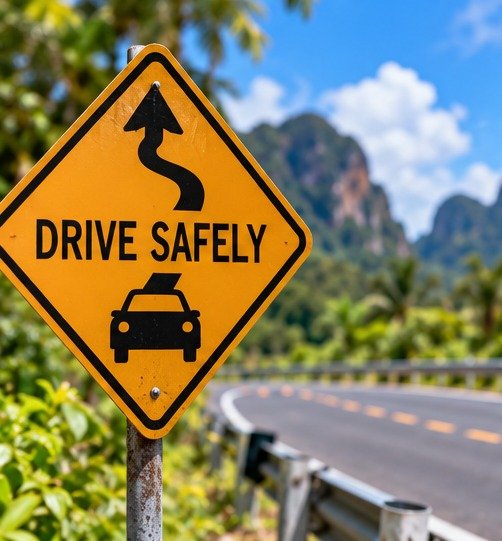
A winding road may be part of the attraction, but it can also lengthen travel and leave fewer convenient places to stop. Ask about the route, breaks and the expected arrival window. Do not add extra viewpoints until the day only works with an uninterrupted, hurried drive.
For passengers prone to motion sickness, discuss suitable management with a pharmacist or clinician before travelling. Medicines that cause drowsiness can affect drivers and may not be suitable for everyone. Do not take a friend’s medication or assume that a product is harmless because it is sold for travel. [8]
Consider the distance to help
Remote routes can make recovery and medical access more difficult. Ask who coordinates assistance if a vehicle breaks down and whether the operator has a contact available during the journey. Carry essential information and water without overloading the vehicle or obstructing access to exits.
Check current border advice for the exact route rather than treating the entire north or south as one category. A scenic detour is not an exemption from an official restriction. If a route enters an area against which travel is advised, revisit both the itinerary and the insurance implications. [9]
Manage festival traffic and evening returns
Plan around the day you are actually travelling
A route that works on an ordinary weekday may be slower or more congested around a local event. Ask the accommodation or operator about access changes and pickup arrangements. Do not use an old travel-time estimate as evidence that a connection remains comfortable during a major celebration.
When an evening event is involved, agree a return point before the group disperses. Make sure it remains accessible if streets are closed to vehicles. Each traveller should have the address and a contact route, not just the person who made the booking.
Keep impairment out of the transport plan
Do not drive after drinking or accept a ride with an impaired driver. Arrange another way home before the evening starts. The practical rule does not require estimating blood-alcohol levels or trying to decide whether a familiar driver seems only slightly affected. [1]
If the intended driver drinks, the plan changes. Having a car or motorcycle parked outside does not create an obligation to use it. Make a separate arrangement for the people first and deal with collecting the vehicle when the driver is fit and the conditions are suitable.
Ask better questions before paying
A useful enquiry is specific
Instead of asking whether a transfer is safe, ask for the actual vehicle, passenger capacity, seat belts, child restraints, pickup address and operator contact. Include anything essential about your party. Specific questions give the provider something verifiable to answer and make it easier to identify an unsuitable substitution later.
For Krabi Airport-Ao Nang transfer options, check whether the service is shared or private, whether there are intermediate stops and whether the fare covers your exact accommodation. Keep any special arrangements in the written booking record. A conversation outside the platform may be harder to retrieve when a different dispatcher takes over.
Keep confirmation proportionate
You do not need a dossier for a short transfer, but you do need enough information to identify what was promised. Save the confirmation, supplier contact and pickup instructions. For complex family or accessibility needs, ask for photographs or dimensions when they would resolve an important question.
No response can guarantee how the journey will unfold. The value of these questions is to expose avoidable mismatches before you travel. If a provider repeatedly answers a precise question with broad reassurance, compare another option rather than assuming the detail is unimportant.
Know how to raise a concern during a journey
Avoid distracting the driver at a critical moment
If speed or behaviour concerns you, make a calm request when it is safe to speak. Ask for a stop at a suitable staffed location if you need to leave or contact the operator. Do not lean into the driving area, grab controls or turn a disagreement into a physical confrontation.
The presence of other passengers does not mean somebody else will act. A clear request such as asking the driver to slow down or stop at the next safe place is more useful than a general complaint passed around the vehicle. Keep the conversation focused on the immediate behaviour and the practical change you need.
Have a way to continue without that vehicle
Carry the operator contact, accommodation details and enough payment access for a reasonable alternative. The appropriate reserve depends on the route; a remote journey needs a different plan from a city taxi. Do not assume that a replacement can be summoned instantly everywhere.
When you contact the booking company, describe the facts and location. Preserve evidence only when safe. Refund and complaint processes can be pursued later, while the immediate priority is making the rest of the journey manageable for your party.
Prepare for a breakdown or collision
People and immediate danger come first
If there is an injury, call 1669 for an ambulance and provide the location. Police can be reached on 191 and Tourist Police on 1155. Follow the emergency operator’s instructions. Do not stand in traffic or expose yourself to another collision to retrieve belongings or obtain photographs. [2]
If you are a passenger, tell the driver or operator about any injury rather than assuming it will be noticed. Seek appropriate medical assessment when needed. A vehicle still being able to move does not mean every occupant is fit to continue the itinerary.
Keep records without inventing blame
When safe, record the vehicle details, people involved, location and timing. Contact the rental company, motor insurer or travel insurer as appropriate. Keep receipts and medical documents, and ask what further reporting is required. Describe what you saw rather than guessing the legal cause of the collision.
Do not delay emergency care to obtain authorisation for a non-urgent expense. Equally, ask before agreeing repairs, recovery or replacement arrangements that may affect a claim. A pre-travel note of the relevant numbers makes these conversations easier when you are tired or distressed. [10]
Two examples of a more workable road plan
An arrival after a long international flight
Suppose a couple arrives with a domestic connection the next morning. Rather than collecting a car and driving a long first leg, they book a nearby overnight stop and an identified transfer. The room, reception hours and next pickup are confirmed. This illustrative plan reduces the number of decisions made while tired without claiming any particular airport processing time.
The trade-off is another check-in and the cost of the stop. However, the couple can judge those known inconveniences against the demands of an immediate drive. A faster-looking itinerary is not necessarily the one that gives them the most usable holiday time.
A family moving between beach bases
Consider a family with two children and substantial luggage. They request an appropriate vehicle and restraints, confirm the exact hotel addresses and leave the day free from a fixed afternoon excursion. If a problem arises at pickup, they have time to ask for a replacement instead of accepting an unsuitable car to protect another booking.
They also identify a meal stop and carry essential documents in the cabin, not underneath all the luggage. The plan is not complicated; it simply recognises the real needs of the party. The useful lesson is that passenger numbers alone do not define whether a transfer vehicle is adequate.
Advantages and limits of passenger-first planning
What this approach improves
Planning around the occupants makes hidden requirements visible. A working belt, suitable child restraint, realistic stop and manageable arrival matter more than the vehicle photograph. It also gives companions a shared standard, so one person’s concern does not have to become a debate about whether they are overreacting.
The approach can simplify a holiday by reducing unnecessary transfers or moving the accommodation closer to daily needs. Sometimes it costs more or takes longer. Those are genuine trade-offs to consider openly, rather than pretending that every more careful choice is automatically cheaper.
What it cannot establish
You cannot inspect every component of a vehicle or predict every other road user. A clear operator response and good reviews are not a safety certificate. The guide therefore avoids declaring any marketplace, transport category or popular route universally safe.
Do not let that uncertainty create paralysis. Use the checks that materially change the decision, leave room for alternatives and reassess when the actual arrangement differs from what was promised. A practical standard is more useful than searching indefinitely for a journey with no possible risk.
Common road-travel mistakes
Treating the timetable as the highest priority
A missed service is inconvenient, but it does not justify an unsuitable vehicle or a rushed drive. Build the itinerary so one delayed leg does not threaten every booking that follows. On a multi-stage journey, identify the last comfortable connection rather than only the last theoretically possible one.
Another error is assuming that a short transfer needs fewer checks. You still need the correct vehicle, a usable restraint and a clear destination. The small amount of time needed to establish those basics is easier to find before departure than after a disagreement begins.
Ignoring the walking part
Travellers often compare airports and buses carefully while treating the final walk as an afterthought. Check the surface, crossings, lighting and bags you will carry. A route that is fine in daylight with a small bag may be unsuitable at night with children and suitcases.
Finally, do not let one organiser hold every booking and contact. Share essential information so another person can act if the organiser is unwell or their phone fails. A robust transport plan remains understandable to more than one member of the party.
Frequently asked questions
Are private transfers always safer than shared minivans?
No. Private service can give you more control over stops and timing, but it does not automatically establish driver competence, vehicle condition or restraint availability. Compare the actual arrangements and verify them at pickup. A label on a booking page cannot replace those checks, and a suitable shared service may answer your practical needs more clearly.
Should I bring a child car seat from home?
Consider doing so when an appropriate seat cannot be reliably confirmed at the destination. Check airline carriage arrangements and compatibility with the vehicle you will use. The seat must suit the child’s size and be installed according to its instructions. A generic promise that a child seat is available leaves important questions unanswered. [1]
Is it sensible to drive immediately after arriving from the UK?
Assess your rest, arrival time and the demands of the route. A long unfamiliar drive after an overnight flight can create avoidable pressure. An identified transfer and overnight stop may be a more manageable first day. This is a planning judgement, not a universal requirement, but fatigue deserves a place in the decision rather than being treated as something to push through. [4]
Do I need an international permit to drive a hire car?
For UK licence holders, GOV.UK currently lists the 1968 International Driving Permit for Thailand, carried with the valid national licence. Check the current official advice, rental conditions and the vehicle category before departure. Other nationalities and recognised licence arrangements may differ; do not copy another traveller’s documents without confirming your own position. [6]
What should I do if the promised child seat is missing?
Pause the journey and contact the operator for the correct arrangement. Keep the written confirmation available and allow time for a replacement where possible. Do not treat carrying the child on an adult’s lap as an equivalent solution. The value of arranging the seat in advance is lost if an unsuitable substitution is accepted without question.
Can I rely on a hotel saying that a route is walkable?
Ask what walkable means for your needs: pavements, crossings, gradients, lighting and the entrance you must use. A fit adult with no luggage may describe a route very differently from someone using a pushchair or mobility aid. Specific questions, recent photographs and a realistic alternative are more useful than a single reassuring adjective.
How should I handle a driver who is going too fast?
Make a calm request at a safe moment and, if needed, ask to stop at a suitable staffed place. Contact the operator without distracting the driver or escalating into confrontation. Keep an alternative transport plan where practical. The immediate aim is to change the journey safely; a detailed complaint can be made afterwards.
Which emergency number is most useful after a crash?
For urgent medical assistance in Thailand, call 1669. Police are reached on 191 and Tourist Police on 1155. Provide a clear location, the nature of the injuries and any immediate danger. Seek help first and gather documents only when it is safe; do not expose yourself to traffic to photograph the scene. [2]
Final recommendation: protect the people, then the timetable
Build road journeys around the people travelling: their restraints, luggage, mobility, rest and ability to cope with the arrival. Confirm the actual operator and vehicle, and treat the walking route and final transfer as part of the booking rather than a detail to improvise later.
Choose schedules with room to stop, change or delay. A well-designed itinerary does not require a driver to make up lost time or a family to accept whatever vehicle arrives. It gives you a practical alternative when the promised arrangement is not suitable.
The best transport decision is rarely captured by a single label such as private, premium or fastest. It is the one that answers the important questions for your party and remains workable when the day does not unfold exactly as planned.
Sources and fact-checking notes
Reviewed 05 October 2026. WHO figures quoted here refer to 2021 estimates reported in the 2023 global assessment, not current tourist injury probabilities. Transport comparisons are editorial assessments of practical features, not measured safety rankings. Laws, road restrictions, warnings and operator arrangements should be rechecked for the actual journey. No provider listed through an affiliate link has been safety-certified by this publication.
- CDC: Traffic and road safety
Seat belts, child restraints, vehicle selection and pedestrian precautions. Reviewed 05 October 2026.
- FCDO: Getting help in Thailand
Emergency and consular contact routes. Reviewed 05 October 2026.
- WHO Thailand: Road safety
Historical 2021 estimates reported in the 2023 global assessment, not a 2026 tourist-risk forecast. Reviewed 05 October 2026.
- CDC Yellow Book: Injury and death during travel
Travel injury prevention, transport selection and restraint advice. Reviewed 05 October 2026.
- FCDO: Thailand safety and security
Country-specific security, law, transport and outdoor-risk advice. Reviewed 05 October 2026.
- GOV.UK: International driving permit country checker
UK-issued permit type and requirement to carry the underlying driving licence. Reviewed 05 October 2026.
- Thai Meteorological Department: Warnings
Official weather warnings; check the issue date and affected area. Reviewed 05 October 2026.
- NaTHNaC: Medicines and travel
Original packaging, prescription documentation and transport planning. Reviewed 05 October 2026.
- FCDO: Thailand regional risks
Geographically specific border and security risks. Reviewed 05 October 2026.
- FCDO: Foreign travel insurance
Choosing cover and understanding exclusions; not an insurer recommendation. Reviewed 05 October 2026.
Illustrations in this article were created for Taylor’s Trailblazing Travels. Third-party photographs, where used, are credited beside the image or in the source list.