Transport decisions / Scooter rental
Thailand Scooter Rental Guide: Licence, Insurance and Risks
The rental price is the easy question. Your entitlement, cover and ability to decline matter more.
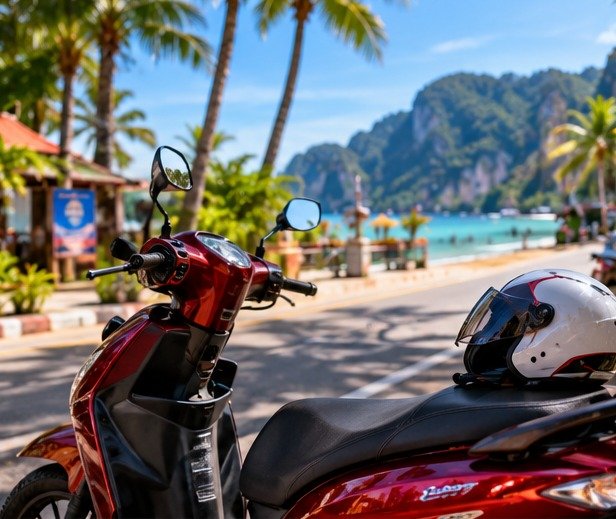
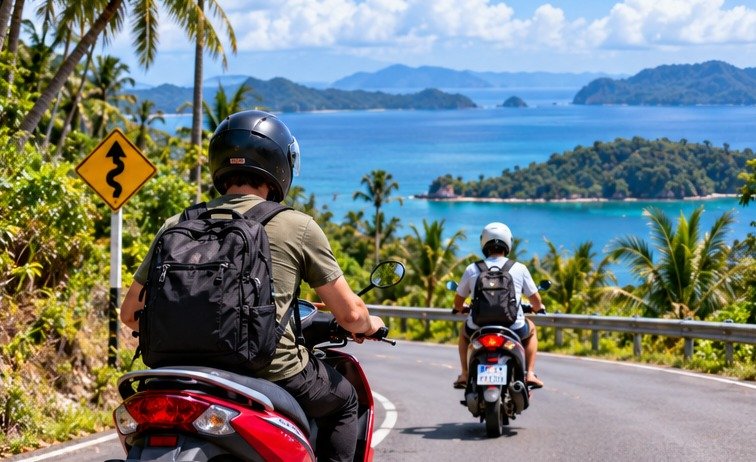
Original scooter-planning illustration. It does not depict an inspected rental vehicle, an approved helmet or a recommended riding route.
This Thailand scooter rental guide begins before the rental desk. The first decision is not whether a small automatic bike is easy to operate; it is whether you already have the lawful entitlement, experience and insurance needed for the machine and journey you are considering. A friendly shopkeeper cannot supply those things by handing you a key.
For someone who has never ridden a motorcycle, the clearest recommendation is not to learn on public roads during a holiday. Thailand’s road risks deserve more attention than the daily rental price, and an automatic transmission does not remove the need to judge traffic, surface conditions or braking. CDC traveller guidance discourages motorcycle travel; this article explains the checks rather than treating riding as a necessary part of visiting Thailand. [1]
The legal discussion is aimed mainly at UK licence holders making a short visit. Other nationalities, ASEAN licence holders and residents may have different document routes, so use your own issuing authority and Thailand’s Department of Land Transport. Examples are decision tools, not legal opinions, insurance guarantees or inspected-rental recommendations. No shop, helmet or road has been personally tested for this guide.
For a new rider
Choose another mode
A holiday road is not an appropriate place to acquire basic motorcycle skills.
For UK visitors
Check the 1968 permit
Carry the valid underlying licence and the correct motorcycle entitlement as well.
For insurance
Separate the questions
Your medical care, the rental bike, other people and recovery costs need distinct answers.
At the counter
Keep your passport
Showing identification is different from leaving your passport as a guarantee.
Thailand scooter rental guide: decide whether to ride at all
Begin with the journey you need
List the trips the scooter is supposed to solve. Are you trying to reach a beach once, travel to dinner every evening or cross a mountain pass with luggage? Those are different tasks. A single excursion may be easier to organise with a driver, while a poorly located hotel may create a daily transport problem that is better solved by changing the base.
Do not let a rental desk frame the decision as a choice between two engine sizes. There is always an earlier question: does riding belong in this holiday at all? For a visitor without established motorcycle skills, the answer should be no. A brief demonstration in a forecourt is not training for unfamiliar public traffic.
Use alternatives before accepting dependency
Compare Phuket Airport-Patong transfers when planning your first day, rather than collecting a bike immediately after a flight. The purpose is to separate arrival logistics from riding decisions. Inspect the actual vehicle and restraint arrangements whichever booking route you use.
This guide orders the checks by consequence: entitlement, insurance and competence come before price, colour or convenience. That is a planning framework, not a ranked list of rental businesses. A failure at any essential step is a reason to stop rather than compensate with enthusiasm at another.
Understand what a scooter means for licensing
Automatic does not mean licence-free
A scooter’s step-through shape and automatic transmission do not make it equivalent to a bicycle. You need the appropriate lawful motorcycle entitlement for the vehicle, not merely a car licence that a rental shop accepts as identification. FCDO and Thai embassy guidance require valid driving documentation for the vehicle being used. [4] [5]
Ask for the actual engine capacity and specification, not a vague description such as small bike. A model offered as an upgrade may fall outside the entitlement you hold. Do not assume that two scooters which look similar have the same capacity, power or legal classification.
Read the restriction as well as the category
On UK documents, categories and restriction codes both matter. A letter on the back of the photocard is not enough when an accompanying code limits the vehicles you can drive. Check the official record and obtain clarification before travelling if the meaning is uncertain. [6]
The rental contract should identify the bike you are actually taking. A handwritten reference that does not match the registration or model makes later questions harder. If the shop changes the machine, recheck both the paperwork and condition instead of treating the substitution as an administrative detail.
Distinguish a full licence from UK CBT
Learner permission is not a full motorcycle licence
Compulsory Basic Training is part of the UK learning process. GOV.UK explains that completion can allow certain learner riding with L plates; it is not a full motorcycle test pass. Do not treat a CBT certificate as an internationally transferable motorcycle licence or assume it authorises Thai scooter hire. [3]
A full car licence may include particular moped entitlements depending on circumstances, but those should not be stretched to cover ordinary rental motorcycles. The right question is not whether you have ridden a small machine at home. It is whether your current licence and international documentation expressly cover this vehicle.
Capacity and power can change the answer
As a simplified UK reference, A1 covers motorcycles up to 125cc and 11kW, subject to the category’s requirements; A2 and A have different limits. A 155cc scooter is not within a 125cc capacity limit simply because it is automatic. Check all restrictions, not engine size alone. [7]
| Document or entitlement | What to check | What not to assume |
|---|---|---|
| Car-only licence | Whether any relevant motorcycle entitlement exists | That a rental shop’s acceptance makes a scooter lawful |
| CBT certificate | Its learner status under UK rules | That it becomes a full licence abroad |
| Full A1, A2 or A entitlement | Capacity, power and restriction codes | That every rental motorcycle is covered |
| International permit | Correct vehicle category and validity | That it adds a category missing from the national licence |
This table is a UK-focused screening tool, reviewed 05 October 2026; it is not a substitute for checking your particular licence. [7] [6]
Obtain the correct international permit before departure
Follow your issuing country’s official route
For a UK-issued licence, GOV.UK lists the 1968 International Driving Permit for Thailand and says to carry the national licence as well. The permit translates or evidences existing entitlement; it is not a separate driving qualification. Check the category recorded in it before leaving the issuing point. [2]
Apply through the authorised process described by GOV.UK. Be wary of websites selling an impressive-looking international licence without establishing that it is a valid official permit. A downloadable translation is not something to rely on merely because a commercial website says it is accepted worldwide. [8]
Do not generalise the UK answer to everyone
Some official Thai material refers to both international conventions or other recognised licence arrangements. That does not change the practical UK instruction to use the current GOV.UK checker. Visitors with another country’s licence should use their own issuing authority and DLT rather than copying a British traveller’s document list. [9]
For longer stays or residence, ask DLT about the appropriate Thai licensing route. An older embassy page describing an application is not a promise that every tourist can obtain a licence quickly on arrival. This article does not offer an emergency workaround for arriving without the documents you need.
Separate legal entitlement from riding competence
Paperwork cannot assess your recent experience
Even a valid full licence does not establish that you are comfortable riding after years away, carrying a passenger or negotiating steep wet roads. Think about recent experience on a comparable machine and in comparable conditions. A new environment adds demands rather than cancelling the need for existing skills.
A sensible self-check asks whether the planned route would be reasonable for you at home in unfamiliar traffic, without a guide to make decisions for you. If the honest answer is no, the holiday setting is not a reason to lower the standard. Excitement and confidence are not evidence of competence.
Avoid learning under transport pressure
Do not book accommodation that forces you to ride before deciding whether you should. Compare Koh Phangan accommodation locations with the journeys you expect to make on foot or by transfer. Ask about slopes, lighting and local transport rather than relying only on the distance to the beach.
If you need instruction, obtain proper training in an appropriate setting before making motorcycle travel part of a future trip. This guide is not a riding lesson and cannot teach braking, cornering or hazard perception through a few paragraphs. A holiday should not depend on acquiring those skills at the rental counter.
Ask four separate insurance questions
Your body and the rented machine are different risks
Start with your travel insurer: will this exact activity be covered, as rider or passenger, with your licence and permit, on this engine size and route? Ask about emergency medical treatment, evacuation and repatriation. Do not stop at a summary heading that says adventure activities are included; the exclusions and conditions matter. [10]
Then ask the rental business about the motorcycle itself. Who pays for accidental damage, theft, recovery, loss of use and the excess? Ask for the policy or contract terms, not just a handwritten assurance that the bike is insured. A travel medical policy is not evidence that damage to the rental machine is covered.
Other people and property need an answer too
Ask what protection applies if you injure somebody else or damage another vehicle or property. Identify the insurer, policy number, limits and any driver restrictions. Do not assume that a deposit caps your liability or that the rental charge includes every consequence of a collision.
Finally, ask how claims and recovery are arranged. An insurance document can be of little practical help when nobody can explain which number to call, whether the vehicle must remain at the scene or how authorisation works. Keep the answers available offline and obtain clarification from the insurer rather than asking the shop to interpret your travel policy.
Understand the limits of compulsory cover
A legal minimum is not comprehensive protection
Thailand’s compulsory motor scheme, often called Por Ror Bor, provides limited accident-related personal-injury benefits. A hospital explanation describes medical benefits for eligible road casualties, including tourists, but it is not a promise that every bill or every type of loss will be paid. Do not treat evidence of compulsory cover as comprehensive motorcycle or travel insurance. [11]
Ask what additional motor cover the vehicle has and whether it applies to you as a foreign renter. A certificate should correspond to the actual bike and rental use. If the only answer is that everyone rides this way, you still do not have the information needed to judge the financial exposure.
Avoid universal claims about exclusions
It is too simplistic to say that one missing document automatically voids every possible policy and statutory benefit. Equally, it is dangerous to assume that a minor fine is the only consequence of missing entitlement. Different covers have different conditions, and a claim can be refused where those conditions are not met. [4]
The useful approach is to resolve uncertainty before renting. Write down the activity, capacity, licence, permit, passenger arrangement and route, then ask the relevant insurer for a specific answer. If the answer remains unclear, choose transport that does not depend on that uncertainty.
Send insurers a question they can answer
Describe the actual activity
A good enquiry might say: I hold this full motorcycle category and this international permit, and I am considering a rented automatic motorcycle of this capacity in Thailand for local transport. Will medical, evacuation and repatriation cover apply, and what conditions or exclusions should I read? Add whether you plan to carry a passenger.
For the rental motor insurer, ask separately about third-party injury, third-party property, damage to the rented bike and theft. Include the operator’s proposed contract so the response is about the real arrangement. A generic yes to scooter riding leaves too much unresolved.
Preserve the answer with the policy
Save the insurer’s reply, the policy schedule and the applicable wording version together. Make sure the reply comes from someone authorised to explain the policy. A message from a comparison website or another traveller is not equivalent to confirmation from the insurer handling the risk.
Use a water-resistant document pouch for paper copies if that suits your trip. The pouch is only an organisational accessory; it does not make the contents legally sufficient or change a policy’s conditions. Keep a protected digital copy as well, away from the device most likely to be damaged in an accident.
Read the rental contract before leaving identification
Identify the business and the agreement
Look for a business name, contact number, vehicle registration, dates, return time and written deposit terms. Establish what happens if you return early, are late, lose a key or cannot ride the machine back. If the document is in a language you cannot understand, seek a reliable explanation before signing rather than guessing from the layout.
Ask how a damage claim is assessed and whether there is an itemised schedule. Clarify whether recovery or days out of service can be charged. You do not need to predict every dispute, but you should know the basis on which a charge would be made.
Keep the passport under your control
FCDO advises against leaving your passport as a guarantee with motorcycle rental businesses. Showing it for identity checks is different from leaving it until the bike is returned. Find another arrangement or another provider if the business insists on retaining the original. [4]
Photograph the signed agreement and payment receipt. Avoid signing blank spaces or an incomplete vehicle description. A cash deposit should have a clear receipt and refund arrangement. Do not assume that a small deposit means the rest of your liability is also small.
Inspect the actual motorcycle, not a sample outside
Separate condition evidence from mechanical safety
Photographs can record scratches, cracked panels, mirrors and the fuel level. They are useful evidence if a return dispute arises, but they do not establish that brakes, tyres or steering are safe. Treat documentation and mechanical assessment as separate jobs, neither of which substitutes for the other.
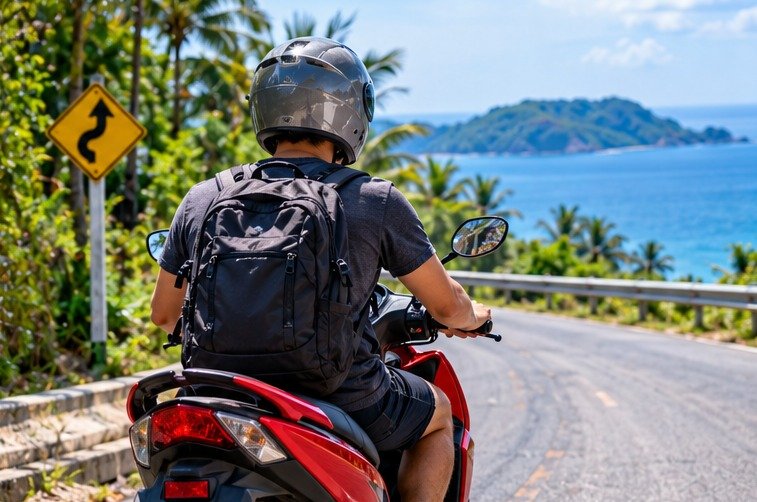
Before accepting a machine, have the provider demonstrate the controls, lights, indicators, horn, brakes and locking arrangements. Look for obvious damage, leaks and tyre problems. If anything is unfamiliar or questionable, ask a competent professional to assess it or decline the rental. Do not use this article as a mechanical inspection checklist that guarantees roadworthiness.
Make discrepancies part of the agreement
Ensure existing damage is acknowledged in writing and linked to the correct registration. Capture clear, well-lit images from several sides, including close views of disputed areas. Take them before the bike is moved or used, and keep the original files rather than relying only on a messaging-app copy.
Do not accept an unsuitable replacement because your first choice is unavailable. Recheck licence compatibility, insurance and the contract when the vehicle changes. If an operator is unwilling to give you time to examine the machine and paperwork, the ability to walk away is more valuable than the reservation.
Treat helmet fit and protective clothing seriously
A helmet is not just a box to tick
SHARP, the UK Department for Transport helmet programme, emphasises correct fit, comfort and retention. A helmet that moves excessively or can roll off when fastened is not an acceptable fit. Take time to assess the actual helmet rather than accepting whichever one is easiest to pick up from the rack. [12]
Check condition and history where possible. A shell that looks attractive can still have an unknown impact history or damaged fastening. Follow manufacturer guidance on care and replacement. Do not use a sticker or a shopkeeper’s confidence as your only evidence that a helmet provides the protection you expect. [13]
Heat does not make exposed skin protective
Choose appropriate motorcycle protective clothing and footwear through a competent supplier. Ordinary holiday shorts, sandals or a loose beach cover-up are not an equivalent substitute. If carrying suitable equipment feels incompatible with the trip, that is another reason to reconsider riding rather than pretending the clothing question has disappeared.
This guide deliberately does not recommend an unverified helmet from a marketplace search. Fit and authenticity need more care than a convenient affiliate button can provide. Spend the effort on an appropriate in-person assessment or select another transport mode.
Plan the route around conditions, not map optimism
A short distance can still be a demanding ride
Look at the route’s hills, junctions, road type, lighting and possible return conditions. A short line on a map tells you little about surface changes or traffic at the time you will travel. Do not let a scenic destination distract from the difficulty of reaching it and returning before conditions deteriorate.
Check official weather warnings and local closures before setting off. Heavy rain, standing water and poor visibility can change the decision quickly. If the route becomes unsuitable, stop somewhere safe and arrange another way back rather than treating completion as proof of confidence. [14]
Build a non-riding return option
A phone with maps is useful only when you stop to use it. Never handle it while riding. Save the route and accommodation address offline, and use mobile-data options only after checking compatibility and coverage limitations. Connectivity is not a rescue guarantee, particularly away from populated areas.
A waterproof phone pouch can help protect a device when used and tested according to its instructions. It does not make a phone safe to operate on the move. Keep navigation, photography and messaging separate from controlling the motorcycle.
Consider fatigue, alcohol and passengers before the key turns
The return journey needs its own assessment
Do not assume you will be as alert after a long day as you were at breakfast. Heat, a poor night’s sleep and a late meal can change the situation. Choose a return plan that does not depend on pressing on when tired. CDC advice recommends avoiding night driving in unfamiliar or rural areas and not travelling with an impaired driver. [1]
For alcohol, use a simple personal rule: do not ride after drinking. Do not calculate how close you might be to a legal threshold. A rule that is easy to follow before the evening starts is more useful than trying to make a judgment while impaired.
A passenger creates another decision
Check that both the law and the policy permit the passenger arrangement, and that the motorcycle is designed for it. The passenger needs appropriate equipment and must consent freely to the journey. Your entitlement and experience do not make their comfort level irrelevant.
If children are travelling, do not treat a motorcycle as the default solution to unavailable car seats. Organise an appropriate car transfer or change the plan. The absence of a suitable alternative at one counter is a reason to plan earlier, not to lower the standard for the child.
Calculate the full cost rather than the daily sticker
Include the costs you would otherwise ignore
The comparison should include rental, fuel, suitable equipment, deposit arrangements, any verified additional cover, parking, recovery exposure and alternative transport when you choose not to ride. Some are actual costs; others are unresolved liabilities. Do not add a guessed figure for serious uninsured exposure and pretend that it becomes a manageable budget line.
As hypothetical arithmetic created on 05 October 2026, five rental days at THB300 would be THB1,500 before fuel or other costs. That is not a market quote. If your plan also needs transfers on arrival and departure, compare the combined itinerary rather than contrasting five rental days with one isolated taxi fare.
Put location into the calculation
A room that requires a vehicle for every meal can be a false economy. Compare Phuket accommodation locations with access to food, the beach and transport. Ask the property for an honest description of the route, not simply whether the distance is walkable for someone.
The most important saving may be avoiding a rental you did not need. If one day requires a vehicle, compare private-car excursion options for that day and verify seat belts, stops and hours. A higher quoted fare may buy a simpler plan without creating motorcycle responsibilities for the whole stay.
Compare realistic alternatives by the task
Intercity journeys and island transfers
For an intercity move, compare Bangkok-Chiang Mai transport with attention to arrival times and station access. For a mainland-island connection, examine Krabi-Koh Lanta transfer options and confirm whether the service includes road and sea legs. Neither requires you to carry luggage on a scooter.
A mountain journey deserves a separate comparison. You can review Chiang Mai-Pai transport listings, but a minivan is not automatically comfortable or risk-free. Ask about the operator, pickup point, luggage and restraint arrangements. The aim is to choose the best-supported available arrangement, not to label one vehicle category universally safe.
Local exploration without permanent rental
In a city, combine walking where practical with established public transport or an identified car service. A small zipped daypack can make walking days easier without carrying all your documents and money at once. Choose the size around what you need, not around a claim of theft-proof design.
For a structured day in the north, compare Chiang Mai activity descriptions and look for transport details, pace and cancellation terms. A tour can remove the need to organise a difficult route, but you still need to assess the actual provider and whether the activity suits your party.
Agree a return procedure before the rental begins
Leave time for a proper handover
Confirm the return location, opening hours and fuel requirement when collecting the bike. Ask what happens if the business is closed or the staff member who checked it out is absent. A hurried drop-off just before an airport transfer creates avoidable pressure if someone raises a dispute.
On return, photograph the bike and fuel reading in good light and ask for written confirmation that the rental is complete. Check the deposit refund or card-release process and keep the receipt. Do not delete the original condition photographs until any payment or claim question is resolved.
Do not argue from the roadside
If a damage charge appears, ask for the itemised basis and compare it with the signed condition record. Stay factual and contact the relevant insurer or booking channel. Do not sign an admission or a document you cannot understand merely to speed up departure; ask for translation or legal assistance as appropriate.
If threats or passport retention are involved, seek assistance rather than escalating the confrontation. Tourist Police can be reached on 1155. That contact does not guarantee a particular civil outcome, but it provides an official route to ask for help and language support. [15]
Know what to do after a collision
Protect people before documents
Stop and seek emergency assistance when anyone is injured. Call 1669 for an ambulance and 191 for police where required; give a clear location and describe the immediate danger. Do not put yourself in moving traffic to recover a phone or photograph a vehicle. Follow emergency-service instructions rather than improvising medical treatment. [16]
Do not delay urgent care while checking which hospital appears in a review ranking. Contact your travel insurer as soon as practical, but paperwork should not become a barrier to calling for help. If you are not fit to ride, do not attempt to return the scooter yourself.
Keep a factual record when it is safe
Record registrations, contact details, the location and the circumstances without speculating about blame. Notify the rental business and relevant motor insurer using the agreed emergency contacts. Keep medical reports, receipts and any police documentation, including translations when needed.
An insurer may need to authorise some arrangements, so ask before agreeing non-urgent recovery or repairs. Equally, do not treat a statement in this guide as an instruction to leave an unsafe situation unchanged. Immediate safety and directions from emergency services take priority over preserving the perfect photograph.
Use a final go-or-no-go check
All the essential answers must be yes
Before accepting the keys, verify the actual motorcycle, correct entitlement, valid permit, written cover and suitable equipment. Then assess your experience and today’s route. This is not a points system: excellent weather does not compensate for missing legal entitlement, and a low excess does not compensate for an unsuitable helmet.
| Check | Evidence you should have | If it is missing |
|---|---|---|
| Entitlement | Correct licence category and restrictions | Do not rent the motorcycle |
| Permit | Official valid permit where required | Use another transport option |
| Cover | Written answers for the actual activity and vehicle | Resolve with the insurer or decline |
| Condition | Acceptable machine and documented handover | Request a suitable alternative or leave |
| Competence and conditions | Established skills and a manageable route today | Change the journey rather than forcing it |
The checks are editorial screening questions, reviewed 05 October 2026, not an inspection or legal certification.
Give yourself permission to reverse the decision
A rental agreed yesterday does not require you to ride today if you are ill, tired or concerned about the conditions. Keep the provider’s contact and a return alternative. Paying for an unused day can be frustrating, but it is not a reason to convert a financial disappointment into a transport risk.
For a group, agree that anybody can decline a ride without debate. Organise separate transport rather than making one person’s discomfort a test of friendship. The strongest plan is one that remains workable when someone says no.
Three rental decisions worked through
A car driver offered a convenient beach scooter
Consider a visitor whose full entitlement is for cars and whose hotel suggests hiring a small automatic motorcycle. The visitor has ridden a bicycle and feels confident about balance. None of that establishes motorcycle entitlement or the skills required in traffic. The decision should stop at the document and experience checks rather than continuing into a discussion of price.
The practical fix is to examine why the scooter seemed necessary. If it was only for a beach outing, compare a return transfer. If every meal requires a vehicle, consider a different accommodation base for the remaining stay. This is not an admission that the trip was badly planned; it is a normal adjustment when the transport assumptions turn out not to work.
A qualified rider offered an unexpected upgrade
Now consider a traveller with a full restricted motorcycle category, the appropriate permit and an insurer’s written response for the original machine. The reserved bike is unavailable and a larger model is offered at no extra charge. The price is irrelevant until the new capacity, power and policy conditions are checked.
A genuinely suitable replacement may be possible, but the rider needs new answers about the actual vehicle. Do not accept the upgrade on the assumption that a more expensive machine must be a better option. If the information cannot be confirmed, the sensible choice is to decline or use another provider, not to hope that the original paperwork will be close enough.
An experienced rider facing a changed return journey
Finally, imagine a properly documented and experienced rider whose planned daylight return is delayed by heavy rain. Yesterday’s decision to rent does not decide today’s weather question. A workable plan includes somewhere safe to stop, a way to contact the provider and enough flexibility to arrange collection or another journey.
The rental terms may make that change inconvenient or costly. Nevertheless, the correct comparison is between the options available now, not between the weather you hoped for and the money already spent. This is why a fallback deserves attention before the ride begins: it turns a difficult decision into a practical phone call rather than a test of determination.
Benefits and drawbacks of scooter independence
What experienced, properly prepared riders may value
A suitable motorcycle can offer flexible departure times and access to places that do not fit a fixed transport schedule. For a rider with established skills and resolved paperwork, that flexibility may be part of the appeal. However, describe the benefit accurately: it is control over some logistics, not freedom from responsibility or a guarantee that every road is suitable.
Those benefits are conditional on being able to protect the rider and passenger, understand the contract and respond to a problem. When a rental depends on ignoring one of those conditions, the apparent convenience is being purchased by accepting an unresolved risk.
What the rental price does not show
The drawbacks include exposure to traffic and weather, responsibility for a borrowed machine, unfamiliar contract terms and the possibility of costs beyond a deposit. Carrying equipment and arranging a non-riding fallback can also make the supposed simplicity less simple.
For many visitors, a walkable base and occasional transfers provide enough independence without those obligations. This is not a judgment about adventurousness. It is a comparison between the holiday you want and the responsibilities you are actually willing and equipped to take on.
Common mistakes at the rental counter
Accepting a substitute for evidence
A shop saying that police rarely check does not establish legal permission. An insurance label does not describe the cover. A helmet on the seat does not establish fit. Treat each claim as the beginning of a question, not the end of one.
Another common error is checking your documents against the bike you planned to hire rather than the one you receive. An upgrade or replacement can change capacity and policy conditions. Revisit the essential checks whenever the actual arrangement changes.
Making the contract a future problem
Do not postpone reading return, damage or recovery terms until after a collision. The point when you can decline the agreement is the best time to understand it. Keep the signed version and any written clarification rather than relying on a conversation that nobody can later verify.
Likewise, do not plan to obtain the right international permit only after being asked for it. Arrange documentation before departure through the authorised issuing route, and check that its vehicle categories reflect your valid underlying licence. [8]
Frequently asked questions
Can I rent a scooter with just a UK car licence?
Do not assume so. You need lawful entitlement for the actual motorcycle, supported by the appropriate documentation. A car-only licence does not become motorcycle permission because a rental shop accepts it. Check any moped entitlements and restriction codes carefully rather than extending them to a larger scooter. Resolve the category with your issuing authority before travelling. [7]
Is UK CBT enough for Thailand?
CBT is learner training, not a full motorcycle licence. It should not be treated as an international entitlement for scooter hire in Thailand. The ability to ride a restricted learner motorcycle in the UK does not answer the foreign licensing or insurance questions. A first holiday is a poor time to discover that the document you relied on was not sufficient. [3]
Which international driving permit do UK travellers need?
The current GOV.UK country checker lists the 1968 permit for Thailand. Carry the valid national licence alongside it, and ensure the motorcycle entitlement is properly represented. The permit does not create a category you do not hold. Other issuing countries and recognised licence arrangements should be checked through their own official channels. [2]
Does travel insurance cover all scooter accidents?
There is no universal answer. Cover depends on the policy, activity, engine size, licence, helmet and other conditions. Medical benefits, damage to the rental bike and liability to others are separate questions. Obtain written clarification for your exact arrangement rather than assuming that a general travel policy or the rental business’s insurance covers everything.
Is a small scooter safe for a beginner?
A smaller machine does not remove the need for motorcycle skills or the hazards of unfamiliar traffic. For someone without established riding experience, choose another way to travel. A few minutes in a forecourt cannot provide the training needed for public roads, and a quiet-looking route may become quite different on the return journey.
Should I leave my passport as the deposit?
FCDO advises against leaving a passport as a guarantee with motorcycle rental businesses. Showing it for identity verification is a different matter. Agree another documented arrangement or choose another provider. Keeping control of the document is particularly important when you need it for hotels, onward travel or assistance after a dispute. [4]
Can I carry a passenger if my friend is comfortable with it?
Consent is necessary but not sufficient. Confirm the bike’s suitability, your entitlement, local requirements and the insurance terms for carrying a passenger. Both people need appropriate equipment. If the arrangement cannot be confirmed, choose another mode rather than treating the passenger’s confidence as a replacement for those checks.
What should I do if I become too tired to ride back?
Stop somewhere safe and arrange another way to return. Contact the rental business about collection or recovery under the agreed terms. It is better to plan that possibility before setting off, including how you will pay and communicate. Do not make the original rental price a reason to continue when the journey has become unsuitable.
Final recommendation: make declining a normal option
For an inexperienced rider, use transfers, public transport or organised outings rather than learning on Thai public roads. For an experienced rider, the decision still begins with the actual motorcycle, current legal entitlement, official permit and written insurance answers. Only then do condition, route and price become relevant.
Keep the passport, document the agreement and refuse substitutions that change the arrangement beyond what you have checked. A professional conversation should leave you clearer about responsibilities, not more dependent on reassurance.
The most useful thing to take to a rental desk is the ability to leave without a bike. A well-chosen base and a credible transport alternative make that possible. Independence is not defined by having a scooter key; it is having enough information and flexibility to choose the journey that genuinely suits you.
Sources and fact-checking notes
Reviewed 05 October 2026. This article provides general planning information rather than legal, insurance or riding instruction. UK permit guidance is kept distinct from document routes for other nationalities and Thai residents. Policy wording, licence restrictions and the actual rental contract decide individual questions. Cost figures, where used, are explicitly hypothetical arithmetic, not researched market prices. Commercial links mainly support alternatives to riding and do not certify an operator’s safety.
- CDC: Traffic and road safety
Seat belts, child restraints, vehicle selection and pedestrian precautions. Reviewed 05 October 2026.
- GOV.UK: International driving permit country checker
UK-issued permit type and requirement to carry the underlying driving licence. Reviewed 05 October 2026.
- GOV.UK: Compulsory basic training
Distinguishes learner training from a full motorcycle licence. Reviewed 05 October 2026.
- FCDO: Thailand safety and security
Country-specific security, law, transport and outdoor-risk advice. Reviewed 05 October 2026.
- Royal Thai Embassy, London: Driving in Thailand
Official visitor-document guidance; older residence-licensing text should be checked with DLT. Reviewed 05 October 2026.
- GOV.UK: Driving licence codes
Restrictions printed alongside vehicle categories on a UK licence. Reviewed 05 October 2026.
- GOV.UK: Motorcycle licence requirements
UK motorcycle category, capacity and power restrictions. Reviewed 05 October 2026.
- GOV.UK: Get an international driving permit
Authorised UK issuing arrangements, eligibility and permit validity. Reviewed 05 October 2026.
- Department of Land Transport: International driving information
DLT information on international permits and Thai licence applications. Reviewed 05 October 2026.
- FCDO: Foreign travel insurance
Choosing cover and understanding exclusions; not an insurer recommendation. Reviewed 05 October 2026.
- Samitivej Chonburi: Compulsory motor insurance
Hospital explanation of limited accident-related medical benefits; not a universal coverage guarantee or hospital endorsement. Reviewed 05 October 2026.
- Department for Transport SHARP: Get the right fit
Helmet fitting and retention; not a certification of rental helmets. Reviewed 05 October 2026.
- Department for Transport SHARP: Helmet care
Manufacturer-led helmet maintenance and replacement guidance. Reviewed 05 October 2026.
- Thai Meteorological Department: Warnings
Official weather warnings; check the issue date and affected area. Reviewed 05 October 2026.
- Thailand Tourist Police: contact information
Official Tourist Police contact details, including 1155. Reviewed 05 October 2026.
- FCDO: Getting help in Thailand
Emergency and consular contact routes. Reviewed 05 October 2026.
Illustrations in this article were created for Taylor’s Trailblazing Travels. Third-party photographs, where used, are credited beside the image or in the source list.