
How to Book Trains, Buses and Ferries in Thailand with 12Go
From the first search to the correct boarding document: a practical way to book the journey you actually need.
Original conceptual montage of rail and ferry travel; this is not a real shared station-and-pier location.
Booking Thailand transport with 12Go is straightforward once you separate three tasks: finding the right journey, understanding exactly what the operator includes, and obtaining the document you need to board. Most expensive mistakes happen between those tasks. A route may look correct while departing from the wrong Bangkok terminal, arriving at the wrong island pier or requiring a ticket-collection stop you have not allowed time for.
This guide walks through the process from the first search to the departure point. It covers trains, long-distance buses, minivans, ferries and combined tickets, with particular attention to station names, overnight dates and connections. The examples show how to assess a booking rather than promoting whichever result is highlighted first.
The website and source checks were completed on 4 October 2026. Screen layouts can differ by device and change later, so follow the purpose of each step when a label moves. No test purchase was made, and no live ticket price is promised here. Direct operator booking remains a valid alternative, particularly when you already know the service you need.
Exact places and dates
Pick the actual station, airport or pier and check overnight arrival dates.
Same journey, same extras
Match operator, class, passengers, luggage and the final payment total.
Check the status
A payment acknowledgement is not always an immediately issued seat.
Read the document
Follow printing, collection, check-in and boarding instructions for that product.
What 12Go does, and what it does not do
Treat the platform as a booking intermediary
12Go brings together travel products supplied by operators. Its terms distinguish the platform from the supplier and make individual product conditions relevant to the booking. Therefore, do not expect one luggage rule, one cancellation policy or one vehicle standard to apply to every result simply because you used the same website. [1]
Decide when comparison adds value
The platform is particularly useful when a route has several operators or when you want to investigate a combined road-and-sea journey. It can be less necessary for a simple local train bought at a station or a familiar operator whose own booking system already meets your needs.
Use the same standard for both direct and agency purchases: clear itinerary, transparent total, understandable conditions and a practical way to get support. This guide's selection method prioritises those features rather than an unsupported ranking of every company in Thailand. The purpose is to help you choose deliberately, including deciding not to book when the details do not make sense.
Define the journey before opening the results
Write the real start and finish
Start with the place you will physically leave and the place you need to reach. Bangkok is a broad origin; an airport, railway station, bus terminal and hotel pickup are much more specific. Likewise, Koh Samui can mean several arrival piers or a transfer continuing to your accommodation.
Make a short note containing the date, earliest realistic departure, latest acceptable arrival, number of people and luggage. Add any non-negotiable requirement such as a lower berth, child seat or a vehicle that can handle a mobility device. This note prevents a cheap but unsuitable result from quietly changing the requirements you started with.
Decide whether you need one product or several
A journey from Bangkok to an island may be sold as a combination, or you may assemble separate train, bus and ferry bookings. Neither arrangement should be assumed protected without reading its conditions. Decide what you are prepared to manage independently before choosing a result with an extremely short connection.
Enter the date, places and full passenger count
Use autocomplete carefully
Type the origin and select the intended place from the suggestions. Repeat for the destination, then choose the travel date. Do not leave a broad city selection in place when you specifically require an airport pickup. After using a saved link, recheck the date and passenger count rather than trusting earlier search settings.
The route links in this article are starting points, not saved quotes or bookings. They should be checked for your travel date and party before you compare results. A page that opens without suitable departures does not by itself prove that every local operator is sold out or that no transport exists.
Midnight belongs to a precise calendar date
For a service leaving at 00:30 on Tuesday, you normally need to be ready late on Monday evening. A departure at 23:30 on Tuesday is almost a day later. Put the date beside the time in your travel notes and compare it with the hotel night you have booked.
An overnight Bangkok to Surat Thani search is a good place to practise reading the arrival date as well as departure. The following morning may be marked with a next-day indicator. Check that date before reserving a ferry, accommodation or excursion; otherwise, two individually valid bookings can still be impossible to use together.
Filter for a suitable transport type and time
Reduce the list without hiding a better option
Start with the transport mode you are willing to use, then inspect departure and arrival times. For a long journey, seat or berth type can matter more than a small saving. For a short minivan ride, pickup convenience and luggage space may matter more than an impressive-sounding service name.
A broad Bangkok to Hua Hin comparison can illustrate the trade-off between a station-based service and a pickup closer to your hotel. Keep one alternative transport type in mind until you have checked the actual endpoint. Filtering too early can hide a slightly different product that solves the final transfer more neatly.
Compare complete durations, not the shortest badge
Look for the stages that sit inside the displayed journey time. Does it include a pickup run, a change of vehicle, a waiting period at a pier or a hotel drop-off? A combined itinerary can be useful precisely because these stages are included, but that also means its headline duration is not simply time in one vehicle.
Treat arrival times as scheduling information rather than appointments guaranteed to the minute. In particular, avoid buying another independent service that departs soon afterwards from a different location. Build a separate connection allowance for walking, finding the next operator and checking in, even when the map makes the distance look small.
Open the details before choosing the departure
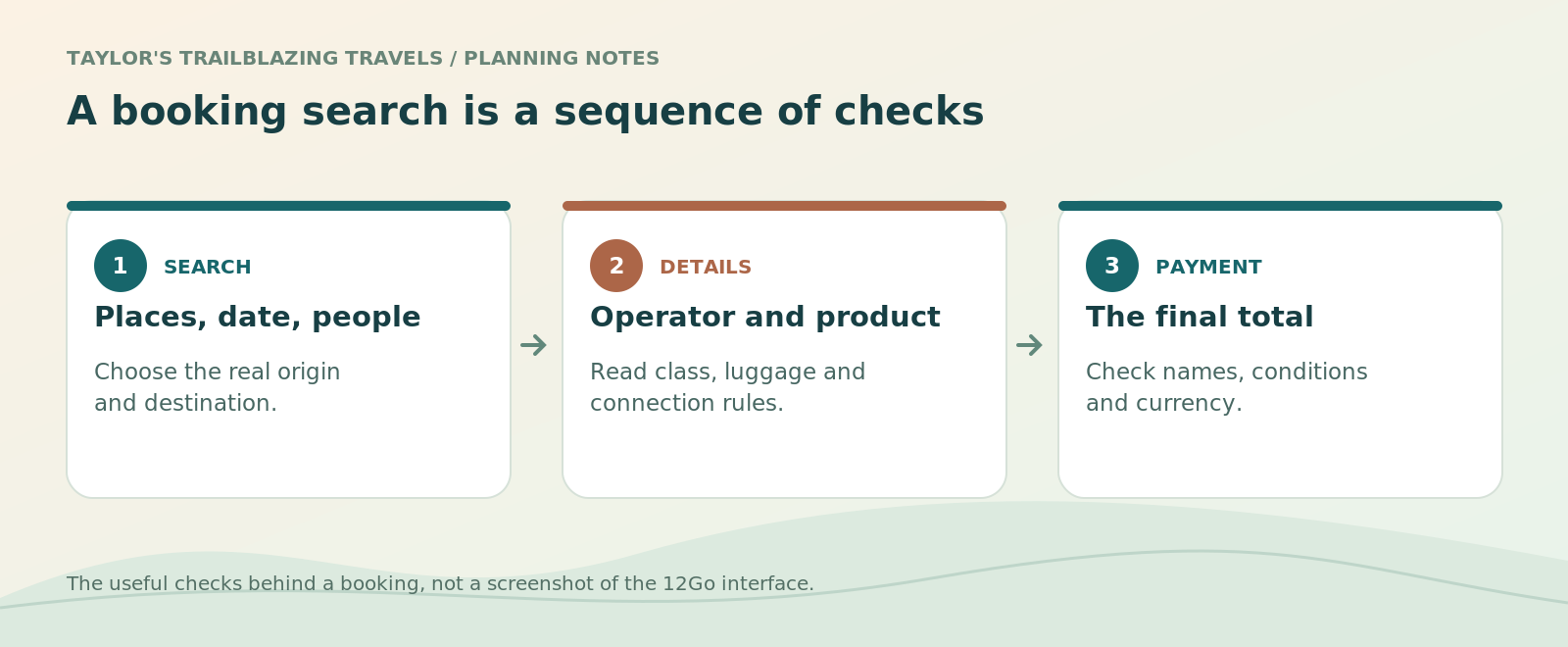
Read the operator and the exact pickup
Open the listing's detail view rather than booking from the headline card alone. The current platform uses individual trip cards with operator and location information. Compare the location text, map and instructions together; each adds context that can be lost in a short search heading. [2][3]
On a Bangkok to Ayutthaya search, for instance, investigate whether the result is a train, minivan or other service and where it actually starts. A city pair does not establish the transport experience. Similarly, confirm whether your arrival is near the place you intend to explore or whether you need another local transfer.
Ask whether you can realistically reach the meeting point
Copy the pickup address into your itinerary, but also read any descriptive instruction such as an operator's office, counter or hotel lobby. A map pin can be useful without identifying the precise door where staff expect you. Give yourself time to find that door before the reporting deadline.
If the detail view is vague about something that affects your ability to travel, pause and ask support or the operator. Do not fill the gap with an assumption based on a different departure. It is better to clarify baggage, accessibility or ticket collection before payment than to discover that the operator's answer makes an otherwise cheap ticket unusable.
Compare class, seat and luggage together
A comfort label needs detail
Terms such as VIP, express and premium are not a universal specification across independent bus and van companies. Read the seat configuration, vehicle description and actual inclusions where provided. Recent, relevant reviews can offer context, but a review of another route or vehicle is not a guarantee about your departure.
For Bangkok to Krabi ground-transport options, compare the arrival location and overnight comfort with the fare. A more expensive ticket can still be poor value if it drops you far from the hotel at an awkward hour. Conversely, a simpler service can be appropriate when you understand its limits and the schedule fits.
Luggage is an operator question
Check the number, size and weight of bags allowed and whether oversize items need prior approval. A minivan can have less practical storage space than a large coach. Do not assume you can solve that at the door by buying an extra seat unless the operator explicitly allows the arrangement.
For a combined journey, read the rules for every stage. One generous segment does not cancel a stricter requirement on the next. Lomprayah's published terms, for example, specify luggage and reporting conditions for its services. Those are useful supplier-specific checks, not a universal 12Go baggage allowance. [4]
Review passenger details and the final price
Type from the document, not from memory
Enter each passenger's name and requested identity information carefully. Match the travel document where the product requires it, and check every traveller rather than only the lead name. A typing mistake can become difficult to change once a supplier has issued a ticket.
Where child ages or passenger categories are requested, answer for the actual travellers. Do not invent an adult passenger to bypass an unclear child option. Ask for clarification before booking, especially when a child needs an individual seat, a berth or particular documentation. A fare that appears cheaper because a passenger is missing is not a valid comparison.
Read the total in the currency you will pay
Before authorising payment, check the final total, selected extras and cancellation conditions. Compare that amount with any direct quote for the same service, class and date. A difference can reflect service fees or a different product; it should be understood rather than automatically judged either unfair or worthwhile.
Use Bangkok to Phuket results to explore the route, then compare the chosen departure on like-for-like terms. Do not judge a platform from the cheapest figure shown for some other date. Also remember that your payment provider may treat foreign-currency spending differently; check its terms separately instead of assuming a display currency removes every conversion cost.
Distinguish payment, confirmation and boarding
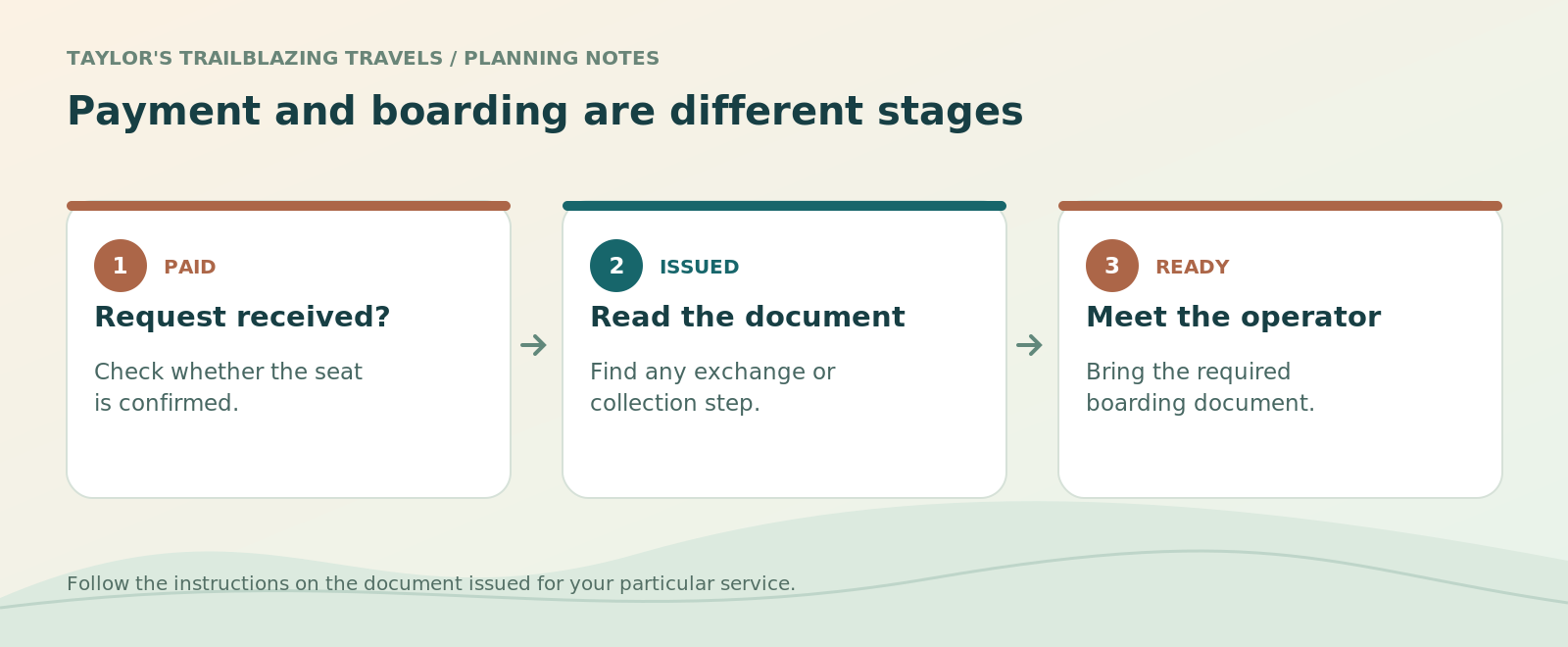
Payment is one stage, not the finish line
12Go's terms explicitly say a booking may not be instantly confirmed after payment and that an acknowledgement can mean the request is still being processed. Monitor the status rather than assuming that money leaving your account proves a particular seat is issued. This matters especially when the next booking depends on that departure. [1]
Once confirmation arrives, inspect the passenger list, date, route and operator again. Save the Booking ID and keep it with the trip information. The platform's booking-help page uses that identifier to locate the reservation. A clear reference is more useful to support than a description such as the bus I booked last week. [5]
Read the document for the action it requires
A receipt, voucher and boarding ticket may serve different purposes. Open the issued document and look specifically for instructions to print it, exchange it, collect another ticket or show it electronically. Do not generalise from a previous bus journey to a railway booking simply because both documents arrived as a PDF.
If the instructions conflict or appear incomplete, resolve the question before the travel day. Keep the original file as well as a screenshot of the important details; a cropped image can omit a code or condition that staff need. The format accepted for boarding is determined by the actual product, not by whether your phone can display the attachment.
On a small screen, swipe the table sideways to see every column.
| What you receive | What to establish | Your next action |
|---|---|---|
| Payment acknowledgement | Has the requested service actually been confirmed? | Check booking status before assuming you hold a seat |
| Confirmed itinerary | Are the people, dates and places correct? | Save the reference and inspect boarding instructions |
| Voucher requiring exchange or collection | Where, when and with which documents? | Allow a separate collection stage |
| Accepted electronic boarding ticket | Does the operator require printing or another check? | Follow the issued ticket's specific instructions |
A worked train search: Bangkok to Chiang Mai
Begin with a real requirement, not a featured result
Imagine two adults who want to leave Bangkok on an evening train and arrive the following day. One traveller strongly prefers a lower berth. The first job is to enter the correct date and two passengers, then select trains and compare the departures that actually fit the intended evening.
Open the details for a suitable service and read the departure station, train number and class. Next, check how berth selection is handled. If the interface only records a preference, do not describe that preference to your companion as a confirmed allocation. A cheaper upper berth is not equivalent to a lower berth when that difference is essential to the passenger.
Compare before committing the rest of the trip
Look at the same train on SRT's direct service where it is available to you. Match the class and passenger count, then compare the final amount and any collection requirement. There is no need to argue that one method is always superior: the usable ticket and the process matter more than the booking channel's label.
Do not book a tightly timed excursion for the arrival morning merely because the timetable appears to leave enough time. Allow for a delayed train, reaching the hotel and the possibility that the room is not ready. A relaxed first activity can be more valuable than saving an hour on paper.
Complete the booking by inspecting what was issued
After confirmation, check both names, the travel date, origin, train number and issued berth information. Then resolve whether you have the accepted ticket or a collection instruction. Put that instruction into the departure-day plan, including the location and opening hours where relevant.
Finally, save the train's arrival station for the next transfer. The task is complete only when you know how both travellers get from the first hotel to the train and from the arriving station to the next address. The booking email is one part of that plan, not the whole itinerary.
Booking a Thai train: the details that matter most
The station and train number come first
For many long-distance journeys, Bangkok's main terminal is Krung Thep Aphiwat rather than the historic Hua Lamphong station. That does not mean every train in Bangkok uses the new terminal. Read the origin on the actual train listing and issued ticket, then cross-check the train number with official railway information. [6][7]
A Chiang Mai to Bangkok train comparison is a useful starting point for the return leg. Confirm the arrival station before deciding how to reach your Bangkok hotel or airport. The word Bangkok in a route heading is less precise than the station printed on the ticket.
A seat preference is not the same as an issued berth
Check whether you are selecting an available berth, stating a preference or making a request that still needs confirmation. Where sleeping together matters, verify the issued carriage and berth details for the whole party. Do not assume that two tickets in the same class necessarily put passengers beside one another.
Collection arrangements also deserve attention. 12Go's current office page lists ticket-collection locations, including a Bangkok point at Chatuchak MRT. Use the location and instructions tied to your booking rather than an old blog's description of a different office. A collection stop can be separate from the station where you board. [8]
Compare the official booking alternative
The State Railway of Thailand operates D-Ticket as its direct online service. It is worth checking when you know your train and can use the system. Compare the actual availability, class, conditions and final amount rather than assuming that an agency is always necessary or that either channel always has the lowest usable total. [9]
Booking buses and minivans without choosing the wrong terminal
Bangkok has more than one road departure point
Read the pickup field carefully: a bus terminal, operator's office, roadside meeting point and hotel pickup are different arrangements. Your hotel may recognise a general terminal name while your ticket actually requires check-in at a particular company counter. Save both the broad location and the operator-specific instruction.
For a Chiang Mai to Pai minivan search, pay particular attention to baggage and the meeting point. The right question is not simply whether a vehicle goes to Pai. It is whether the departure you can reach, with the bags you have, arrives at a place from which your next stage is manageable.
Overnight services need an arrival plan
A very early arrival can leave you waiting before your hotel accepts check-in. Contact the property about luggage storage or early access instead of assuming that the room night automatically begins when your bus arrives. If you need immediate rest, book the arrangement explicitly rather than relying on a helpful exception.
Keep documents, medication, valuables and items needed overnight in the bag that stays accessible. Check how and when luggage is returned, especially if the service ends at an office rather than a large terminal. Before leaving the vehicle area, count your belongings and confirm you have collected the correct bag. A rushed transfer is a poor moment to discover that two cases looked identical.
Booking ferries: the pier is as important as the island
Match the departure and arrival piers
An island can have several piers, and an operator can use a particular one. Check the actual pier names on both sides, then calculate the transfers to and from them. A hotel near one pier is not automatically convenient for a ticket arriving at another.
For Samui to Koh Phangan ferry options, read the ports and any included road stage before comparing the fare. For Phuket to Phi Phi departures, check the Phuket meeting point and the reporting time. The island name is only the beginning of a usable booking.
Reporting time can be earlier than you expect
Use the operator's deadline rather than arriving at the pier at the sailing time. As a dated example checked on 4 October 2026, Lomprayah's terms instruct passengers to report at its office at least 60 minutes before departure. Other operators and products can use different procedures, so read the specific ticket. [4]
Keep the last sailing of the day in mind when choosing a connecting flight or long road journey. A boat that cannot be reached leaves fewer alternatives than a missed urban train. Moreover, do not pressure staff to operate in unsuitable conditions; plan a mainland night or another fallback rather than treating a published timetable as a guarantee that weather cannot intervene.
Combined tickets: useful coordination, not automatic protection
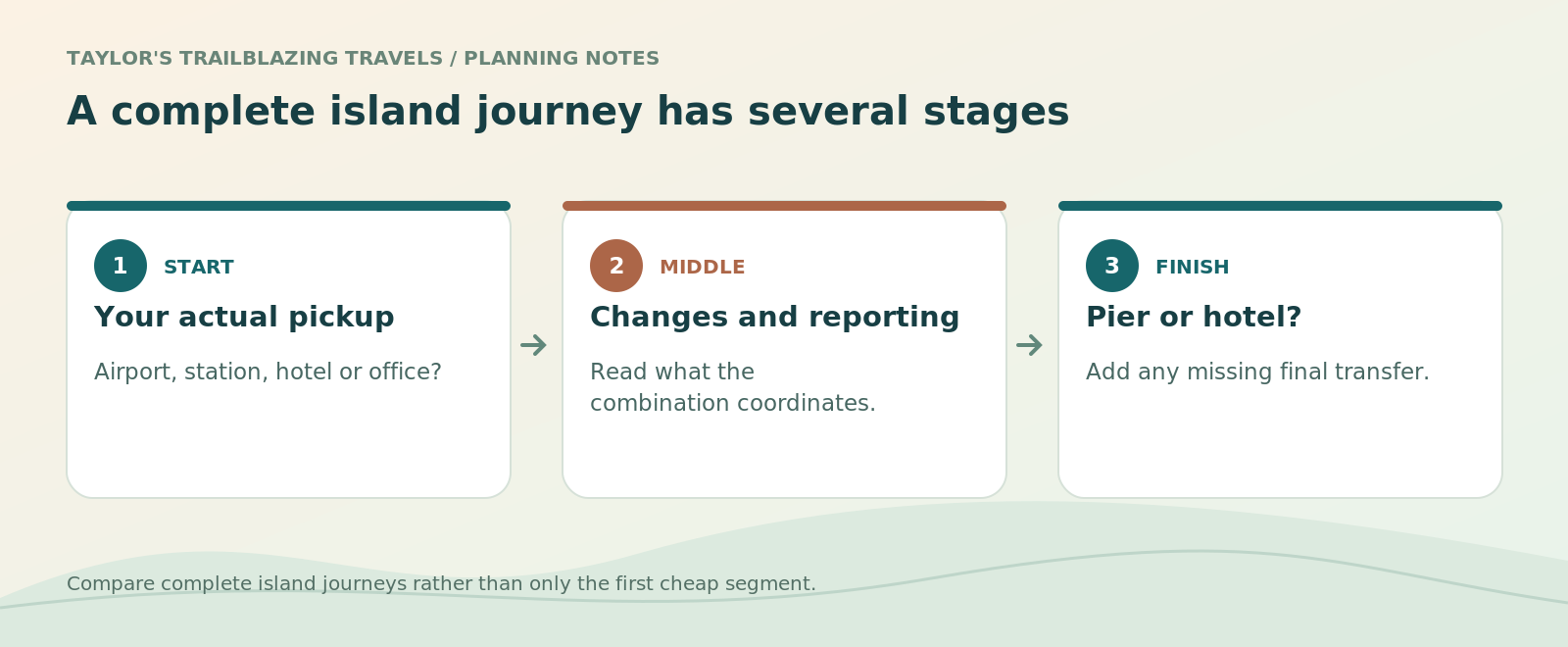
Write the stages as a chain
For a Surat Thani Airport to Samui combination, identify airport reporting, road transfer, ferry and final drop-off separately. A result can include several stages and still stop at an island pier. Check whether the hotel transfer you need is included or must be added. [10]
Do the same for Krabi to Koh Lanta options. Read whether your selected product starts at an airport, hotel or office. Similar route headings can conceal very different pickup coverage. The sensible choice depends on where you will actually be, not on the most convenient place name in the search box.
Ask who handles a missed connection
Some products describe connections as coordinated or guaranteed; others explicitly describe a self-connection. Read the exact scope and conditions rather than assuming the label covers a separately booked flight before the itinerary begins. A supplier may coordinate its own bus and boat without accepting responsibility for an airline delay.
Where the rules are unclear, ask a specific question: if this first stage arrives late, who arranges the replacement for the next stage and what costs remain mine? Keep the answer. If no satisfactory answer is available, add a larger buffer or book an overnight stop. A coherent plan is more valuable than fitting the most transport into one calendar day.
A worked island booking: compare complete journeys
One combination versus independently assembled stages
Suppose you want to travel from Bangkok to Koh Tao. Compare complete Bangkok to Koh Tao combinations with the individual mainland and ferry stages you are considering. Write down the departure location, each change, arrival pier and final hotel transfer for both approaches. Do not compare a complete combination with only the cheapest first segment of the independent plan.
Read whether the combination includes accommodation, meals or an extended wait; never assume those are included simply because the total trip runs overnight. If you plan to assemble separate stages, check how you get between the mainland railway station and the ferry reporting point. That connection can be the decisive part of the choice.
Use the return journey as a stress test
A route that works comfortably on arrival can be much less attractive before an international flight. First choose a mainland or Bangkok arrival with a sensible margin, then select the preceding boat and ground transport. If the only viable plan depends on the last ferry running perfectly, change the itinerary rather than treating the booking site's availability as an endorsement.
Check the operator's weather and cancellation instructions close to departure. A ticket is not a forecast. Keep enough flexibility to remain on the island or mainland if the operator changes the service, and contact the booking channel promptly when an issued itinerary no longer matches the operating plan.
Compare the actual final address
A ferry ending at an island pier and a combination including a hotel drop-off are not the same product. Price the missing transfer, but also consider whether it is easy to arrange at the arrival time. For a late arrival or a remote property, knowing exactly who completes the final stage can be worth paying more for.
Once booked, tell the accommodation which pier you will use and whether you need their help with collection. This gives the hotel a chance to correct a misunderstanding before you are standing beside the wrong vehicle on the wrong side of the island.
Changes, cancellations and refunds: inspect the specific product
Do this before paying, not after plans change
Read the deadline, permitted change types and any non-refundable elements for the chosen departure. Save the conditions that apply to your booking so you do not need to reconstruct them later from a different search result. A flexible-sounding label is not a substitute for the actual rule about dates, names or unused travel.
12Go's terms make supplier approval and product conditions relevant to changes and refunds, and its service fees can be treated separately. This guide does not promise that cancelling a journey produces a full refund. Contact the booking channel promptly when plans change and retain the written response. [1]
Separate a refund request from a refund received
If a supplier cancels, ask what remedy is being offered and how to request it. Keep the cancellation message, Booking ID and payment reference together. Meanwhile, avoid repeated duplicate requests through unrelated channels when one documented case is already being handled; a single clear timeline is easier to follow.
The platform has a payment-and-refund support route for payment problems and refund enquiries. Use it with the exact reservation details rather than posting personal information publicly. When checking your bank account, distinguish a pending card authorisation from a completed charge or a refund; your payment provider can explain its own display. [11]
Booking for a family or several friends
Agree the requirements before collecting payment
One person often becomes the group's booking organiser, but that does not mean they should guess everyone else's needs. Confirm passenger names, ages where required, luggage and comfort requirements first. Ask whether anyone needs a particular berth, cannot manage stairs or will bring equipment that needs operator approval.
Then share the proposed itinerary in plain language: where the group meets, how long it travels and what the arrival arrangement includes. A link to a long results page is not the same as agreement on one departure. Make sure everyone is approving the actual product rather than assuming the organiser chose something similar to last year's trip.
Avoid splitting a party accidentally
If the preferred departure has insufficient availability, do not quietly book half the group and hope the remaining places appear later. Ask whether another suitable departure can accommodate everyone or whether splitting the group is genuinely acceptable. The same applies to train berths: adjacent-looking choices in a search may not remain available while several separate payments are made.
Keep a single final passenger record once the tickets are issued. Share each traveller's necessary documents securely and make the reporting instructions available to more than one responsible adult. If the organiser's phone stops working, the whole party should still know the operator, location and Booking ID.
Plan the meeting before the official check-in deadline
For a group, set an internal meeting time earlier than the operator's reporting requirement. That gives space for a late hotel checkout, a missing bag or a passenger who has gone to the wrong entrance. Use a specific landmark or desk, not somewhere near the station.
Decide how to contact someone who becomes separated and what to do if a member cannot travel. The goal is not to create an elaborate procedure. It is to prevent one missing message from becoming a last-minute decision that affects several paid tickets.
What to do when the booking appears to go wrong
No email, uncertain status or a payment error
First, confirm that you used the intended email address and check the spam folder. Then use the official booking-support route to recover the reservation or clarify its status. Do not immediately make the same booking again while the first payment is uncertain; you could end up with two valid reservations.
12Go's help page provides booking identification and email-based access options. Keep your reference and the exact time of the attempted purchase available. If you need to share a screenshot, remove unrelated card information and private data that the support agent does not need. [5]
A pickup problem on the day
Read the voucher's contact instructions and confirm your exact location before concluding that the driver or operator is absent. Check the terminal, floor, door or office name, not just the map pin. Send a short message containing the Booking ID, departure time and where you are waiting.
If you are running late, contact the supplier promptly but do not assume that a scheduled bus or ferry will wait. Ask what alternatives exist and what action preserves any remaining value in the booking. Avoid making safety-compromising requests to a driver in an attempt to recover time; the better remedy is an earlier departure or a replacement plan.
A fair way to compare 12Go with booking direct
Keep every comparison like for like
Match the date, departure, operator, class, passenger count, baggage and cancellation conditions. A direct quote for an ordinary seat does not prove that an agency's sleeper berth is overpriced. Equally, a platform showing a cheaper different departure does not establish that it undercuts the operator on your actual journey.
Here is an illustrative comparison prepared on 4 October 2026, not a live fare quote. Suppose the direct ticket is THB 900, an agency ticket for the same service is THB 1,050, and the agency arrangement removes a separate collection journey you would otherwise value at THB 200. The agency costs THB 150 more in cash but may still be worthwhile for that traveller.
Convenience is a choice, not a universal saving
Another traveller already passing the ticket office could reasonably choose the direct purchase. Someone needing help comparing a multi-stage route might value the agency more. Put a value on the convenience you actually receive rather than paying for a reassuring interface without understanding its practical benefit.
Also consider who will handle changes, which contact channels are available and whether the chosen booking method suits your confidence level. The best channel is the one that gives you a correct, usable ticket with conditions you understand. It does not have to be the same channel for every journey in your holiday.
When availability and booking windows are unclear
Empty results do not always mean the same thing
First check that the date is within the period the particular service is selling and that you selected the correct location. Then remove unnecessary filters and compare the operator's own information. A train, bus and ferry may open sales on different schedules, so avoid applying one universal advance-booking rule to the whole holiday.
If a journey appears unavailable, decide which requirement you can genuinely change: date, time, class, origin or mode. Change one at a time so you understand why a new result appeared. Otherwise, it is easy to think you found the missing train when you actually selected a bus from a different departure point.
Hold off on dependent non-refundable bookings
When the first travel stage is essential to reaching a remote hotel or a final ferry, establish it before committing the most restrictive later reservations. That does not require buying every bus months in advance. It means recognising which unavailable segment would make the rest of the itinerary unusable.
For an alternative date, compare the total effect on accommodation and transfers, not just the fare. A cheaper departure that adds another hotel night may still be enjoyable, but it is not necessarily a financial saving. Make the change because it improves the complete plan rather than because a single number looks better.
12Go advantages and limitations
What works well
The main benefit is seeing multiple transport choices together and being able to investigate unfamiliar routes in one place. That can help you build an itinerary before committing hotels, especially when several operators serve similar city pairs. A clear combined product can also reduce the number of separate reservations you manage.
Trade-offs to weigh
The limitation is that the suppliers remain different. Your previous good experience with one operator does not establish the baggage policy, punctuality or refund terms of another. Convenience at the search stage should be followed by careful reading at the product stage.
Common mistakes before and after payment
The most consequential errors are selecting the wrong pickup location, misreading an overnight date, confusing a voucher with the required boarding document, and assuming an independent connection is protected. Another is booking for fewer people than are travelling and only noticing when the issued passenger list arrives.
Before payment, say the journey aloud: people, date, departure place, departure time, operator, class, arrival place and arrival date. After payment, compare the issued information with that sentence. This takes less time than recovering from an incorrect booking and helps someone travelling with you spot a detail you have repeatedly overlooked.
Keep a useful record of each booked travel day
Save the facts that change the journey
A practical record has the Booking ID, operator, full pickup, reporting time, departure and arrival dates, passenger names and accepted boarding document. Add the luggage allowance and any specific written agreement, such as a child seat or approved oversized bag. These are the details that answer questions at the desk.
Keep payment receipts and cancellation conditions in the same folder but distinguish them from the document used to board. Give files understandable names on your own device so that an old outbound voucher is not mistaken for the return. Do not edit or crop away codes, passenger names or instructions that staff may need to see.
Review changes as changes to the whole day
When the operator sends a new time or meeting point, update your hotel pickup and the next connection. Tell travelling companions what changed rather than merely forwarding an unexplained email. The person arranging the first taxi needs the new reporting time, not just the old plan plus a message somewhere in the inbox.
This small habit keeps the booking useful until departure. It also creates a clear record if you later need help: the original itinerary, the change notice and the action you took are easier to understand than several disconnected screenshots.
Frequently asked questions
Is 12Go the company operating my train, bus or ferry?
Not generally. The platform’s terms describe third-party suppliers providing the products. Check the operator named on your selected departure and its particular conditions. That distinction matters for vehicle type, luggage, reporting procedures and changes; one account on the website does not create one uniform transport service. [1]
Is payment confirmation enough to board?
Not necessarily. A payment acknowledgement can precede confirmation, and an issued document can still require printing, exchange or collection. Check the booking’s status and follow the actual boarding instructions. The important question is what your operator will accept, not simply whether you have an email showing that money was paid. [1]
Do all Thai train tickets need collecting?
Do not assume a single rule. Read the document issued for your particular booking and follow any collection or electronic-ticket instructions. When collection is required, verify the assigned place and its opening hours before planning the journey to the station. The platform’s current office list is a reference, not permission to collect every ticket anywhere. [8]
Can I choose a lower sleeper berth?
Check what the booking interface actually offers and whether the berth is confirmed or only requested. Afterwards, inspect the issued carriage and berth details. If a particular arrangement is essential, clarify it before paying and avoid assuming that a preference entered during checkout guarantees the final allocation.
Why does a route show no departures?
The date, passenger count, filters or selected origin may be limiting the results. Recheck them, try the correct station or pier and compare official operator information. An empty platform result is not by itself proof that every transport service on the route is cancelled or sold out.
Are combined bus-and-ferry tickets protected?
Some products coordinate their own stages, but you must read the conditions of the actual combination. Do not assume it also protects an independently booked flight that arrives beforehand. Ask what happens when a stage is late, who arranges the next option and which additional costs you would have to cover.
Is 12Go always more expensive than booking direct?
A universal answer would be misleading. Compare the same departure and inclusions at the final payment stage. Then decide whether any extra fee buys useful convenience for your journey. A lower headline figure for a different date, class or pickup location is not a like-for-like saving.
What information should I send to support?
Provide the Booking ID, travel date, route, passenger name where required and a concise description of the problem. Include relevant messages or screenshots without exposing unnecessary financial information. For a pickup issue, add the exact meeting point and scheduled departure time so the operator can identify the situation quickly. [5]
Should I print everything?
Follow the actual product’s instructions. Printing a backup can be useful when specifically requested or when you are concerned about phone access, but it does not turn a voucher into a different ticket. Keep the original digital document and make sure codes remain readable rather than relying on a cropped or low-quality screenshot.
What is the last check before leaving the hotel?
Confirm the date, pickup location, reporting deadline, operator and accepted boarding document. Charge the phone, make the instructions available offline and leave enough time to find the meeting point. Then count the people and bags. A correct booking still needs a workable journey from your hotel to the departure desk.
What should I do when two sources show different pickup instructions?
Use the details issued for your specific booking as the starting point, then ask the issuer or operator to resolve the conflict. Send both versions and request one confirmed location with the reporting time. Do not average two addresses or choose the one that happens to be closer to your hotel.
Can someone else keep the tickets for the whole group?
They can help organise the documents, but avoid having only one accessible copy. Share the necessary booking and boarding information with another responsible traveller and keep personal data secure. Each passenger should know the operator and meeting point even when one person handled the payment.
Book the journey you understand, not the result that shouts loudest
Use 12Go to make unfamiliar transport easier to compare, then slow down at the point where the individual operator's details begin. Confirm the locations, passenger list, luggage, timing and conditions before paying. Afterwards, complete the job by checking status and obtaining the document that actually gets you aboard.
For a complicated holiday, keep one short record per travel day rather than a folder of unexplained confirmations. Show how you reach the departure point, what happens on each stage and how you leave the arrival point. That record makes connections visible and prevents a missing local transfer from hiding between otherwise sensible tickets.
The best booking is neither automatically the cheapest nor the one with the most prominent badge. It is a service you can reach, use and recover from if plans change, bought through a channel whose role you understand. That is the standard to apply whether you choose 12Go, an operator's website or a railway ticket counter.
Sources and fact-checking notes
Last editorial source check: 04 October 2026. Official airport, railway, government and airline pages support operational facts; booking-platform and operator pages support their own product information. Timings described as planning allowances are editorial judgements, not guaranteed connections. Constructed price examples are labelled and are not live offers.
Availability, pickup instructions, baggage conditions and operating details can change. Recheck the actual ticket and current operator guidance before travel. The original scene artwork is illustrative and should not be used as a map or evidence of a specific terminal layout.
- 12Go: terms of use and supplier-specific product conditions.
- 12Go: Bangkok to Chiang Mai, individual operator and station listings.
- 12Go: Krabi Airport to Ao Nang, individual transfer listings.
- Lomprayah: service conditions, check-in and luggage, updated May 2026.
- 12Go: booking support and Booking ID recovery.
- Thai Government: Krung Thep Aphiwat and the long-distance service move.
- State Railway of Thailand: current timetable search.
- 12Go: current ticket-collection offices.
- State Railway of Thailand: D-Ticket official booking service.
- 12Go: Surat Thani Airport to Koh Samui, individual transfer listings.
- 12Go: payment and refund support.
Illustrations in this article were created for Taylor’s Trailblazing Travels. Third-party photographs, where used, are credited beside the image or in the source list.