Bangkok Train Stations Guide
Match the station to the ticket, understand the different rail systems and reach the right platform without rushing.
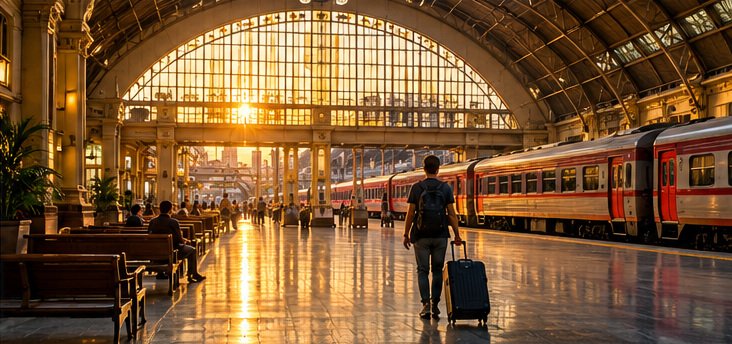
Original railway-scene illustration, not a photograph or navigational plan of a specific station.
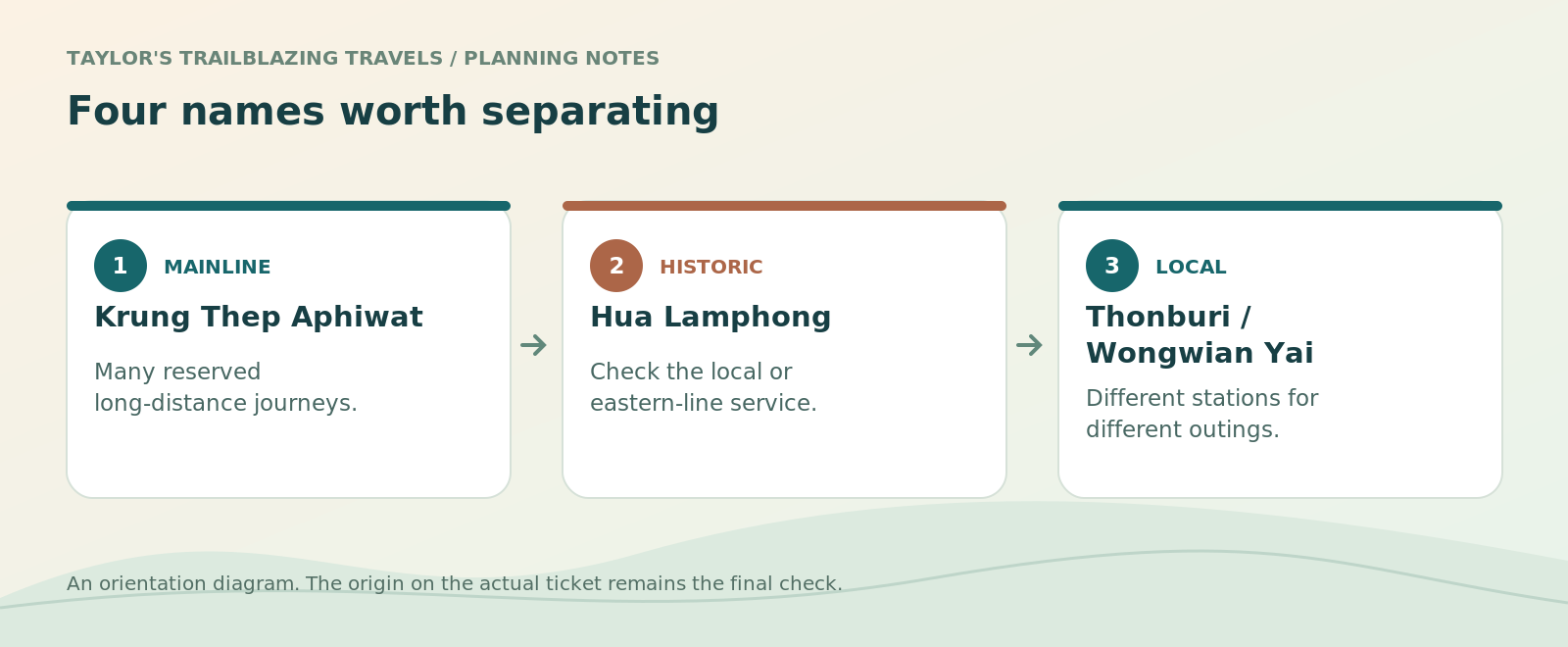
Bangkok train stations are easy to confuse because several names describe different parts of the city's rail network. Krung Thep Aphiwat is the main starting point for many long-distance journeys. Hua Lamphong still matters, Thonburi serves a different set of trips, and Wongwian Yai is a separate local railway station as well as the name of a BTS stop. Heading to 'the Bangkok station' is not a complete transport plan.
This guide helps you match your ticket to the right building and reach it with enough time to board calmly. It concentrates on the stations visitors are most likely to need for intercity travel and local rail outings, with clear distinctions between long-distance trains, the MRT, the BTS, the Airport Rail Link and the Red Line.
The station selection is based on practical visitor use, not a ranking of architecture or size. Official railway and urban-rail sources were checked on 4 October 2026. Train allocations and departure details can change, so use your issued ticket, the official timetable and the station's current displays for the final decision.
Check Krung Thep Aphiwat
The principal starting point for many reserved intercity services.
Hua Lamphong still matters
Look at the actual local or eastern-line train, not a blanket rule.
Investigate Thonburi
Check the ordinary Kanchanaburi and Nam Tok service with SRT.
Station + train + date
Those details are more precise than a broad Bangkok destination.
Bangkok train stations: choose the ticket, then the building
A destination does not uniquely identify a station
Bangkok has several railway starting points and multiple urban-rail systems. Two services towards the same general region may not depart from the same place. Therefore, use the train number, departure date and exact origin together, especially when comparing an ordinary local service with a reserved express or sleeper.
The following table is an orientation tool, not a timetable. It identifies the questions to ask before arranging a taxi or hotel transfer. Check the railway's live information for the actual train rather than treating a familiar destination as permission to turn up at any station serving that direction. [2]
On a small screen, swipe the table sideways to see every column.
| Station or system | What it helps with | Important distinction |
|---|---|---|
| Krung Thep Aphiwat | Many long-distance northern, northeastern and southern services | Also known in older material as Bang Sue Grand Station |
| Bangkok / Hua Lamphong | Relevant local and eastern-line departures | Not closed merely because many express trains moved |
| Thonburi | Ordinary services towards Kanchanaburi and Nam Tok | Not a synonym for every station west of the river |
| Wongwian Yai railway station | Mahachai local railway | Separate from BTS Wongwian Yai |
| MRT Bang Sue | Urban-rail access to Krung Thep Aphiwat | An MRT trip is not a long-distance rail ticket |
| Red Line Don Mueang | Airport-related suburban rail travel | Check separate long-distance stops and tickets |
| Airport Rail Link Makkasan | BKK airport access and a connection towards MRT Phetchaburi | Not your long-distance sleeper departure terminal |
Save one unambiguous destination
Send your driver the station's full name and show the ticket where practical. A hotel reception can help confirm the appropriate map pin. Avoid saving a station solely as Bangkok or Bang Sue when your plan depends on a particular building, entrance or rail system.
Krung Thep Aphiwat: the principal long-distance starting point
Understand why older guides disagree
The main transfer of designated northern, northeastern and southern long-distance services to Krung Thep Aphiwat took place on 19 January 2023. Official government information records that change. Consequently, a guide that directs every Chiang Mai sleeper passenger to Hua Lamphong can be describing an earlier arrangement rather than your present journey. [1]
Allow time for the building, not just the train
Krung Thep Aphiwat is a substantial terminal. Leave time to enter the correct area, find the departure display and understand when access to your train is permitted. Reaching the outside of the station five minutes before departure is not equivalent to reaching a small platform where the train is immediately beside the entrance.
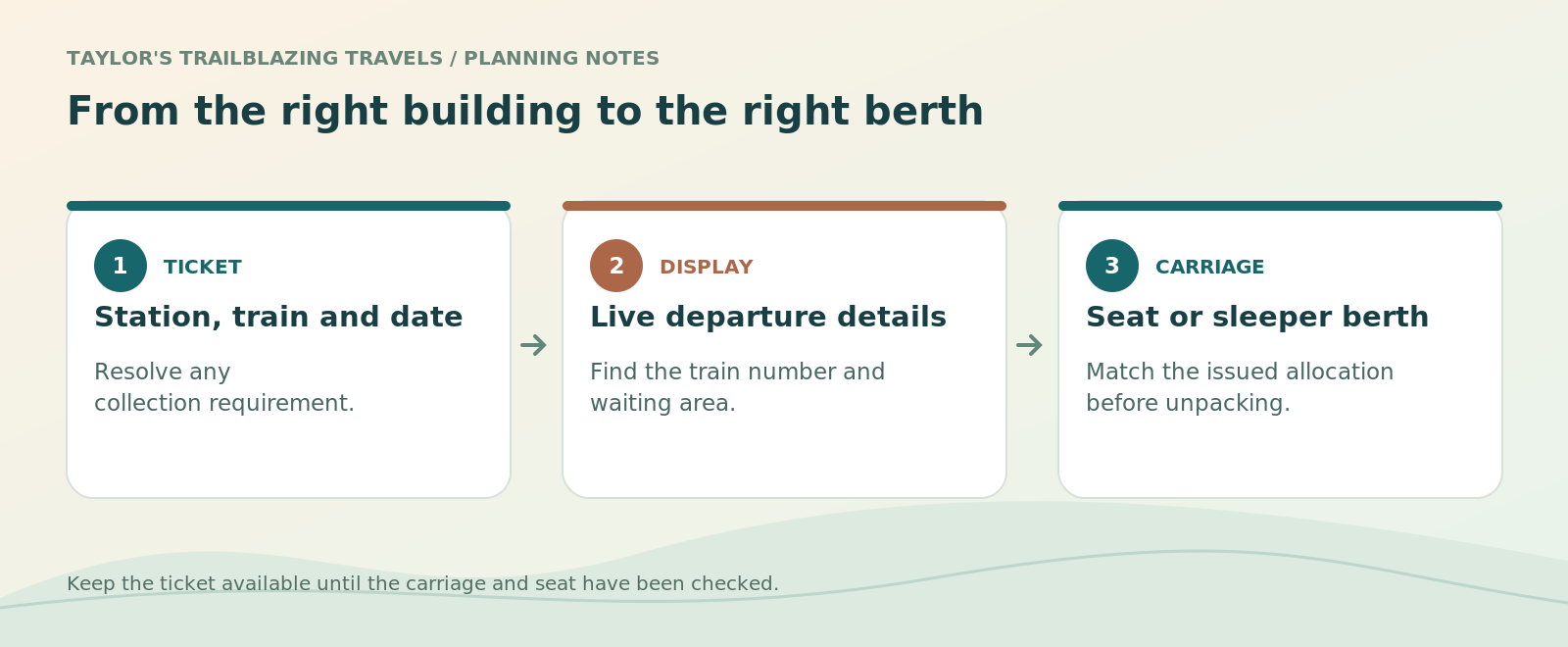
Find the train number on the display, then confirm the waiting or boarding area with staff if anything is unclear. Your destination can appear on several services, while the train number identifies the one you have booked. Keep the ticket accessible until you are in the correct carriage and seat or berth.
Hua Lamphong: still relevant, but not for every sleeper
Bangkok Station is not simply obsolete
Hua Lamphong, also shown as Bangkok Station in railway information, remains relevant to local and eastern-line travel. The current SRT timetable includes departures from Bangkok on the eastern network. Therefore, neither 'all trains moved' nor 'everything still leaves Hua Lamphong' is a useful rule. [3][2]
Keep the historical visit separate from the journey
You may want to see Hua Lamphong even when your long-distance train leaves elsewhere. That is a sightseeing decision, not a reason to start your sleeper journey at the wrong station. If you visit with luggage, plan how you will continue to the correct terminal and avoid leaving the transfer until the last possible moment.
MRT Hua Lamphong provides urban-rail access to the area. Read the MRT map and follow the railway-station signs at the exit rather than assuming the first street-level exit is the most convenient with bags. Then check the SRT departure information inside the station, not merely the urban-rail platform signage. [5]
Thonburi: check this station for Kanchanaburi and Nam Tok
A different railway outing
The ordinary railway journey towards Kanchanaburi and Nam Tok is associated with Thonburi in SRT's visitor and timetable information. Confirm the exact service and day's schedule before setting out. Do not head automatically to Krung Thep Aphiwat just because it is Bangkok's principal long-distance terminal. [4][2]
If your priority is reaching Kanchanaburi conveniently rather than specifically riding that train, compare Bangkok to Kanchanaburi transport options. Read the transport type: the appropriate ordinary train may need a different purchase process from a coach or private vehicle offered in a booking platform's results.
Budget for reaching Thonburi properly
Check the station pin rather than using Thonburi as a broad district destination. Allow extra time for the final approach when your route includes a river crossing or several local connections. A cheap rail fare is not the full journey cost if getting to the departure point requires a lengthy taxi or an overnight change of hotel.
For an out-and-back day, identify the usable return train before choosing the outward service. If the return does not suit your plans, investigate a different transport combination or an overnight stay. Riding one scenic section can be worthwhile without forcing the entire day to depend on a last train you have little margin to catch.
Wongwian Yai, Mahachai and the Maeklong misunderstanding
The railway station and BTS stop are different places
Wongwian Yai railway station serves the local line towards Mahachai. BTS Wongwian Yai belongs to the urban Skytrain system and should not be treated as the same platform or ticket gate. If you arrive by BTS, plan the onward movement to the railway station instead of assuming a direct paid-area interchange. [4][2]
This distinction matters most on an early departure. A map showing similar names can hide the walking and navigation stage. Save the railway station's actual entrance and leave room to find the ticket counter before the train leaves.
Maeklong is a multi-stage outing, not one through train
A self-guided rail journey towards Maeklong involves the Wongwian Yai-Mahachai line and a separate Ban Laem-Maeklong railway, with an intervening river crossing and movement between stations. Check each stage rather than searching only for one direct Bangkok-to-Maeklong train. The official railway network information identifies the separate station groups. [4][2]
This can be an interesting transport day, but it is not a casual gap-filler before an important airport departure. Check the return sequence, allow time to find the crossing and avoid standing on the track for photographs. If the connections do not leave enough room, choose a simpler day plan instead of trying to make every change at the last minute.
Bang Sue: the name needs a second question
Grand terminal, junction and MRT references can coexist
Older descriptions may use Bang Sue Grand Station for Krung Thep Aphiwat. MRT Bang Sue is the urban-rail station connected with the terminal area. Meanwhile, railway references to Bang Sue Junction can describe a different operational point. Ask which system and building a direction refers to rather than treating every Bang Sue label as identical. [1][6]
The Red Line operator's Krung Thep Aphiwat station information identifies a connection with MRT Bang Sue. This is the relevant relationship when you approach the long-distance terminal by the Blue Line. Nevertheless, you still need to leave the urban-rail journey and find the correct long-distance departure area. [7]
A clear instruction beats a familiar nickname
For a taxi, use Krung Thep Aphiwat Central Terminal and confirm the intended entrance or drop-off with the driver. On the MRT, select Bang Sue and follow signs towards the terminal. With a long-distance ticket, follow the station named by SRT. Keeping those three instructions separate prevents a nickname from making the whole plan ambiguous.
If a booking page uses an older English name, compare the map pin, train number and official origin before paying. Do not silently assume that a renamed listing is wrong, but do not assume that every similar name is harmless either. Resolve the mismatch while there is time to ask a useful question.
Match the train to the part of Thailand you are visiting
Northern and northeastern routes
Krung Thep Aphiwat is the first station to investigate for many reserved long-distance services towards the north and northeast. Compare Bangkok to Nong Khai trains or Bangkok to Ubon Ratchathani trains for your date, then check the actual origin and train number. The route examples are not guarantees of seat availability. [1][2]
For a shorter trip such as Ayutthaya, the type of service can change the departure point and purchase process. Use Bangkok to Ayutthaya options as a comparison, not as a reason to ignore ordinary local trains or assume that all services leave the same station.
Southern journeys and island connections
For the south, compare Bangkok to Surat Thani trains and Bangkok to Chumphon trains against your final destination. Arriving at a railway station is not arriving at an island pier. Check the next transfer's pickup point and reporting time before fixing the rail departure.
Be particularly careful when a ticket displays Surat Thani but a later booking begins at Surat Thani Airport or a town office. Those are different meeting points. Write the exact locations in a sequence so that any missing road stage becomes visible before you buy a tightly connected journey.
Reaching the main terminal from Suvarnabhumi
A rail approach involves more than one system
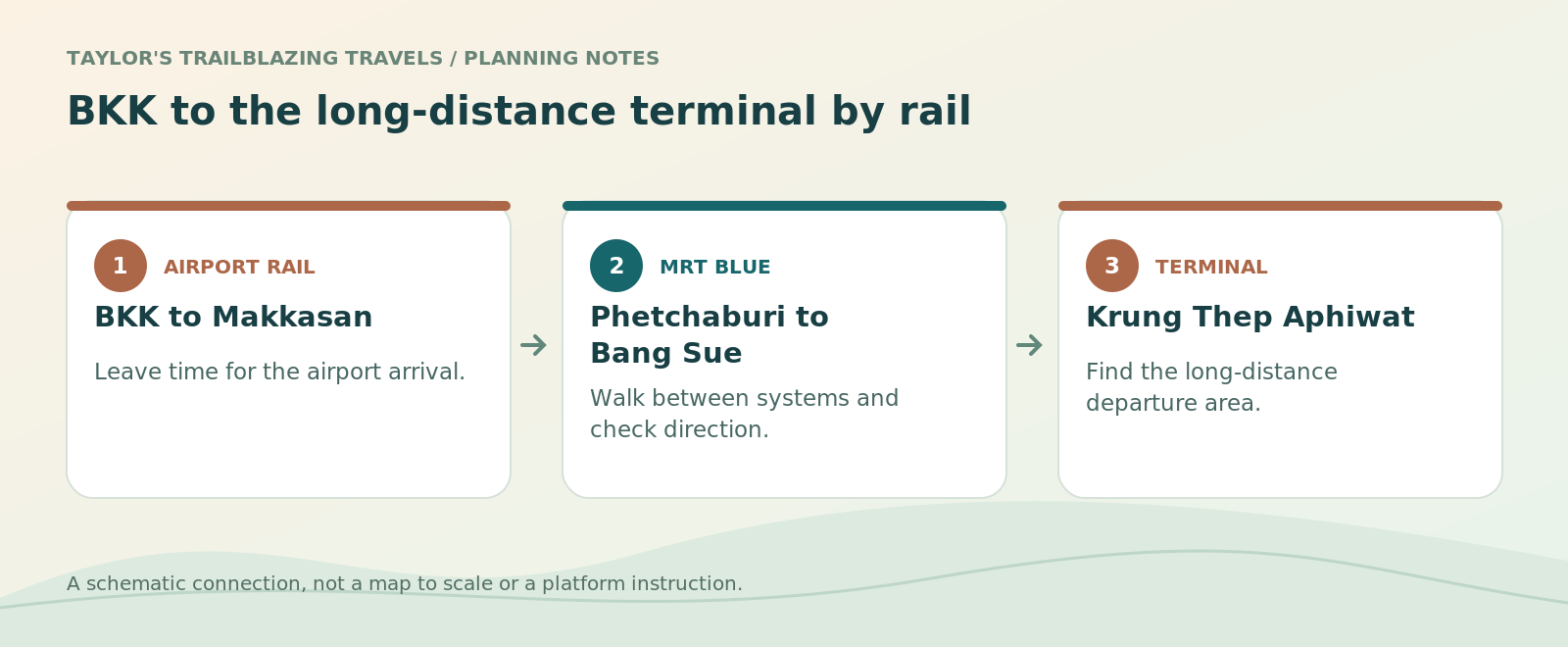
One route to investigate is the Airport Rail Link from BKK to Makkasan, the connection to MRT Phetchaburi, and the Blue Line towards MRT Bang Sue for Krung Thep Aphiwat. Check the current operator maps and service times, and choose the suitable direction rather than assuming the first Blue Line train will take the shortest route. [8][9][6]
This is not a direct airport-to-sleeper train. Budget for the interchange, ticketing and walking within the destination terminal. An airport arrival with heavy luggage or a family group may make a road transfer more suitable even when rail is available.
Work backwards from railway reporting, not airport landing
If you are arriving internationally, allow for disembarkation, immigration, baggage collection and the journey across the city. Landing time is not the time you can begin the airport train or taxi. A generous margin is especially valuable when missing the booked sleeper would alter the next day's hotel and island connections.
Keep the first evening flexible when possible. If the incoming flight is uncertain, an overnight Bangkok stay can be simpler than trying to connect immediately to the last useful train. A sensible plan should survive an ordinary airport delay without forcing you to cross the city in a rush.
Reaching the main terminal from Don Mueang
The Red Line is a useful starting point
The Red Line connects Don Mueang station with Krung Thep Aphiwat. Its station information describes the link towards Don Mueang's domestic terminal. Follow the airport signs to the appropriate walkway, then check the current train direction and operating information. [10][7]
Add time for reaching the station from your arriving terminal and for moving through Krung Thep Aphiwat after the suburban ride. A short time shown for the train does not include your entire journey from aircraft seat to long-distance berth.
Do not assume your booked train stops at Don Mueang
Some travellers may find an appropriate long-distance service with a stop nearer the airport, but that must be verified for the exact train. Do not buy a ticket from one station and assume you can board elsewhere without checking SRT's conditions and the service's stopping pattern. [2]
If a different boarding point would improve the itinerary, resolve it with the railway or ticket issuer before travel. That is more reliable than making a last-minute platform decision from an old map. Equally, if the ticket says Krung Thep Aphiwat, plan to reach that terminal rather than treating the airport station as an automatic substitute.
Moving between Bangkok's railway stations
Hua Lamphong to Krung Thep Aphiwat
The MRT Blue Line can form the core of this transfer through its Hua Lamphong and Bang Sue stations. Use the current route map and allow for walking at both ends. This is a transfer between separate railway starting points, not an internal terminal change with a guaranteed connection. [5][6]
A taxi may be preferable with several bags or when your journey begins away from the MRT. However, calculate the full time during the period you intend to travel. A quiet-road estimate from a different hour should not determine whether you can catch an important booked train.
Thonburi and Wongwian Yai need their own plans
Neither station should be treated as a simple continuation inside the Krung Thep Aphiwat complex. Check the final local approach, the relevant river or road crossings and where the actual railway entrance lies. If you combine two railway experiences in one day, leave a substantial gap rather than trying to transfer on the tightest theoretical route.
Keep a fallback in mind. It may be a later local train, a different road service or abandoning a sightseeing stage. A fixed long-distance sleeper is a poor place to spend the last of your contingency time after an ambitious local-rail outing.
Two practical station-to-train examples
An evening sleeper after a Bangkok hotel stay
Imagine that your ticket names Krung Thep Aphiwat and the train leaves in the early evening. Start with the hotel's checkout and luggage-storage arrangement. Decide whether you will return for your bags before travelling to the terminal or keep them with you for the afternoon. That decision determines which transfer you actually need to plan.
Next, check the accepted boarding document and any collection requirement. If collection is elsewhere, visit that point while there is still ample time, rather than adding it after you have already reached the terminal. Only then choose the city-to-station route and a departure time that includes the final terminal walk.
At the station, locate your train number and waiting area before buying food. That gives you a fixed point to return to and reduces the temptation to follow passengers whose destination sounds similar. Once aboard, check the carriage and berth before putting luggage out of reach.
A morning local train rather than a reserved sleeper
Now imagine a local outing beginning at Thonburi or Wongwian Yai. The station is different, the sales process may be different and the return train matters more to the day plan. Confirm the timetable first, then calculate how you reach the actual railway entrance early enough to buy the relevant ticket where needed.
Do not automatically copy the previous sleeper's preparation. A railway app, agency voucher or seat-reservation habit from a different service may not describe this journey. Ask the station about the intended train and keep the return options visible, particularly if you plan to continue beyond the first destination.
After arriving, identify the return station before wandering far from it. A pleasant local-rail day can become stressful when you know the departure time but not how long it takes to walk back to the correct entrance. Build exploration around the actual service rather than expecting the railway to fit an open-ended sightseeing plan.
Buying the right ticket and understanding collection
Direct railway booking is a valid first check
SRT's official D-Ticket system provides online booking for relevant services. Use the origin, destination, date and train details to compare what is actually available. Some local journeys involve a different sales process, so a lack of results for one search should prompt a timetable or station enquiry rather than a conclusion that the railway does not exist. [11][2]
For an agency booking, read the issued document carefully. Establish whether it is the accepted boarding ticket or whether you must collect or exchange something first. A downloadable file is a format, not proof that every Thai train uses the same boarding process.
Collection can be somewhere other than the platform
12Go's current office information includes specific ticket-collection points. Follow the one assigned to your reservation and its opening hours. An old instruction referring to an office beside a different Bangkok station should not override the document issued for your journey. [12]
Put collection time into the plan before the journey to the departure terminal. If the collection point opens too late for your intended train, ask about the arrangement before travelling. Do not assume railway staff at another station can simply recreate a ticket that is waiting at an agency office elsewhere in the city.
Inside the station: from entrance to the correct carriage
Identify the train, then the platform
Start with the departure display and your train number. Check whether the train is boarding, delayed or waiting for a platform announcement. If staff direct passengers to a holding area, use it rather than walking through restricted routes in search of a carriage you have seen in a photograph.
Once boarding begins, match the carriage number and seat or berth to the ticket. Do not rely solely on the final destination painted on the train or the first carriage you reach. A short question to staff is preferable to settling into the wrong berth and having to move all your luggage after departure.
Keep the ticket accessible through the journey
Retain the ticket or accepted electronic document for checks. If you are travelling with another person, make sure each can access their own details rather than leaving everything on one phone that may run flat. Keep identity documents available where required without leaving them in an exposed pocket.
Before disembarking, gather small items from charging points, seats and luggage racks. Agree with companions who is taking each bag so that everyone does not assume somebody else collected it. At the destination, move away from the platform edge before stopping to read hotel instructions or arrange onward transport.
Luggage, food, toilets and waiting facilities
Do not build the day around an unverified facility
Facilities vary between a major terminal and a small local station. Check any essential requirement, such as luggage storage or an accessible toilet, directly rather than assuming every station provides it throughout the day. A service described in an old guide may have different hours or a different location.
Carry enough drinking water and suitable food for the waiting period, while keeping the bag manageable. For an overnight train, put the items you need before sleep in a smaller accessible pouch. It is awkward to open a large suitcase repeatedly in a busy aisle or compartment.
Make luggage work on more than polished floors
You may encounter steps, platform gaps and short outdoor sections even when most of the journey uses modern infrastructure. Choose luggage you can move safely and avoid packing so heavily that you depend on an unknown stranger to lift it. Ask staff about assistance rather than improvising across tracks or barriers.
A mobile-data option such as Airalo for a compatible phone can help with maps and messages, but save the ticket and directions offline as well. Check whether your chosen plan supports the communication you need. A data connection should make the journey easier, not become the only way you can identify your station.
Step-free travel and families: ask about the whole route
A lift at one station does not describe every stage
The Red Line operator lists lifts and other facilities at its stations, but you still need to consider the hotel approach, any urban-rail interchange and the long-distance train itself. Ask about the assistance needed for the particular train and boarding point rather than relying only on a station's general accessibility symbol. [7][10]
Describe whether the traveller can manage a short step, needs help crossing a platform gap or travels in a mobility device. Confirm dimensions and handling arrangements where relevant. Written, journey-specific advice is more useful than a general assurance that the station is modern.
Keep a manageable pace through the terminal
With children, plan toilet and food stops before the final boarding stage where practical. Keep the party together while checking displays, and agree who carries the documents and who counts the bags. A large concourse is not a good place to let several people follow different guesses about the platform.
If a family member needs more time, choose an earlier arrival rather than trying to recover it with a hurried interchange. The additional waiting can be made comfortable with a small accessible bag of essentials. It is easier to wait near the correct departure area than to reorganise a group halfway through the wrong station.
Do not assume every sleeper layout suits every traveller
Check the booked berth or compartment arrangement, particularly when someone has difficulty climbing or needs frequent access to luggage. A preference for a lower berth should be resolved in the ticketing process, not left for the evening when the train may be full.
For an adult supervising a child, inspect the issued carriage and berth allocation together. Two tickets in the same class are not a complete answer about how the party is placed. Clarify an unsuitable allocation with the issuer while there is time to consider a different train.
Staying near a station: useful for some trips, unnecessary for others
Match the hotel to the right departure
A hotel near Hua Lamphong is not automatically convenient for an early train from Krung Thep Aphiwat. Search around the station on the actual ticket, then inspect the walking or driving route. A map distance can be misleading where large roads, station entrances and limited crossings determine the usable approach.
For a genuinely early or late long-distance journey, Krung Thep Aphiwat-area accommodation can be worth investigating. Verify the address, reception hours and luggage arrangements with the property. Do not assume that a station-themed hotel name places the entrance beside your required concourse.
A city base may still be the better choice
If you have several days in Bangkok before the train, choose a hotel that suits those days and arrange a sensible departure transfer. Moving hotels just to save one station journey can create more packing and checkout work than it removes. The right choice depends on your departure time and how easily your existing base connects to the station.
For an overnight train arrival, ask the next hotel what happens if you reach it before normal check-in. A confirmed luggage-drop arrangement can be enough; immediate room access is a different request. Write down the agreement so that an early arrival does not turn into an avoidable argument at reception.
Timing the departure: a worked planning example
Separate city travel from station time
Consider an illustrative evening train departing at 18:30. You decide to be at the terminal at 17:30 and allow 60 to 90 minutes for the hotel-to-terminal journey. That suggests leaving the hotel around 16:00 to 16:30, with an earlier start if luggage collection or another task must happen first. These are constructed planning assumptions, not official reporting rules.
The example is useful because it shows where time disappears. A 45-minute urban-rail ride does not include walking from the hotel, buying tickets, interchanging or navigating the long-distance terminal. Add those tasks explicitly instead of assuming the journey starts when you reach the first platform.
Protect the next morning as well
A late train arrival can affect a separately booked flight, ferry or tour. Avoid scheduling the next service so tightly that the rail trip must run exactly on time. For an island connection, check whether the booked product coordinates its own stages and what happens when a delay falls outside those stages.
If the itinerary has no usable recovery option, add an overnight stop or change the following booking. The goal is not to avoid all uncertainty, which is impossible, but to avoid making every ordinary delay disproportionately expensive.
Using Bangkok railway stations: advantages and limitations
The reward of getting the station right
Bangkok’s rail network gives you several ways to leave the city, from reserved overnight journeys to local railway outings. Choosing the right starting point can reduce road travel and turn transport into a worthwhile part of the holiday. It also lets you organise accommodation around the journey you are actually taking.
Trade-offs to weigh
The difficulty is that the systems overlap without becoming one interchangeable network. Similar names, older station references and generic city labels can all create confusion. Solve that with a precise ticket-and-station check rather than trying to memorise every line in Bangkok.
Common station mistakes that cause unnecessary rushing
Do not send every sleeper passenger to Hua Lamphong, assume every Bangkok train leaves Krung Thep Aphiwat or confuse BTS Wongwian Yai with the railway station. Equally, do not treat MRT Bang Sue as the long-distance platform itself. Each is a different version of the same mistake: stopping the planning one level too early.
Finally, avoid arriving at a station before resolving ticket collection and document requirements. Being at the correct building is not enough when the accepted ticket is waiting elsewhere. Check station, train number, date, boarding document and reporting arrangements together the evening before travel.
Common mistakes when a booking is changed
Recheck the station after changing the train
A replacement service can use a different origin, stop pattern or class. Read the new ticket from the beginning instead of looking only at the time that changed. Then update the driver, hotel reception and travelling companions with the new station and reporting plan.
A change of arrival station also affects the next transfer. If a driver has already been arranged, send the updated train number and location rather than assuming the supplier can infer the change. Keep the original and replacement documents separate so that the wrong version is not shown at the counter.
Do not solve a ticket problem with an unsupported boarding assumption
When you miss the intended departure or reach the wrong station, contact SRT or the issuer about the available options. Another train going in the same direction is not automatically a valid replacement for your ticket. Nor is another station automatically an acceptable place to join the original service.
Keep the problem simple when asking for help: show the ticket, identify where you are and explain what happened. That is more effective than presenting several speculative alternatives at once. A clear answer about one usable next step is what you need before paying for another journey.
Frequently asked questions
Which Bangkok station does the Chiang Mai sleeper use?
For the main long-distance services, Krung Thep Aphiwat is the station to check. However, use the actual origin and train number on your issued ticket for the final decision. Older guides directing every sleeper passenger to Hua Lamphong predate the principal service move or overlook the current allocation. [1][2]
Has Hua Lamphong closed?
No. It remains relevant to local and eastern-line journeys in current railway information. What changed was the origin of designated long-distance services. Check the exact train rather than turning the move into an all-or-nothing rule about whether the historic station is used. [3][2]
Is Bang Sue Grand Station the same as Krung Thep Aphiwat?
Older descriptions commonly use Bang Sue Grand Station for the terminal now called Krung Thep Aphiwat. Nevertheless, MRT Bang Sue and railway references to Bang Sue Junction require attention to the system and exact location. Use the full terminal name when arranging a driver. [1][6]
Which station should I use for Kanchanaburi?
Investigate the ordinary Thonburi services towards Kanchanaburi and Nam Tok, then confirm the day’s train and timetable with SRT. A bus or private-transfer result for the same city pair is a different product. Do not assume every westbound journey starts at the principal long-distance terminal. [4][2]
Can I take one train from central Bangkok to Maeklong?
The self-guided railway outing involves separate Wongwian Yai-Mahachai and Ban Laem-Maeklong lines, with movement and a river crossing between them. Plan the individual stages and their return connections. It is not one continuous train from Bangkok’s main long-distance terminal. [4][2]
Does the Airport Rail Link go to Krung Thep Aphiwat?
Do not treat it as a direct service to the long-distance terminal. A useful route to investigate uses Makkasan, the connection to MRT Phetchaburi and the Blue Line towards Bang Sue, followed by the terminal walk. Check current maps and operating times for your journey. [8][9][6]
Can I board my long-distance train at Don Mueang instead?
Only plan this after confirming that the specific train stops there and that your ticket and boarding arrangement permit it. The presence of a station beside the airport does not make it an automatic substitute for the origin you booked. Ask SRT or the issuer before changing the boarding plan. [2]
How early should I arrive for a sleeper train?
Arriving around an hour ahead can be a useful planning allowance for an unfamiliar large terminal, with more time for ticket collection or assistance. It is not a universal railway rule. Follow your ticket’s instructions and allow enough time to find the train and carriage without rushing.
Should I stay beside the railway station?
It can help for a very early departure, but a well-connected city hotel may be better for the rest of your visit. Compare the total inconvenience of moving hotels with one planned station transfer. If you do stay nearby, check the real entrance and route rather than relying on straight-line map distance.
What is the single most useful check?
Read the station, train number and departure date together on the issued ticket. Then confirm the accepted boarding document and how you will reach that exact station. Those details are more valuable than a general statement about where trains to a particular region usually leave.
Can I rely on a screenshot of a station map?
Use it as a backup for orientation, not as a live platform instruction. Maps can help identify the correct building and interchange, but departure screens and railway staff provide the current boarding information. Keep the train number and ticket available so that you can ask a precise question when a sign or entrance differs from the saved image.
What should I tell a hotel arranging my station taxi?
Give the full station name, train number and the time you intend to reach the terminal. Mention luggage or assistance needs. Ask the hotel to confirm the usable entrance rather than simply requesting a ride to Bangkok station. This makes the hotel’s advice specific to your booked journey instead of a general estimate for another terminal.
Use the full station name and leave time for the last walk
Start with the train you intend to board, not a familiar Bangkok landmark. Confirm the full station name, match the number and date, and resolve any ticket-collection step before planning the journey across the city. At the terminal, use the current display and staff directions rather than an old platform description.
For most visitors, understanding the difference between Krung Thep Aphiwat, Hua Lamphong, Thonburi and Wongwian Yai is enough to remove the biggest source of confusion. The remaining task is practical: choose a transport route that suits your bags and travel companions, then leave space to find the correct entrance and carriage.
Rail travel becomes much easier when the first decision is precise. A few minutes spent identifying the right building at home are worth far more than a hurried taxi ride between two stations on the evening of departure.
Sources and fact-checking notes
Last editorial source check: 04 October 2026. Official airport, railway, government and airline pages support operational facts; booking-platform and operator pages support their own product information. Timings described as planning allowances are editorial judgements, not guaranteed connections. Constructed price examples are labelled and are not live offers.
Availability, pickup instructions, baggage conditions and operating details can change. Recheck the actual ticket and current operator guidance before travel. The original scene artwork is illustrative and should not be used as a map or evidence of a specific terminal layout.
- Thai Government: Krung Thep Aphiwat and the long-distance service move.
- State Railway of Thailand: current timetable search.
- State Railway of Thailand: Hua Lamphong eastern-line timetable.
- State Railway of Thailand: local trips from Thonburi and Wongwian Yai.
- Bangkok Expressway and Metro: MRT Hua Lamphong and the Blue Line.
- Bangkok Expressway and Metro: Bang Sue interchange.
- SRT Red Line: Krung Thep Aphiwat station and MRT connection.
- Airports of Thailand: Suvarnabhumi ground transport.
- Bangkok Expressway and Metro: Phetchaburi and Makkasan interchange.
- SRT Red Line: Don Mueang station, terminal connection and facilities.
- State Railway of Thailand: D-Ticket official booking service.
- 12Go: current ticket-collection offices.
Illustrations in this article were created for Taylor’s Trailblazing Travels. Third-party photographs, where used, are credited beside the image or in the source list.