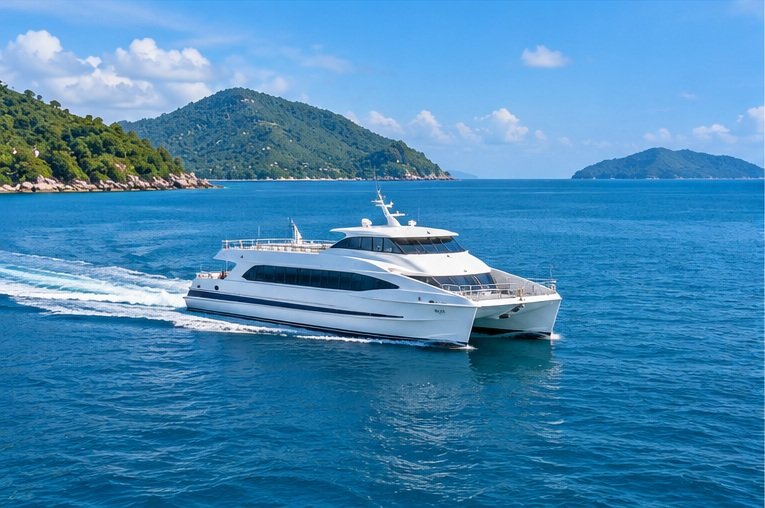
Koh Samui to Koh Phangan: Ferry Guide
Choose the right piers, compare the full transfer cost and connect the two islands without a last-minute rush.
The Koh Samui to Koh Phangan ferry journey is short enough to look effortless and varied enough to reward a little planning. The ticket may start at Pralarn, Bangrak, Nathon, your hotel or the airport. Meanwhile, arriving at Thong Sala is a different decision from arriving at Haad Rin. The useful comparison is therefore the entire route between two addresses, not simply the fastest crossing shown on a booking page.
For most visitors, the sensible starting point is a scheduled passenger service to Thong Sala with a clearly named Samui departure pier. Lomprayah's current published timetable includes several Samui terminals and different vessel types, while Haadrin Queen serves a separate Samui-Haad Rin connection. [1][4] Neither route should be selected from the island name alone. Choose the arrival that suits your accommodation, then examine the departure location and transfer cost.
This guide compares published operator information with booking-platform listings and separates those facts from editorial planning allowances. It does not promise that every published service is available on your travel date. All displayed fares and timetable examples were checked on 3 October 2026. Your issued ticket, reporting instructions and operator updates remain the authority for the journey you actually book.
Where you land
Match Thong Sala or Haad Rin to the accommodation.
A named terminal
Pralarn, Bangrak and Nathon are different locations.
Both road legs count
Compare like-for-like pier or hotel endpoints.
A realistic reporting margin
Read the current operator rule, not an old blog summary.
Koh Samui to Koh Phangan ferry options at a glance
Pick the destination pier before comparing the departure time
First locate your Phangan accommodation. Thong Sala and Haad Rin are not interchangeable arrival points, so a saving on the crossing can disappear into a longer onward transfer. Send the hotel your proposed pier and ask how they recommend reaching the property from there. A transfer quotation based only on 'the ferry' is too vague when different services use different landing places.
Next identify the most practical Samui terminal for your starting address. The time spent driving across Samui, waiting for check-in and reaching the room on Phangan can outweigh a small difference in the sea journey. This is why the options below are compared by whole-trip fit rather than ranked by fare or an unsupported claim that one operator is always fastest.
| Route choice | Useful when | Confirm first |
|---|---|---|
| Samui pier to Thong Sala | Your hotel transfer is practical from Thong Sala | Named Samui office, boat and Phangan collection. |
| Samui to Haad Rin | Your actual destination is the Haad Rin area | Haadrin Queen date, exact port and accommodation transfer. |
| Hotel or airport plus ferry | You want a defined road-and-sea arrangement | Coverage, pickup time, delay policy and end point. |
Swipe or scroll this table on a small screen. Route comparison checked 3 October 2026 using operator and reseller information [1][3][4].
Use a two-stage shortlist
Shortlist the route first and the individual sailing second. A convenient route with a slightly later departure can be better than an early sailing from a distant pier. Conversely, someone leaving a hotel beside a terminal may value a pier-only fare. Record the exact start and end point of each option so that transfers are neither omitted nor paid for twice.
Pralarn, Bangrak and Nathon are different terminals
Read the pier name all the way to the end
Pralarn, also written Pralan, is associated with the Mae Nam area; Bangrak is in the north-east; Nathon is on the west side. These separate Samui terminals appear in the operator's route information. [1] Some tickets use an operator name alongside the place name. Keep both parts when sending the address to a driver, because a broad neighbourhood label may not identify the correct counter or boarding point.
Do not let an old hotel message override the final voucher. Terminals and operating arrangements can change, particularly around weather disruption. Ask the seller to confirm the current meeting point when different documents disagree. A saved map pin is helpful, but it should come from the booking or operating company rather than an unrelated search result for a similarly named pier.
Compare the road leg honestly
Request a door-to-terminal transfer estimate from your accommodation using the actual departure time. Traffic, pickup circuits and a steep hotel access road can make a simple map estimate optimistic. Add the operator's reporting requirement after the road journey, not inside it. Your plan should identify when you leave the hotel and when you expect to reach the office, as two separate entries.
For a group, agree the luggage count as well as passenger numbers. A vehicle that accommodates four people may not comfortably carry four large cases. Ask about child seats or boarding assistance before payment. These details are easier to resolve when booking than outside reception with a departure approaching and an unsuitable vehicle waiting.
Thong Sala versus Haad Rin
Thong Sala as a general-purpose arrival
Thong Sala is the destination used by the scheduled route examples in this guide; booking pages identify it explicitly. [3] It is a sensible starting point for comparing onward transfers, but not a promise that every hotel is nearby. Ask your accommodation for the correct meeting arrangement and whether collection is included. A property in a more distant bay may need advance notice or a different vehicle.
When comparing fares, distinguish a pier arrival from an accommodation arrival. A combined ticket might continue by shared vehicle and therefore show a longer total duration. That does not make it a slower ferry. It means the product includes more of the journey, possibly with a pickup or drop-off circuit that a pier-only ticket excludes.
Haad Rin when the south-east is the actual destination
Haadrin Queen's own website identifies its Samui and Phangan ports and provides a date-based schedule search. [4] Consider this route when your accommodation or plans are genuinely around Haad Rin. However, confirm the vessel, exact Samui meeting point and sailing for your chosen day. Do not import a departure time from an old blog or from the reverse direction.
Haad Rin is not automatically the better arrival merely because a party is part of your visit. Check the accommodation address and your transfer arrangements. Equally, a traveller staying elsewhere should not assume that landing there provides the simplest island-wide connection. The right question is where you need to be after collecting your bags.
Read a ferry timetable without mistaking it for availability
Selected services from the operator's current publication
The examples below are from Lomprayah's timetable linked from its official website, marked effective 25 August 2026 and checked on 3 October 2026. They illustrate different terminals and vessel categories; they are not a live booking result or a complete daily departure list. Verify the sailing for your date and passenger details before building a connection around it. [1]
| Samui departure | Boat type | Departs / arrives | THB |
|---|---|---|---|
| Pralarn | Catamaran | 08:00 / 08:30 | 350 |
| Bangrak | Catamaran | 09:30 / 10:00 | 350 |
| Pralarn | Ferry | 11:00 / 11:30 | 250 |
| Nathon | Catamaran | 12:15 / 12:45 | 350 |
| Pralarn | Speedboat | 14:30 / 14:50 | 350 |
| Bangrak | Speedboat | 17:30 / 18:00 | 350 |
Swipe or scroll this table on a small screen. Source [1], linked operator PDF page 30, effective 25 August 2026; checked 3 October 2026. Selected published examples to Phangan, not guaranteed availability. Road transfers are additional unless specified.
A timetable can contain a route that a particular reseller does not offer for the date you search. Conversely, a booking site may display a combined transfer with an earlier starting time than the ferry itself. Compare the description and endpoints before deciding that two sources contradict each other. Where a difference remains unresolved, ask the operator rather than choosing the version that fits your plans best.
The last listed sailing is not a reliable rescue plan
Do not arrive on Samui assuming a late crossing will have space or operate in all conditions. Plan an overnight alternative if your flight is delayed beyond the usable connection. The cost of a room may be inconvenient, but it is a clearer contingency than depending on an unconfirmed night transfer after the scheduled service has finished.
For travellers already staying on Samui, a daytime departure with a comfortable hotel transfer is usually a practical choice. That is an editorial preference based on simplifying the journey, not a claim that a certain clock time is inherently safe. Your circumstances, operator instructions and conditions should decide the actual booking.
Separate the fare from the complete journey cost
A published ticket price is only one line of the budget
The timetable examples above show pier-to-pier fares, not the total cost from your Samui room to your Phangan room. Add the first road transfer, any baggage charge and the onward vehicle if they are not included. Use the final payment screen to check service charges and currency, rather than comparing only the first price displayed in a search result.
For illustration, a THB 350 fare plus an assumed THB 250 Samui transfer and THB 200 Phangan transfer gives THB 800 per person. The transfer figures are invented budget inputs prepared on 3 October 2026, not verified local quotations. Replace them with real prices for your addresses. The example shows why an apparently more expensive combined ticket can deserve a second look.
Compare a party total with another party total
Private vehicles are often quoted for the vehicle, while ferries and shared transfers may be per passenger. Divide or multiply consistently before comparing them. Two travellers sharing a car should not accidentally add its entire price twice. Similarly, a fare advertised for one person is not the price of moving a family, even when one child qualifies for a reduced rate.
Before payment, confirm the treatment of children, additional luggage and unusual equipment. Keep a record of the quotation when it differs from the standard booking page. A clear written answer is more useful than discovering at the pier that the seller and operator interpreted your request differently.
The booking details worth checking twice
Match the product to the journey you intend to take
Read the route from left to right. Does it begin at an airport desk, a hotel pickup or a ferry office? Where does it finish: Thong Sala, Haad Rin or an accommodation drop-off? In this listing, does 'transfer' describe a road vehicle, the ferry, or both? Take a moment to identify each stage rather than assuming that one confirmation covers everything between your hotels.
Next verify the traveller names and date, including the direction of travel. A return result can look very similar to an outward result on a small screen. Check whether the time shown is a pickup time or vessel departure, and note how early reporting is required. Save the final confirmation with its booking reference and contact information.
Use the seller and the operator for different questions
The booking seller handles its own payment, amendment and refund process. The operating company is usually the relevant source for boarding, pier changes and sailing status. Keep contact details for both when you buy through an intermediary. A hotel may help communicate, but it should not be expected to resolve an unreported ticket error at the last moment.
Send one specific question when a detail is missing: for example, whether the named hotel is inside the pickup area or whether a large suitcase incurs a charge. Avoid a vague request asking whether everything is included. A precise answer gives you something meaningful to compare with the confirmation and reduces misunderstandings on the travel day.
Allow for landing, luggage and the road to the pier
Flight arrival is the beginning of the connection
A plane's scheduled arrival does not tell you when you will be standing at the ferry office. Disembarkation, baggage collection, any applicable formalities and finding the vehicle all take time. Then comes the road journey and ferry reporting requirement. Work through those stages individually before choosing a sailing. Do not subtract only the crossing time from the afternoon and assume the connection is generous.
A combined airport-to-Phangan product can simplify arrangements, but read what happens when the flight is late. One transaction is not evidence of unlimited missed-connection protection. Ask how the pickup is identified, whether the driver monitors the flight and which later departure may be offered if the booked one is missed. Retain the written response.
Know when an overnight stay is the cleaner solution
Choose an overnight Samui stay when a late arrival would otherwise leave only a fragile connection. Staying near your actual next-day terminal can reduce the following morning's driving, but verify the location rather than booking any property described as near a pier. Keep food and basic overnight items accessible in your luggage so that the contingency is straightforward.
This decision is especially useful with children, mobility needs or bulky bags. The question is not whether somebody has once made the connection more quickly. It is whether your particular party can reasonably handle a delay without losing the first Phangan night or accepting an unsuitable transport option under pressure.
Report to the office before joining the boarding queue
Follow the current reporting rule
Lomprayah's published terms currently require passengers to arrive at its office at least 60 minutes before departure. [2] Checked 3 October 2026, this is stricter than some older summaries describing shorter check-in margins. Follow the current operator and voucher instructions, and clarify any conflict beforehand. Other companies may have different procedures; do not transfer one operator's rule to every ticket.
Have the booking reference and required identification ready, with the confirmation available offline. Keep the whole party together until you understand the process for tickets, stickers or luggage labels. Joining a visible queue is not necessarily the same as checking in. Ask staff to confirm the direction and destination if several sailings are being prepared at once.
Leave yourself time to correct a small problem
Early reporting gives space to resolve a misspelt name, locate the right desk or ask about a changed pier. It also allows a toilet stop and a check that everyone has essential items outside the checked bags. None of these tasks should be attempted while the gangway is being prepared for departure.
When staff direct you towards boarding, keep travel documents, money and medication in a small personal bag. Check that luggage labels match the destination and collect all bags after arrival before leaving the unloading area. A short crossing can still involve hurried baggage handling at both ends, so a distinctive tag and a quick bag count are worthwhile.
Understand the allowance before arriving with a large case
Published allowance versus what your ticket includes
Lomprayah's current terms permit large luggage up to 20 kilograms and list a THB 200 charge above that weight, checked 3 October 2026. They also distinguish small personal items and certain sports equipment. [2] Confirm how your actual pieces are treated, particularly when travelling with diving equipment, oversized bags or more than one substantial case. Do not assume an airline allowance transfers to the ferry.
Other operators may apply different rules, and a combined ticket can include a road vehicle with its own capacity limits. Provide both dimensions and weight when an item is unusual. 'One bag' could mean a small backpack or a large hard-shell case, which is not enough information for a useful answer about storage.
Pack for handling and spray, not an underwater expedition
Keep the suitcase easy to identify and secure loose straps before handing it over. Put valuables and essential documents in a bag you retain, while protecting them from spray during boarding. A luggage cover may help with dirt and splashes, but check that it does not hide a tag or catch on steps. Never rely on packaging claims as a reason to leave electronics exposed.
Catamaran, ferry and speedboat are not identical experiences
Compare facilities rather than marketing labels
The published schedule differentiates vessel types. [1] Before choosing, ask about seating, shade, toilets, boarding steps and where large bags are stored. A boat described as fast or premium does not establish the facilities needed by your party. Likewise, a short crossing is not automatically comfortable for someone who has difficulty with motion or moving between levels.
For travellers concerned about seasickness, discuss suitable preparation with a pharmacist or clinician before travelling. This guide does not recommend a particular medicine or dose. Tell the crew when someone needs assistance and follow their seating instructions. Avoid assuming that an open deck, particular seat or specific boat shape can guarantee a motion-free journey.
Keep the boarding process simple
Wear footwear that stays on and keeps your hands free for support. Pack the items needed during the crossing in one small accessible bag rather than repeatedly opening a suitcase. When carrying a child or helping another traveller, agree who handles the remaining luggage before reaching the gangway. Do not create a last-second balancing problem with bags, drinks and a phone.
Follow crew instructions about movement on board, lifejackets and accessible areas. The brief duration of the crossing is not a reason to ignore them. An attractive view will still be there after everyone is seated and equipment is secure; a photograph does not need to be taken while stepping between a moving boat and the pier.
Ask about the actual boat and vehicle
Families and travellers requiring assistance
For children, confirm the fare using the child's age on the travel date and ask separately about the road transfer seat. Lomprayah's online age wording overlaps at age eleven, so obtain a clear quotation rather than resolving that ambiguity yourself. [2] A discounted ferry ticket does not by itself explain whether a dedicated vehicle seat or suitable lifejacket is provided.
People needing mobility assistance should ask about the gangway, steps, movement between decks, toilet access and luggage help. A ferry terminal can have different boarding arrangements from a large international passenger port. Request practical details from the operator for the intended sailing, and confirm the land-transfer vehicle as well. One accessible stage does not make the entire journey accessible.
Pets, sporting equipment and hired vehicles need separate approval
Do not assume that an ordinary passenger booking covers a pet, bicycle, surfboard or vehicle. Policies can differ between boats and between the road and sea portions of a combined journey. Obtain written confirmation for the exact service, including the item, dimensions, restraint or packaging requirements and additional charge. The booking category should reflect what you are bringing.
A hire car or scooter creates a second permission issue: the rental agreement and insurance. This guide's sample tickets are passenger products and do not establish vehicle space. Discuss an authorised route with the rental company and ferry operator before making arrangements. Leaving a vehicle on Samui and arranging transport on Phangan may be simpler than attempting an unapproved crossing.

Check sailing status, not only the forecast icon
A short crossing still depends on conditions
Use the Thai Meteorological Department's southern east-coast and marine guidance, then confirm the departure with the operator. [5] Local rain at your hotel does not describe the entire crossing, and a blue patch of sky does not settle conditions offshore. Follow official restrictions and crew decisions. Do not search for a private boat solely to bypass a cancellation or safety warning.
Keep the accommodation informed if weather affects your arrival. Ask when reception closes and whether a later transfer can still be arranged. A ferry change can ripple into a hotel pickup, room access and an evening meal. Contacting the property early gives more options than arriving late with everyone expecting the original plan.
Have an overnight fallback that you can actually use
Set aside a way to pay for an additional room and keep basic items accessible. Save the details of a suitable area to stay, but avoid booking several non-refundable backups unnecessarily. The aim is a workable response to disruption, not an expensive stack of overlapping reservations. Review the cancellation conditions of the Phangan room as well as those of the boat.
A timetable alteration is not a personal failure to plan. The useful measure is whether you can respond without losing documents, accepting an unsafe option or being unable to contact the next accommodation. Protect those basics and revise the rest of the day once the operating situation is clear.
Distinguish voluntary changes from operator disruption
Read the terms attached to your purchase
Lomprayah's published terms contain amendment conditions and describe tickets as non-refundable for voluntary cancellation; they also limit responsibility for missed onward flights or trains. [2] A reseller may have its own service conditions. Read both where relevant and save the version that applies to your booking. Do not assume a flexible hotel booking gives the ferry the same flexibility.
When you need to change a trip, contact the original seller with the booking reference, desired alternative and passenger details. Ask about the deadline, any additional payment and when a revised confirmation will be issued. Until the change is confirmed, keep the original arrangement in mind rather than treating a sent message as a successful amendment.
Preserve evidence without promising a particular outcome
If a sailing is cancelled or materially changed, ask the operator and seller what options apply to that event. Keep messages, receipts and the explanation provided. An operator cancellation, a voluntary change and a missed check-in are different situations, so the outcome should not be inferred from another traveller's experience.
Travel insurance may be relevant, but coverage depends on the policy and circumstances. Check the policy directly rather than assuming any delay creates a claim. This article explains the planning questions, not your legal entitlement to compensation. Clear records and early contact are the practical steps you can control when the travel day changes.
Get from the pier to the correct accommodation
Confirm the pickup before leaving Samui
Send your Phangan accommodation the operator, arrival pier and expected time. Ask for the meeting point, driver identification and the total transfer price when it is not included. The phrase 'we can arrange a taxi' does not necessarily mean a vehicle has already been reserved. Request confirmation if you are relying on collection, especially for a late or less convenient arrival.
Once ashore, collect every bag before leaving the unloading area. Follow the agreed meeting process rather than accepting the first person who approaches. If the boat is late, message the property as soon as practical. A calm check against the saved details is more effective than repeatedly moving between vehicles with your luggage.
Keep the rest of the day light
Treat arrival on Phangan as the start of settling in, not the moment a full sightseeing afternoon must begin. Room availability, a shared transfer circuit or a needed meal can absorb the remaining time. Keep anything prepaid for later in the day comfortably separated from the advertised ferry arrival, or choose the following day instead.
For a remote accommodation, ask about food on arrival and the final approach to the room. A vehicle drop-off may still be followed by steps or a path. Knowing this in advance helps you pack the small bag sensibly and arrange assistance where needed, rather than discovering the difficult part after the main journey has finished.
Plan the transfer around rest, not just the event
Book the whole sequence for a party visit
When an event is central to the trip, verify its date separately before reserving transport. Then book the arrival pier, accommodation and any onward transfer as one coherent plan. A party ticket or hotel booking does not reserve ferry space. Likewise, being on the right island does not remove the need to reach the event area from your accommodation.
Do not make an overnight party depend on an unconfirmed late return crossing. Establish the actual service, meeting point and conditions in advance, or stay on Phangan. The same care applies the next morning: allow time to sleep, eat, pack and reach the pier. An early onward departure can be a poor fit for the night you have planned.
Separate accommodation choice from the event name
A room close to the event may suit someone who prioritises easy access, while another traveller may prefer distance and an arranged transfer. Decide explicitly. Check noise expectations and checkout time, especially if you intend to recover before moving on. An attractive late checkout is only useful when it fits a confirmed ferry and the rest of the journey.
For groups, nominate one person to keep the transport details, but share the actual voucher with everyone. Phones can run out of charge or become separated from their owners. A common saved meeting point and a clear departure agreement make it easier to stay together without turning the transfer into a series of last-minute negotiations.
Do not let a short crossing create a fragile onward route
Continuing to Koh Tao
For onward travel to Koh Tao, compare a through arrangement with separate island stays rather than assuming every boat continues in the way you need. Check whether passengers change vessels and whether your baggage is transferred. A stop at Phangan and a stay on Phangan are different products. The confirmation should make clear which one you purchased.
When spending several nights on Phangan, book the onward ferry around checkout and a realistic road transfer. Do not automatically choose the earliest service. A departure that allows you to rest and reach the pier comfortably can be the better use of the day, even if it arrives on Tao a little later.
Returning to Samui for a flight
For the reverse journey, check the Samui arrival terminal and allow the road transfer and airline deadline separately. Bangkok Airways publishes airport check-in information; it is not a guarantee that a ferry connection will work. [6] For an important flight, returning to Samui the previous day is a more conservative option than assembling the tightest possible same-day connection.
Do not rely on the outward timetable to plan the return. Different directions can have different sequences and stopping patterns. Save a separate confirmation for each leg, and recheck the later journey near its date rather than assuming nothing will change while you are away.
Keep communication and essentials with you
Make the important details available without a signal
Download the ticket, operator contact, hotel address and pickup instructions before leaving reliable Wi-Fi. A mobile data plan can make coordination easier, but check device compatibility, activation and whether ordinary voice calling is included. A map link that requires a connection is less useful than a saved image when you need to show the correct terminal to a driver.
Carry enough accessible payment options for an unexpected transfer or room rather than placing every card in the main case. Keep required medication and identification with you during boarding. The small personal bag should contain what you need if the luggage stack is temporarily inaccessible, not another collection of items you will never use during the crossing.
Keep the kit small enough to handle safely
Bring drinking water, sun protection and a light layer according to the conditions and your chosen vessel. Avoid carrying several loose items when stepping aboard. A single secure bag leaves a hand free and makes it easier to assist a child or companion. Follow the crew's instructions about where to place it after boarding.
Check the seating and bag area before disembarking. Phones, glasses and travel documents are easy to leave behind when everyone focuses on the large suitcase. Give one person responsibility for counting the bags, then verify that each traveller has their personal essentials before leaving the pier. That final pause is simpler than recovering something after the boat departs again.
Pier-only ticket or combined transfer?
Where a pier-only booking works well
A pier-only ticket suits travellers who already have a convenient way to reach the correct terminal and a clear onward plan. It separates the costs and gives control over the road vehicles. For someone staying near the departure point, paying for an additional pickup circuit may add little value. The simpler ticket can be the right choice when its missing stages are genuinely solved.
The trade-off is coordination. You must allow the reporting margin and manage delays between independently booked stages. A driver running late does not automatically make the ferry wait. The saving therefore needs to be worthwhile after considering the extra responsibility, particularly for a group with luggage or specific assistance needs.
Where a combined ticket earns its extra cost
A combined product can reduce booking administration and provide a defined handover from road vehicle to boat. It is useful when pickup coverage fits your accommodation and the final drop-off is the place you need. Read the route carefully: a combined service with a long collection circuit may be convenient without being the quickest door-to-door option.
Neither format removes weather risk or guarantees compensation for a missed separate flight. Choose according to the stages actually included and the support promised in writing. The strongest booking is not necessarily the one with the fewest confirmations; it is the one whose responsibilities, timings and endpoints you understand.
What most often turns an easy crossing into a difficult day
Going to the right area but the wrong pier
Keep the full operator and terminal name in your transport messages. Do not send a driver a generic 'Samui ferry pier' search result or assume the previous hotel's advice still matches a new ticket. When a pier changes, confirm both the new location and the reporting time. An instruction to use a different terminal may require an earlier road departure.
Another error is confusing arrival on Phangan with arrival at the hotel. Count disembarkation, luggage and the road transfer. An excursion scheduled shortly after the boat lands can be unworkable even when the crossing is punctual. The ferry is one stage of a transfer day, not the entire day measured from one reception desk to another.
Trusting an old schedule or an incomplete fare
Use dated operator information for research and a confirmed booking for the actual journey. Generic route summaries, search snippets and another traveller's screenshot are not a ticket. Likewise, inspect the final cost with luggage and transfers before declaring the cheapest sailing the cheapest journey.
Do not leave a critical question until check-in. Child fares, mobility assistance, pets and oversized equipment need specific confirmation. Finally, keep a viable overnight alternative for a late flight or disrupted sailing. An easy backup prevents pressure to accept an unsuitable solution simply because the original plan had no room for change.
Samui to Phangan ferry FAQs
How long does the crossing take?
The published examples in this guide include approximately 20-30 minutes at sea, depending on the terminal and vessel. Other products can take longer, particularly when they include road transfers. [1][3] Add reporting, boarding, luggage collection and the journey at each end before estimating the hotel-to-hotel time. A short crossing does not make a one-hour complete transfer realistic.
Which Samui pier should I use?
Choose the pier that fits your starting address and the arrival you need on Phangan, then compare the dated sailings. There is no single terminal that is automatically best for every visitor. Check the full pier and operator name on the final confirmation and send that to your driver. The most convenient island district is not always the exact place your boat uses.
Can I go directly from Samui Airport to Phangan?
A combined road-and-ferry booking may be available, but confirm the meeting point, included stages and response to a delayed flight. [1] Landing time is not ferry check-in time. Allow for baggage and the road journey, then add the operator's reporting margin. For a late arrival, a Samui overnight stay may be the more practical arrangement.
Is Haad Rin the same arrival as Thong Sala?
No. They are different Phangan arrival points and can lead to different onward transfers. Haadrin Queen publishes its own Samui-Haad Rin port information. [4] Choose according to your accommodation, not only an event name or the shortest advertised crossing. Ask the hotel to confirm the transfer from the pier you are considering.
Do I need to print the ticket?
Follow the instructions attached to your booking. Keep a readable offline copy and the required identification even where a mobile confirmation is accepted. Do not assume every company uses the same check-in process. A charged phone and accessible booking reference help, while a backup copy can be useful when more than one traveller depends on the same device.
Can I take the final ferry before a flight connection?
A tight ferry-to-flight connection is not a dependable way to protect an important departure. Add the correct Samui road transfer and airline deadline, then consider what happens if the sailing changes. A previous-day return is more conservative. The operator's published terms do not provide general reimbursement for missed onward flights. [2]
Choose two correct endpoints and a comfortable margin
Start with your Phangan accommodation, choose Thong Sala or Haad Rin accordingly and then select a convenient Samui departure. Compare the complete cost, including both road journeys, rather than buying the lowest displayed fare. Save the final voucher, report according to the current operator instructions and keep the arrival afternoon light.
A well-chosen ferry ticket should make the island change straightforward, not force every other part of the day to fit an optimistic crossing time. When a flight arrives too late or conditions disrupt the service, use the overnight alternative. The short sea journey is the easy part once the two ends of the route have been planned properly.
Sources and fact-checking notes
The timetable table uses selected entries from the operator PDF, not live seat availability. Haadrin Queen is treated as a distinct Haad Rin option. Illustrative transfer sums are marked as assumptions, not quotations. Child-age wording and conflicting reporting instructions should be clarified directly before paying.
- Lomprayah – official timetable and linked 2026 publicationOperator timetable; selected examples only, checked 3 October 2026. Consult the latest linked edition and your ticket.
- Lomprayah – Terms of ServiceOperator reporting, baggage, child-ticket and amendment conditions, checked 3 October 2026. Ticket-specific clarification takes priority where wording is ambiguous.
- 12Go – Koh Samui to Koh PhanganReseller route and endpoint information. Search results are date-dependent and not a complete operator timetable.
- Haadrin Queen – ports and schedule searchOperating company port information and link to its date-based schedule. No unverified fixed departure times are copied.
- Thai Meteorological Department – regional and marine forecastOfficial live forecast resource. Recheck for the travel date; this article does not reproduce a forecast as an evergreen guarantee.
- Bangkok Airways – check-in informationAirline reporting guidance. Verify the airport and flight-specific deadline.
Illustrations in this article were created for Taylor’s Trailblazing Travels. Third-party photographs, where used, are credited beside the image or in the source list.