Phuket vs Koh Samui 2026: Which Island Is Better?
Weather, beaches, flights, costs, nightlife and day trips compared — with a practical verdict for your month and travel style.
Phuket and Koh Samui can both deliver the classic Thai island holiday, yet they solve different planning problems.
Phuket gives you the widest range of flights, hotels, beaches and excursions. It also feels larger, busier and more like a collection of separate resort towns. Koh Samui is easier to understand as one island circuit, with a strong resort and wellness identity, although flights and private transport can cost more.
The biggest practical difference is weather. Phuket faces the Andaman Sea; Samui sits in the Gulf of Thailand. Their rainfall peaks do not arrive at the same time, so a recommendation that ignores your month is incomplete. This guide starts with season and access, then compares the ordinary details that shape the holiday: where you will eat, how often you will need a taxi, whether the beach is suitable on the day and what remains enjoyable when a boat trip is cancelled.
Best all-round first trip
Phuket, for wider flights, hotels, transport and weather-proof alternatives.
Best summer first check
Koh Samui, especially for many June-to-August beach holidays.
Best for nightlife and choice
Phuket, led by Patong and a much broader island-wide scene.
Best for a resort rhythm
Koh Samui, when the hotel, beach and evening area work together.
Phuket vs Koh Samui: the short verdict
The most useful default
Phuket is the safer all-round recommendation when you have not yet fixed the month, airline or exact holiday style. Its larger airport, broad accommodation market and range of developed beach towns give you more ways to recover from an expensive flight, a poor-weather day or a mixed group with different interests. You can choose nightlife in Patong, a conventional beach base in Kata or Karon, family-friendly resort areas around Kamala and Bang Tao, or a quieter airport-side stay at Nai Yang.
Koh Samui wins when the holiday brief is more specific. It works particularly well when a direct flight is affordable, the trip falls in a useful Gulf weather window and the group wants a resort-led week rather than a large catalogue of competing districts. Bophut, Choeng Mon and Mae Nam can create a calmer evening rhythm, while Chaweng supplies the island’s main nightlife and retail centre.
Karen’s four-question decision shortcut
- Which island has the stronger historical weather pattern for the exact month?
- Can you reach one island directly without losing most of a day?
- Which named beach area supports the evening you actually want?
- After adding flights and local transport, which complete trip still fits the budget?
When one answer is decisive, stop comparing hotel pools. A slightly less impressive room on the right coast and in the right neighbourhood normally produces the easier holiday.
Phuket vs Koh Samui at a glance
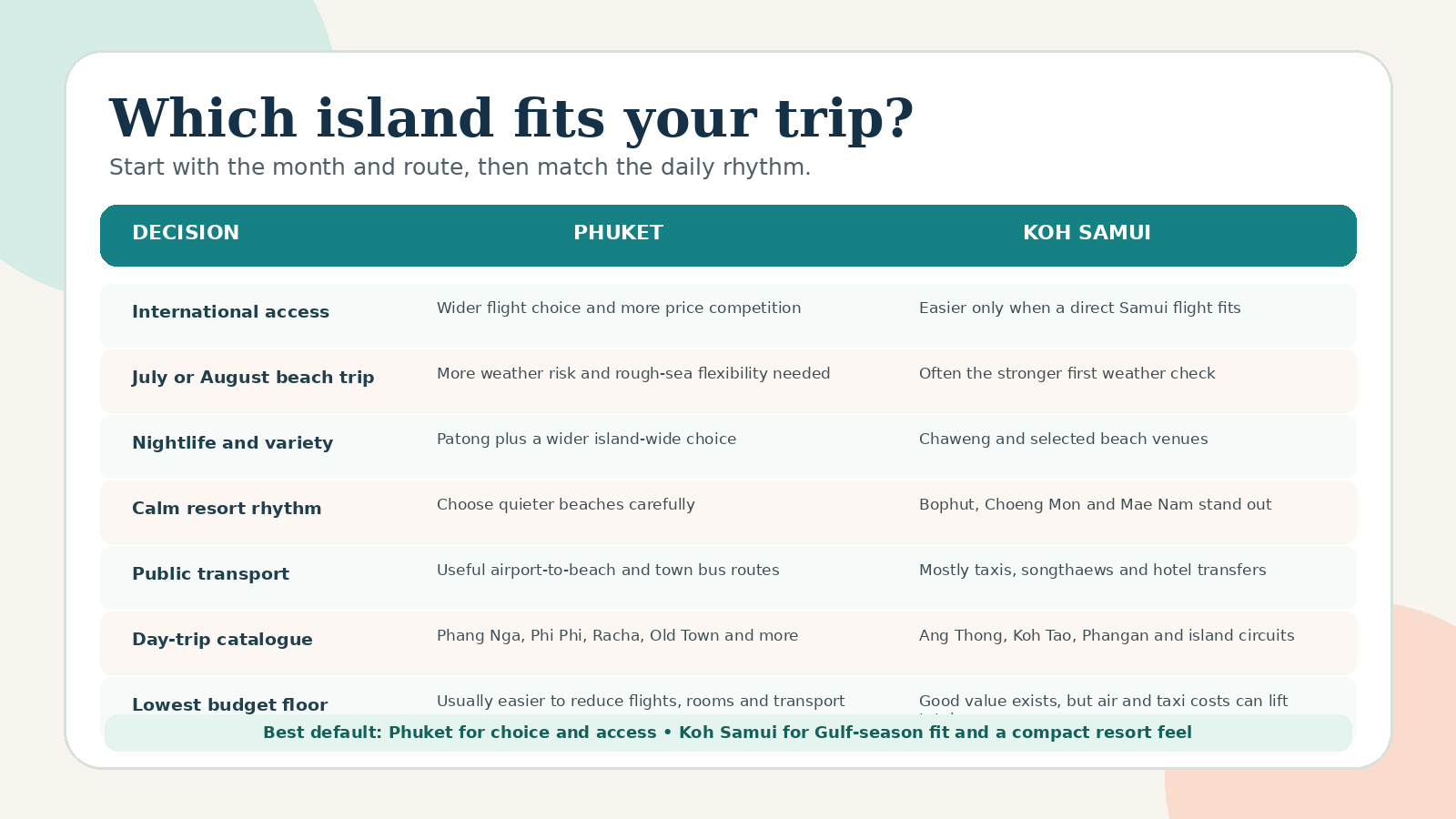
This table is a first filter rather than a scorecard. “Phuket” can mean a quiet Mai Khao resort or a room beside Bangla Road; “Koh Samui” can mean lively Chaweng or a secluded Taling Ngam property. The exact beach and hotel may reverse an island-level result.
| Question | Better starting point | Reason |
|---|---|---|
| Overall first-trip default | Phuket | More ways to match flights, budgets and different traveller needs. |
| International and regional air access | Phuket | A larger airport and broader route competition. |
| Compact resort-island feel | Koh Samui | One main island circuit and a strong resort/wellness identity. |
| Nightlife | Phuket | Patong plus a larger range of late bars, shows and clubs. |
| Quiet couples’ base | Koh Samui, slight edge | Bophut, Choeng Mon, Mae Nam and quiet west-coast stays. |
| Public transport | Phuket | Airport-to-beach, town-to-Patong and Old Town services. |
| Day-trip variety | Phuket | More marine, bay, cultural and inland choices. |
| Access to Koh Tao and Koh Phangan | Koh Samui | Direct Gulf ferry network. |
| July or August beach planning | Often Koh Samui | Historical rainfall is usually lower than Phuket in these months. |
| November to February first trip | Often Phuket | Strong Andaman season and extensive flight/hotel choice. |
| Lowest budget floor | Phuket | More low-cost flights, rooms and public transport. |
| Families | Draw | Hotel design, beach access and transfer length matter more than the island label. |
| Wellness and resort time | Koh Samui, slight edge | A mature villa, spa, yoga and resort market. |
| Mixed-interest group | Phuket | More separate districts and non-beach alternatives. |
The category that should outrank everything else
If the trip is built around swimming, snorkelling or boat days, weather and sea conditions come first. If the holiday is a short break, direct access may matter more. For a long resort stay, the hotel’s location, restaurant access and pool are likely to outrank the number of excursions.
Where the comparison is genuinely a draw
Both islands can suit families, couples, solo travellers and luxury holidays. Neither is universally quieter, cheaper or more beautiful. Those outcomes depend on the district, room, travel dates and transport habits. Treat sweeping claims such as “Samui is peaceful” or “Phuket is too busy” as incomplete until the writer names the beach.
Weather and the best month for each island
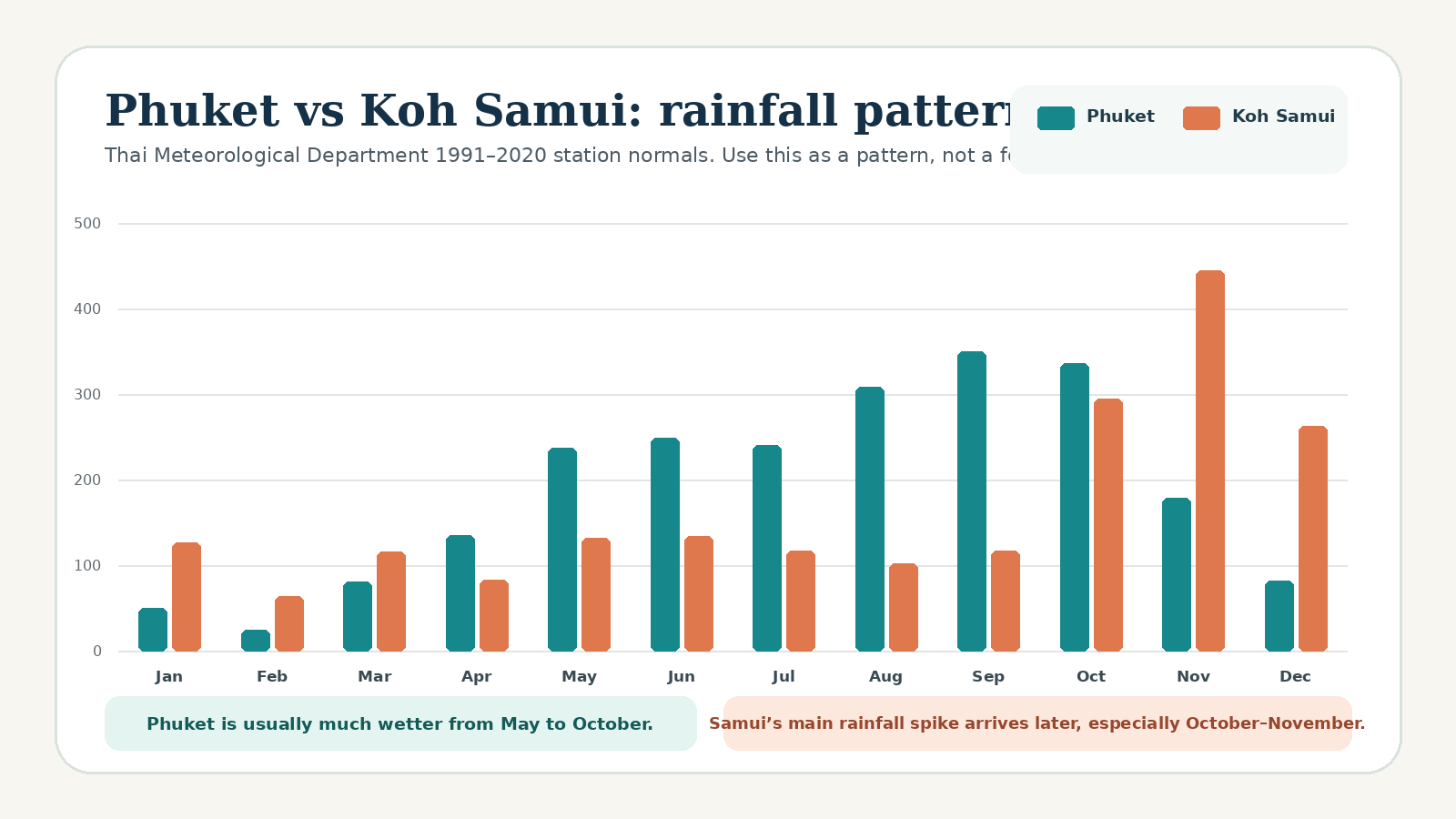
The Thai Meteorological Department’s 1991–2020 station normals explain why the two islands cannot share one “best time” label. Phuket’s rainfall pattern rises strongly from May and remains high through October. Ko Samui is comparatively useful through much of the European summer, then records its largest rainfall totals in October and November. [3]
Month-by-month first choice
| Month | First island to check | Planning interpretation |
|---|---|---|
| January | Either; price Phuket first | Both can work. Phuket rainfall normal 49.9 mm; Samui 126.8 mm. Peak demand can matter more than rain. |
| February | Phuket, slight edge | The driest climate-normal month at both stations: Phuket 24.0 mm and Samui 64.3 mm. |
| March | Either | Hotter weather; Phuket’s normal rainfall remains below Samui’s, but both are credible beach choices. |
| April | Either with heat planning | Transition month. Samui’s station normal is lower, while Songkran and heat can affect price and pace. |
| May | Koh Samui first | Phuket’s southwest-monsoon pattern strengthens and its normal rainfall rises sharply. |
| June | Koh Samui | Samui normal 133.6 mm versus Phuket 249.4 mm; still check wind and local sea conditions. |
| July | Koh Samui | Samui normal 117.0 mm versus Phuket 240.2 mm. School-holiday demand may raise fares. |
| August | Koh Samui | Samui normal 102.2 mm versus Phuket 308.7 mm. Neither figure guarantees a dry week. |
| September | Koh Samui, cautiously | Samui remains lower in the station normals, while the Andaman side is still wet and sea plans need flexibility. |
| October | No automatic winner | Phuket begins transitioning; Samui’s late-year rainfall rises. Keep bookings flexible. |
| November | Phuket | Phuket’s normal drops to 178.2 mm while Samui peaks at 444.6 mm. |
| December | Phuket, usually | Phuket’s normal is 82.0 mm; Samui remains wetter historically at 263.1 mm. |
Phuket’s Andaman pattern
Phuket is usually easiest from roughly November into April, when the Andaman coast has its broadest calmer-season case. From May onwards, heavier rainfall, surf, currents and cancelled small-boat trips become a larger part of planning. The island does not shut down: hotels, restaurants, Old Town and many attractions continue, and a flexible traveller may find good room value. However, a low-season booking should include a strong pool, non-beach alternatives and a willingness to abandon a sea plan without resentment.
Never turn a monthly guide into permission to ignore a red beach flag. West-coast swimming conditions change quickly, and local safety instructions outrank a forecast app or the behaviour of other swimmers. TAT’s Phuket information and the live TMD marine outlook provide context, but the lifeguard on the beach makes the practical decision. [4] [12]
Koh Samui’s later wet-season peak
Samui’s weather advantage is not “dry all summer”. It is a different rainfall distribution. June, July and August have much lower climate-normal totals than the same months in Phuket, which is why Samui often becomes the stronger first check for a school-holiday beach trip. By contrast, October and November are historically much wetter. December can still be unsettled before the clearer early-year pattern returns.
Sea conditions around Samui, Ang Thong, Koh Phangan and Koh Tao still vary with wind and storms. A sunny breakfast at the hotel does not guarantee a comfortable open-water crossing. Keep at least one flexible day and avoid placing a weather-dependent boat trip immediately before a separate flight.
Flights, airports and arriving without wasting a day
Why Phuket is usually easier to reach
Phuket International Airport serves a much wider set of domestic and international routes. That does not guarantee a cheap fare, but it normally gives travellers more combinations and more competition. The practical downside appears after baggage reclaim: Phuket is long from north to south, and the drive to Kata, Karon, Nai Harn or Rawai can be slow in traffic. A low-cost flight that lands late may also remove the bus option and increase the airport-transfer cost.
AOT lists airport buses, the Phuket Smart Bus, public vans, taxis, app pickup points and car rental as current transport choices. [5] Check the actual service and hotel stop on the travel date rather than assuming every bus serves every beach.
Why Samui can feel wonderfully easy — at a price
Samui International Airport sits close to Chaweng, Choeng Mon and Bophut. Bangkok Airways confirms that it operates the airport, whose open-air layout is part of the arrival experience. [7] When the flight and hotel fit, you can move from aircraft to resort quickly and avoid a ferry altogether.
The price comparison changes when the direct fare is high. A mainland alternative may combine a flight or train to Surat Thani, road transport to Donsak and a car ferry to Nathon or Lipa Noi. Seatran’s booking results checked in September 2026 showed the Donsak–Nathon passenger crossing at 200 THB and about 1 hour 30 minutes. [8] That figure covers the sailing, not the airport, station, pier check-in or final hotel journey.
| Access question | Phuket | Koh Samui |
|---|---|---|
| Airport character | Large AOT airport with a broad domestic and international network | Small resort-style airport operated by Bangkok Airways |
| Best advantage | More route competition and easier long-haul/regional combinations | Very quick arrival when a direct flight and north-east hotel align |
| Main compromise | Long road transfers to southern beaches and traffic variability | Direct fares can be high; alternatives involve mainland road and ferry legs |
| Budget alternative | Low-cost domestic flights and buses from the airport | Fly/train/bus to Surat Thani, transfer to Donsak, then ferry |
| Typical airport-to-base planning | About 20–100 minutes depending on beach and traffic | About 10–45 minutes for many north/east bases; longer to west/south |
| Changing islands | Direct flight or most of a day by road and ferry | Direct flight or ferry/road chain back across southern Thailand |
Price the door-to-door route
Compare baggage allowance, airport transfer, pier transfer and arrival time together. A £40 saving is poor value when it creates two extra hand-offs, a late hotel arrival and no margin for delay. Conversely, a couple travelling slowly may prefer the mainland route to Samui and use the saving for several nights of accommodation.
Getting around Phuket and Koh Samui
Phuket’s public-transport advantage is real but limited
Phuket Smart Bus currently promotes three routes, including the airport–Patong–Karon–Kata–Rawai spine. Its 2026 site lists the main airport route at 100 THB, the town-to-Patong route at 50 THB and a free Old Town shuttle. [6] Those fares and timetables can change, and traffic can make a scheduled journey late. Even so, the network gives a solo traveller a genuine alternative to paying for every airport or beach transfer.
The bus is most useful when the hotel sits close to a stop and the traveller has time. It is less useful for a late arrival, a family carrying several cases, a hillside property or a connection that cannot tolerate delay. Ask the hotel for the nearest stop name, then check live tracking before setting out.
Samui rewards a well-positioned hotel
Samui has shared songthaews, taxis, private drivers and hotel vehicles, but visitors should not build a tight itinerary around a single assumed fare or timetable. A central Bophut, Chaweng or Lamai room can remove several daily rides; a beautiful remote villa may require a pre-arranged vehicle for every dinner.
For budgeting, allow roughly 800–1,500 THB per day for a couple using two or three private rides on either island, with Samui more likely to sit near the upper end. This is a planning allowance, not a quoted tariff. Long cross-island journeys, airport pickups, late-night rides and large vehicles can cost more.
| Getting around | Phuket | Koh Samui |
|---|---|---|
| Public bus | Useful. Route 1 links the airport with Patong, Karon, Kata and Rawai; other current services cover town connections. | Limited as a complete visitor network; shared songthaews may help on main roads. |
| Taxis and app cars | Wider vehicle competition in many developed areas, though traffic affects price and time. | Convenient but often a larger share of the daily budget. |
| Private driver | Good for a south-coast/Old Town circuit or a group. | Good for a waterfall, temple and beach circuit, especially with children. |
| Walking | Works within a chosen beach town; not between districts. | Works in parts of Chaweng, Bophut or Lamai; not around the whole island. |
| Scooter | Only for licensed, insured, experienced riders. Traffic can be intense. | The ring road looks simple, but hills, rain and junctions still demand experience. |
Do not let a cheap room create an expensive week
Before booking, map the hotel against three real journeys: airport arrival, the most likely evening area and the main excursion pickup zone. Add the likely transport cost to the room total. A central room that costs 500 THB more each night can still be better value when it removes two taxis and an hour of travel every day.
Beaches and the best areas to stay
Phuket has more beach towns and more obvious contrasts. Samui is smaller, yet its coasts still create very different holidays. The right comparison is not “Phuket beach versus Samui beach”; it is “Kata versus Bophut”, “Bang Tao versus Choeng Mon” or another pair that matches the same traveller.
Phuket: choose a town, not merely a shoreline
Patong is the honest choice when nightlife, shopping and convenience are central. Kata and Karon are easier conventional first bases. Kamala softens the intensity for families, Bang Tao supports resort and dining-led stays, and Nai Yang makes a low-stress first or final night near the airport. The quieter southern and northern beaches can be rewarding, but they usually increase transport dependence.
Phuket’s west coast also needs a live swimming decision. During the wetter season, surf and currents can change a beautiful beach into a shoreline-only day. The detailed Taylor’s Trailblazing Travels Phuket beach guide compares twelve areas and emphasises local flags, guarded zones and exact hotel access. [15]
Koh Samui: match the ring-road base to the evening
Chaweng has the broadest nightlife, shopping and restaurant choice. Lamai offers a smaller beach-town balance. Bophut is attractive when dinner and a walkable evening matter more than the best swimming beach directly outside the room. Choeng Mon often suits family resort stays, while Mae Nam, Lipa Noi and Taling Ngam become progressively slower and more transport-dependent.
A “quiet Samui villa” may be perfect for travellers who want breakfast, pool, sunset and an early dinner at the property. It can be frustrating for a group expecting to walk to ten restaurants. Ask how long the real road journey takes after dark and whether the hotel vehicle operates at the times you will use it.
| Area | Best for | Everyday feel | Main compromise |
|---|---|---|---|
| Patong, Phuket | Nightlife, shopping and maximum convenience | Lively, dense and commercial | Noise, crowds and a less relaxed beach identity |
| Kata, Phuket | First-time couples and families | Busy but manageable beach town | Peak crowds, hills and seasonal surf |
| Karon, Phuket | Long beach and an open resort strip | More spacious than Kata | Area is spread out; hotel position changes the walk |
| Kamala, Phuket | Families and quieter evenings | Village-resort compromise | Less nightlife; some hotel-to-beach road crossings |
| Bang Tao, Phuket | Resorts, villas and polished dining | Long, varied and upmarket in sections | Transport often needed between beach, hotel and restaurants |
| Nai Yang, Phuket | Airport stop and low-key northern stay | Shaded, relaxed and convenient | Far from southern sights and nightlife |
| Chaweng, Samui | Nightlife, shopping and first-time convenience | Samui’s busiest centre | Noise and traffic vary sharply by section |
| Lamai, Samui | Beach-town balance | Lively without full Chaweng intensity | Long layout; not every hotel is close to the useful centre |
| Bophut, Samui | Couples, families and walk-out dinners | Dining-led evenings around Fisherman’s Village | Beach quality varies by section; can be premium-priced |
| Choeng Mon, Samui | Family resort stay and shorter airport access | Compact, calmer and resort-oriented | Smaller independent dining choice |
| Mae Nam, Samui | Slower stays and value-conscious couples | Relaxed north-coast rhythm | Evening options are dispersed |
| Taling Ngam/Lipa Noi, Samui | Quiet sunsets and resort seclusion | Remote, scenic and slow | Private transport and hotel dining become central |
Beachfront, beach access and sea view are different
Read the property map at street level. A sea-view room can sit high above the road; beach access can involve steps or a public lane; beachfront may still place the room at the rear of a large resort. Families, travellers with reduced mobility and anyone carrying beach equipment should confirm the actual route rather than relying on one listing label.
Atmosphere, food and nightlife
Phuket feels like several holidays joined by traffic
Phuket’s size is both its strength and its complication. One day can combine Old Town architecture, a southern viewpoint and a beach dinner; another can remain entirely inside a resort area. The island is better for mixed groups because separate districts can satisfy nightlife, shopping, family pools, local food and quiet resort time. However, travelling between those districts often takes longer than the map suggests.
Patong dominates the nightlife comparison. It provides the largest concentration of late bars, clubs, shows and 24-hour energy, while Kata, Karon, Bang Tao and Old Town offer more moderate evenings. Travellers who want sleep should inspect recent reviews for street noise, construction and beach-club music rather than assuming distance in metres tells the whole story.
Samui’s evening identity changes by coast
Chaweng is the closest equivalent to a large nightlife centre, although it remains smaller than Patong. Bophut is more about dinner, bars and a walk around Fisherman’s Village. Lamai sits between those moods. Remote west and south-coast stays become quiet early and often place the resort at the centre of the night.
Samui’s compactness can make the island feel coherent after the first day, but it does not make every journey short. A room on the wrong side of the island can still create repeated 30–50 minute rides. The best atmosphere is the one you can enjoy without organising transport every evening.
Choose the ordinary night, not the exceptional one
Imagine 20:30 on the third evening. Do you want to walk to street food, sit beside the hotel pool, browse shops, hear live music or go to a late club? That ordinary answer is more useful than a list of once-only attractions. Phuket gives more choices; Samui can make one chosen rhythm easier.
Day trips and activities: variety versus focus
Phuket wins on quantity and variety
Phuket’s position opens several different excursion directions. Phang Nga Bay provides limestone scenery and sheltered-water routes; Phi Phi offers iconic bays and a much busier marine tourism scene; Racha and Coral Island create other boat-day options. On land, Old Phuket Town, food experiences, viewpoints and the north or south coast provide alternatives when a long sea day is not attractive.
The large catalogue is not automatically a quality advantage. Compare vessel type, group size, pickup zone, park fees, snorkelling support, lunch, insurance and cancellation terms. A premium small-group trip can be worth the difference when it avoids an exhausting early pickup and crowded timetable. Equally, a traveller who wants one scenic boat day does not need to choose Phuket solely because it offers twenty versions.
Samui’s smaller set covers the main holiday needs
Mu Ko Ang Thong National Park is the headline scenery trip west of Samui and Koh Phangan. The Department of National Parks describes an archipelago of more than forty islands with limestone cliffs, beaches, reefs and the inland sea viewpoint. [10] Access, park rules and seasonal operation should be checked for the date.
Koh Tao and Koh Nang Yuan suit snorkelling or diving-led days, while Koh Phangan can be visited independently or through a tour. Those crossings can be long and sea-dependent. A traveller who mainly wants to rest should choose one boat day rather than treating every nearby island as compulsory.
| Activity question | Phuket | Koh Samui |
|---|---|---|
| Signature marine landscape | Phang Nga Bay | Mu Ko Ang Thong National Park |
| Famous island outing | Phi Phi or Racha/Coral choices | Koh Tao and Koh Nang Yuan |
| Neighbouring social island | Phi Phi overnight or Phuket beach towns | Koh Phangan by ferry |
| Cultural/inland fallback | Old Phuket Town, food and museums | Temples, waterfalls, cooking and an island circuit |
| Best for sheer variety | Phuket | Samui’s list is smaller but coherent |
| Main weather risk | Andaman waves and seasonal park/route conditions | Gulf wind, open-water crossing and late-year rain |
Protect the final day
Do not place a long boat trip on the day before an unconnected international flight unless the itinerary has a recovery plan. Weather cancellations, late returns and pier transfers are normal operational risks, not rare disasters. Keep the final full day flexible or use it for an activity near the hotel.
Costs, hotels and which island offers better value
Phuket generally has the lower budget floor, not because every hotel or meal is cheaper, but because there are more ways to reduce each category. A low-cost flight, a 100-THB bus and a well-positioned guesthouse can create a materially cheaper trip. Samui’s direct-flight fare and taxi dependence may raise the minimum before the hotel is considered.
September 2026 planning bands
The figures below are budgeting allowances for ordinary travel dates, not live quotes or promises. Christmas, New Year, Songkran, school holidays, major events and short-notice bookings can move prices well outside the range. Always compare the final total, cancellation terms, breakfast, child occupancy and transfer cost.
| Cost item | Phuket planning range | Koh Samui planning range | What changes the price |
|---|---|---|---|
| Simple private room | 900–1,800 THB | 1,100–2,200 THB | Location and air-conditioning matter more than a nominal star rating. |
| Comfortable mid-range room | 2,500–5,500 THB | 3,000–6,500 THB | Peak dates and exact beach can move the range sharply. |
| Full-service resort | 6,000 THB and above | 6,000 THB and above | Luxury and private-pool villas can exceed this many times over. |
| Local meal per person | 80–180 THB | 80–200 THB | Tourist-beach and resort settings cost more. |
| Cafe/casual restaurant per person | 180–450 THB | 200–500 THB | Drinks and beachfront position change the bill. |
| Private-transport allowance per couple/day | 600–1,300 THB | 800–1,500 THB | Depends on hotel location and number of journeys. |
| Major boat day per person | 1,500–4,500+ THB | 1,800–4,500+ THB | Group size, vessel, park fees and destination determine value. |
A realistic couple’s daily total
Before international flights and a major boat trip, a mid-range couple might plan roughly 4,500–10,000 THB per day in Phuket or 5,000–11,500 THB in Samui. That can cover a comfortable room, ordinary meals, drinks and local transport. A resort stay with spa treatments, cocktails and private drivers can exceed those bands quickly, while a budget traveller using buses and local food can spend less.
How to compare hotel value properly
Open the map before sorting by price. Check the real walk to the beach and dinner, the road gradient, recent noise reviews, breakfast terms, taxes, child occupancy, extra-bed wording and the cancellation deadline. Then add the airport transfer. A remote Samui villa or hillside Phuket view room can be excellent value only when its transport and meal pattern matches the holiday.
Small island items that prevent expensive inconvenience
Waterproof dry bags help on speedboats and wet pier transfers. Likewise, a light UPF layer is more useful than repeatedly applying sunscreen during a long snorkelling day. Choose size and fit from current specifications and recent reviews rather than buying the first sponsored listing.
Which island is better for your travel style?
The most useful recommendation names both a traveller and a constraint. A family with a direct Samui flight and a beachfront resort is not making the same decision as a solo traveller relying on buses. Use the table as a starting point, then test the exact hotel and route.
| Traveller | Better starting point | Why |
|---|---|---|
| First international Thailand trip | Phuket | Broader flights, areas, prices and backup plans. |
| July or August beach holiday | Koh Samui | Stronger historical rainfall pattern, subject to live conditions. |
| Nightlife-led trip | Phuket | Patong and a larger late-night ecosystem. |
| Quiet couples’ resort week | Koh Samui, slight edge | North-coast and remote resort options can create a coherent slow stay. |
| Family needing easy airport arrival | Koh Samui if the fare works | Short transfer to many north-east resorts. |
| Family needing choice and rainy-day backup | Phuket | More hotels, transport, shopping, hospitals and non-beach options. |
| Budget backpacking | Phuket | Lower flight and transport floor, more hostels and social areas. |
| Wellness, yoga and villa holiday | Koh Samui | Strong resort, spa and wellness market. |
| Diving focus | Samui as a gateway | Koh Tao is the stronger dive base; consider staying there. |
| Many different day trips | Phuket | Larger marine and land catalogue. |
| Reduced mobility | Either, after property-level checks | Accessible room, level route, transfer and beach access decide the result. |
| Solo traveller without a scooter | Phuket | Public transport and tour choice reduce private-ride dependence. |
Families: reduce hand-offs and inspect the room
Samui’s airport can justify a higher fare when it removes a long road or ferry day. Phuket can justify a longer airport transfer when the chosen resort provides a better room layout, supervised children’s facilities and more rainy-day options. Confirm whether every child is included in the booked occupancy, whether breakfast is charged separately and whether the beach walk involves a busy road.
Couples: quiet is an area choice
Samui has a slight island-level advantage for a resort-led couples’ week, but a quiet Phuket stay at Nai Yang, Kamala, Nai Harn or a well-chosen Bang Tao property may fit better. Do not pay for seclusion before checking dinner transport. A private pool is less romantic when every evening requires a negotiation with a driver.
Solo travellers: count each private journey
Phuket’s buses, hostels and larger tour market generally make it easier to meet people and control transport costs. Samui can suit wellness, remote work or a slower trip, but a solo traveller pays the full taxi rather than sharing it across a family. A central base becomes particularly valuable.
Travellers with reduced mobility
Neither island can be called uniformly accessible. Pavements, gradients, boat boarding, sandy approaches and hotel steps vary. Request room measurements, lift access, shower type, step-free restaurant routes and vehicle support in writing. A level resort with a private transfer can work better than a central hotel surrounded by broken pavements, regardless of island.
Seven-night Phuket and Koh Samui itinerary examples
A seven-night island stay does not need seven major activities. Both plans below protect one main boat day, two slow days and the final departure margin. Move the marine day according to the live forecast rather than attaching it emotionally to Tuesday.
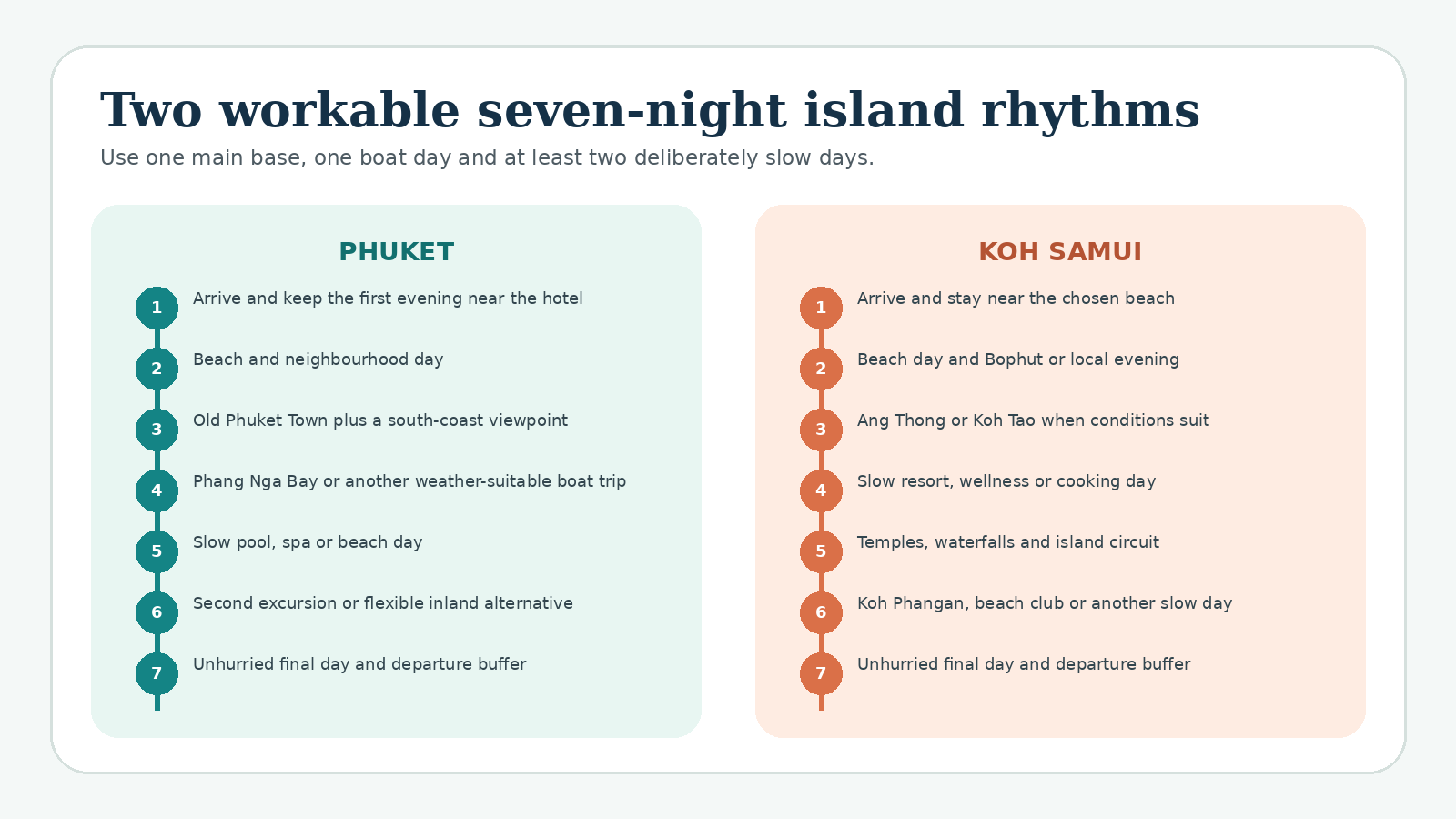
| Day | Phuket rhythm | Koh Samui rhythm |
|---|---|---|
| 1 | Arrival, check-in and dinner near the hotel | Arrival, check-in and a local beach evening |
| 2 | Beach and neighbourhood day | Beach day, then Bophut or the chosen local centre |
| 3 | Old Phuket Town and a south-coast viewpoint | Ang Thong or Koh Tao when conditions suit |
| 4 | Phang Nga Bay or another weather-suitable boat trip | Slow resort, spa, cooking or wellness day |
| 5 | Slow pool, spa or beach day | Temples, waterfalls and an island circuit |
| 6 | Second excursion or flexible inland alternative | Koh Phangan, a beach club or another slow day |
| 7 | Flexible final day and departure buffer | Flexible final day and departure buffer |
Why Phuket’s week contains more optional branches
Phuket supports two substantially different excursion days without repeating the same type of experience. Old Town and the coast can form one land day, while Phang Nga or an island trip forms the main marine day. The detailed five-day Phuket itinerary on this site shows how to group those areas without excessive cross-island travel. [16]
Why Samui’s week should remain slower
Samui’s strength is not squeezing Ang Thong, Tao, Phangan and an island circuit into consecutive days. Choose one major boat day, then decide whether a second outing genuinely improves the holiday. A resort pool, beach lunch, massage or cooking class can be the reason for choosing Samui rather than an empty space between attractions.
Can you combine Phuket and Koh Samui?
The two islands sit on opposite coasts
Phuket and Samui look close on a national map, but the usable route crosses southern Thailand. A direct flight is the only option that protects most of the day. Overland combinations involve road travel to the Surat Thani/Donsak side, pier check-in, a Gulf crossing and a final island transfer.
Current 12Go listings checked in September 2026 showed combined road-and-ferry options occupying roughly seven to ten hours, while direct flight schedules were around an hour in the air. [14] Those are examples, not guaranteed future timetables. Delays, hotel pickup and baggage handling extend the real door-to-door time.
When combining both makes sense
- The Thailand trip lasts at least fourteen nights.
- Each island offers a distinct purpose, such as Phuket’s excursions and Samui’s resort week.
- A direct flight or comfortable full-day transfer fits the budget.
- The itinerary includes recovery time before any separate long-haul departure.
When it creates more work than value
Do not split a seven-night beach holiday between both islands. Two airport or pier days, two check-ins and two area-learning periods leave less time than the itinerary suggests. Choose the coast that fits the month, then add a nearby island or mainland stop if the trip genuinely needs variety.
Phuket and Koh Samui pros and cons
Phuket advantages
- Wider domestic and international flight choice.
- Accommodation from hostels to major resorts and villas.
- More public transport and app-vehicle competition.
- Largest choice of nightlife, shopping and rainy-day alternatives.
- Broad marine and land excursion catalogue.
- Easier default for mixed-interest groups.
Phuket trade-offs
- Traffic and long cross-island journeys.
- Some districts feel heavily developed.
- Andaman wet-season waves can disrupt beach and boat plans.
- The wrong beach creates repeated taxi costs.
- Patong can overwhelm travellers who expected a quiet island.
Koh Samui advantages
- Compact resort-island identity and an easy-to-understand main road loop.
- Direct airport access close to several popular bases.
- Strong family, couples, villa, wellness and spa market.
- Useful June-to-August seasonal case.
- Direct Gulf connections to Koh Phangan and Koh Tao.
- Quiet north, west and south-coast options.
Koh Samui trade-offs
- Direct flights can be expensive.
- Private transport can consume a larger share of the budget.
- Late-year rainfall peak needs careful planning.
- Remote resorts reduce spontaneous dining and nightlife.
- Smaller excursion and indoor-activity catalogue.
The hidden trade-off both islands share
Convenience and calm pull in opposite directions. The most walkable, restaurant-rich base is rarely the quietest, while the most secluded resort usually increases transport and meal dependence. The best booking accepts that compromise deliberately instead of discovering it after arrival.
Common Phuket vs Koh Samui mistakes
Most disappointing island choices are not caused by picking the objectively “wrong” destination. They come from hiding a known trade-off until it becomes expensive. These are the errors worth removing before payment.
1. Choosing from one beach photograph
The image does not show the travel month, current, road, gradient, noise or distance to food.
2. Ignoring the two weather systems
Phuket and Samui sit on different coasts and have different rainfall peaks.
3. Comparing only room prices
Add flights, airport transfer, taxis, breakfast and cancellation terms.
4. Treating every area as representative
Patong is not Nai Yang; Chaweng is not Taling Ngam.
5. Booking consecutive boat trips
One rough-sea period can cancel both and leave no recovery day.
6. Assuming an island is walkable
Walking works within selected centres, not around either island.
7. Learning to ride a scooter on holiday
Road, licence and insurance risks are too significant for convenience.
8. Combining both islands in one week
The cross-coast transfer consumes too much of a short beach holiday.
9. Placing a marine trip before a flight
A late boat or cancellation can damage the departure plan.
10. Believing “beachfront” answers every access question
Room position, steps, road crossings and tidal conditions still need checking.
Frequently asked questions
These answers give the island-level recommendation. The chosen beach, flight and hotel still need a final property-level check.
Which is better, Phuket or Koh Samui?
Phuket is the stronger default for broad flight choice, hotel variety, nightlife, public transport and a large day-trip menu. Koh Samui is often the better fit for a compact resort-island holiday and for some June-to-August beach trips. The most reliable decision uses your month, arrival route, preferred beach area and evening style rather than a universal ranking.
Is Phuket or Koh Samui better for a first visit to Thailand?
Phuket is usually easier for a first international trip because its airport has a wider network, the island has accommodation at almost every price and there are more backup activities when weather changes. Samui can be just as easy when a direct flight is affordable and the chosen hotel sits close to the beach, restaurants and the airport.
Which island is cheaper?
Phuket normally has the lower budget floor. More flight competition, a larger room market and useful public buses make it easier to trim costs. Samui can still offer good-value rooms and meals, but direct flights and repeated taxis can lift the total. Compare the complete trip rather than the nightly room price.
Which has better beaches?
Both have excellent beaches, but they organise them differently. Phuket offers more distinct beach towns and a broader choice of atmosphere. Samui offers a compact loop of lively, family-friendly and quiet coasts. Swimming conditions, hotel access and the travel month matter more than a single island-wide score.
Is Koh Samui better than Phuket in July?
Often, yes. Thai Meteorological Department climate normals show a much lower historical July rainfall total at Ko Samui than at Phuket, while Phuket is within its wetter Andaman period. That is a useful planning signal rather than a promise. Check the live forecast, wind, waves and local beach flags before committing to sea activities.
Which is better for nightlife?
Phuket wins for scale and variety, especially around Patong, while other beaches provide quieter evenings. Samui has a lively centre in Chaweng, a more dining-led evening in Bophut and selected beach clubs, but the island-wide late-night choice is smaller.
Which island is better for families?
It is a draw at island level. Phuket gives families more hotel choice, medical and retail backup, public transport and rainy-day alternatives. Samui can provide an easier resort rhythm and shorter airport transfers for north-east coast hotels. Room occupancy, pool safety, beach conditions and the real hotel-to-dinner route should settle the choice.
Can you visit Phuket and Koh Samui in the same trip?
Yes, but the islands sit on opposite coasts. A direct flight protects time, while an overland bus or van plus ferry normally occupies most of a day. Combining both is most sensible on a trip of at least two weeks, with a clear reason for each island and a buffer before any separate long-haul flight.
How many nights do you need?
Five to seven nights works well on either island. Four nights is enough for a faster beach break with one main outing. Eight to ten nights suits a resort-led holiday, families who need slower days or travellers planning two weather-dependent boat trips.
Which island is better for couples?
Samui has a slight edge for couples seeking a compact resort holiday, particularly around Bophut, Choeng Mon, Mae Nam or a carefully chosen quiet west-coast property. Phuket is stronger for couples who want restaurants, nightlife, Old Town, several beach choices and a wider excursion catalogue.
Which is better for solo travellers?
Phuket is generally easier for solo travellers who want hostels, public buses, tours and a larger social scene. Samui suits solo travellers who prefer wellness, a quieter resort base or onward travel to Koh Phangan and Koh Tao, although private transport can weigh more heavily on a one-person budget.
Do you need a scooter on either island?
No. Choose a well-located base, use buses where practical in Phuket and arrange taxis, shared songthaews, hotel transfers or day tours. A scooter only makes sense for a properly licensed, insured and experienced rider wearing a suitable helmet. Island roads, rain, sand and unfamiliar junctions are not a good training environment.
Phuket or Koh Samui: the final recommendation
Choose Phuket when flexibility is the priority
Phuket is the stronger default for a first trip, a mixed group, nightlife, broad flight choice, public transport and several different excursion styles. It is also the easier island on which to reduce the budget, provided the hotel is positioned near the beach and evening area you will actually use.
Choose Koh Samui when the month and resort rhythm align
Samui is the better decision for many June-to-August beach holidays, for travellers who can justify a direct flight and for couples or families wanting a coherent resort week. Its value improves sharply when the hotel removes daily taxi journeys and the group is happy with one major boat day rather than a long attraction list.
The recommendation I would use
For a first November-to-March Thailand island holiday, I would usually choose Phuket and then spend more time selecting the right beach. For a July holiday, I would begin with Koh Samui and compare the direct flight against a mainland-and-ferry route. During October, November or another transition period, I would keep both on the shortlist until the booking terms and current forecast made one clearly easier.
Phuket vs Koh Samui is therefore not a beauty contest. It is a decision about coast, arrival, neighbourhood and the ordinary pace of the week. Once those four pieces fit, both islands can be an excellent choice.
Sources and fact-checking notes
This article was fact-checked on 10 September 2026. The research separates three kinds of information: official destination descriptions, long-term climate normals and date-specific commercial examples. Those categories should not be treated as interchangeable.
What the dated figures mean
Weather normals describe the 1991–2020 pattern. The Seatran fare and route examples were visible during the September 2026 check. Hotel, taxi, meal and tour amounts are transparent planning ranges rather than guaranteed quotes. Airlines, ferries, parks, attractions and roads can change with little notice, so recheck the exact travel date before paying.
Research boundaries
No first-hand visit has been claimed. Recommendations are research-led planning judgements based on route efficiency, weather patterns, area character, realistic daily costs and the trade-offs reported by official providers. A listing platform can help compare choices, but the operator, government authority, beach flag and live forecast remain the final source for safety and operation.
- Tourism Authority of Thailand — Phuket destination guide — Destination context, beaches and activities.
- Tourism Authority of Thailand — Ko Samui destination guide — Samui areas, activities and island context.
- Thai Meteorological Department — 1991–2020 climatological data — Phuket and Ko Samui monthly rainfall and temperature normals.
- Thai Meteorological Department — current seven-day forecast — Live wind, rain, wave and warning context.
- Airports of Thailand — Phuket airport transport — Current airport buses, vans, taxis and road-transfer context.
- Phuket Smart Bus — official 2026 service site — Current routes, fares, timetable and live tracking.
- Bangkok Airways — Samui International Airport — Airport operator and official airport information.
- Seatran Ferry — live booking results — Donsak–Nathon sailing time and September 2026 passenger fare example.
- Lomprayah — 2026 timetable — Current Gulf ferry-network planning context.
- Department of National Parks — Mu Ko Ang Thong — National-park geography, official status and visitor context.
- Tourism Authority of Thailand — Thailand in September — Gulf and Andaman seasonal planning context.
- Tourism Authority of Thailand — things to do in Phuket — Official Phuket beach and attraction context.
- UK FCDO — Thailand travel advice — Current safety, insurance and legal guidance.
- 12Go — Phuket to Koh Samui route results — Dated comparison examples for direct and combined journeys.
- Taylor’s Trailblazing Travels — best Phuket beaches — Live internal guide used for the detailed Phuket area comparison.
- Taylor’s Trailblazing Travels — Phuket itinerary — Live internal guide used for the practical five-day route.
Illustrations in this article were created for Taylor’s Trailblazing Travels. Third-party photographs, where used, are credited beside the image or in the source list.