12 Best Restaurants in Chiang Rai for 2026
A research-led shortlist for northern Thai food, market evenings, garden cafés and one memorable special meal.
Budget bowls to tasting menus
Practical three-day plan
Chiang Rai rewards travellers who mix one proper northern meal with a market night and a slower riverside or garden setting.
The best restaurants in Chiang Rai are not interchangeable. A bowl of khao soi near the Clock Tower solves a quick lunch; a riverside restaurant works for a relaxed group dinner; a themed café is closer to an attraction; and Locus Native Food Lab is a planned evening in its own right.
This guide keeps those purposes separate. It preserves the strongest venues and planning advice from the original research, replaces vague placeholders with named choices, and treats prices and opening patterns as dated planning anchors rather than promises. The recommendations are based on current operator information, Chiang Rai tourism listings and cross-checked recent sources, not claimed first-hand visits.
Chivit Thamma Da
Riverside gardens, a broad menu and enough range for brunch, cake, drinks or dinner.
Lu Lam or Barrab
Choose Lu Lam for a riverside sharing meal; choose Barrab for a compact city-centre introduction.
Khao Soi Phor Jai
A practical daytime stop for curry noodles and other northern staples near the central area.
Opening pattern
Local noodle shops can finish early; markets are day-specific; tasting menus need advance confirmation.
Start with the purpose of the meal, then check location and opening pattern. Ratings alone cannot tell you whether a venue fits a quick sightseeing day, a family dinner or a special evening.
| Meal type | Best use | Planning range | Check before going |
|---|---|---|---|
| Local noodles or one-dish meal | Breakfast, early lunch or a fast central stop | About ฿50–฿120 | Daytime hours, sell-outs and cash |
| Northern Thai sharing meal | Trying several curries, dips, sausages and vegetables | About ฿180–฿600 per person | Spice, raw preparations and group size |
| Garden or riverside restaurant | Brunch, celebration, mixed tastes or a slower evening | About ฿300–฿900 per person | Transport, table area and current hours |
| Market evening | Flexible small portions and no reservation | About ฿120–฿350 | Correct day, weather, seating and small cash |
| Contemporary tasting menu | A food-led special occasion with regional storytelling | Several thousand baht | Exact menu price, service dates, deposit and duration |
The shortlist balances regional food, atmosphere, affordability and practical variety. Published hours and prices below were checked on 11 September 2026 where live information was available; always reconfirm before a journey made solely for one venue.
1. Chivit Thamma Da Coffee House, Bistro & Bar
AreaKok River
BudgetMid-range
Chivit Thamma Da is the strongest all-round setting in the list. Its official site describes a family-owned restaurant on the Kok River serving homemade food, bakery, coffee and drinks across garden, lawn, terrace, bar and library spaces. That range makes it useful for mixed groups who do not all want the same meal.[3]
The venue currently publishes daily hours of 09:00–22:00 and offers direct table booking. Allow more time than for a standard café because the grounds are part of the experience. A taxi or ride-hailing car is usually simpler than treating it as a casual walk from the Clock Tower.
2. Khao Soi Phor Jai
AreaJetyod Road
BudgetLow
Phor Jai is the most concrete replacement for the original guide’s vague “local specialist”. It is known for khao soi and other northern noodle dishes in the central area, making it easy to combine with the Clock Tower, Jetyod Road or an arrival-day walk.
Recent listings place bowls roughly in the ฿50–฿100 range and describe daytime opening, although published closing times vary. Go for breakfast or lunch rather than building an evening around it, take small cash and keep a nearby alternative in case the shop closes early or sells out.[12]
3. Larb Sanam Keela
StyleSharing plates
BudgetLow to mid
Larb Sanam Keela suits travellers who want a robust northern meal rather than polished café dining. Recent 2026 sources highlight larb, garlic-topped fried fish and makhwaen-spiced dishes; the menu rewards a group that can share several plates.[13]
Ask specifically whether a larb preparation is cooked or raw, and explain your preferred chilli level. This is not the best first stop for a diner who needs extensive English allergy discussion, but it is a useful counterpoint to garden restaurants and Western comfort food.
4. Lu Lam Restaurant
AreaKok River
BudgetLow to mid
Lu Lam is a practical choice for comparing several northern Thai dishes at one table. Chiang Rai’s tourism directory describes a riverside restaurant operating since 1981, with dishes including larb moo, gaeng hang lay, nam prik noom, nam prik ong and gaeng khae.[4]
The same listing gives a broad ฿79–฿299 dish range and service around 10:00–20:00, with slightly later closing on some days. Treat those as planning anchors because the page was last updated in 2025. Reserve for a larger group, then confirm the return ride before settling in by the river.
5. Barrab Northern Restaurant
AreaCentral Chiang Rai
BudgetLow to mid
Barrab works when you want northern food without turning the meal into a separate riverside excursion. Order a small spread rather than one familiar curry: a sausage, chilli dip, vegetable dish and slow-cooked curry give a better sense of the region.
Recent listings conflict on the weekly closure: an owner-verified listing updated in August 2026 shows Wednesday closed and service from 11:00–20:00 on the other days, while another current directory still shows Saturday closed. Check Barrab’s official Facebook page or call on the day rather than relying on either schedule alone.[14]
6. Malong Der Chiang Rai
AreaBan Du
BudgetMid-range
Malong Der gives the shortlist a more contemporary northern-Thai option. The local tourism directory describes modern Lanna presentation, local sourcing and a compact khantoke-style set, with a published range of roughly ฿300–฿500.[6]
Plan it as a daytime destination rather than a late dinner. The listing gives 09:00–17:00 from Tuesday to Sunday and shows Monday closed, so confirm the current service day before travelling to Ban Du. It is most efficient when paired with another northern-side stop.
7. Hungry Wolf’s Steak & Ale-House
StyleSteakhouse
BudgetMid-range
Hungry Wolf’s earns a place because longer Thailand trips sometimes need a deliberate break from chilli, rice and noodles. It is useful for families, groups with mixed tastes, or anyone who simply wants a burger, steak or substantial Western-style dinner.
The official site currently publishes 11:30–22:30 Sunday to Thursday and 11:30–23:30 Friday and Saturday, with the kitchen and bar closing half an hour earlier. Check the live menu before travelling for a particular cut or dish.[7]
8. Melt in Your Mouth
AreaKok River
BudgetMid-range
Melt in Your Mouth combines an English-style garden and riverside setting with Thai and Western food, desserts and drinks. It works particularly well for an afternoon break, a family celebration or a group that values atmosphere but needs a broad menu.
Chiang Rai’s tourism directory lists daily 09:00–20:00 opening, a ฿100–฿400 dish range and reservation availability. Because that listing was last updated in 2025, confirm current hours and any preferred seating area directly.[5]
9. Lalitta Café
StyleAttraction-café
BudgetEntry plus food
Lalitta is a fantasy-forest attraction with waterfalls, mist, gardens and extensive photo opportunities. Choose it because that designed environment appeals to you, not because you want a benchmark for everyday Chiang Rai cooking.
Recent 2026 information commonly gives daily opening around 08:00–20:00 and an adult entry charge around ฿60 that may be credited against purchases. Both policy and price can change, so check the official social page before setting off. Pairing it with Wat Huay Pla Kang reduces unnecessary transport.[9]
10. Chiang Rai Night Bazaar food area
AreaCentral
BudgetLow
The Night Bazaar is the easiest answer after a delayed arrival or a day whose finish time is uncertain. Walk through the food area before buying, choose small portions from more than one stall, and look for visible turnover rather than relying on one viral recommendation.
The Tourism Authority of Thailand lists the Night Bazaar as a Chiang Rai attraction, although exact stall hours and participation can vary.[10] Carry small notes, have an indoor fallback during heavy rain and expect a livelier setting than a quiet dinner.
11. Saturday Walking Street food stalls
DaySaturday
BudgetLow
Saturday Walking Street turns Thanalai Road into a food, craft and performance evening. It is more than a dinner stop, so arrive with time to browse, sample several small dishes and watch the street activity rather than expecting restaurant-style seating.
A recent Chiang Rai guide gives an operating window from late afternoon to around 22:00, while other listings start later. Use 16:00–22:00 as a planning window, not a guarantee, and verify locally during public holidays or severe weather.[11]
12. Locus Native Food Lab
AreaMae Kon
BudgetHigh
Locus is the specific special-meal choice that the original draft lacked. Its official site describes contemporary interpretations of northern Thai food using local and seasonal ingredients, presented as a long set-menu experience at Pa Sak Thong.[8]
Book directly and ask for the current menu price, drinks, dietary flexibility, deposit, service dates and expected finish time. The live site currently shows conflicting opening patterns across pages, which makes direct confirmation essential. Arrange the return car in advance because this is not a central walk-in dinner.
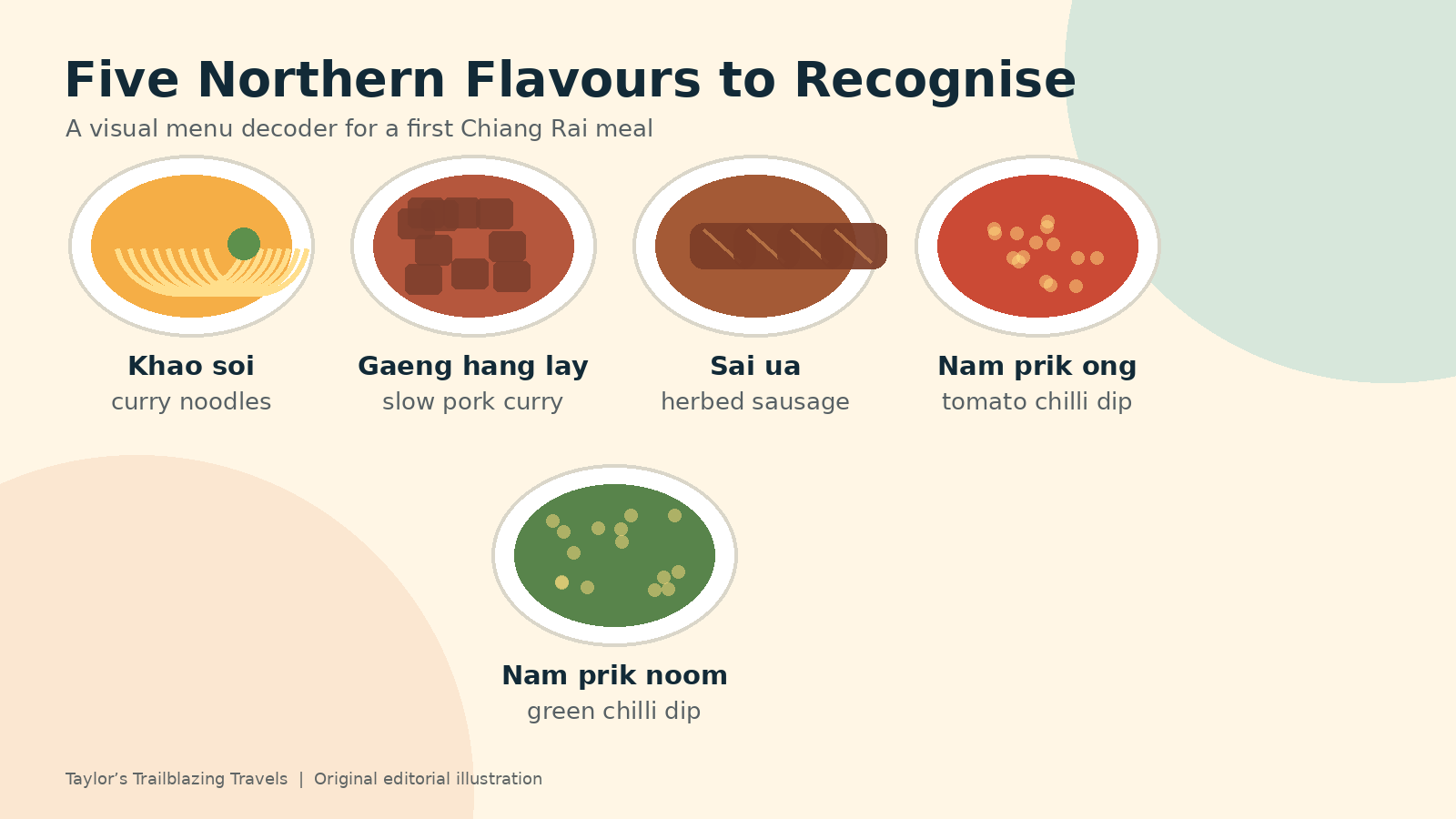
A strong Chiang Rai meal goes beyond ordering the same pad Thai or green curry you could find across the country. These dishes provide a useful starting vocabulary.
| Dish | What to expect | Useful ordering note |
|---|---|---|
| Khao soi | Curry noodle soup with soft and crisp noodles | Usually easiest as a solo lunch; richness and chilli vary between shops. |
| Gaeng hang lay | Slow-cooked pork curry with warm spices | Good for sharing with rice; ask about portion size before adding several curries. |
| Sai ua | Herbed northern sausage | Order a smaller portion alongside dips and vegetables rather than making it the entire meal. |
| Nam prik ong | Tomato and minced-pork chilli dip | Commonly served with vegetables and pork rinds; not vegetarian by default. |
| Nam prik noom | Smoky green-chilli dip | Heat varies; ask before assuming the green colour means mild. |
| Larb kua | Cooked northern minced-meat salad with herbs and spices | Say that you want the cooked version when raw meat would be unsuitable. |
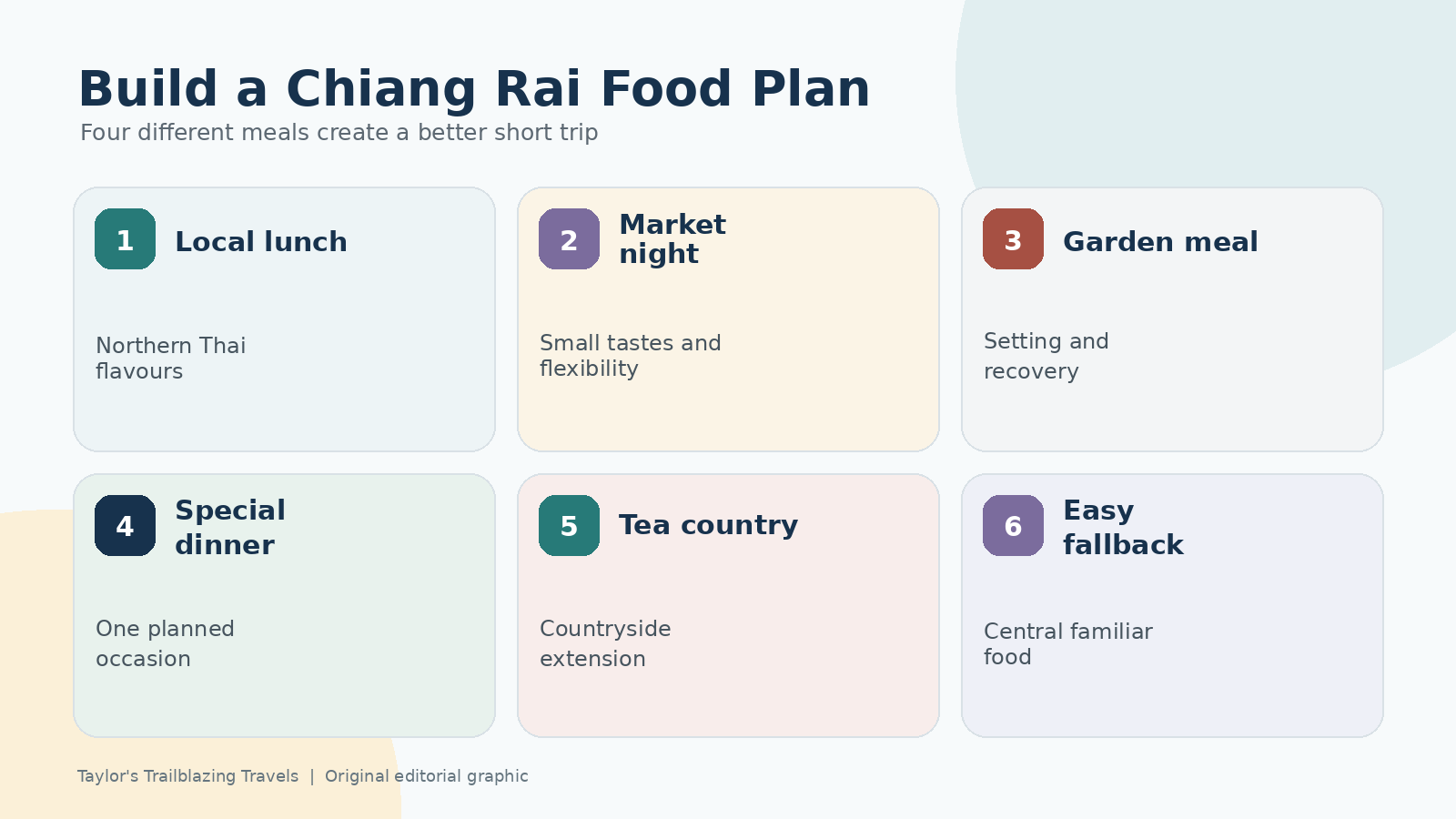
The plan deliberately leaves one meal open. Appetite, heat, rain and tour returns are more predictable after arrival than they are months before the trip.
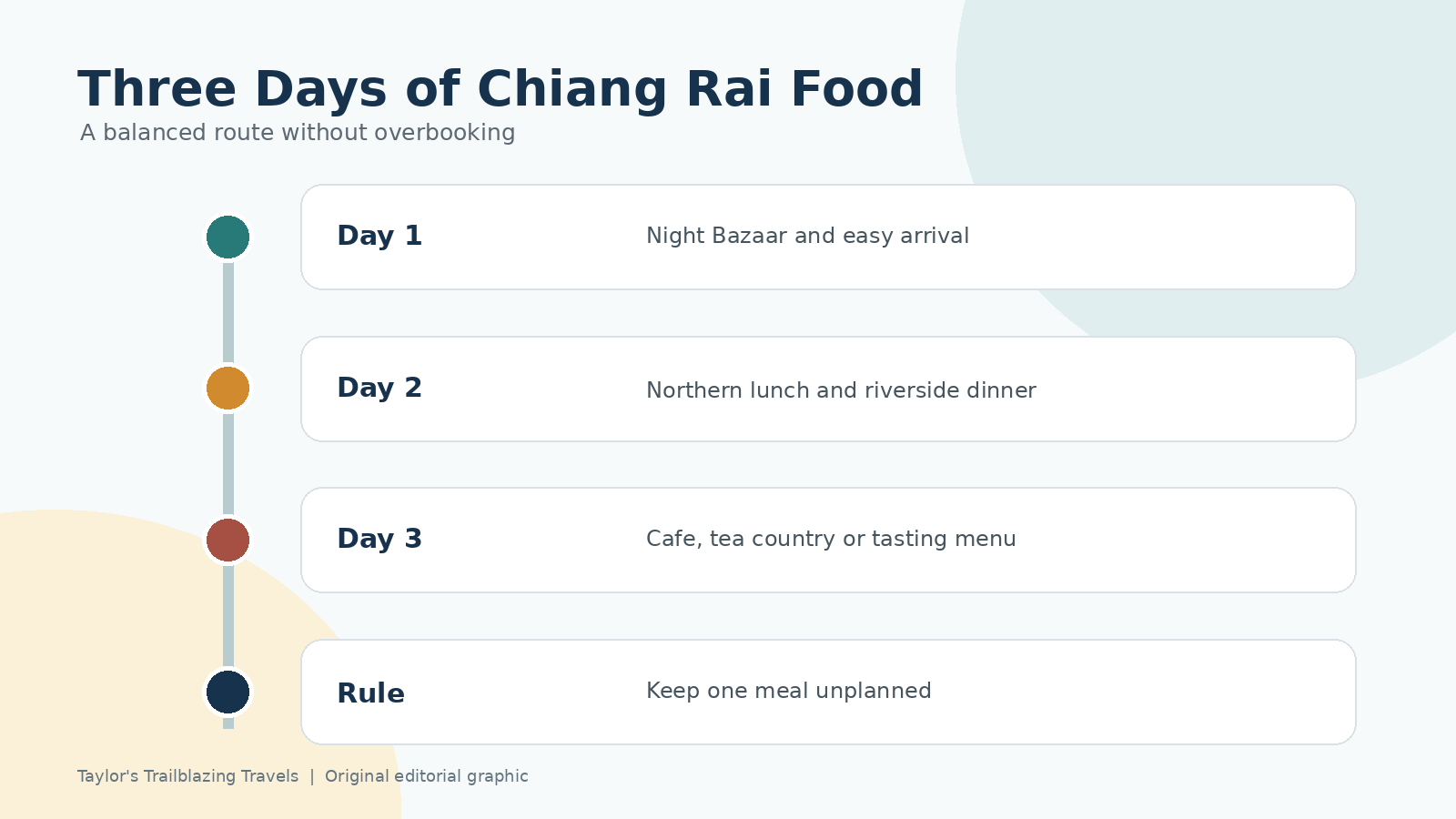
Day 1: central food and an easy evening
After arrival, eat near the hotel or use the Night Bazaar. This keeps the evening resilient when a flight, bus or transfer runs late. Walk the stalls once before choosing, buy small portions and stop when tired rather than treating the first night as a food challenge.
Day 2: a northern lunch and slower dinner
Have khao soi or a northern sharing lunch after the morning sights. In the evening, choose Chivit Thamma Da for broad appeal, Lu Lam for a local riverside spread, or Barrab when staying central. On Saturday, the walking street can replace the booked dinner.
Day 3: garden café, cooking class or special meal
Use the final day for Melt in Your Mouth, Lalitta when the setting genuinely appeals, or Locus when the trip includes a food-led special occasion. Keep lunch lighter before a long tasting menu, and protect the next morning when an early departure follows.
Vegetarian and vegan meals
Tofu does not automatically make a Thai dish vegan. Curry paste may contain shrimp paste, broth can contain meat, and fish sauce may be used even when no meat is visible. Explain the full requirement and ask separately about fish sauce, shrimp paste and stock. A translated dietary card is useful when the restriction is strict.
Severe allergies
Choose a restaurant where staff can discuss ingredients and cross-contact clearly. Markets are excellent for visible, freshly cooked food, yet shared grills, oils, utensils and sauces make severe-allergy control harder. Carry prescribed medication, keep the hotel address available and do not rely on a generic “no nuts” phrase when the allergen may appear in pastes or garnish.
Spice and unfamiliar preparations
Ask for mild food before the kitchen starts cooking rather than trying to remove chilli afterwards. Northern dips and larb can be much hotter than their appearance suggests. Meanwhile, a mixed group can order one mild vegetable or egg dish alongside stronger curries so that everyone has a dependable option.
Chiang Rai can be inexpensive, but the total changes sharply when a meal includes a designed setting, imported drinks, a long taxi journey or a tasting menu.
| Approach | When it works | Check first | Main limitation |
|---|---|---|---|
| Walk-in local shop | Flexible breakfast or lunch | Current hours, cash and sell-outs | May close earlier than expected |
| Direct restaurant booking | Garden, riverside or group meal | Table area, arrival grace period and cancellation | Fixes the day around one time |
| Hotel assistance | Language support or a celebration | Deposit, transport and who holds the booking | The hotel may favour familiar partners |
| Cooking class platform | Comparing several activities and cancellation policies | Pickup boundary, menu and group size | Less freedom than an ordinary meal |
Carry cash even when cards are advertised
Larger restaurants may accept cards, while markets and smaller shops often prefer Thai cash or local QR payment. Carry small notes for stalls and transport. A card logo at the entrance does not guarantee that every foreign card or terminal will work.
Price the return journey
Riverside, Ban Du and Mae Kon venues can look close on a map while still requiring a vehicle. Save the venue in the ride-hailing app before dinner, take a screenshot of the address and arrange a pickup time for remote or late-finishing meals. At Locus, return transport deserves the same attention as the reservation.
Read menus for “++” and set-menu terms
A listed price may exclude service charge and tax, especially in hotels or formal dining. Ask whether water, pairings and non-alcoholic drinks are included. For a tasting menu, also confirm the number of courses, expected duration, deposit and cancellation deadline.
Pros
- Northern dishes give the city a clear regional identity.
- Local lunches and markets can be excellent value.
- Riverside and garden venues create memorable slower meals.
- The compact centre makes a flexible food evening straightforward.
- One premium meal can contrast well with inexpensive daytime food.
Cons
- Opening hours can be inconsistent across websites and listings.
- Popular cafés may prioritise photography and atmosphere over local depth.
- Remote restaurants add transport cost and return-journey planning.
- Raw preparations, fish sauce and shrimp paste require clear questions.
- Weekend markets are useless when the itinerary falls on the wrong day.
Food and restaurant choices
What food is Chiang Rai known for?
Start with northern Thai dishes such as khao soi, gaeng hang lay, sai ua, nam prik ong, nam prik noom and cooked larb. Tea, local coffee and market snacks also fit the wider Chiang Rai food picture.
What is the best restaurant in Chiang Rai for a first visit?
Chivit Thamma Da is the easiest all-round atmospheric choice, while Lu Lam or Barrab provides a stronger northern-food priority. The better answer depends on whether setting, local depth or central convenience matters most.
Where should I eat khao soi in Chiang Rai?
Khao Soi Phor Jai is a practical central starting point. Go during daytime, verify the current opening pattern and keep an alternative nearby because specialist noodle shops can close early or sell out.
Is Chiang Rai Night Bazaar good for food?
Yes, particularly for a flexible arrival evening or an indecisive group. The advantages are choice, low commitment and central location; the trade-offs are variable stall quality, noise, weather exposure and limited comfortable seating.
Cost, booking and payment
Are Chiang Rai restaurants expensive?
They do not have to be. A local bowl may cost roughly ฿50–฿120, a mixed northern meal often falls around ฿180–฿600 per person, and a garden or riverside meal may run about ฿300–฿900. Contemporary tasting menus sit far above those ranges. These are September 2026 planning estimates, not guaranteed prices.
Do Chiang Rai restaurants take cards?
Many larger venues do, but small shops and market stalls may prefer cash or Thai QR payment. Carry small baht notes and retain a second payment method rather than assuming a foreign card will be accepted.
Do I need restaurant reservations?
Reserve Locus and any important weekend garden or riverside dinner. Most noodle shops and markets are walk-in. For a three-night trip, one fixed dinner is usually enough.
Dietary needs and trip planning
Is vegetarian or vegan food easy to find?
Options exist, although sauces, curry pastes and stock may contain fish sauce, shrimp paste or meat. Explain the requirement clearly and ask about the whole preparation rather than only the visible ingredients.
Which Chiang Rai market is best for food?
The Night Bazaar is easiest because it is central and generally operates in the evening. Saturday Walking Street offers more of a weekly local-event atmosphere when the date aligns. Use the Night Bazaar as the dependable plan and the walking street as the day-specific bonus.
How many meals should I plan in advance?
For three nights, reserve one special dinner, identify one northern lunch and leave the other meals flexible. That protects the itinerary without reducing every day to a timetable.
For a first three-night stay, my research-led choice would be Khao Soi Phor Jai or another busy northern specialist for one daytime meal, the Night Bazaar or Saturday Walking Street for one flexible evening, and Chivit Thamma Da or Lu Lam for one slower dinner.
Choose Locus instead of the riverside dinner when food is a central reason for the trip and the cost, limited service pattern and return transport all suit your plans. Choose Lalitta only when the visual setting itself is part of the appeal. That combination makes the trade-offs visible and gives Chiang Rai more range than three bookings chosen from the same “top restaurants” list.
Research was checked on 11 September 2026. Direct operator pages were preferred for current hours and booking information; Chiang Rai tourism listings supplied local context and price ranges; recent secondary sources were used only where no reliable operator page was readable. Conflicting schedules are disclosed in the article rather than silently resolved.
- Tourism Authority of Thailand — Chiang Rai destination overview.
- Chiang Rai Digital Tourism Directory — restaurant directory.
- Chivit Thamma Da — official site, booking, address and opening hours.
- Chiang Rai Digital Tourism Directory — Lu Lam.
- Chiang Rai Digital Tourism Directory — Melt in Your Mouth.
- Chiang Rai Digital Tourism Directory — Malong Der.
- Hungry Wolf’s Steak & Ale-House — official site and opening hours.
- Locus Native Food Lab — official site, concept, contact and service information.
- Lalitta Café — official site, cross-checked against 2026 visitor information.
- Tourism Authority of Thailand — Chiang Rai Night Bazaar.
- Bon Voyage Thailand — 2026 Chiang Rai walking-street guide.
- Khao Soi Phor Jai — recent venue information, cross-checked against current map listings.
- Larb Sanam Keela — January 2026 venue notes, cross-checked against current listings.
- Barrab Northern Restaurant — official Facebook page, cross-checked against conflicting August–September 2026 directory hours.
Illustrations in this article were created for Taylor’s Trailblazing Travels. Third-party photographs, where used, are credited beside the image or in the source list.