Plan your trip / Travel money
Thailand Money Guide: Cash, Cards, ATMs and Fees
Understand the fee layers, keep payment choices open and avoid a costly conversion by accident.
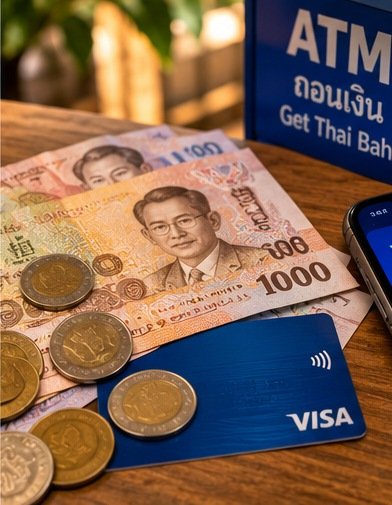
Conceptual travel-money still life; banknote details are illustrative, not authentication guidance.
A useful Thailand money guide starts with a mixed system: some baht for everyday spending, a suitable card for larger payments and a backup that is not stored in the same place. Trying to travel entirely cashless can be awkward, while carrying the whole holiday budget as cash creates a different problem. The aim is flexibility without unnecessary fees.
The detail that deserves particular attention is the ATM charge. Current fee schedules from three major Thai banks distinguish between foreign-issued Visa and Mastercard cards. Therefore, a single fee copied from an older travel blog is not a reliable budget for every withdrawal. Your own card provider's charges and any currency-conversion offer sit on top of that local-bank question.
This guide uses bank, card-network and government sources checked on 4 October 2026. Worked examples are labelled as illustrations rather than live exchange rates or personal financial recommendations. Use the framework to check your existing accounts and plan accessible spending money, not as a reason to open a product whose full terms you have not read.
Core system
Cash + card + backup
No single payment route needs to carry the whole trip.
ATM check
Bank and card network
A local fee is separate from the issuer's charges.
Conversion choice
Read THB versus GBP
Choose deliberately, not by button colour.
Cash planning
Fund the next stage
Balance fixed fees against carrying and storage risks.
Thailand money guide: a practical cash-and-card system
Give each payment method a job
Use cash for the small transactions where it is convenient or necessary, a suitable card for larger purchases when accepted, and a separate backup for a lost card or failed payment. The exact split depends on your route and accommodation. A city hotel paid online creates a different cash requirement from several nights in a small property with payment due on arrival.
Before leaving home, list the items already paid and those still to settle. Then separate "cash needed soon" from "money available if plans change". These are different amounts. You can keep access to a contingency without carrying the whole sum in a wallet every time you leave the room.
Avoid a false choice between cash and technology
A banking app can show spending and help manage a card, but it does not replace the physical card at every machine or merchant. Likewise, carrying baht does not mean abandoning online bookings or contactless payments. Build a simple system that still works when one method is unavailable rather than depending on everything functioning at once.
| Situation | Practical first option | What to check | Useful backup |
|---|---|---|---|
| Small local purchase | Baht cash or an accepted local payment method | Change and the amount due | Smaller notes |
| Hotel or substantial purchase | Suitable card when accepted | Currency, fees and any deposit hold | Second card or agreed alternative |
| Cash withdrawal | Physical card with understood terms | Local ATM fee, issuer fee and conversion choice | Another card or licensed exchange counter |
| Online transport booking | Card or supported checkout method | Total, currency and cancellation terms | Keep the voucher offline |
| Unexpected disruption | Accessible emergency funds | Account access and payment acceptance | Separate reserve and contact details |
Baht, notes and the change you actually need
Learn the denominations, not just the exchange rate
Thailand uses the baht, written THB or with the baht symbol. The Bank of Thailand's circulating-note information lists familiar denominations including 20, 50, 100, 500 and 1,000 baht. Use the central bank's images for identification rather than the conceptual artwork in this article. [1]
For everyday spending, a mixture of smaller notes is more useful than a wallet containing only the largest denomination. A small purchase may be difficult to settle when the seller has limited change. Therefore, ask for a reasonable mix when exchanging money or break a larger note during a suitable purchase, without assuming every stall can change it.
Keep the day's cash separate
Carry the amount you expect to use that day plus a modest buffer, and store the remainder separately. This reduces how much you expose each time you pay. It also makes it easier to see whether today's spending is running ahead of your plan without repeatedly counting the entire trip reserve in public.
A simple zipped organiser can help keep notes, coins and receipts distinct. small cash and document organisers is an optional product search, not an essential purchase: an existing secure pocket or small pouch may work perfectly well. Choose something that makes money easier to manage, rather than a bulky accessory that attracts attention whenever you need a small payment.
How much cash should you arrive with?
Work from the first two days
Start with the airport transfer, any accommodation payment due immediately, meals, small transport and a little flexibility. Do not choose an arrival amount solely because another traveller carried it successfully. Their hotel may have been prepaid, their transfer included or their route much less cash-dependent than yours.
As a planning illustration, a couple whose hotel and main transport are prepaid might keep around THB 3,000-5,000 accessible for initial everyday spending and a modest arrival buffer. This is not a spending target or a universal requirement. Increase or reduce it according to the actual unpaid items, and retain another way to obtain funds.Amounts dated 4 October 2026.
Do not confuse access with carrying everything
Having money available in an account is different from carrying it all in notes. You can plan the next withdrawal or exchange around the route while limiting the cash held at any one time. However, do not leave the balance so tight that a failed machine or closed counter creates a problem before the next meal or transfer.
Use the site's Thailand travel budget guide to estimate the wider holiday cost, then convert that into a payment plan rather than withdrawing the full total automatically. A budget tells you what the trip may require; a cash plan tells you how to pay for it safely and conveniently as you move through the itinerary.
Current ATM fees: check the bank and the card network
Three official schedules, not a universal tariff
The table below records foreign-card withdrawal charges from the banks' own published schedules, checked on 4 October 2026. It is a selected verification exercise, not a claim that these are the only banks or the cheapest machines in Thailand. The screen shown for your actual card remains the final opportunity to accept or cancel the transaction. [2] [3] [4]
| ATM operator | Foreign-issued Visa | Foreign-issued Mastercard | Official schedule reviewed |
|---|---|---|---|
| Bangkok Bank | THB 250 per withdrawal | THB 350 per withdrawal | July 2026 schedule, item 29.8 |
| Kasikornbank | THB 250 per withdrawal | THB 350 per withdrawal | September 2026 schedule, section 18 |
| Krungsri | THB 250 per withdrawal | THB 350 per withdrawal | Effective 11 March 2026, page 8 |
These are local operator charges, not the whole cost of obtaining baht. A foreign-exchange markup, your card's cash-withdrawal charge or credit-card interest may still apply. Therefore, choosing a machine by its local fee alone can produce a misleading comparison when your two cards have different issuer terms.
Check the displayed charge before continuing
Read the amount and cancel if you are not comfortable with the total or cannot understand the screen. Do not assume that a bank's domestic-account fee or a special cardless service applies to your foreign physical card. Those are different products, often with different eligibility and funding arrangements.
Keep a note of the operator, amount withdrawn and fee for your own records. Then compare the final posted account transaction, not just a pending notification, against what you accepted. This makes an unexpected charge easier to discuss with the issuer and helps you plan the next withdrawal using your own verified experience.
The four costs that can hide inside a withdrawal
Separate the local fee from your account's fee
The local ATM operator may charge for dispensing cash. Your own bank or card provider may also charge for an overseas withdrawal or currency conversion. These are separate layers, so a card advertised as having no overseas fee does not automatically remove the Thai machine's charge. Equally, a lower local charge does not compensate for every possible issuer markup.
Credit cards introduce another question: whether the withdrawal is treated as a cash transaction, with a separate rate or interest timing. Halifax's guidance, for example, explains that cash transactions can attract fees and interest from the transaction date. That illustrates why you must inspect your own card's terms rather than generalising from its ordinary purchase benefits. [5]
Conversion is a separate decision again
An ATM can offer to charge your account in your home currency instead of processing the withdrawal in baht. This is dynamic currency conversion, not the same thing as the local withdrawal fee. Visa explains that the screen should show the currencies, exchange rate and any markup, and should let you accept or decline the offer. [6]
My usual planning preference is to withdraw in THB and let the chosen card's issuer or network handle conversion, after checking its terms. However, that is not a promise of one exact exchange rate. The key is to understand who is converting the money and to avoid accepting a poorly explained home-currency quote by accident.
Dynamic currency conversion: what to look for on the screen
Choose the currency deliberately
At a shop terminal, ask for the payment to be processed in baht when that is your chosen method. At an ATM, distinguish accepting the local machine fee from accepting a conversion offer. The buttons and wording vary, so do not follow a memorised instruction such as "always press the left button" without reading what it says.
If the screen makes the decision unclear, cancel and use another method rather than guessing under pressure. A statement that conversion is "recommended" does not explain whether it is good value for your account. The useful comparison is the offered home-currency amount against the likely cost under your own card's conversion terms.
A numerical illustration
Suppose a purely hypothetical mid-market-style reference is 45 baht to the pound, while a conversion offer uses 42 baht to the pound. A THB 9,000 payment would be GBP 200 at the first illustrative rate and about GBP 214.29 at the second, before any other fees. The difference is around 7.14% of the lower sterling amount.Amounts dated 4 October 2026.
Those are made-up rates for explaining the arithmetic, not rates available on 4 October 2026 or a forecast. The lesson is that the exchange rate can matter more than a small visible fee. Calculate the amount you will actually pay rather than assuming a familiar currency on the screen is automatically the safer choice.
How large should each withdrawal be?
A fixed fee rewards fewer transactions mathematically
When the local charge is fixed per withdrawal, taking a useful amount at once spreads that fee across more cash. However, the arithmetic is only one part of the decision. Withdrawal limits, your remaining trip, safe storage and the risk of carrying cash can make a smaller amount the better practical choice.
| Cash received | With a THB 250 fee | With a THB 350 fee | What the percentage excludes |
|---|---|---|---|
| THB 2,500 | 10.00% | 14.00% | Issuer charges and exchange-rate effects |
| THB 7,500 | 3.33% | 4.67% | Issuer charges and exchange-rate effects |
| THB 15,000 | 1.67% | 2.33% | Issuer charges and exchange-rate effects |
The percentages divide the local fee by the cash received. They do not claim that those amounts are available from every machine or within every card's limit. Use them to understand why repeated tiny withdrawals can be expensive, not as an instruction to withdraw the largest possible sum.
Choose an amount that fits the next stage
Estimate the cash-only spending until the next convenient banking stop, then add a modest buffer. Check the card's daily and monthly limits before travelling, because a Thai machine can also impose its own transaction limit. The lower practical limit is the one that affects the withdrawal, even when another part of the system would allow more.
Do not repeatedly retry a failed large amount without considering the cause. Check the account, limits and messages first, then decide whether another amount or card is appropriate. A sequence of unexplained attempts can leave you uncertain about pending transactions and still without the cash you need.
Cash exchange: compare the amount you receive
Commission-free does not mean best value
An exchange counter can advertise no commission while using a less favourable rate. Therefore, ask how many baht you will receive for the actual notes you are exchanging, after every fee. Compare like amounts rather than being distracted by a large rate board that may show different terms for different denominations or currencies.
A hypothetical GBP 200 exchange at 44 baht per pound produces THB 8,800, while 43 baht per pound produces THB 8,600. That THB 200 difference is an arithmetic illustration dated 4 October 2026, not a live quote. It gives you a sensible basis for deciding whether a detour to another counter is worthwhile.
Use a legitimate counter and retain the receipt
Choose a bank or licensed exchange business and follow its identification requirements. Bring the identification it requests, check the displayed total and count the received money before leaving the counter. Do not assume that every branch accepts every type of note or that an old receipt establishes today's rate.
If bringing sterling, check acceptance of your particular notes in advance, especially notes issued by Scottish or Northern Irish banks. Acceptance can vary between exchange providers even when the notes are valid at home. Carrying a widely accepted alternative or a backup card is more useful than arguing about legal-tender terminology at a busy counter.
Choosing which of your cards to use
Read the account's current schedule
Check overseas purchase fees, cash-withdrawal fees, the conversion basis, limits and any conditions attached to a fee-free allowance. A monthly subscription or account requirement can affect whether a benefit is worthwhile for your trip. Do not select a card simply because somebody described it as a travel card without naming the relevant plan.
A useful comparison starts with the cards you already hold. One might be better for purchases while another is better for cash. However, confirm both sets of terms rather than assuming that Visa is always better than Mastercard or that a premium account always has the lowest total cost.
Network differences do not settle the whole calculation
The selected Thai-bank schedules show different local fees for Visa and Mastercard, but issuer charges can outweigh that difference. For example, a card with a lower local withdrawal charge could still cost more overall if it adds a substantial conversion markup. This is why a network-only recommendation would be too simplistic.
Keep a second usable card separate from the first, ideally with an independent way to access funds. That reduces the impact of one lost wallet, blocked card or account problem. It does not eliminate every failure, but it gives you an alternative that does not depend on immediately fixing the original issue at the same machine.
Cards, contactless payments and hotel deposits
Ask what the merchant actually accepts
A card-friendly hotel or larger retailer does not establish universal card acceptance across your trip. Check before ordering or committing to a service when payment flexibility matters. For small purchases, keep cash available rather than assuming every QR code or contactless-looking sign supports your particular foreign card.
Confirm the transaction currency and final total before authorising. If a surcharge is proposed, ask how it changes the full amount and whether another payment method is accepted. This guide does not attempt to state one universal legal rule for every merchant arrangement; the practical first step is to avoid agreeing to a price you have not understood.
A deposit hold is not the same as a final charge
Ask accommodation providers whether they take a preauthorisation, a cash deposit or a completed payment, and how release or refund is handled. Also check whether the physical card must be presented at check-in. Those details can affect available funds even when the room itself was prepaid through a different platform.
When comparing Booking.com hotel payment conditions with Agoda hotel payment conditions, inspect payment timing, taxes, cancellation and deposit conditions rather than only the first displayed nightly amount. A cheaper headline may require a less convenient payment arrangement. Keep the confirmation so that you can distinguish the room charge from any separate deposit later.
Thai QR payments and tourist wallets
A QR code is not universal card acceptance
A Thai QR payment can rely on a compatible local or cross-border payment system. Do not assume that scanning it with any UK banking app will complete a transaction. Ask which method the merchant accepts and keep another way to pay. A phone camera recognising the code is not evidence that your bank can send the required payment.
Tourist-wallet products can bridge some of that gap. KBank's TAGTHAi Easy Pay information describes a wallet for foreign visitors with Thai QR payments and cardless cash access. However, eligibility, funding methods, limits and fees need checking for the exact product version available when you apply. [7]
Verify the current version before loading money
The official webpage and the linked sales sheet reviewed for this guide do not fully align on funding methods. The page also carries a migration notice for older PAY & TOUR wallets. Therefore, confirm the current terms with KBank rather than treating a remembered blog tutorial as an authoritative setup process. [7] [8]
The sales sheet describes a THB 20 cardless-withdrawal fee and a promotional waiver through 31 December 2026, checked on 4 October 2026. That is a specific wallet condition, not proof that foreign physical cards withdraw free from KBank machines. Consider funding costs, leftover-balance rules and the effort of registration before deciding whether the wallet is useful for your trip. [8]
Prepay selected travel costs without losing flexibility
Reduce cash needs where it genuinely helps
Booking a train, ferry or airport transfer online can reduce the amount you need to settle in cash on arrival. It can also create a clearer record of the service purchased. However, prepayment is not automatically a saving: compare the final currency, payment fees and cancellation conditions with the alternative before committing.
For a northern route, Bangkok-to-Chiang-Mai booking options is one way to compare Bangkok-Chiang-Mai transport. For an island connection, Samui-to-Phangan booking options helps compare Samui-Phangan options. Use the actual dates and service details, and do not prepay a fragile connection solely to reduce the cash in your wallet.
Keep the booking scope clear
An online transfer may cover the car but not an additional boat, hotel extension or luggage charge. Check the inclusions, then record which remaining items still need payment. Phuket airport-to-Patong searches and Krabi airport-to-Ao-Nang searches are useful examples of route-specific searches when airport transport forms part of that calculation.
For a separately organised pickup, pre-booked Bangkok airport-transfer listings provides another comparison channel. Search results can mix transfers and excursions, so select the intended service carefully. The objective is to make payment more predictable, not to turn every part of the holiday into a non-refundable booking before you know the itinerary works.
Online banking, eSIMs and verification codes
Check access before leaving home
Make sure you know the banking app's login method, can receive required verification messages and have the issuer's official contact details. A phone replacement or forgotten password is harder to resolve while standing at a foreign ATM. However, do not store a card PIN beside the card or in an obvious unprotected note simply to make it easier to remember.
A data connection can help with banking and booking updates. Airalo eSIM plan comparisons is an option for comparing Thailand eSIM packages, but check whether the chosen product includes data only or additional calling features. Airalo explains that a data-only eSIM may require a separate active line for ordinary calls and SMS, with the home provider's roaming conditions still relevant. [9]
Do not confuse app messages with text messages
An internet messaging app can work over data while a bank's SMS code still depends on the registered telephone line. Test the setup before relying on it abroad. Also check what happens if the phone is lost, because a second physical card is less useful when you cannot access the account needed to fund it.
Use official bank apps and verified contact channels rather than links in unexpected messages. If an urgent message asks for card details or a new payment, pause and check through a route you already trust. A familiar hotel name or booking reference in a message does not by itself prove that the sender is legitimate.
Cash handling, receipts and a lost-card fallback
Make small transactions easy to verify
Know the approximate amount you are handing over and check the change before putting it away. Keep receipts for substantial payments, deposits and withdrawals, but there is no need to collect every small receipt indefinitely. A simple record of significant transactions is more useful than an unsearchable bag of paper.
Split reserve cash and backup cards rather than placing everything in one wallet. A secure pouch can protect documents from rain or spray when the route includes boats. water-resistant document-pouch options is an optional comparison for that purpose; check its closure and specifications, and avoid treating any accessory as a substitute for sensible storage.
If a card disappears, stop the chain of exposure
Use the issuer's official process to freeze or report the card, then review recent activity. If it may have been retained by a machine, record the bank, machine location, time and any reference before seeking help. Do not disclose the PIN to someone offering to retrieve the card or resolve the transaction on your behalf.
Use the backup method while the issue is investigated, and keep notes of communications. Refunds, disputes and replacement arrangements depend on the issuer and circumstances, so this guide cannot promise a particular outcome or timescale. What you can control is having another way to pay and enough information to describe the problem accurately.
Carrying cash across borders
Thailand's declaration rules are not a spending recommendation
Thai Customs' declaration system says foreign currency or relevant bearer instruments above the equivalent of USD 15,000 must be declared. It also gives separate rules involving Thai currency and combined holdings above THB 450,000. These thresholds were checked on 4 October 2026; consult the current official instructions for your circumstances before carrying a large amount. [10]
Taking Thai banknotes out has separate permission rules. For destinations outside the specified neighbouring-country exceptions, the Customs system identifies amounts above THB 50,000 as requiring Bank of Thailand permission. Do not mistake an import declaration threshold for unrestricted permission to export the same currency. [10]Amounts dated 4 October 2026.
The UK departure or return rules also matter
For Great Britain, GOV.UK says cash of GBP 10,000 or more must be declared when carried between Great Britain and a country outside the UK; the total can apply to a family or group travelling together. Northern Ireland has different rules, including a EUR 10,000 threshold in the situations described by the guidance. Checked 4 October 2026. [11]
These are separate systems, so satisfying one country's rule does not automatically satisfy another's. Most ordinary holiday spending does not require carrying anything close to these amounts. Nevertheless, travellers taking substantial cash should read the actual official requirements rather than treating a travel-budget example as customs advice.
Spend down the remaining baht sensibly
Plan the last withdrawal around the last days
As departure approaches, review what is still unpaid before using another ATM. A fresh fixed-fee withdrawal can be poor value when you need only a small amount, while deliberately running out can make the final taxi or meal awkward. Keep the remaining payments visible so that you are not making the decision from a vague feeling that the wallet looks empty.
Use small notes and coins during ordinary purchases where practical rather than collecting an inconvenient remainder. However, do not spend unnecessarily simply to avoid bringing a modest amount home. Compare any exchange-back cost with whether you expect to use the currency on another trip.
Keep the records that may still matter
Retain accommodation deposit evidence and substantial payment receipts until the relevant transactions have settled. Check that refunds or released holds appear as expected, allowing for the issuer's processing rules. A pending balance can look confusing immediately after departure, so compare the final account record before assuming an unresolved hold is a duplicate completed charge.
The site's Thailand packing list can help organise the travel documents and payment backups you actually need. Keep that system simple enough to maintain through checkout, transport and the flight home. A good money plan ends with clear records and manageable leftovers, not another complicated task at the airport.
Bank-counter withdrawals are not automatically a free workaround
Check the actual service and card eligibility
Some travellers look for an over-the-counter withdrawal to avoid an ATM charge. However, a bank counter can have its own fee, supported card types and identification requirements. Krungsri's schedule, for example, lists THB 200 for a counter withdrawal using an international Visa card, checked on 4 October 2026. That is a specific published service, not evidence that every branch offers free cash. [4]
Before making a special journey, confirm whether the intended branch can handle your card and whether the issuer treats the transaction as a cash advance. A lower local fee may be outweighed by account charges, interest or the time spent reaching the branch. Compare the complete cost rather than treating a counter as an automatic loophole.
Keep a fallback when the transaction fails
If a withdrawal is declined, check the account and any message before trying again. The reason could involve a limit, card setting, temporary network issue or the particular machine, and this guide cannot diagnose it from the decline alone. Use the issuer's official support route when the cause is unclear.
If the account shows a debit but no cash was received, note the machine, time, amount and any receipt, then contact the operator and issuer through verified channels. Avoid making repeated replacement withdrawals without understanding the available balance. A separate reserve lets you deal with the problem methodically rather than accepting unsolicited help that asks for private card details.
Pros and cons of cash, cards and a mixed approach
Cash is flexible, but physical
Baht notes are useful for everyday transactions and do not depend on a charged phone or a functioning payment terminal. They also make a daily spending allowance easy to see. The drawbacks are loss risk, change management and the cost of obtaining or exchanging the cash in the first place.
Cards can reduce the amount carried and provide a clearer transaction record, but acceptance, account terms and verification still matter. A single excellent card is not a complete fallback plan if it is lost, blocked or inaccessible. Likewise, a phone wallet is convenient without being a universal replacement for the physical card.
The mixed system is more resilient
My preference is a manageable amount of baht, one suitable everyday card and a separate backup, with larger travel costs prepaid only when the booking terms make sense. This is a practical framework rather than a product ranking. Adjust it to your route, unpaid accommodation and comfort with cash handling.
The compromise is keeping track of more than one payment method. However, a short record of prepaid items, current cash and the next expected withdrawal makes that manageable. The benefit is avoiding a situation where one failed machine or lost phone leaves every part of the holiday dependent on fixing the same problem immediately.
Common money mistakes
Optimising one fee while ignoring the total
A lower local ATM fee can be outweighed by issuer charges or a poor conversion offer. Compare the full transaction, not just the most visible number. Similarly, an exchange counter advertising no commission can still deliver fewer baht for your notes than another legitimate provider.
Another mistake is withdrawing tiny amounts repeatedly without noticing the cumulative fixed charges. Yet the opposite extreme is not automatically better: carrying far more cash than you need creates its own risk. Choose amounts around the next stage of the itinerary rather than following a universal maximum-withdrawal rule.
Depending on one device or one payment route
Do not assume a data-only eSIM receives every bank text, a Thai QR code accepts your UK app or a hotel booking automatically includes its deposit. Check those details beforehand. Finally, avoid applying a promotional tourist-wallet fee to an ordinary foreign-card withdrawal; similar-looking services can have very different conditions.
Frequently asked questions
Should I take cash or use cards in Thailand?
Take a mixture. Cash is useful for smaller payments, while a suitable card can work well for larger transactions when accepted. Keep a separate backup and plan around the items still unpaid. The right balance depends on your accommodation and route, not a single percentage that fits every holiday.
Are all Thai ATM fees the same?
No. The selected official schedules checked for this guide distinguish between card networks, and other operators or products can have different terms. Your own issuer can add further charges. Read the machine's actual fee screen and your card conditions before proceeding rather than relying on one old fee quoted online.
Should I choose pounds or baht at a card terminal?
My usual preference is baht, allowing the chosen card's conversion process to apply, after checking its terms. A pounds quote can include dynamic currency conversion at the merchant's offered rate. Read the currencies and total carefully; the familiar currency is not automatically the lower-cost option.
Does a fee-free travel card remove the ATM's charge?
Not necessarily. A provider may waive its own fee without refunding the separate charge imposed by the local ATM operator. Check exactly what "fee-free" covers in your account's current terms. Also distinguish ordinary purchases from cash withdrawals, which may have different allowances or interest treatment.
Is it cheaper to withdraw more cash at once?
A fixed local fee becomes a smaller percentage of a larger withdrawal, but that does not settle the practical decision. Consider limits, remaining spending, storage and loss risk. The calculations in this guide illustrate the fee burden, not a recommendation to carry the maximum amount a machine will dispense.
Can I use a UK banking app for Thai QR payments?
Do not assume compatibility. Thai QR payments depend on supported payment systems, and recognising a code with your phone camera is not enough. Check the bank or wallet's current capabilities and keep cash or another accepted method available. Tourist-wallet products have their own eligibility, funding and fee conditions.
Will a data-only eSIM receive my bank's text codes?
Not necessarily. The bank may send ordinary SMS to your registered home number, while the travel eSIM supplies internet data only. Check the phone setup and home provider's roaming conditions before departure. A messaging app working normally does not prove that the bank's verification code will arrive.
Should I use a credit card to obtain cash?
Check the specific card's cash-transaction rules first. Fees and interest timing can differ from ordinary purchases, even on a card with useful travel benefits. A suitable debit card may be preferable, but this guide cannot decide for your account without its terms. Keep credit access as a considered option rather than an automatic default.
Can I exchange Scottish or Northern Irish notes?
Acceptance varies between exchange businesses, so ask the intended provider before relying on particular notes. A note's status at home does not guarantee acceptance by every overseas counter. Keep another payment route available and compare the actual baht received after fees, rather than making the whole arrival depend on one exchange transaction.
How do I avoid carrying too much cash?
List the next few days' cash-dependent payments, add a modest buffer and plan the next convenient way to obtain more. Keep the day's spending separate from the reserve and store a backup card elsewhere. This gives you flexibility without turning the entire holiday budget into money carried on every outing.
The money system I would use
I would travel with a manageable baht reserve, a card whose overseas purchase and withdrawal terms I understand, and a separate backup. Before each ATM transaction, I would check the local charge, choose the currency deliberately and withdraw an amount that fits the next stage of the trip rather than an arbitrary maximum.
For larger bookings, I would compare the final payable amount and cancellation conditions, then record what remains due locally. That keeps cash useful without making it the only option. The objective is not to eliminate every possible fee at any cost; it is to make spending predictable, avoid poorly understood conversion and retain a workable alternative when one payment method fails.
Sources and fact-checking notes
- Bank of Thailand: circulating banknotes
Official denomination and identification material; article artwork is not a currency-authentication resource. Reviewed 4 October 2026.
- Bangkok Bank: July 2026 fee schedule
Page 25, item 29.8; the relevant fee table was visually checked. Reviewed 4 October 2026.
- Kasikornbank: September 2026 fee schedule
Page 10, section 18; foreign-card fees visually checked in the Thai schedule. Reviewed 4 October 2026.
- Krungsri: international-card withdrawal fees
Effective 11 March 2026, page 8; foreign-card ATM and international-Visa counter fees. Reviewed 4 October 2026.
- Halifax: credit-card cash transactions
Illustrates why cash fees and interest require checking separately from purchase benefits. Reviewed 4 October 2026.
- Visa: dynamic currency conversion
Currency-choice disclosure and the separate conversion offer. Reviewed 4 October 2026.
- KBank: TAGTHAi Easy Pay information
Tourist-wallet functions and current migration notice; verify the exact product terms. Reviewed 4 October 2026.
- KBank: tourist-wallet sales sheet
Wallet fees, promotional waiver and funding conditions; discrepancies with the webpage are explicitly noted. Reviewed 4 October 2026.
- Airalo: data-only eSIMs and SMS
Ordinary calls and SMS may need a separate line; check home-provider charges. Reviewed 4 October 2026.
- Thai Customs: Currency Declaration System
Current declaration and Thai-currency export-permission thresholds. Reviewed 4 October 2026.
- GOV.UK: taking cash in and out of the UK
Great Britain and Northern Ireland rules differ; consult the instructions for the actual journey. Reviewed 4 October 2026.
Illustrations in this article were created for Taylor’s Trailblazing Travels. Third-party photographs, where used, are credited beside the image or in the source list.