Plan your trip / Cash planning
How Much Cash Should You Take to Thailand?
Calculate the cash you need for the next stage, without confusing it with the cost of the whole holiday.
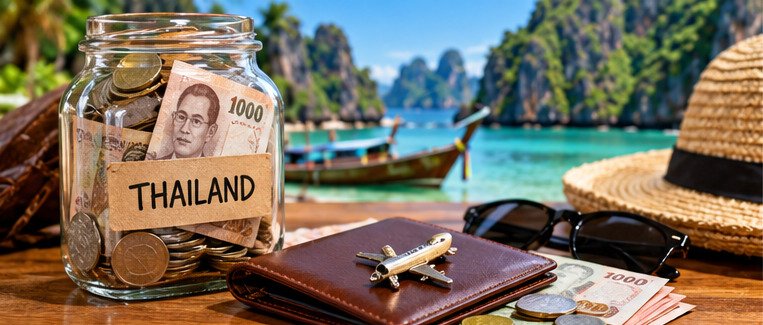
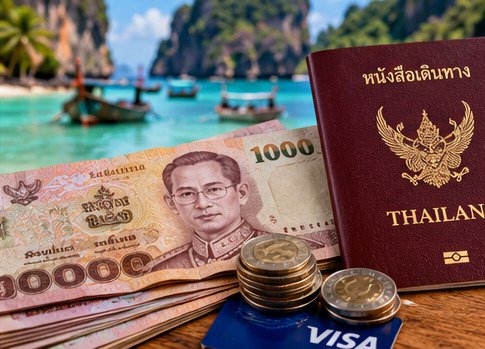
Original conceptual artwork: the cash arrangement illustrates planning, not a recommended storage method or genuine banknote details.
How much cash should you take to Thailand? Start by separating what the holiday costs from what you will actually pay in notes. A prepaid room, a card payment and a cash-only transfer belong in different parts of the calculation. Once those items are labelled, the amount to carry becomes much easier to judge.
This guide focuses on practical spending cash rather than repeating a complete country budget. It uses explicit daily assumptions and worked examples so you can substitute your own itinerary. The examples are not measured averages, and they do not assume that every traveller eats, stays or travels in the same way.
There is also an essential distinction at the border: a small everyday spending float is not advice about satisfying immigration proof of funds. Check those requirements separately before deciding what to bring. The planning approach here is research-led, with official financial and government information reviewed on 5 October 2026.
Calculate first
Unpaid cash expenses
Separate settled bookings, card payments and cash-only bills.
Carry sensibly
Fund the next stage
A two-week cash total is not a daily wallet target.
Protect the plan
An independent reserve
Keep backup funds distinct from ordinary spending.
Arrival check
Entry evidence is separate
A spending example does not replace immigration requirements.
How much cash should you take to Thailand? Start with three amounts
Your holiday budget is not your wallet balance
There are three different numbers to calculate: the cost of the whole trip, the cash you expect to spend during it, and the smaller amount you need to carry between opportunities to replenish it. A hotel paid before departure belongs in the first number but not the second. Tomorrow’s market lunch belongs in both the second and third. Treating these numbers as interchangeable is how people end up with either an unnecessarily thick wallet or no usable change.
For example, an expensive resort holiday can require relatively little everyday cash when accommodation, meals and transfers have genuinely been settled. Conversely, a modest guesthouse route can use cash frequently even though its total budget is lower. Therefore, do not copy a stranger’s cash allowance merely because your trips last the same number of nights.
Keep entry evidence separate
Spending convenience is not the only consideration on arrival. The Royal Thai Embassy in London currently lists proof of sufficient funds of at least THB20,000 per person among possible checks for visa-exempt visitors. This does not establish that a phone balance, credit limit or particular alternative is always accepted. Confirm the current evidence requirements for your passport, entry category and journey before deciding what to bring. [1]Amounts / assumptions checked 5 October 2026.
Build the cash calculation from your actual bookings
Sort every remaining expense
Make four columns on paper: already paid, payable by card, definitely payable in cash, and payment method unconfirmed. Start with the last column. A reservation confirmation is not necessarily a payment receipt, and a hotel that accepts cards for rooms may handle deposits or transfers differently. Ask the property what will actually be collected, in which currency and by which method.
Next, identify expenses that are shared. A private car may be priced per vehicle, while a ferry ticket is normally issued per passenger. Put the correct total into the party’s cash plan before dividing anything. Otherwise, a couple can accidentally budget two cars or only one person’s admission, with both errors concealed inside a tidy daily figure.
Use a replenishment formula
Suppose two people estimate THB1,200 a day in combined cash spending for four days, have THB800 of confirmed cash-only extras and want a THB2,000 reserve. Their working float is THB7,600. If they already hold THB2,100, the shortfall is THB5,500. These are arithmetic assumptions, not surveyed destination prices. The reserve should cover a plausible setback rather than an arbitrary percentage.Amounts / assumptions checked 5 October 2026.
A practical cash-only daily allowance
Choose what you will pay in cash
The table offers starting assumptions for cash spending after accommodation, major transport and principal activities have been paid or allocated to a suitable card. It is deliberately not a complete Thailand holiday budget. Food, small purchases and local journeys can move between cash and card depending on where you actually go.
On a small screen, scroll the table sideways.
| Cash-spending pattern | Working amount per adult per day | Assumptions to check |
|---|---|---|
| Light cash use | THB500-800 | Most substantial bills paid separately; simple small purchases |
| Mixed cash and card | THB800-1,200 | Several cash meals or small journeys; modest extras |
| Cash-heavy days | THB1,200-1,800 | More meals, transport and discretionary spending paid in notes |
| Special excursion or shopping day | Price individually | Add the actual unpaid amount, not another generic daily allowance |
Reviewed 5 October 2026. Financial tables distinguish published terms from illustrative calculations; examples are not live quotes.
Adjust the inputs, not the label
These are editorial planning ranges dated 5 October 2026, not claims about what every budget or luxury traveller spends. Select a starting amount, then test it against your own meal pattern and itinerary. A breakfast included in the room reduces one category; an evening of shopping increases another. Neither requires changing the whole trip into a different travel style.
Children also need their own assumptions. Do not mechanically halve an adult allowance when the main cost is a vehicle that costs the same for the family. Equally, a child who shares meals and has no paid activities should not automatically receive the adult cash total. Build family expenses by item where the difference matters.
Cash for seven, fourteen and twenty-one days
Estimate total cash use without carrying it all
A daily allowance becomes useful when you can see the likely trip total. However, the number below is the sum you might use over time, not the amount to place in a wallet at departure. It excludes the separate disruption reserve and individually priced extras.
On a small screen, scroll the table sideways.
| Daily cash assumption per adult | Seven days | Fourteen days | Twenty-one days |
|---|---|---|---|
| THB600 | THB4,200 | THB8,400 | THB12,600 |
| THB1,000 | THB7,000 | THB14,000 | THB21,000 |
| THB1,500 | THB10,500 | THB21,000 | THB31,500 |
Reviewed 5 October 2026. Financial tables distinguish published terms from illustrative calculations; examples are not live quotes.
For a couple using the middle assumption, fourteen days means THB28,000 of combined cash spending. They could still replenish in stages rather than hold that entire sum simultaneously. Their travel dates, available banking limits and safe storage should determine those stages, not an instruction to withdraw every few days regardless of cost.Amounts / assumptions checked 5 October 2026.
Count usable days properly
An overnight flight does not create a full day of destination spending, whereas a late flight home may require almost a complete extra day’s food and transport. List arrival and departure days separately. This is more accurate than multiplying the number of hotel nights by a daily figure and hoping the edges cancel out.
Likewise, record prepaid meals on excursion days. A tour that includes lunch can lower ordinary cash spending, but optional drinks, admissions or a transfer outside the pickup zone may replace the saving. Only remove an allowance when the inclusion is confirmed.
A worked two-week example for a couple
Start with a realistic payment split
Imagine fourteen usable days, with hotels and intercity travel settled. The couple plans combined cash spending of THB1,200 daily, two confirmed cash-only extras totalling THB1,600, and a separate THB3,000 disruption reserve. Expected ordinary cash use is THB18,400; available cash funding including the reserve is THB21,400. The unused reserve remains their money, not an expense to spend deliberately.Amounts / assumptions checked 5 October 2026.
Now divide the route into four city days, five inland days and five beach days. The couple should revise each stage for its actual unpaid items rather than assume equal consumption. An arrival transfer paid on the day increases the first stage; prepaid resort meals may reduce the last. This makes their cash schedule a map of obligations rather than a repeating daily number.
Recheck before each move
At the end of the first stage, compare the estimate with actual cash used. Include outstanding reimbursements between the travellers, otherwise one wallet may appear healthier simply because the other person paid every shared bill. Then recalculate the next stage from the cash still available.
What to prepare for your first twenty-four hours
Fund the arrival chain
Write down the route from the airport to the room, the next meal and the first morning’s plans. Decide which payments are already resolved and which remain uncertain. A traveller landing late should not depend on finding a particular exchange counter open or successfully registering a payment app while tired.
One option is to compare Suvarnabhumi-to-Bangkok transfer listings. Another is to use official airport transport information and pay locally. Compare the complete cost, meeting instructions, waiting arrangements and cancellation policy. A prepaid transfer only reduces the cash requirement when the relevant balance and extras have genuinely been paid.
Carry denominations you can use
A large note may cover the arrival budget mathematically while being inconvenient for a small purchase. Therefore, request a mixture when practical and keep a few smaller notes accessible. Do not assume a driver, stallholder or tiny shop can break the largest note immediately, particularly at the start of a trading day.
Keep the first-night address and the transport confirmation available offline. Airalo’s eSIM options can be a useful advance-data comparison, but the plan must suit the handset and its activation conditions. Data-only products do not automatically receive ordinary calls or bank verification texts. Your home banking access needs its own check. [2]
Where the cash requirement changes along the route
Cities, smaller stops and islands
The relevant question is not simply whether a place has ATMs. Ask whether a sensible replenishment point fits your route, opening-hour preferences and available time. A machine across town is less useful when you leave early with luggage, and a card accepted at one hotel says little about the next guesthouse’s payment arrangements.
Before an island leg, confirm the unpaid boat or transfer balance and any stated local fees. Compare Surat Thani-to-Koh Samui transport when that is your route, then read the actual origin, pier and transfer inclusions. A combined ticket and a pier-only ticket create different cash needs even when their destination label looks identical.
Do not let a booking platform answer the wrong question
For accommodation, use Bangkok stays on Booking.com to inspect the payment schedule, not merely the headline nightly price. Then ask the chosen property about deposits and accepted payment methods. A listing described as pay later does not, on its own, mean pay by whichever method you prefer on arrival.
The same check applies to Thailand accommodation on Agoda. A room reservation, a refundable card authorisation and an actual debit are different events. Record each appropriately. Keeping these distinctions clear can prevent a large double allowance for a bill that was already charged, or a shortfall for one that was not.
Arriving alone changes the backup calculation
Shared costs do not always halve
A solo traveller should not simply divide a couple’s cash example by two. A private transfer or an extra room during a disruption may cost the same for one person as for two, even though meals and admission tickets are individual expenses. Identify those fixed obligations before selecting the reserve. The relevant question is what you would personally need to fund, not the average spending of a larger party.
Keep one usable fallback independent
Without a companion’s wallet immediately available, the separation between everyday money and a backup becomes more significant. Keep a suitable second payment method and the official bank contact route accessible through a sensible independent arrangement. A trusted person at home can know the broad itinerary without receiving your PIN, banking password or security codes.
For the first night, I would prioritise a clear arrival route and confirmed payment arrangements over a marginal exchange saving. That is a planning preference, not a claim that solo travel requires unusually large cash holdings. The aim is to make the next essential payment possible while a problem is resolved, without turning the entire trip balance into money carried on the street.
What prepaying can genuinely solve
Move predictable expenses out of the wallet
Advance payment can reduce cash handling for a fixed, high-priority activity. For example, compare Bangkok activities on GetYourGuide when you already intend to book a structured city experience. Check whether admissions, transport, meals and optional extras are included; do not categorise the entire day as cash-free because one voucher is paid.
For a beach stage, Krabi activities on GetYourGuide can help identify which boat trips include transfers and which collect specified extras separately. Read the operator’s own wording. A payment marked excluded remains in the cash plan until you have confirmed another accepted payment method.
Preserve flexibility where it matters
Prepaying every possible day is not automatically a saving. You may exchange a cash-handling inconvenience for a cancellation penalty or an itinerary that cannot adapt. I would prepay important transport and genuinely desired experiences, while leaving room for weather, tiredness and local decisions.
Keep a small register of bookings with the amount paid, outstanding balance and cancellation deadline. The register need not be a spreadsheet; a phone note works. However, share it with your companion. A booking that only one person understands is less helpful during a lost-phone problem or an unexpected change of plans.
ATM withdrawals: fewer is not always better
Understand the fixed-fee incentive
The Bangkok Bank schedule checked for this guide lists THB250 for foreign-issued Visa withdrawals and THB350 for foreign-issued Mastercard withdrawals. These are selected local-bank charges, not the full cost of using every card at every Thai ATM. Your issuer’s fees and conversion method remain separate. [3]Amounts / assumptions checked 5 October 2026.
A fixed local charge creates an incentive to avoid repeated tiny withdrawals. For example, four withdrawals attracting THB250 each cost THB1,000 in local charges, while two cost THB500. That arithmetic is useful, but it does not establish that carrying more cash is always the better choice. Loss exposure, remaining needs and card limits also matter.Amounts / assumptions checked 5 October 2026.
Match the withdrawal to the next stage
Before pressing confirm, check the amount already held, the next known cash commitments and how much you are comfortable storing. Near the end of the trip, a smaller withdrawal with a relatively high fee percentage can still cost less overall than obtaining a large unwanted surplus and exchanging it back.
Likewise, read the currency-conversion screen deliberately. Visa distinguishes the local transaction from an offered home-currency conversion. Choosing THB normally leaves conversion to the card’s arrangements rather than accepting that separate offer; it does not remove the local withdrawal fee. Compare your own issuer terms rather than treating a button label as a universal saving guarantee. [4]
Should you bring pounds, baht or both?
Give each currency a purpose
Some travellers prefer to arrive with usable baht and replenish by card. Others carry a planned amount of home currency to exchange locally. Either can work when the all-in cost, documentation and storage are understood. There is no need to buy another foreign currency merely because an old forum says it exchanges well in Thailand.
For a UK traveller, compare the net baht from exchanging pounds directly with the net baht obtainable through the intended card. Buying dollars first creates a second conversion unless a genuinely better total can be demonstrated. A slightly more attractive headline rate can disappear once both exchanges and any collection costs are included.
Bring acceptable notes and identification
Superrich Thailand and SuperRich Currency Exchange (1965) publish their own documentation and exchange conditions. They are separate businesses. Confirm the intended branch, the notes you hold and the identification required before carrying a large cash sum there. A photograph of a passport should not be assumed to replace an original where the provider requires one. [5] [6]
Keep any pounds intended for exchange separate from the small baht spending wallet. Otherwise, paying for an inexpensive snack can expose money that has no role in that transaction. This separation is a practical habit, not a reason to buy expensive specialist equipment.
Organise cash so a small problem stays small
Use a working wallet and a separate reserve
The working wallet should contain the money you expect to use during the day, not every banknote you own. Store the remainder separately and avoid placing both payment cards with the same cash. Think through the loss of each single item: would you still have a way to pay, contact your bank and reach your accommodation?
An existing zipped compartment may be enough. Small cash organisers on Amazon UK are worth comparing only when they improve an awkward arrangement you already have. Check the dimensions against folded notes and cards; an oversized organiser that you constantly leave behind solves little.
Protect against ordinary travel conditions
For a boat-heavy route, compare Water-resistant document pouches on Amazon UK for splash protection and a closure you can operate reliably. Treat water-resistance claims cautiously, keep the pouch inside another bag and do not assume any consumer pouch makes valuables safe to leave unattended.
Count cash privately when convenient, retain withdrawal or exchange receipts until reconciled, and record your bank’s official contact route. These steps are more useful than constantly displaying or recounting money in public. Consult current FCDO advice for destination-specific security issues; no wallet system guarantees protection. [7]
Cash reserves for disruptions and deposits
Price a plausible setback
A reserve should answer a specific question: what would you need to pay before your normal arrangements were restored? Consider an extra night, a replacement local transfer, meals during a delay and a temporary payment-method failure. Some of these may be payable by card, so the entire reserve does not necessarily need to be banknotes.
In a worked planning example, an extra room at THB2,000, replacement transport at THB1,500 and meals at THB500 total THB4,000. Those figures are assumptions dated 5 October 2026, not quoted local prices. Replace them with realistic amounts for your actual accommodation level and route before choosing a reserve.
Keep deposits visible but separate
A refundable deposit is not ordinary spending, yet it can reduce available money until returned. Ask whether the property takes cash or a card authorisation, what documents are issued and when the money or authorisation is released. Do not assume a card refund is immediately available for the next payment.
Similarly, an expected insurance reimbursement is not cash currently accessible. Keep records for a possible claim, but plan how to fund necessary payments while the claim is considered. The cash reserve and travel insurance serve different purposes; one does not replace the other.
Check the border rules before carrying a large sum
Declaration is not the same as a spending allowance
Thai Customs currently specifies declaration for foreign currency above the equivalent of USD15,000 and Thai currency above THB450,000, with an additional combined-currency threshold above THB450,000. There are also separate controls on exporting Thai currency; taking more than THB50,000 to destinations such as the UK requires permission. These are not interchangeable limits. [8]Amounts / assumptions checked 5 October 2026.
For Great Britain, GOV.UK requires declaration when taking GBP10,000 or more between Great Britain and a country outside the UK; combined family or group holdings can count. Northern Ireland rules differ. Check the precise route and current official procedure rather than splitting cash between travellers to assume a declaration disappears. [9]Amounts / assumptions checked 5 October 2026.
Avoid learning the wrong rule from an old page
Older guidance can show a different Thai foreign-currency threshold. This article prioritises current Customs information, while recognising that declarations, export permission and immigration proof of funds answer different questions. A small holiday spending allowance does not exempt someone from another applicable requirement.
Most routine cash plans will be far below these declaration figures. Nevertheless, a long stay, family pot or onward journey can make them relevant. When close to a threshold or carrying mixed currencies, obtain current official guidance before departure rather than relying on a rough mental conversion at the airport.
Adjust the plan without turning the holiday into bookkeeping
Review cash at useful checkpoints
A brief review before changing accommodation is usually more useful than accounting for every coin after every purchase. Note the cash remaining, upcoming unpaid items and the next practical chance to replenish. Then compare the actual pace of spending with the original assumption and adjust only what needs changing.
For a shared holiday, decide whether one person runs the common cash pot or each pays separate categories. Neither arrangement is inherently better. What matters is not mistaking a transfer between the two travellers for fresh spending, or counting a reimbursement twice when reconciling the day.
Spend down carefully near departure
During the final few days, distinguish useful remaining cash from a surplus you are trying to get rid of. Keep enough for confirmed transport, food and a modest disruption margin. Then use ordinary planned purchases to reduce the excess, rather than buying souvenirs simply because cash remains.
Allow for provider rules if exchanging leftover baht. Coins may not be accepted for exchange, and a second conversion has its own rate spread. Consequently, a sensible end-of-trip cash estimate can save more than repeatedly chasing tiny rate differences earlier in the holiday. [5]
Turn a three-day spending log into a better estimate
Record enough detail to spot the cause
For the first few days, record the main cash categories rather than every tiny item. Suppose a traveller starts with THB5,000 and spends THB650, THB1,050 and THB800 on three successive days. The remaining ordinary balance is THB2,500 and the average is about THB833 a day. These are invented bookkeeping figures for a planning exercise, not observations of typical Thai spending.Amounts / assumptions checked 5 October 2026.
However, the average alone can mislead. If the middle day included a one-off THB400 purchase, ordinary recurring use was lower. If tomorrow includes a cash-only transfer, it will be higher again. Mark the unusual items before carrying the average forward. That extra minute prevents a short sample from turning an exceptional day into the budget for the entire trip.Amounts / assumptions checked 5 October 2026.
Reconcile the actual notes
Compare the recorded balance with what is physically available. Missing entries may be a shared meal, a cash deposit, a reimbursement or an exchange between wallets, rather than mysterious overspending. Keep the reserve out of the daily calculation unless you consciously use it; otherwise the apparent balance will make routine spending look more affordable than intended.
A companion can maintain the list while the other person pays, but both should understand the system. Agree in advance whether gifts, shopping and solo activities come out of the common pot. This is particularly useful for groups whose members have different budgets: a shared cash fund should not silently subsidise spending that some travellers never agreed to.
Cash-only accommodation and longer stays
Deal with the largest obligation first
An unpaid room balance can dwarf several days of food spending. Obtain a written answer about the amount, due date and payment method before arrival, especially when an independent property has requested cash. Confirm whether taxes, any deposit and an agreed transfer are included, then retain the receipt after payment. Do not treat an informal message from an unfamiliar number as sufficient proof that the payment instructions changed.
For a longer stay, agree the payment schedule rather than arrive with the entire rental balance in notes by default. A legitimate staged arrangement, documented card payment or other accepted method may reduce cash exposure. Nevertheless, use only the options actually offered by the provider; do not assume an overseas bank transfer is quick, inexpensive or available without checking the bank and recipient details.
Make the plan accessible to the people using it
Someone who finds touchscreens, small print or unfamiliar bank machines difficult may reasonably choose a different replenishment routine. A staffed branch or exchange counter during opening hours can be preferable to a late-night ATM stop, even when the headline cost is slightly higher. Build that preference into the itinerary rather than treating it as an avoidable inconvenience on the day.
Likewise, families with young children or travellers moving with substantial luggage may value one planned cash stop over several spontaneous ones. The aim is not to prove you can obtain money at the last possible moment. It is to keep the practical payment tasks proportionate to the holiday, with enough independence that one tired person is not responsible for every decision.
Pros and cons of the main cash strategies
A cash-heavy approach can make small payments simple, but brings storage and loss concerns. A card-heavy approach reduces physical cash handling, yet depends on acceptance, working equipment and understood charges. My research-led preference is a mixed arrangement with a defined cash job and a genuinely independent backup, rather than loyalty to one payment method.
Common cash-planning mistakes
Counting a reservation as a payment
Check whether the money has actually been collected and whether anything remains due locally. The same mistake affects rooms, transfers and activities. A saved confirmation is evidence of a booking, not necessarily evidence that the cash requirement has disappeared.
Taking the whole holiday budget out every day
A day bag does not need to fund every remaining night of the trip. Separate the daily amount from the reserve and avoid reorganising large bundles in public. Meanwhile, make sure the companion who does not carry the main wallet still has a practical way to pay.
Forgetting issuer limits and verification
A card that works for purchases can still have a lower cash limit or require an authentication method that becomes awkward abroad. Test access, record the relevant limits and keep official contact details before travelling. Do not wait until the first declined transaction to discover how account recovery works.
Saving a fee by creating a bigger problem
Withdrawing too much to improve the percentage cost can leave an expensive surplus or more cash than you can comfortably manage. Compare the whole decision: fees, conversion, convenience, storage and the cost of exchanging unused money. The smallest fee percentage is not automatically the smallest holiday cost.
Frequently asked questions
Is THB10,000 enough cash for two weeks?
It may cover part or all of a light cash-spending plan, but the number means little without knowing what is already paid. At an illustrative THB700 per day, fourteen days use THB9,800 before special extras or a reserve. Accommodation, excursions or a transfer payable in cash can change the answer immediately. Separately, do not confuse this spending calculation with any entry proof-of-funds requirement.Amounts / assumptions checked 5 October 2026.
How much cash should a couple take?
Calculate shared bills once and individual spending twice where appropriate. Then choose how many days to fund at a time. For example, combined cash use of THB1,600 daily over three days is THB4,800 before known extras and a reserve. That is an illustrative working float, not a claim about average couple spending or sufficient entry evidence.Amounts / assumptions checked 5 October 2026.
Can I rely entirely on a phone and a payment card?
I would not make that the only arrangement for a varied trip. Confirm payment acceptance with the businesses you intend to use and keep usable cash for small or unexpected transactions. A phone failure can also affect banking, maps and booking confirmations simultaneously, so an independent backup matters even when most planned purchases are electronic.
Should I exchange all my money at the airport?
Not automatically. Compare the amount needed immediately with the available net quote and the practicality of exchanging later. Funding the first stage can be sensible without committing the whole holiday balance. Equally, a special journey to obtain a marginally better rate may cost more than it saves. Use the total baht received after travel and fees as the comparison.
Does a fee-free card make every withdrawal free?
No. A card issuer can waive its own charge while a Thai ATM operator still adds a local fee. Withdrawal limits, conversion and excess-allowance charges may also apply. Read the issuer terms and the machine’s confirmation screen separately rather than treating a marketing headline as a description of the complete transaction.
Should I keep all the cash in the hotel safe?
There is no storage method that fits every room or guarantees protection. Use the most appropriate secure arrangement available, keep the working amount separate, and consider what happens if either your room access or day bag becomes unavailable. Do not place every card, all cash and all account-recovery information in one location simply because it seems convenient.
What should I do with money left at the end?
First retain enough for the remaining journey and a sensible disruption margin. Then compare using it for planned purchases with exchanging the surplus through an appropriate provider. Do not manufacture spending to avoid taking notes home. Small coins may be harder to exchange, so think about change during the final ordinary purchases rather than at the departure gate.
The cash plan I would use
I would start with confirmed entry requirements, then create a separate spending plan based on the actual route. Accommodation and major travel would have clear payment labels, the next stage would have a calculated cash float, and a reserve would be kept distinct from everyday spending. This is planning judgement drawn from the sources and examples above, not a report of a personal trip.
Before each move, I would check the balance and upcoming commitments rather than withdraw by habit. A suitable card, working account access and a separate backup would support the cash plan without pretending that every business accepts every payment method.
The useful answer to how much cash you should take to Thailand is therefore a calculation, not one magic number: meet entry requirements, fund the cash expenses you can identify, allow for a realistic interruption and replenish sensibly. That approach remains useful even when your hotels, spending style or bank fees change.
Sources and fact-checking notes
- Royal Thai Embassy London: visa-exemption and visa-on-arrival schemes
Proof-of-funds information is separate from this guide's spending-money examples; confirm evidence accepted for your passport and route. Reviewed 5 October 2026.
- Airalo Help: calls, texts and data-only plan types
Many packages are data-only. Read the individual plan rather than assuming bank SMS or ordinary voice calls are included. Reviewed 5 October 2026.
- Bangkok Bank: fees schedule, 27 July 2026, ATM section page 25
Foreign-issued card-network charges; the relevant table was visually checked. Reviewed 5 October 2026.
- Visa: dynamic currency conversion and the cardholder's choice
Separates local-currency payment from an offered home-currency conversion. Reviewed 5 October 2026.
- Superrich Thailand: exchange questions and documentation
Passport or qualifying ID, cash-exchange information and coin limitations. Reviewed 5 October 2026.
- SuperRich Currency Exchange (1965): frequently asked questions
Original valid identification, cash-exchange commission policy, branch differences and payment restrictions. This is a separate business from Superrich Thailand. Reviewed 5 October 2026.
- FCDO: Thailand safety and security
Country travel advice; practical storage suggestions in the article are editorial precautions, not guarantees. Reviewed 5 October 2026.
- Thai Customs: currency declaration system and cash thresholds
Current Customs guidance is used rather than older embassy pages showing a different foreign-currency threshold. Declaration and export permission are different obligations. Reviewed 5 October 2026.
- GOV.UK: taking cash in and out of the UK
Great Britain and Northern Ireland have different rules. Family or group totals can matter. Reviewed 5 October 2026.
Illustrations in this article were created for Taylor’s Trailblazing Travels. Third-party photographs, where used, are credited beside the image or in the source list.