Thailand by month / January
Thailand in January
Build a winter escape around the right coast, comfortable sightseeing days and enough time between stops.
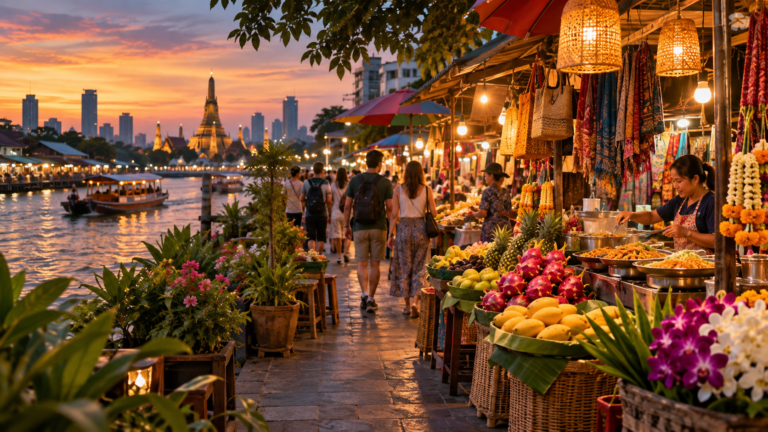
Original conceptual illustration. January-inspired scene, not a weather forecast or a claim that a particular beach will be calm.
Thailand in January is a useful starting point for a first trip because several different experiences can fit the same holiday: a few days in Bangkok, cooler northern mornings and time on the Andaman coast. However, the month does not give every part of the country the same weather. A mountain sunrise and an afternoon beside the sea require different expectations, clothes and daily pacing.
The best January itinerary is not necessarily the one with the most famous stops. It is the route that leaves enough time to enjoy them without depending on a perfect sequence of flights, road transfers and ferries. Choose a small number of bases, understand the regional differences and leave the most weather-sensitive activities flexible.
This guide uses official seasonal descriptions and the historical normal columns of a Thai Meteorological Department bulletin. Those numbers describe regional averages over 1991-2020, not a forecast for your travel dates or a promise for January 2027. Destination priorities, itineraries and budget examples are research-led planning judgements rather than claims of personal visits or measured price surveys.
Balanced first trip
Bangkok, north, Andaman
Combine different experiences without crossing between both southern coasts.
Packing difference
A northern warm layer
A mountain dawn can feel very different from an island afternoon.
Beach judgement
Prefer coast-specific data
January is not equally dry everywhere in southern Thailand.
Booking priority
Protect the main connections
Secure awkward dates and room requirements before optional day trips.
Thailand in January: who the month suits best
A balanced first visit rather than a single-purpose expedition
January is particularly useful when you would like to combine cities, northern culture and a beach stay. TMD describes upper Thailand as being in its cooler part of the year, while the south remains moderated by surrounding seas. That provides a sensible starting framework for a varied holiday, although daytime sightseeing can still be hot. [1] [2]
The month suits travellers willing to make a few key bookings once their dates are firm. You can keep individual meals and outings spontaneous without leaving every long-distance connection or family room to chance. This is especially valuable when your international flights fix the beginning and end of the trip.
When a different plan may be better
A holiday focused entirely on the Gulf islands needs a more careful January weather comparison than a simple claim that Thailand is dry. Likewise, someone whose main aim is mountain views should consider air quality as well as temperature. A dry day does not automatically provide a clear view or clean air. [1] [5]
Travellers who dislike moving can still enjoy January without combining three regions. Bangkok with one beach base is a complete holiday, not an inferior version of a north-to-south circuit. Let the amount of rest you need determine the number of stops.
Read January weather by region
What the historical numbers actually mean
The table uses the 1991-2020 normal columns in TMD’s published January-March bulletin. The temperature values are regional mean daily minimums and maximums, not the full range of temperatures you might experience. Rainfall is the historical monthly total, not an amount assigned to every individual resort. [1]
On a small screen, swipe the table sideways to read every column.
| Region | Mean daily minimum | Mean daily maximum | January rainfall |
|---|---|---|---|
| Northern Thailand | 16.2°C | 31.2°C | 10.6 mm |
| Northeastern Thailand | 17.6°C | 30.7°C | 6.5 mm |
| Central Thailand | 19.8°C | 32.7°C | 7.1 mm |
| Eastern Thailand | 22.0°C | 32.2°C | 22.9 mm |
| Southern east coast | 22.7°C | 30.5°C | 112.0 mm |
| Southern west coast | 23.2°C | 32.6°C | 50.2 mm |
| Bangkok and vicinity | 22.8°C | 32.3°C | 21.8 mm |
Turn the table into a choice, not a guarantee
The most useful contrast is between cooler northern nights and consistently warm southern conditions, plus the wetter January normal on the southern east coast. It does not follow that one entire coast will be dry throughout your stay or that the north never gets rain. Check TMD’s current forecast as departure approaches. [4]
Northern Thailand: enjoy the contrast between morning and afternoon
Use a city base before adding remote stops
Chiang Mai is a practical northern base for a first itinerary because it lets you combine urban sightseeing with separately planned outings. Rather than changing hotels every night, give the base enough time to absorb a slower arrival day, a local day and an outdoor day chosen around conditions.
TAT highlights northern mountains, mist and seasonal flowers in January, but these are opportunities rather than timed performances. Blooming and visibility vary by place and year. Do not make an entire trip depend on a particular hillside matching a promotional photograph on one morning. [3]
A mountain dawn is not the city average
Regional averages cannot describe every elevation and exposure. The northern minimum in the table should not be treated as a minimum at a summit. Check the forecast for the altitude and departure time of a mountain outing, and take a layer that remains useful after the sun comes up. [1]
Allow an easy afternoon after an early start. A sunrise trip, long drive and full evening programme can become an endurance exercise rather than a holiday. Choose the feature that matters most, then leave room for a warm drink, a slower lunch and an unplanned stop.
Bangkok: arrange sightseeing around neighbourhoods
Keep one part of the city together
January can make outdoor sightseeing more appealing than in hotter periods, but the Bangkok regional normal still has a daily maximum above 32°C. Treat shade, water and indoor breaks as part of the day rather than precautions reserved for the hot season. [1]
Group nearby sights and meals instead of crossing the city for every recommendation. A morning of temples followed by a relaxed riverside lunch is easier to manage than several distant appointments. Before setting a rigid schedule, check the actual opening arrangements, dress requirements and transport for the attractions you choose.
Use evenings without overfilling the day
An evening food walk can be a good contrast to daytime sightseeing. Compare Bangkok food-walk options by meeting point, walking distance, group size and dietary arrangements. A guided evening is useful when it solves a practical need; it is not compulsory to enjoy dinner in the city.
Leave some energy for the journey back. Choose a base with an understandable return route and avoid booking an early departure immediately after a late-night activity. The number of sights ticked off matters less than whether the day remains comfortable for everybody travelling.
The Andaman coast: choose a base with a purpose
Phuket, Krabi and Koh Lanta are different holiday shapes
For a beach-led stay, compare how much movement each base requires. A resort area with nearby restaurants can reduce daily transport, while an island-hopping base may encourage more boat trips. Neither is automatically better; the right answer depends on whether you prefer a settled holiday or frequent excursions.
The TMD normal shows lower January rainfall on the southern west coast than on the southern east coast. That supports considering the Andaman side for a first January beach stay, but it does not establish the conditions at a particular bay. Sea warnings and beach flags still govern swimming and boating. [1] [8]
Stay long enough to have a second chance
Five nights in one beach base gives more room to choose a suitable boat day than two nights followed by another transfer. Keep one attractive land-based alternative and avoid placing every activity on the first full day. A rest morning or local meal is not wasted time.
Compare Krabi accommodation using the real location, beach access and cancellation conditions. Do not select a room solely by a wide-angle sea photograph. Ask how you reach restaurants, whether the beach is directly accessible and what transport is needed for the outings you actually intend to take.
The Gulf islands: a possible choice, not a universal January default
Read the east-coast difference honestly
The southern east-coast normal in the table is wetter in January than the west-coast normal. TMD’s seasonal descriptions also explain the distinct influence of the northeast monsoon on southern weather. That makes coast-specific planning more useful than a nationwide dry-season label. [1] [2]
This does not mean Koh Samui, Koh Phangan or Koh Tao cannot be enjoyable. It means you should choose them for reasons beyond an assumption of guaranteed sunshine, and keep boat-dependent days flexible. A comfortable base with alternatives matters more when a particular crossing or excursion may change.
Be careful with a short island chain
Trying to fit several Gulf islands into a few nights makes each transfer disproportionately important. If weather affects a ferry, the whole sequence can become difficult. For a short holiday, consider one island or a longer stay rather than a fast checklist of beaches.
Do not add a Gulf island to an Andaman itinerary simply because both look nearby on a national map. The road and sea connections can consume much of a day. Choose one coast for a shorter trip unless the cross-coast journey is itself part of a deliberately slower plan.
Mainland beach alternatives and eastern routes
A coast without a ferry can simplify the holiday
A mainland beach stay can be useful for travellers who want less luggage handling and fewer sea-dependent transfers. Consider the practical road or rail journey, the local area and how you will reach meals and activities. A beach hotel that needs a car for every outing may be less convenient than its map position suggests.
For a family or anyone with mobility needs, ask about the route from room to pool, restaurant and beach. A property being close to the sea does not establish that the paths are step-free or that the swimming area is supervised. Obtain answers to your specific requirements before payment.
Weather does not override regional travel advice
For eastern routes and any journey towards international borders, check the current FCDO regional advice for the exact province, road and destination. Conditions and restrictions can change independently of the season. A January weather advantage does not make a route appropriate when official warnings advise otherwise. [6]
Keep this check close to booking and repeat it before departure. Do not rely on a month-by-month article to reproduce a moving warning map indefinitely. The linked official page is the place to resolve the current boundary and the effect on your own itinerary and insurance.
Air quality: include it in the northern decision
Dry weather and clean air are not the same measure
The FCDO warns that Bangkok and Chiang Mai can experience high pollution and seasonal smoke haze, which may worsen some health conditions. Check current readings and relevant health guidance as well as the weather forecast. A sunny icon does not describe particulate levels. [5]
January should not be described as automatically smoke-free. Equally, a poor reading on one date does not prove the conditions for every future January visit. Keep the northern element adaptable enough to change outdoor plans, and seek individual medical advice if air pollution is particularly relevant to your health.
Make the alternative useful before you need it
Choose accommodation where an indoor break is comfortable, and avoid committing every day to exposed viewpoints or strenuous walking. Have a city-based option that you would enjoy regardless of visibility. Check cancellation terms for a remote excursion when the main purpose is a clear panorama.
For a mixed-region itinerary, consider how the order would change if the north became unsuitable. You may not need to rearrange anything, but understanding the alternative in advance makes the decision less pressured. Flexibility is a tool for changing a plan, not a guarantee that all extra costs will be covered.
A two-week January route with thirteen nights
The balanced route
On a small screen, swipe the table sideways to read every column.
| Days | Base and nights | Main purpose | Planning note |
|---|---|---|---|
| 1-3 | Bangkok, 3 nights | Recover from arrival, explore a few connected neighbourhoods. | Keep the first day light and leave one flexible block. |
| 4-7 | Chiang Mai, 4 nights | Northern culture and one selected outdoor excursion. | Check air quality and the mountain forecast separately. |
| 8-12 | Krabi area, 5 nights | Beach time and a boat day chosen around conditions. | Confirm the available flight route before selecting the room. |
| 13 | Bangkok, 1 night | Position for the international departure. | Choose the correct airport area or a reliable transfer plan. |
| 14 | Depart | Travel home. | No island crossing is required that morning. |
Why these nights are not split further
The route gives each region a reason to exist. Bangkok is more than an arrival lounge, the north has time for an unhurried day, and the beach stay can absorb a changed activity. Adding another island or a second northern city would take time from those purposes.
A direct internal flight may not suit every date or fare. Where a connection is needed, compare the total journey and avoid arriving so late that you need an unplanned final boat transfer. The sample works only when the transport is arranged to support it, not when a timetable is forced around attractive hotel photographs.
Shorter and longer trips: change the number of regions
Seven or ten days need fewer bases
For a seven-day trip, choose Bangkok plus one other region, or stay in one region and explore from a stable base. Two or three nights in a city and the remainder at a beach can feel more complete than a compressed north-and-south circuit. Arrival and departure days should not be counted as full sightseeing days.
With ten days, the same two-region approach gives extra breathing room. Spend it on a slower beach stay, a second local day or a useful final-night buffer. Do not automatically convert every additional night into a new destination and another packing session.
Three weeks allow depth rather than constant movement
An extra week can support a second northern base or a longer coastal stay. Add it where the journey is straightforward and the new place offers a different experience. Keep at least some multi-night stops so laundry, rest and weather changes can be handled without disrupting the whole route.
For example, compare whether another northern city is genuinely more valuable than an additional unplanned day in the first one. The answer depends on your interests, not a universal list of essential stops. A longer itinerary should become more comfortable, not merely more complicated.
Book transport in the order that protects the route
Start with the difficult connections
If adding Chiang Rai, check the Chiang Mai to Chiang Rai journey and consider whether the transfer suits your remaining nights. A city that looks close on a national map still needs a practical arrival, check-in and return plan. Decide what you will remove before adding another stop.
Keep coastal transfers visible
Compare Phuket to Krabi transport and Krabi to Koh Lanta options only when those movements are part of your chosen route. Read the operator, pickup point, baggage terms and whether a land or sea segment is involved. Similar destination labels can refer to very different arrivals.
Do not assume a booking marketplace protects separately purchased connections. Keep a margin where the next leg matters and confirm current times with the operator. For an international flight, leaving a boat-dependent base the day before is a useful conservative planning choice, not a mandatory rule for every traveller.
Choose hotels around the January routine
City rooms should make daily movement easier
Compare Bangkok rooms by the places you expect to visit and the return journey after dinner. A low room price may be poor value when it requires several long transfers a day. Check reception hours, luggage arrangements and the exact room type rather than assuming every rate includes the same facilities.
In the north, compare Chiang Mai accommodation for the neighbourhood you prefer, not simply the first result with a pool. Think about evening noise, access for day-trip pickups and whether a quieter day at the property would be comfortable if outdoor conditions are poor.
Read the conditions attached to your exact room
A photograph of a balcony or family space may belong to another room category. Check the booked configuration, cancellation deadline, meal basis and any deposit arrangements. Where a specific feature matters, ask the property directly and keep its reply.
January planning is easier when the accommodation matches the daily rhythm: a comfortable arrival, a practical return after dinner and a manageable departure morning. A spectacular room that creates transport problems can make an otherwise simple route feel difficult.
Build a budget from components, not a promised daily average
A worked example for two people
The table is illustrative planning arithmetic prepared on 05 October 2026, not a survey of January prices or a set of live quotes. It assumes two people sharing one room, thirteen nights and fourteen days. Replace each assumption with the rates and activities you actually choose.
On a small screen, swipe the table sideways to read every column.
| Component | Assumption | Calculation | Model total |
|---|---|---|---|
| Accommodation | THB 2,400 per room per night | 13 nights x THB 2,400 | THB 31,200 |
| Meals and ordinary drinks | THB 1,600 per couple per day | 14 days x THB 1,600 | THB 22,400 |
| Local transport | THB 800 per couple per day | 14 days x THB 800 | THB 11,200 |
| Activities | A chosen whole-trip allowance | Fixed example allowance | THB 10,000 |
| Subtotal | Before excluded items | Sum of the four components | THB 74,800 |
International flights, internal flights or other long-distance journeys, insurance, shopping and contingency are excluded from that subtotal. Add them separately. The purpose is to show how a total is built, not to claim that this amount buys a particular standard of holiday in every destination.
Test the expensive choices first
Obtain actual room and internal-transport prices for the fixed dates before refining a food allowance. A single change to the room type or flight can matter more than small daily savings. Compare the whole itinerary with the available budget rather than trying to rescue an unaffordable route through unrealistic meal assumptions.
Keep a contingency appropriate to the trip and personal circumstances. It should cover a manageable change without encouraging unnecessary spending. No universal percentage can guarantee that every cancelled ferry, medical problem or changed flight will fit inside the amount set aside.
Understand where January spending can rise
Busy dates make flexibility valuable
Around the New Year period, investigate the actual availability and conditions of the room you need before assuming that a late search will produce an equivalent option. Family layouts, connected rooms and specific accessible features deserve particular attention because substitutes may not meet the same need.
There is no verified nationwide percentage premium in this guide. Prices depend on dates, destination, room and booking conditions. Compare several acceptable alternatives for the same nights and judge the total cost, including the transfers created by a more remote property.
Avoid buying flexibility twice without a reason
A flexible room, changeable flight and extra buffer can each solve a different problem, but examine what you are paying for. A refundable booking that becomes non-refundable before the relevant decision date may not provide the flexibility you expected. Read the deadline rather than just the word “free”.
For tours, compare what is included and whether the operator supplies the equipment you need. Do not buy a bundle simply because the number of inclusions sounds generous. The useful value is the part you will actually use, with conditions you understand.
Choose activities that work with the season
Put the weather-sensitive outing in a flexible slot
A mountain viewpoint, island excursion or boat transfer should not be the only worthwhile event in a short stay. Place it early enough that there may be another opportunity, but keep an enjoyable alternative. Current weather and local restrictions still determine whether it runs. [4] [8]
Compare Chiang Mai excursions by journey length, group size, actual stops and the amount of walking. A long list of attractions can mean spending much of the day in a vehicle. Choose the outing whose main feature you care about rather than the one that promises the most names.
Ask what the boat day requires of you
Review Krabi island-tour options for the real operator, departure point, life jackets and cancellation terms. A marketplace listing does not inspect the vessel on your behalf. Consider your swimming ability and whether staying aboard or skipping an activity is possible. [8]
For diving, place the activity early enough to allow the appropriate interval before flying, and follow the dive centre’s screening and specialist advice. Do not treat the final transfer day as a spare slot for another dive simply because the flight leaves in the evening. [12]
January 2027: separate dates from event programmes
New Year does not make the whole month identical
The first days of January and a later mid-month stay can require different booking decisions. Check the actual hotel, transport and attraction arrangements for your dates instead of treating every January day as a public holiday or every later date as quiet. A fixed date is not a complete operating schedule.
For an arrival around New Year, confirm the late check-in and transfer rather than assuming the usual service arrangement applies. Keep the first full day adaptable. A long flight followed by a tightly booked morning is avoidable pressure, even when the weather is attractive.
Lunar New Year is not in January 2027
The Hong Kong Observatory’s 2027 calendar places the first day of the first lunar month on 6 February. Therefore, do not copy a January Lunar New Year itinerary from another year into January 2027. The calendar establishes the date, not the programme of celebrations in a particular Thai neighbourhood. [7]
Seasonal flower displays and local events also need current announcements. Treat a tourism article describing annual highlights as inspiration, then check the organiser’s actual dates and access information before paying for travel built around that event. A recurring attraction is not a guaranteed performance on your preferred morning.
Pack for warm days and a few cooler settings
Build a small, adaptable wardrobe
Take light clothes that work for repeated wear and laundry, plus an outfit appropriate for the temples or formal venues you plan to visit. Add a useful warm layer for northern mornings and air-conditioned transport. The aim is compatibility between activities, not a different outfit for every photograph.
A lightweight fleece may suit a northern itinerary, while a compact daypack keeps the layer, water and daily essentials manageable. Compare fit and weight with what you already own. These are functional categories, not products tested for this guide.
Keep beach protection separate from the cold-morning layer
A packable sun hat, suitable sunscreen, swimwear and comfortable footwear remain useful even when the trip begins with a chilly dawn. Add a rain layer and protect important documents from spills or boat spray. Low historical rainfall does not mean that luggage can be left unprotected.
Check the baggage allowance for every carrier before packing around the most generous international ticket. Keep necessary medication and documents accessible on travel days. A smaller bag can make repeated transfers easier, but only if it still contains the items that matter for your circumstances.
Health and connectivity belong in the plan
Do the preparation before a busy travel week
Check current travel-health advice and arrange any necessary professional consultation well before departure. Declare relevant conditions to the insurer and confirm that planned activities are covered. A winter escape does not remove the need to consider heat, insect exposure, medication rules or access to care. [5] [9]
Build ordinary breaks into sightseeing days. Shade, drinking water and a slower afternoon are useful even when the morning feels pleasantly cool. Ask for individual medical advice where necessary rather than relying on a general travel article to set a fluid target or decide whether an activity is appropriate.
Keep the phone useful without depending on it completely
Compare Airalo options for maps and messages after checking compatibility, validity and what the plan includes. Data-only service is not automatically a normal calling line, so keep an alternative for important calls and account verification. Download essential bookings and addresses before leaving a reliable connection. [11]
Do not make every arrival depend on opening a fresh email at the kerb. Save the first hotel’s address, transfer instructions and the contact number offline. For a group, make sure more than one person can access the essential information.
Adapt the route for families, couples and limited mobility
Give everyone a reason to enjoy the base
A couple may value a quiet evening area, while a family may need easy meals and a dependable pool routine. Someone with limited mobility may care more about a step-free route than a high viewpoint. Ask each traveller what makes an ordinary day comfortable before adding extra excursions.
January’s variety does not require everyone to do the same amount of walking. Use a shared base and allow optional outings where practical. An unhurried breakfast or a shorter activity can make the whole trip more enjoyable than asking the least energetic person to keep pace with the longest schedule.
Confirm the awkward transition points
Ask about vehicle access, stairs, boat boarding and luggage handling before booking a route with several changes. A journey described as a transfer can include waiting areas and uneven surfaces that are not obvious from the headline. Written answers to specific questions are more useful than a general suitability label.
For younger children, protect the arrival and departure days from unnecessary activity. For older relatives, allow time to rest after long transport. These choices are not limitations on the holiday; they are the design decisions that let everybody enjoy it.
A relaxed January day has a deliberate shape
Example: northern sightseeing without a dawn-to-midnight schedule
Choose either an early mountain outing or a full city morning, rather than automatically combining both. Have a simple breakfast plan, carry the layer needed for the departure time and leave space after lunch. If visibility or air quality makes the outdoor plan unattractive, use the city-based alternative already chosen.
Keep the evening close to the accommodation after a long drive. A booked performance or distant dinner can be enjoyable, but it should not force a rushed return from the day’s main activity. The purpose of the example is pacing, not an official timetable for a particular attraction.
Example: a coastal day with options
Check the local forecast and beach warnings, then choose the day’s activity. On a suitable boat day, keep the rest of the schedule light enough to absorb a later return. On another day, use the beach or pool only where conditions and supervision allow, with a shaded meal or short local outing as an alternative. [4] [8]
Avoid promising the same experience every morning of the stay. A holiday with several enjoyable options is more resilient than one built around a single photograph. That resilience is often worth more than adding another destination to the booking list.

The final checks before departure
Reconfirm the facts that can change
Read current FCDO advice for the actual route, review the latest Thai weather information and check airline or operator messages. Verify entry requirements for your nationality and document type, using the official route rather than an old social-media checklist. A January travel article cannot guarantee that next year’s administrative rules will be unchanged. [4] [6] [10]
Check the arrival airport and the departure airport separately when travelling through Bangkok. Then review the transfer and the correct hotel address. Similar-looking booking summaries can conceal an inconvenient airport change or a room in the wrong part of the city.
Keep one page of essentials
Save flight references, the first accommodation, local contacts, insurance details and the planned route somewhere accessible offline. Make sure a companion or trusted contact can find them. Keep the daily sightseeing list separate so the essential information is not buried under restaurant ideas.
At the same time, remove bookings that no longer fit. A cancelled room or superseded transfer left beside the current confirmation can create avoidable confusion. The final preparation should make the trip simpler, not add another long list of things to remember.

Let the arrival and departure airports support the route
Compare a return ticket with a different-airport departure
Before fixing the internal itinerary, compare the journey home from the region where you intend to finish. Arriving in Bangkok and leaving from a southern airport can sometimes remove a return positioning leg, but only when a suitable international itinerary actually exists for your dates. Compare the total fare, baggage, connection and transfer requirements rather than assuming a different-airport ticket is automatically cheaper.
A Bangkok return can still be the better option when it offers a more convenient long-haul journey or fits a redemption booking. In that case, accept the final positioning night as part of the plan instead of pretending it is an unnecessary loss of beach time. The value is a calmer departure and less dependence on several separate services on the same morning.
Check which journeys are on one ticket and which are independent. A shared booking email does not necessarily establish the protection you expect across different purchases. Ask the issuing airline or agent about missed connections and changes, then keep the answer with the current itinerary.
Give a long-haul arrival a manageable first day
A flight landing early does not necessarily mean the hotel room is available immediately. Ask about luggage storage and the actual check-in arrangement. Choose a simple meal and a nearby low-pressure activity for the waiting period, rather than booking a distant excursion on the assumption that you will feel energetic after the journey.
For a family, consider whether paying for a confirmed early-access arrangement solves a real need. Compare that with a later arrival, a simpler first-night base or fewer activities. The correct choice depends on the flight and travellers; it should not be justified by an invented universal rule about jet lag or the cheapest arrival time.
If continuing domestically on the arrival day, examine the airport, baggage and check-in requirements before choosing the connection. Leave room for immigration, collecting bags and any airport change that your particular booking requires. Do not use an example transfer time from another passenger as a promise for your own arrival.
Finally, make the first base easy to identify. Save its full address and the current transport instructions offline, and check that everybody in the party has the same booking. A well-chosen first day does not need to be spectacular. It needs to get you rested, oriented and ready to enjoy the parts of January that brought you to Thailand.
Pros and cons of visiting in January
Reasons to choose it
The regional climate pattern supports a varied first trip, with northern contrast, city sightseeing and an Andaman beach stay fitting into a manageable route. Cooler mornings can be particularly appealing for travellers escaping a British winter.
January also rewards a few longer bases. You can combine different experiences without needing to move every other day, leaving room for weather changes, rest and a useful final-night buffer.
Trade-offs to accept
Dates and desired room types may need deliberate booking, the Gulf coast requires a more careful weather comparison, and northern air quality cannot be assumed from the season. Mountains and beaches also need different clothing choices.
No region comes with guaranteed sunshine or safe swimming. A successful January trip still depends on current warnings, suitable activities and an itinerary that can be adjusted without falling apart.
Common January planning mistakes
Calling the whole country dry and cool
The regional normal table shows why that label is incomplete. Southern rainfall differs by coast, while warm daytime maximums remain relevant even in the cooler season. Use the actual route to decide the packing and pace, and check the current forecast rather than treating averages as limits.
Counting transfer days as full holiday days
An internal flight includes getting to the airport, waiting, flying, collecting bags and reaching the next room. A ferry day has its own stages. Protect the time you came to enjoy by reducing bases rather than squeezing every arrival into an evening of compulsory sightseeing.
Copying festival dates from a different year
Lunar dates move against the Gregorian calendar and local event programmes may change. Confirm the year and organiser before building the trip around a parade, flower display or celebration. For 2027, do not mistake the February Lunar New Year date for a January event. [7]
Frequently asked questions
Is January a good month for a first Thailand holiday?
It is a strong planning option for a varied route, especially Bangkok, the north and the Andaman coast. The regional differences still matter: mountain mornings can be cold, city afternoons warm and the southern Gulf coast wetter than a national dry-season description suggests. Choose a few bases and keep outdoor activities responsive to current conditions. [1]
Is Phuket or Koh Samui the better January weather choice?
The southern west-coast historical normal is drier than the southern east-coast normal in January, which supports considering the Andaman side when weather is the main deciding factor. These are regional averages, not a forecast for either resort. Compare the actual accommodation, activities and current marine information before choosing. [1] [4]
Will northern Thailand be cold?
Northern mornings and high ground can be cold compared with the coast, while afternoons can still be warm. The regional normal does not describe the temperature at a mountain summit. Check the specific forecast for an early excursion and carry a useful warm layer rather than packing only for the afternoon conditions. [1]
How many destinations should I include in two weeks?
Three main bases plus a practical departure-night stop can work when the transport is straightforward. Fewer may be better for families, limited mobility or a holiday focused on rest. The sample route has thirteen nights across fourteen days; adding another destination should involve removing time or a stop elsewhere, not pretending transfers take no time.
Is January guaranteed to be free of smoke haze?
No. Check current air quality in the places you will visit and seek personal medical advice where relevant. The FCDO warns about pollution and seasonal haze in cities including Bangkok and Chiang Mai. Dry weather and a clear forecast do not establish the particulate level or guarantee mountain visibility. [5]
How far ahead should I book?
There is no single deadline that guarantees the best price. Once dates are fixed, investigate the rooms and long-distance connections that are hard to substitute, especially around busy periods or with specific family and access requirements. Keep less critical outings flexible where that helps you choose suitable weather and avoid paying for activities you do not need.
Is Lunar New Year in January 2027?
No. The Hong Kong Observatory calendar places Lunar New Year on 6 February 2027. Local Thai celebrations may run over different dates and need their own announcements. Do not copy an itinerary from a year when the festival fell in January and assume the same programme will apply. [7]
Should I bring a rain jacket even in January?
A compact rain layer can still be useful, particularly for mixed-region travel and changing conditions. Historical low rainfall does not mean no rain, and protecting documents or electronics from boat spray is a separate need. Pack a small adaptable set of items rather than choosing between an all-winter bag and an all-beach bag.
Final recommendation: use January's variety without rushing it
For a first trip, start by comparing Bangkok, one northern base and one Andaman base. Then remove a region if the available time, transport or personal needs make the route feel hurried. The month offers useful possibilities, but you do not need to collect every one of them in the same fortnight.
Use climate normals to choose the shape of the trip, actual quotes to build the budget and current forecasts and warnings to choose the day’s activity. That separation keeps the plan honest: averages guide expectations, bookings establish costs and local conditions decide what is appropriate when you arrive.
Sources and fact-checking notes
Weather numbers are regional 1991-2020 normals from the clearly labelled normal columns of a TMD bulletin, not the bulletin’s 2026 forecast and not a prediction for January 2027. Itineraries and budget calculations are original examples. Calendar notes do not confirm local event programmes. Current restrictions must be rechecked before departure.
Official pages and provider information were checked on 05 October 2026. Examples, priorities and suggested itineraries are editorial planning judgements, not quotations, guarantees or personal inspection reports.
- TMD: January-March bulletin, 1991-2020 normals – Only the labelled historical normal columns in tables 1-3 are used, not the January-March 2026 forecast.
- TMD: Seasons of Thailand – General seasonal boundaries; onset varies and southern coasts differ.
- Tourism Authority of Thailand: January – Seasonal destination inspiration; not a beach-safety or sunshine guarantee.
- Thai Meteorological Department – Current regional forecasts, marine conditions and warnings.
- FCDO: Health in Thailand – Travel-health preparation, air pollution and care access.
- FCDO: Thailand travel advice – Current regional and disruption warnings; recheck immediately before travel.
- Hong Kong Observatory: 2027 lunar calendar – Lunar New Year date only; not a Thai festival programme or holiday notice.
- FCDO: Safety and security in Thailand – Swimming, transport, crime and activity precautions.
- FCDO: Foreign travel insurance – Activities, existing conditions, emergency costs and policy exclusions.
- FCDO: Thailand entry requirements – Passport status, permitted stay, overstay and current arrival requirements.
- Airalo: Data-only eSIMs, calls and messages – Data access is separate from a normal voice and SMS line.
- Divers Alert Network: Flying after diving – Minimum intervals for specified recreational dive profiles and warnings about symptoms.
Illustrations in this article were created for Taylor’s Trailblazing Travels. Third-party photographs, where used, are credited beside the image or in the source list.