
Thailand Digital Nomad Visa 2026: DTV Rules, Costs and Best Bases
Understand the permission first, build a defensible application and choose a base that supports a working week.
An original remote-work scene, not a photograph of a named coworking space or a representation of visa approval.
The Thailand digital nomad visa is usually the Destination Thailand Visa, or DTV, discussed under its workcation route. It can support a longer stay for eligible remote workers and freelancers, but it should not be understood as five years of uninterrupted residence, automatic permission for every kind of work or an exemption from tax.
This guide was checked on 7 October 2026 and uses the current London mission's requirements where it gives a UK example. That distinction matters. The London page was updated on 8 September and includes a police-clearance certificate, while other missions publish their own residence, document and timing conditions. Older checklists that omit those requirements are not a safe basis for an application. [1]
The aim is to help you separate three decisions: whether your intended activity fits the route, whether your evidence is ready and where you could maintain an ordinary working week. The base recommendations are planning judgements, not a ranking based on measured internet speeds or a claim of personal residence. Official instructions and individual professional advice take priority over this general guide.
Which application route?
Remote work, an eligible activity and a dependant application require different supporting evidence.
Five years is validity
The permitted stay for an individual entry is a different clock.
Police clearance
Check the September 2026 requirements rather than relying on an older online checklist.
A tested working setup
Choose a short initial stay before committing to a long lease or membership.
Thailand digital nomad visa: identify the right pathway
The DTV has more than one purpose
The official e-Visa category separates workcation, specified Thai activities and applications by a qualifying spouse or child under twenty. It also tells applicants to check the responsible embassy or consulate for its specific documents. Therefore, a list copied from someone who applied elsewhere is useful only as background, not as your final checklist. [2]
Start by writing a plain description of what you intend to do in Thailand. An overseas employee continuing remote duties, a freelancer serving clients and someone enrolling in a genuine training activity are different application stories. Your documents should support the actual story rather than use whichever label appears easiest to obtain.
A visa is not a substitute for work-scope advice
Do not treat the workcation description as a blanket permission to take local employment, sell any service to Thai customers or operate any kind of business. The suitability of a particular arrangement can involve employment, business and tax rules beyond the visa checklist. Obtain written clarification from the relevant authority or a qualified adviser before accepting work whose status is unclear.
Likewise, do not buy an unrelated class simply to manufacture an application purpose. A short holiday activity and a documented programme offered for an eligible activity route are not interchangeable. The Los Angeles mission, for example, publishes additional Muay Thai evidence requirements, illustrating why a generic booking confirmation is not a universal answer. [5]
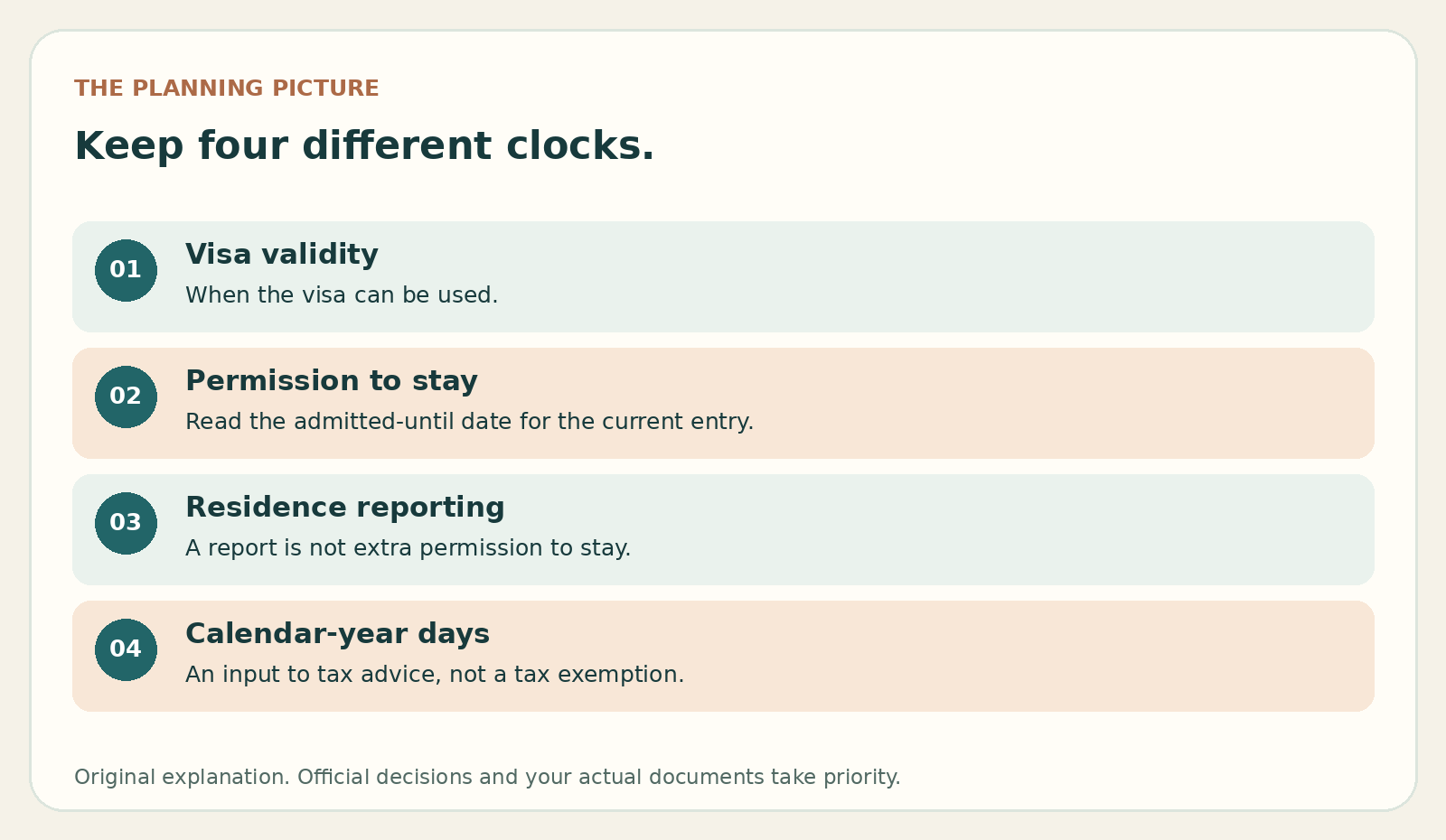
Understand the four separate clocks
Validity and permission to stay
Read the visa's validity period and the admitted-until date from the actual documents. They answer different questions. A long-validity multiple-entry visa does not erase the limit on an individual stay, and an application for an extension should not be treated as approval before it is granted.
| Record | What it controls | What it does not establish |
|---|---|---|
| Visa validity | The period in which the multiple-entry visa can be used | A continuous five-year stay |
| Admitted-until date | The permission granted for the current entry | Your next reporting deadline or tax status |
| Residence reporting | Any required notification while remaining in Thailand | Extra days of permission to stay |
| Calendar-year day count | An important input to a tax-residence review | Whether every item of income is foreign-sourced |
Use dates rather than approximate months
Put the actual entry date, admitted-until date and any reporting deadline into a calendar as soon as they are known. Set an early reminder to review documents and another before the deadline. Do not use a phrase such as six months from now when the official permission is expressed in days and an exact date appears on the stamp.
A useful personal record has one line per arrival and departure, with a photograph of the relevant document stored securely. This reduces the chance that a return trip or a passport change makes your own history difficult to reconstruct. It also helps an adviser review your circumstances without relying on memory.
Re-entry still needs a real travel plan
Leaving and returning should not be treated as a purely administrative game. Check the rules for the country you intend to visit, confirm the DTV remains valid and carry evidence appropriate to your return. Border decisions remain with the authorities. Build enough time and money into the trip to handle a changed service or a request for clarification rather than assuming a same-day turn will always work.
What the current London example actually requires
Use the updated checklist
London's DTV workcation list includes passport biodata, a recent photograph, permanent-residence evidence, financial evidence, employment evidence or a professional portfolio, and a police-clearance certificate issued within six months of submission. Its stated financial amount is at least GBP 12,000, shown alongside THB 500,000. These are the mission's published figures, checked 7 October 2026, not a currency conversion calculated here. [1]
Do not assume every residence document is accepted
The wording about permanent residence matters, especially for someone who is living temporarily in the application country. A passport nationality and a current address are not automatically the same evidence category. Before paying, ask the mission how its current requirement applies to your status rather than relying on a friend's successful application under an older version of the rules.
For a British citizen, check which document the actual application asks you to upload. For a non-British applicant using London, inspect the additional immigration-status and employment requirements. The correct response to an unclear upload field is an official clarification, not an invented document or a misleading explanation.
Compare missions without shopping for a loophole
Washington and Los Angeles both publish their own bank-statement, residence and criminal-record instructions. Their details are not interchangeable with London's. Use those pages to understand that local variation exists, then follow the mission that actually has jurisdiction over your application. A different mission's more convenient wording does not establish your right to apply there. [6] [5]
Prepare evidence that an assessor can understand
Employment or freelance evidence
For an employee, aim for a coherent set of documents showing who employs you, what you do and how the intended remote arrangement relates to the job. For a freelancer, organise genuine current work evidence and a professional portfolio so that the connection between your identity and your activity is clear. Do not add confidential client material without permission simply to make the file look substantial.
A concise explanatory page can help an adviser or the mission understand a complicated work history, but it must not replace required documents. Keep dates, names and roles consistent across the application. Where an old trading name differs from your current one, explain the relationship rather than hoping the difference will be overlooked.
Financial evidence is not an application fee
The central e-Visa DTV page lists last-three-month bank statements with a minimum THB 500,000 or equivalent, or sponsorship documentation, subject to the mission's requirements. Do not assume a single balance screenshot or a briefly borrowed amount establishes acceptable evidence. Where joint funds or sponsorship are involved, obtain the responsible mission's answer on the exact documents and relationship evidence. [2]
Keep proof-of-funds evidence conceptually separate from the cash you plan to spend after arrival. A suitable account balance does not prove that your monthly income can support the move. Conversely, a high income does not automatically replace the required form of financial evidence. Build both the application file and a practical spending plan.
Police certificates need their own lead time
ACRO's Police Certificate service is intended for overseas visa, residence and related purposes; its instructions ask applicants to check acceptance with the requesting authority. Prepare the identity and address-history information required by the actual service and inspect delivery arrangements. Do not substitute a different background check simply because it is quicker to obtain. [7]
When a document does not fit the upload field
Do not alter an official record to make it look like a different document. Ask whether the mission accepts a combined file, an explanation with supporting records or another specified form of evidence. Keep the answer with your application notes and follow any instruction about translations or certification.
A professional portfolio should make genuine work understandable, not imply clients, qualifications or contracts that do not exist. Remove unnecessary confidential material before seeking advice, but do not redact required information from an official submission contrary to the mission's rules. When those obligations conflict, resolve the question with the mission and the relevant client or employer before uploading.
Apply through the official channel with realistic timing
Complete the application carefully
The Ministry of Foreign Affairs' e-Visa process uses an online account, an application form, supporting documents and payment, followed by processing and an emailed decision document. Submission and payment do not guarantee approval, and the official service states that visa fees are non-refundable. Check all personal details against the passport before paying. [4]
The official e-Visa service says applications can be made only while you are currently outside Thailand. London additionally requires you to remain within its jurisdiction during processing. Do not assume an online form allows an application from any physical location. [4]
Use an email address you can monitor reliably and retain the application reference. Save a copy of what you submitted so that any later request can be answered consistently. If you use an adviser, make sure you still understand the stated purpose and can obtain the full submission record; responsibility should not disappear into a third party's inbox.
London's timing is not an express-service promise
London recommends applying six to eight weeks before departure and no earlier than ninety days before intended arrival. Its current general page gives approximately fifteen working days for processing, with longer periods possible when more evidence or an interview is needed. It also warns that leaving its jurisdiction before the decision can cause cancellation. [3]
Build your travel plan around that uncertainty. Do not set a non-refundable lease commencement on an assumed approval date. Keep an alternative departure date available where possible, and avoid signing a long accommodation contract before the permission needed for the intended stay is established.
Make the uploaded evidence readable
London's general instructions require readable official documents and do not accept screenshots or password-protected files. Follow its current file-format and size requirements in the application. A document that exists on your laptop but cannot be read by the assessor is not a completed submission. [3]
Before uploading, open each file on another device. Check that every page is present, names are legible and no critical section has been cut off. Keep translations and the corresponding originals clearly paired. This is administrative preparation, not a reason to alter a statement's contents or obscure an inconvenient detail.
Fees, evidence funds and the move are different budgets
Keep three money columns
The first column is money paid for the application and preparation. A separate column records money evidenced to meet a requirement. The third is money available for travel, living costs and contingencies. Mixing those columns can make a move look affordable even when the available day-to-day cash is much smaller than the headline bank balance.
| Item | Figure or treatment | Meaning |
|---|---|---|
| London DTV application | GBP 300 | Published visa fee, not an approval guarantee [1] |
| London financial evidence | At least GBP 12,000 / THB 500,000 as stated by London | Evidence threshold, not a payment to the embassy [1] |
| Central DTV financial evidence | Last three months of statements with minimum THB 500,000 or equivalent; sponsorship route also listed | Check the mission-specific application instructions [2] |
| Police certificate / translations | Obtain the current quote from the actual provider | Separate application-preparation costs |
| Extension, if requested | Confirm the current Immigration fee and evidence locally | Not included in the original visa fee or guaranteed |
| Accommodation deposit / setup | Separate cash requirement | Not the same as monthly spending or proof-of-funds evidence |
Get a real quote for the extras
Police certificates, translations, document certification and professional advice vary by situation. Obtain actual quotations instead of filling the budget with a generic online total. If an agent charges a service fee, separate it from the government fee and ask what happens if more evidence is requested or the application is refused.
Be cautious about anyone promising guaranteed approval. The official decision remains with the authorities. A useful adviser should explain the service, responsibilities, evidence needed and limits of the engagement clearly, rather than sell certainty that the official process does not provide.
Do not spend the contingency before arrival
Keep enough accessible money for a change of accommodation, a replacement work device or an earlier return journey. These are ordinary relocation risks, not exotic worst cases. An application can be successful while the practical move still proves unsuitable, and an exit reserve gives you more freedom to make a sensible decision.
A working-month cost model you can adapt
Start with your actual routine
The model below was constructed on 7 October 2026 for one person. It is not a measured average for Thailand or a claim that a particular city delivers these costs. Its value is in exposing assumptions: a separate workspace, paid transport, insurance and utilities all remain visible rather than disappearing behind an attractive rent figure.
| Category | Monthly assumption | Check before committing |
|---|---|---|
| Accommodation | THB 20,000 | Actual unit, contract length and deposit |
| Food and ordinary drinks | THB 12,000 | How often you cook and eat out |
| Workspace | THB 5,000 | Call rooms, access hours and membership terms |
| Local transport | THB 4,000 | Your real commute without assuming a scooter |
| Mobile / internet provision | THB 1,000 | Data, tethering and any broadband bill |
| Utilities | THB 3,000 | Metering, air-conditioning use and inclusions |
| Insurance allowance | THB 4,000 | Replace with a suitable personal quotation |
| Laundry / household / small extras | THB 2,000 | Exclude substantial travel and equipment |
| Working subtotal | THB 51,000 | Before tax, flights and visa-related costs |
| 20% reserve | THB 10,200 | Unexpected costs and short-term changes |
| Planning total | THB 61,200 | Not an affordability or visa-eligibility guarantee |
Replace the largest assumptions first
Obtain a realistic accommodation quote for the length of contract you will actually sign, not a twelve-month rate when you only want six weeks. Then price your normal working setup and transport. If your work depends on a private call room, a cheap communal desk is not a like-for-like alternative.
Keep tax, international travel, visa preparation and major equipment outside the subtotal until you have advice or quotations. Family costs need their own model; multiplying one person's rent by the number of family members is unlikely to describe the accommodation you require. Likewise, school or childcare arrangements cannot be inferred from a dependant visa.
Test the budget during an initial stay
Record actual spending for a short period and separate one-off purchases from recurring costs. A month with a rental deposit and a new monitor will look very different from an ordinary month, while a first-week holiday mindset can overstate leisure spending. Use the record to decide whether the base is affordable without pretending that an unusually frugal week proves a long-term budget.
Tax: do not confuse an overseas payment with foreign-sourced income
The visa does not settle the tax question
The Revenue Department's published guidance distinguishes Thai-sourced income from foreign-sourced income. It explains that work performed in Thailand can create Thai-sourced income even when paid abroad. For relevant foreign-sourced income earned from 1 January 2024, it describes a tax-year residence threshold of at least 180 days and remittance conditions. A DTV is not presented as a general tax exemption. [11]
Accordingly, do not assume that an overseas employer, overseas bank account or an invoice issued abroad answers the source-of-income question. Tax treaties and foreign-tax relief may matter, but their application depends on facts and evidence. Arrange advice covering both Thailand and any continuing home-country obligations before relying on a tax outcome. [11]
Prepare a useful adviser brief
Write down where you expect to work, the dates you expect to be in each country, who pays you and the nature of each income stream. Add whether you are an employee, sole trader, company owner or a combination. Keep the brief factual; do not begin with the answer you hope the adviser will confirm.
Track arrivals and departures, contracts, invoices, payment dates and transfers. Ask which records should be retained and how income is classified in your circumstances. That preparation is more useful than a generic statement that digital nomads do not pay tax. The aim is a defensible, lawful arrangement, not a strategy for hiding work or avoiding records.
Arrival, extensions and ordinary reporting
Read the permission granted at arrival
Check the admitted-until date before leaving the immigration area and retain your approval document securely. If the stamp appears inconsistent with the permission you expected, ask an official promptly rather than waiting until the end of the stay. A booking confirmation or an online explanation is not a substitute for the entry record.
The Thailand Digital Arrival Card is a separate arrival process through Immigration's official service. It does not grant a visa or extend a stay. Follow the current submission window and update instructions for the journey concerned rather than reusing an old arrival record without checking it. [10]
Reporting is not an extension
Immigration operates residence-notification services for foreigners remaining in Thailand beyond the relevant reporting period. A residence report does not grant additional days of stay. Check the current method, timing and local requirements with Immigration, and keep reporting tasks separate from any application to extend permission. [9]
Ask your accommodation provider how required address reporting is handled and retain the confirmation they supply. Do not assume a short-stay platform booking means the relevant local process has been completed. Equally, avoid improvising a legal interpretation when moving between addresses; obtain current instructions from the responsible office.
Plan an extension early enough to solve problems
Before seeking an extension, confirm the relevant office, evidence, fee and timing directly with Immigration. Your circumstances and the basis of your visa matter. Leave room to obtain an additional document or change plans if the extension is not granted. The original visa's long validity should never become a reason to ignore the current admitted-until date. [8]
Families and partners need their own application plan
Relationship evidence is only one part of the process
The official category includes a qualifying spouse and children under twenty, but that should not be read as one application covering the whole household. Check the required application, identity and relationship evidence for each person. Where funding is shared, ask the mission precisely how it wants the account and sponsorship information presented rather than dividing a remembered threshold informally. [2]
Make a separate checklist for each traveller, then identify documents shared between the files. Marriage, birth or adoption records may require translations or other formalities depending on where they were issued and the responsible mission's rules. Start with the actual documents you possess and resolve differences in names or dates through the proper process.
Check the plan beyond immigration
Accommodation, schooling, childcare, healthcare and a partner's own work arrangements are separate decisions. A dependant category does not promise a school place, insurance cover or permission for every activity a family member wants to undertake. Obtain the relevant professional or institutional answer rather than assuming the principal applicant's approval resolves the entire move.
For accommodation, ask about real occupancy, usable sleeping space and quiet areas during calls. A room that works for one remote worker may be unsuitable when a partner or child is also there all day. A larger deposit or longer lease may be involved, so the household budget needs actual quotations rather than the one-person model multiplied mechanically.
Avoid separating the family's decision dates unnecessarily
Coordinate the applications and travel commitments carefully, especially when one decision may arrive before another. Ask the mission how linked applications should be handled. Keep a fallback that does not force one person to travel without the permission or documents they need. The family's practical readiness matters as much as the first approval email.
Best bases: match the place to the working week
This is a comparison framework, not a popularity league
The five bases below are selected to represent different practical trade-offs: a large city, a northern cultural base, a mainland coast, a large tourism island and a Gulf island. No measured broadband ranking, universal cheapest-city claim or personal-residency experience is implied. The address you choose can matter more than the destination name.
| Base | Why consider it | Main trade-off | First check |
|---|---|---|---|
| Bangkok | A city-oriented routine and extensive transport choices | Neighbourhood and commute can dominate the day | Walk to the station at your normal commuting time |
| Chiang Mai | A compact-feeling cultural base and a slower routine | Seasonal air quality and individual room noise | Forecast, health advice and the room during calls |
| Hua Hin | Mainland coastal living without a ferry dependency | The exact location can still require regular rides | Groceries, workspace and the road connection |
| Phuket | A choice between town and coastal neighbourhoods | Those neighbourhoods create very different commutes | Which side of the island holds your weekly needs |
| Koh Samui | An island stay with a deliberate off-clock routine | Weather, transport and address-level connectivity | A backup connection and a workable onward plan |
Use the same test in every location
Try the connection during the hours when you need calls, inspect the chair and desk, listen for building noise and walk the route to food and supplies. Ask how power or connectivity failures are handled, but do not turn an informal reassurance into a contractual guarantee. Keep a second way to get online where the work genuinely requires it.
Choose an initial stay short enough to leave if the setup fails. A discounted long lease can become expensive when you must rent a separate workspace or pay repeated transport costs. Once you know the base works, negotiate the longer arrangement from evidence rather than from a photograph and an optimistic map pin.
Bangkok: choose the neighbourhood before the skyline
When it makes sense
Bangkok is my first comparison point for someone who wants a city-based routine and values a broad choice of neighbourhoods and services. The decision should begin with the working day: where you need to be, how often you travel and whether your preferred accommodation is convenient for useful public transport. A dramatic skyline is a bonus, not a substitute for a sensible commute.
Test the walk to the station in ordinary clothes during the time you would use it. A short distance on a map can still feel inconvenient when access involves a busy crossing, poor shade or several indirect turns. Select a neighbourhood that makes everyday errands simple, not merely a building that looks impressive from a pool terrace.
How to use the first week
Keep the first working week stable. Do a neighbourhood orientation on a free half day, then test the room through several real calls before agreeing a longer stay. Check whether a local workspace has a suitable private-call option instead of assuming every shared office permits long meetings in its open area.
At the end of the trial, review sleep and noise as seriously as internet speed. A reliable connection does not compensate for repeated late-night disturbance. The best city base is the one that supports your ordinary obligations with the least avoidable effort.
Chiang Mai: a slower rhythm needs a seasonal check
What to test
Chiang Mai is worth comparing when you want a less metropolitan-feeling base and intend to spend most working days in one neighbourhood. Choose between an Old City-oriented stay, a different residential area or a more commercially active district only after checking your own errands and workspace needs. Do not assume a neighbourhood label guarantees quiet or reliable internet.
Inspect room noise at your actual call times and ask about construction. A pleasant daytime cafe can become unsuitable when your working hours extend into the evening. Likewise, a hotel desk may look adequate for a short email but feel uncomfortable through several focused hours.
Air quality belongs in the decision
FCDO health advice warns about air pollution and seasonal haze, including in the north. Check current conditions and seek individual medical advice where relevant, rather than assuming a generally attractive climate means every month suits a long stay. Keep a realistic relocation option if the conditions do not work for you. [12]
Move between bases on a day without a critical work commitment. An overnight train can be an experience to choose deliberately, but it should not be treated as a guaranteed night's restorative sleep before an important meeting. Inspect the actual service and berth through the railway's official information. [16]
Hua Hin: mainland coastal living without an island transfer
Why it belongs on the shortlist
Hua Hin is a useful comparison for someone who wants a coastal routine while avoiding a ferry-dependent base. However, the relevant question is still the address. A property far from everyday shops and a suitable workspace can create regular transport needs even when its beach setting looks appealing.
Before committing, walk the ordinary routes you would use after work. Check food options, grocery access, laundry and a realistic place for exercise. These small repeated journeys shape a month's experience more than an occasional excursion. A compact everyday routine can be a strong reason to choose a less dramatic location.
Keep the Bangkok connection practical
Price the complete journey to or from Bangkok, including the starting and finishing points. A cheap intercity ticket may not be convenient if it ends far from the accommodation or requires a separate late-evening transfer. Plan a relocation outside a work deadline and leave flexibility for traffic or a changed service.
Treat the first stay as a test of whether mainland coastal life fits your working pattern. Some people will value the quieter pace; others will miss the variety of a larger city. Neither response is a failure. The trial exists to discover that difference before a long contract makes changing your mind expensive.
Phuket and Samui: do not let the beach conceal the commute
Phuket: town and coastal bases solve different problems
Phuket Town and a coastal neighbourhood are not interchangeable choices. Start with where your weekly needs will be, then judge the accommodation against those journeys. A room near the beach may be worthwhile when you will use it regularly, but less useful if every essential errand creates a substantial round trip.
Ask about actual broadband in the room, not merely Wi-Fi somewhere in the building. Confirm whether utilities are included and what conditions apply to a longer stay. If you expect to work from a shared space, test the journey in the time window you will actually use rather than on a quiet sightseeing afternoon.
Samui: make the island routine explicit
For Samui, compare a convenient Bophut-area starting point with other neighbourhoods according to your own transport and workspace needs. Do not base the whole plan on hiring a scooter unless you hold the appropriate licence, have suitable insurance and are comfortable with the conditions. A base that works without riding gives you more flexibility. [17]
The Gulf's seasonal rain pattern is another reason to keep the working setup indoors and the onward plan realistic. A sheltered terrace in an illustration is not evidence that outdoor laptop work will be pleasant every day. Check the current forecast and retain a practical alternative when weather affects transport. [14] [13]
The shared island test
Before extending either island stay, ask whether the base still works on a rainy Tuesday with several calls and no leisure time. If the answer depends on perfect weather, a particular cafe table or a daily ride you do not enjoy, improve the arrangement or choose another base. A working stay is not a continuous beach holiday.
Connectivity, equipment and employer permission
Build a connection plan, not a speed claim
Test upload, calls and stability with the tools your work actually uses. A single speed-test result is not proof of reliable video meetings throughout the day. Ask what happens during an outage and identify a second connection or nearby workspace before the first important deadline, not after it.
Airalo's Thailand products have package-specific data, validity and device requirements. Check tethering and activation details before treating a travel eSIM as a work backup. Do not assume that a plan described casually as unlimited has no fair-use or speed conditions. [15]
Take only equipment that solves a real problem
A laptop stand, keyboard and mouse may improve a workable desk, but they add weight and still depend on the chair and table. Check your airline allowance and whether replacement equipment is realistically available before carrying an entire office. Keep essential data backed up and protected according to your employer's or client's requirements.
Permission from work is a separate conversation
Discuss the location with your employer or clients where the arrangement requires it. Cover working hours, access to systems, confidential information, insurance and any restrictions on where services may be performed. A visa approval does not tell an employer that every contractual, security or payroll issue has been resolved.
For your first month, avoid changing cities every few days. Establish a reliable routine, test the real workload and reserve travel for genuinely free time. A successful remote-work stay is measured partly by whether your ordinary responsibilities remain manageable, not by how many destinations appear in the background of a call.
Use the first thirty days as a genuine working trial
Arrival days: establish the essentials
On the first few days, check the entry record, the accommodation address process and a way to obtain essential supplies. Test your equipment and connection before committing to a full working schedule. Keep some rest time after the journey; a tired first impression is not a reliable basis for a six-month lease decision.
Record the contact details for the property, the nearest practical workspace and any essential professional support. Store the information securely in a place you can access if the main phone fails. Do not leave all account recovery methods dependent on a single device or a phone number you will no longer control.
Week one: run an ordinary week, not a holiday version
Work the hours you genuinely expect to maintain. Test calls, sleep, meals and the journey to a workspace when needed. Include at least one mundane errand and a day when you do not visit a major attraction. The purpose is to discover whether the base supports your routine, not to prove that a week of cafes and sightseeing feels enjoyable.
Keep a brief note of problems and whether they are fixable. A poor chair might be easy to replace; persistent noise beside the room may not be. Separate a temporary inconvenience from a structural mismatch before deciding to leave or to sign a longer commitment.
Weeks two to four: improve one thing at a time
Try a different workspace, revise the grocery routine or move to a quieter room before changing cities completely. Recheck the budget using actual spending and preserve the reserve for genuine surprises. By the end of the trial, decide whether to extend the arrangement, try another base or return home. None of those outcomes requires defending the original plan as a personal success or failure.
Before a move, update the relevant address and reporting arrangements through the proper channels. Keep upcoming deadlines visible and schedule the travel outside important work commitments. The practical benefit of a flexible stay is the ability to change something that does not work without losing control of the administration.
Pros, cons and the mistakes to avoid
Advantages
- A defined route worth assessing for eligible remote workers and other qualifying applicants.
- Multiple entries can support a longer-term travel plan within the visa conditions.
- Several different Thai bases can be trialled before choosing a longer stay.
Trade-offs
- Mission-specific evidence and updated requirements demand preparation.
- Permission to stay does not resolve tax, employment or every family need.
- A successful application does not guarantee an affordable or suitable working base.
The most expensive mistake is committing too early
A long lease, a prepaid course or an inflexible flight can create pressure to submit an unsuitable application or ignore an unresolved work issue. Reverse the order: establish eligibility and evidence, understand the decision process, then commit to the arrangements that depend on approval. Keep genuinely optional purchases separate.
Avoid four misleading shortcuts
Do not equate visa validity with continuous stay, treat a bank screenshot as a complete financial file, assume salary paid abroad is automatically foreign-sourced, or rely on a dependant status to settle every family member's work and study needs. Each shortcut skips a different question that deserves its own evidence or advice.
Keep the routine administratively simple
Store documents securely, keep a dated checklist and review the current official pages before each significant application or move. A tidy record is more helpful than repeatedly searching social-media anecdotes for reassurance. When requirements are unclear, ask a precise question containing your actual circumstances rather than collecting contradictory answers to a vague one.
Frequently asked questions
Is DTV the official name of Thailand’s digital nomad visa?
Destination Thailand Visa is the official name used in the government application system. Digital nomad visa is a common description of its workcation pathway, not a separate permission covering every activity. Identify the appropriate category and the responsible mission before treating a general online summary as your own application checklist.
Can I remain in Thailand for the full visa-validity period?
No continuous stay should be inferred from the validity period. You must follow the permission granted for the current entry and obtain any extension through the proper process. Keep the admitted-until date separate from the visa expiry date, and plan travel or an extension early enough to address an unexpected document request.
Do I pay the proof-of-funds amount to the embassy?
No: financial evidence and the visa fee are different concepts. The evidence demonstrates the funds required by the current application rules, while the published visa fee is a separate payment. Do not confuse either with your monthly living budget, rental deposit or the money needed for a contingency and return journey.
Is a police certificate now part of the London checklist?
Yes. Check London’s latest DTV checklist for the required certificate, its age and the submission conditions. Use the appropriate issuing service, and leave enough time to obtain the document before you intend to apply. [1]
Can I use a short cooking class as proof for an activity application?
Do not assume so. An ordinary holiday class and the supporting evidence for an eligible activity pathway are different things. Ask the responsible mission what it requires, then obtain genuine documents from the provider. The leisure and accommodation links in this guide do not establish DTV eligibility or constitute visa assistance.
Will I owe no Thai tax if the client pays a foreign bank account?
That conclusion is unsafe. The location where work is performed can matter, and income source is not determined solely by where a payment lands. Ask a qualified adviser to review your work, day count, income streams and any treaty position. Keep records instead of relying on a general claim that remote workers are exempt.
Which base should a first-time applicant choose?
Choose after the permission and practical work arrangement are understood. For a city routine, begin by comparing Bangkok; for a slower northern stay, test Chiang Mai with a seasonal check; for a mainland coast, investigate Hua Hin. Phuket and Samui need a particularly clear transport and connectivity plan. The actual room matters more than the destination label.
Should I book six months of accommodation before applying?
That creates an unnecessary commitment unless a specific, verified application requirement makes a particular booking appropriate. A short, flexible initial stay allows you to test noise, workspace and everyday access. Do not present this general suggestion as permission to ignore documents your responsible mission explicitly requires.
The recommendation: permission, evidence, then the base
Treat the DTV as a structured application and an ongoing set of responsibilities, not a lifestyle product that removes paperwork. Begin with the correct purpose and current mission requirements, build a genuine evidence file and obtain advice where the work or tax position is uncertain. Keep every important date separate.
Then choose a short initial stay that lets you test an ordinary working week. A comfortable desk, reliable sleep, practical transport and a sensible exit reserve will matter more than an attractive remote-work photograph. The strongest plan remains workable after the excitement of arrival has passed.
Sources and fact-checking notes
Official pages reviewed on 7 October 2026. London figures are labelled as a UK-jurisdiction example, not universal fees or a live exchange-rate conversion. Central and mission-specific requirements must be read together. Tax material summarises published Revenue Department guidance and highlights the need for individual advice; it is not a personalised tax conclusion. Monthly costs and base comparisons are constructed planning tools.
- 01Royal Thai Embassy London: Destination Thailand Visa, updated 8 September 2026Reviewed 7 October 2026.
- 02Thai e-Visa: current DTV category and document requirementsReviewed 7 October 2026.
- 03Royal Thai Embassy London: current visa general informationReviewed 7 October 2026.
- 04Ministry of Foreign Affairs: official Thai e-Visa applicationReviewed 7 October 2026.
- 05Royal Thai Consulate-General Los Angeles: DTV, updated 1 October 2026Reviewed 7 October 2026.
- 06Royal Thai Embassy Washington: DTV requirementsReviewed 7 October 2026.
- 07ACRO: official Police Certificate informationReviewed 7 October 2026.
- 08Immigration Bureau: reporting and residence servicesReviewed 7 October 2026.
- 09Immigration Bureau: notification of residence over 90 daysReviewed 7 October 2026.
- 10Immigration Bureau: official Thailand Digital Arrival Card manualReviewed 7 October 2026.
- 11Thai Revenue Department: how foreigners living in Thailand pay taxReviewed 7 October 2026.
- 12FCDO: Thailand health adviceReviewed 7 October 2026.
- 13Thai Meteorological Department: current forecastsReviewed 7 October 2026.
- 14Thai Meteorological Department: seasons of ThailandReviewed 7 October 2026.
- 15Airalo: Thailand eSIM specificationsReviewed 7 October 2026.
- 16State Railway of Thailand: official D-Ticket bookingReviewed 7 October 2026.
- 17FCDO: Thailand safety and securityReviewed 7 October 2026.
Illustrations in this article were created for Taylor’s Trailblazing Travels. Third-party photographs, where used, are credited beside the image or in the source list.