Travel money / Currency exchange
Thailand Currency Exchange Guide
Compare the real result of an exchange, not just the largest number on a rate board.
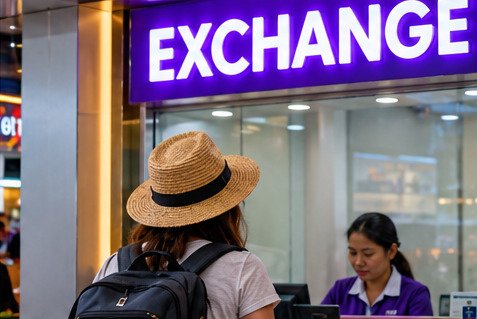
Original exchange-counter concept, not a named branch, documentary photograph or current rate quote.
A useful Thailand currency exchange guide should explain what to compare before naming a supposedly unbeatable counter. The currency, note denomination, transaction direction and branch can all change the offer. Meanwhile, a small improvement on a rate board may be worth less than the journey taken to obtain it.
This guide starts with the net baht you receive and uses explicit calculations to make competing offers comparable. It covers arrival money, city counters, UK notes, identification and leftover baht, while keeping card withdrawals and credit-card-funded currency in their proper place as separate comparisons.
Provider information was reviewed on 5 October 2026. Example exchange rates are invented teaching figures, not quotes or predictions. The named businesses are research sources, not a ranking of every provider, and the artwork is not evidence of a real exchange transaction.
Read the board
Buying vs selling
The provider's perspective determines the correct side.
Compare fairly
Net baht after costs
A high headline rate can lose after fees or travel.
Check your notes
Issuer and denomination
Do not assume every pound note receives one quote.
Keep it practical
Match the route
Convenience can outweigh a very small rate improvement.
Thailand currency exchange: compare the baht you receive
Begin with a net amount
The best exchange comparison is not the brightest rate board or the largest no-commission sign. It is the amount of usable baht received for the same home-currency amount, after any explicit fee and the practical cost of obtaining it. A provider can advertise no commission while building its margin into the rate. Another can show a fee but still produce a competitive final result.
Before comparing, specify the currency, note type, amount, branch and direction of exchange. A quote for selling baht back into pounds is not the quote for arriving with pounds and buying baht. Likewise, a rate associated with one denomination or headquarters location may not apply to the notes and branch you intend to use.
Use a method, not a permanent winner
This guide compares the mechanics of banks, authorised exchange businesses, airport counters and card withdrawals. It does not rank every counter in Thailand or claim that one company always offers the best rate. The named exchange providers publish useful primary information, but their inclusion is not a guarantee about tomorrow’s quote.
All provider information was reviewed on 5 October 2026. Numerical rate examples in the explanations are deliberately hypothetical and labelled as calculations, not live offers. That distinction matters because an article should teach a reusable comparison rather than freeze a changing currency quote into apparently permanent advice.
Buying and selling rates: read from the provider's perspective
When you hand over pounds
On a conventional exchange board, the buying rate is the rate at which the provider buys your foreign currency. Therefore, when you give the counter pounds and receive baht, the provider is buying pounds from you. When you later use baht to obtain pounds, it is selling pounds to you. Superrich Thailand’s own rate labels make this direction explicit. [1]
In an invented example, a board shows a GBP buying rate of 43.00 and selling rate of 43.50, both expressed as baht per pound. Exchanging GBP100 into baht at the buying rate yields THB4,300 before any separate charge. Buying GBP100 back at the selling rate requires THB4,350. The difference is the spread, not a mistake in arithmetic.Amounts / assumptions checked 5 October 2026.
Check how the rate is quoted
Not every display uses the same unit. Some currencies are quoted per unit, others can be presented per hundred units or in a format that makes the direction easy to misread. Ask for the final amount in baht before handing over notes if the board is unclear.
A useful plain-language question is how much baht you will receive for the exact notes you are holding, including any charge. This avoids a debate about labels and turns the quote into something you can verify. Confirm the calculation on the receipt and count the money before leaving the counter.
A worked comparison of three exchange offers
Start with the same GBP500
The table uses made-up rates to demonstrate the method. It is not a list of current providers or a rate forecast. The exchange amount is GBP500 in every row, and the separate fee is assumed to be deducted from the baht received.Amounts / assumptions checked 5 October 2026.
On a small screen, scroll the table sideways.
| Hypothetical offer | Calculation | Net baht received |
|---|---|---|
| A: 42.80, no explicit fee | 500 x 42.80 | THB21,400 |
| B: 43.10, THB100 fee | 500 x 43.10 – 100 | THB21,450 |
| C: 43.00, no explicit fee | 500 x 43.00 | THB21,500 |
Reviewed 5 October 2026. Financial tables distinguish published terms from illustrative calculations; examples are not live quotes.
Offer C produces the most baht in this exercise even though B displays the highest rate. Meanwhile, A’s no-fee wording does not make it best. The net difference between the most and least favourable offers is only THB100, so a special journey to obtain the winner could easily erase the advantage.Amounts / assumptions checked 5 October 2026.
Add collection and travel costs
Suppose reaching C would require an extra THB150 journey that you would not otherwise make. Its effective advantage disappears. However, if you will pass that counter anyway, the same trip cost should not automatically be charged to the exchange decision. Include only the additional cost caused by choosing that option.Amounts / assumptions checked 5 October 2026.
Time also matters, although its value is personal rather than a universal hourly figure. A small saving may not justify rearranging a day with luggage or children. Compare the practical result, not only the rate, and remain comfortable choosing a convenient legitimate provider when the difference is modest.
How much does a small rate difference really save?
Multiply the difference by the amount
The same calculation works for a larger spread. If one offer provides 0.40 more baht per pound, exchanging GBP500 gains THB200 before any additional fee or journey cost. Once the saving is visible, you can decide whether it is worth pursuing instead of assuming every decimal difference deserves a detour.Amounts / assumptions checked 5 October 2026.
Do not confuse precision with certainty
A converter displaying many decimal places may look authoritative, but it does not guarantee a cash counter will offer that exact rate for your notes. A screen can be stale, show an indicative market rate or refer to a different transaction type. More digits do not answer those questions.
Save the timestamp and provider context when comparing an online quote with an in-person offer. If the rate has changed, ask whether the original quote was binding or merely indicative. Do not assume an image saved earlier reserves a rate unless the provider’s booking process expressly says it does.
Exchange in the UK or after arrival?
Buying some baht before flying
Obtaining a modest arrival supply before departure can remove one task from a tired airport arrival. Compare the delivered or collected total, including any collection charges, minimum order and buy-back conditions. The practical benefit is certainty about usable arrival money, not proof that every pre-trip purchase is the cheapest route.
Check that the notes are suitable for the first payments. A mathematically adequate sum entirely in large denominations may still be awkward for a small transfer balance or snack. Ask what denominations are available rather than assuming an order will contain the mix you prefer.
Exchanging in Thailand
A planned local exchange can work well when you bring acceptable notes, have the required identification and can reach an appropriate provider without a costly detour. It also means carrying unexchanged cash until the transaction is completed. Compare that exposure with your comfort level and the alternatives available through your cards.
There is no dependable rule that one country always wins for every currency and amount. Obtain comparable quotes close to the decision, then consider convenience and storage. Splitting a planned cash amount between an arrival supply and a later exchange is an option, not an obligation to perform multiple transactions.
Airport counters: buy convenience deliberately
Fund the first stage rather than making an automatic all-or-nothing decision
The airport question is often framed badly: exchange everything or exchange nothing. A more useful approach is to calculate the unpaid arrival costs and decide how much immediate baht is needed. You can then compare the available quote with the value of reaching the accommodation without another task.
A late landing, limited mobility or a complicated onward connection can make convenience especially valuable. Conversely, a traveller with a suitable payment card, prepaid transport and a straightforward city route may have more flexibility. The correct choice follows the arrival plan, not a rule about airports as a category.
Verify the exact counter and opening arrangements
Do not assume every counter in one airport uses the same rate, hours or service. Likewise, do not rely on a blog’s remembered floor or desk location when the provider’s current branch information differs. Check the actual provider directory and have an alternative for a delayed flight. [2]
When considering Bangkok hotels on Booking.com, look at how the arrival route reaches the property. A conveniently located hotel can remove a transport detour that would otherwise overwhelm a small exchange saving. The accommodation choice should serve the holiday, but its location is part of the cash-access calculation.
City exchange counters, bank branches and similarly named companies
Use an identifiable authorised provider
The Bank of Thailand describes an authorised money-changer category for businesses permitted to buy and sell foreign banknotes outside the commercial-bank category. Use an identifiable legitimate provider and its official contact information rather than handing cash to an informal stranger offering an unusually favourable deal. [3]
A commercial bank and an exchange specialist may have different rates, hours and note policies. Compare the specific service you need instead of assuming the bank is always expensive or the specialist is always best. A provider’s name is not a substitute for a current net quote.
Green and orange are not one interchangeable business
Superrich Thailand and SuperRich Currency Exchange (1965) are separate companies with separate websites and policies. Make sure the rate, branch location and documentation information belong to the business you actually intend to visit. A map result, photograph or familiar colour scheme should not be the only check. [1] [4]
If a website shows headquarters and branch rates separately, select the relevant location. Also confirm opening hours directly, especially around holidays or when making a special journey. A competitive counter that is closed when you arrive is not a workable exchange plan.
Which notes should a UK traveller bring?
Denomination can affect the quote
Some providers publish different buying rates for different note denominations. Superrich Thailand’s rate table, for example, separates certain GBP and USD denominations. Therefore, a headline rate may not be the rate for the particular bundle you hold. Ask for the total based on the actual notes, not an imagined all-large-note order. [1]
The possible difference should be calculated rather than exaggerated. In a hypothetical case where two accepted denominations differ by 0.05 baht per pound, GBP500 changes the result by THB25. It may be worth choosing conveniently available notes, but not paying a large fee or making a special journey for a very small gain.Amounts / assumptions checked 5 October 2026.
Scottish and Northern Irish notes need a specific check
Do not repeat the blanket claim that Scottish notes can never be exchanged in Thailand. At the review date, Superrich Thailand displayed a separate SCOT entry, distinct from its GBP rows. That is evidence of a specific listed category, not a guarantee that every Scottish note is accepted at every branch or at the same rate as Bank of England notes. [1]
For Scottish or Northern Irish notes, ask the intended provider about the issuer, denomination and current acceptance before travelling. Likewise, check damaged, marked or older notes rather than assuming a general currency label covers every condition. Bringing a straightforward accepted mix can be more useful than arriving with a large amount that requires several enquiries.
Documentation, note condition and the counter process
Have identification ready without exposing it unnecessarily
Keep identification accessible in a secure place and present it only through the provider’s legitimate process. If a requirement seems unexpected, ask the counter to explain it or consult the official contact route. Avoid sending passport images to an unverified social-media account merely because it claims to represent a familiar exchange company.
Confirm, count and retain the receipt
State the currency and amount, confirm the rate and net baht, and ask about the denomination mix if it matters. Allow the counter to check the notes, then count the received cash before putting it away. If there is a discrepancy, raise it while the transaction can still be reviewed at the desk.
Keep the receipt until the exchange is reconciled with your cash plan. It provides a record of the provider, date and amount; it is not a guarantee of a future buy-back rate. Store it separately from any public photograph of the trip so passport or transaction details are not shared inadvertently.
Why buying dollars first is not an automatic saving
Follow both conversion steps
Suppose a UK traveller converts GBP500 into another currency and later exchanges that currency into baht. The final result depends on both rates and both sets of charges. An attractive second rate cannot be evaluated without the cost of obtaining the intermediate currency in the first place.Amounts / assumptions checked 5 October 2026.
In a deliberately simplified example, GBP500 buys USD620, and the Thai counter then offers THB34 per dollar. The result is THB21,080 before other costs. If a direct pound exchange would provide THB21,500, the two-step route loses THB420. These invented numbers show the method, not current relative currency values.Amounts / assumptions checked 5 October 2026.
Existing foreign cash is a different situation
If you already hold useful foreign notes from another trip, the decision is whether exchanging those notes now is preferable to keeping them for a known future use. That is not the same as buying new dollars specifically to add another conversion. Identify the actual alternative before claiming one route saves money.
Avoid speculating on which currency will strengthen during the holiday. Funding an ordinary trip is different from taking an exchange-rate position. A sensible plan can prioritise predictable access and manageable amounts without trying to forecast a market movement that may not occur.
Cash exchange versus a suitable debit card
Compare total home-currency cost
For an ATM alternative, include the Thai operator charge, the issuer’s cash terms and the conversion method. For a cash exchange, include the provider’s rate, any explicit charge and the cost of obtaining or carrying the notes. Then compare the same amount of spendable baht.
Mastercard’s official converter is an indicative tool, not a promise about every bank’s final debit. The issuer may apply additional charges or a different arrangement, and the network conversion does not apply when the merchant or ATM performs the conversion instead. Check the card’s actual terms before using a calculator result as an exact withdrawal quote. [6]
Keep the payment decision separate from the exchange decision
A card can sometimes pay an expense directly without any cash withdrawal. However, that only helps when the merchant accepts it and the total currency and fees are sensible. Do not buy a more expensive product simply because it avoids visiting a counter.
For a planned northern journey, compare Bangkok-to-Chiang Mai transport before deciding how much cash to exchange for it. For a Gulf island hop, inspect Koh Samui-to-Koh Phangan options. The specific ticket’s payment conditions, departure point and exclusions determine whether cash is actually removed from the plan.
Card-funded currency and tourist wallets need extra scrutiny
A credit-card purchase of cash can have different treatment
A counter that accepts a card is not automatically offering the same kind of transaction as an ordinary hotel purchase. Your issuer may treat buying currency as a cash transaction with different fees and interest. Halifax’s guidance explicitly includes currency purchases among possible cash transactions; check the exact rules for your own card. [7]
The counter can also add its own processing charge or exclude certain cards. Therefore, confirm both sides before paying. A no-commission statement about exchanging physical cash should not be assumed to cover a card-funded transaction under different conditions.
A QR code is not a universal foreign-card payment route
Thailand’s merchant QR environment and a visitor’s overseas banking app are not automatically interchangeable. A specific tourist product such as KASIKORNBANK’s TAGTHAi EASY PAY has its own enrolment and funding arrangements. Its existence does not establish that every foreign card or banking app can pay every Thai QR code. [8]
Before using a wallet, investigate identity checks, funding fees, transaction limits, refund arrangements and what happens to an unused balance. For a short trip, those tasks may outweigh the convenience. Keep an independent payment method rather than exchanging your whole plan for a wallet you have not tested.
Exchange less by clarifying what is already paid
Accommodation balances and deposits
Likewise, distinguish a card authorisation from a completed payment and a refund expected later from money currently available. These distinctions can matter more than a small difference between two exchange boards. Good paperwork reduces the chance of exchanging a large unnecessary sum or arriving short for a legitimate bill.
Transport and activities with clear inclusions
Compare Krabi-to-Phuket transport when it is part of the actual route, then check the vehicle, pickup and luggage conditions. For city plans, inspect Bangkok activities on GetYourGuide. A booking can reduce uncertainty without eliminating every local expense on the day.
For a beach-stage activity, Phuket tours on GetYourGuide and Thailand excursions on Viator can be used to cross-check inclusions and operator arrangements. Do not assume two matching titles include the same admission charges, transfers or optional extras. Price those unpaid items before choosing the next cash-exchange amount.
Keep rate checks useful rather than obsessive
Set a practical comparison routine
Check a small number of legitimate options that are realistically accessible. Record the net amount, branch, time and any specific note requirements, then choose. Refresh the quote when you are ready to transact, rather than spending the holiday monitoring tiny movements that may not affect a modest exchange meaningfully.
Airalo’s eSIM options can be compared for mobile access to official provider information and maps, but buy connectivity for the whole trip’s needs rather than solely to chase rates. Confirm the package and handset compatibility, and save essential addresses offline so the exchange plan does not depend on a perfect connection. [9]
Do not treat a converter as a cash reservation
A currency app may display a market reference rate or a previously downloaded figure. It does not create a right to purchase notes at that rate. Similarly, a map listing can be useful for navigation without proving that the business is open, authorised or offering the best quote today.
Keep the human verification short and specific: are these notes accepted, what net amount will I receive, and what identification is required? Those questions are more useful than asking whether a provider is the best in Thailand, which no counter can answer objectively for every traveller and transaction.
Handling the money after exchange
Separate the currencies and the reserve
After leaving the counter, place unexchanged home currency, working baht and reserve baht in clearly separate places. This reduces the chance of offering the wrong note or exposing the whole cash balance during a small purchase. Check the arrangement privately rather than reorganising it in the queue outside the exchange desk.
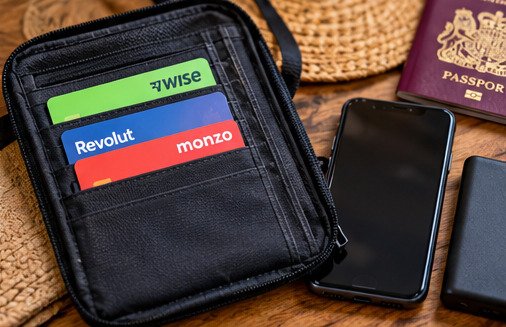
A compact divided travel wallet may help when your current wallet mixes everything together, but an existing secure compartment can work just as well. Choose organisation over bulk. There is no benefit in a system so complicated that you cannot remember which pocket contains the usable daily cash.
Protect documents and use genuine-note guidance
For a trip involving boats or heavy rain, water-resistant document pouches can provide a further layer against splashes when used carefully. They do not remove theft risk, guarantee immersion protection or make it sensible to carry all valuables together. Test the closure and use the manufacturer’s actual limits.
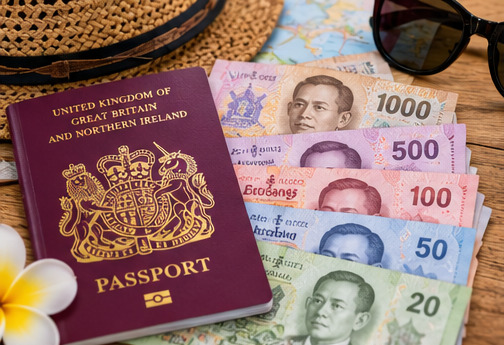
For banknote authenticity, consult the Bank of Thailand’s official security-feature guidance. The illustrations in this article are conceptual travel scenes and must not be used as a reference for genuine currency details. If a note concerns you, ask an appropriate bank or provider rather than comparing it with an AI-generated image. [10]
Exchanging leftover baht before you leave
Reverse the calculation correctly
When you hand baht to a counter and receive pounds, you are buying pounds at the provider’s selling rate. In an invented example, THB4,350 at a selling rate of 43.50 buys GBP100 before any other charge. Using the original buying rate would overestimate what you receive back.Amounts / assumptions checked 5 October 2026.
The return transaction can also depend on available foreign-note denominations and stock. Ask in advance when you need a particular currency or amount. A counter may not provide an exact small residual amount in foreign cash, so keep ordinary spending needs and denomination constraints in mind.
Avoid creating the surplus unnecessarily
Review the cash balance a few days before departure, keeping enough for confirmed transport and a sensible reserve. Then use baht for planned purchases where it makes sense. Do not buy unwanted items just because you would prefer not to exchange the remaining notes.
Coins can be particularly inconvenient to exchange; Superrich Thailand states that it does not exchange coins. Therefore, think about change during the final ordinary transactions rather than arriving at a counter with a mixed pocketful and assuming all of it can be converted. Keep any useful remainder for a genuine future trip rather than treating it as worthless. [5]
Carrying cash across borders: a separate set of checks
Check declaration and export permission independently
Current Thai Customs information includes declaration thresholds above USD15,000 equivalent for foreign currency and above THB450,000 for Thai currency, plus a combined threshold above THB450,000 equivalent. Taking Thai cash above THB50,000 to destinations such as the UK has a separate permission requirement. Do not confuse a declaration threshold with permission to export a particular sum. [11]Amounts / assumptions checked 5 October 2026.
Great Britain’s rules require declaration at GBP10,000 or more when carrying cash between Great Britain and a country outside the UK, and family or group totals can matter. Northern Ireland has different rules. Read the current government instructions for your route before travelling with a large amount or mixed currencies. [12]Amounts / assumptions checked 5 October 2026.
Keep immigration evidence out of the rate-shopping calculation
A spending float and immigration proof of funds are different matters. The Royal Thai Embassy London’s current visa-exemption guidance lists possible evidence of sufficient funds; verify the applicable amount and accepted form for your passport and entry category rather than assuming an exchange plan or phone screenshot satisfies the requirement. [13]
Where official pages disagree, check dates and ask the responsible authority. For the currency thresholds above, current Customs information takes priority over older embassy material displaying a different foreign-currency figure. Do not select whichever old page offers the most convenient number.
A five-minute exchange worksheet
Write down the quote before comparing
Create one row for each realistic option with these fields: provider, branch, time checked, currency and denomination, amount handed over, explicit charge, net baht and additional journey cost. If any field is unknown, mark it unknown instead of substituting the most attractive number from a different website. A comparison with honest gaps is more useful than a precise-looking total built from mismatched assumptions.
For example, one offer may apply only to larger accepted notes, while another applies to the mixed bundle you actually have. Calculate each subset separately if necessary. An illustrative GBP300 at 43.10 and GBP200 at 43.00 produces THB21,530 before other charges. Applying 43.10 to the entire GBP500 would overstate the result by THB20. The difference is small here, but the method prevents a misunderstanding at the counter.Amounts / assumptions checked 5 October 2026.
Decide what counts as an additional cost
A taxi taken solely to exchange cash belongs in the comparison. A train journey you were already making to visit an area may not. Similarly, a delivery charge for a pre-trip order matters, while a normal bank transfer between your own accounts may not create an additional expense. Include the costs caused by the choice rather than every expense that happens on the same day.
Then record the decision and stop shopping once further comparisons are unlikely to change it meaningfully. The purpose of the worksheet is to make a clear choice, not to encourage endless rate monitoring. You are funding a holiday, and the practical value of a straightforward completed transaction can exceed a very small theoretical improvement.
Online quotes, reservations and a locked rate
Check what the confirmation actually promises
An online indication, an order for collection and a binding rate agreement are not necessarily the same thing. Before depending on an advance quote, read whether it reserves currency, fixes a rate, requires prepayment or merely provides information. The confirmation should identify the amount, collection location, deadline and any relevant cancellation condition. Do not fill missing terms with the most convenient interpretation.
If collection depends on a flight arriving on time, consider what happens after a delay. Check the provider’s actual process for late collection or a changed date before paying, especially when the order would use a substantial share of the travel funds. A rate improvement is less useful when the collection arrangement does not fit the journey.
Match the person and documents to the transaction
Ask whether the person collecting must be the person who ordered and which original identification or payment card must be shown. These requirements are provider-specific, so confirm them rather than assuming a companion can collect using a screenshot. Keep the reference secure and accessible, but avoid storing unnecessary payment-card details alongside it.
A well-documented advance order can reduce uncertainty, but it should still be compared with a suitable on-arrival option. Include delivery or collection costs, unused-currency treatment and the practical flexibility you give up. The best arrangement is one you can actually complete, not merely the one with the most attractive displayed rate.
A refusal or a quote that changes at the counter
Ask for the specific reason
If a provider declines a note, ask whether the issue is the currency, issuer, denomination, condition or current branch policy. That answer helps you decide whether another legitimate provider is worth contacting. Do not assume refusal means the note is counterfeit, and do not try to hide damage or misrepresent the currency to obtain acceptance.
When the in-person rate differs from a saved online figure, compare the timestamp, branch and denomination first. A genuine price movement and a mismatch between two quote categories are different explanations. Ask for the net amount before committing. You can choose not to proceed when the revised offer no longer suits the plan.
Keep the fallback proportionate
A rejected small note does not justify carrying an entire cash bundle around several unfamiliar locations. Use the suitable card or reserve already planned for immediate needs, and investigate the exchange issue at a convenient time. Likewise, do not ask an informal intermediary to exchange the note privately for a suspiciously favourable rate.
If a completed transaction appears incorrect, retain the receipt and contact the provider through its official route promptly. Explain the amount tendered, rate agreed and cash received without posting passport or financial details publicly. A clear record is more helpful than a broad accusation based on an old screenshot or a different company’s rate board.
Pros and cons of the main exchange approaches
An arrival purchase prioritises convenience; a city exchange prioritises a planned comparison; a suitable card can reduce the amount exchanged at all. None is automatically right for the whole holiday. Combining methods thoughtfully is more robust than treating one provider or payment route as a complete solution.
Common currency-exchange mistakes
Reading the wrong side of the board
The provider buys your foreign notes when you receive baht, and sells foreign notes when you exchange baht back. Check the direction and unit before calculating. The larger of two displayed numbers is not automatically the number you will receive.
Believing a no-commission headline answers everything
Compare the net baht, not the label. A margin can be incorporated in the rate, and a high displayed rate can be offset by a separate charge. Include any additional journey made solely to obtain the quote.
Bringing notes without checking acceptance
Currency, issuer, denomination, age and condition can all matter to the provider’s assessment. A general GBP listing is not a guarantee for every note in a UK wallet. Ask the actual counter about anything unusual before depending on it as your only cash source.
Confusing a picture with current instructions
A photograph of a rate board, a saved map pin and a generated article illustration serve different purposes. None should override the provider’s current quote and official branch information. Use the factual sources, not the scenery, to make the transaction decision.
Frequently asked questions
Is it always cheaper to exchange money in Thailand?
No universal answer is supported. Compare current net quotes for the same currency, notes and amount, then include collection or travel costs. Exchanging after arrival can be practical, while obtaining some baht before departure can simplify the first stage. The right balance depends on the real offers and your arrival arrangements.
Which Superrich company should I use?
Superrich Thailand and SuperRich Currency Exchange (1965) are separate businesses. Compare the relevant branch’s current quote and requirements rather than choosing by a familiar colour or assuming their websites describe one company. This guide does not claim either always wins for every currency and denomination.
Can I exchange Scottish pound notes?
A blanket refusal claim is inaccurate: the reviewed Superrich Thailand board includes a separate SCOT category. However, that does not guarantee every note, branch or date, nor the same rate as its GBP rows. Confirm your issuing bank and denomination with the intended provider before relying on those notes.
Do I need my original passport?
Some providers explicitly require original valid identification; SuperRich Currency Exchange (1965) states this in its FAQ. Confirm what is accepted for your circumstances. Do not assume a photo, photocopy or expired document will be sufficient merely because another traveller says it worked elsewhere.
Should I buy dollars before going to Thailand?
Only a complete two-step calculation could justify that choice. Buying dollars and then baht can introduce two conversion spreads. Compare the final baht with taking acceptable pounds directly or using the intended card. Already owning foreign cash is a different situation from buying it solely for another exchange.
Is a large banknote always better for the exchange rate?
Some providers publish denomination-dependent rates, but the difference should be calculated against the actual amount. Acceptance, note condition and the convenience of obtaining those notes also matter. Do not incur a larger cost chasing a tiny rate improvement, or assume every company uses the same denomination policy.
Can I pay a currency counter with a credit card?
Availability and charges are provider-specific, and the issuer may treat buying currency as a cash transaction. Confirm the counter’s processing charge and your card’s fees and interest before paying. A no-commission claim for exchanging physical cash is not automatically a promise about card-funded currency purchases.
Will a currency app show the exact cash rate I receive?
Not necessarily. It can show a reference rate, a stale quote or a different transaction type. Check the timestamp, direction, denomination and branch, then ask the provider for the final net amount. A calculator is useful for arithmetic, but it does not reserve cash or guarantee acceptance of your notes.
The exchange routine I would choose
I would fund the first stage of the journey, identify a small number of legitimate providers that fit the route, and compare the final baht for the notes actually available. Before visiting a counter, I would check identification, opening arrangements and anything unusual about the currency. At the counter, I would confirm the net amount, count the notes and retain the receipt.
I would not make a long detour for a saving I had not calculated, buy an intermediate currency without comparing both conversions, or exchange the whole remaining budget when much of it could be paid suitably another way. Near departure, I would reduce the ordinary float while retaining a useful reserve.
A sound Thailand currency exchange plan is therefore less about finding a permanent best counter and more about making one clear, current comparison. The net amount, practical access, documentation and cash exposure belong in the same decision. That method remains useful after today’s rates have changed.
Sources and fact-checking notes
- Superrich Thailand: rate board, currencies and note denominations
Dynamic rates, denomination-dependent rows and a separate Scottish-notes entry; acceptance and final quotes must be confirmed. Reviewed 5 October 2026.
- SuperRich Currency Exchange (1965): branch directory
Check the named branch's opening hours and services before travelling there. Reviewed 5 October 2026.
- Bank of Thailand: authorised money changers
Official explanation of the authorised banknote-exchange business; Thai-language source. Reviewed 5 October 2026.
- SuperRich Currency Exchange (1965): frequently asked questions
Original valid identification, cash-exchange commission policy, branch differences and payment restrictions. This is a separate business from Superrich Thailand. Reviewed 5 October 2026.
- Superrich Thailand: exchange questions and documentation
Passport or qualifying ID, cash-exchange information and coin limitations. Reviewed 5 October 2026.
- Mastercard: currency-conversion calculator and rate limitations
Indicative network calculation; issuer charges and merchant or ATM conversion can produce a different result. Reviewed 5 October 2026.
- Halifax: credit-card cash transactions
Cash transactions can include currency purchases as well as withdrawals; card-specific interest and fees matter. Reviewed 5 October 2026.
- KASIKORNBANK: TAGTHAi EASY PAY tourist-payment information
A specific tourist-payment product, not evidence that every overseas banking app can scan Thai merchant QR codes. Reviewed 5 October 2026.
- Airalo Help: calls, texts and data-only plan types
Many packages are data-only. Read the individual plan rather than assuming bank SMS or ordinary voice calls are included. Reviewed 5 October 2026.
- Bank of Thailand: identifying genuine banknotes
Use official security-feature guidance, not the illustrative banknotes in this article. Reviewed 5 October 2026.
- Thai Customs: currency declaration system and cash thresholds
Current Customs guidance is used rather than older embassy pages showing a different foreign-currency threshold. Declaration and export permission are different obligations. Reviewed 5 October 2026.
- GOV.UK: taking cash in and out of the UK
Great Britain and Northern Ireland have different rules. Family or group totals can matter. Reviewed 5 October 2026.
- Royal Thai Embassy London: visa-exemption and visa-on-arrival schemes
Proof-of-funds information is separate from this guide's spending-money examples; confirm evidence accepted for your passport and route. Reviewed 5 October 2026.
Illustrations in this article were created for Taylor’s Trailblazing Travels. Third-party photographs, where used, are credited beside the image or in the source list.