Travel money / ATM costs
Thailand ATM Fees and How to Reduce Them
Read the local charge, understand your card and compare the full cost of obtaining usable baht.
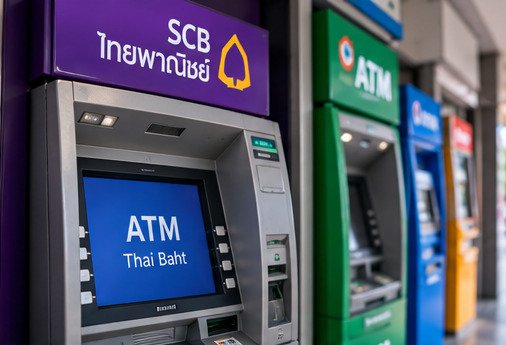
Conceptual bank-machine scene. It does not document a current machine, tariff, bank interface or card acceptance.
Thailand ATM fees are not just the amount printed on a machine’s confirmation screen. A withdrawal can also involve issuer charges, an allowance limit and a separate currency-conversion decision. Understanding those layers is more useful than memorising an old fee from a travel forum.
This guide checks selected official bank schedules and then works through the decisions a traveller can actually control. The comparison distinguishes foreign Visa and Mastercard rows and flags a wording difference in one bank’s English and Thai documents rather than silently treating every card as identical.
The calculations are illustrative and the provider information was reviewed on 5 October 2026. No machine was physically tested for this article, and the examples are not personalised financial advice. Use them to interrogate your own card terms, the actual ATM screen and the amount of cash your route requires.
Bank fee
Read the card-network row
A selected tariff is not a nationwide promise.
Card terms
Include the issuer
Allowances, cash fees and interest can change the result.
Conversion
Understand THB vs GBP
The ATM's conversion is a separate offer.
Withdrawal size
Fund a practical stage
Lower fee percentages do not justify unwanted surplus cash.
Thailand ATM fees: what the current bank schedules actually say
Start with the bank and card network
A single nationwide ATM fee is an unreliable starting point. The official schedules reviewed for this article distinguish between card networks, and some English wording is narrower than the corresponding Thai heading. The table is a check of selected major banks, not an exhaustive market survey or a promise that every machine and every card will display the same amount.
On a small screen, scroll the table sideways.
| Bank and official schedule | Foreign Visa | Foreign Mastercard | Scope to read carefully |
|---|---|---|---|
| Bangkok Bank, schedule dated 27 July 2026 | THB250 | THB350 | Foreign-issued card rows in the ATM section |
| Krungsri, effective 11 March 2026 | THB250 | THB350 | International-card ATM withdrawal rows |
| KASIKORNBANK, effective 22 September 2026 | THB250 | THB350 | English table says international credit cards; confirm debit/prepaid treatment on the machine |
Reviewed 5 October 2026. Financial tables distinguish published terms from illustrative calculations; examples are not live quotes.
These amounts were checked against the official documents on 5 October 2026. Bangkok Bank and Krungsri provide the clearest foreign-card rows for this comparison. KASIKORNBANK’s Thai document uses broader foreign-card wording, while the English heading refers to international credit cards; the actual confirmation for your card remains important. [1] [2] [3] [4]
Do not turn a selected comparison into a universal claim
Other networks, card arrangements or machines can have different terms. Therefore, the table does not establish that these banks are cheapest or that a fee reported elsewhere is impossible. It establishes why an old flat-fee statement should not be used without checking the bank, card and date.
At the machine, read the local charge before confirming. If it differs from your expectation, stop and investigate rather than repeatedly trying transactions in the hope that one silently becomes free. A successful withdrawal is a financial transaction, not a harmless test of a blog’s remembered fee.
The four layers inside the total cost
Separate the operator from the card issuer
The Thai ATM operator’s charge is one layer. Your own card provider may add a cash-withdrawal charge, an overseas-transaction charge, an excess-allowance fee or interest for a credit-card cash transaction. These are not necessarily displayed together on the ATM screen because different organisations apply them.
Currency conversion is another layer. A transaction submitted in baht is converted under the card’s applicable arrangements unless you already hold and correctly use that currency balance. Alternatively, a machine may offer its own home-currency conversion. That offer has a rate and potentially a markup distinct from the local withdrawal charge. [5]
Compare like with like
For example, a card with a lower local network charge may still be more expensive if its issuer levies a substantial cash fee. Conversely, a fee-free issuer does not cancel the Thai operator’s charge. The labels refer to different parts of the transaction; neither alone answers which card is cheaper for you.
Why small withdrawals can be disproportionately expensive
Calculate the local fee as a percentage
Dividing a fixed fee by the cash received makes the trade-off visible. The percentages below include only the stated local fee, not issuer charges or currency conversion. They are arithmetic examples dated 5 October 2026, not all-in withdrawal quotes.
On a small screen, scroll the table sideways.
| Cash received | THB250 local fee as a share of cash | THB350 local fee as a share of cash |
|---|---|---|
| THB2,000 | 12.50% | 17.50% |
| THB5,000 | 5.00% | 7.00% |
| THB10,000 | 2.50% | 3.50% |
| THB20,000 | 1.25% | 1.75% |
Reviewed 5 October 2026. Financial tables distinguish published terms from illustrative calculations; examples are not live quotes.
The same fee consumes a larger share of a small withdrawal. That is why obtaining a little cash several times can become expensive. However, the table is not an instruction to choose the largest number available. It describes a cost relationship, not your cash need or your safe storage capacity.
Compare the trip total too
Suppose you need THB20,000 over a stage of the trip. Four withdrawals with a THB250 local fee total THB1,000 in operator charges; two total THB500; one totals THB250. The arithmetic saving must be weighed against carrying more money and the possibility that your card or the machine will not permit the larger amount.Amounts / assumptions checked 5 October 2026.
If you actually need only THB3,000 before flying home, withdrawing THB20,000 is a different decision entirely. The unused surplus, possible return conversion and loss exposure can outweigh an attractive fee percentage. Start with spending requirements, then optimise the number of transactions within sensible limits.Amounts / assumptions checked 5 October 2026.
Choose a withdrawal size that fits the next stage
Estimate cash commitments rather than guessing
List ordinary cash spending until the next convenient banking stop, confirmed cash-only extras and a modest reserve. Subtract the notes already held. Then compare that shortfall with the available card limit and the amount you are comfortable storing. This produces a meaningful target before the machine’s suggested amounts influence you.
A traveller needing THB6,000 before the next base, already holding THB1,500 and wanting a THB1,000 reserve has a THB5,500 shortfall. That is an invented planning example, not a claim about destination prices. A nearby permitted amount may be practical, but the decision should remain connected to the actual shortfall.Amounts / assumptions checked 5 October 2026.
A shared cash pot needs shared understanding
Two travellers can reduce duplicate small withdrawals by coordinating common expenses, but only when both understand the arrangement. Record who contributed, what the money covers and where the reserve is held. Do not transfer every person’s money onto one card or into one wallet merely to save one operator charge.
Likewise, do not share PINs or let a companion improvise withdrawals from your account without understanding the bank’s rules. Coordination can be as simple as one person paying a shared meal while the other pays a later shared journey. The aim is fewer unnecessary transactions, not weaker account security.
Dynamic currency conversion: read the choice, not the colour
Identify what is being offered
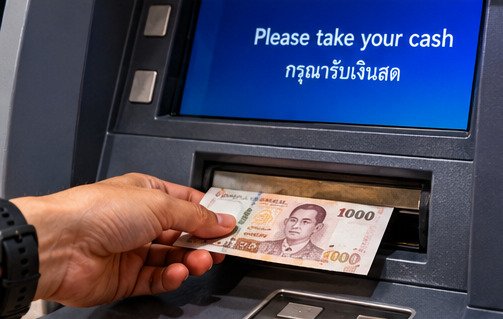
An ATM can offer to debit your home-currency account at a stated conversion rather than submitting the baht transaction through your card’s usual arrangements. Visa calls this dynamic currency conversion and says the local and home-currency amounts, rate and additional markup should be disclosed. The cardholder should have a choice. [5]
A screen may use reassuring words such as guaranteed or show a familiar pound amount. Familiarity does not make the offer cheaper. Compare the conversion with the card terms and do not assume that declining the conversion means cancelling every part of the withdrawal. Screen wording and button placement vary, so read the specific options.
Understand what declining does not do
My normal planning preference with a suitable travel card is to request the transaction in THB and use the card’s understood conversion arrangements. That is not a mathematical guarantee for every possible issuer. It also does not remove the ATM operator’s charge, an issuer cash fee or credit-card interest.
Compare the cards you already hold
Build a small terms checklist
For each card, write down the network, issuer cash fee, exchange-rate method, free allowance if any, reset period and daily withdrawal limit. Include whether the account has sufficient accessible funds and whether overseas cash withdrawals are enabled. A card that looks attractive on one line can be unsuitable because of another line.
Check the account type precisely. Personal and business accounts, free and paid plans, and debit and credit products can differ even within the same brand. Do not use another customer’s screenshot as evidence of your own allowance. Open the current official terms or ask the issuer a focused question.
Use current examples without calling them a ranking
The following UK examples illustrate different fee structures, not a recommendation to open a particular account. The relevant provider pages were checked on 5 October 2026. Local ATM charges can remain payable in each case.
On a small screen, scroll the table sideways.
| UK personal product example | Published point relevant to cash | Why it changes the calculation |
|---|---|---|
| Starling personal account | No Starling overseas withdrawal fee; published GBP300-equivalent daily ATM limit | A daily cap can prevent one large withdrawal even without an issuer fee |
| Monzo base allowance outside the EEA | GBP200 in a rolling 30-day period, then 3%; other plans differ | Previous withdrawals and the rolling window matter |
| Wise UK card | GBP250 monthly cash allowance, then 2.69% on the excess | Check remaining allowance, conversion charges and the account’s current terms |
Reviewed 5 October 2026. Financial tables distinguish published terms from illustrative calculations; examples are not live quotes.
These are concise snapshots of selected terms, not complete product reviews. Eligibility, paid-plan costs, card delivery, conversion charges and other conditions may affect suitability. Consult the provider information for the product you actually hold. [6] [7] [8]
Card-network savings can be outweighed by issuer fees
Work through a two-card comparison
Imagine two cards obtaining the same THB10,000. Card A attracts a THB250 local charge plus an assumed three per cent issuer cash charge on the cash principal. Card B attracts THB350 locally and no issuer cash charge. Ignoring conversion differences for this example, Card A costs THB550 and Card B THB350. The lower local fee did not produce the cheaper total.Amounts / assumptions checked 5 October 2026.
Real issuers may calculate their charge on a different base, apply a minimum or include other components. Therefore, replace the simplified assumptions with the actual terms before using the result. The example’s purpose is to show why choosing by Visa versus Mastercard alone can be misleading, not to state how a particular bank calculates its bill.
Allowance thresholds create another complication
Suppose a card has only a small part of its no-fee cash allowance left. A larger withdrawal may push some of the transaction above that allowance, while several smaller withdrawals can trigger more Thai operator charges. Compare both totals rather than assuming that staying below an allowance at every individual machine visit avoids the provider’s cumulative calculation.
Also check the timing. A rolling thirty-day allowance is not automatically refreshed on the first of the month, and a monthly allowance may follow the provider’s specified cycle. Leaving the country and returning does not, by itself, reset a bank’s account allowance. [7] [8]
Withdrawal limits: the smallest applicable limit wins
Three different constraints can interact
Your issuer’s daily limit, the ATM’s transaction limit and your available balance can all constrain a withdrawal. Note availability or a machine fault can add another practical restriction. There is no need to memorise one supposed universal Thai maximum when the relevant combination depends on the card and machine.
If the card’s daily cap is expressed in pounds, its baht equivalent changes with the applicable conversion. Fees may also affect available funds or how a bank measures a limit. Leave enough headroom and check with the issuer rather than requesting exactly the mental conversion of the maximum and assuming it must succeed.
Avoid repeated attempts without a diagnosis
A decline does not necessarily mean the account lacks money. Check the banking app for a message, confirm the relevant controls and use official help if necessary. Repeatedly trying different amounts or PINs without understanding the problem can make an already stressful situation harder to resolve.
Before an early departure or an island stage, arrange any necessary withdrawal while you still have alternatives. This is not a claim that remote places never have ATMs. It is a scheduling principle: the best time to discover a problem is not the moment your transfer is waiting and the next obligation requires cash.
Household allowances and time boundaries
Two cards do not necessarily mean two allowances
Check whether a provider measures its cash allowance per account, per customer or across related accounts. Monzo’s current guidance, for example, explains that allowances are shared across a customer’s personal and joint accounts. Having another piece of plastic or moving money between those accounts does not automatically create another independent no-fee allowance for the same person. [7]
For a couple, review each person’s actual terms without assuming either complete separation or complete pooling. A household calculation should identify whose card performs the withdrawal, which allowance applies and what has already been used. This prevents a plan that looks efficient on paper from crossing an unexpected threshold during the trip.
Clarify the reset time before depending on it
A daily cash limit and a thirty-day or monthly allowance are different controls. If a large payment depends on an allowance refreshing, ask the issuer how its reset is defined and displayed. Do not assume a Thai midnight, a UK midnight and a bank’s processing day are interchangeable. The most reliable guide is the available allowance shown or confirmed for the particular account.
Likewise, a pending transaction can complicate the available balance even before it is finally posted. Leave room for legitimate fees and other commitments rather than funding an account to the exact principal of the intended withdrawal. When the calculation is close to a limit, a clear answer from the issuer is better than several speculative attempts at different machines.
Keep the shared cash record simple
After a successful withdrawal, record the cash principal separately from the fees when settling costs between companions. Otherwise, one traveller may appear to have contributed less simply because their card paid the operator charge. Decide whether fees are a shared holiday expense and record the agreement. A few clear entries prevent minor banking costs from becoming an avoidable disagreement later.
Are bank-counter withdrawals a free workaround?
Do not assume the counter removes every charge
Krungsri’s reviewed schedule includes a THB200 charge for withdrawing at branches or exchange booths using an international Visa card. That is a specific counter-service row, not evidence that every bank counter is free or that every debit, credit or prepaid card is accepted on identical terms. [2]Amounts / assumptions checked 5 October 2026.
A counter can also involve identification requirements, opening hours, transaction limits and the issuer’s own cash treatment. Ask the branch about the exact service and card before making a special journey. A passport and a card do not guarantee that a particular transaction will be available.
Price the alternative honestly
If a counter saves a modest local charge but requires paid transport and substantial time, it may not be a useful saving. Conversely, a conveniently located staffed branch may be preferable for a traveller who values assistance or has a problem to resolve. Convenience and accessibility are legitimate considerations, not failures to optimise.
Be especially careful with a credit card. Halifax’s guidance explains that cash transactions can attract immediate interest and can include more than just ATM use, such as purchasing currency. Check your own card’s treatment before describing a counter transaction as a clever fee-free solution. [9]
Cash exchange versus withdrawing baht
Compare the same spendable amount
A cash-exchange quote can be compared with an ATM withdrawal, but only after accounting for the amount of home currency surrendered, the net baht received and any costs of reaching the provider. A commission-free counter still has a buy/sell spread. Likewise, a no-issuer-fee card can still incur the Thai operator’s fee.
For an illustrative comparison, obtaining THB10,000 for GBP235 costs less than obtaining it for GBP240, regardless of which route advertises no commission. However, if reaching the cheaper provider costs the equivalent of more than the difference, the apparent saving disappears. These are invented comparison figures, not current exchange quotes.Amounts / assumptions checked 5 October 2026.
Do not manufacture an extra conversion
A UK traveller should not automatically buy dollars to exchange into baht. First calculate the result of both conversions and compare it with taking acceptable pound notes directly or using the chosen card. A second currency can add a spread and handling risk without solving anything.
When cash exchange is part of the plan, use an appropriate authorised provider and confirm identification, branch hours and note acceptance. Superrich Thailand publishes documentation and exchange information, while SuperRich Currency Exchange (1965) has its own policies. Do not assume the similarly named businesses are interchangeable. [10] [11]
Reduce cash demand without creating a more expensive booking
Pay predictable transport directly when it makes sense
On a southern route, Phuket-to-Krabi transport can help clarify whether a booked journey includes the transfer you need. For an island connection, Surat Thani-to-Koh Samui options can show different starting points and inclusions. A pier-only ticket does not eliminate the cash requirement for reaching the pier.
Avoid the false saving
Spending extra to avoid an ATM fee is only a saving when the extra cost is lower than the fee and the service is otherwise suitable. A more expensive prepaid excursion does not become good value merely because it reduces the wallet balance you need. Calculate the whole transaction and keep the itinerary’s purpose in view.
For known city plans, compare Bangkok activities on GetYourGuide and check all exclusions. Similarly, Chiang Mai activity listings are useful for clarifying included transport or meals. Only remove a cash allowance when the payment and relevant inclusion are confirmed, not when a booking is merely reserved for later payment.
Hotels and tours: keep card payments deliberate
A card-friendly room can simplify cash planning
When looking at Bangkok stays on Booking.com, inspect the payment schedule and ask about the method used for any deposit or balance. A property may accept a card for one purpose and have different arrangements for another. A refundable authorisation also affects available credit differently from a settled room charge.
Compare Thailand properties on Agoda on the total stay cost and conditions, not a vague assumption that booking through an app means everything is already paid. Saving a withdrawal fee should not push you into a non-refundable room that does not fit the route.
Know which activity costs remain local
For Krabi boat activities on GetYourGuide, check admission charges, pickup zones and optional extras. For a second comparison, Thailand tours on Viator can help identify a different operator or inclusion set. Two similarly titled listings can create different cash needs.
If a provider offers to convert a card charge into pounds, treat that as another conversion decision. Prepaying online does not make currency choices disappear. Compare the final currency, total and cancellation terms, then keep the receipt so the payment can be reconciled with the amount eventually posted to the account.
Banking access, verification and a practical backup
Test access before departure
Confirm that you can enter the banking app, read transaction notifications and reach the official support route. Check how verification works when the home SIM is abroad. An internet connection can support an app, but it does not automatically provide ordinary SMS reception or a working voice number.
Airalo eSIM plans can be compared as a way to obtain travel data, provided the device and plan are suitable. Read the product’s actual inclusions; many eSIM packages are data-only. Keep any bank verification arrangement separate from the assumption that mobile internet solves every account-access problem. [12]
Separate the backup physically and operationally
A second card is less useful when it is stored with the first and both are lost together. Likewise, two cards linked to the same unavailable account may not provide as much independence as you expect. Think through the particular failure you are protecting against rather than simply counting pieces of plastic.
A small zipped travel wallet can help separate everyday cash from a reserve, but an existing secure compartment may do the same job. For wet transfers, compare water-resistant document pouches cautiously and test the closure without valuables first. Neither item prevents theft or replaces sensible storage and account controls.
Using an ATM carefully without following a rigid screen script
Prepare before the card goes in
Choose a machine and setting you are comfortable using, preferably with a clear bank identity and an official support route. Have the intended amount in mind, understand the card’s limits and keep enough privacy to enter the PIN. Do not accept unsolicited help that requires handing over the card or exposing account information.
Read the fee and currency options as separate decisions. The order can vary, so a guide that tells you to press a particular coloured button on every Thai machine is unsafe advice. Confirm the transaction only when you understand the cash amount, charge and conversion choice shown for your card.
Finish the transaction before walking away
Collect the card, cash and any receipt in the order the machine provides them, check that the session has ended and put items away before leaving. Do not become so focused on counting banknotes that you forget the card or leave the screen active. Reconcile the amount somewhere appropriate rather than displaying a large sum unnecessarily.
If the machine or surroundings make you uncomfortable, stop and use another appropriate option. Avoiding an unpleasant situation is worth more than a small theoretical saving. Current FCDO advice provides destination-specific security context; the practical steps here are precautions, not guarantees about any individual machine. [13]
A retained card, missing cash or a charge you do not recognise
Keep the evidence that helps a bank investigate
Record the machine’s bank, location, identifier if visible, approximate time, requested amount and what happened. Retain the receipt and the relevant account entry. Do not photograph or share the PIN, complete card details or security codes. Useful evidence explains the transaction without exposing information needed to misuse the account.
Contact the ATM operator and your issuer through official channels as appropriate. If a card has been retained, ask the issuer what protective action to take and whether retrieval is possible through the bank’s stated process. Do not rely on a stranger who offers to recover it or demands another transaction as proof.
Distinguish a pending entry from a settled problem
An account notification, pending authorisation and final posted debit are not necessarily identical stages. Ask the issuer how to handle the specific situation and retain records while it is reviewed. Do not promise yourself a universal reversal deadline from an unrelated traveller’s experience.
Meanwhile, use the independent backup rather than repeating the failed transaction several times without guidance. If money is needed urgently, explain the practical situation to the issuer or a trusted travel companion, but do not send account credentials to someone offering to help. Resolving the problem and funding the next necessary expense are separate tasks.
Build an all-in withdrawal estimate before comparing alternatives
Put the components in one currency
For a worked calculation, assume you want THB10,000, the operator adds THB250, and the applicable conversion is an invented THB43 for GBP1. The amount before further issuer charges is therefore THB10,250 divided by 43, or about GBP238.37. If the hypothetical issuer then charges two per cent on that converted total plus GBP1.50, the estimated account debit is about GBP244.64.Amounts / assumptions checked 5 October 2026.
Now compare a second hypothetical card with a THB350 local fee, the same assumed conversion and no additional issuer charge. Its estimated debit is THB10,350 divided by 43, or about GBP240.70. Despite the higher local charge, the second card costs about GBP3.94 less in this constructed example. None of the exchange rates or issuer terms in this calculation is a live quote or a description of a named product.Amounts / assumptions checked 5 October 2026.
Check the basis and the final posting
An issuer might calculate a percentage on the cash principal, the full submitted transaction or another defined amount. It might use a minimum charge, a different conversion day or different treatment for a pre-held currency balance. Those details must come from the card’s terms, not be filled in with a convenient assumption. Keep the calculation simple enough that you can explain every line.
After withdrawal, compare the estimate with the final posted debit and separately posted fees. A pending display can be useful evidence but should not automatically be treated as the final conversion result. If the outcome differs materially, ask the issuer which rate, date and charging rule were used. That explanation is more useful for the next transaction than assuming the ATM charged an unexplained extra amount.
When a paid plan or reimbursement is worth investigating
Calculate the break-even point conservatively
A higher cash allowance can be attractive, but any subscription or upgrade cost belongs in the comparison. Suppose an optional plan costs GBP10 for the relevant period and would avoid only GBP6 of issuer cash charges on the planned trip. On cash fees alone, it does not break even. Those are hypothetical figures; actual plans can have minimum commitments, eligibility rules and other charges.Amounts / assumptions checked 5 October 2026.
Do not count the same benefit twice. If you already intend to pay for a feature independently, it may have genuine value. If you would never otherwise buy it, assigning it a generous retail value can make an unsuitable upgrade look economical. Likewise, a waived issuer charge does not automatically include reimbursement of a Thai ATM operator fee.
Read refund conditions rather than assuming them
Where a product advertises ATM-fee reimbursement, check which fees qualify, any transaction or monthly cap, where the card must be issued and how reimbursement is claimed. Do not assume a benefit available to an overseas customer exists on a UK version of a similarly named account. This guide does not verify or recommend a universal reimbursement product.
For a single holiday, improving the routine with cards you already understand may be simpler than opening another account. For repeated travel, a careful comparison can be worthwhile, but evaluate the full ongoing relationship rather than one attractive withdrawal example. There is no need to borrow money or maintain an unsuitable paid product merely to chase a small cash-access saving.
A final-day example: the smallest percentage is not the objective
Compare cash needed with cash obtained
Imagine that the remaining cash requirement is THB2,500 and you already have THB500. You need another THB2,000, not a fresh multi-week float. A THB250 local fee on that amount is a large percentage, but obtaining THB10,000 instead creates THB8,000 that has no identified purpose. The larger withdrawal improves one ratio while changing the underlying transaction.Amounts / assumptions checked 5 October 2026.
You could review whether a planned meal or transfer can be paid with a suitable card at the same total cost. You could also use acceptable home currency already brought for exchange, after comparing the actual quote. However, do not invent spending, buy an unwanted activity or pay a large transport fare to another bank simply to avoid admitting that a small final cash withdrawal has a fixed cost.
Preserve a practical departure reserve
The final balance should still account for an ordinary delay or a payment method that fails. Leaving yourself with exactly the quoted fare and no alternative can be uncomfortable when plans change. Keep the reserve proportionate to the remaining journey, and distinguish accessible card funds from banknotes needed before a suitable card payment becomes possible.
After reaching the final airport, reassess rather than spend down blindly. A reserve has done its job even when it returns home unused. The money is not wasted merely because it was available for a problem that did not happen; the relevant cost is any avoidable fee or conversion loss, not the unspent principal itself.
Pros and cons of the main fee-reduction strategies
The best strategy is therefore not a universal bank or maximum withdrawal size. It is a small set of understood choices that fits your existing accounts, likely cash needs and route. A plan that saves slightly less but works reliably can be more useful than one that depends on perfect timing and several unfamiliar products.
Common ATM-fee mistakes
Quoting an old universal amount
Check the date and the network. A traveller’s earlier receipt does not establish today’s tariff for another bank, card or transaction type. Use official schedules where possible and confirm the amount on the machine before accepting it.
Confusing fee-free with cost-free
An issuer’s waived fee does not remove the local operator charge, conversion costs or a charge above an allowance. Ask which fee a marketing claim is describing. Then compare the full amount debited for the same usable cash.
Treating a credit card like a debit card
The cash-transaction rules can be substantially different, including interest from the transaction date. Read the actual credit agreement rather than assuming a convenient emergency withdrawal behaves like an ordinary purchase. [9]
Withdrawing surplus money to improve a percentage
The low fee percentage on a large withdrawal is only useful when the cash has a purpose and can be managed safely. Near departure, compare the absolute fee with the consequences of taking far more than you need. Avoid turning a small charge into an expensive leftover balance.
Frequently asked questions
Are all Thailand ATMs charging THB220?
No single amount should be treated as universal. The selected current Bangkok Bank and Krungsri documents used here list THB250 for foreign Visa and THB350 for foreign Mastercard, while other cards or arrangements can differ. Check the date, network and actual machine confirmation. This guide does not claim to have tested every Thai ATM.Amounts / assumptions checked 5 October 2026.
Which Thai bank has the cheapest ATM fee?
The reviewed schedules do not justify naming a universal cheapest bank for every foreign card. Even identical local charges can produce different total costs when issuer fees and conversion differ. Compare the actual charge offered for your card with its own terms, and include the cost and inconvenience of reaching an alternative machine.
Should I always use a Visa card instead of Mastercard?
Not automatically. In the selected schedules, Visa has a lower local charge, but the issuer’s cash and conversion terms can outweigh that difference. Use the two-card calculation in this guide with your own numbers. A card-network logo is one input, not a complete product comparison.
Is declining conversion the same as declining the withdrawal?
Not necessarily. A machine can offer a separate conversion choice within the withdrawal process. Read the wording carefully: the aim with a suitable card is usually to submit the transaction in THB rather than accept the machine’s home-currency rate. If the distinction is unclear, cancel and seek official clarification rather than guessing from button colours.
Can I withdraw at a bank counter without paying a fee?
Do not assume so. Krungsri’s schedule includes a specific charge for international Visa counter withdrawals, and your issuer can apply its own cash treatment. Availability, identification, limits and opening hours also matter. Ask about your exact card and transaction before travelling to a branch for an assumed saving.
Why was a large withdrawal declined when I have enough money?
The issuer’s daily limit, machine limit, available notes, account controls or a security check may be relevant. A sufficient balance alone does not guarantee approval. Check the bank’s message and official support rather than making repeated unexplained attempts or sharing your PIN with someone offering assistance.
Does splitting a withdrawal avoid my card’s allowance limit?
A cumulative monthly or rolling-period allowance normally concerns the total covered by the provider’s terms, not whether each individual withdrawal is small. Splitting can also create extra Thai operator fees. Check the exact allowance period and calculation before assuming that several small transactions solve the problem.
How much should I withdraw before going home?
Work backwards from remaining cash-only expenses and a modest disruption reserve, then subtract the notes you already have. Do not choose the maximum merely to reduce the local fee as a percentage. A smaller final transaction can be the more economical choice when the alternative is a large surplus requiring another conversion.
The fee-reduction order I would follow
First, I would read the cash terms for the cards already available and confirm account access. Next, I would calculate the cash needed for the next stage, including a sensible reserve. At the machine, I would check the local fee and conversion choice separately, then reconcile the completed transaction with the eventual account entry.
Only after those steps would I consider a different card, a counter withdrawal or a cash-exchange detour. Those alternatives can be useful, but their total costs and practical constraints deserve the same scrutiny as the ATM they replace.
Thailand ATM fees are easier to manage when the problem is broken into bank charge, issuer terms, conversion and transaction size. The goal is not a mythical completely free withdrawal in every situation. It is to avoid paying for mistakes while keeping enough usable money and a reliable backup for the trip.
Sources and fact-checking notes
- Bangkok Bank: fees schedule, 27 July 2026, ATM section page 25
Foreign-issued card-network charges; the relevant table was visually checked. Reviewed 5 October 2026.
- Krungsri: international-card withdrawal fees, effective 11 March 2026
ATM network rows and the separate international Visa counter-withdrawal row, page 8. Reviewed 5 October 2026.
- KASIKORNBANK: service-fee schedule, effective 22 September 2026
Page 10. The English heading specifies international credit cards; confirm the screen for debit and prepaid products. Reviewed 5 October 2026.
- KASIKORNBANK: Thai-language fee schedule, 22 September 2026
Thai-language foreign-card wording is broader than the English credit-card heading. Reviewed 5 October 2026.
- Visa: dynamic currency conversion and the cardholder's choice
Separates local-currency payment from an offered home-currency conversion. Reviewed 5 October 2026.
- Starling Bank: using a personal account while travelling
Issuer charges, exchange-rate treatment and the published daily ATM limit; local operator charges remain separate. Reviewed 5 October 2026.
- Monzo: understanding withdrawal fees when travelling
Plan-specific and rolling-period cash limits; use the terms for your own account. Reviewed 5 October 2026.
- Wise UK: card and cash-withdrawal pricing
UK pricing, monthly cash allowance and excess-withdrawal percentage; conversion and third-party fees are separate. Reviewed 5 October 2026.
- Halifax: credit-card cash transactions
Cash transactions can include currency purchases as well as withdrawals; card-specific interest and fees matter. Reviewed 5 October 2026.
- Superrich Thailand: exchange questions and documentation
Passport or qualifying ID, cash-exchange information and coin limitations. Reviewed 5 October 2026.
- SuperRich Currency Exchange (1965): frequently asked questions
Original valid identification, cash-exchange commission policy, branch differences and payment restrictions. This is a separate business from Superrich Thailand. Reviewed 5 October 2026.
- Airalo Help: calls, texts and data-only plan types
Many packages are data-only. Read the individual plan rather than assuming bank SMS or ordinary voice calls are included. Reviewed 5 October 2026.
- FCDO: Thailand safety and security
Country travel advice; practical storage suggestions in the article are editorial precautions, not guarantees. Reviewed 5 October 2026.
Illustrations in this article were created for Taylor’s Trailblazing Travels. Third-party photographs, where used, are credited beside the image or in the source list.