
Domestic Flights in Thailand
Choose the right airport, compare the complete fare and make every flight earn its place in your holiday.
Original scene illustration: a domestic flying day in Thailand, not a photograph of a specific gate or airport.
Domestic flights in Thailand are most useful when they remove a genuinely long journey, not simply because a search result shows a low fare. The difference between a good booking and an awkward one is often the airport code, the baggage allowance and what happens after landing. A short flight can still occupy much of a day once you add hotel transfers, check-in and the journey to your next beach.
This guide helps you choose a sensible route, compare the full cost and organise the travel day without turning every stop into another airport visit. It is written for independent travellers arranging their own hotels and transport, particularly those combining Bangkok, northern Thailand and the south. The recommendations are research-led planning judgements, rather than claims of having personally flown every airline or tested every airport.
The airline examples below were checked on 4 October 2026. They illustrate different booking decisions, not a ranking by safety or a promise about future punctuality. Your ticket, operating airline and latest airport instructions take precedence over a general guide.
Long regional jumps
Use flights to connect genuinely different regions, not to squeeze in another one-night stay.
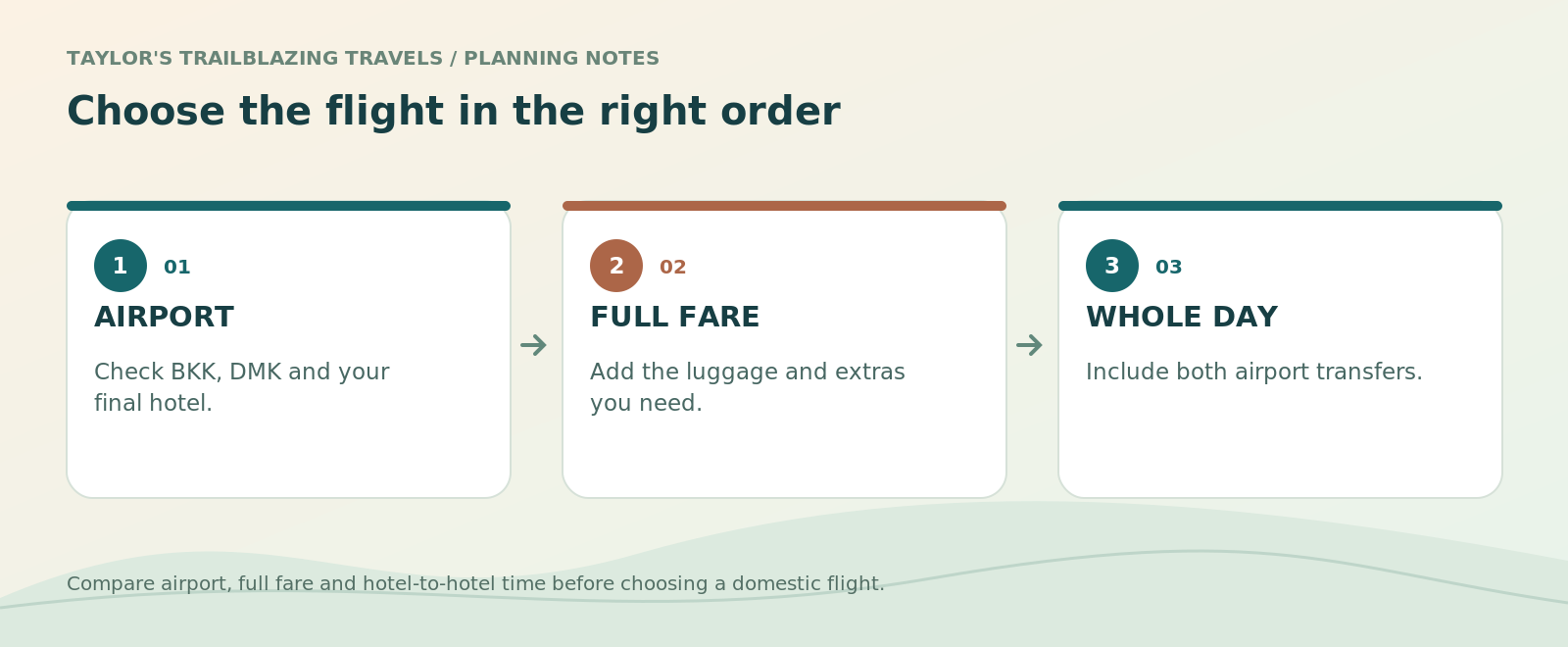
Read the airport code
BKK and DMK are separate airports. Check both legs before comparing prices.
The complete fare
Count the baggage, required seats and airport access you actually need.
Separate-ticket timing
Keep a useful recovery margin, especially before a ferry or international flight.
Domestic flights in Thailand: make the route earn its place
Start with the time you actually recover
Look at the holiday as a sequence of nights, not a collection of attractive flight prices. Moving from Bangkok to Chiang Mai can justify a flight when you have a short trip and value arriving rested. However, flying away for one night and returning immediately can consume more useful time than it creates. Count packing, checkout and finding the next hotel as part of the move.
For an illustrative domestic travel day, allow an hour to reach the airport, two hours before departure, ninety minutes in the air and another hour for arrival and the hotel journey. That is five and a half hours before a significant delay. These are deliberately rounded planning assumptions, not a published minimum or a timetable for every route.
Compare alternatives with the same endpoints
Compare your Bangkok hotel with your Chiang Mai hotel, rather than a flight's airborne time with a train's station-to-station time. Conversely, a sleeper train can replace an overnight hotel while still leaving you tired the next morning. Decide which experience you prefer rather than pretending either option has no trade-off.
BKK and DMK are different airports, not terminals
Read the three-letter code before the price
Suvarnabhumi uses BKK; Don Mueang uses DMK. Bangkok Airways' own airport information lists both airports separately, including distinct check-in locations. Therefore, neither the word Bangkok nor an airline's name is enough to identify your departure building. Confirm the airport independently for the outbound and return legs. [2]
A return search can offer BKK on the way out and DMK on the way back. That may be perfectly workable when you are spending several nights in Bangkok. It is a very different proposition when you are trying to meet an international departure on the same afternoon. Save the airport code in your calendar entry as well as the flight number.
A cheaper flight can create an expensive airport change
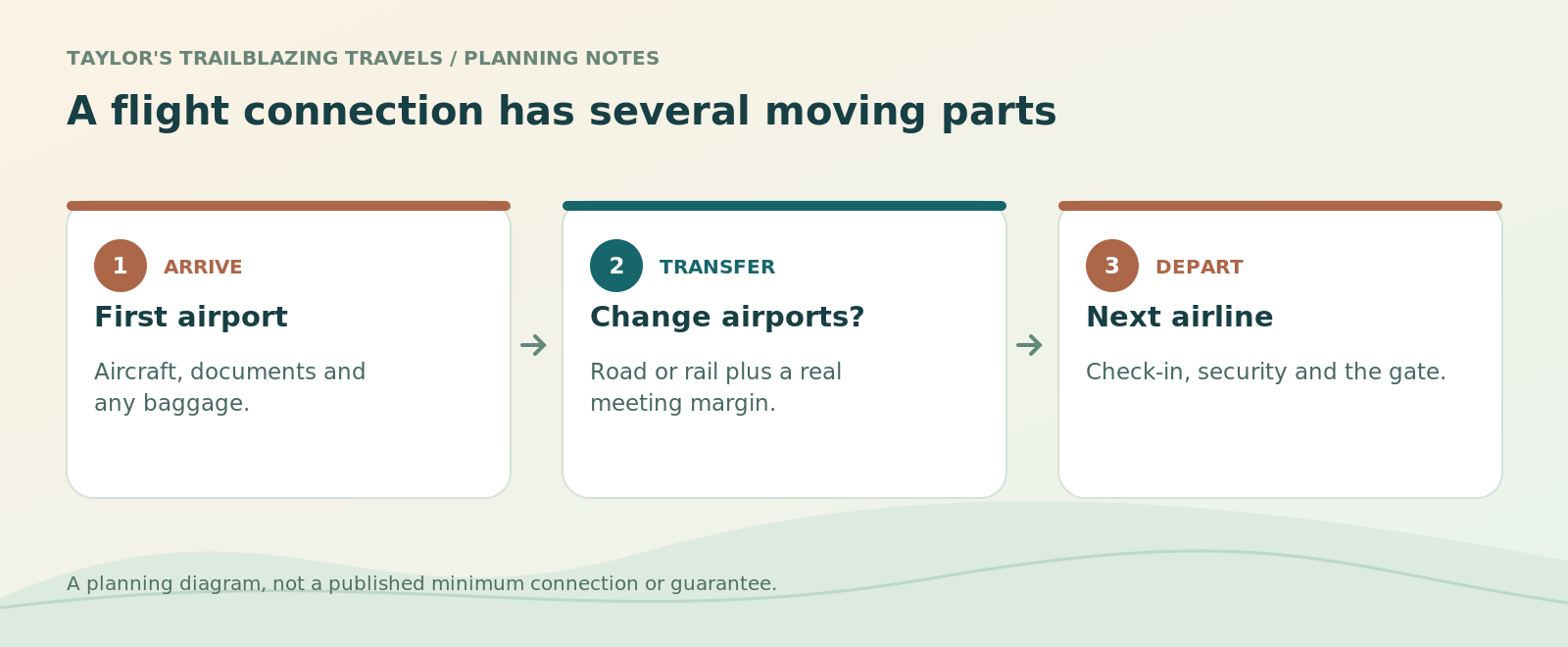
Before accepting a cross-airport connection, add the ground journey, check-in deadline and consequences of a delayed first flight. You leave one airport and travel through the city road or rail network; it is not a gate-to-gate transfer. Checked luggage does not travel between Bangkok's airports on your behalf merely because both flights appear in one search.
Understand the airline and the fare you are buying
Full-service does not remove the need to read conditions
Thai Airways and Bangkok Airways provide useful reference points for comparing an inclusive fare with an unbundled one. Nevertheless, the marketing label is not the contract. Check the allowance, change conditions, seat selection and operating carrier for the actual ticket. A codeshare flight number can sell a seat on another airline's aircraft. [3]
Thai Airways introduced piece-based baggage rules for relevant tickets issued or wholly unused tickets reissued from 25 November 2025, for travel commencing on or after 2 March 2026. Its domestic economy summary lists one checked piece up to 23 kilograms for the named fare categories. That is a reason to stop repeating older advice that every domestic THAI ticket simply includes a loose weight allowance. Ticket eligibility and your recorded entitlement still control. [4]
Compare low-cost fares by the extras you need
With airlines such as Thai AirAsia and Thai Vietjet, inspect cabin-bag limits and whether checked baggage is included in the chosen bundle. Their published policies are a better starting point than an old comparison chart. Similarly, look up Thai Lion Air or Nok Air on your travel date rather than assuming one low-cost airline's allowance applies to another. [5][6]
Do not buy every optional extra automatically. A meal may add little on a short sector, whereas a checked bag or seats together may matter greatly to your party. The useful question is not which airline is universally cheapest. It is which available flight delivers your required luggage, timing and flexibility for the lowest acceptable total.
Pick flights that fit Thailand's geography
Long jumps and cross-country moves
A direct northern-to-southern flight can prevent an unnecessary return through Bangkok. Search your precise date for Chiang Mai to Krabi options and inspect whether the result is actually nonstop. If only a long connection is available, compare another departure day before rebuilding the holiday around it. A route's appearance in a search box does not guarantee a daily service.
For a Bangkok-and-Andaman holiday, compare Bangkok to Krabi flights with Bangkok to Phuket flights. The destination airport should follow the accommodation area. A cheaper flight into the wrong province can create a long road transfer that cancels the saving and uses the first beach afternoon.
Islands require a second decision
Samui has its own airport, while other island plans can involve a mainland landing followed by road transport and a ferry. Bangkok Airways' network includes Samui, Phuket, Krabi and northern destinations, but consult its current operating map and actual booking results for individual links. [3]
Compare flights into Koh Samui against the complete mainland alternative, not against the mainland airfare alone. Once you add a ferry, transfer and possibly an overnight stop, the apparently expensive airport may be the simpler choice. Equally, a mainland route can work well when you intend to visit that area rather than treating it solely as an obstacle.
Calculate a total fare instead of a headline bargain
A worked comparison without pretending to quote the market
The following is a constructed example prepared on 4 October 2026. It explains the calculation; these are not checked live fares, offers or expected prices. Replace every number with the actual checkout total for your dates before making a booking.
On a small screen, swipe the table sideways to see every column.
| Item | Illustrative lower headline fare | Illustrative inclusive fare |
|---|---|---|
| Ticket | THB 1,200 | THB 1,850 |
| Checked bag required by this traveller | THB 500 | Included in this example |
| Chosen seat | THB 150 | Included in this example |
| Extra airport-transfer cost caused by the choice | THB 300 | THB 0 extra |
| Comparable total | THB 2,150 | THB 1,850 |
The first option is THB 650 cheaper at the headline stage but THB 300 dearer in this example's final comparison. The lesson is not that inclusive airlines always win. A cabin-only traveller who does not need the extra transfer could reach the opposite result. The assumptions belong to the traveller, not to the airline's advertising.
Compare per person and per party separately
Airfare usually grows with passenger numbers, whereas one suitable private transfer may carry the whole party. Put shared costs in a separate column so you do not accidentally charge a car four times or divide a per-person shuttle fare by four. Also check whether the selected vehicle genuinely holds everyone's cases.
Finally, assess cancellation flexibility against your likely plans. Paying more for a flexible ticket is difficult to justify when all dates are fixed, but valuable when an onward appointment may change. Read what flexible actually allows: a waived change fee is not necessarily a waiver of a fare difference.
Choose a departure time that fits the rest of the day
Early flights have a hidden starting time
An early departure can leave more of the destination day available, but calculate when you must leave your actual hotel. A flight at 07:00 might require a very early wake-up once packing, checkout and airport access are included. Compare that with a later departure before concluding that the earliest flight gives you the most usable holiday time.
Check breakfast, reception and the first practical public-transport option. If your preferred airport train is not available early enough, include a road transfer in the total. The apparent saving from an early ticket can disappear when it requires a different hotel or an unexpectedly expensive pickup.
Midday and evening flights solve different problems
A midday flight can make a hotel change feel orderly: check out, travel and arrive with time to settle in. However, it may divide two otherwise useful days. Decide whether a leisurely morning or an early arrival matters more, particularly when the destination hotel cannot provide immediate room access.
An evening departure can preserve a final day in the first city, provided the hotel can keep your luggage and you can still reach the airport comfortably. At the other end, confirm reception and transport. A late arrival at a mainland gateway is especially unattractive when your intended ferry has already finished for the day.
Avoid unsupported cheapest-day rules
There is no verified universal cheapest weekday or booking interval claimed in this guide. Instead, compare a small number of adjacent dates that genuinely work for you, using the same luggage and passenger requirements. Keep a record of the final totals so that changing extras do not masquerade as a fare increase.
Once a suitable price fits the budget, weigh further searching against the risk of losing the timing you need. Saving a little more is less valuable when it pushes you onto a departure that forces another airport change or makes the first hotel night unusable.
Baggage rules: check weight, pieces and dimensions
Your international allowance does not automatically continue
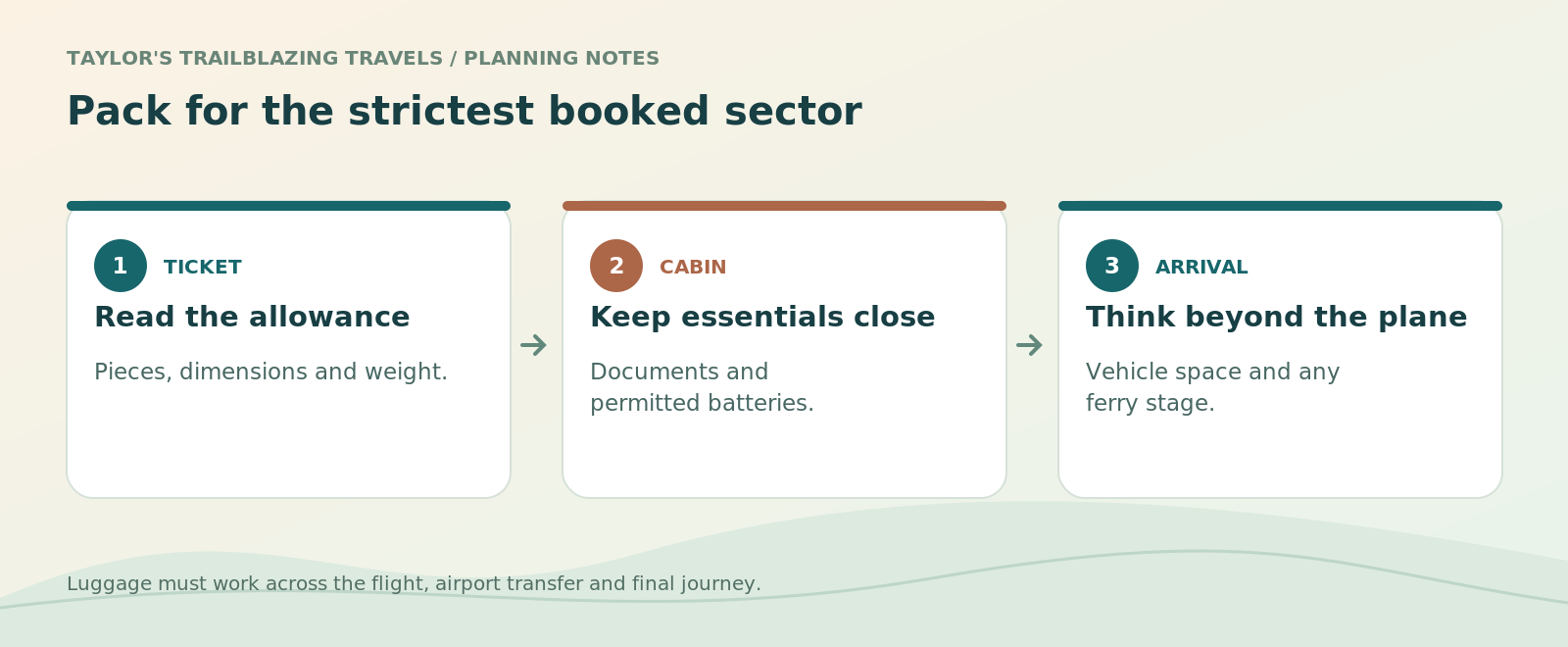
Separate domestic tickets can have a different allowance from the long-haul flight that brought you to Thailand. Build your packing plan around the most restrictive sector you will actually use. Buying extra weight in advance may solve one problem, but it does not override a maximum bag size or a per-piece limit.
For comparison, Bangkok Airways lists a 20-kilogram checked allowance for adult and child economy passengers. AirAsia's standard cabin policy permits two items with a combined weight no higher than seven kilograms, with separate size limits for the larger and smaller item. These examples were checked on 4 October 2026 and are not a combined rule for all airlines. [7][5]
Weigh the bag as it will reach the counter
A laptop, camera, chargers and a filled toiletries pouch can make a nominally small backpack heavy. Measure wheels, handles and protruding pockets where the airline includes them. Furthermore, weigh the personal item as well when the policy uses a combined cabin allowance. Moving a charger from one bag to another does not reduce the combined weight.
Keep a modest margin rather than aiming for exactly the published maximum on a home scale. Remove genuinely unnecessary items before buying a larger allowance. For a multi-flight holiday, one compact packing system is easier than repacking at every airport; the related packing guide above is a useful starting point for deciding what earns space.
Sporting equipment and unusual bags need a separate answer
A golf bag, diving equipment, musical instrument or other unusually shaped item may not fit the ordinary baggage allowance even when its total weight appears acceptable. Ask the airline how it is classified, whether advance notice is required and which dimensions apply. Keep the answer with your booking rather than relying on a general customer-service conversation from another trip.
For several domestic sectors, check every operating carrier before buying the first ticket. One airline accepting the equipment does not establish the conditions for the rest of the route. Also tell the airport-transfer supplier about bulky items so that you do not solve the flight problem and create a vehicle-space problem after landing.
Book direct or through an agent with your eyes open
Direct airline booking has a practical advantage
An airline booking can simplify communication about a schedule change because you deal with the carrier's own reservation. That does not mean every agent is a mistake. A comparison platform can be useful for seeing routes and timings together, especially while deciding whether to fly or use ground transport. The important distinction is who issued the ticket and who handles changes.
If you book through 12Go, its terms explain that travel products are provided by suppliers and that product-specific conditions apply. Read the chosen fare's rules before payment rather than treating a platform's presence as a universal cancellation guarantee. Keep both the booking reference and any airline reservation code. [8]
Check the final screen slowly
Confirm the spelling of each passenger's name against the travel document, the date, the airport code and the baggage allowance. Then check the payment currency and the final amount. Where the airline requires cardholder verification or additional documentation, organise that before leaving home rather than discovering it at the desk.
After payment, look for an issued itinerary and the status of the booking. A payment notification alone should not end the checking process. Open the reservation with the airline when the details supplied allow it, and verify that every traveller and sector appears. Save a copy locally because a booking hidden inside an inaccessible email account is much less helpful at a busy counter.
Leave realistic space around separate tickets
Protected connections and self-transfers are not interchangeable
Ask the airline or seller whether the journey is sold as a protected connection and whether bags are checked to the final destination. Do not infer either fact from a single payment or one itinerary email. Minimum connecting times are operational thresholds for specific arrangements, not comfortable targets for independently assembled trips.
Bangkok Airways explicitly distinguishes separate tickets when publishing its connection guidance. Therefore, do not take an airline's permitted through-connection time and reuse it for a landside self-transfer with baggage collection. The two journeys involve different tasks and different responsibility when the first service is late. [2]
Choose a buffer you can afford to lose
For an international arrival followed by a separate domestic flight at the same airport, four or five hours can be a useful conservative starting point for planning. With an airport change, consider six hours or more, and often an overnight stay. These are editorial planning margins, not guaranteed safe connections or airline-approved minimums.
Increase the margin for children, assistance requirements, checked bags, a final departure of the day or an onward booking you cannot easily replace. Conversely, do not interpret travelling without a suitcase as permission to remove every buffer. Aircraft arrival, immigration and walking distances still exist. When the itinerary is expensive or unusually important, an extra night is often the clearest way to reduce the number of things that must go perfectly.
Organise check-in, documents and the gate
Work backwards from the hard deadline
Departure time is not the time you should reach the check-in desk. The airline closes processes before the aircraft leaves, and online check-in does not automatically remove bag-drop or document checks. A comfortable general starting point is to reach the airport about two hours before a domestic departure, then increase that for peak demand or special arrangements.
As a dated airline example, Bangkok Airways currently lists domestic check-in closure 40 minutes before departure and gate closure 15 minutes before departure, with variations at some airports. These are deadlines, not arrival recommendations. Its online check-in guidance adds separate instructions for bag drop and reaching the gate. [2][9]
Keep the travel document accessible
Foreign visitors should take their original passport and the documents required by the operating airline. Do not plan to rely on a photograph of a passport without explicit confirmation that it is accepted. A booking with mismatched names is best corrected before the airport, while there is time to obtain a written answer.
After security, find the gate before settling down for food. Watch the airport screens for changes rather than relying entirely on an earlier boarding pass. At a large airport, a gate change can add a meaningful walk. If you need to leave a companion briefly, agree an actual meeting point and keep the group updated instead of assuming everybody will interpret the same terminal landmark correctly.
Landing is not the end of an island transfer
Reserve the difficult connection first
A late mainland arrival may miss the usable ferry connection even when the flight itself is on time. Search Surat Thani Airport to Samui transfers before committing to the flight. Inspect the actual pickup location, reporting deadline, pier and final drop-off; city, airport and train-station pickups are different products. [10]
Book the restrictive element first when practical. A ferry that runs only at suitable times deserves more attention than a hotel that accepts arrivals throughout the evening. However, a combined ground-and-sea booking is not automatically connected to your independently booked flight. Ask what happens if that flight is delayed.
Match the transfer to the hotel address
For an Andaman stay, Krabi Airport to Ao Nang transfers provide a useful comparison between shared and private options. Read whether the product ends at a hotel, a central drop-off or a pier. An apparent Ao Nang result can include nearby areas or Railay, so the destination text matters more than the search heading. [11]
Send your accommodation name and full address to the supplier, particularly when two properties have similar names. Include the flight number when requested, but still read the waiting-time policy. Flight tracking can help a driver adjust; it does not establish unlimited waiting or oblige a ferry to delay departure.
Phuket arrivals deserve a beach-specific plan
If you are landing at HKT, compare Phuket Airport to Patong transfers only for a Patong-based stay. A hotel in Kamala, Rawai or another beach area needs its own quote and route. The convenient transfer for one resort should not become a generic Phuket assumption copied into every booking.
Check whether you are buying a shared service with other drop-offs or a vehicle travelling directly to your address. The first may be economical for a solo traveller; the second can be worthwhile for a group or a late arrival. Neither is automatically better without considering how many people, bags and stops are involved.
Batteries, family travel and assistance need early attention
Separate cabin essentials from hold luggage
Pack documents, essential medication, valuables and a change of clothes so that they remain available if a checked case is delayed. Keep permitted power banks in cabin baggage. Thailand's 2026 guidance also restricts their use and storage in flight, limits passengers to two and requires a readable energy rating; verify the operating airline's current conditions before travelling. [12]
Do not use an old packing checklist that simply says any small power bank is fine. The labelled watt-hour rating and airline policy are the relevant checks, not a seller's broad travel-friendly claim. Protect devices against damage and short circuits, and follow crew instructions about where they must remain accessible.
Ask specific questions about the help you need
When arranging assistance, describe the actual task: walking a long concourse, climbing aircraft stairs, transferring to a seat or travelling with a mobility device. A vague request for help may not answer whether the booked flight and airport arrangements suit you. Confirm battery specifications and handling requirements for powered equipment directly with the carrier.
Families should check child seating, pushchair handling and any required documents before payment. Keep snacks, a spare outfit and essential supplies in the bag that stays with you. Meanwhile, allocate one adult to documents and another to bags during a busy check-in, when possible. A simple division of jobs reduces repeated searching without relying on staff to supervise belongings.
Have a disruption plan that starts before the airport
Keep the next commitment flexible
Place a relaxed evening after a flight rather than a non-refundable excursion that starts shortly after landing. On the final domestic sector before a long-haul departure, consider returning to the departure city the previous day. That creates options if a flight is retimed and avoids making the whole holiday depend on one short connection.
Read insurance wording for the particular events and separate-ticket arrangements you are relying on. Do not assume that cover for a delayed flight reimburses every independently booked hotel, transfer or missed connection. This is a document-checking task rather than a reason to buy the most expensive policy without understanding it.
Stay reachable without depending on one Wi-Fi connection
Check messages from the airline and booking agent before leaving the hotel. A working data connection can help you receive changes and contact a driver, but download the itinerary and meeting instructions as well. An Airalo eSIM is one option for compatible, unlocked phones; compare coverage, activation rules and whether the plan includes the kind of communication you need.
If a cancellation occurs, establish your available rebooking or refund choices with the ticket issuer before buying a replacement in panic. Keep receipts for necessary expenses and ask for written confirmation of the disruption. The relevant airline and ticket conditions determine your options; this guide does not promise a specific compensation outcome.
Build a two-week route with fewer airport days
A three-base example
For a fourteen-night trip, one workable planning pattern is three nights in Bangkok, four in Chiang Mai and seven in one southern area. The numbers are illustrative, not an instruction to book those exact durations. This pattern uses flights to connect genuinely different regions while leaving enough nights at each base to unpack and enjoy the visit.
Search the middle and final sectors before paying for all hotels. A convenient direct flight on one day and a long connection on the next can change which order makes sense. Also compare an international arrival in Bangkok with departure from Phuket when your long-haul options permit it; an open-jaw itinerary may remove an otherwise unnecessary domestic return.
Keep the final night useful
When flying home from Bangkok on a separate ticket, returning the previous afternoon can turn a connection buffer into a last city evening. Alternatively, use Suvarnabhumi-area accommodation options when an early departure makes a city detour unattractive. Check the property's real transfer time and shuttle arrangements, not just the word airport in its name.
For the return sector, Chiang Mai to Bangkok flight comparisons should be filtered by the airport you need. Resist adding another destination merely because a cheap flight exists. Every additional base needs a reason strong enough to justify another checkout, baggage decision and transfer day.
Keep a return-flight comparison separate from the outward bargain
A good outward fare can distract from an awkward return. Compare both sectors before paying, including the airport at each end and the time you must leave the final hotel. A low-cost evening arrival in Bangkok is not useful when the international flight you hoped to catch departed that afternoon.
For separate one-way tickets, save each confirmation clearly and verify both after booking. Changing one leg does not automatically update the other. If you decide to stay longer in the south, check the impact on the final Bangkok night and long-haul departure before changing only the domestic flight.
Allow for belongings acquired during the trip
Leave some space for the items you realistically expect to bring home. A bag that met the outward allowance may become heavier after shopping or carrying an extra gift for a companion. Review the final domestic sector's allowance while you still have time to buy an appropriate addition through the airline.
Avoid solving the problem by placing prohibited batteries or valuables in checked baggage. Reorganise only within the rules for each item, and keep essential documents accessible. A measured bag, a clear entitlement and a little unused capacity make the last airport day easier than a suitcase that already needed to be forced shut before the holiday began.
The advantages and limitations of flying
Where flights work well
Flying can protect time on a short holiday, connect distant regions and reduce the fatigue of an overnight road journey. It is particularly useful when the destination airport is close to the area you actually intend to visit, the departure fits normal hotel hours and your luggage already meets the ticket conditions.
A sensibly chosen flight can also make a varied itinerary realistic without forcing every traveller to enjoy long overland travel. Someone who sleeps badly on buses may value a daytime flight more than the apparent saving from replacing one hotel night. That is a legitimate preference, not poor budgeting.
Where the benefit disappears
Airports introduce fixed deadlines, security procedures and baggage rules. Short routes can lose their advantage once access journeys are included. Moreover, a flight to a mainland gateway does not remove weather-sensitive ferry travel, while a cross-airport connection can add a new weak point rather than solve one.
Evaluate the environmental effect alongside convenience, especially when a rail journey would otherwise fit the itinerary. No route-specific carbon calculation is claimed here. The practical recommendation is simply to avoid unnecessary backtracking and repeated short stays: fewer moves usually make the holiday easier whether you travel by plane, train or bus.
Common mistakes that are easy to prevent
Mistaking a cheap result for a completed plan
First, avoid booking from the city label without checking the airport. Another error is comparing a cabin-only fare with an inclusive fare while intending to check a suitcase. Also remember that an arrival at the airport is not an arrival at the resort. These errors interact: one low fare can trigger an airport change, extra baggage and a missed ferry.
Make a one-line travel record for each sector: date, operating airline, flight number, origin code, destination code, baggage and next transfer. Keep the record alongside the ticket, not instead of it. This gives you a quick way to spot an inconsistent airport before it becomes a taxi problem.
Treating the last possible option as the normal option
Avoid building plans around the final domestic flight before an international departure, the last ferry after a mainland arrival or the check-in desk's closing minute. A schedule with no alternative is inherently fragile even when every individual booking looks reasonable.
Finally, resist unnecessary upgrades purchased in a hurry. Decide at home which extras matter to your party and compare their final cost. An airline's promotional badge, an agent's popularity label or a countdown on a booking page should not replace a slower check of the actual journey you are committing to.
Frequently asked questions
Is it worth flying within Thailand?
It is often worthwhile for long moves, particularly between northern Thailand and the south or when you have limited holiday time. For shorter journeys, compare the complete hotel-to-hotel day. The answer changes with your departure airport, baggage, available train or bus options and how much you value arriving rested.
Which Bangkok airport should I choose?
Choose the airport that best fits your hotel and next flight, then compare the full cost. BKK is Suvarnabhumi and DMK is Don Mueang. Never assume that both legs of a return booking use the same airport. An airport change between separate flights needs its own ground-transport plan. [2]
Is checked baggage included on domestic flights?
Sometimes. It depends on the airline, ticket and date of issue or travel. Bangkok Airways and Thai Airways publish different allowance structures, while low-cost bundles can vary. Read the entitlement shown in your own booking and check both the number of pieces and permitted weight. [7][4]
Can I take my long-haul suitcase on a domestic flight?
Usually the question is whether it meets the domestic airline’s size and weight conditions and whether you have bought the necessary allowance. A generous international ticket does not automatically cover a separate domestic booking. Check oversized or sporting equipment directly with the carrier rather than adding ordinary baggage and hoping it is sufficient.
How early should I reach the airport?
About two hours before a domestic flight is a useful planning starting point, with more time for busy periods, assistance or unfamiliar airports. This is not a universal airline rule. Find the operating carrier’s bag-drop, check-in and gate deadlines and work backwards with a comfortable margin.
Can I book a domestic flight after landing from overseas?
You can arrange it, but a separate ticket makes the timing risk yours unless specific protection says otherwise. Allow for immigration, baggage and any airport change. For an expensive onward journey or an uncertain arrival, an overnight stay can be more sensible than buying a tight connection and hoping everything runs early.
Is Surat Thani the same as flying to Samui?
No. A mainland airport-to-Samui transfer involves additional ground and sea travel, whereas USM is Samui Airport. Compare the entire journey and its final departure times before deciding. A transfer listing may end at a pier rather than your hotel, so check the last part as carefully as the first. [10][13]
Should I always book the cheapest airline?
No. Book the cheapest suitable itinerary after adding the extras you need and the cost of reaching both airports. A slightly higher fare can be better value when it avoids an airport change or an overnight stop. Equally, a simple cabin-only flight can remain excellent value when its timing suits you.
Are power banks allowed in checked baggage?
Do not pack a power bank in checked baggage. Check Thailand’s current cabin-only rules and your airline’s capacity, quantity, storage and in-flight-use restrictions. The 2026 guidance is stricter than many older travel articles, so inspect the rating on the device before leaving home. [12]
What should I save after booking?
Keep the issued itinerary, passenger details, airline reference, baggage entitlement and change conditions. Download the airport-transfer meeting instructions separately. Then put the airport codes and reporting time in your calendar. This small record helps when email access is poor or several similar-looking flights appear in your booking history.
The flight worth booking is the one that improves the holiday
Use flying to connect the regions you genuinely want to visit, then spend enough nights in each place to make the move worthwhile. Start with the right airport and arrival time, compare a complete fare, and give separate tickets breathing room. Those decisions normally matter more than winning a small headline-price saving.
Before paying, read the final itinerary aloud: airport, date, flight, luggage and onward journey. After paying, verify the issued booking and keep the documents available offline. On the travel day, arrive with time to solve an ordinary problem rather than only enough time for a perfect airport run.
For a short first visit, two well-chosen domestic flights can be more useful than a complicated web of cheap sectors. For a slower trip, mix flights with rail or road journeys that you actually want to experience. The best plan is not the one with the most efficient-looking map; it is the one that leaves you with usable days and manageable travel decisions.
Sources and fact-checking notes
Last editorial source check: 04 October 2026. Official airport, railway, government and airline pages support operational facts; booking-platform and operator pages support their own product information. Timings described as planning allowances are editorial judgements, not guaranteed connections. Constructed price examples are labelled and are not live offers.
Availability, pickup instructions, baggage conditions and operating details can change. Recheck the actual ticket and current operator guidance before travel. The original scene artwork is illustrative and should not be used as a map or evidence of a specific terminal layout.
- 12Go: Suvarnabhumi to Chiang Mai flight listings.
- Bangkok Airways: airport check-in, airport codes and counter deadlines.
- Bangkok Airways: current route network.
- Thai Airways: piece-concept baggage policy for travel from 2 March 2026.
- AirAsia: cabin baggage policy, updated 13 April 2026.
- Thai Vietjet: baggage policy.
- Bangkok Airways: baggage allowance.
- 12Go: terms of use and supplier-specific product conditions.
- Bangkok Airways: online check-in and boarding deadlines.
- 12Go: Surat Thani Airport to Koh Samui, individual transfer listings.
- 12Go: Krabi Airport to Ao Nang, individual transfer listings.
- Thai Government Public Relations Department: 2026 power-bank requirements.
- Samui Airport: official airport information.
Illustrations in this article were created for Taylor’s Trailblazing Travels. Third-party photographs, where used, are credited beside the image or in the source list.