Best Food Areas in Bangkok
Eight food districts, the right time to visit and a meal plan that leaves room to enjoy the city.
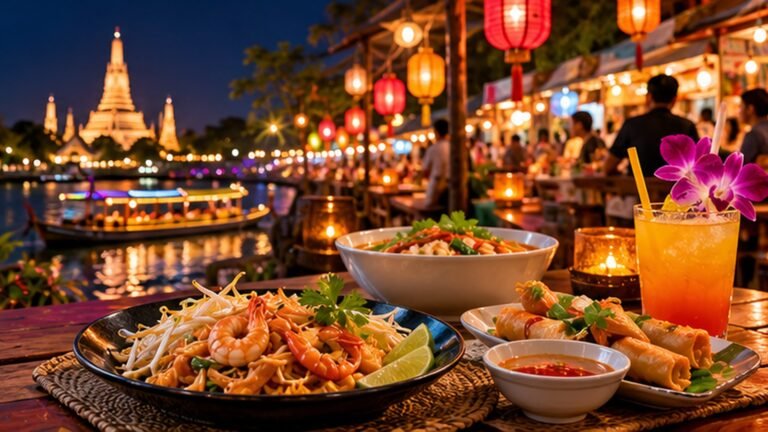
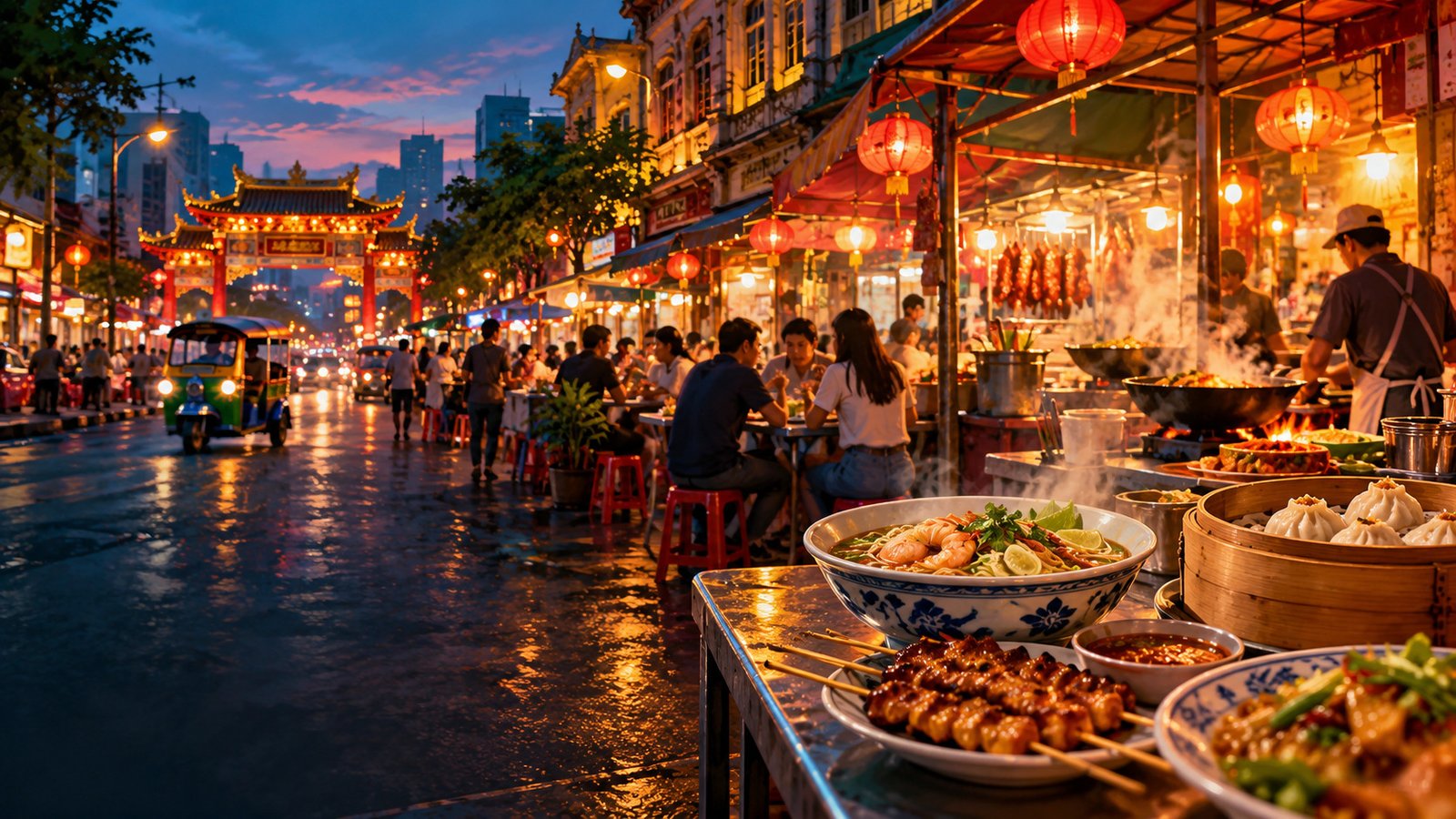
Bangkok food-street illustration: a conceptual scene, not a photograph of a particular stall or an exact street layout.
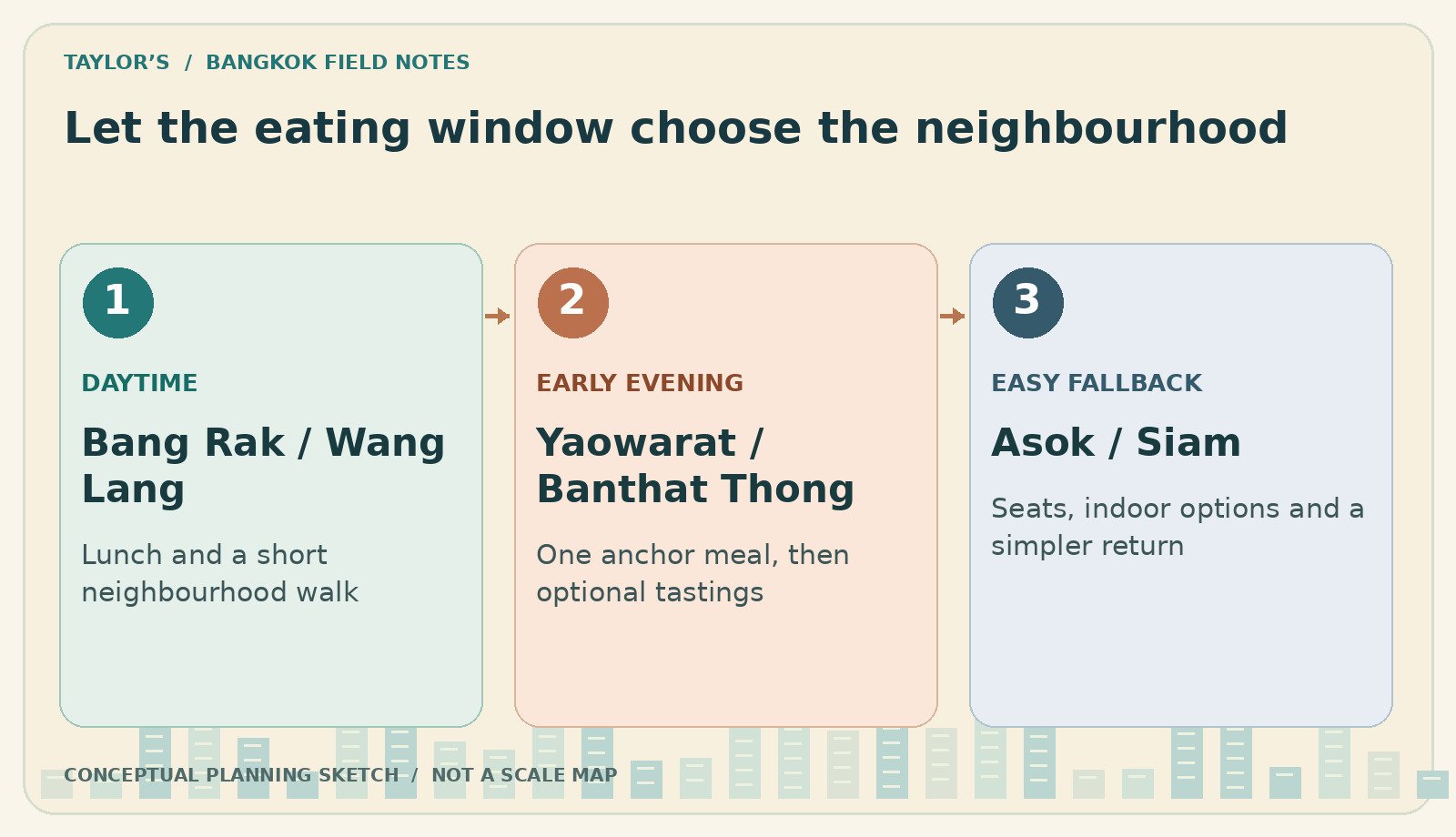
The best food areas in Bangkok are not interchangeable. Yaowarat suits an evening built around small dishes and bright street scenes; Bang Rak makes a more flexible lunch stop; Wang Lang rewards a daytime visit across the river. Meanwhile, a food court near your hotel can be the right choice when somebody needs a seat, a predictable menu or a break from the heat.
The useful question is not where Bangkok's single best meal is hiding. It is which neighbourhood matches the time available, the food you enjoy and the journey you are prepared to make afterwards. A celebrated lunch stall does little for a traveller arriving after it has sold out. Similarly, crossing the city for dessert can turn a pleasant evening into an expensive transport exercise.
This guide compares eight practical food districts, explains how to combine them with sightseeing and gives you a way to order without buying an entire second dinner at every stop. Recommendations are research-led planning judgements, not claims that every stall has been personally visited or inspected.
Yaowarat
Choose a compact tasting route, not an exhausting stall checklist.
Bang Rak
Build the meal into a short Charoen Krung or river day.
Wang Lang
Make the river crossing and lunch one considered outing.
Asok or Siam
Use a food court or seated restaurant when the group needs an easier meal.
Best food areas in Bangkok: choose by occasion
How this shortlist was made
The areas below were selected for a useful concentration of food, a recognisable reason to visit and a workable place in a Bangkok itinerary. Official tourism information establishes neighbourhood context, while venue directories and MICHELIN's editorial coverage help identify the kinds of food available. Inclusion is not a hygiene certification, and the order is not a league table of culinary quality. [1] [2] [3]
Instead, compare three things: the eating window, the route to your next stop and the amount of uncertainty your group enjoys. A confident couple can improvise around a cluster of shophouses. A family with a hungry child may need one confirmed restaurant first, with browsing afterwards. Someone with a serious allergy needs an establishment able to discuss ingredients and cross-contact, not merely a district with a strong reputation.
| Area | Useful eating window | Choose it for | Main planning catch |
|---|---|---|---|
| Yaowarat | Evening | Thai-Chinese tasting walk | Crowds; individual stall opening varies |
| Bang Rak / Charoen Krung | Lunch or a confirmed evening venue | Food alongside a neighbourhood or river day | The road covers several distinct stretches |
| Wang Lang | Daytime | Market snacks and a river-side lunch | Check the crossing and final walking route |
| Nang Loeng | Late morning / lunch | Traditional dishes and desserts | Vendors can finish before the market closes |
| Banthat Thong / Sam Yan | Dinner | An evening near the Siam side of the city | Pin the restaurant, not just the whole road |
| Talat Phlu | A confirmed shop's trading window | Traditional food away from the usual first-trip circuit | BTS and conventional-rail locations are different |
| Or Tor Kor | Daytime | Produce, fruit and a market meal | Not the same operation as Chatuchak weekend shopping |
| Asok / Siam food courts | When the chosen venue is open | Seats, choice and an indoor fallback | Check the payment system and restaurant type |
Editorial visit suggestions, reviewed 3 October 2026. These are not guaranteed opening hours for individual businesses.
Start with one anchor meal
Choose one meal that really matters, then leave the rest loose. Your anchor could be a noodle lunch in Bang Rak, a Chinatown tasting walk or an early dinner near Banthat Thong. Once that is settled, add a drink, a snack and perhaps dessert rather than three more compulsory venues.
This also makes closures easier to handle. Save two alternatives within the same small area before leaving the hotel. When a queue is longer than your appetite or a shop has finished its signature dish, you can change direction without rebuilding the evening. The neighbourhood is the plan; a single social-media favourite should not control it.
Back to the guide ↑Yaowarat: the strongest choice for an evening food walk
What makes the area distinctive
Yaowarat is the natural starting point for visitors who want Bangkok's Thai-Chinese food culture and an energetic night-time setting. TAT describes the neighbourhood's mix of savoury dishes, seafood and desserts. Its editorial feature is useful for orientation rather than as a current timetable for every shop, so verify any must-visit business separately. [1]
Plan a compact circuit near Yaowarat Road rather than trying to cover Chinatown in one sitting. MRT Wat Mangkon is the useful rail reference. However, the easiest station exit depends on the first restaurant, and a place described as being in Chinatown may sit several streets away from the neon-lit stretch you pictured. Pin the actual doorway, not just the district name. [4]
How to eat here without over-ordering
Begin with a modest bowl or shared cooked dish, then walk before deciding what comes next. Save grilled seafood for a deliberate choice rather than an automatic second course. At any stall selling by weight, establish the weight, preparation and total price before cooking starts. A displayed unit price is not necessarily the cost of the whole fish on the counter.
For two people, an enjoyable sequence might be one noodle stop, one savoury snack and one shared dessert. That is a suggested structure, not a fixed package. Build in a seated break if standing and negotiating crowds become tiring. A quieter restaurant is not a failure to experience street food; it may make the rest of the walk much more enjoyable.
Timing and the journey home
An early-evening arrival gives you time to orientate before committing to dinner. Nevertheless, trading patterns vary by business, weekday, festival and weather. Do not assume either that every stall opens every evening or that a quieter pavement means all Chinatown restaurants are closed. Confirm a specific booking or food-tour meeting point directly.
Agree the exit plan before the group separates for snacks. A named MRT entrance or a recognisable hotel lobby is more useful than a message saying to meet by the big sign. After dinner, follow current station last-train information rather than allowing one more stop to remove your rail option. Keep enough cash or battery for a road journey if plans change.
Back to the guide ↑Bang Rak and Charoen Krung: a flexible lunch district
Food with a neighbourhood walk
Bang Rak works particularly well when you want food to sit inside a wider day rather than become an evening event. Around Charoen Krung, established food businesses share the area with places of worship, older commercial buildings and creative spaces. TAT identifies the district's varied cultural influences and its street-art corridor, providing a stronger reason to explore than simply counting famous restaurants. [5]
Use a short section of the neighbourhood. The streets around Saphan Taksin and the river are not the same micro-area as every gallery or cafe farther north. Pick a lunch venue, then choose one nearby walk. Trying to join every Charoen Krung recommendation into a single continuous route can produce much more pavement time than expected.
The practical advantage over a night market
A daytime meal lets you see the menu and the streets before evening crowds change the atmosphere. You can also make a substantial lunch the main meal, leaving dinner near the hotel. This is useful on a temple day when the group may be tired by late afternoon.
However, opening hours still belong to individual businesses. A shop that concentrates on breakfast and lunch should not be treated as an all-day option. Search its current official channel, or ask accommodation staff to telephone when the meal is important. Keep an alternative with seating rather than relying on a list assembled from old reviews.
Combining food with the river
Saphan Taksin and Sathorn Pier make the southern end of this area useful for a rail-and-river day. Before boarding, check the actual boat route, direction and last departure. The tourist boat and commuter boats are different services, and a ticket for one does not automatically work on the other. [6]
Avoid ending a long river excursion with an ambitious walking tour simply because both carry the word riverside. The most comfortable version is often lunch, a short exploration and one boat journey. If you are choosing accommodation around this pattern, compare the hotel's walk to the pier and station separately; they are related transport points, not identical entrances.
Back to the guide ↑Wang Lang: daytime eating on the Thonburi side
Why it belongs on a food itinerary
Wang Lang is useful for travellers who want a busy daytime food-and-shopping area near the river rather than another modern shopping centre. TAT places the market beside Siriraj Hospital and Wang Lang Pier, and highlights its concentration of food alongside clothing and other shops. That is the part of its guidance relevant here; references to past ceremonial events should not be read as a current events calendar. [7]
Visit with a short wish list: one savoury meal, a look at the snack stalls and a dessert only if you still feel like it. The lanes are working commercial spaces, so keep moving when not buying and step aside to consult a map. A large backpack or open umbrella can be awkward in a narrow section.
Make the crossing part of the plan
First decide which bank you are starting from and which pier serves your intended crossing. Not every boat that passes a pier goes to the opposite bank, and not every stop is served by every route. Ask for the destination by name and look for current pier signs before paying.
Do not let a short river crossing create false confidence about the whole outing. Walking from a hotel to the first pier, waiting, finding the market and returning all take time. As an editorial allowance, keep two to three hours for a relaxed food visit when you are already sightseeing around the river; add your separate cross-city journey on top.
Who will enjoy it most
Wang Lang suits people who like browsing, can cope with changing stall availability and want a daytime alternative to Chinatown. It is less straightforward for a group needing guaranteed step-free access, plentiful space around a buggy or detailed ingredient explanations at every counter. In those situations, identify a seated restaurant first and make the market optional.
A guided neighbourhood walk can help when the river logistics or unfamiliar menus would otherwise dominate. However, check that the advertised itinerary really includes Wang Lang; a general Bangkok market tour might go somewhere entirely different. Ask about walking distance and food substitutions before paying.
Back to the guide ↑Nang Loeng: a focused lunch for curious eaters
Choose it for traditional dishes and desserts
Nang Loeng offers a more concentrated market visit than an evening spread across several districts. Traditional savoury dishes and sweets are the reason to make this market part of the day. Use a late-morning arrival as a planning choice, not a promise that every stall will be ready. Individual vendors may finish earlier or trade on different days, so confirm the business that matters most to your visit. [8]
The appeal is looking carefully at a small number of foods rather than attempting an exhaustive tasting challenge. A prepared curry-and-rice meal, noodles and a dessert counter provide different things to compare: textures, ingredients, presentation and how customers order. Buy what you can reasonably finish and ask before photographing a person or their workspace.
Keep the itinerary proportionate
This is a good choice for someone staying nearby or combining lunch with a specific Old Town plan. It is a weaker choice when you would cross Bangkok solely for a stall whose current opening you have not checked. A district's historical interest cannot rescue a visit made at the wrong time of day.
Allow flexibility in the journey. The market is not immediately outside the same rail stations used for Siam or Asok, so compare the final road or walking section before leaving. For a mixed-interest group, keep this outing shorter than a full food tour and follow it with something everyone has chosen. That prevents one person's enthusiasm for sweets becoming everybody else's long detour.
Back to the guide ↑Banthat Thong and Sam Yan: dinner with plenty of choice
The useful distinction from Yaowarat
Banthat Thong is a practical alternative when your evening already sits around Siam, National Stadium or Sam Yan. MICHELIN's Bangkok food itinerary describes the road's shophouse dining and Thai-Chinese dishes. That supports its inclusion as a food area, but does not mean every restaurant on the road has a guide distinction. [2]
Choose it for restaurant-hopping possibilities and a lively dinner rather than expecting the same visual setting as Chinatown. The surrounding area covers more ground than a single map pin suggests. Before heading out, choose a northern or southern starting point according to the first restaurant, then compare the walk from National Stadium or Sam Yan instead of treating the two stations as interchangeable.
Queues need a stopping rule
Decide how long you will wait before hunger makes the decision for you. Twenty minutes might be acceptable for a particular dish, while an hour could crowd out the rest of the evening. The right threshold depends on your interest, but agreeing it early is better than renegotiating while standing on a pavement.
Keep a second venue nearby with a different style of food. If the first stop is a rich shared dish, a lighter second stop gives the evening variety. Conversely, buying full meals at three fashionable restaurants usually creates waste, not a better understanding of the area. A small group can share, but check minimum orders and seating arrangements instead of assuming every business welcomes a tasting-only visit.
Add an indoor afternoon, not another distant market
A practical pairing is an indoor visit around Siam or National Stadium, a rest, then dinner in the Banthat Thong area. BACC is one possible cultural stop, but its official visiting page says it closes on Mondays, so it is not an automatic fallback every day. [9]
When booking a food walk, inspect the meeting point and food list rather than buying by the word Bangkok alone. A tour may be an excellent experience but operate in a completely different district. Independent travellers can simply save two restaurant pins and use the area as an unhurried dinner plan.
Back to the guide ↑Talat Phlu: a rewarding choice beyond the first-trip circuit
Understand the station-name trap
Talat Phlu deserves attention for its established food businesses and older neighbourhood setting. TAT's district feature places several food stops around Thoet Thai Road and the conventional railway station. Crucially, that setting should not be confused with standing immediately outside BTS Talat Phlu. The shared name is not a guarantee of a short final walk. [10]
Check the exact route from your chosen rail stop or arrange a short road connection. This is especially important when travelling with someone who would find a long exposed walk uncomfortable. A place can be rewarding without being the easiest recommendation for every first-time visitor.
Build the visit around lunch or one confirmed shop
Traditional dishes and desserts make this area appealing, but the businesses do not follow one collective timetable. Some concentrate on an early meal, while others become useful later. Therefore, confirm the specific place that motivated the trip and let nearby browsing be the flexible part.
Treat the railway as operational infrastructure, not a photo set. Remain clear of tracks, signals and staff working space, and do not stand somewhere unsafe to recreate an image. A pleasant neighbourhood meal does not require access to the exact viewpoint seen online.
When to choose somewhere closer
Talat Phlu is particularly suitable for repeat visitors, people already exploring Thonburi or travellers with a confirmed food interest. For a first night after a long flight, Bang Rak or a good meal near the hotel is usually the more forgiving plan. That is a judgement about effort, not an assertion that one area's cooking is superior.
A private food tour becomes useful when it can explain the dishes and manage the route without rushing. Confirm that Talat Phlu is included and that the quoted duration leaves actual eating time after transfers. Otherwise, an independent visit to one well-chosen shop may be better value.
Back to the guide ↑Or Tor Kor: ingredients, fruit and a daytime market meal
Pair it with the correct part of Chatuchak
Or Tor Kor is a food market in the Chatuchak area, highlighted by TAT for produce and prepared food. It makes a sensible addition when ingredients, fruit and market browsing interest you more than another evening restaurant district. However, the prepared-food market and Chatuchak's large weekend shopping market are not the same place or the same operating proposition. [11]
Plan the food stop around your actual appetite. Browsing produce immediately after a huge hotel breakfast can be frustrating, while arriving dehydrated and exhausted after hours of shopping is equally unhelpful. A shorter shopping session followed by an intentional lunch works better than treating the market as emergency refuelling.
Ask how an item is priced
For fruit and other goods sold by weight, confirm the unit and the quantity you are buying. Prepared portions, whole fruit and premium varieties are different purchases. Pay attention to what can be eaten now and what would need refrigeration; a hotel room without reliable cold storage limits sensible leftovers.
Do not assume fresh produce can travel home in your luggage. Destination-country import rules vary, so enjoy what you buy locally unless you have checked the relevant customs requirements. A food market is an excellent place to try something new without turning it into a souvenir project.
Back to the guide ↑Sukhumvit and Siam food courts: the useful comfort option
A different tool, not a lesser meal
Food courts belong in a practical guide because travel days are not always ideal eating conditions. Seating, several cuisines and nearby facilities can make them the right answer for a group with different appetites. Terminal 21's official directory places Pier 21 on its fifth floor and lists numerous food counters; check the current payment arrangement when you arrive. [3]
Do not confuse a food court with every restaurant inside the same shopping centre. A sit-down restaurant, a premium food hall and a quick-service counter may have different price levels and service styles. Look at the menu before ordering rather than expecting one building to have one budget.
Keep location advantages honest
Asok works for travellers already using the BTS-MRT interchange. Siam works when shopping or indoor activities are the main afternoon plan; Siam Paragon's official access information identifies its connection with Siam BTS. Neither district needs to replace a food-focused neighbourhood elsewhere in the trip. They simply make an otherwise awkward meal easier. [12] [13]
For a rainy day, choose the venue first and check the last exposed section between transport and the entrance. A shopping centre nearby is not necessarily connected all the way to your hotel. Carry a small rain option and keep a simple dinner near your room as a backup.
Ordering a shared meal without confusion
Establish the portion before the photograph
When a displayed dish catches your attention, ask whether the price is for one serving, a shared plate or a particular weight. Point to the item and confirm the number of portions with the person taking the order. A menu photograph can show a presentation rather than the exact quantity included in the price, so it is worth making the purchase explicit.
For a small group, appoint one person to place the shared order and keep track of what has already been bought. Otherwise, two people may independently order the same dish while someone else assumes it is still being considered. This is especially easy during a tasting walk when several counters are visible at once. Start with less and add another portion only when you know you need it.
Check how seating and payment work
Ask whether the tables belong to the stall you are buying from or to a separate restaurant. Do not occupy a business's seats with food purchased elsewhere unless staff say that is acceptable. Likewise, establish whether payment is made when ordering, when the food arrives or before leaving. Watching the process helps, but a brief question is better than an awkward assumption.
Keep the first stop simple enough that everybody can understand the arrangement. Once the group has eaten and settled into the neighbourhood, the next choice becomes easier. Solo travellers can use the same approach by choosing a single dish with a clear portion and seating arrangement rather than ordering a large shared plate because it appears repeatedly in photographs.
Leave space for the people working
Stand clear of the cooking and serving area while deciding. Have payment ready, avoid blocking access with bags and move away from a busy counter to compare notes. Buying a meal is also an interaction with a working business, not merely collecting content for the trip. A courteous, unhurried approach often makes the whole outing feel less complicated.
Back to the guide ↑What a food outing should cost
Use allowances rather than a universal meal price
The figures below are editorial budgeting examples prepared on 3 October 2026, not surveyed market averages or live restaurant quotes. They deliberately allow for a small amount of variety rather than promising the cheapest bowl available. Seafood, premium ingredients, alcohol and famous queue-driven venues can move the total considerably.
| Example outing | Food allowance per adult | What the example includes | Add separately |
|---|---|---|---|
| A modest market lunch | 180-350 baht | A main dish, a drink and a small extra | Transport and shopping |
| A varied tasting evening | 400-800 baht | Several modest portions shared or spread across stops | Premium seafood, alcohol and transport |
| A seated comfort meal | 350-900 baht | A broad working envelope for a meal and drink | Any service charge or tax not shown in the menu |
| A guided food walk | Use the current listing total | Compare tastings, guide, group size and drinks | Hotel transfer or optional items where excluded |
Hypothetical budgeting allowances prepared 3 October 2026, not restaurant quotes or measured neighbourhood averages. Ask the full price before ordering.
A useful budget separates the meal from the journey. Two travellers may save little by choosing a cheaper dish across town if they add several road trips to reach it. Likewise, a food tour includes more than the retail cost of snacks: guiding, interpretation, route planning and sometimes transport are part of what you are purchasing.
Agree the expensive parts first
Check whether seafood is priced per item, by weight or as a set, and ask about preparation charges. At restaurants, look for service-charge and tax wording before comparing one menu with another. Do not assume a photograph of a set meal describes everything included in the price beside it.
Cash in smaller notes is useful for flexible purchases, although payment methods vary. Carry enough for the intended evening without displaying your entire travel budget. A foreign bank card or payment app should not be your only fallback at a small stall, and an unfamiliar QR code does not by itself establish that your own account can pay it.
Back to the guide ↑Three food routes that leave room to enjoy Bangkok
A first-evening Chinatown plan
Make the first evening short: arrive with a saved station pin, walk the main stretch, choose one anchor meal and add a dessert if everybody still feels comfortable. Keep the return journey uncomplicated. This route is designed for orientation, not a competition to try the largest number of dishes.
For a first visit, a guided walk can reduce the language and ordering work. Compare the specific inclusions against your interests: walking length, number of tastings, drinks, group size and the point where the tour ends. Tell the organiser about food restrictions before booking, not during the first tasting.
A river-and-lunch plan
Start with the river sight that matters most, then make lunch either Wang Lang or Bang Rak, not both. Add one neighbourhood stroll afterwards and leave enough time for the return boat or rail connection. This arrangement keeps the eating stop connected to the day's geography.
If heavy rain or fatigue changes the plan, replace browsing with a seated lunch rather than trying to preserve every stop. The meal can still be memorable even when the river excursion is shortened. A useful itinerary has a good smaller version, not just an ambitious complete version.
A market-and-modern-city plan
Choose Or Tor Kor when the northern part of the city already features in your day, or choose Banthat Thong when your afternoon is around Siam. Do not combine those areas simply because both are associated with food. Make one the main destination and use the other on a different day.
For an extended stay, alternate exploratory meals with easy ones near the hotel. This keeps unfamiliar menus enjoyable and avoids spending every evening planning the next journey. A cooking class can also replace one food walk: it offers a different way to understand ingredients without requiring another series of restaurant stops.
Back to the guide ↑Food restrictions, hygiene and booking a worthwhile tour
Do not use popularity as a safety certificate
TravelHealthPro recommends recently prepared, thoroughly cooked food served piping hot and careful food-and-water hygiene. It also notes that street food requires particular care. A queue, expensive decor or an award does not establish how your individual portion was handled. Choose what you can assess and follow your own clinical advice when you have additional health needs. [14]
Serious allergies need a more controlled approach than pointing at a picture. Carry a clear translation of the allergy, ask about shared utensils and preparation surfaces, and decline the meal when communication is uncertain. A vegetarian-looking dish may still contain animal-based sauces or stock, so specify ingredients rather than relying solely on the dish name.
What a guide should clarify
Ask whether the organiser can genuinely accommodate your restriction throughout the route. A promise to remove a topping is not the same as controlling cross-contact. Similarly, halal requirements or a strict vegan diet should be checked against each planned venue, not assumed from the neighbourhood's reputation.
For any paid walk, request the approximate amount of standing, the availability of toilets and the cancellation terms. Compare like with like: a small-group tasting walk and a private transport-inclusive evening are different products. A guide is most useful when they solve an actual obstacle, rather than simply lead you to places you could already find easily.
Keep navigation simple
Save the first venue, meeting point and return station offline. Mobile data is helpful for changed meeting locations and hotel messages, but an eSIM only works with a compatible, unlocked phone. Review the plan's data allowance, activation rules and coverage rather than buying solely by its headline price.
Back to the guide ↑Pros and cons of a neighbourhood-led food plan
What works well
Choosing a district rather than a long list of isolated restaurants gives you alternatives when a place closes, sells out or has a queue. It also lets different members of the group choose different dishes without adding another taxi journey. The practical benefit is flexibility: the evening can be shortened without feeling abandoned.
A neighbourhood approach encourages comparison without turning meals into a ranking exercise. You might notice how two shops prepare similar noodles or how dessert choices change between daytime and evening areas. That is more useful than declaring one dish the best in Bangkok after a single visit.
What still requires effort
Browsing is less comfortable when pavements are crowded, weather is poor or seating is scarce. Ingredients may be difficult to establish, and a group with conflicting food restrictions may struggle to share dishes. In those cases, a booked restaurant or carefully arranged private tour is often a better starting point.
The method also depends on timing. A daytime market and an evening restaurant street cannot simply swap places in the itinerary. Confirm one anchor opening, choose a compact route and allow yourself to stop once the outing has done what you wanted.
Common mistakes that make food days harder
Chasing too many famous names
A saved map full of recommendations is not a meal plan. Remove stops that require a separate cross-city transfer, duplicate a dish you have already chosen or only appeal because somebody else queued there. Three satisfying tastes in one area usually beat a rushed sequence of distant counters.
Confusing nearby with convenient
A restaurant may be close in a straight line but awkward across a main road, railway or river. Check the walking route and the actual transport entrance. Talat Phlu's station names and Wang Lang's river access are particularly good reasons to inspect the final part of the journey rather than trusting a broad neighbourhood label.
Treating every market as an evening market
Nang Loeng and Wang Lang are useful daytime choices, whereas Yaowarat is especially suited to an evening food walk. Individual shops still differ. Check dates, current hours and any festival changes instead of building the day around a generic market opening copied from an old post.
Buying before asking the full price
Confirm quantities and charges before seafood is cooked or a large shared dish is ordered. Then keep enough appetite for the part of the evening you were most looking forward to. A budget problem and an over-ordering problem often begin with the same rushed decision.
Back to the guide ↑Frequently asked questions
Which Bangkok food area should a first-time visitor choose?
Choose Yaowarat for a deliberate evening food walk, especially when atmosphere and trying several small dishes are the priorities. Choose Bang Rak for a more flexible daytime meal within a river-oriented itinerary. Neither requires an ambitious restaurant checklist. Start with one confirmed venue, save a nearby alternative and leave the final stop optional.
Is Chinatown always the cheapest place to eat?
No. The cost depends on the business, ingredients and amount ordered, not simply the district. A noodle meal, premium seafood dinner and guided tasting tour are different purchases. Compare the total including transport, drinks and any service charges. A convenient food court can sometimes fit a modest budget better than a distant evening built around several stops.
Can I eat in these areas without joining a tour?
Yes, provided you are comfortable choosing businesses, checking prices and managing your own route. A tour is most helpful when interpretation, a planned tasting sequence or a small group makes the experience easier. It does not automatically make every dish suitable for an allergy or dietary restriction; those details still need advance confirmation from the organiser.
Which option is easiest in heavy rain?
An indoor food court or restaurant near the hotel is the most manageable fallback, particularly around Asok or Siam when you are already there. Check the exposed walk from the station or hotel, because not every building is connected. Do not cross the entire city to recreate an outdoor food walk when local conditions make a shorter meal more sensible.
Can children enjoy a Bangkok food walk?
They can when the outing has a confirmed meal, seating and a short escape route. Avoid making a hungry child wait through several uncertain queues before the first substantial dish. Ask guides about walking distance and familiar alternatives, and choose a quieter restaurant when crowds or unfamiliar food become too much. The family does not need to finish every planned tasting.
Is one food district enough for a short stay?
Usually, yes. One focused evening and a few well-chosen meals near sightseeing stops can give a short visit plenty of food variety. Add a second district only when it fits the route or offers something you particularly want. A good meal near your hotel is often more valuable than another hour spent travelling after a full day.
Back to the guide ↑My recommendation: match the district to your day
For a first Bangkok trip, make Yaowarat the planned food evening and use Bang Rak as a flexible daytime option. Add Wang Lang when you are already exploring the river, or Banthat Thong when the day's geography is centred on Siam. Nang Loeng, Talat Phlu and Or Tor Kor deserve their own timing rather than being squeezed into the gaps.
Keep one easy indoor meal in reserve, especially for arrival day or bad weather. Then judge the outing by whether everybody ate well and enjoyed the neighbourhood, not by how many celebrated stalls were checked off. Bangkok offers enough variety that a shorter, well-timed route can feel far richer than an exhausting food marathon.
Back to the guide ↑Sources and fact-checking notes
Neighbourhood choices reflect food variety, timing and workable routes, not inspected hygiene scores. Historical tourism features are used for context only. Budget figures are explicitly illustrative; no live restaurant quote or guaranteed tour availability is implied.
Editorial review: 3 October 2026. Search and comparison links do not guarantee a particular product, room, departure or price. Confirm the final details with the operator before paying.
- Tourism Authority of Thailand: Yaowarat food overview
Neighbourhood and dish context only. This older feature is not used as a current restaurant timetable or price list.
- MICHELIN Guide: Bangkok street-food districts
Used for district and cuisine context, not current award status or a claim that every venue has a distinction.
- Terminal 21 Asok: Pier 21 directory
Official or first-party information checked 3 October 2026; confirm operating details for your date.
- BEM: MRT Wat Mangkon station
Operator station map and access; use live notices for service changes.
- Tourism Authority of Thailand: Charoen Krung street art and neighbourhood
Official or first-party information checked 3 October 2026; confirm operating details for your date.
- Chao Phraya Tourist Boat: official operator
Use the operator for current piers and operating times. This is not the same ticketing system as commuter express boats.
- Tourism Authority of Thailand: Wang Lang food and riverside setting
Used for location and food context. The page contains historical procession material, not a current events announcement.
- Tourism Authority of Thailand: Nang Loeng Market
Market-level information; individual vendor days and sell-out times differ.
- Bangkok Art and Culture Centre: plan your visit
Published hours, general entry conditions and National Stadium connection checked 3 October 2026. Special events may have different charges.
- Tourism Authority of Thailand: Talat Phlu
Location and neighbourhood context. Confirm individual shops rather than relying on the feature for live opening times.
- Tourism Authority of Thailand: Or To Ko Market
Used for market location and food focus. General souvenir suggestions do not replace customs rules.
- BEM: MRT Sukhumvit station and connections
Official or first-party information checked 3 October 2026; confirm operating details for your date.
- Siam Paragon: getting here and vehicle pickup
Official or first-party information checked 3 October 2026; confirm operating details for your date.
- NaTHNaC / TravelHealthPro: food and water hygiene
General travel-health guidance, not a guarantee that any individual restaurant or dish is safe.
Illustrations in this article were created for Taylor’s Trailblazing Travels. Third-party photographs, where used, are credited beside the image or in the source list.