
Thailand Elephant Sanctuaries 2026: How to Choose an Ethical Experience
A hands-off guide to welfare checks, current observation-led venues, prices, transfers and the marketing claims that should stop a booking.
Thailand elephant sanctuaries are not defined by one enforceable welfare standard. The label can describe a genuine observation-led refuge, a venue in transition, or a business still selling close contact under softer language.
That makes the programme more important than the sign at the entrance. Riding is an obvious warning, yet bathing, hugging, hand-feeding and guaranteed close photographs can also require an elephant to remain controlled around a stream of visitors. By contrast, a credible hands-off visit asks the tourist to watch, listen and accept that the animal may walk away.
This guide uses current independent welfare guidance and official venue information checked on 10 September 2026. It does not award permanent ethical labels. Ownership, visitor activities, elephant health and independent assessments can change, so the final check must happen immediately before payment.
Clearest welfare rule
Observe rather than ride, wash, touch or direct the elephant.
Straightforward half-day
Phuket Elephant Sanctuary’s canopy or half-day observation programmes.
Chiang Mai day option
ChangChill, with forest observation and city pickup on its full-day programme.
Slower rural experience
BEES or BLES, when fixed dates and longer travel fit the wider route.
What does an ethical elephant experience look like?
More elephant choice, less tourist control
A higher-welfare visit gives the elephant more choice and the visitor less control. The animal decides whether to forage, socialise, dust, bathe or remain out of sight. Mahouts and carers can still be present because captive elephants require skilled management, veterinary treatment and safe boundaries. However, the day is not built around making every elephant repeat the same encounter for every arriving group.
World Animal Protection’s 2026 guide asks travellers to avoid direct contact and look for autonomy, natural behaviour and responsible population management. ABTA’s guidance similarly treats tourist contact or feeding without a barrier as unacceptable and advises travellers that genuine sanctuaries should not breed animals for tourism or allow visitors to touch them. [1] [3] [4]
Hands-off does not mean unmanaged
Captive elephants cannot simply be released into unfamiliar forest. Many are older, injured, habituated to people or legally tied to owners and carers. Good management may include protected contact for health checks, nighttime enclosures, emergency restraint, supplementary food and a mahout remaining within sight. The relevant distinction is who performs the interaction and why: trained care for the elephant’s health is different from repetitive contact sold for a photograph.
Karen’s simplest test
Read the attraction’s main promise. When the headline is about what you will do to an elephant—wash it, feed it, hug it, walk beside it or pose with it—the programme is organised around the visitor. When the promise is what you will learn while elephants choose their own behaviour, the model is more credible.
What the 2026 elephant-welfare research says
World Animal Protection’s Bred to Entertain assessment was published in January 2026 after field research at 236 Thai tourism venues holding 2,849 elephants. The organisation reported that 69% were living in poor or unacceptable conditions, 26% in improved conditions and only 5% in the best possible captive conditions. It also found that more than half were kept on short chains during the day, 42% were still used for rides and only 7% were involved in higher-welfare observation-only experiences. [2]
The marketing shift matters
Riding and shows have declined, which is progress. Nevertheless, washing and care-taking products have expanded. These activities can appear kinder because there is no saddle, yet they still depend on bringing a powerful wild animal into predictable proximity with changing groups of tourists. A bucket, scrub brush or banana does not make the control disappear.
Even the strongest venue is still captivity
The same research warns against treating the highest-scoring captive conditions as perfect. A sanctuary visit is therefore not the same as seeing a wild herd. The practical aim is to support the best available long-term care for elephants who cannot return to the wild, while reducing demand for breeding and entertainment.
The hands-off elephant-sanctuary checklist
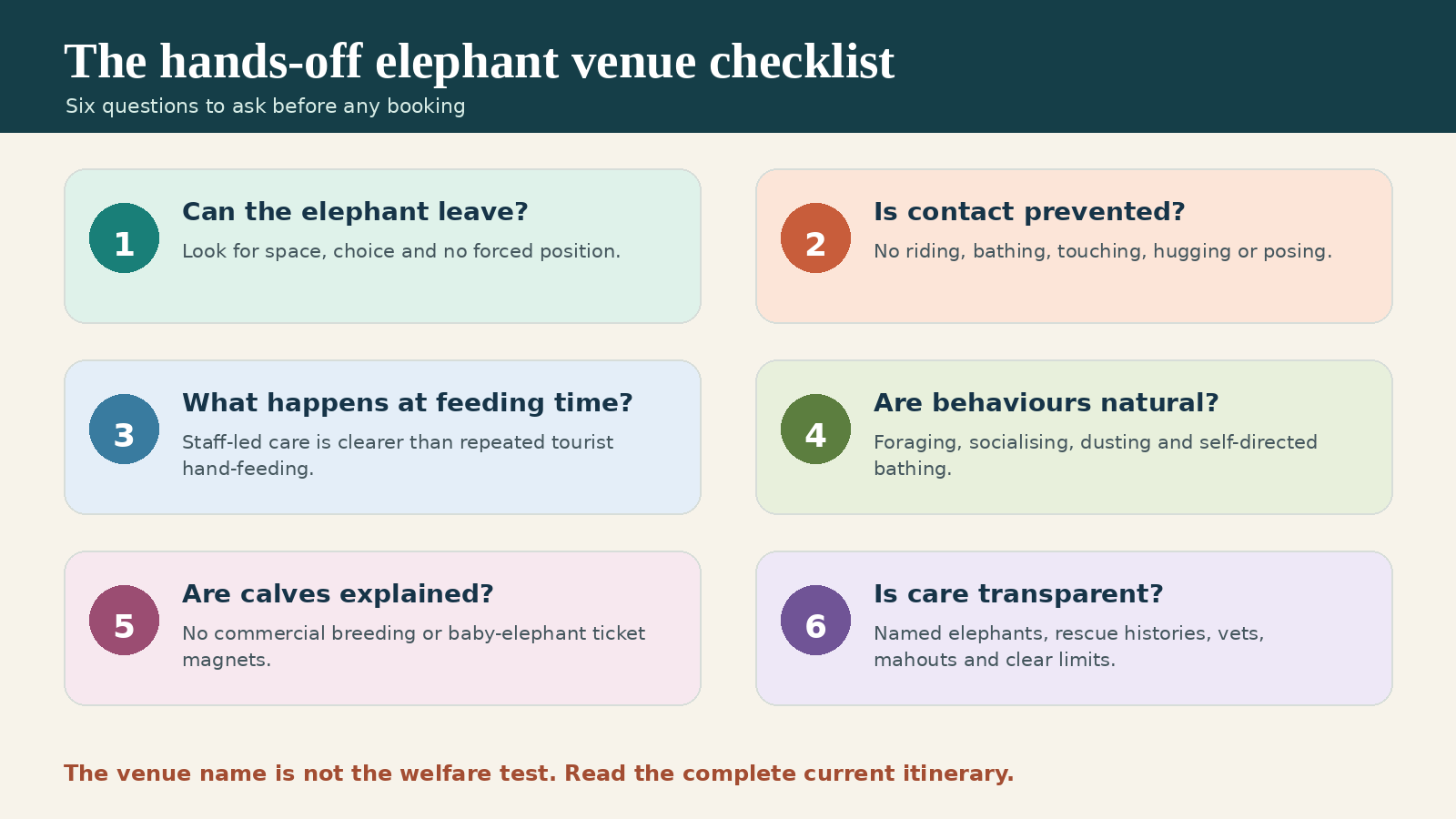
Use the following screen before comparing price or convenience. A venue does not need glossy wording; it needs a visitor model that leaves the elephant with meaningful choice.
| Check | Encouraging sign | Reason to stop and ask |
|---|---|---|
| Visitor distance | Observation from a route, deck or protected boundary | Touching, hugging, crowding or guaranteed close photographs |
| Feeding | Staff-led care; protected barrier only where independently accepted as transition | Every group hand-feeds to hold elephants near visitors |
| Movement | Elephants can leave, choose companions and set the pace | Tight routines, forced positioning or constant direction |
| Behaviour | Foraging, dusting, self-directed bathing and socialising | Painting, football, dancing, tricks or staged play |
| Young elephants | A documented rescue or orphan case | Breeding, unexplained calves or babies used as ticket magnets |
| Space and shelter | Varied land, shade, water, soft ground and rest | Concrete pens, exposed standing areas or little room to move |
| Care and staff | Named histories, veterinary support and skilled mahouts | Vague rescue claims and no explanation of long-term care |
| Safety | Guides maintain distance and explain emergency control | Unprotected tourist contact with no clear escape route |
Read every programme, not just the homepage
Some organisations offer an observation programme beside a bathing or feeding package. The selected time slot may reduce contact, but the wider business can still depend on the interaction model. Search every current itinerary for ride, bath, wash, touch, feed, hug, photo, show and walk with.
Ask how elephants avoid the group
A statement that elephants are “free roaming” is incomplete when the visitor route follows them closely or carers repeatedly steer them back. Ask whether there is a minimum distance, how group size is controlled and what happens when an elephant chooses the forest instead of the viewing area.
Check the business beyond the animals
Mahout salaries, stable employment, veterinary support, land rental and food bills affect welfare. Transparent venues explain how tourism supports those costs and why their visitor capacity is limited. By contrast, a cheap ticket is not automatically harmful and an expensive ticket is not proof of good care; the operating model matters more than the price tag.
Red flags that ethical marketing can hide
Bathing presented as kindness
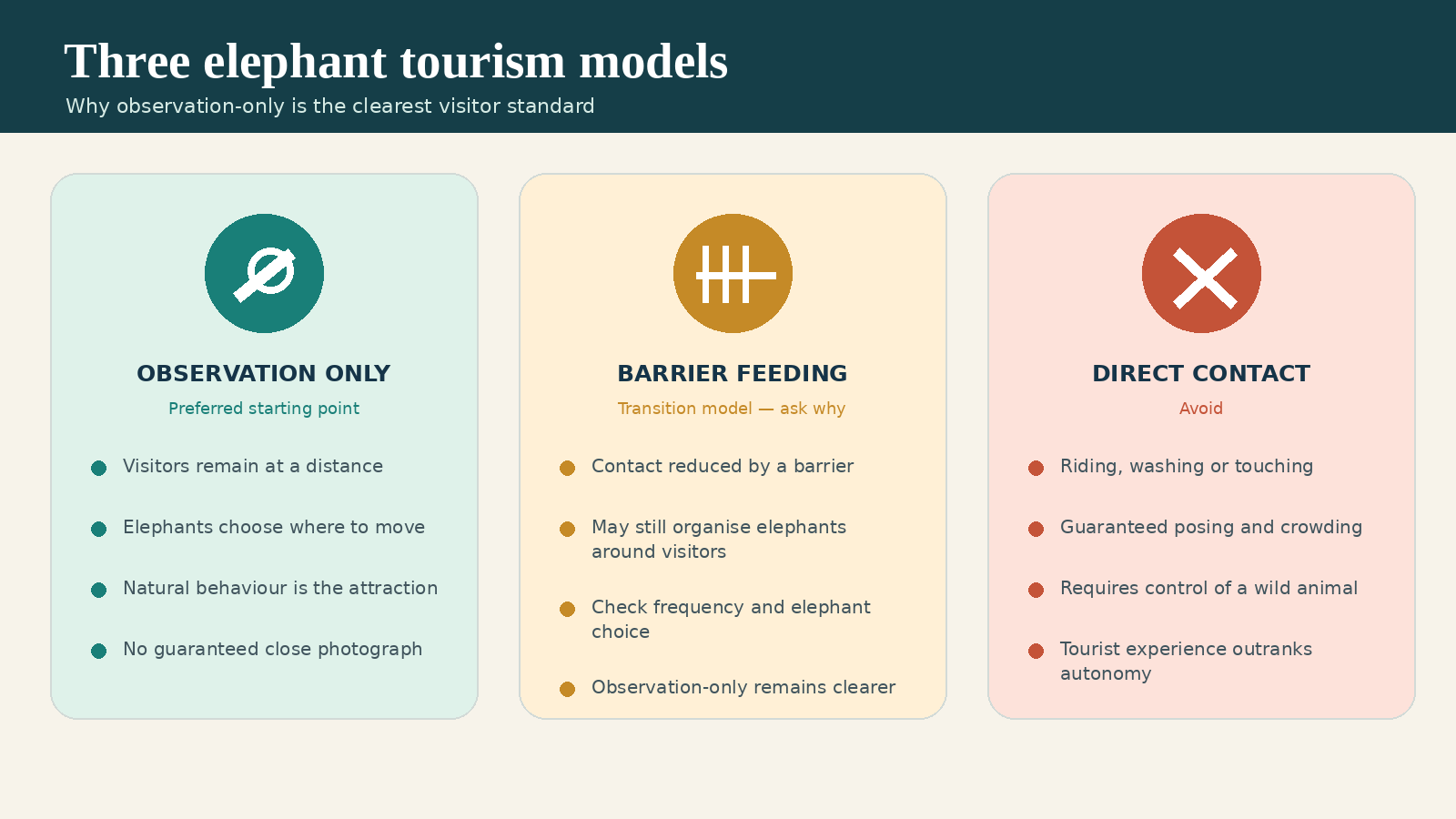
Tourist bathing is often sold as help with skin care or as a natural river moment. However, elephants can bathe, dust and coat themselves without rotating groups of strangers. ABTA explicitly lists elephant bathing among unacceptable tourist activities, while World Animal Protection advises observation rather than direct contact. [1] [4]
Feeding used to guarantee a close photograph
Routine visitor feeding fixes an elephant in place and makes proximity predictable. World Animal Protection’s transition guidance may recognise feeding across a barrier at some venues, but observation-only remains the clearer standard. Ask who prepares food, who delivers it, how often it happens and whether elephants are free to ignore it.
“Walk with elephants” without a stated distance
A forest walk can mean watching elephants from a safe route, or it can mean tourists following closely while food keeps the animals beside them. The words alone do not settle the welfare question. Look for a stated distance, guide control, group size, terrain and a promise that the elephants—not the timetable—lead the movement.
Baby elephants with no documented history
A rescued orphan can legitimately require sanctuary care. A steady supply of young elephants is different. Ask where a calf was born, why it is present, whether its mother is there and whether the organisation breeds for commercial tourism. Vague rescue language is not evidence.
A hands-off product inside a contact business
Some businesses sell a low-contact option while continuing rides, bathing or shows elsewhere on the property. Decide whether the entire operation matches your values. Otherwise, the “ethical” product may simply widen the same business’s customer base.
Claims that outside review is unnecessary
Independent assessment is not flawless, yet a venue that dismisses all external welfare questions should make a traveller cautious. Credible organisations explain their model, acknowledge difficult trade-offs and update policies publicly when practice changes.
Thailand elephant sanctuaries to research in 2026
The venues below are examples for current research, not lifetime endorsements. The status column reflects World Animal Protection’s 2026 public page at the time of checking. The price column records displayed adult starting figures and can change without notice.
| Venue | Region | Independent-list position | Displayed planning price | Why travellers research it |
|---|---|---|---|---|
| Phuket Elephant Sanctuary | Phuket | WAP best-practice list | 1.5 hours from THB 1,900; 3.5 hours from THB 3,000 | Observation-only; feeding ended from April 2026 |
| Following Giants | Krabi / Koh Lanta | WAP best-practice list | Krabi 90 minutes THB 1,700; Koh Lanta two hours THB 1,800; full day THB 3,850 | No riding, bathing, feeding or performance policy |
| ChangChill View Doi / Hillside | Near Chiang Mai | WAP best-practice list | Half-day THB 1,900; full day THB 2,500 | Forest observation with deck-based activities |
| BEES | Mae Chaem, Chiang Mai Province | WAP best-practice list | Day programme shown at THB 2,500; multi-day prices by enquiry | Hands-off rural stays; no walk-ins |
| Boon Lott’s Elephant Sanctuary | Sukhothai | WAP best-practice list | Lunch day THB 4,000; overnight THB 8,000 per adult/night | Very low capacity and route-defining stay |
| Somboon Legacy Foundation | Sai Yok, Kanchanaburi | WAP best-practice list | Half day THB 2,200; child THB 500 | Hands-off; new Sai Yok location from April 2026 |
| Elephant Forest Phitsanulok | Wang Thong / Phitsanulok | WAP best-practice list | 1.5 hours THB 1,700; full day THB 3,850 | Observation-led forest programmes; direct contact prohibited |
| Elephant Nature Park | Chiang Mai | WAP “other high welfare” section with caveat | Half day THB 2,500; SkyWalk THB 3,500; overnight THB 5,800 | Current hands-off options, but not on the 2026 best-practice list at the time checked |
Prices and programmes checked 10 September 2026. “WAP” means World Animal Protection. Recheck the exact date, site and programme before booking.
Other names on the current best-practice list
World Animal Protection’s Thailand list also names Global Vision International in Chiang Mai, Kindred Spirit Elephant Sanctuary, Mahouts Elephant Foundation’s LIFE and Palatha projects, plus both ChangChill sites. These may suit longer volunteering, community-based or route-specific travel, but the same programme-level screen still applies. [1]
Why Elephant Nature Park is separated
Elephant Nature Park remains a prominent rescue centre and its official pages show observation-led options. Nevertheless, World Animal Protection’s 2026 page places it under “other high welfare venues” and states that it was temporarily removed from the elephant-friendly list because of a legal investigation. This guide does not speculate about that investigation. It simply avoids presenting ENP as having the same current independent-list position as the venues above. [1] [16]
Northern Thailand: Chiang Mai and Phitsanulok options
ChangChill: the clearest Chiang Mai day-trip fit
ChangChill operates View Doi and Hillside sites in Mae Win, around 1.5 hours from Chiang Mai. Its full-day page displays THB 2,500 per adult and THB 1,800 for children under ten, with pickup around 07:30–08:00 and return around 16:30–17:00. Visitors observe elephants grazing and socialising from a distance, watch natural mud bathing from a raised rest point, prepare enrichment that is placed in feeding tubes and learn about local Karen culture. [9] [10]
This is the most straightforward choice when the wider holiday already includes Chiang Mai and one full countryside day is available. However, confirm whether the booking is for View Doi or Hillside, the walking difficulty, the child policy and the pickup boundary.
BEES: a rural stay rather than a quick city excursion
Burm and Emily’s Elephant Sanctuary sits in Mae Chaem District, roughly 2.5 to three hours from Chiang Mai Old City. Its current site describes hands-off, observation-based visits across 300-plus acres and offers two-, four- and seven-day programmes on fixed schedules. A separate day programme is displayed at THB 2,500 per adult and THB 1,800 for ages 10–17, beginning at 08:00 from the local meeting point; it requires advance booking and suits travellers already using the Mae Hong Son loop. [11]
BEES is therefore a poor fit for a rushed “free morning” in Chiang Mai but a strong fit for travellers who want rural immersion and can shape the route around transfer days. Ask about the exact programme calendar, insurance information, accommodation standard, dietary needs and the amount of hiking.
Elephant Forest Phitsanulok: useful on a north–central route
Elephant Forest Phitsanulok is around an hour from Phitsanulok city. Its official FAQ says visitors cannot feed, touch or bathe elephants. Current activities range from a 30-minute enrichment session at THB 700 to a 1.5-hour forest walk and food-preparation programme at THB 1,700, while the six-hour full day is THB 3,850 and includes transfer under stated conditions. [15]
Because the venue is not in central Chiang Mai, it makes most sense for travellers passing through Phitsanulok, Sukhothai or the lower north. Programme wording such as “walk alongside” should still be checked for the actual distance and group practice on the chosen date.
Elephant Nature Park: research the exact option and current status
ENP’s official site currently displays half-day visits at THB 2,500, the full-day SkyWalk at THB 3,500 and a two-day/one-night stay at THB 5,800. The main park descriptions emphasise observation, chosen herds and elevated viewing. Yet some linked projects on the same booking site still describe tourist feeding and walking close to elephants, which reinforces the need to screen the exact product rather than rely on the organisation name. [16]
Phuket, Krabi and Koh Lanta hands-off options
Phuket Elephant Sanctuary: easiest short observation format
Phuket Elephant Sanctuary’s 90-minute canopy programme starts at THB 1,900 for adults, while the 3.5-hour half day starts at THB 3,000. Both are listed for all ages. Visitors use the canopy walkway and natural trails, observe elephants roaming, foraging and bathing by choice, and visit the on-site elephant hospital. The sanctuary states that all visitor feeding ended from April 2026. [5] [6]
The shorter programme is useful for families, older travellers or a Phuket itinerary that cannot absorb a full day. Still, confirm whether the selected rate includes shared transfer, how much ground-level walking is involved and whether a mobility-limited guest can remain on the walkway.
Following Giants Krabi: strong for Ao Nang and nearby bases
The Krabi site currently lists a 90-minute programme at THB 1,700, a half day at THB 2,750 and a full day at THB 3,850. Its transfer area covers Ao Nang, Nopparat Thara, the Railay connection, Thalane Pier, Klong Muang, Tubkaek and, with a two-person minimum, Krabi Town. The programme states no riding, bathing, feeding or unnatural performances. [7]
Forest paths can be steep, wet or muddy, so the lowest duration is not automatically the easiest for limited mobility. Ask how far the group follows elephants, whether boots are supplied and whether the 90-minute option includes the same transfer area.
Following Giants Koh Lanta: build it into the island rather than a transfer day
Koh Lanta prices begin at THB 1,800 for two hours, rise to THB 2,750 for a half day and THB 3,850 for the full day. Transfers cover Koh Lanta Yai, with stated conditions for Old Town and late bookings. Full-day participants also undertake a cave and waterfall hike, making the programme more physically demanding than a simple observation visit. [8]
Choose the shorter programme when the main holiday is beaches and local food. Choose the full day only when the forest hike is genuinely wanted; longer does not automatically mean more ethical.
Sukhothai and Kanchanaburi options
Boon Lott’s Elephant Sanctuary: small-scale Sukhothai stay
BLES limits overnight guest numbers to ten and recommends a stay that is long enough to follow the elephants’ changing routine rather than demand a fixed show. The current overnight rate is THB 8,000 per adult per night, THB 3,000 for children under 12 and free for under-threes. It includes meals, accommodation and stated transfers from Sukhothai airport, bus or train points, or accommodation within Sukhothai Province. Walks can reach six kilometres on mixed terrain. [12]
A newer Elephant Lunch Experience provides a single-day alternative at THB 4,000 per adult and THB 2,500 per child, with a minimum of two and maximum of six guests. BLES says the day has no riding, bathing or directing and includes hotel transfers and a plant-based forest picnic. [13]
This is not an add-on to a crowded Bangkok schedule. It suits travellers who are willing to spend time in Sukhothai or Si Satchanalai and accept that the elephants’ needs may change the day.
Somboon Legacy Foundation: the Kanchanaburi and Bangkok-side option
Somboon moved to a new Sai Yok site from April 2026. Its current plan-your-visit page displays morning and afternoon half-day experiences at THB 2,200, with children aged 4–12 at THB 500 and under-threes free. The programme is hands-off, with observation, education and activities such as an elephant-poo paper workshop. Advance booking is required and no walk-ins are accepted. [14]
Home Phutoey is the stated meeting and transfer point, and the site advises that short stretches can be steep and uneven. Full-day availability was changing during the move, so treat old full-day or overnight descriptions as historical until the current booking page confirms them.
Why a regional route can improve welfare choices
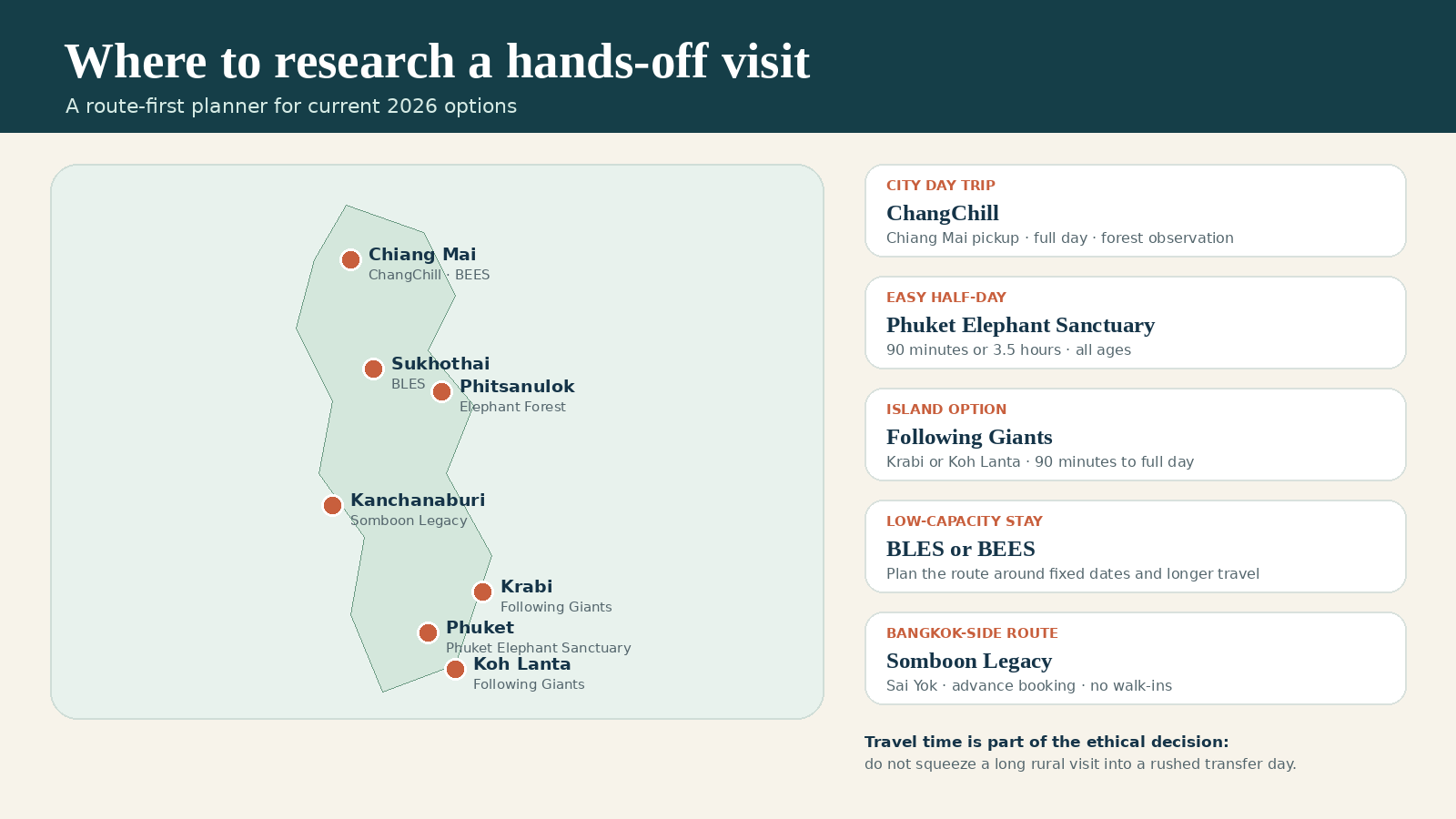
When travellers insist on fitting an elephant visit into whichever resort they already booked, convenience can beat scrutiny. A route-first approach works better: choose a current hands-off venue, then decide whether Chiang Mai, Phuket, Krabi, Koh Lanta, Sukhothai, Phitsanulok or Sai Yok belongs in the holiday.
Prices, programme formats and what the fee supports
| Format | 2026 planning band | What to compare |
|---|---|---|
| 90 minutes to two hours | THB 1,700–1,900 for the strongest mainstream short options | Transfer, protected viewing, group size and walking |
| Half day | About THB 1,900–3,000 | Pickup zone, meal, child policy, terrain and refund terms |
| Full day | About THB 2,500–3,850 | Drive time, actual observation time and physical extras |
| Low-capacity day visit | About THB 4,000 | Maximum group size, private transfer and route fit |
| Overnight / multi-day | About THB 5,800–8,000+ per adult night | Accommodation, fixed arrival days, deposit and included transport |
These are dated planning ranges from the verified examples in this guide, not a national tariff.
A higher price is not proof
Land, food, veterinary care, rescue costs and fair mahout wages are expensive. Even so, a premium ticket can fund polished marketing rather than better welfare. Compare what visitors do, how elephants avoid them, how many people arrive at once and whether the organisation explains long-term care.
A short programme can be enough
Observation quality does not rise in a straight line with duration. A well-managed 90-minute canopy visit may place fewer demands on an elephant than a full day of following the herd through forest. Choose the time needed to understand the work, not the longest package available.
What the fee should support
Travel time, transfers and where to base yourself
Chiang Mai
Use at least one complete day for ChangChill. For BEES, add the fixed pickup day and a return that may consume much of the following day. A four-day city itinerary becomes tight once a long rural programme is inserted, so five nights is more comfortable when temples, food and the mountains also matter. [17]
Phuket, Krabi and Koh Lanta
Phuket Elephant Sanctuary is in the island’s north-east rather than beside the main west-coast resorts. Following Giants Krabi and Koh Lanta cover stated pickup zones, yet late booking can remove the included transfer. Confirm the collection point in writing, especially when arriving from Railay, Koh Yao, Krabi airport or a southern Koh Lanta beach.
Sukhothai, Phitsanulok and Sai Yok
BLES is best paired with a Sukhothai stay. Elephant Forest can work with Phitsanulok rail, air or road travel. Somboon’s new Sai Yok location is a separate Kanchanaburi-region plan rather than a central Bangkok attraction.
Do not put the visit on a flight day
Elephant programmes can change with weather, animal health or forest conditions. Keep the visit away from a same-day flight, ferry or non-refundable train. A responsible venue may move the viewing point or shorten the plan because an elephant needs space; the itinerary should be able to absorb that.
Families, accessibility and medical considerations
Children
Hands-off visits can teach patience and respect more effectively than a promised touch. However, “all ages” does not mean every route suits every child. Ask about drive length, toilet access, heat, insects, railings, walking surfaces, emergency exit and whether a family can stop early without disrupting the group.
Reduced mobility
The best option may be a raised walkway rather than a forest trail. Phuket Elephant Sanctuary’s canopy programme is the clearest starting point to discuss, but accessibility still needs direct confirmation for the individual guest. Meanwhile, BLES warns of walks up to six kilometres, Somboon describes steep and uneven sections, and Following Giants full days include demanding terrain.
Medical and sensory needs
Carry prescribed medication, drinking water, sun protection and insect repellent. Tell the venue about allergies, mobility limits, pregnancy, heat sensitivity or sensory needs before paying. Rural phone signal can be weak, and a long transfer may be harder than the viewing itself.
Safety boundaries are part of welfare
Elephants are powerful wild animals. Do not encourage a child to approach, call, clap, offer food or step across a guide’s boundary for a picture. A distant mahout is not evidence of abuse by itself; trained carers can protect both elephants and visitors when they use humane management and intervene only when necessary.
- Choose the shortest suitable drive and walking route.
- Ask whether seating and shade are available throughout.
- Confirm the child age band rather than assuming a national rule.
- Carry suitable travel insurance and follow current Thailand advice. [20]
- Leave immediately when staff encourage unsafe or unwanted contact.
How to book a sanctuary responsibly
Book direct when the venue policy is the reason for the choice
The official programme page is the best place to see the current itinerary, cancellation terms, pickup boundary and visitor-contact policy. A marketplace listing can lag behind a policy change or combine an ethical-looking product with contact experiences from unrelated operators.
Use a written ten-question check
- Does any current programme include riding, bathing, touching, hugging, painting, tricks or shows?
- Do visitors feed elephants; if so, how, how often and why?
- Can elephants move away from every visitor area?
- Are any calves bred at the venue?
- What is the maximum group size?
- How much walking is involved and on what surface?
- What veterinary care and mahout employment are provided?
- Which pickup zones and transfer conditions apply?
- What changes when weather or elephant health disrupts the plan?
- Can the complete current itinerary be sent in writing?
A changed itinerary can be reassuring
A responsible venue may cancel a forest walk, move the group to a deck or show fewer elephants because the animals have chosen another area. That is not a failed tour. A guaranteed close-up is often the more worrying promise.
Read recent reviews selectively
Reviews are useful for punctuality, food, footwear, toilets and transfer communication. They are less reliable when visitors praise “lots of touching” or complain that elephants stayed far away. A distant, unscripted sighting can be exactly what a hands-off model should produce.
What to expect on a hands-off visit
The elephants may do very little
A real observation visit can be quiet. Elephants may spend most of the time eating, stand behind vegetation, rest, dust themselves or move away. The absence of a performance is not a lack of value; it is the point.
The guide should explain individual histories and care
Useful interpretation covers rescue background, ageing, diet, social relationships, foot care, the mahout’s role and the limits of captivity. It should not turn suffering into theatre or claim that every elephant has already been “healed”.
Weather changes the route
Wet-season paths can be muddy and rivers can rise. Hot-season programmes may require more shade and slower walking. Wear grippy closed shoes unless the venue says otherwise, use breathable clothing, carry a rain layer and keep cameras quiet with flash disabled.
The visitor’s behaviour matters
- Stay inside the stated viewing boundary.
- Do not call, clap, whistle or use food to attract an elephant.
- Never use a drone unless the venue explicitly permits it.
- Follow the guide immediately when an elephant changes direction.
- Accept that an obstructed photograph may be the most respectful one.
Pros and cons of visiting a captive-elephant sanctuary
Advantages of a well-screened visit
- Tourist money supports food, land, carers and veterinary work.
- Observation can replace demand for riding and shows.
- Visitors learn why captive elephant welfare is complex.
- Elephants retain more distance and behavioural choice.
- Clear policies reward venues that move away from contact.
Limits to understand
- No captive venue can recreate a wild life.
- Ethical labels and independent lists can change.
- Long transfers add cost, emissions and physical effort.
- A quiet programme may not deliver a close photograph.
- Tourism revenue can still create pressure to expand capacity.
The honest trade-off
A carefully chosen visit can improve conditions for elephants already in captivity, yet it does not solve the wider system of ownership, breeding and commercial demand. The responsible decision is to support less contact now while also refusing products that create the next generation of entertainment elephants.
Common elephant-sanctuary mistakes
Most poor choices begin with a photograph or a convenient pickup rather than a welfare screen. Avoid these common errors:
- Believing the word sanctuary without reading the exact programme.
- Calling bathing ethical simply because there is no saddle.
- Choosing a venue for guaranteed touching or close photographs.
- Treating every programme under one organisation as identical.
- Assuming a 2025 or 2026 list position will never change.
- Booking through a marketplace before identifying the actual operator.
- Ignoring breeding, calves and the wider business model.
- Treating every mahout tool or presence as proof of abuse without context.
- Expecting wild behaviour from elephants who still live in managed captivity.
- Squeezing a rural visit between a ferry, train or flight.
- Publishing a blanket endorsement after one short visit.
- Arriving without suitable footwear, insurance or a confirmed pickup.
The mistake that causes the most confusion
“No riding” is only the beginning. A venue can remove saddles while retaining washing, hand-feeding, hugging and staged posing. Screen every interaction, not just the most obvious one.
Frequently asked questions
These answers use the hands-off standard applied throughout the article.
What is the most ethical way to see elephants in Thailand?
Choose an observation-led, hands-off venue with no riding, bathing, touching, shows or routine visitor feeding. Elephants should be able to leave the viewing area, socialise, forage and bathe on their own terms.
Are elephant sanctuaries in Thailand ethical?
Some use higher-welfare observation models; others use the word sanctuary while selling direct contact. Judge the current programme, breeding policy, space, care, transparency and independent guidance rather than the name.
Is bathing elephants ethical?
Leading tourism-welfare guidance advises against it. Tourist bathing requires repeated close contact and control. A higher-welfare programme lets elephants bathe when they choose while visitors observe from a protected distance.
Is feeding elephants ethical?
Routine hand-feeding can be used to guarantee proximity and photographs. Observation-only is the clearest standard. Some transition venues use feeding across a barrier, so ask how frequently it happens and whether elephants can opt out.
Which Chiang Mai elephant sanctuary should I research?
ChangChill is the most straightforward current day-trip option in this guide, while BEES suits a longer rural stay. Elephant Nature Park has hands-off programmes, but its current independent-list caveat should be read before booking.
What is a hands-off option in Phuket?
Phuket Elephant Sanctuary states that it ended visitor feeding from April 2026. Its 90-minute canopy and half-day programmes focus on observing elephants roaming, foraging and bathing by choice.
Are there hands-off elephant experiences in Krabi or Koh Lanta?
Following Giants operates in both places and states that it offers no riding, bathing, feeding or unnatural performances. Recheck the exact programme, walking difficulty and pickup zone.
What is the best option near Bangkok?
Somboon Legacy Foundation is in the Sai Yok area of Kanchanaburi Province. It is not central Bangkok, requires advance booking and works best as a planned Kanchanaburi extension.
How much does an ethical elephant sanctuary cost?
Mainstream short and day programmes in this guide run from about THB 1,700 to THB 3,850 per adult. Low-capacity day visits and overnight stays can cost THB 4,000 to THB 8,000 or more. Prices are dated examples, not guarantees.
Can children visit?
Often yes, but age bands, heat, transfer length, railings and walking surfaces vary. Choose a hands-off route and ask whether the family can use a shorter walkway or leave early.
Why are elephants still managed by mahouts?
Captive elephants may be elderly, injured, habituated to people or unable to return to the wild. Skilled mahouts provide daily care and safety. The welfare question is whether management is humane and necessary, not whether carers are invisible.
How do I verify a sanctuary before paying?
Read the complete current itinerary, check the latest independent welfare list, search every programme for contact language, ask how elephants can avoid visitors and obtain the policy in writing.
How to choose a Thailand elephant sanctuary responsibly
Choose the experience that asks least from the elephant
The strongest default is a programme where visitors remain at a respectful distance and the elephants decide what happens next. No ride, bath, touch, show or routine hand-feeding should be required to make the day feel worthwhile.
Match the venue to the existing route
For a straightforward Phuket half day, begin with Phuket Elephant Sanctuary. Around Chiang Mai, compare ChangChill with the longer rural commitment of BEES. In Krabi or Koh Lanta, Following Giants is the clearest current hands-off research option. For a route through Sukhothai or Phitsanulok, compare BLES and Elephant Forest. From Bangkok, plan Somboon as a Sai Yok or Kanchanaburi extension rather than a casual city excursion.
The recommendation I would use
I would start with World Animal Protection’s current best-practice list, remove every programme that promises visitor contact, then choose the option with the shortest sensible travel time and clearest written policy. Finally, I would reconfirm the exact activities a few days before the visit. Thailand elephant sanctuaries can change; careful travellers should be willing to change their booking too.
Sources and fact-checking notes
This article was fact-checked on 10 September 2026. Venue prices, elephants, visitor policies, transfer areas and programme availability can change. Recheck the linked official pages and ask the venue to confirm the exact activity in writing before paying.
How recommendations were handled
No first-hand visit has been claimed. The shortlist combines the current independent welfare list with official programme details, then applies a conservative hands-off screen. A venue’s inclusion is a starting point for current research rather than a lifetime seal of approval.
How prices should be read
Every amount is a dated adult planning figure visible during the September 2026 check. Child definitions, transfers, taxes, card fees, deposits and cancellation terms differ. When a venue is moving, changing programmes or asking visitors to enquire, older descriptions should not be treated as current.
- World Animal Protection — Elephant Friendly Tourist Guide 2026 — Current best-practice list, screening guidance and the separate caveat applied to Elephant Nature Park.
- World Animal Protection — Bred to Entertain report launch — 236 venues, 2,849 elephants, welfare findings and observation-only share.
- ABTA — Animal Welfare Guidelines — Unacceptable practices and Five Domains welfare framework.
- ABTA — Advice for travellers on activities involving animals — Traveller advice on bathing, touching, feeding and genuine sanctuaries.
- Phuket Elephant Sanctuary — Half Day Program — Current 3.5-hour format, all-ages policy, starting price and observation model.
- Phuket Elephant Sanctuary — Canopy Walkway Tour — Current 90-minute format, price and April 2026 end to visitor feeding.
- Following Giants — Krabi booking — Current programme prices, transfer zones and booking conditions.
- Following Giants — Koh Lanta booking — Current programme prices and Koh Lanta transfer conditions.
- ChangChill — Full Day Visit — Current price, timings, forest observation and programme detail.
- ChangChill — Hillside and View Doi — The two Mae Win locations and resident-elephant context.
- BEES — Visit Us — Hands-off programmes, fixed schedules, distance, prices and booking requirements.
- Boon Lott’s Elephant Sanctuary — Overnight Stay — Capacity, rates, transfers, reservations and walking demands.
- Boon Lott’s Elephant Sanctuary — Elephant Lunch Experience — Current day format, guest limits, rates and inclusions.
- Somboon Legacy Foundation — Plan Your Visit — New Sai Yok programme, current half-day rates and hands-off format.
- Elephant Forest Phitsanulok — FAQ and activities — No direct contact policy, location, family guidance, programmes and prices.
- Elephant Nature Park — official visitor site — Current half-day, SkyWalk and overnight formats and displayed prices.
- Chiang Mai Itinerary 2026 — Taylor’s Trailblazing Travels — Live internal guide for realistic route and day allocation.
- Koh Lanta Guide — Taylor’s Trailblazing Travels — Live internal planning context for a southern island stay.
- Bangkok 4-Day Itinerary — Taylor’s Trailblazing Travels — Live internal guide for Bangkok before a Kanchanaburi extension.
- UK FCDO — Thailand travel advice — Current safety, insurance and legal guidance.
Illustrations in this article were created for Taylor’s Trailblazing Travels. Third-party photographs, where used, are credited beside the image or in the source list.