Phuket / Airport transfers
Phuket Airport to Patong, Kata and Karon
Compare the complete west-coast journey, from the airport meeting point to the hotel entrance.
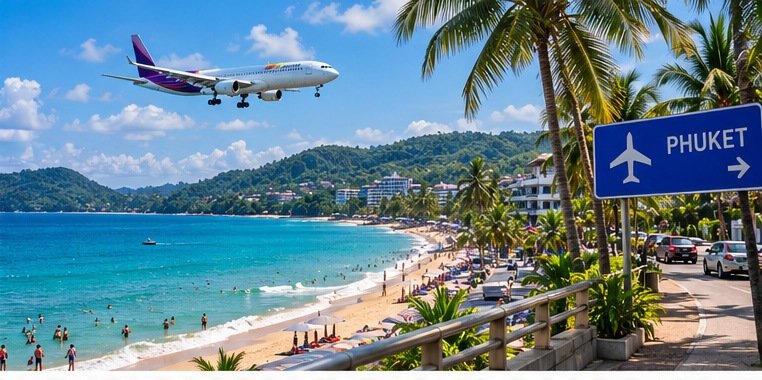
Illustrated coastal arrival, not an actual flight photograph or a route map.
Phuket Airport to Patong, Kata and Karon is not a quick hop between neighbouring resorts. The airport sits towards the north of the island, while these three beach areas lie farther south along the west coast. That makes the choice between a public bus, shared minivan and direct car a real decision about time, luggage and the final approach to your hotel.
The most useful starting point is the actual address. A beachfront hotel, a property up a hill and an apartment behind the resort's main road can require very different final journeys. Therefore, this guide compares the complete transfer rather than assuming that reaching "Kata" or "Patong" means you have reached reception.
Recommendations are based on current operator information and research-led planning judgement, not claimed personal rides. Confirmed public-bus details are distinguished from editorial road-time and cost allowances. The aim is to help you choose a ride you can recognise, pay for and complete without turning the first afternoon into a complicated transport project.
Public transport
Smart Bus along the west coast
A stopping service, not a private hotel shuttle.
Group comfort
Price the whole car
Compare against every paid seat and the final connection.
Hotel access
Check hills and side streets
A beach-area drop-off may not be reception.
Departure day
Check the northbound plan
Do not borrow the arrival timetable for the return.
Phuket Airport to Patong, Kata and Karon: the practical choice
Choose the bus for a suitable daytime journey
Phuket Smart Bus is the clearest low-cost option when your arrival fits its current timetable and your accommodation is convenient for a stop. The operator lists the airport route through Patong, Karon and Kata towards Rawai. However, it is a stopping public service, not a private hotel shuttle, so its usefulness depends on the last walk as much as the fare. [1]
With substantial luggage, several travellers or a hillside address, a direct car is often the stronger overall choice. You pay for fewer changes and a specified destination. Meanwhile, a shared minivan sits between the two: it can reduce the price for one passenger, but may involve waiting for others and dropping them at different hotels before reaching yours.
Compare like with like
This guide ranks options by four practical tests: whether they run when you are ready, the total cost for your party, the amount of luggage handling and the reliability of the final drop-off. It does not rank providers by commission or claim that a particular app is always cheapest. The same traveller may sensibly choose a bus on arrival and a car for an early return flight.
| Option | Best fit | What to confirm | Main compromise |
|---|---|---|---|
| Smart Bus | Light luggage; daytime arrival; hotel near a stop | Current departure, stop and last walk | Longest stopping journey |
| Shared minivan | Solo travellers seeking a lower-cost hotel transfer | Departure wait, exact drop-off and bag space | Other passengers' stops |
| Airport taxi or booked car | Couples, families and bulky bags | Complete vehicle price and hotel entrance | Higher total than one bus ticket |
| App-booked car | Travellers with working data and a clear pickup point | Live quote, vehicle and meeting instructions | Availability and pickup wait |
| Hotel-arranged transfer | Difficult access or specific assistance needs | Inclusions, vehicle, flight delays and payment | Often less price competition |
Understand the airport and beach geography
The three resorts are not interchangeable
Patong is normally the first of these three resort areas reached when travelling south along the west-coast bus route; Karon and Kata follow. Nevertheless, a private driver may choose a different road depending on conditions. Do not insist on following the bus route simply because it is the route shown in a public-transport diagram. [1]
A hotel described as "near Patong" could sit well away from the main beachfront streets. Similarly, Kata Noi is not the same drop-off as central Kata, and accommodation above either beach can require another climb or drive. Therefore, check the property pin and entrance before accepting a fare that covers a broad resort label.
Use two travel-time clocks
The first clock runs from landing until you are ready to leave the airport. It includes disembarking, any immigration, baggage and finding the meeting point. The second runs from meeting the vehicle until reaching the hotel. Combining them gives a more honest arrival plan than quoting only an empty-road driving estimate.
As editorial road allowances, plan roughly 60-90 minutes for Patong, 75-110 minutes for Karon and 80-120 minutes for Kata after meeting a direct driver. These are not guarantees, and heavy traffic or disruption can exceed them. A public bus or shared transfer needs additional room for waiting, stops and the final approach.
Choose the correct meeting point at HKT
Domestic and international arrivals need precise instructions
Read the terminal information on your booking and follow the pickup instructions for the service purchased. A driver waiting at one arrivals area will not necessarily see you at another. If the operator asks for the flight number, provide it accurately so that the booking identifies your arrival rather than simply the airline's name.
Keep the driver's contact method available offline where possible. Then, if your phone struggles to connect, an airport information desk or your accommodation may be able to help identify the correct meeting area. Do not walk between terminals on the basis of an old screenshot when current signs or staff can resolve the question more directly.
Why this guide avoids a universal door number
AOT's Phuket pages reviewed for this article give differing descriptions for the Smart Bus location, including inconsistent floor information. Consequently, a single door-and-floor instruction would look more certain than the source material supports. Use the operator's current directions and airport signage to locate the stop on your travel day. [2] [3]
The same principle applies to taxis and app rides. A transfer representative, a metered taxi desk and an app pickup zone are not interchangeable meeting points. Stay with the arrangement you booked, and ask a staffed airport counter for help before leaving the terminal area to follow an unsolicited offer.

Phuket Smart Bus: fare, payment and route
The checked fare is simple
The operator's payment page lists a THB 100 flat single fare for the airport-Patong-Rawai route, checked on 4 October 2026. It also lists cash, contactless Visa, Mastercard and JCB, plus Apple Pay and Google Pay. A Thai-bank QR option is mentioned, but a foreign banking app should not be assumed to support it. [4]
Carry a practical backup even when intending to tap a card. A failed payment, empty phone battery or temporary terminal problem should not leave you unable to board. Keep the payment step separate from any bus-stop navigation: first identify the correct service and destination, then pay using an accepted method.
Check the timetable and live position
Use the operator's current timetable and tracking links rather than an airport directory's opening hours as a substitute for a departure schedule. An operating span describes a service day; it does not establish the next bus from your stop. The timetable itself warns that traffic can change the estimated times. [1]
For planning, a journey towards the southern beach stops can occupy around two hours or more once the stopping route is underway. Add your waiting time and hotel walk separately. This is an editorial allowance rather than a guaranteed running time, so avoid attaching a non-refundable dinner or activity to the earliest plausible arrival.
Airport taxis and pre-booked private cars
Understand the pricing method
Ask whether the journey uses a meter or a fixed destination price and what additional charges apply. Do not combine a quoted fixed fare with a surcharge copied from a different airport's taxi rules. Some airport-directory entries reviewed here contained unrelated place references, so this article does not publish those figures as Phuket's definitive taxi tariff. [5]
For a working budget, allow approximately THB 900-1,400 per standard car to Patong and THB 1,000-1,600 to Karon or Kata. These are editorial planning ranges, not current offers or maximum legal fares. Larger vehicles, difficult access, late reservations and specific service conditions can change the price; check the written total for your actual trip.Amounts dated 4 October 2026.
Buy the capacity you need
A car described as carrying three or four passengers may not accommodate their full holiday luggage. Send the operator the number of large cases, cabin bags and unusual items. A larger vehicle can be the sensible option even when there are only a few passengers, because safe luggage storage matters throughout a longish island drive.
For advance comparisons, private Phuket airport-transfer listings offers another private-transfer search. Read whether airport waiting, parking, the hotel zone and any child-seat request are included. Meanwhile, a hotel-arranged car may be worth comparing when reception knows that ordinary vehicles struggle with the final approach or that a specific entrance must be used.
App rides: compare the quote, not the reputation
Arrange the pickup when you can reach it
Grab's airport help includes Phuket among its airport pickup locations and explains immediate and flight-linked advance arrangements. However, the conditions shown in your booking are the ones that matter, particularly for changed flights and waiting periods. Do not treat a standard immediate ride as though it automatically tracks your aircraft. [6]
Before ordering, make sure your bags are with you and the selected pickup point is reachable. Compare the complete quote with a taxi or private-transfer offer for the same destination. An app may be competitive, but there is no reliable promise that it will undercut every airport desk at every time of day.
Keep the journey attached to the booking
Check the registration, vehicle and driver identity before boarding. Use the platform's messaging to clarify a meeting point rather than accepting an unexplained switch to a different car. If something does not match, pause and resolve it in the staffed airport area; arriving at the beach slightly later is preferable to leaving in a vehicle you cannot verify.
Mobile data helps with both directions and contact. Airalo travel eSIM comparisons is one option for comparing Thailand eSIM packages, provided your phone supports the selected product. Nevertheless, save the hotel address and pickup instructions offline. A data plan is useful support, not a substitute for knowing where you are meant to meet.
Patong: choose the entrance, not just the beach
A central address can still be awkward
Patong has a broad accommodation area, from busy central streets to hills and quieter edges. A map pin near the beach does not tell you whether the car can stop at the front door, whether reception is behind another building or whether evening access changes around a busy road. Ask the property for its preferred arrival point.
For a Smart Bus arrival, identify the useful stop and the remaining walk before boarding. Then consider whether that walk is realistic with your actual luggage and the weather. A stop that seems close when you are walking freely may feel different after a long flight with a case, a child and an unfamiliar road crossing.
Keep the first evening local
A direct transfer is especially helpful when arriving after dark or staying uphill. Conversely, a bus can work well when the accommodation is near an easy stop and you have no fixed arrival appointment. Match the option to the address rather than assuming every Patong hotel is equally convenient for public transport.
Patong hotel searches can help compare accommodation locations, but inspect the map and ask the property about access before paying. The site's Phuket five-day itinerary is useful for the days after arrival. Leave that wider sightseeing plan until you have reached your room; a transfer day does not need an additional cross-island excursion to count as a successful start.
Karon: the long beachfront changes the last mile
Decide which part of Karon you need
Karon's long beach area means that reaching the district is not the same as reaching your hotel. A property near the northern end can require a different final walk from one towards Kata. Therefore, give the operator the full address and ask which stop or drop-off best serves it, especially when choosing a shared service.
Avoid relying on the distance between a hotel pin and the shoreline. The useful question is the route from the vehicle to reception, including roads, steps and any uphill approach. A visually close property may still be inconvenient with luggage, whereas a slightly less dramatic location can have a straightforward entrance.
Price the final connection honestly
When a bus leaves you needing another ride, add that to the comparison before deciding that public transport is clearly cheaper for the party. The additional cost may still be worthwhile for one passenger. However, several bus tickets plus a final car can erode much of the saving over a direct airport transfer.
Use Karon hotel searches to compare Karon accommodation as a distinct search, then verify the entrance directly. Do not let a booking platform's broad Phuket location label settle the transport question. Your arrival will be easier when the hotel, transfer operator and your saved map all describe the same place.
Kata and Kata Noi: avoid the wrong final stop
Confirm which beach your booking describes
Kata and Kata Noi are neighbouring but different destinations. A transfer advertised simply to Kata should not be assumed to include every property beyond the main beach area, particularly a hillside resort or a more secluded address. Put the exact property name on the booking and obtain confirmation before accepting the price.
The Smart Bus route serves the Kata area on its way towards Rawai, but that does not make it a door-to-door service for Kata Noi. [1] Ask the hotel whether the current stop is a sensible arrival option with bags. A short local connection can be perfectly reasonable, provided it is planned rather than discovered after you have left the bus.
Give the longer transfer room to breathe
Kata is farther along the resort sequence than Patong, so keep the arrival evening light. A delayed flight followed by a stopping road journey can remove the time you expected for an activity. Instead of booking an immediate boat excursion or a distant restaurant, start with something close to the accommodation.
For a stay prioritising a particular beach entrance, Kata hotel searches offers a way to inspect locations before committing. Cross-check the map against the property's own directions. Then choose the transport that gets you to reception without an unnecessary uphill walk at the end of an already long travel day.

Work out the group cost and value
A cheap seat is not automatically a cheap family journey
Consider an illustrative quote of THB 1,200 for a direct car carrying four people and their confirmed luggage. Four public-bus tickets at THB 100 each would cost THB 400, leaving a difference of THB 800 before the final hotel transfer. The car therefore adds THB 200 per person in this example, not the entire vehicle price each.Amounts dated 4 October 2026.
These figures are an arithmetic example dated 4 October 2026, not an advertised car offer. Your actual quote may differ. Nevertheless, the calculation is useful because it turns a vague argument about "expensive taxis" into a decision about what each traveller pays for less waiting and a direct arrival.
Include time without pretending everyone values it equally
One solo traveller may happily accept a longer bus journey to preserve spending money. A family with tired children may prefer to spend more on getting to the room. Neither answer is wrong. The meaningful comparison is between complete journeys that the whole party can actually manage.
Do not forget return travel, either. A sensible budget can combine a public bus on a relaxed daytime arrival with a confirmed car before an early flight. That approach may be more useful than buying the same method both ways merely to make the booking look tidy.
Children, luggage and mobility requirements
Confirm equipment before the travel day
Describe any child-seat requirement and ask which seat the provider can supply for the child's size. Include pushchairs and larger bags in the luggage count. A vehicle image in a listing does not guarantee that the specific car dispatched has the space or equipment you need.
For a larger family, ask whether the quoted price is for one vehicle and whether all passengers count towards capacity. Then keep the written answer with the booking. If there is uncertainty, choose a clearer service rather than trying to solve a seating problem at the kerb while other passengers wait.
Check both boarding and hotel access
Travellers with mobility needs should ask about step height, equipment storage and whether an adapted vehicle is available when required. Also clarify the route from the drop-off to the room. A car can deliver you to a property without removing steep paths, stairs or a separate buggy transfer within a hillside resort.
For public transport, confirm the actual boarding arrangement with the operator before depending on it. Do not infer accessibility from a photograph of one vehicle. The practical question is whether the service on your date and the stop near your hotel support the complete journey you need to make.
Late arrivals, traffic and rain
Book around the time you will leave the terminal
A flight landing near a final bus departure is not a secure bus connection. Immigration, baggage and finding the stop still come first. Therefore, use a current timetable to assess the plan and have a realistic car alternative when the margin is small. A directory's closing time is not a guarantee that a bus will wait.
For a late private pickup, confirm who monitors delays and how long the included waiting lasts. Send a message when your flight changes substantially, even if tracking is advertised. Meanwhile, tell the hotel about late check-in so that a smooth drive does not end at an entrance you cannot access.
Allow disruption to change the plan
Heavy rain can slow traffic and make a final walk much less pleasant. TMD's current warnings are more useful for a travel-day decision than a monthly climate average. [7] Check the forecast and local information shortly before arrival, then use a direct car when conditions make the original public-transport plan impractical.
A waterproof layer over luggage can help at an exposed stop, but it does not fix a flooded or unsafe route. Stay in a staffed area while rearranging transport rather than walking into conditions you cannot assess. The aim is a workable arrival, not proving that the cheapest plan must survive every change.
Returning to Phuket Airport without a fragile schedule
Start with the airline's airport-arrival advice
Work backwards from the airline's check-in and bag-drop requirements, not just the flight departure time. Then add the hotel pickup, the road journey and a separate disruption margin. The farther south your accommodation, the more careful you should be about assuming a fast morning drive will always be available.
A private-car planning allowance of around two hours for the hotel-to-airport collection-and-road stage can be sensible from Kata or Karon, with more room during disruption. This is not an airline minimum or a guarantee. From Patong, use the actual route and current conditions rather than automatically borrowing a shorter estimate from a different hotel.
A bus return needs a backup departure
Check the northbound timetable separately; the service you noticed travelling south does not establish your return time. If a delayed or missed bus would threaten check-in, choose an earlier service or another method. For an early flight outside useful bus hours, a confirmed car is the simpler arrangement.
Phuket return-airport transfer searches is a starting point for comparing return transfers, but change the pickup location to your exact hotel area. Confirm the booking the previous evening and ask for a contact number. Keep your documents and any required payment ready so that checkout does not consume the buffer you deliberately allowed.
Three arrivals that call for different choices
One traveller, a cabin bag and central Patong
A solo passenger arriving comfortably within the bus timetable and staying near a practical Patong stop has a strong reason to consider the Smart Bus. The lower cost is meaningful because there is nobody sharing a car fare. However, check the final pavement route and hotel entrance before treating a small bag as proof that any walk will be easy.
The right plan is to leave the airport without another fixed appointment, follow the current stop information and contact the hotel if the arrival slips. If the next bus is substantially delayed or heavy rain makes the final walk unattractive, compare a car again. A budget decision can change with conditions without becoming inconsistent or wasteful.
Four people, checked bags and a Karon resort
For a group, start with luggage capacity and the location of reception. Four individual fares are the alternative to one vehicle price, but only when the vehicle genuinely fits the cases. Send the bag count before booking and ask whether the hotel entrance is inside the quoted drop-off area.
Then decide what the direct ride is worth for the whole party. An included child seat, a clear flight-delay arrangement or avoiding a second local taxi may justify the difference. Conversely, a luxury vehicle with no useful extra capacity may not. This is a comparison of practical service, not a contest between public transport and the most expensive car available.
A late flight and a hillside Kata address
This is the arrival where I would prioritise a confirmed vehicle and the hotel's own access instructions. A public stop near the beach is not enough when the last part is a steep road and reception closes or changes procedure overnight. Send the flight details to both the driver and the property so that neither mistakes a delay for a cancelled arrival.
Ask whether an ordinary car reaches reception or whether the hotel has a separate internal transfer. Also identify the contact to use if the entrance is difficult to find after dark. These questions are best settled before the flight, because the savings from a vaguely defined drop-off can disappear quickly when the final few hundred metres require another arrangement.
Read transfer listings without being misled by the headline
Look beyond the first displayed price
A search can show a price for one passenger, a starting vehicle category, a restricted zone or a service that is not available for your exact arrival. Enter the full party and destination before comparing the payment total. Then check the booking currency and any optional extras that were selected automatically.
Make sure a return checkbox has not changed a one-way comparison into a two-way booking, or vice versa. Also inspect whether the service is shared, private or a sightseeing product with airport pickup. Similar pictures of a minivan can describe very different arrangements, so the written itinerary should decide what you are buying.
Clarify stops without assuming bad intent
A shared transfer may legitimately use an office to organise vehicles, while another service may go directly towards the hotels. Ask in advance whether such a stop is part of the journey and how it affects expected arrival. That gives you a basis for choosing the product without labelling every operational pause a scam or accepting an unexplained detour as inevitable.
If an optional tour or shopping visit is proposed, separate it from the airport ride you agreed to buy. You can decline an extra purchase without changing the destination on the original booking. Keep the receipt and service description available so that any disagreement is about a specific arrangement rather than competing memories of a hurried conversation.
Keep the transfer separate from the rest of the holiday
Do not accidentally buy a sightseeing day
Some listings combine an airport pickup with stops or an extended driver booking. That can be useful when deliberately planned, but it is not the same product as a direct ride to the hotel. Check the itinerary before paying, particularly when a search returns attractions alongside transfer options.
Likewise, resist making firm same-day sightseeing commitments before knowing your realistic hotel arrival. A flight delay can make a prepaid excursion the most expensive part of what looked like an economical transfer plan. Instead, use the first afternoon for a local meal, a short walk and settling the practical arrangements.
Compare the area before changing hotels
A split stay between Patong and Kata can be enjoyable, but it adds another packing and transfer day. Do it because the two areas support different parts of your holiday, not because an airport map makes them look close enough to swap casually. The site's Phuket beach comparison helps compare the beaches without assuming they offer identical experiences.
For a longer Thailand route, Thailand packing list is useful when choosing luggage that works across several transport types. Keep the airport car, later excursions and onward travel as separate decisions. This makes it easier to see where a direct ride is worthwhile and where a shared service genuinely saves money without adding a troublesome connection.
Pros and cons: public transport or direct car?
Public transport's strongest case
The Smart Bus has a clear published fare, follows the relevant west-coast resort sequence and provides a genuine alternative to hiring a car. For a traveller with a manageable bag and a hotel near a stop, that can be an excellent use of time and money. However, the route is stopping rather than express, and the last walk still belongs in the plan.
A shared minivan can offer a compromise, especially when the drop-off is useful and the departure is reasonably clear. Its weakness is uncertainty about waiting and other passengers' stops. Ask those questions before purchase rather than assuming that a minivan will be nearly as direct as a private car.
A direct car's strongest case
A confirmed car reduces luggage handling and lets the whole party travel to a specific entrance. This is particularly valuable after a late flight, in poor weather or with equipment that needs advance arrangements. Nevertheless, its higher cost should be judged against a complete alternative, not defended automatically as the only sensible way to travel.
The best choice is conditional: take the bus when it fits the timetable and hotel, choose a shared vehicle when its terms are clear, and pay for a direct car when it removes an actual difficulty. There is little value in a theoretical saving that turns into an avoidable extra ride and a long final walk.
Common booking mistakes
Confusing Phuket Town with the beach resorts
A service to Phuket Town does not automatically continue to Patong, Karon or Kata. Check both endpoint names before paying. Also distinguish an airport bus route from a local connection starting at a town bus terminal. A familiar "Phuket" label is not sufficient to establish that the ticket solves your airport journey.
Another common error is choosing the cheapest displayed fare without checking whether it is per person or per vehicle. Then, at the final payment screen, the party total changes. Compare the same number of travellers and the same luggage requirement across each option so that the calculation remains meaningful.
Treating a screenshot as a current instruction
A saved app fare, bus timetable or door number can become outdated. Use screenshots as offline support after confirming the current booking, not as proof that the same arrangement will operate indefinitely. Finally, avoid assuming an airport transfer includes an uphill hotel extension or Kata Noi simply because the nearby resort name appears in the listing.
Frequently asked questions
What is the cheapest straightforward option?
For a suitable daytime arrival, the Smart Bus is the clearest low-cost public option among those compared here. However, the total still includes reaching your hotel from the stop. A solo traveller with light luggage benefits most; a group should compare all tickets and any final ride against a direct vehicle quote.
Does the Smart Bus serve all three resorts?
The operator lists the route south from the airport through Patong, Karon and Kata to Rawai. That establishes the resort sequence, not a hotel drop-off service. Check the stop nearest your address and whether the last walk is manageable before relying on it with holiday luggage. [1]
Can I pay for the bus with a UK bank card?
The operator lists contactless Visa, Mastercard and JCB, as well as supported phone wallets. Your issuer may still apply its own foreign-spending conditions, so check those separately. Keep an alternative payment method available rather than assuming that a contactless logo guarantees every individual transaction will succeed. [4]
How long does the airport transfer take?
For a direct car, use roughly an hour to two hours depending on resort, hotel and conditions, with disruption able to exceed that. Public and shared transport need extra time for waiting and stops. Airport arrival formalities happen before either journey, so do not use the road estimate as your landing-to-room time.
Is Grab always cheaper than an airport taxi?
No consistent saving can be promised. Compare the live app quote with the actual taxi or private-transfer price for the same hotel and vehicle capacity. Also consider the pickup location and waiting time. The cheaper option on a quiet afternoon may not be the cheaper option after a late flight.
Should I reserve a car for a late arrival?
That is usually my planning preference when the bus timetable no longer fits, particularly for Kata, Karon or a difficult hotel entrance. Confirm the flight details, included waiting and late check-in arrangements. A reservation helps only when the operator and hotel understand the arrival you actually expect to make.
Is Kata Noi included in a Kata transfer?
Not necessarily. Ask the operator to confirm your exact property, because a broad Kata zone may not include every nearby beach or hillside hotel. The same caution applies to "near Patong" addresses. A written acknowledgement of the hotel is more useful than an assumption based on the area name.
Can a standard car take four large suitcases?
Do not assume it can. Passenger capacity and luggage capacity are separate limits, and the dispatched vehicle may differ from a generic listing photograph. Give the provider the case count and approximate sizes, plus any pushchair or equipment. Choose a larger confirmed vehicle when necessary rather than resolving capacity at pickup.
Is it sensible to take the bus for an early flight?
Only when the current northbound departure gets you to the airport with a comfortable margin and a workable fallback. For flights outside that window, book another transfer. The risk is not just a delayed ride: missing check-in can cost far more than the amount saved by choosing the bus.
Do I need a return booking with the same provider?
No. Compare the return on its own merits, because the timing and priorities may differ. A relaxed public-bus arrival and a confirmed early-morning car departure can be a sensible combination. What matters is that each journey has the right endpoint, capacity, payment arrangement and realistic timing.
The arrival plan I would book
For a couple or family with checked bags, I would compare complete private-car quotes to the exact hotel entrance, especially in Kata or Karon. For a solo daytime arrival near a convenient stop, I would give the Smart Bus serious consideration. A shared minivan earns its place when the departure and drop-off conditions are clear rather than merely cheap-looking.
Before leaving home, settle the address, save the meeting instruction and understand the total for the party. Then check the current timetable or pickup status on the travel day. A good Phuket transfer is one that gets you to the right room without surprise changes, leaving the beach holiday to begin after the transport job is finished.
Sources and fact-checking notes
- Phuket Smart Bus: timetable and routes
Operator route sequence, current timetable and live-tracking access; traffic can affect times. Reviewed 4 October 2026.
- AOT: Phuket Smart Bus listing
Lists an Exit 3 / first-floor location; compare current operator directions. Reviewed 4 October 2026.
- AOT: alternate Smart Bus listing
Contains a conflicting floor description; not used as a guaranteed meeting instruction. Reviewed 4 October 2026.
- Phuket Smart Bus: payment and fares
Official airport-route fare and accepted payment methods checked 4 October 2026. Reviewed 4 October 2026.
- AOT: taxi-directory inconsistency
This Phuket-hosted listing refers to Don Mueang; those tariff and terminal details have not been applied to Phuket. Reviewed 4 October 2026.
- Grab Help: advance bookings
Primary product information; read the terms of the actual airport reservation. Reviewed 4 October 2026.
- Thai Meteorological Department: current warnings
Travel-day weather checks and disruption planning. Reviewed 4 October 2026.
Illustrations in this article were created for Taylor’s Trailblazing Travels. Third-party photographs, where used, are credited beside the image or in the source list.