Krabi / Road + boat transfers
Krabi Airport to Ao Nang and Railay
Ao Nang by road, Railay by road and boat: make every handover clear before booking.
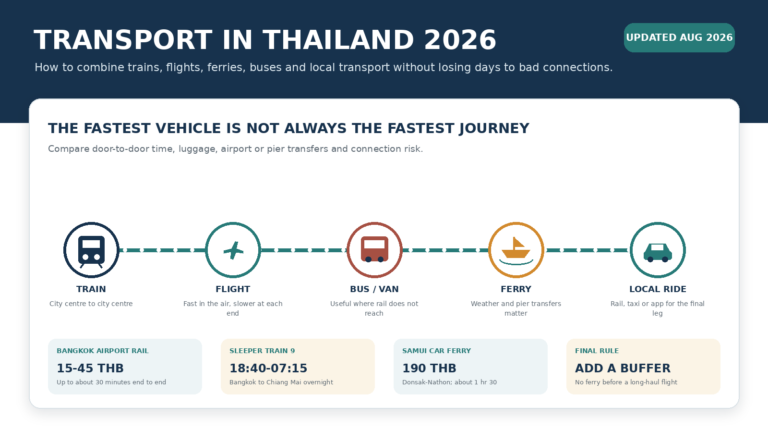
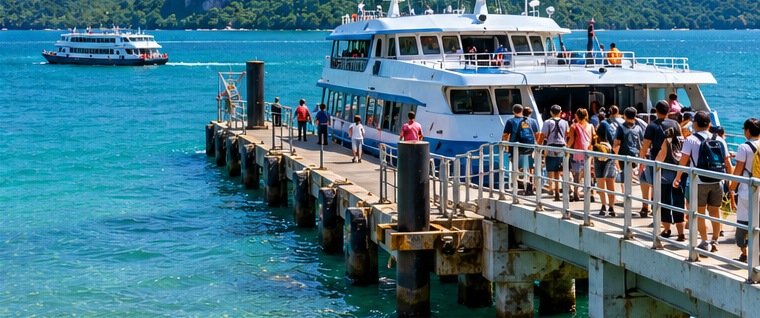
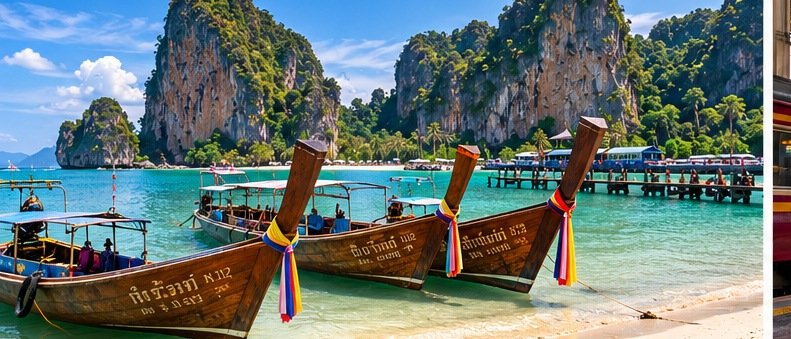
A coastal arrival illustration, not a map of a particular pier or boat service.
Krabi Airport to Ao Nang and Railay starts with one essential distinction: Ao Nang is a road transfer, while Railay requires a boat as part of the journey. A taxi that reaches the coast has not necessarily completed a Railay booking. Knowing that before you choose a ticket prevents the most expensive and frustrating arrival mistakes.
The best transfer depends on where you are sleeping, the time your flight arrives and how comfortable you are moving luggage between vehicles and a boat. A solo traveller heading to an Ao Nang guesthouse has different priorities from a family arriving after dark for a Railay resort. Therefore, this guide compares the whole chain from the terminal to reception.
The advice is research-led rather than a claim of personal journeys. Published hotel-transfer examples are clearly dated, while road times and general budgets are labelled as planning allowances. Boats remain subject to weather and operating decisions, so no attractive-looking timetable should be treated as a promise that every connection will run exactly as planned.
Simplest arrival
Ao Nang by road
Useful for late flights and early departures.
Railay priority
Confirm the boat stage
A taxi to a pier is not necessarily an all-in transfer.
Best question
Which pier does the hotel use?
Some resorts have their own arrangements.
Useful fallback
A mainland overnight
Do not force a crossing when the plan no longer works.
Krabi Airport to Ao Nang and Railay: choose the correct journey
Ao Nang is the simpler arrival
For Ao Nang, choose a shared airport transfer or a direct car to the exact hotel. A shared service can make sense for a solo traveller with time to spare; a private car is more attractive for several passengers, bulky luggage or a late flight. However, check whether the booked destination is the hotel entrance or a nearby transfer point.
The road journey is only one part of the arrival clock. Collecting bags, finding the vehicle and waiting for other passengers can add time before you leave the airport. As an editorial allowance, plan roughly 40-60 minutes on the road for a direct central-Ao-Nang transfer, increasing that for traffic or a more distant property.
Railay needs a coordinated road-and-boat plan
Railay's resort information confirms that access is by boat. Common arrangements use a road transfer towards Ao Nam Mao or Ao Nang, followed by the relevant landing on the peninsula. Some resorts use a private pier instead, so the hotel's own instructions can be more useful than a general route recommendation. [1] [2] [3]
| Destination | What the transfer must include | Sensible planning approach | Main question |
|---|---|---|---|
| Ao Nang hotel | Road journey to a verified address | Shared service or private car | Is reception inside the quoted zone? |
| Railay East | Road to the right pier plus a boat | Coordinated transfer or carefully checked separate legs | Which mainland pier and final landing? |
| Railay West | Road plus boat, often involving a beach landing | Confirm luggage and weather arrangements | Will you land near the hotel or walk across? |
| A resort using its own pier | The property's specified road and boat arrangements | Contact the hotel directly | Is the pier private and is access arranged? |
Before booking: pin the hotel and identify its arrival side
Hotel names do not explain access
Save the full property name, address and a screenshot of its entrance or landing instructions. Accommodation can use "Ao Nang" in its wider address while sitting outside the central beach zone. Likewise, "Railay" does not tell a driver which pier or boat arrangement your hotel expects you to use.
Ask the property one practical question: "Which arrival route do you recommend for this flight, with these passengers and bags?" Include the landing time and the date. A hotel can often explain the useful side of Railay, any assistance available and whether an evening arrival needs advance coordination. That answer should inform the ticket, not arrive after you have purchased the wrong one.
Check the final walking route
Railay East and West are different landing areas, and reaching one side may still leave a walk to your accommodation. Do not assume the resort's beach photograph marks the place where all transfers arrive. Ask whether staff meet the boat, whether luggage can be assisted and whether the path includes steps or uneven sections.
For Ao Nang, the same principle applies on a smaller scale. A property behind the beachfront or uphill can be less convenient for a shared drop-off than the map suggests. Therefore, compare accommodation on Ao Nang accommodation listings or Railay accommodation listings with the arrival route in mind, then verify the practical details directly with the hotel.
Leaving Krabi Airport without a booking mix-up
Match the service to the voucher
After collecting your bags, find the counter or representative identified in your confirmation. A shared van, a private car and a combined Railay transfer may use different meeting arrangements. Keep the booking reference accessible and check the operator name rather than leaving with the first person offering a ride towards the beach.
If the meeting point is unclear, remain in a staffed public area while contacting the provider. Send a description of the nearby sign or exit, not just "I am outside". Meanwhile, avoid repeatedly moving between doors without updating the driver; a stable, recognisable location usually makes a missed meeting easier to resolve.
Confirm the destination before loading bags
For Ao Nang, repeat the hotel name and show the pin. For Railay, repeat both the mainland pier and the destination side or resort. This simple check matters because a driver taking you to a pier has a different job from one responsible for a complete airport-to-hotel transfer.
Ask who handles the next stage and where you should go after leaving the vehicle. A useful combined booking should explain the handover, not merely show a boat symbol in the sales image. Keep the operator's contact details until you have reached reception, because the most confusing moment is often between the road and water parts of the journey.

Private cars, larger vehicles and app alternatives
Compare the complete car price
A direct vehicle is the straightforward option for an Ao Nang hotel when you value a clear pickup and fewer stops. As an editorial budget allowance, plan roughly THB 600-1,000 for a standard car to a central Ao Nang address. Obtain the actual total for your date, vehicle and hotel before paying; this is not a fixed official fare.Amounts dated 4 October 2026.
Check whether the price is for the whole vehicle, whether airport parking and waiting are included and what happens after a delayed flight. A cheaper quote can become less useful if it covers fewer bags or a narrower drop-off zone. Conversely, a more expensive service may add features you do not need for an ordinary daytime ride.
Capacity is not just a passenger count
Krabi Shuttle's own site distinguishes vehicle sizes and says child seats or boosters can be requested. That is useful evidence that equipment should be arranged rather than assumed. Nevertheless, confirm the actual seat type and luggage space for your booking; a general service description is not a guarantee about every dispatched vehicle. [4]
private Krabi transfer listings and family and larger-vehicle transfer searches provide alternative ways to inspect private-transfer listings. Compare their actual inclusions instead of choosing purely from the first price shown. If considering an app ride, check the live pickup instructions and availability at the airport, but retain another option rather than relying on an unconfirmed driver as your only arrival plan.
Railay via Ao Nam Mao: understand the handover
The mainland pier is not the destination
Ao Nam Mao is a commonly used mainland departure point for reaching Railay East, including arrangements described by Railay Princess. The airport-to-pier road leg and the pier-to-Railay boat leg should be clear on the confirmation. [1] A car booking to the pier alone does not imply that a boat seat or hotel porter is waiting for you.
When booking separate legs, ask where tickets are sold, which boat you should join and whether there is a scheduled departure or a wait for passengers. Keep enough time to locate the correct counter and move luggage. The short crossing itself should not disguise the practical minutes needed before boarding.
Read a resort's example correctly
Railay Princess publishes an airport-transfer-plus-joining-boat service from THB 1,500 net one way during its stated daytime band, for up to six people, and separately lists a joining boat at THB 100 per person. These are that resort's published examples checked on 4 October 2026, not universal pier tariffs. Confirm the complete party total and inclusions directly. [1]
A hotel package can be worthwhile because it connects the stages and gives you one contact if something changes. However, confirm whether the road vehicle is private while the boat is shared. Those are different service components, and the word "private" should not be allowed to describe the whole journey ambiguously.
Railay via Ao Nang: know what a beach landing involves
The route can suit a west-side stay
Ao Nang can be a useful departure area for Railay West, particularly when the boat arrangement and weather make that landing practical. Nevertheless, the exact service matters: a general transfer to Ao Nang does not automatically include the boat, and a beach arrival is not the same experience as stepping onto a fixed terminal platform.
Ask where the boat boards and what the landing is expected to involve with the current tide and conditions. You may need to manage steps, sand or water at the edge. Therefore, keep footwear and luggage suitable for a more hands-on arrival rather than assuming that a large wheeled case will roll continuously from airport to room.
Match the route to your hotel, not a photograph
A scenic west-side arrival can be appealing, but the more practical route may still be the one your hotel recommends from another pier. A property on the east side, or one with its own transfer arrangements, may not benefit from the extra walk created by choosing the prettiest-looking landing.
Use Ao Nang-to-Railay boat options to compare relevant boat listings only after checking the precise boarding and landing points. For a broader base decision, the site's Ao Nang versus Railay comparison explains why Ao Nang and Railay suit different priorities. Choose the route that delivers you safely and sensibly to the room, leaving the scenery to be enjoyed after the luggage is dealt with.
Resort transfers and private piers
Some hotels use a different system
Rayavadee describes a road transfer from Krabi Airport to its private Nong Nuch pier followed by its own boat journey. Its information asks guests to communicate arrival details directly, including when the room was booked through another platform. That is a useful reminder not to send every Railay guest to the same public pier. [2]
If your hotel uses a dedicated pier or boat, ask whether independent arrival is permitted, what departure times apply and how the land stage should be arranged. A taxi driver knowing "Railay" does not establish access to a private facility. Obtain the hotel's current directions rather than assuming a public-boat ticket can be substituted without consequences.
Judge the price against coordination
A resort transfer can cost more than arranging each leg yourself, but part of what you are buying is a clear handover. Compare the scope: vehicle, boat, luggage assistance, meeting point and what happens if the flight is late. A premium is easier to assess when you know which practical responsibilities the hotel is taking on.
For a room search on Railay resort listings, treat transfer arrangements as a separate question unless explicitly included in the rate. A booking platform confirmation usually establishes the accommodation reservation, not every aspect of the journey there. Contact the property before travel so that both sides understand how and when you expect to arrive.

Luggage and boarding: prepare for the boat stage
Pack the items you need within reach
Keep travel documents, valuables, electronics and anything essential during the journey in a small bag you can control. The main case may be placed elsewhere on the boat. Therefore, do not pack the only working phone, booking confirmation or dry layer deep inside luggage that becomes difficult to reach once boarding begins.
A water-resistant inner bag can protect important items from spray or rain, but it should not be treated as proof that every boat transfer is safe in all conditions. small dry-bag options is an optional product search for travellers who need this protection elsewhere in the trip as well. An existing suitable dry liner may do the same job without another purchase.
Ask for help before stepping aboard
Let the crew direct the boarding order and ask what help is available with larger cases. Do not try to carry several bags while negotiating an unfamiliar step or a moving boat edge. If a required life jacket or an appropriate fit is unavailable, raise it before departure rather than assuming the crossing is too short for equipment to matter.
After landing, check that every bag belongs to your party before leaving the area. Similar suitcases are easy to confuse when several people unload together. A clear luggage label and an agreed hotel meeting arrangement reduce avoidable problems without requiring elaborate equipment or a complicated packing system.
Children and accessibility: check every stage
A suitable car does not guarantee a suitable boat
A confirmed child seat on the road section solves only that part of the journey. Ask separately about boat boarding, an appropriate life jacket and the amount of assistance available. Include the child's age and size rather than relying on a generic "family friendly" description in a listing.
Allow time to settle children before the pier transfer, especially after a flight. However, communicate any delay to the person coordinating the boat. A booked connection can become harder to manage when one operator assumes you have already left the airport and another is waiting at the pier without an update.
Describe functional requirements clearly
For mobility needs, explain what assistance is necessary: step-free boarding, remaining in a wheelchair, storage for equipment or help with a short uneven path. Then ask the hotel and transport provider to confirm whether they can support that complete journey. Neither "accessible resort" nor "private transfer" establishes that the road-to-boat handover will work.
When the required support cannot be confirmed, a road-accessible Ao Nang base may be the more practical choice. That is a judgement about this arrival chain, not a claim that every Railay visit is unsuitable. Match the accommodation and transfer to the assistance available rather than discovering a mismatch after reaching the coast.
Late arrivals and the last-boat problem
Do not infer a boat from an airport landing time
A flight arriving before sunset does not necessarily leave enough time for baggage, road travel and the final useful boat. Check the operator's actual deadline and whether your flight can meet it with a sensible margin. A published private evening service is also not a guarantee that it can operate in poor conditions or without advance arrangement.
For an uncertain late arrival, I would compare an Ao Nang or Krabi mainland overnight rather than force a fragile Railay connection. mainland overnight accommodation options is a practical search for that fallback. Choose a room with workable late check-in and arrange the following day's boat after receiving current information.
Tell the hotel when the plan changes
Contact the Railay property before abandoning a booked transfer or changing the first night's arrival. Ask how the accommodation booking and transport charges are affected. Do not assume that a weather problem, late flight or missed boat automatically creates a free cancellation; the relevant terms and the property's response need checking.
Likewise, avoid treating a charter boat as an unconditional rescue plan. Confirm the operator, conditions, passenger capacity and total before agreeing. If the crew or authorities say the crossing should not operate, use the mainland alternative rather than trying to persuade another boat to make the same journey.
Rain, wind and tide: what changes the arrival
Separate climate from the travel-day decision
Seasonal patterns help choose a month, but the current marine forecast and operator's decision govern a particular crossing. TMD publishes current warnings, which should be checked close to travel. [5] A sunny-looking beach at the moment you arrive does not by itself establish conditions along the entire boat route.
Build flexibility into the plan when the boat is the only access to your accommodation. That may mean a mainland fallback, a less restrictive first-night booking or simply avoiding another paid activity immediately after arrival. The useful buffer is one that gives you an alternative, not merely a few extra minutes written between tightly connected bookings.
Tide affects handling as well as timing
Ask the operator about the expected boarding and landing arrangement rather than trying to interpret a tide chart without local context. The practical issue is how you and your bags will move between shore and boat. A different landing point or a longer final walk may be manageable if the hotel has explained it beforehand.
Keep electronics protected, wear footwear you can manage on the actual surface and let staff explain the safest boarding sequence. However, equipment and preparation do not override a cancellation. The decision to wait on the mainland can be the best part of an otherwise well-organised Railay arrival.
A realistic transfer budget for different parties
Compare the same scope
For Ao Nang, compare shared tickets with the complete vehicle quote. For Railay, add road transport, boat seats or charter, any luggage charges and the final hotel approach where applicable. A low airport-to-pier price should never be compared with an airport-to-resort package as though they cover the same journey.
Suppose a family receives a hypothetical all-in road-and-boat quote of THB 1,800 for four travellers. Its effective cost is THB 450 per person. That does not prove it is cheap or expensive; it gives a fair unit for comparison with four separate seats. This is an arithmetic example dated 4 October 2026, not an available fare.
Keep a separate disruption allowance
A mainland room, replacement transfer or larger vehicle can cost more than the planned connection. Therefore, avoid using every available baht on the cheapest possible route with no room to change it. The aim is not to carry excessive cash, but to retain access to a payment method that can fund a sensible alternative.
Before travel, identify which parts are prepaid and which are due on arrival. Then keep enough local cash for the latter and ask whether cards are accepted. An online booking platform accepting your card does not establish that a separate pier counter, porter arrangement or local driver will accept the same payment method.
Sample arrival plans that leave room for reality
A daytime Ao Nang arrival
After collecting bags, meet the confirmed driver or check the next shared departure. Go directly to the hotel, store luggage if the room is not ready and keep the first meal nearby. This avoids turning a flight arrival into an unnecessary town-and-beach circuit before you have even checked in.
For a solo traveller using a shared vehicle, accept that the route may include other stops and leave the afternoon flexible. For a family using a private car, confirm luggage capacity before the flight day. Both plans work when their limitations are understood; neither benefits from pretending the shortest driving estimate covers the whole arrival.
A daytime Railay arrival
Start with a hotel-confirmed road-and-boat plan, including the correct pier and the contact for each stage. Reach the pier with enough time to locate the booking desk, organise bags and board without rushing. Then allow for the final path or hotel assistance after landing, rather than scheduling an immediate activity at the resort.
If the flight is late, contact the coordinating operator before leaving the airport. They may advise a different departure or a mainland overnight. The strongest version of this plan is not the one with the most precise-looking timetable; it is the one that remains understandable when an hour disappears at baggage reclaim.
Return travel: protect the flight, not just the transfer
Ao Nang departures are a road-planning problem
For an Ao Nang return, work backwards from the airline's airport-arrival requirement and add pickup, loading, road time and a disruption margin. A shared service needs room for collection stops before it reaches you or the airport. Therefore, confirm the actual collection time rather than borrowing the timing of a direct taxi.
Ao Nang-to-airport options can help compare return options. Enter the exact hotel and check the notice period, especially for an early flight. Keep the contact details available the evening before departure so that a missing vehicle can be addressed before it uses up the buffer.
Railay departures add a weather-dependent stage
For Railay, add the boat booking, boarding, crossing, unloading and transfer to the road vehicle before the airport drive begins. A short boat ride does not make those stages disappear. If the flight is early or expensive to replace, I would seriously consider spending the final night on the mainland.
Use Railay-to-airport options to inspect combined return listings, but confirm the actual pickup side and whether the road connection is coordinated. Neither a boat operator nor a separate taxi should be assumed to protect an unrelated flight. Choose a return plan that still works when the first departure is delayed, moved or cancelled.
Decoding the words used in a Railay transfer listing
"Joining boat" means you are sharing that stage
A booking can give your party a private airport car and then place you on a boat with other passengers. That is not inherently a problem, but it changes how departure timing works. Ask whether the boat follows a published departure, waits for a group or uses the hotel's own coordination, and decide whether that arrangement suits the flight.
A private boat, by contrast, should identify the capacity, route and timing agreed for your party. It still operates subject to safe conditions and the provider's terms. Do not read "private" as permission to sail at any time regardless of weather, or assume it includes every additional passenger and piece of equipment you later add to the booking.
"Pier transfer" can stop before the water
A road booking ending at Ao Nam Mao is not necessarily a Railay hotel transfer. The endpoint may be exactly what the seller promised, even if you expected more. Therefore, look for an explicit description of the boat and destination landing, then ask who you meet when the driver stops.
Similarly, a hotel voucher showing an address in Ao Nang's wider administrative area does not establish road access to the property. Use the hotel's actual arrival directions rather than its postal address alone. The most useful description is a sequence you can repeat back to the operator: airport, named pier, boat arrangement, landing and final hotel approach.
The pier handover, step by step
Find the booking contact before unloading everything
When the car reaches the pier, identify the relevant counter or representative while the driver is still available. Show the voucher and confirm the destination. If the boat stage appears to be missing, resolve that before the road vehicle leaves whenever practical, rather than discovering the gap after all the luggage has been set down.
Ask when the next step happens and where your party should wait. Then organise a manageable boarding bag and keep the main cases together. This prevents the frequent small confusion of one person going to buy tickets while another assumes boarding has begun. A simple shared understanding is more useful than rushing towards the first boat that looks ready.
Check the hotel handover before the crossing
Ask whether staff will meet you on the Railay side and how you recognise them. If the final approach is independent, obtain the walking direction and property contact before leaving the mainland. A phone signal or battery problem is less troublesome when you already know the name of the landing and the basic route to reception.
On arrival, count the bags before leaving the unloading area. Then follow the agreed hotel arrangement rather than accepting a second service without knowing whether the first booking already includes assistance. Keep receipts and confirmations until the transfer is complete; they are useful for distinguishing a genuinely additional service from something that was already paid for.
A short stay: decide whether changing bases is worthwhile
Two bases create another luggage journey
A night in Ao Nang followed by Railay can make sense after a late flight, but an unnecessary split stay adds checkout, transport and another check-in. For a very short visit, compare that cost in usable holiday time before booking both properties. A single comfortable base may give you more freedom than an itinerary designed mainly to collect different hotel locations.
If you do split the stay, choose the transfer day deliberately. Avoid placing a timed excursion immediately before the hotel move, because returning late can affect the boat and reception arrangements. Send both properties the plan so that luggage storage and arrival timing are understood rather than improvised between checkouts.
Keep the fallback proportional to the problem
An uncertain evening crossing does not necessarily require abandoning the whole Railay stay. A mainland first night and a confirmed next-day transfer may preserve most of the trip while removing the weakest connection. However, ask the booked resort about the missed-night terms before assuming that the change is cost-free.
Likewise, a weather concern on the final morning may be better addressed with a mainland last night than by shortening the holiday by several days. The objective is a proportionate adjustment to the vulnerable part of the route. That kind of planning protects the experience you actually wanted instead of letting one awkward airport time dictate every night of the trip.
Pros and cons of the two arrival styles
Ao Nang: fewer moving parts
Ao Nang's strongest practical advantage is road access. A direct car can take you to the hotel without a boat handover, while shared options offer a cheaper alternative for flexible travellers. This is especially useful for a short stay, a late arrival or a flight departure that would otherwise depend on an early crossing.
The compromise is that you are choosing a different base from Railay, not simply a cheaper way to reach the same place. You may still want a separate boat day later. However, that day can be chosen around conditions rather than becoming an unavoidable part of entering or leaving your accommodation.
Railay: the setting comes with a transfer chain
Railay offers the appeal of arriving by water and staying on the peninsula, but the boat is a real logistical commitment. Bags, boarding, landing and weather deserve attention. A coordinated hotel transfer can simplify those stages, although it does not remove the possibility of disruption.
Choose Railay when that arrival style suits the trip and you can accommodate its constraints. Choose Ao Nang when dependable road access matters more. The most useful comparison is not which destination sounds more special, but which one fits your arrival time, equipment and tolerance for a weather-dependent connection.
Common mistakes that make the journey harder
Buying only the first leg
The most obvious error is buying a taxi to Ao Nam Mao and assuming the boat is included. Check the booking's endpoint and inclusions. Also distinguish a private road vehicle from a private boat; a transfer can combine one private stage with one shared stage without being wrong, provided it is described clearly.
Another error is using a resort's advertised transfer price as a universal public-pier tariff. Hotel arrangements can include different services, guest conditions and operating bands. Therefore, use the dated examples in this guide to frame questions, not to insist that every operator must offer the same price.
Leaving no room for the last handover
A booking that lists only driving time can make Railay look closer than the complete arrival feels. Add the boat process and the final hotel approach. Finally, do not leave every return decision until the morning of an early flight. A mainland overnight can be a sensible route choice rather than an admission that the island-style stay was a mistake.
Frequently asked questions
Can a taxi drive directly to Railay?
No. Railay's resort information describes boat access, so a normal road taxi cannot complete the whole journey to a Railay hotel. You need the appropriate pier and boat arrangement, or a coordinated transfer. Confirm the final landing and any walk to reception before treating a ticket as airport-to-hotel transport. [1] [3]
Which is easier after a late flight: Ao Nang or Railay?
Ao Nang is the simpler default because the arrival can be completed by road. A Railay evening transfer may be possible when arranged and conditions permit, but it should not be improvised from an assumed last-boat time. When the connection is uncertain, a mainland overnight gives the plan a more manageable fallback.
Should I use Ao Nam Mao or Ao Nang for Railay?
Ask the hotel which route fits your property, flight and luggage. Ao Nam Mao commonly serves east-side arrangements, while an Ao Nang departure can suit a west-side arrival. Some resorts use a different private pier. The correct answer is the route matching your actual booking, not one pier recommended for every traveller.
Is a hotel transfer always private?
No. It may combine a private car with a joining boat, or use shared departures on both stages. Read the description and ask which parts are exclusive to your party. That distinction affects waiting, passenger capacity and price, so it should be settled before booking rather than inferred from a vehicle photograph.
How much time should I allow to reach Railay?
Allow for airport formalities, the road journey, pier waiting, boarding, crossing and the final hotel approach. A two-to-three-hour landing-to-hotel allowance may be a useful starting point for a coordinated daytime arrival, but it is editorial planning rather than a guarantee. Longer waits, weather or flight disruption can require a different plan entirely.
Can I bring a large suitcase?
Ask the operator about its luggage allowance and handling arrangements. A large case can be transported on some services, but the difficult part may be carrying it across sand, steps or a boat edge. Keep essential items in a smaller protected bag and confirm assistance when needed rather than assuming continuous wheeled access.
What happens when the boat is cancelled?
Contact the operator and hotel, establish the next safe option and ask how the relevant bookings will be handled. Refund or rebooking rights depend on the actual terms and circumstances. Do not assume a cancellation automatically covers an unrelated hotel or flight, and do not seek an unsafe crossing just to preserve a tight itinerary.
Do children need advance arrangements?
They may need a suitable car restraint, an appropriate life jacket and help with boarding. Describe the child's age and size to the provider and confirm what can be supplied. A family-friendly hotel description is not enough to establish the equipment available on the particular road-and-boat transfer you are booking.
Can I stay in Railay before a very early flight?
It may create an unnecessarily fragile departure. Check the confirmed boat and road arrangements against the airline's requirements, then consider a mainland final night when the margin is poor. That is especially worthwhile when missing the flight would disrupt an international connection or an expensive separate booking.
Should I book an excursion for the arrival afternoon?
I would normally leave it open. The flight, road transfer and any boat handover already create enough uncertainty, and an early hotel arrival can be used pleasantly without another prepaid appointment. The site's Krabi five-day itinerary helps organise later days, when you can choose activities with a clearer idea of conditions and energy.
The arrival plan I would choose
For Ao Nang, I would compare a shared seat against a direct vehicle for the whole party and choose according to luggage, timing and the hotel entrance. For Railay, I would first ask the property for its recommended pier and a complete road-and-boat quote. The coordination can be worth paying for when the alternative is a poorly understood handover.
Above all, do not buy a journey with a missing final stage. Confirm what happens after the car stops, how the boat operates and how you reach reception. Then keep a mainland alternative for a late or disrupted arrival. That produces a more dependable start than chasing the shortest advertised transfer time.
Sources and fact-checking notes
- Railay Princess: transfer services
Hotel-published airport-plus-joining-boat and separate boat examples; confirm the complete quote. Reviewed 4 October 2026.
- Rayavadee: getting here
Private Nong Nuch pier, advance communication and the resort's transfer arrangements. Reviewed 4 October 2026.
- Railay Village: transportation
Confirms boat-only access and road/boat arrangements; conflicting price snippets are not used as a universal tariff. Reviewed 4 October 2026.
- Krabi Shuttle: airport transfers
Provider information on vehicle types and requested child equipment; availability must be confirmed for the booking. Reviewed 4 October 2026.
- Thai Meteorological Department: warnings
Current conditions should inform the boat-day decision; no crossing is guaranteed by this guide. Reviewed 4 October 2026.
Illustrations in this article were created for Taylor’s Trailblazing Travels. Third-party photographs, where used, are credited beside the image or in the source list.