Mae Hong Son Travel Guide 2026: Routes, Things to Do and Practical Tips
A road-first guide to the lakeside town, misty mountain excursions, realistic journey times, changing seasons and a three-day plan that leaves room to breathe.
Road transport is the reliable plan
Best broad window: November–January
Mae Hong Son sits in a mountain-ringed valley close to the Myanmar border, and the journey is part of its appeal. Unlike a quick city break, this is a destination where repeated bends, changing visibility and limited transport shape the whole plan. The reward is a small, walkable lakeside centre, Shan-influenced temples and a northern day-trip circuit that feels very different from Chiang Mai or Pai.
This Mae Hong Son travel guide is designed for independent travellers deciding whether the time and road are worthwhile. It separates the compact town from the much wider province, uses official airport and park information where available, and labels variable prices as dated planning examples rather than guarantees. Advice is research-led; it does not pretend to be a personal visit.
The core planning judgement is simple: stay long enough to recover from the road. One late arrival and one early departure gives you almost no Mae Hong Son at all. Two nights can work for the town; three nights are much better when Ban Rak Thai, Pang Oung or the national-park stops matter.
Three nights near the lake
It protects two full days and avoids turning the mountain journey into an overnight transit stop.
Pang Oung and Ban Rak Thai
Start early, combine them on one northern circuit and keep enough daylight for the return road.
Shared minivan and central stay
Spend on one driver day only when the mountain circuit is a priority.
The town is compact; the sights are not
Walking works around the lake, while most province highlights require a car, driver or experienced rider.
Is Mae Hong Son worth visiting?
Mae Hong Son is worth visiting when you want a slower northern stop and accept that access is less convenient than Chiang Mai, Chiang Rai or Pai. The town itself is modest rather than packed with headline sights. Its value comes from the combination: reflective Chong Kham Lake, Shan-style religious architecture, a hilltop viewpoint, cooler mountain air at the right time of year and day trips through forested border country.
Who is most likely to enjoy it?
It suits road-trip travellers, photographers who can work around changing light, couples looking for quiet evenings, and anyone interested in the cultural connections between northern Thailand and neighbouring Shan areas. It also makes sense as the far side of a longer Mae Hong Son Loop, particularly when Pai and Pang Mapha are already part of the route.
Who may prefer a different stop?
Travellers with severe motion sickness, very limited holiday time or a strong preference for frequent public transport may get better value from Chiang Mai plus Chiang Rai. Families can make Mae Hong Son work, although a private car is often easier than repeated shared vans and the long northern circuit needs careful pacing. Meanwhile, nightlife-led travellers should not expect the range found in Bangkok, Phuket or even central Chiang Mai.
How many days do you need in Mae Hong Son?
Two nights are the practical minimum after a daytime arrival. Three nights are better because they create two complete days: one for the town and nearby sights, another for the mountain circuit to Pang Oung and Ban Rak Thai. A fourth night becomes useful when you want a slow village stay, a rest day after the road or flexibility for rain and haze.
| Nights | What fits | Best for | Main compromise |
|---|---|---|---|
| 1 | Lake, temples and perhaps Doi Kong Mu | Transit only | No proper mountain day; vulnerable to a late arrival |
| 2 | Town plus one full excursion | Efficient loop travellers | Little weather margin |
| 3 | Town, northern circuit and a flexible morning | Most first visits | Still requires selective sightseeing |
| 4+ | Remote overnight, hot spring or slower local time | Scenery, photography and road-trip recovery | Longer commitment to a remote region |
Count nights, not calendar labels
A six-hour scheduled journey can occupy nearly the whole useful day after terminal travel, waiting, stops and check-in. Consequently, a “two-day trip” with one arrival and one departure may provide only a few evening hours. Write the hotel-to-hotel time beside each segment before deciding that Mae Hong Son fits.
Build in one recovery margin
Mountain roads affect people differently. A light first evening is sensible after a shared van, particularly for anyone prone to nausea. Avoid paying for a tightly timed sunset tour on arrival day; walk the lake instead and move Doi Kong Mu to the following afternoon if necessary.
Best time to visit Mae Hong Son: weather, smoke and rain
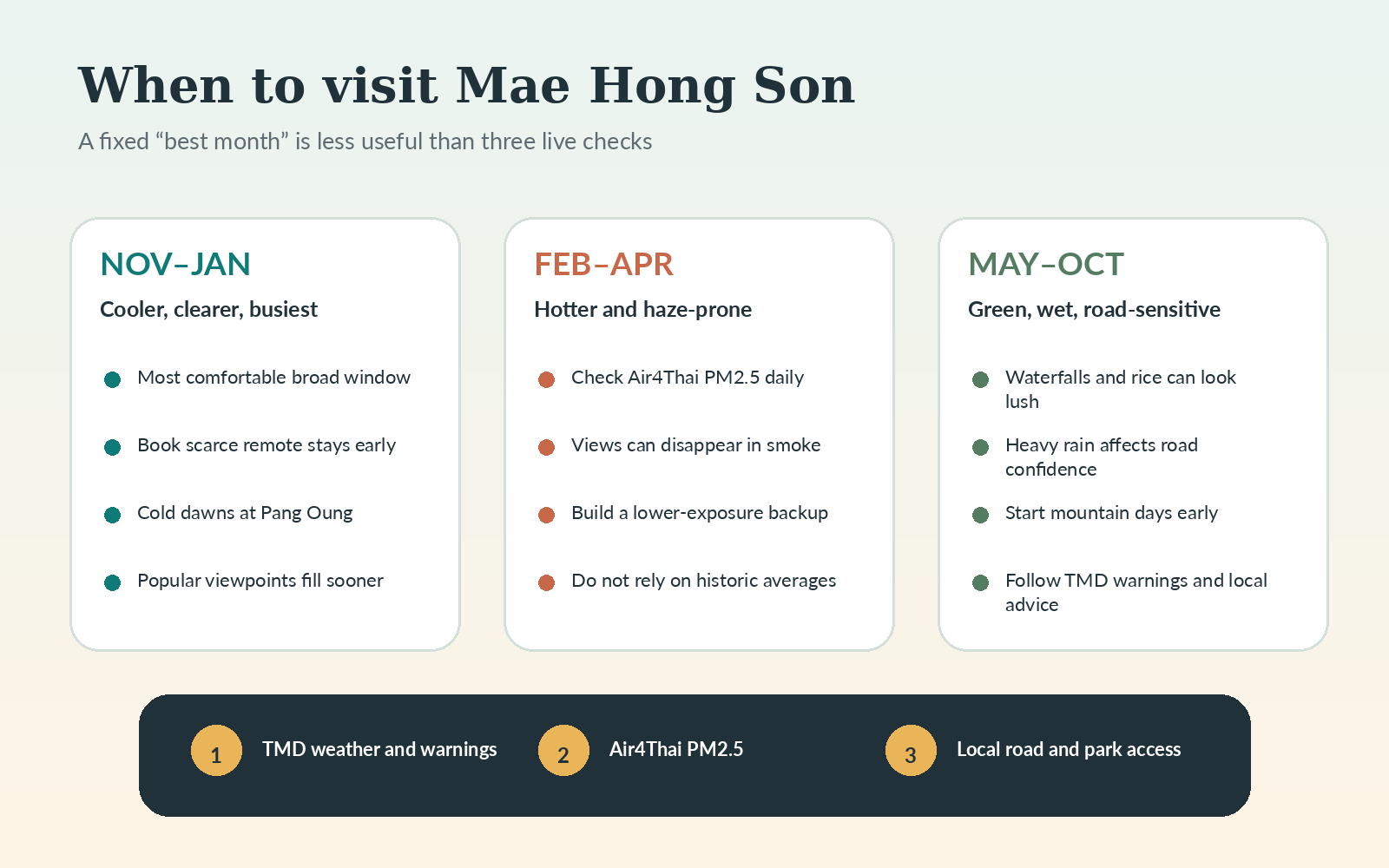
November to January is the easiest broad period for comfortable mornings and clearer mountain views. It is also the most popular time, so small remote properties and Pang Oung stays can sell out. February to April can be hot and affected by smoke. From May into October, the landscape becomes greener, while heavy rain can reduce visibility and make steep roads less forgiving.
Cool season: November to January
Choose this period for the best overall balance of road confidence, early-morning mist and comfortable walking. Bring a warm layer for dawn at Pang Oung and breezy sunset viewpoints. Book important remote stays before fixing non-refundable transport, because room supply is much smaller than in Chiang Mai.
Smoke-prone months: February to April
Do not treat a historic “burning season” date as a guarantee. Air quality changes by day and district. Check the Pollution Control Department’s Air4Thai reporting for Mae Hong Son shortly before committing to long outdoor days, then recheck each morning. A poor PM2.5 reading can affect comfort and health even when the sky looks only mildly hazy.[15]
Rainy season: roughly May to October
Rain can produce vivid vegetation and stronger waterfalls, but the decision is about road conditions rather than whether showers are aesthetically pleasant. Follow Thai Meteorological Department warnings, ask accommodation staff about recent access and avoid turning a delayed start into a night-time mountain return.[14]
How to get to Mae Hong Son
Plan around the road. Official Department of Airports statistics recorded zero scheduled domestic movements and zero scheduled domestic passengers at Mae Hong Son Airport from 1 January to 31 July 2026.[4] A proposed Ezy Airlines service for September or October was then reported as postponed indefinitely.[5] Flight schedules can change after publication, but a route announcement is not a ticket you should build a holiday around.
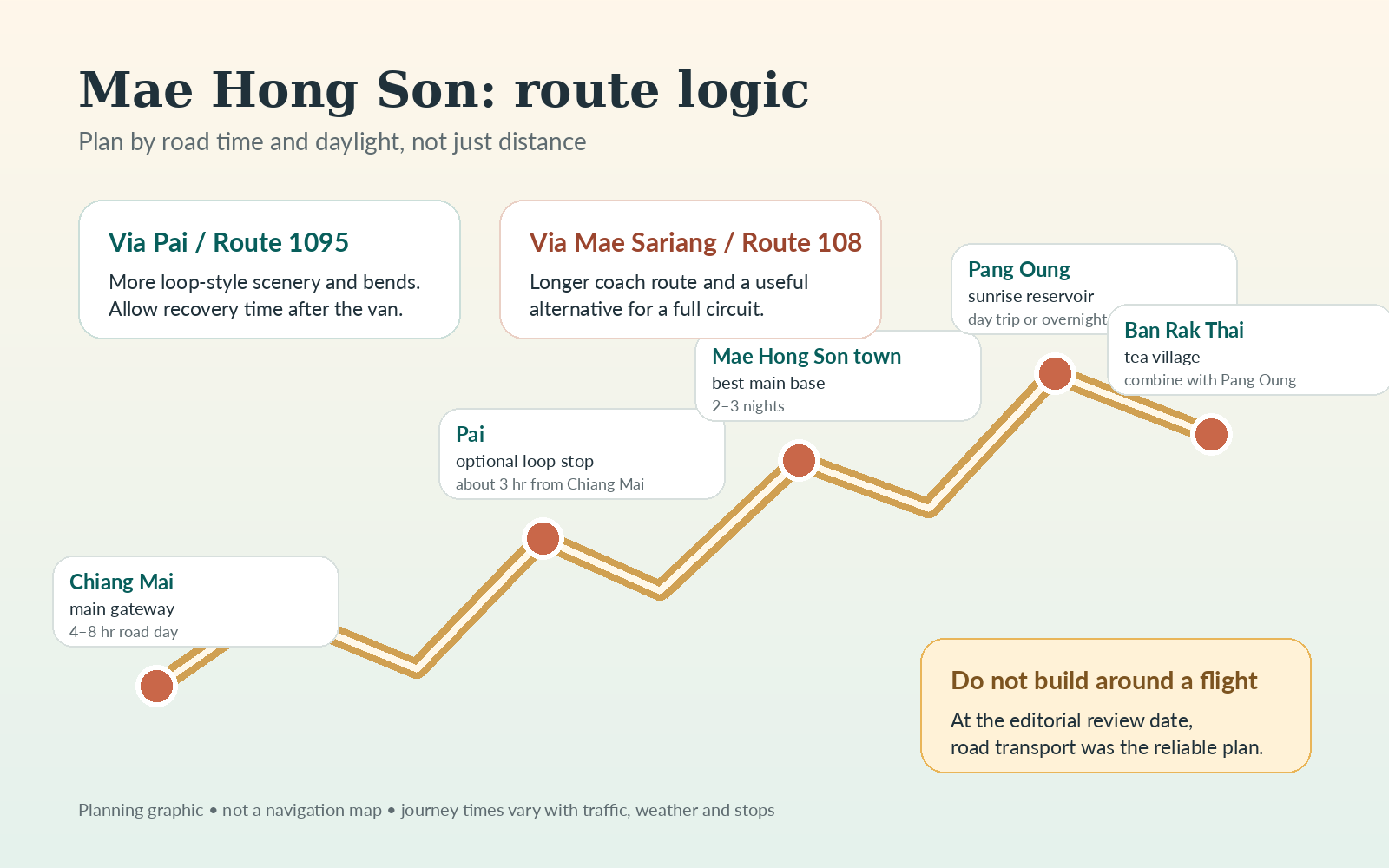
Shared minivan or coach from Chiang Mai
Prem Pracha is the established scheduled operator. Published listings checked for September 2026 showed multiple daytime minivans taking about six hours via Pai, plus longer coach options via Mae Sariang. A timetable is a departure plan, not a hotel-to-hotel promise: allow time to reach Chiang Mai Arcade, arrive before departure, make road stops and continue from the Mae Hong Son terminal.[2][3]
| Option | Published / planning time | Planning price | Best for | Trade-off |
|---|---|---|---|---|
| Shared van via Pai | About 6 hours scheduled | About THB 350 one way | Solo travellers and budget trips | Repeated bends; limited personal stops |
| Coach via Mae Sariang | Roughly 8 hours scheduled | About THB 500–600 one way | Full loop or different road route | Longer day |
| Private car or van | Usually 5.5–7 hours plus chosen stops | Often THB 6,000–10,000 per vehicle | Families, groups, bulky luggage and motion sickness | High cost for one traveller |
| Self-drive car | Driver-dependent; allow a full daylight day | Rental, fuel, insurance and one-way conditions vary | Experienced mountain drivers | Fatigue, weather and liability sit with you |
Transport prices are dated planning examples checked on 16 September 2026; operators, vehicle class, demand and exchange rates can change them. Confirm the live timetable and total luggage allowance before paying.
Via Pai or via Mae Sariang?
The Pai route makes sense for travellers already moving clockwise around the loop. It is scenic but sustained and winding. The Mae Sariang route supports a complete circuit and avoids simply retracing the same road; however, it is still a long mountain day. Neither route should be squeezed between a morning check-out and a fixed evening connection.
Booking the road journey
Book a specific service once the accommodation sequence is fixed. Compare the departure terminal, actual operator, luggage conditions, cancellation terms and arrival point rather than choosing only by headline price.
Compare current Mae Hong Son transport
12Go can be useful for checking bookable shared services and private transfers in one place. Confirm that the result actually terminates in Mae Hong Son town and inspect the operator and class before payment.
Getting around Mae Hong Son safely
The lakeside centre is walkable. Doi Kong Mu, Su Tong Pe Bridge, Fish Cave, Pha Suea, Pang Oung and Ban Rak Thai are not. Local app-based ride availability can be limited, especially outside the centre, so organise the return journey before leaving rather than assuming a driver will appear later.
Driver, car or motorbike?
A hired driver is the lower-friction choice for the northern mountain circuit because it removes navigation, parking and fatigue from a long sightseeing day. Experienced mountain drivers may prefer a rental car when their licence and insurance are valid. Motorbikes offer flexibility, but this is not a sensible place to learn cornering, braking or wet-weather control.
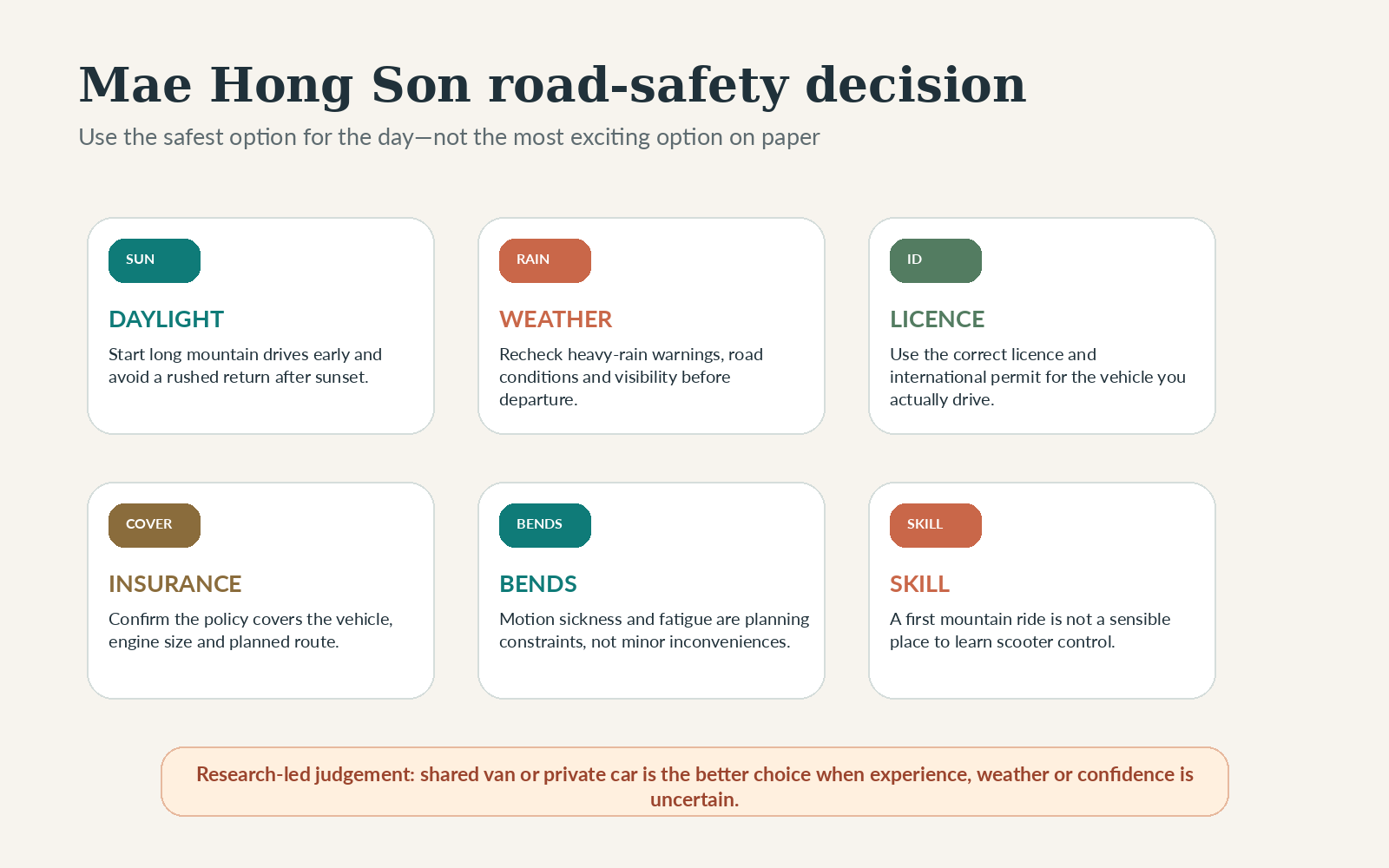
Road checklist before leaving town
- Start with enough daylight for the full route plus an unplanned stop.
- Ask about current rain, landslide, fog and construction conditions.
- Carry the correct driving licence, international permit and insurance evidence.
- Check tyres, brakes, lights and fuel before remote roads.
- Keep a downloaded map, hotel address and driver number offline.
- Stop when tired; mountain bends punish rushed decisions.
Motion-sickness planning
Request a forward-facing seat near the front when possible, eat lightly, keep water accessible and focus on the horizon rather than a phone. Anyone needing medication should seek pharmacist or medical advice appropriate to their health and avoid assuming a travel gadget replaces clinical guidance.
Motion-sickness bands
Some travellers like reusable acupressure bands because they are compact and non-drug. Evidence and individual results vary, so treat them as an optional comfort aid rather than a guarantee.
Compact waterproof layer
A light jacket is useful for sudden mountain rain and cool dawns. Prioritise packability, ventilation and enough room over normal clothes.
Where to stay in Mae Hong Son
For a first visit without a car, stay near Chong Kham Lake or within an easy walk of the centre. You can reach the evening market, lakeside temples and restaurants without arranging a ride. Travellers with a car may prefer a quieter edge-of-town property, although that convenience disappears if every meal requires driving.
| Area | Best for | Advantages | Watch for |
|---|---|---|---|
| Chong Kham Lake and centre | First visit, no car, easy evenings | Walkable temples, market and food | Rooms facing busy roads or event noise |
| Edge of town | Drivers, quiet stays, parking | More space and calmer nights | Transport needed for dinner and the lake |
| Ban Rak Thai | Tea-village atmosphere and early lake views | Avoids a rushed day-trip turnaround | Small inventory, higher seasonal demand, remote road |
| Pang Oung area | Sunrise mist and simple nature stay | Early access before day visitors | Basic facilities, cold nights and booking constraints |
Central stay versus remote overnight
Central Mae Hong Son is the best all-round base because it keeps meals and evenings simple. Choose Ban Rak Thai or Pang Oung overnight only when sunrise atmosphere matters enough to justify moving luggage, accepting fewer services and checking the return road. A split stay can work, but it is not automatically more relaxing.
Compare accommodation before fixing the route
Use the map view, recent guest reviews, parking details and cancellation terms. For a remote stay, confirm the exact road location and whether dinner is available after dark.
Accommodation examples and availability were reviewed on 16 September 2026; live prices vary by dates, room type and cancellation conditions.
Things to do in Mae Hong Son town
The town list is deliberately short. It prioritises places that fit together on foot or within a brief drive, give cultural context and do not force a visitor to race between distant stops. Opening times at active temples can change around ceremonies, so behave as a guest rather than treating the buildings as fixed-hour attractions.
Walk around Chong Kham Lake
The lake is the town’s natural orientation point. Early morning is quiet; the evening brings reflected temple lights and a more social atmosphere. Use it as the start and finish of a walking loop rather than a single photo stop.
Visit Wat Chong Kham and Wat Chong Klang
The neighbouring lakeside temples are known for Shan and Burmese-influenced architecture. Dress for an active religious site, remove shoes where required, avoid blocking worshippers and ask before photographing people. A respectful half-hour may be more meaningful than rushing through every building.
Go to Wat Phrathat Doi Kong Mu for the valley view
The hilltop temple looks across the town, lake, airport and surrounding ridges. A current visitor listing gives daily hours of 07:00–19:00 and free entry, although temple access can change for events.[11] Arrive before sunset rather than at the final moment, then descend cautiously before full darkness if you are driving yourself.
Browse the evening market when it is operating
Market activity is seasonal and event-dependent. Look for local snacks, tea and simple meals, but do not promise yourself a large night market every date of the year. Ask accommodation staff what is open that evening, then keep expectations proportionate to the town’s size.
Ban Rak Thai, Pang Oung and the northern mountain circuit
This is the most useful full-day excursion from Mae Hong Son town, provided the roads and weather are suitable. The order below is geographic rather than a popularity ranking. A driver may reverse it to catch morning light, avoid traffic or respond to access conditions.
-
Tham Pla, or Fish Cave
The park site is north of town and works as a short nature stop. It belongs to Tham Pla–Namtok Pha Suea National Park, whose official page describes a mountainous protected area and a rainy period from around mid-May to mid-October.[6] Do not feed wildlife outside permitted arrangements, and confirm current park access on arrival.
-
Pha Suea Waterfall
The waterfall is strongest after rain and can be less dramatic late in the dry season. A current visitor listing gives daily hours of roughly 08:00–16:30 and treats it under the same park ticket as Fish Cave.[9] Slippery surfaces matter more than the viewing distance, so wear footwear with grip.
-
Pang Oung
The pine-fringed reservoir is most atmospheric near first light, which is why an overnight can outperform a hurried midday visit. A current listing reviewed in July 2026 shows 06:00–20:00, a planning entry fee of THB 100 for foreign adults and a bamboo-raft example of about THB 150.[8] These are changeable visitor details, not guaranteed prices.
Pang Oung fees and hours checked 16 September 2026; confirm locally before travel.
-
Ban Rak Thai
The lakeside village is associated with tea cultivation and Yunnanese heritage. Walk slowly, buy from local businesses when it suits your budget and remember that homes and livelihoods are part of the setting. The village itself is generally treated as free to enter; small boat rides and food are separate purchases.[12]
| Stop | Useful visit | Dated planning cost | Main caution |
|---|---|---|---|
| Fish Cave and Pha Suea | About 1–2 hours combined | Park entry often listed at THB 100 foreign adult | Waterfall flow and paths vary by season |
| Pang Oung | 45–90 minutes; longer at dawn | THB 100 foreign adult; raft about THB 150 | Narrow approach and cold early mornings |
| Ban Rak Thai | 1.5–3 hours with a meal | No general village ticket; optional boat roughly THB 150–350 per boat | Weekend crowds and slow mountain road |
Planning fees were checked on 16 September 2026 using the official park dataset and current visitor listings. Confirm at the ticket booth or operator because local prices, operating times and package inclusions change.
Day trip or overnight?
Choose a day trip when you want one central hotel and a simple route. Choose an overnight near Pang Oung or Ban Rak Thai when sunrise is the priority and you are comfortable with basic or limited services. Do not assume sleeping remotely removes all driving: you still need a safe transfer and a clear plan for meals and onward luggage.
Check guided options carefully
Mae Hong Son has fewer standardised group tours than major Thai resorts. Read the exact pickup area, vehicle type, stops, meal inclusions and return time before booking.
Extra stops when you have more time
Su Tong Pe Bridge
The long bamboo walkway links rice fields and a temple area outside town. A current visitor listing describes daily access around 06:00–18:00, free entry with donations welcomed, and a walk of roughly 30–45 minutes for many visitors.[10] Go early for cooler air, move carefully on flexible or wet bamboo and keep quiet around religious activity. Rice-field appearance varies with the agricultural season.
Pha Bong Hot Spring
Pha Bong is a practical add-on south of town rather than a reason to redesign the whole trip. DASTA lists it about 10 kilometres from the centre, with hours of 08:00–17:00 and historical examples including THB 50 for a private bath hour.[13] Treat those prices as an older official listing that requires confirmation, particularly if a soak is central to the visit.
Pha Bong service examples checked 16 September 2026; the source may not reflect the latest on-site charge.
Pang Mapha and Tham Lod
These fit best between Pai and Mae Hong Son rather than as a rushed return day from town. Cave access, river levels and guide arrangements vary, so give the area its own night when possible. This also breaks the winding journey and adds a quieter contrast to Pai.
Khun Yuam and Mae Sariang
Travellers completing the loop can continue south through Khun Yuam and Mae Sariang. The route makes a satisfying circuit, but each stop needs a clear reason and a realistic driving day. Adding towns only to “complete the loop” can turn the journey into continuous packing.
A realistic three-day Mae Hong Son itinerary
This itinerary is ordered to minimise repeated journeys and protect the longest excursion. It assumes three nights, a road arrival, and either a driver or suitable vehicle for day two. Reverse the days when weather or air quality makes that safer.
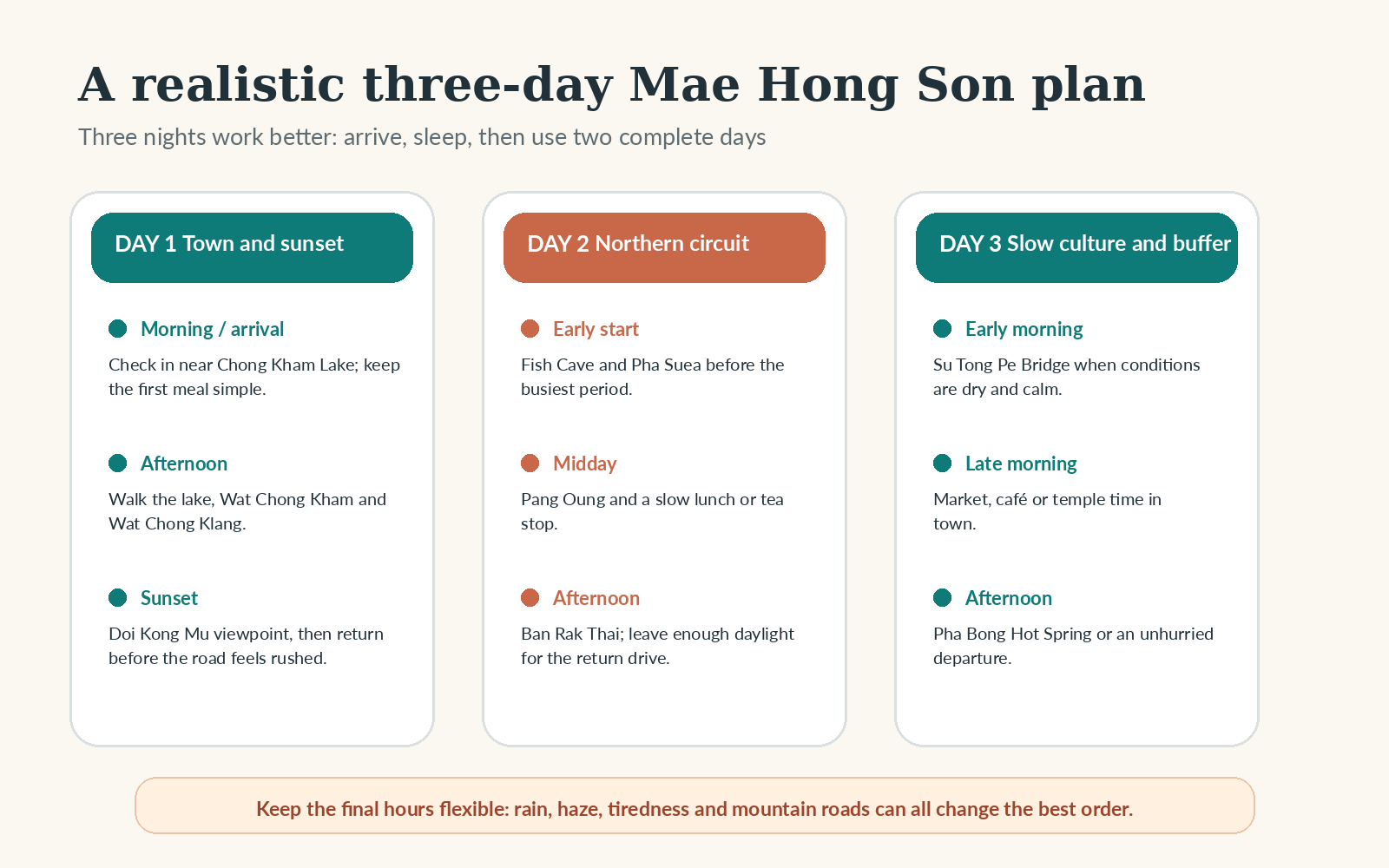
Day 1: arrival, lake and Doi Kong Mu
After checking in, walk around Chong Kham Lake and visit the lakeside temples without setting a stopwatch. Rest during the hottest part of the afternoon. Head to Doi Kong Mu with enough time to find a respectful viewpoint before sunset, then return to town for dinner. Move the viewpoint to day three if the road arrival leaves you tired.
Day 2: Fish Cave, Pha Suea, Pang Oung and Ban Rak Thai
Leave early with water, a light layer and a clear return time. Stop briefly at Fish Cave, continue to Pha Suea if water and paths make it worthwhile, then give Pang Oung and Ban Rak Thai the largest share of the day. Eat before the late-afternoon return and avoid stretching the final stop until the driver must rush in fading light.
Day 3: Su Tong Pe, town and a flexible finish
Visit Su Tong Pe Bridge early when the walkway is cooler, then return for breakfast or market time. Use the afternoon for Pha Bong Hot Spring, a café, another temple visit or complete rest. This lighter day also acts as the buffer if day two was disrupted by rain, haze or a closed road.
Departure morning
Choose a later road departure when possible. Buy snacks, take motion-sickness precautions and do not plan an important flight from Chiang Mai on the same evening. A road delay should be inconvenient, not trip-ending.
Mae Hong Son costs and daily budget
Mae Hong Son can be inexpensive once you arrive, but transport changes the total. A solo traveller using shared vans and a central guesthouse spends very differently from a couple hiring a driver and staying beside Ban Rak Thai. Compare the whole route, not just a low nightly room rate.
| Expense | Lower-cost planning range | Comfort planning range | What changes it |
|---|---|---|---|
| Central room, per night | THB 550–1,100 | THB 1,300–3,000+ | Weekend, cool season, room condition and cancellation |
| Meals and drinks, per person/day | THB 350–700 | THB 800–1,500+ | Tea-village dining, cafés and alcohol |
| Local town transport/day | THB 0–300 | THB 400–1,000 | Walkability, negotiated return rides and hotel location |
| Northern circuit vehicle/day | Shared with others where available | About THB 2,500–4,500 per vehicle | Vehicle size, driver time, fuel, stops and pickup point |
| Attractions/day | THB 0–200 | THB 300–700 | Park ticket, optional raft, donations and hot-spring service |
| Daily total excluding Chiang Mai transfer | THB 1,200–2,100 per person | THB 2,800–5,500+ per person | Solo versus shared vehicle and accommodation level |
All budget figures are planning ranges checked on 16 September 2026. They are not quotes. Hotel rates, driver prices, park fees and meal costs vary by season, group size, location and booking terms.
Where the budget is most sensitive
The private driver day is the largest swing for many travellers. A group can divide it; a solo visitor cannot. Remote accommodation may also look modest until dinner, transfer and cancellation conditions are included. Conversely, the central town is easy to enjoy without paying for multiple attractions.
Do not prepay every local detail
Secure the scarce components first: the road journey, essential hotel and any remote high-season stay. Leave ordinary meals, donations and flexible town transport for the trip. This reduces the risk of paying for a fixed itinerary when smoke, rain or fatigue changes the sensible plan.
Food, temples and respectful travel
Mae Hong Son’s food and architecture reflect northern Thai, Shan and cross-border influences. Look for dishes and snacks with specific local descriptions rather than assuming every menu item represents one fixed tradition. Seasonal markets and small restaurants change, so ask what is available that day.
Eating without overplanning
Choose one market meal, one sit-down local dinner and a tea-focused stop at Ban Rak Thai if it fits the route. Check prices before ordering fish, tea sets or food sold by weight. Carry cash in small denominations because remote businesses may not accept cards or a mobile payment method available to overseas visitors.
Temple etiquette
- Cover shoulders and knees, remove shoes where signs or local practice require it, and keep voices low.
- Do not climb on religious structures or position people disrespectfully for a photograph.
- Ask before photographing monks or worshippers, particularly during alms-giving.
- Keep feet away from Buddha images and avoid interrupting ceremonies.
Community and border-area sensitivity
Village life is not a themed attraction. Buy tea, food or crafts because the product suits you, not because a photograph feels owed. Avoid intrusive portraits, drones near homes or religious places, and questions that push residents to explain personal migration histories. Near border areas, follow signs and official instructions rather than exploring unmarked roads.
Connectivity, money, health and packing
Mobile data and offline backup
Coverage can weaken between towns and in mountain valleys. Save the hotel address, key phone numbers, maps and tickets offline. An eSIM can reduce airport setup, but compare network coverage, data allowance, hotspot rules and phone compatibility rather than choosing only by advertised price.
Cash and payments
Carry enough cash for remote meals, small fees, donations and a transport contingency, while splitting it between secure places. Use town ATMs before a full-day circuit instead of relying on a village machine. Decline unhelpful currency conversion at card terminals or ATMs only when you understand the alternative exchange rate and fee structure.
Health and insurance
Travel insurance should cover the itinerary and planned activities, including any vehicle you drive. The UK FCDO advises travellers to obtain suitable cover for destinations, activities and emergency expenses.[16] Keep medication in original packaging, carry drinking water and take heat, smoke and motion sickness seriously rather than waiting for symptoms to become severe.
What to pack
- Light warm layer for dawn and hilltop wind.
- Compact waterproof jacket and bag cover in wetter months.
- Footwear with grip for bamboo, wet paths and temple steps.
- Sun protection, insect repellent and refillable water bottle.
- Power bank and offline copies of tickets, insurance and licence.
- A well-fitting mask when PM2.5 is elevated, chosen with appropriate health guidance.
Mae Hong Son pros and cons
Advantages
- Compact, atmospheric town centre around Chong Kham Lake.
- Distinctive Shan-influenced temples and cultural context.
- Strong combination of town, reservoir, tea village and protected landscape.
- Works naturally as part of a longer northern road loop.
- Quieter evenings than Thailand’s major tourist centres.
Limitations
- Long, winding road access and no dependable scheduled flight at the review date.
- Most headline sights outside town require private road transport.
- Smoke, heavy rain and visibility can substantially change the experience.
- Remote stays have limited inventory and services.
- Poor fit for a rushed one-night itinerary.
The deciding question
Would the mountain journey feel like part of your holiday or an obstacle between more important places? Mae Hong Son is compelling for the first traveller and inefficient for the second. That distinction matters more than the number of attractions on a checklist.
Common Mae Hong Son planning mistakes
1. Treating one night as a meaningful visit
A late road arrival followed by an early departure gives only a lake walk. Either allow two or three nights or leave Mae Hong Son for a trip with more time.
2. Building the itinerary around an announced flight
Air routes can be proposed, postponed or removed. Verify a bookable direct service with the operating airline; otherwise, use the road timetable as the foundation.
3. Renting a scooter because it looks flexible
Flexibility does not compensate for limited riding skill, poor weather, invalid insurance or fatigue. A shared van, car or driver is the more responsible choice when any of those are uncertain.
4. Trying to see every northern stop in one day
Fish Cave, Pha Suea, Pang Oung and Ban Rak Thai already form a full circuit. Adding several detours can push the return into darkness and reduce every place to a photograph.
5. Ignoring live smoke and rain information
A beautiful forecast screenshot from a previous year proves nothing about today’s PM2.5 or road conditions. Check official live sources and maintain a lighter alternative.
6. Booking a remote room without checking meals and transport
Confirm the exact map location, dinner availability, check-in time and onward pickup. A scenic room becomes stressful when the final approach is after dark or no food is available.
7. Scheduling a same-day international connection
Return to Chiang Mai at least one night before an important flight. Delays on a winding mountain route are plausible and may not be insurable when the connection was unrealistic.
Mae Hong Son frequently asked questions
Is Mae Hong Son worth the journey from Chiang Mai?
Yes for travellers who want a quieter mountain town, Shan-influenced temples and the Ban Rak Thai–Pang Oung circuit. No route is universally worthwhile: with fewer than two nights or strong motion sickness, Chiang Mai plus a nearer excursion may be a better use of time.
Can you fly from Chiang Mai to Mae Hong Son?
Do not assume so. Official airport statistics showed no scheduled domestic service from 1 January to 31 July 2026, and a subsequently announced Ezy Airlines route was reported as postponed indefinitely. Recheck airline booking systems for your dates, but plan the itinerary around road access unless a direct ticket is genuinely on sale.
How long is the road journey from Chiang Mai?
Published shared-van services commonly show about six hours via Pai, while longer coach routes via Mae Sariang can take around eight hours. Hotel-to-hotel time is longer after terminal travel, waiting, breaks and final transfer.
What is the shared minivan fare?
A Prem Pracha planning fare of about THB 350 one way via Pai was checked on 16 September 2026. Vehicle class and operator schedules can change, so verify the current booking page before paying.
How many nights should I stay?
Three nights are the strongest first plan. Two nights can cover the town and one excursion; one night is mainly a transit stop. Four nights suit a remote overnight or weather buffer.
Is Mae Hong Son good without a scooter?
Yes. Stay near Chong Kham Lake, walk the centre and hire a driver or join a suitable trip for the northern circuit. A scooter is not necessary, and it is a poor choice for an inexperienced mountain rider.
When is smoke season?
Risk is commonly higher from February into April, but exact conditions change by day. Check Mae Hong Son readings on Air4Thai and adapt outdoor plans to current health guidance.
Can Pang Oung and Ban Rak Thai be visited in one day?
Yes, and they fit naturally with Fish Cave and Pha Suea on a long northern circuit. Start early, keep stops selective and agree a safe return time with the driver. An overnight is better when first-light mist is the main aim.
Do I need to pre-book a driver?
Pre-book for a cool-season weekend, family group, remote pickup or a fixed day-two itinerary. Ask for the vehicle type, total hours, included fuel, planned stops, overtime policy and return time in writing.
Is Mae Hong Son suitable for children?
It can be, particularly with a private car, a central hotel and shorter stops. The long bending road, cold dawns and limited remote facilities require more breaks and fewer ambitions than an adult-only itinerary.
The clearest Mae Hong Son recommendation
Choose Mae Hong Son when you can give it three nights and treat the road as part of northern Thailand rather than lost time. Stay near Chong Kham Lake, keep arrival day light, devote one full day to Pang Oung and Ban Rak Thai, and preserve a flexible final day for weather, air quality or simple rest.
Skip or postpone it when the itinerary has only one spare night, when a same-day flight connection would follow the return road, or when the journey would be endured rather than enjoyed. Chiang Mai, Chiang Rai or a shorter countryside trip can deliver a better holiday than forcing a remote stop into the wrong schedule.
The strongest version of Mae Hong Son is unhurried: morning mist without a race, temples without a checklist and mountain roads completed in daylight. Build around those conditions and the destination earns its place in a longer Northern Thailand route.
Sources and fact-checking notes
Transport, flight, park, weather, air-quality and safety claims were checked against the sources below on 16 September 2026. Official sources were preferred. Where an official page did not expose a clear current visitor price or hour, a dated secondary visitor listing is identified as such and the article tells readers to confirm locally.
- Tourism Authority of Thailand: Mae Hong Son province — Tourism Authority of Thailand. Destination context and official tourism framing. Checked 16 September 2026.
- Prem Pracha booking and timetable service — Prem Pracha Transport. Scheduled road transport operator and booking check. Checked 16 September 2026.
- Chiang Mai to Mae Hong Son transport listings — 12Go Asia. Cross-check of bookable bus and private-transfer options and journey durations. Checked 16 September 2026.
- Mae Hong Son Airport traffic statistics, 1 January to 31 July 2026 — Department of Airports, Thailand. Official evidence that scheduled domestic flight movements and passengers were zero in the published period. Checked 16 September 2026.
- Ezy Airlines postpones planned Chiang Mai–Mae Hong Son route — Thailand Edition (secondary news report). Cautious cross-check of the reported indefinite postponement of the announced September/October 2026 route. Checked 16 September 2026.
- Tham Pla–Namtok Pha Suea National Park — Department of National Parks, Wildlife and Plant Conservation. Official park identity, geography, season and contact details. Checked 16 September 2026.
- National park entrance-fee dataset — Department of National Parks, Wildlife and Plant Conservation. Official fee dataset and reminder that park charges can change by notice. Checked 16 September 2026.
- Pang Oung visitor information — Thai Holiday Guide (secondary current visitor listing). Current practical hours, planning fees, rafting and road cautions; confirm locally. Checked 16 September 2026.
- Namtok Pha Suea visitor information — Thai Holiday Guide (secondary current visitor listing). Current practical opening pattern and shared national-park ticket planning; confirm locally. Checked 16 September 2026.
- Su Tong Pe Bridge visitor information — Thai Holiday Guide (secondary current visitor listing). Current practical hours, donation model and walking expectations; confirm locally. Checked 16 September 2026.
- Wat Phrathat Doi Kong Mu visitor information — Thai Holiday Guide (secondary current visitor listing). Current practical hours, free entry and viewpoint planning; confirm locally. Checked 16 September 2026.
- Ban Rak Thai Village — Gplace / local tourism listing. Distance, access pattern and village visitor context. Checked 16 September 2026.
- Pha Bong Hot Spring — DASTA CBT Thailand. Location, listed hours and historical service-price examples; verify before relying on them. Checked 16 September 2026.
- Mae Hong Son provincial weather — Thai Meteorological Department. Official weather and warning check close to travel. Checked 16 September 2026.
- Air4Thai air-quality reporting — Pollution Control Department, Thailand. Live PM2.5/AQI check for Mae Hong Son, especially from February to April. Checked 16 September 2026.
- Thailand travel advice — UK Foreign, Commonwealth & Development Office. Insurance, local law, road and general safety checks for UK travellers. Checked 16 September 2026.
Illustrations in this article were created for Taylor’s Trailblazing Travels. Third-party photographs, where used, are credited beside the image or in the source list.