Hanoi Travel Guide: Neighbourhoods, Sights and First-Visit Planning
A practical first visit, built around the right neighbourhood and days that leave room to pause.
AI-generated editorial illustration inspired by Hoan Kiem Lake, Hanoi.
A good Hanoi travel guide should help you decide what belongs in the same day. A lake walk, a museum and a long lunch can make a satisfying day; a list that sends you back and forth across the city usually cannot.
Use this guide to choose where to sleep, which historical sites deserve your time and how much flexibility to leave around arrival. The suggested routes, time allowances and budget are editorial planning models, based on the sources below.
Start around Hoan Kiem Lake; judge the exact street and room as carefully as the neighbourhood.
Two main sightseeing blocks per day, with a proper meal and rest between them.
Choose the historical story that interests you instead of collecting every entrance ticket.
The Mausoleum interior is scheduled to remain closed until 2 November 2026; recheck before travelling.
Hanoi travel guide: choose your base first
Think of central Hanoi as several useful clusters, rather than one walkable attraction list. Hoan Kiem Lake and the Old Quarter form the first-visit core; the Temple of Literature and Ba Dinh heritage sites sit west of it. West Lake is a much larger area, so “near the lake” does not identify a convenient hotel by itself. The tourism board’s walking routes illustrate these distinct groupings. [2]
| Base | Choose it when… | The trade-off | Check before paying |
|---|---|---|---|
| Old Quarter, north of Hoan Kiem | Food walks and evening wandering are your main priorities. | Being in the middle of the activity can work against early nights. | Room position, window type and recent noise comments. |
| South/east of Hoan Kiem, including the French Quarter | You want a central base with access to the lake and southern city walks. | Compare the actual walking route to your favourite restaurants. | The final total and whether breakfast is worth the supplement. |
| Ba Dinh / Truc Bach vicinity | Heritage visits and lakeside time outweigh repeated Old Quarter evenings. | You may pay for more short rides back to the food and shopping core. | Distance to your chosen museum and door-to-door pickup access. |
| West Lake / Tay Ho area | You are staying longer and want your accommodation to be part of the trip. | The larger lake area spreads your sightseeing journeys out. | The exact lakeside neighbourhood, rather than a broad Tay Ho label. |
Apply a simple test: pin your hotel and the three places you most want to visit. If each needs a separate cross-city journey, the room saving has to justify that lost time. For a short stay, choose convenience for your daily routine; for a longer one, a more spacious room may be a worthwhile compromise.
Old district names still appear on booking platforms. Vietnam changed to a two-tier local administration system in July 2025, removing district-level administrations. Use the hotel’s current full address and map pin for pickups instead of relying only on the familiar area name. [3]
Compare the same dates, room type, cancellation conditions and final payable amount on both services. These are Hanoi-wide searches; use the map to narrow them to your selected base.

How many nights—and which season?
Three nights commonly give you two full city days if you arrive on the first afternoon and depart on the fourth morning. Four nights give you three. These are counting examples, not a promise about flight timings: a late arrival followed by an early excursion does not leave a spare Hanoi day.
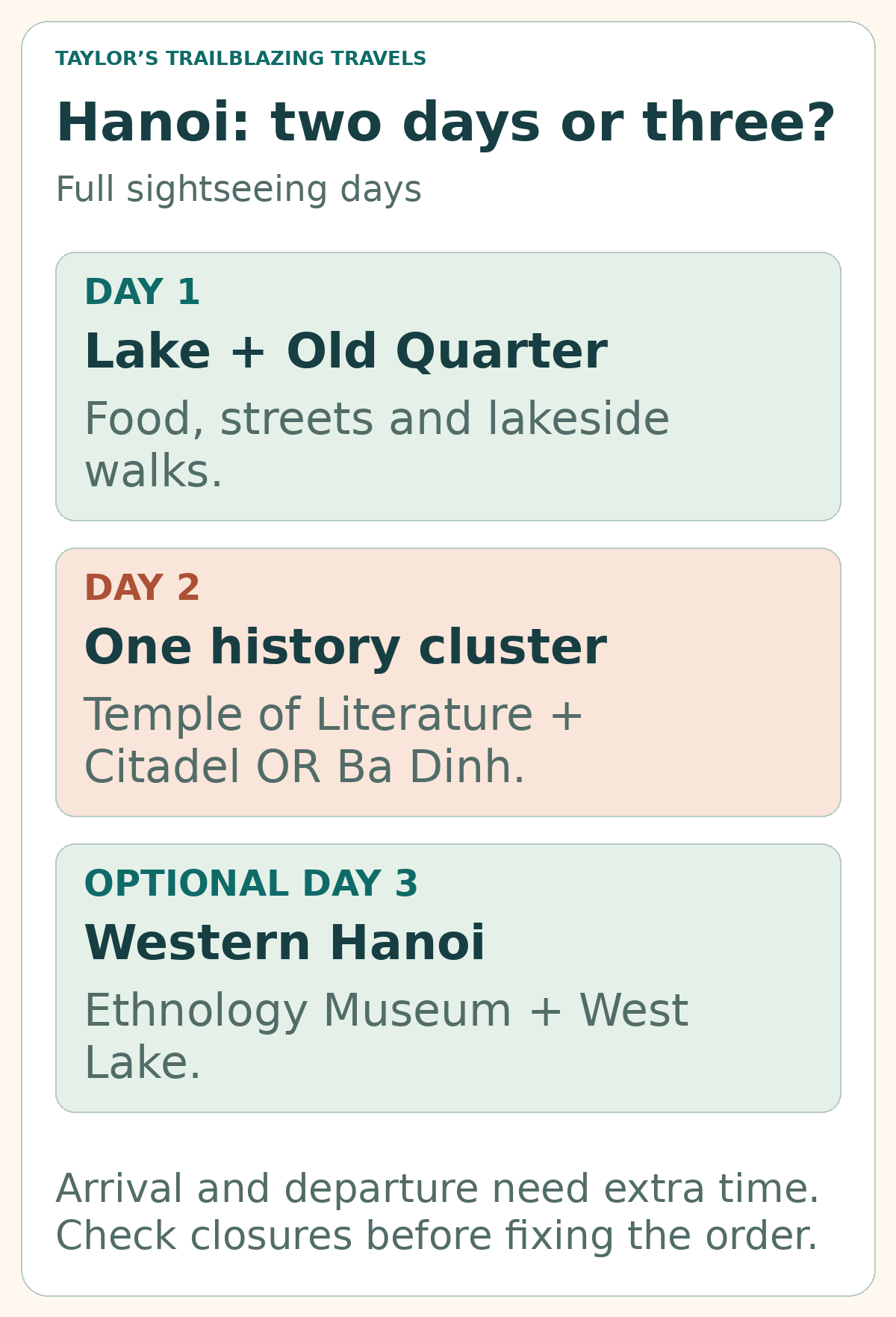
- One full day: concentrate on the lake, Old Quarter and one major indoor sight.
- Two full days: add a western heritage cluster without rushing across town.
- Three full days: choose the Ethnology Museum and West Lake, or spend longer on your preferred interests.
Hanoi has hot, humid summers and cooler winters that can be drizzly. Autumn is a useful starting point for comfortable outdoor planning, but the date alone will not guarantee blue skies. Keep a museum or performance available when weather reduces your appetite for walking. [1]
In hot weather, shift the longest outdoor block to the morning and protect a midday pause. In cooler, damp weather, organise shorter walks around a warm meal or café. Check attraction calendars and your actual travel dates around Tet; do not build a rigid holiday itinerary from a normal-week timetable.
Back to top ↑Choose the sights by the story you want
Hoan Kiem, the Old Quarter and a performance
Use Hoan Kiem Lake as your orientation point, then explore the surrounding streets in short loops. You do not need to “complete” the Old Quarter: a chosen market or shopping street, a meal and time to observe its street life work better than an exhaustive circuit. Water puppetry adds a different kind of evening, with the Thang Long theatre beside the lake. [1] [7]
Compare performance time, seat category and whether you receive an admission ticket or a voucher requiring collection. A booking service is useful when you want to secure a particular evening; it is still worth checking the theatre’s own ticket arrangements.
Compare Thang Long puppet-show tickets
Temple of Literature and Imperial Citadel
The Temple of Literature honours Confucius and learning; the temple dates to 1070 and the Imperial Academy followed in 1076. Choose it for courtyards and the history of education. Thang Long’s UNESCO-listed central citadel instead offers layers of political and archaeological history. Treat these as different stories, even if you combine them in one day. [4] [5]
Allow roughly 75–90 minutes for the temple or about two hours for a more considered citadel visit as planning choices. Add time if you read every exhibition panel. Those allowances include pausing, but not a long meal or a transfer from a distant hotel.
Hoa Lo or the Museum of Ethnology
Hoa Lo is a compact historical-prison visit near the southern part of the central sightseeing area. Its displays address imprisonment and wartime history, so choose it deliberately rather than as a light filler. The official website lists daytime opening from 08:00 to 17:00; special tours are separate arrangements. [6]
The Museum of Ethnology is a stronger choice for a broader introduction to Vietnam’s communities. Indoor displays and the outdoor architecture garden make it worth protecting a half-day including travel. Its published hours are 08:30–17:30, with Monday and Lunar New Year closures. Check the day before fixing your third-day plan. [8]
Mausoleum: check the actual visit date
As checked on 23 October 2026, the announced maintenance closure runs from 4 September to 2 November 2026, with reopening planned for 3 November. Do not include an interior visit during that closure. For later travel, confirm the current admission days, security requirements and any further notices; an external visit to Ba Dinh and admission to surrounding attractions are separate decisions. [9]
Build two useful days, then choose your third
This grouping model deliberately limits each day to two main blocks. Allow approximately three hours for the morning, two for the afternoon and an optional evening activity. The space between is for a meal, transfer, rest and delay—not a missing attraction to fill.
| Day | Morning focus | Afternoon choice | Evening |
|---|---|---|---|
| Day 1: find your bearings | Hoan Kiem Lake and a manageable Old Quarter loop. | Choose Hoa Lo or a south-lake architectural walk. | Food walk or puppet show; avoid booking both on a tired arrival day. |
| Day 2: follow a historical thread | Temple of Literature or a longer Imperial Citadel visit. | A second heritage stop if energy allows, otherwise Truc Bach lakeside time. | Dinner close to your hotel. |
| Day 3: broaden the picture | Museum of Ethnology, after checking opening days. | One selected stretch of West Lake, then a café or rest. | A reserved performance or favourite food neighbourhood. |
The groupings draw on the city’s published walking routes and the individual attraction locations. They are intentionally less ambitious than a sightseeing checklist: the museum in the west does not belong between two short Old Quarter appointments. [2] [4] [6] [8]
If you travel with children, replace one indoor historical visit with an unstructured meal and lakeside pause. If you are a keen history reader, keep the original visit and remove the evening plan. With restricted mobility, ask each venue about its specific step-free entrance and facilities; a compact map does not establish an accessible route.
Arrive calmly and keep city transport simple
Noi Bai Airport to your hotel
Noi Bai separates domestic Terminal 1 and international Terminal 2, with a free inter-terminal shuttle. Read the terminal on your booking and follow current airport signs when connecting. For the city, the airport lists bus 86 to Hanoi Railway Station at VND 50,000 per trip. That is an advertised fare checked on 23 October 2026; recheck the current service and your nearest stop before relying on it. [10] [11]
The bus makes most sense when you arrive during service hours, can handle your luggage and understand the final walk or ride. A pre-arranged car is easier for a late arrival, several bags or a hotel reached through unfamiliar lanes. Agree the complete price and pickup instructions, and tell the provider if you need a child seat or particular vehicle space.
For planning, reserve a 60–90-minute road-transfer window between the airport and a central hotel, with extra time for heavy traffic. This is a buffer to test against a current route estimate, not an advertised journey duration. Immigration, baggage and airline check-in time sit outside it.
Within Hanoi
Walk within a cluster and take a car between clusters when the journey would consume your sightseeing time. Hanoi Metro publishes route and station information, but its network map also depicts underground or future sections. Check operating stations before choosing a hotel for a rail connection, and do not assume there is an airport train. [12]
FCDO advises using pre-arranged transport or recognised taxi apps and booking the whole journey in the app. Match the vehicle details before boarding and keep valuables away from passing traffic. [13]
Make your own walking decisions at crossings, follow signals and use marked crossings where available. Do not step onto active railway tracks or bypass barriers for a photograph. If a lane feels awkward with a pushchair or luggage, ask the hotel for a better pickup point instead of forcing the shortest map route.
Back to top ↑Give food its own space in the plan
Start with a small set of dishes rather than a long restaurant checklist: phở for noodle soup, bún chả for grilled pork with noodles and herbs, and chả cá for turmeric-seasoned fish with dill. Egg coffee is another distinctive Hanoi choice. Those give you different meals to look for across your stay. [1]
Keep one meal flexible each day. A fixed cross-city restaurant reservation can undermine an otherwise sensible sightseeing cluster, particularly if you have already booked a performance. Ask for a current menu and prices before ordering, and tell the kitchen about dietary needs explicitly rather than assuming a dish name settles its ingredients.
A guided food walk is useful if choosing and ordering unfamiliar dishes is the barrier to enjoying the evening. The linked three-hour Hanoi walking tour is one option to assess. Its current listing excludes children under six, vegetarians and vegans, and says it cannot cater for food allergies or special dietary requirements. If that affects you, choose a suitably tailored alternative. Otherwise, check the meeting point and leave room in the day’s meals for the tastings. [14]
Check this Hanoi walking food tour
Back to top ↑A budget you can adjust rather than blindly copy
Build the room cost first, then add meals, local journeys, admissions and airport transfers. The table is an illustrative spending envelope for two adults sharing one room for three nights and budgeting for three spending days. Amounts are chosen assumptions in Vietnamese dong, not a survey of current rates or a claim that a particular hotel is available.
| Item | Assumption | Couple total |
|---|---|---|
| Room | VND 900,000 × 3 nights | VND 2,700,000 |
| Meals and non-alcoholic drinks | VND 500,000 per day for two × 3 | VND 1,500,000 |
| Local journeys | VND 200,000 per day for two × 3 | VND 600,000 |
| Admissions and activities | Shared allowance across the stay | VND 600,000 |
| Airport transfers | Shared allowance for both directions | VND 600,000 |
| Subtotal | Before contingency | VND 6,000,000 |
| Contingency | 15% of subtotal | VND 900,000 |
| Total | Two adults; VND 3,450,000 each | VND 6,900,000 |
International and onward travel, insurance, shopping and higher-cost guided excursions are excluded. An arrival day with extra meals may require another spending-day allowance. If your hotel costs VND 400,000 more per night, add VND 1,200,000 to the couple’s subtotal across three nights before recalculating contingency.
Use verified individual costs to refine the model: for example, the Ethnology Museum publishes an adult ticket of VND 40,000. The airport bus fare is a separate per-person cost, so two passengers travelling both ways at the advertised VND 50,000 fare would spend VND 200,000 before any last-mile rides. Neither example makes every activity or transfer fit the allowance. [8] [11]
Back to top ↑Keep onward trips from consuming Hanoi
Hanoi is a starting point for northern Vietnam, but an excursion is not spare city time. If you only have two full days, using one for an out-of-town trip halves your time here. Add nights if both the city and the countryside are important to you.
For Ninh Binh, compare where each service actually drops you: Ninh Binh town, Tam Coc and an accommodation pickup are different practical products. 12Go lists bus, van, train and car options from Hanoi. Read the operator’s pickup, luggage and transfer details rather than choosing solely on the headline duration. Check rail departures with Vietnam Railways as well when comparing a train. [15]
Compare Hanoi–Ninh Binh departures
For a bay cruise or a mountain stay, ask for the complete transfer plan before choosing a departure-day flight. Keep a buffer between a long-distance arrival and a non-flexible booking; do not assume a road transfer will finish exactly when its listing suggests.
Before you travel
Check entry requirements for your nationality and passport, including any current arrival or health declarations. An international-to-domestic connection requires you to enter Vietnam; do not treat it as an airside shortcut around entry requirements. [16]
Save your hotel’s address, pickup point and essential bookings offline. Mobile data can help with navigation and booking a ride. Airalo offers Vietnam eSIMs, but check that your phone is unlocked and eSIM-compatible and read the selected plan’s activation, coverage and call/text terms. The link opens its general store; choose Vietnam there. [17]
Browse Airalo and select Vietnam
Back to top ↑Frequently asked questions
Is Hanoi better as one continuous stay or a night on each side of a tour?
A continuous stay makes sightseeing easier. Split nights can still work for luggage storage and transfers, but check that the return night leaves useful waking time in the city rather than only an overnight connection.
Should I pay extra for an Old Quarter hotel?
Only if you will use its location. Compare the extra room cost with the number of additional journeys a cheaper base creates. If early nights matter, ask about the specific room rather than assuming a side street will be quiet.
Can I fit the Ethnology Museum into a brief city break?
Yes, by giving it a dedicated half-day including transport and dropping another major visit. Check the Monday and holiday closures first. Do not add it as a quick stop between central appointments. [8]
Do I need to book every attraction in advance?
Prioritise your room, airport arrival arrangements and any performance or guided experience tied to a specific time. For ordinary museum visits, check the attraction’s current ticket arrangements before committing your whole day to advance bookings.
What should I remove if the weather is poor?
Remove the longest outdoor loop first. Keep a museum, a leisurely meal and a shorter nearby walk. Avoid turning a rain backup into a second overfilled itinerary.
Choose the plan that suits your visit
For most first visits, choose three nights near Hoan Kiem Lake, keep two full days for the city, and add a fourth night if you want the Ethnology Museum or a slower West Lake afternoon. Prioritise one historical thread, one food experience and time in the streets between them. That plan leaves Hanoi with a purpose of its own before you travel onwards.
Back to top ↑Sources and methodology
Researched and editorially reviewed on 23 October 2026. Official tourism, attraction and transport sources support the destination facts. Suggested bases, day groupings and budget examples are editorial planning models; they are not reports of personal visits or live booking quotes. Recheck dated prices, access and operating details before travelling.
- Vietnam National Authority of Tourism — Ha Noi
- Vietnam Tourism — 3 walking tours of Ha Noi
- Viet Nam Government News — two-tier local administrations
- Van Mieu — Quoc Tu Giam
- UNESCO — Central Sector of the Imperial Citadel of Thang Long
- Hoa Lo Prison Relic — official visitor website
- GetYourGuide — Thang Long Water Puppet Theatre
- Vietnam Museum of Ethnology — official website
- People’s Deputies newspaper / VNA — Mausoleum closure announcement
- Noi Bai International Airport — transfer flight guidance
- Noi Bai International Airport — transport to/from the airport
- Hanoi Metro — official network information
- FCDO — Vietnam safety and security
- GetYourGuide — Hanoi Street Food & Local Life Walking Tour
- 12Go — Hanoi to Ninh Binh
- FCDO — Vietnam entry requirements
- Airalo — Vietnam eSIM information
Illustrations in this article were created for Taylor’s Trailblazing Travels. Third-party photographs, where used, are credited beside the image or in the source list.