
Thailand itineraries / independent travel
Thailand Backpacking Itinerary: 1 Month
A complete 30-day route with northern heritage, southern nature and enough time to unpack between moves.
A Thailand Backpacking Itinerary for one month should give you time to develop a routine, not merely enough time to visit more bus stations. Thirty days allow a useful mix of cities, northern heritage, forest scenery and a coastal stay. The challenge is deciding where to stop moving so the month feels like travel rather than a continuous series of bookings.
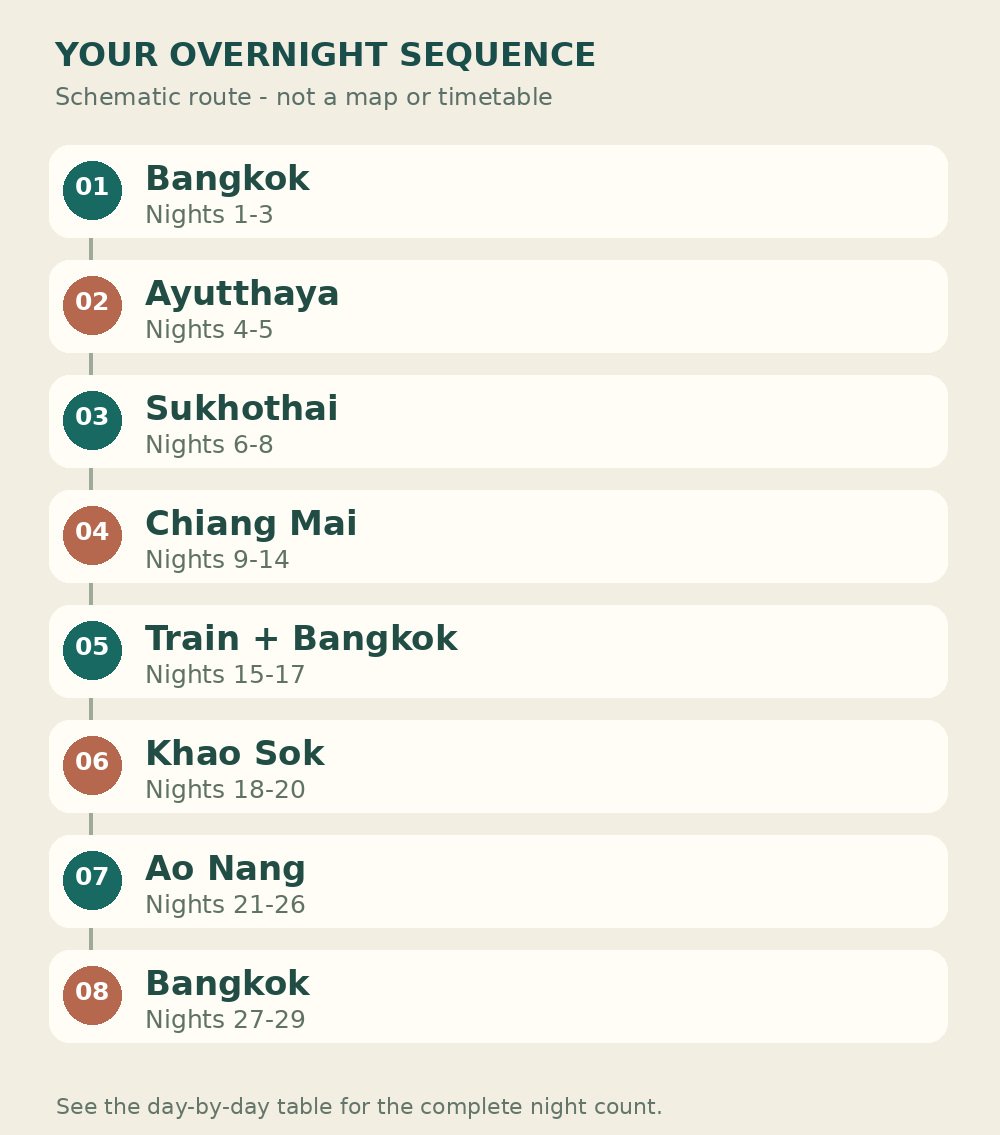
This route begins in Bangkok, moves through Ayutthaya and Sukhothai to Chiang Mai, then returns south with two sleeper journeys separated by a proper Bangkok hotel night. Khao Sok provides a nature-focused stop before six nights in Ao Nang. The default finishes with a domestic flight back to Bangkok and three nights there before the international departure.
It is a research-led route for independent travellers who are comfortable organising several connections. It is not the cheapest possible month, a party circuit or a claim that every transport service operates at a fixed time. The plan includes explicit recovery days, a transparent budget and simpler alternatives, so you can remove complexity without losing the character of the trip.
Northern stretch
Four distinct stops
Bangkok, Ayutthaya, Sukhothai and Chiang Mai.
Southern stretch
Forest then coast
Khao Sok village and a six-night Krabi base.
Recovery
Two train nights only
A Bangkok hotel separates the sleeper journeys.
Entry check
Count actual days
A 31-day calendar month is not a 30-day permission.
The Thailand Backpacking Itinerary: 30 days, not 31
Understand the night count before booking
The route contains twenty-nine nights: twenty-seven in accommodation and two on trains. Arrival is day 1 and departure is day 30. That distinction matters both for reservations and for entry permission. A calendar month can be longer than thirty days, so do not use the word month as a substitute for counting the actual dates on your ticket.
The northern half moves gradually through different historical settings. The southern half uses only two bases, Khao Sok village and Ao Nang, rather than introducing several island ferries. Bangkok appears more than once because it provides a practical break between long journeys and a useful departure buffer. Those repeat stays are intentional, not an accidental gap in the route.
| Day / nights | Base | Nights | Move or focus |
|---|---|---|---|
| 1-3 | Bangkok | 3 | Arrival and a compact city introduction. |
| 4-5 | Ayutthaya | 2 | Day 4 train or road journey. |
| 6-8 | Sukhothai | 3 | Day 6 road journey or rail to Phitsanulok plus road. |
| 9-14 | Chiang Mai | 6 | Day 9 daytime move north. |
| 15 | Sleeper to Bangkok | 1 | Check out; board the southbound train. |
| 16 | Bangkok | 1 | Shower, sleep and separate the overnight journeys. |
| 17 | Sleeper to Surat Thani | 1 | A second, separately booked train. |
| 18-20 | Khao Sok village | 3 | Arrive by road from the station area; nature days. |
| 21-26 | Ao Nang, Krabi | 6 | Day 21 road transfer; a single coastal base. |
| 27-29 | Bangkok | 3 | Day 27 flight in the default version; recovery buffer. |
| 30 | Departure | 0 | International journey home. |
Why the route is not an island checklist
Six nights in Ao Nang create room for a chosen boat outing, a land-based day, laundry and rest without changing accommodation. You could replace the coastal base, but adding several islands would require taking nights from somewhere else. Treat every proposed addition as a trade: identify the destination or recovery day you would remove before committing.
The selection method is based on variety, manageable lengths of stay and straightforward overnight accounting. It is not a ranking of Thailand's best destinations. A traveller interested mainly in diving, beaches or nightlife should build a more concentrated southern route instead of following this one simply because it covers more types of places.
Check admission rules before buying a month of beds
A full month needs a precise departure date
At the editorial review on 05 October 2026, the Thai Embassy in London described a thirty-day tourism visa exemption for eligible British and Irish passport holders, effective from 15 September 2026. Eligibility and repeat-entry conditions must still be checked for the individual traveller. Do not rely on an older sixty-day assumption or treat entry as automatic. [1]
For a thirty-day trip, inspect the date stamped in your passport immediately after admission. A late international departure or a cancelled service can create a problem when you have used every available day. A cautious alternative is to shorten the coastal stay by one or two nights and depart correspondingly earlier, rather than planning to resolve any overstay risk at the airport.
Keep the administration separate from the route
Complete the official arrival-card process in the permitted submission window and use the genuine Immigration Bureau website. The card is not a visa and does not extend an admission period. Keep the first accommodation address, onward-travel evidence and relevant booking details accessible, including offline copies in case airport connectivity is unhelpful. [2]
This itinerary does not include border runs, work placements or assumptions about receiving an extension. If your intended trip requires a different immigration arrangement, settle it before building the holiday around non-refundable reservations. Travel planning becomes simpler once the legal length and purpose of your stay are clear.
Choose dates and preserve a workable alternative
Weather is a routing decision
Northern sightseeing, a forest stop and the Andaman coast do not respond identically to the seasons. Use Thailand's broad monsoon pattern as a planning aid, not as a daily forecast. The southern east coast can have a different rainy-season rhythm from the Andaman side, so replacing Krabi with an island elsewhere requires a fresh check rather than a simple name swap. [3]
Before booking Chiang Mai, inspect current conditions relevant to outdoor activity, including air quality. Before the southern leg, review weather warnings and the practical effect on road access and tours. A month gives you some freedom to adjust, but that freedom only exists if all twenty-nine nights have not been locked into inflexible bookings.
Make one simplified version in advance
A useful backup removes Khao Sok and adds those three nights to the northern or coastal stay, depending on conditions. Another keeps the whole trip in central and northern Thailand, avoiding the long move south. Decide what you would preserve first: the heritage stops, the coast or the nature experience. That makes disruption decisions less emotional when you are already travelling.
Do not automatically replace a cancelled outing with an equally long journey elsewhere. Sometimes the best adjustment is staying put, doing laundry and waiting for clearer information. A backpacking month should have enough ordinary days that an unplanned rest does not feel like the entire holiday has gone wrong.
Days 1 to 3: start with a compact Bangkok stay
Arrival and the first useful neighbourhood
On day 1, reach your accommodation, understand the check-in arrangement and find food nearby. A hostel social area can be a good place to meet people, but you do not need to join a late night immediately after a long flight. Choose the first bed for reliable arrival and sleep rather than a reputation for having the busiest bar.
For days 2 and 3, divide Bangkok into small geographical areas. One morning can focus on a principal cultural sight, while another can be a neighbourhood and food walk. The Grand Palace's official visitor information is the correct place to check clothing and access rules before a visit. Avoid building the day from unrelated attractions scattered across the city. [5]
Establish the routine you will need for a month
Use the first stay to work out a simple laundry cycle, a place for travel documents and a method of tracking spending. Put the next accommodation address into an offline note and download the relevant map area. These are small jobs, but doing them once creates a system you can repeat at every later stop.
Also separate shared social plans from your own transport commitments. A group formed at breakfast may be fun company for an afternoon, but it does not need to determine the rest of your month. Keep enough independence to leave an activity or change accommodation without relying on people you have just met.
Days 4 and 5: give Ayutthaya an overnight stay
Day 4: move north without rushing the ruins
Travel from Bangkok to Ayutthaya and settle into the accommodation before trying to cover the historic sites. Check the actual Bangkok departure station and the onward journey from Ayutthaya station to your bed. The train itself is only part of the transfer, particularly when you are carrying a larger pack and arriving during the hottest part of the day.
Use the remaining afternoon for a short orientation, a meal and perhaps one nearby site if conditions suit. An overnight stay removes the need to compress everything into a hurried return trip. You can also ask locally about practical routes, bike hire and any restrictions before deciding how to spend the full day.
Day 5: choose a manageable heritage circuit
Ayutthaya is a UNESCO-listed historic city, but its significance does not mean you need to visit every ruin. Choose a small group of sites, allow time to look properly and break the day with shade and lunch. The UNESCO description is useful background for understanding the former capital rather than treating the visit as a sequence of photographs. [6]
A bicycle can suit some travellers, while others will prefer arranging short local rides. Decide based on road confidence, heat and the day's distance, not on the idea that backpacking must involve the cheapest possible vehicle. Keep an easy route back to the accommodation and avoid committing to a circuit that only feels manageable in the cool morning.
Days 6 to 8: slow down in Sukhothai
Day 6: remember that Sukhothai is not a rail stop
The move from Ayutthaya to Sukhothai requires a road component. A rail-based version uses Phitsanulok followed by onward road transport; a road service may offer a different combination. Read the actual pickup, transfer and final drop-off details before paying. Do not interpret a search result between two place names as proof of a direct train.
Choose accommodation according to your plan for the historic park. A bed near the park supports an early start and easy return, while a town-based stay may suit other transport or food preferences. Confirm the exact location rather than assuming every property described as Sukhothai is within a short walk of the ruins.
Days 7 and 8: one substantial visit, one flexible day
Use day 7 for a carefully chosen part of the historic park. Sukhothai and its associated historic towns are recognised by UNESCO, but the associated sites should not be treated as an automatic one-day circuit. Start with the area you most want to understand and give it enough time. [7]
Day 8 can revisit a favourite section, take a modest local outing or simply provide recovery before Chiang Mai. A three-night stay is valuable precisely because the second full day does not need to copy the first. Prepare the next transfer in daylight, settle laundry and choose an early dinner rather than creating a late finish before another long move.
Do not confuse Sukhothai with all its associated towns
The UNESCO listing includes Sukhothai, Si Satchanalai and Kamphaeng Phet. Their shared heritage does not make them one compact attraction, so this route's three-night stop should not be read as a commitment to see all three. An additional associated town needs its own transport calculation and a clear reason to take time from the main visit. For a first trip, depth at the chosen base is often more satisfying than collecting the entire listing. [7]
Use the flexible day to decide whether another site genuinely interests you after the first visit. If the answer is yes, obtain a complete return-journey plan and check admission and access separately. If not, a second short visit to the area you enjoyed, a leisurely meal and preparation for the northern move are worthwhile uses of the time. The point of the third night is having a choice rather than another obligation.
Day 9: reach Chiang Mai and unpack properly
Choose a daytime move where practical
Use a daytime road journey from Sukhothai to Chiang Mai where the available service fits. Identify the departure point and the arrival terminal, then calculate the transfer to the accommodation. Keep food, drinking water, documents and a light layer in the day bag instead of placing everything useful beneath the vehicle with the main pack.
On arrival, stay local. Six nights mean there is no need to begin with a city-wide outing. Check the bed, storage, washing arrangements and reception hours, then find a convenient evening meal. If the accommodation is clearly unsuitable for sleep or safety, use the cancellation terms and available alternatives rather than persuading yourself to tolerate it for the whole stay.
Pick atmosphere deliberately
For a long hostel stay, distinguish sociable from noisy. A common area can support meeting people without requiring a dormitory above a late-night venue. Look for recent reports about sleep, air conditioning, lockers and staff responsiveness. Meanwhile, a guesthouse may offer better value for someone sharing a room or needing quieter evenings.
Choose a neighbourhood around the everyday journeys you expect to make. Walking access to food and a few interests can matter more than a free breakfast you rarely use. Chiang Mai's cultural and surrounding landscape appeal rewards a flexible stay, but a remote bed can turn that flexibility into repeated transport spending. [8]
Days 10 to 14: use the long northern stay well
Day 10: a modest old-city introduction
Walk a compact area, visit one or two places that genuinely interest you and allow time to pause. A long stay means you can learn the city in pieces rather than completing a grand circuit immediately. Religious sites should be approached respectfully, with appropriate clothing and attention to local signs, even when they sit beside ordinary cafes and shops.
Spend the afternoon deciding which paid experience deserves a place in the budget. A cooking class, a guided cultural visit or a carefully selected nature outing can each work. Choose the one connected to your interests, not the one a new hostel group happens to book first. Leave another day free so a cancellation does not remove your only opportunity.
Days 11 and 12: separate the demanding activities
Put a more substantial outing on one day and a low-effort local day beside it. For example, pair a countryside visit with a following day devoted to a neighbourhood, a market and laundry. Avoid booking two distant excursions consecutively just because each is described as a day trip. Hotel collection and road time can make both considerably longer than the headline activity.
For any elephant visit, investigate the current programme and use observation-led welfare criteria rather than the venue's name. Riding, bathing or touching should not be a selling point. World Animal Protection offers a useful framework for choosing a visit that does not depend on direct tourist contact. [9]
Days 13 and 14: let ordinary travel happen
These days are the opportunity to repeat a favourite meal, join a modest social outing or have a morning with no appointment. They also provide space for repairs, replacing something lost and dealing with administrative tasks. Backpacking is more sustainable when the practical jobs fit inside the route instead of being squeezed into midnight packing sessions.
On day 14, check the sleeper arrangements, the ticket format and the arrival plan in Bangkok. Organise a small overnight bag with everything needed between checkout and the next hotel. Then avoid a very late final evening. The train may save a hotel night, but it should not be expected to repair several nights of poor sleep.
Day 15: take the overnight train south
Know what has actually been booked
Read the train number, date, carriage and berth information on the issued ticket. Some agencies first confirm a request or process before issuing the final travel document, so understand the distinction. The State Railway's D-Ticket system is the official reference for train searches and bookings; an agency can be convenient but adds its own terms and handling. [10]
Do not book a berth solely by price without understanding its type and position. Travellers who need easier access may prefer a lower berth, subject to availability and suitability. Keep valuables and essential medication with you, and use a small bag that can remain close rather than repeatedly opening the main pack in a narrow space.
Make the boarding day intentionally light
After checkout, store the pack where agreed and have a straightforward meal before heading to the station. Leave room for traffic and unfamiliar boarding arrangements. Arriving with time to understand the platform is more useful than extracting one extra attraction from the afternoon and beginning the overnight journey flustered.
The sleeper is a transport choice, not a guarantee of a full night's sleep. Noise, lighting, motion and other passengers can affect rest. Consequently, the following day is kept easy and includes a real Bangkok hotel night. That break is one of the most important choices in the month, even though it looks less exciting than another destination.
Day 16: recover before the second sleeper
A hotel night is part of the route
After arriving in Bangkok, go to the accommodation according to its agreed check-in arrangements. Arrange luggage storage or early room access in advance if needed. Have a shower, a proper meal and a quiet afternoon rather than attempting a second full Bangkok sightseeing programme immediately after the train.
This overnight stay separates the two sleeper journeys. It also creates a practical place to reorganise clothing for the southern part of the trip and confirm the Khao Sok pickup. The value lies in making the following several days easier, not in adding another set of photographs to the month.
Recheck the southern chain as one journey
Confirm the next train, its arrival station and the pickup point for the road transfer. Surat Thani station, the city and the airport are not interchangeable collection points. Ask the onward provider how they handle a delayed train and keep the contact details somewhere accessible without mobile data.
Also check weather and access information before proceeding into the forest region. A nature stop should not be treated as a fixed entitlement when local authorities or operators report unsafe conditions. Where the onward journey is disrupted, the Bangkok break gives you a better place to make a revised plan than a rushed decision between two vehicles.
Day 17: Bangkok to Surat Thani overnight
Book the correct destination and service
Use the second sleeper as a separate journey with its own ticket and boarding requirements. Do not assume that a booking engine will automatically choose a train because the itinerary describes one. Transport searches can include buses and flights as well, so check the service type before comparing prices and arrival times.
The rail booking window can extend well ahead for eligible journeys, but do not assume every short segment or service becomes available in the same way. Search your actual origin, destination and date with the railway or a clearly identified agent. Keep the published ticket conditions with the booking rather than relying on remembered general rules. [11]
Avoid a fragile first activity in the south
The following day should contain the road transfer and settling into Khao Sok village, not a tightly timed lake departure. A delayed train can then be inconvenient without immediately losing an expensive excursion. Book the accommodation for the actual arrival date and tell it how you expect to reach the village.
Carry what you need for another overnight journey, including a light layer and basic toiletries. Keep the larger backpack organised for station steps and short transfers. A bag that is manageable for you without help makes the trip easier, particularly when platform conditions or vehicle luggage arrangements differ from what you pictured at home.
Days 18 to 20: forest first, lake optional
Day 18: arrive at the right part of Khao Sok
After reaching the Surat Thani railway station area, take the confirmed road transfer to Khao Sok village. Check the address carefully because a village guesthouse and a floating lake room involve different logistics. The default route uses three village nights; it does not assume that a lake package, boat transfer and separate accommodation have already been arranged.
Khao Sok National Park includes forest and limestone landscapes in Surat Thani province. That provides the setting for the stop, but it does not make every trail, cave or water activity appropriate on every day. Confirm current access with the park and responsible local operators before deciding what to do. [12]
Day 19: choose one guided nature experience
Select an activity around current conditions, fitness and your budget. Ask what is included, where it begins, how long the road transfer takes and what happens if weather changes. A clearly explained short guided walk can be a better choice than an ambitious programme with vague descriptions of caves, swimming and several additional stops.
Do not treat a low advertised price as the final cost until you understand admissions, transport, meals and required equipment. Equally, do not assume a more expensive tour has stronger safety arrangements. The useful comparison is the actual programme, operator communication and suitability for the day, not simply the length of its marketing description.

Day 20: keep a second opportunity, not a second obligation
The extra full day creates room to move an outing or choose another small experience. It can also remain quiet. A lake visit is optional and should be assessed separately, including travel to the pier, boat arrangements and the realistic time away from the village. Do not add it merely because a photograph made it look close to the guesthouse.
Pack for the following road journey while there is still time to dry or separate damp clothing. Ask the accommodation to confirm the pickup and whether the fare reaches your Krabi base. This prevents the common mistake of assuming that arrival somewhere in Krabi province means arrival at an Ao Nang hostel door.
Day 21: reach the coast without adding another leg
Use Ao Nang as a practical base
Travel from Khao Sok to the Krabi area and continue to the booked accommodation in Ao Nang. Check whether the transport ends in Krabi Town or at your actual lodging. Keep the remainder of the day for food, a short walk and understanding the immediate area rather than booking a sunset boat trip against an uncertain arrival.
Ao Nang is used here because one base can support several types of coastal day. It is not presented as an undiscovered beach or the only worthwhile place to stay. A traveller wanting a quieter setting may choose elsewhere, but should compare the effect on everyday meals, local transport and the departure to Bangkok.
Inspect the practical details on arrival
Check the walk to food, laundry and any pickup point used by the outings you are considering. A room that looks close on a map can involve an inconvenient slope or road crossing. Settle the ordinary needs first, then use the six-night stay to make selective choices instead of immediately purchasing a package for every remaining day.
For a hostel, secure documents and valuables according to the available storage rather than leaving them on a bed while meeting new people. Keep enough independent money and access to transport to leave a social situation that feels uncomfortable. Being sociable and maintaining practical boundaries are compatible parts of independent travel.
Days 22 to 26: build a coastal week, not five tours
Days 22 and 23: learn the conditions, then choose
Use the first day for a local orientation and an easy beach or town-based plan. Check the sea conditions and local advice before committing to a boat outing. The second day can hold the excursion you care about most, provided it is suitable. This order gives you information before you pay rather than trying to justify a purchase made during the transfer.
Compare boat trips by time on the water, group size, embarkation point and the actual stops, not just the number of islands in the title. Ask what happens when the route changes. A trip with fewer stops may provide more enjoyable time at each one, while a long checklist can mean repeated boarding with little opportunity to settle.
Days 24 and 25: mix movement with a normal day
After a substantial outing, keep a local day available for laundry, food and unstructured time. You might revisit a place, take a modest land-based activity or spend a morning reading. This is where a long backpacking trip differs from a short organised tour: you can use a place as a temporary base rather than consume a new attraction every day.
For water activities, follow current local instructions and use an operator able to explain their safety arrangements. Do not let social pressure from a hostel group determine whether you board a boat or swim. A decision that suits somebody else's confidence, fitness or insurance does not automatically suit yours. [13]
Day 26: finish the coast without a last-minute scramble
Keep the final coastal day flexible enough to pack, settle bills and confirm the next morning's airport transfer. A relaxed meal or familiar walk is a better fit than a long excursion that may return late. Check the baggage allowance again, especially if you have accumulated purchases or wet equipment during the month.
The default flies from Krabi to Bangkok on day 27. For an overland return, replace the night-26 Ao Nang accommodation with an overnight coach or a road-and-sleeper combination through Surat Thani, arriving Bangkok on day 27. That alternative has one fewer accommodation night and one additional transport night; do not pay for both by accident.
Compare a lake package and a coastal outing on equal terms
When deciding which southern activity deserves the money, compare what each one actually provides. A Khao Sok lake package may bundle meals, transport and accommodation, whereas a coastal day trip may provide only a boat programme and lunch. Write down the included nights, transfer points, admissions and equipment before deciding which headline amount offers better value. A package can also create a new luggage-storage or pickup problem that does not appear in its title.
Keep the decision connected to your main interest. Someone travelling for forest scenery may choose the lake experience and fewer coastal tours; someone who mainly wants the sea may keep Khao Sok simple and reserve the activity money for Krabi. Neither choice requires doing both. Ask what you would remove from the existing allowance before adding a second substantial programme, then preserve a quiet day afterwards so the extra experience does not make the end of the month feel hurried.
Days 27 to 30: return early enough to enjoy the finish
Day 27: the flight is part of the plan
This is not a no-flying itinerary. The default uses a domestic flight back to Bangkok to avoid adding another lengthy overland journey after a full month. Compare the complete cost, including baggage, airport transfers and your Bangkok hotel location. Confirm the airport on the ticket because the final international departure may use a different one.
After arrival, settle into the last accommodation and keep the evening easy. Three final nights provide room to recover, handle a delayed regional journey and revisit a small part of Bangkok. They are not a promise that every disruption can be absorbed, so continue checking current advice and transport information. [14]
Days 28 and 29: finish the month deliberately
Use one day for a favourite interest you did not cover at the start and keep the other relatively open. Buy only what you can carry within the remaining baggage allowance. Then organise laundry, documents and the airport transfer before the final evening, rather than treating the last day as an administrative race.
Day 30 is departure. Calculate the pickup around the airline's actual check-in requirements and the journey from your hotel. If the immigration admission period is tight, an earlier departure date is the more conservative plan. A month ends better when you have left room to leave, not only room to explore.
Build a budget that includes the invisible journeys
A transparent solo model
The following budget was designed on 05 October 2026 as an illustrative solo-traveller model. It is not a set of checked live fares. The accommodation calculation uses twenty-seven nights because the two sleeper berths belong in transport. Counting twenty-nine hostel nights as well would overstate the lodging total and hide how the route actually works.
The model excludes international flights, travel insurance, visas or extensions where relevant, major shopping, alcohol-heavy nightlife and specialist courses such as diving qualifications. It includes a selective activity allowance rather than a paid tour every day. Replace the assumptions with real bookings and keep the reserve separate until the trip is over.
| Item | Assumption | THB |
|---|---|---|
| Accommodation | 27 paid nights x 500; sleeper berths are below | 13,500 |
| Food and non-alcoholic drinks | 30 days x 450 | 13,500 |
| Transport | Two sleepers, regional legs, local travel and a return flight allowance | 8,500 |
| Activities | Choose a few paid experiences | 6,000 |
| Laundry, data and incidentals | Allowance | 3,000 |
| Subtotal | Total before reserve | 44,500 |
| Reserve | 15% | 6,675 |
| Worked total | One person; international flights excluded | 51,175 |
Track decisions, not every tiny regret
Review spending after each base rather than trying to evaluate the entire month after every snack. Separate accommodation, transport, food and optional activities so you can see which decisions matter. A higher-than-planned transfer may be manageable; several unplanned tours plus a remote hotel and daily taxis can change the budget much more quickly.
Sharing a room can reduce some costs, but do not assume every solo expense halves when travelling with a friend. Train berths, admissions and most meals remain per person. Agree how shared costs will be split before booking, and retain access to enough money to continue independently if your plans diverge.
Book the constraints first and leave the rest adjustable
Fix the hard-to-replace pieces
Start with the international dates and permitted stay, then secure the sleeper journeys and accommodation around genuinely busy periods. Next, arrange the first arrival and the Khao Sok connection. Ordinary days and optional excursions can often wait until those pieces are clear. This prevents a collection of individually attractive bookings from becoming an awkward overall route.
Read cancellation deadlines in the local time stated by the provider. Keep the final issued ticket, not only the payment receipt, and label each booking with the date and destination. When an agent and an operator are different businesses, know which one handles a change and how to reach them outside office hours.
Make mobile data useful without depending on it
A suitable data plan can simplify maps, translation and contacting accommodation, but download essential addresses and tickets as well. Check compatibility and whether tethering is allowed if you expect to use another device. For a thirty-day trip, a plan that expires before the final Bangkok stay may need a deliberate top-up or replacement.
Keep account recovery details and backup payment access separate from the phone itself. Losing one device should not remove your tickets, money and ability to contact anyone at once. These measures are not glamorous travel preparation, but they can turn an inconvenient afternoon into a manageable problem rather than ending the trip.
Keep the month comfortable enough to continue
Pack for carrying, washing and repeating
Choose a bag you can lift and carry independently for the distances you expect to walk. Test it with the full load before departure rather than trusting its advertised capacity. A smaller, organised pack can be easier on buses and trains, but leaving out essential medication or suitable footwear solely to hit a weight target is not a useful saving.
Plan a repeatable clothing cycle with laundry between major moves. Keep wet items separate and avoid packing everything tightly when it is still damp. An accessible change of clothes is particularly useful around sleeper journeys, when the main pack may not be convenient to open and a room is not immediately available after arrival.
Protect health and personal boundaries
Consult appropriate travel-health guidance and obtain individual advice where needed before departure. Budget for suitable insurance and understand the activities it covers. A low-cost itinerary should not depend on riding a scooter without the correct licence, equipment or cover, nor on ignoring medical advice to avoid losing a booked excursion. [15]
If travelling alone, share major moves with someone you trust and choose accommodation with a workable arrival process. Meeting people is part of backpacking, but there is no obligation to disclose your whole route or follow a group into an activity that feels wrong. Leave enough flexibility, money and confidence to change your mind.
What this month does well, and what it gives up
Reasons to choose it
The route gives the north enough time to feel distinct, separates the sleeper journeys and finishes with a substantial coastal base. It also accounts for every night, including the transport nights, which makes booking and budgeting easier. The repeated Bangkok stays provide practical breathing room rather than forcing every connection into the shortest possible interval.
Reasons to choose something simpler
There are still several accommodation changes and two overnight trains, so this is not a very slow trip. The southern detour adds time and cost, while travellers focused on one interest may prefer a regional month. A first-time independent traveller who dislikes uncertainty could remove Sukhothai or Khao Sok and distribute those nights among the remaining bases.
Common one-month backpacking mistakes
Do not mistake flexibility for having no essentials booked
Leaving every sleeper, arrival bed and departure connection undecided can make a busy-period trip harder rather than freer. Reserve the pieces that would be difficult to replace, then leave ordinary days adjustable. Flexibility works best when it sits around a reliable structure instead of requiring a new overnight solution every evening.
Another mistake is treating a hostel friendship as a reason to discard your own priorities immediately. Change the route when the new plan genuinely appeals, not because saying no feels awkward. Check the financial and immigration consequences first, especially near the end of a thirty-day permission.
Do not add destinations without removing nights
A suggested island, festival or mountain detour may be worthwhile, but it needs space. Identify the accommodation nights, transport and recovery time before saying yes. Finally, avoid counting a sleeper as both a sightseeing day and a full restorative night. The route should remain enjoyable for the person actually travelling, not merely look efficient on paper.
Thailand backpacking itinerary FAQs
Is this a full calendar month?
It is a thirty-day plan with twenty-nine nights. A calendar month can contain thirty-one days, so book by actual dates and check the period granted at immigration. Travellers wanting more margin can shorten the coast and leave on day 28 or 29 rather than using the entire permitted stay.
Can I do the route without the final domestic flight?
Yes, but change the night allocation. Replace the night-26 Ao Nang accommodation with an overnight coach or a road transfer to Surat Thani followed by a sleeper, arriving Bangkok on day 27. Check the live connections before committing. Krabi itself is not a railway station on a direct Bangkok train.
Should I stay on a floating raft house at Khao Sok?
Only as a deliberate, separately researched choice. The default uses a village guesthouse for all three nights. A lake stay changes transfers, meal arrangements, luggage handling and costs. Ask exactly what the package includes and how weather affects access before replacing a village night with it.
Is the budget realistic for every backpacker?
No single allowance suits every date or style. The THB 51,175 worked example, designed on 05 October 2026, is a transparent planning model with a reserve, not a price guarantee. Private rooms, busy dates, frequent drinking, diving courses or many organised excursions can make the month substantially more expensive.
How much should I book before arrival?
Secure the international dates, first accommodation, important sleeper berths and any genuinely busy-period stays. Then decide how much flexibility you value for the remaining bases. The route does not require booking a tour for every day. Transport constraints deserve earlier attention than a long list of optional activities.
Can I skip one destination without breaking the plan?
Yes. Removing Khao Sok simplifies the southern section, while removing Sukhothai reduces a northern connection. Redistribute the nights deliberately and recheck the transport rather than leaving a gap. Keep the final Bangkok buffer and the admission-period calculation intact even when the middle of the trip changes.
Make the long stays earn their place
Choose this route for a month with several kinds of Thailand, not for the highest destination count. Give Ayutthaya and Sukhothai time, use Chiang Mai as a genuine base, separate the sleepers and let the coast provide a slower final stretch. The ordinary days are part of the value of travelling for a month.
Book the difficult-to-replace journeys first, keep a realistic reserve and know which stop you would remove if conditions change. That produces a route you can adapt while still understanding where you are sleeping and how you are getting there. The aim is to finish the month pleased with the choices, not relieved that the moving has stopped.
Sources and fact-checking
This is a research-led route, not a report of personal stays or visits. Official sources support the factual checks; the route order, pace, trade-offs and budget models are editorial planning judgements. Transport searches are not confirmations of availability. Recheck access, entry rules, conditions and prices for your own travel dates.
- Royal Thai Embassy London: visa exemption rules. Entry eligibility, the September 2026 change and admission-stamp checks. Reviewed 05 October 2026.
- Thai Immigration Bureau: digital arrival card. Official arrival-card instructions; this form is not a visa. Reviewed 05 October 2026.
- Thai Meteorological Department: seasons of Thailand. Seasonal pattern, including later rain on the southern east coast; not a trip-date forecast. Reviewed 05 October 2026.
- FCDO: Thailand warnings and insurance. Current disruption and regional advice; review again before travel. Reviewed 05 October 2026.
- The Grand Palace: practical visitor information. Official visit planning and dress requirements. Reviewed 05 October 2026.
- UNESCO: Historic City of Ayutthaya. The heritage site and its historical context. Reviewed 05 October 2026.
- UNESCO: Historic Town of Sukhothai. The historic park and associated towns; not current ticket prices. Reviewed 05 October 2026.
- Tourism Authority of Thailand: Chiang Mai. Northern destination context and attractions. Reviewed 05 October 2026.
- World Animal Protection: elephant-friendly tourist guide. Observation-led selection criteria and current venue guidance. Reviewed 05 October 2026.
- State Railway of Thailand: D-Ticket. Official train search and booking; dates, stations and availability must be checked live. Reviewed 05 October 2026.
- Thai Government: railway advance booking. Background to the 180-day advance-booking extension; individual journeys still need live checking. Reviewed 05 October 2026.
- Tourism Authority of Thailand: Khao Sok National Park. Protected-area context and location; confirm current access with the park. Reviewed 05 October 2026.
- FCDO: safety and security in Thailand. Road, water and severe-weather precautions. Reviewed 05 October 2026.
- Thai Meteorological Department: forecasts and warnings. Check the local forecast and warnings close to each travel day. Reviewed 05 October 2026.
- NaTHNaC TravelHealthPro: Thailand. Destination health information and pre-travel consultation. Reviewed 05 October 2026.
Illustrations in this article were created for Taylor’s Trailblazing Travels. Third-party photographs, where used, are credited beside the image or in the source list.