Three weeks, with space between the highlights.
Bangkok, Ayutthaya, Chiang Mai and two neighbouring coastal bases, with a final night back at the gateway.
A Thailand 3-Week Itinerary should buy you breathing room, not simply a longer list of transfers. Twenty hotel nights are enough to spend a morning somewhere without checking out afterwards, change a boat day when conditions are poor and give northern Thailand more than a rushed temple stop.
This route connects Bangkok, Ayutthaya, Chiang Mai, Ao Nang and Koh Lanta. It uses two neighbouring coastal bases rather than crossing the peninsula to collect another island. Bangkok appears again at the end because a separate international ticket deserves more protection than a same-day journey from an island.
The itinerary is an editorial route, constructed from practical geography, useful stay lengths and current official visitor information. It does not claim first-hand testing of hotels or tours. Its day-by-day allocation is fixed enough to book confidently, while the order of local activities remains deliberately adjustable.
Longer northern stay
Five Chiang Mai nights, not a one-day dash.
One sea, two bases
Ao Nang excursions followed by quieter Lanta days.
Back on day twenty
A gateway night before the separate long-haul ticket.
Choose your coast
Swap the southern block; do not bolt another sea onto it.
The Thailand 3-Week Itinerary: twenty nights, not twenty-one
Twenty-one calendar dates mean twenty hotel nights in this plan. An overnight train replaces a hotel night; it does not create an extra night.
The route in one view
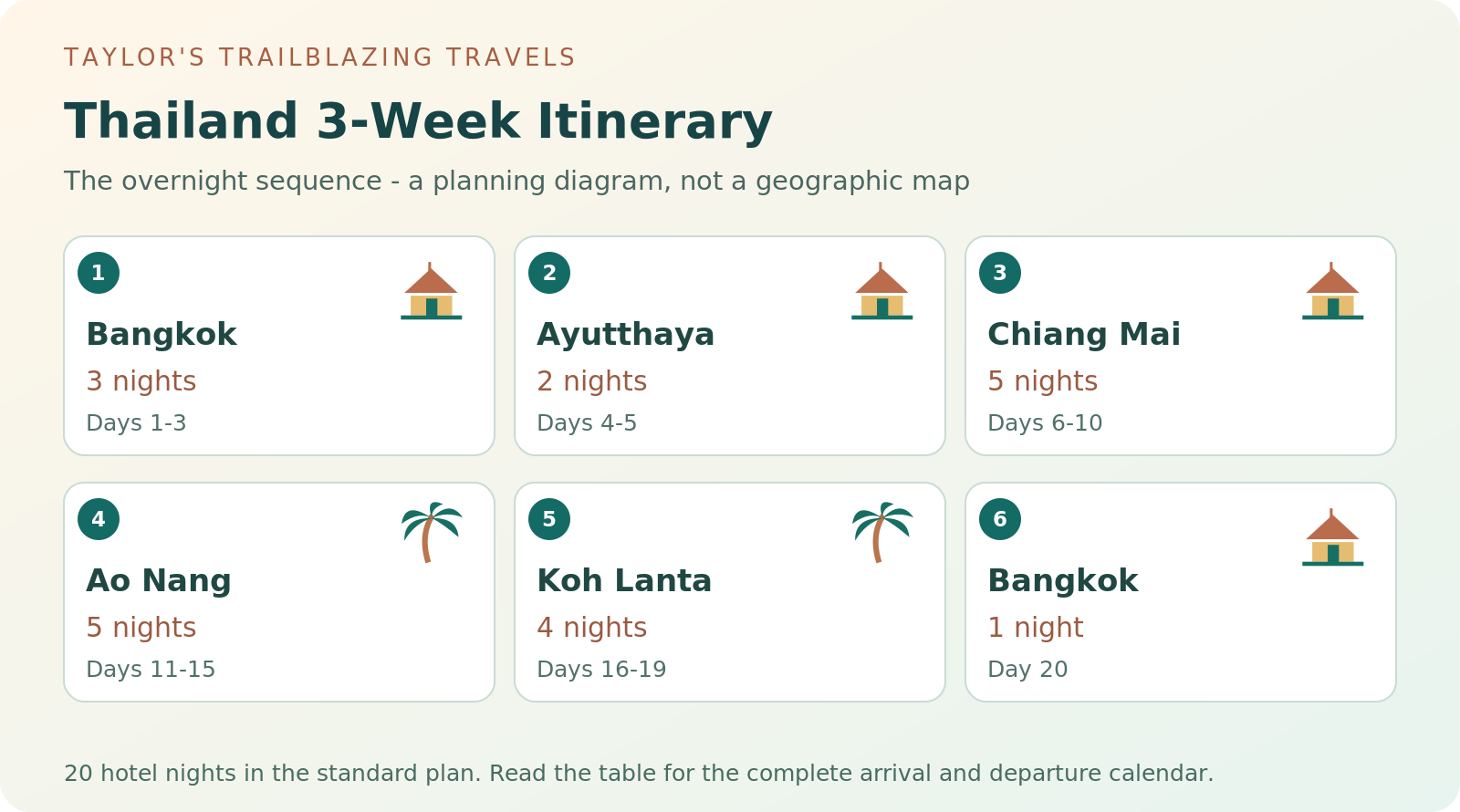
Start with three Bangkok nights, continue to Ayutthaya for two, then spend five in Chiang Mai. Fly south for five Ao Nang nights, move to Koh Lanta for four and return to Bangkok for the final night. Arrival is day one and international departure is day twenty-one. The six accommodation blocks add up to twenty nights, even though Bangkok is visited twice.
This is a five-destination route with a repeat gateway stay, not six unrelated destinations. The selection favours different experiences and reasonably substantial stays. Ayutthaya adds an overnight heritage visit; Chiang Mai has room beyond the old city; Ao Nang and Koh Lanta perform different coastal roles. You can remove any chapter that does not interest you and redistribute its nights rather than replacing it with an equally demanding detour.
| Day(s) | Overnight base | Nights | Plan |
|---|---|---|---|
| 1-3 | Bangkok | 3 | Recover and explore the capital |
| 4-5 | Ayutthaya | 2 | Travel and one unhurried heritage day |
| 6-10 | Chiang Mai | 5 | Travel north and four flexible days |
| 11-15 | Ao Nang | 5 | Travel south and four coastal days |
| 16-19 | Koh Lanta | 4 | Transfer and three slower island days |
| 20 | Bangkok | 1 | Return before the international departure |
| 21 | Departure | 0 | Fly home or continue the trip |
This is a proposed calendar, not a published transport timetable. Scroll within the table on a small screen.
Read the travel days as occupied dates
Days four, six, eleven, sixteen and twenty all involve changing base. Some may leave a pleasant afternoon, but none is treated as a full sightseeing day. This protects the route from a common planning error: adding the advertised travel time to a day already filled with activities, without accounting for checkout, luggage, waiting and the journey between a station or airport and the hotel.
Days 1-3: a measured start in Bangkok
Day 1: recover and establish the practical basics
Travel to the hotel, ask about room access and keep the first evening close to your base. The longer trip gives you no reason to exhaust yourself immediately. A short walk, a straightforward meal and an early night can produce a better first full day than an arrival-afternoon tour booked before the flight times were understood.
Compare Bangkok accommodation around the river and useful city transport. For this chapter, prioritise a location that supports the sights you actually intend to visit. A fashionable neighbourhood can be enjoyable, but it should not require repeated cross-city journeys simply to follow the first two days of your plan.
Day 2: an old-city anchor and an optional second sight
Choose the Grand Palace or Wat Pho as the morning's main visit. Recheck the official entry information and clothing requirements rather than relying on a packing assumption. After the visit, leave space for lunch and a river journey. A second major temple is optional, particularly when the first visit has involved heat or queues. [1] [2]
The river should make the afternoon simpler, not more confusing. Confirm which boat service reaches the intended pier and what its ticket covers. You do not need to purchase a full-day sightseeing product for a single short journey, but the simplest choice depends on the trips you actually plan to make. [3]
Day 3: food, an indoor stop and preparation for Ayutthaya
Give the second city day a different emphasis: a food-led neighbourhood walk, an indoor cultural attraction or a relaxed shopping area with an easy route back. Avoid booking a distant day trip immediately before moving to Ayutthaya. The overnight heritage stop is already the next chapter, and does not need a preview that duplicates its travel.
Before dinner, confirm tomorrow's transport and the location of the Ayutthaya hotel. Decide how you will get from the arrival point to the accommodation. This small step removes the need to improvise the final part of the journey with bags in the afternoon heat.
Days 4-5: give Ayutthaya more than a rushed stop
Day 4: travel north and explore a limited area
Compare Bangkok-to-Ayutthaya travel options using the departure point and service on the actual ticket. Do not assume every rail departure uses the same Bangkok station. Allow time to reach the hotel and leave your luggage before beginning a modest afternoon programme. A first look at one part of the historic area is enough.
Ayutthaya is a UNESCO-listed historic city whose surviving monuments help explain the scale and history of the former capital. That is the reason for the stop here, rather than a desire to add another place name. Choose an overnight stay when you would enjoy exploring at a gentler pace than a same-day return excursion allows. [4]
Day 5: select a small group of monuments
Choose a coherent cluster rather than trying to visit every marked ruin. Agree transport and waiting arrangements before setting out; the monuments should not be assumed to form one compact, continuously shaded pedestrian attraction. A guide can be useful for interpretation as well as logistics, especially when your interest is historical rather than photographic.
Compare Ayutthaya history-focused tours by actual starting point, duration, admission inclusions and transport. A product sold as an Ayutthaya tour may depart from Bangkok rather than from your overnight base. That distinction matters more than an attractive title or a long list of temples.
Choose the hotel around the visit and onward journey
Compare Ayutthaya accommodation near the area you plan to explore, then check the route to the next departure point. An atmospheric room is useful only if the arrival, sightseeing and departure logistics still work. Keep the second evening quiet enough to prepare for the longer northbound move the following day.
Days 6-10: Chiang Mai with room beyond the highlights
Day 6: make the northbound journey deliberately
The standard calendar keeps both Ayutthaya nights in hotels and uses day six for travel to Chiang Mai. One practical arrangement is a prebooked road transfer to the appropriate Bangkok airport followed by a flight north, with a generous gap between independently arranged components. Treat the date as a travel day rather than promising a mountain visit after arrival.
The alternative is an overnight train leaving on the fifth evening. Compare Ayutthaya-to-Chiang Mai transport, then check the service and boarding details against State Railway of Thailand information. In that version, night five becomes a rail night instead of a second Ayutthaya hotel night. The itinerary still contains twenty nights; it does not gain a spare hotel night automatically. [5]
Day 7: a local introduction to Chiang Mai
Use the first full northern day for a compact old-city walk, selected temple visits and an unrushed meal. A five-night base gives you time to understand the city without immediately disappearing on a long excursion. Leave the afternoon adjustable, particularly after a train arrival that provided less sleep than expected. [6]
Compare Chiang Mai old-city hotels with attention to the actual street, room access and noise. For a longer stay, the ability to reach food, laundry and everyday supplies easily can matter as much as the room's decorative appeal. Do not make every small errand require a taxi.
Day 8: choose one northern outing
A Doi Suthep visit is one possibility when the temple and mountain setting appeal. Check weather and air quality beforehand, and do not assume a clear view is guaranteed. Another traveller may prefer a city-based cultural activity instead. The extra days are there to support a choice, not to create a compulsory excursion on every date. [7] [8]
If using a driver or organised tour, confirm the full route, return time and what happens if conditions change. A longer itinerary of stops is not necessarily a better northern day. The practical question is how much of the outing will be spent at places you want to experience rather than sitting in traffic or transferring between them.
Day 9: food, learning and a different pace
Compare Chiang Mai cooking classes with market visits when food is one of the trip's priorities. Check the real class location and transport time, as well as the menu and dietary arrangements. One substantial activity can take the place of several smaller visits and provide a useful change from temples and viewpoints.
Leave the evening open. There is no need to follow a half-day class with a distant market merely because both appear on a city list. A meal near the hotel and a walk through familiar streets can be the point at which a longer stay begins to feel different from a rapid sightseeing circuit.
Day 10: use the spare northern day as intended
Keep the last Chiang Mai day available for laundry, rest, a postponed activity or a neighbourhood you enjoyed enough to revisit. Avoid filling it months ahead with the longest excursion you can find. Its value is partly that it can absorb a change without forcing the rest of the trip to move.
Review tomorrow's flight and baggage rules before the evening. The southbound move is the major geographical jump in the route, so it deserves a clear pickup time and an accessible ticket. Pack the items needed during travel separately from clothes that can remain in the main bag.
Days 11-15: Ao Nang as a flexible coastal base
Day 11: travel south and settle in
Compare Chiang Mai-to-Krabi journeys before fixing the hotel dates. A nonstop service may make the day relatively straightforward, but search results can include connections or self-transfers. Confirm the exact routing, baggage allowance and arrival time. Do not assume a generic route page proves that a suitable direct flight operates on your chosen date. [9]
Reserve the rest of the day for the airport-to-hotel transfer, food and orientation. A favourable arrival may leave time by the beach, but do not promise a paid boat departure before you have even collected the bags. The five-night stay provides four full local days; there is no need to borrow aggressively from the travel date.
Day 12: the nearby peninsula
Use one day for Railay and the Phra Nang area when the conditions suit. From Ao Nang, this gives the coastal chapter a different setting without another hotel move. Ask about boarding, the return arrangement and any walking that the visit requires before deciding it is suitable for everyone in the group. [10]
Keep the programme modest enough to enjoy lunch and return without a rush. A short stay in a scenic place is not improved automatically by adding a difficult viewpoint or a second boat journey. Choose the activities that suit your abilities and the actual conditions rather than reproducing somebody else's ambitious day.
Day 13: one island excursion, selected carefully
Compare Hong Islands trips from Krabi by group size, time on the boat, pickup area and inclusions. Ask whether national-park charges or optional activities are separate. A smaller number of stops can be more appealing than a long itinerary that repeatedly moves people on and off the vessel.
Keep this date interchangeable with the other local days. The marine forecast and operator's decision should determine whether the outing happens. A cancellation is not an invitation to find a less cautious departure; it is a reason to use the land-based part of the holiday. [11] [12]
Day 14: a mainland or hotel day
Choose a nearby mainland activity, a cooking experience or a genuinely quiet day. The choice should reflect what you have already enjoyed, not what remains unticked on a list. A long trip benefits from days with few bookings, because they allow recovery without making the next destination feel like a deadline.
Compare Ao Nang hotels for restaurant access, room comfort and pickup convenience. With five nights, choose somewhere you would be content to spend a wet afternoon. A property selected only for its proximity to a pier may feel less attractive when several hours are spent indoors.
Day 15: keep a weather-swap and packing day
Use the last Ao Nang date for anything postponed, or leave it as a second relaxed day. Confirm the next transfer to Koh Lanta, including the hotel pickup window and drop-off zone. A booking that ends at a pier is different from one that reaches your accommodation, and the final local ride should not be left out of the comparison.

Days 16-19: a slower finish on Koh Lanta
Day 16: move between neighbouring coastal bases
Compare Krabi-to-Koh Lanta transport using the actual origin and destination. Current route listings describe both road/vehicle-ferry journeys and passenger-boat options, but availability varies with date and conditions. The advertised duration may exclude some hotel collection or waiting time. [13]
For planning, set aside much of the day rather than promising a full afternoon excursion on arrival. The first job is reaching the correct beach area and settling in. A road-based journey can still include a vehicle-ferry stage, so do not interpret the word road as proof that no crossing or queue is involved.
Day 17: enjoy the beach area you chose
Spend the first full Lanta day near the hotel. Learn which restaurants and services are realistically walkable and how the beach looks at different times. The purpose of changing from Ao Nang is to create a slower coastal chapter, not to begin another programme of early pickups immediately.
Compare Koh Lanta accommodation around Long Beach and neighbouring areas. Check the exact location, beach access, recent seasonal reviews and any transport you would need after dinner. A map pin on a long coast does not tell you whether the property suits a car-free stay.
Day 18: choose one inland or local exploration
An outing to another part of the island can provide variety, but arrange the transport and return rather than assuming that every place has readily available onward rides. Combine nearby stops and leave time for a proper meal. A short private outing may be more useful to a group than several separately paid journeys.
You do not need to hire a scooter to follow this itinerary. Choosing not to ride should simply influence the hotel location and transport budget. Driving or riding involves appropriate licensing, insurance and judgement about conditions; it is not an incidental activity to add without preparation. [12]
Day 19: rest and prepare the mainland return
Keep the final island day close to the base, with laundry, packing or a last quiet meal as needed. Reconfirm the pickup for tomorrow and the airport named on the flight. Put the travel documents and essential personal items somewhere accessible, particularly if the transfer involves more than one vehicle.
Do not move the main sea excursion to this evening because earlier days were wet. Returning to Bangkok tomorrow is part of the protection for the international ticket. Preserve that margin rather than using it up with a late, weather-sensitive activity that was optional from the beginning.
Days 20-21: put the gateway night to work
Day 20: return to Bangkok before the long-haul flight
Compare Koh Lanta-to-Krabi Airport transfers and book a departure that provides a sensible margin for the domestic flight. Plan the airport arrival using the airline's requirement plus the whole transfer, not the fastest time somebody achieved in a car. Hotel collection, ferry queues and traffic can change the day.
Fly to Bangkok and check into the final hotel. Choose that hotel around tomorrow's departure airport and timing. A final night is a risk-reduction measure, not a guarantee that disruption cannot occur; an earlier mainland return may be appropriate when forecasts or service changes create additional uncertainty.
Day 21: depart with the sightseeing already complete
Leave the last morning free of distant visits. Check the airline's baggage and airport instructions and allow the journey from the hotel on top. If the flight leaves late, a local breakfast or walk can be pleasant, but the day should remain easy to shorten if the departure plan changes.
Bangkok's airports are not interchangeable. Confirm whether the international flight uses BKK or DMK, and do not assume that the domestic arrival airport was the same. A hotel labelled airport hotel is useful only when it serves the airport you actually need. [14]
Choose the transport that preserves the shape of the trip
The Ayutthaya-to-north decision
There are two different planning models here: retain both Ayutthaya hotel nights and use day six for a flight-based move via the appropriate Bangkok airport, or replace the second hotel night with an overnight train. Decide which one you want before paying for accommodation. The rail version changes sleeping arrangements and likely energy levels, not merely the departure time.
For the flight-based version, do not book an early departure that makes the road transfer from Ayutthaya uncomfortably tight. Obtain an actual pickup plan and leave margin for delays before airport check-in. The route deliberately allocates the day to moving north so that you do not have to protect an additional sightseeing reservation after arrival.
Compare complete north-to-south journeys
For day eleven, compare the full airline itinerary, including whether a connection is protected. A low fare with separate-ticket transfers may demand more buffer and possibly another overnight stop. That can change both the cost and the twenty-night calendar. If the available routing is poor, remove Ayutthaya, change the trip order or simplify the southern block rather than ignoring the constraint.
Keep coastal transfers legible
For Ao Nang, Koh Lanta and the airport, write down the exact pickup and drop-off points. Ask whether bags change vehicles and whether the quoted duration includes hotel collection. A single confirmation can still involve more than one vehicle. The practical aim is to know the handover points in advance, not to assume that one booking means one uninterrupted ride.
Choose one coast for the dates, not both for completeness
The Andaman route is not a year-round weather promise
The main itinerary uses Krabi and Lanta because they create a coherent southern block. However, regional climate patterns and current marine conditions may make another coast more suitable. General seasonal advice is only the first screen; use the Thai Meteorological Department's current warnings before committing to individual boat journeys. [15] [11]
The southern east coast can remain wet during part of the period described nationally as the cool season. Therefore, switching from Krabi to Samui solely because a brochure says winter is dry everywhere is not a reliable strategy. Compare the specific region and dates instead. [16]
A Gulf replacement with the same arithmetic
A possible alternative keeps the first ten nights unchanged, then uses five Samui nights, four Koh Phangan nights and the final Bangkok night. That preserves twenty nights. It still requires checking flights, ferries and the day-twenty return; the substitution is a new transport plan, not a simple hotel-name change.
You could use Koh Tao instead of the second Gulf island when that better matches your interests, but do not add all three. The purpose of the coastal block is time in a region, not a contest to board more ferries. For a simpler version, use all nine coastal nights at one base and make only the excursions that genuinely appeal.
Slower versions without losing the three-week structure
Remove Ayutthaya when history is not a priority
Use four initial Bangkok nights, six Chiang Mai nights, five Ao Nang nights, four Koh Lanta nights and one final Bangkok night. The total remains twenty. This removes one hotel change and distributes the time between the two city chapters, rather than inventing another stop just to fill the gap.
This version is particularly useful when the northbound journey from Ayutthaya looks awkward or the group is not enthusiastic about an extended ruins visit. A destination should earn its place through interest, not merely because it lies somewhere between two other places on a map.
Keep only one southern hotel
Use three Bangkok nights, two Ayutthaya nights, five Chiang Mai nights, nine Ao Nang nights and one final Bangkok night. You retain the variety of the inland route while removing the move to Lanta. The longer coastal stay leaves room for weather changes, rest and selected excursions without packing again halfway through the beach chapter.
Alternatively, make the entire trip city-and-north focused when beaches are not important. The useful lesson is the same: redistribute nights explicitly and count them again. A longer holiday should give you permission to travel according to your interests, not create an obligation to include every regional highlight.
Shape the longer stays around what you actually enjoy
A history-led version
Keep the two Ayutthaya nights and use the full sightseeing date for a selective, interpreted visit. In Bangkok, favour one substantial royal or temple visit over several brief stops. In Chiang Mai, give the city itself more attention before adding distant excursions. The thread is time to understand a place, not simply a larger number of historic sites.
A guide is most useful when the explanation and route match your interests. Ask whether the programme focuses on history, photography or a broad sightseeing introduction. Those can be quite different experiences even when the same attraction names appear in the description. A traveller interested in context may prefer fewer sites with a knowledgeable explanation to a long sequence of short visits.
A food-led version
Use one planned food experience in Bangkok and one in Chiang Mai, leaving ordinary meals flexible around them. Avoid scheduling a substantial cookery class between a large breakfast and a prepaid tasting evening. The point is to enjoy the food rather than make eating another tightly timed endurance activity.
The longer hotel blocks also let you return to somewhere you enjoyed. There is no requirement to find a new restaurant for every meal. Familiarity can make dietary communication and daily decisions easier, although serious allergies still require specific discussion each time. Keep a convenient food option near the hotel for late arrivals and evenings when the group wants different levels of activity.
A coast-led version
The nine-night southern block can be organised around one priority sea experience, one nearby peninsula visit and several quieter dates. Choose the accommodation for the holiday you want between outings. A room close to everyday food and a beach you enjoy using may matter more than a property that photographs well but makes every evening dependent on a vehicle.
Avoid turning the move from Ao Nang to Lanta into proof that you also need Phi Phi, Phuket and a Gulf island. Each additional overnight base changes the transport and packing burden. The two coastal bases already provide enough variety for this version; the spare days allow you to enjoy them instead of continually preparing to leave.
How to change the route without breaking the twenty-night calendar
Move a night explicitly
Suppose you decide that Chiang Mai deserves six nights instead of five. Remove one Ao Nang night, travel south on day twelve rather than day eleven, and stay in Ao Nang on nights twelve to fifteen. Lanta still begins on day sixteen and the final Bangkok return still happens on day twenty. The calendar remains twenty nights because a night has been moved, not added invisibly.
Check every linked booking before making that edit. The new flight, the extended northern room and the shortened coastal reservation may have different availability and change terms. A route adjustment is not complete until all three agree. Updating only the hotel can leave a paid flight on the wrong date even though the itinerary document looks correct.
Protect the parts that depend on hard deadlines
Keep the final international departure and the return to the gateway visible while changing earlier stays. If disruption requires an extra inland night, first remove an optional local activity or redistribute a coastal night. Avoid treating the final Bangkok stay as the automatic source of spare time merely because it looks less scenic than the island chapter.
Where the weather is the issue, a longer stay at the current base may be more sensible than chasing conditions through several new transfers. Review the current official advice, then choose a plan that is actually bookable. An elegant alternative on paper is not useful if its hotel, flight or transfer cannot be confirmed on the dates required.
Keep the group informed with one current calendar
After a change, replace the old shared itinerary rather than circulating several competing versions. List each hotel with its check-in date, checkout date and number of nights. Add the transport reference for the move between them. Everyone should be able to identify the next sleeping place and departure point without remembering a discussion from several days earlier.
This matters even when only one person normally organises the trip. A second traveller with the current hotel details and transfer contact can help when a phone loses power or the organiser is unavailable. The aim is a simple shared travel record, not a complicated system that itself needs managing throughout the holiday.
Build a twenty-night budget from the route upward
The sample is a calculation, not a price survey
The illustrative model below was prepared on 5 October 2026 for one adult sharing a double or twin room, travelling twenty-one days and staying twenty hotel nights. It includes an allowance for the main domestic movements, including the final Bangkok return, but excludes international flights, insurance and shopping. Actual flight, room and activity quotations must replace the assumptions before booking.
| Component / assumed allowance | Lean model | More-comfort model |
|---|---|---|
| Accommodation: 20 nights x THB 500 / 1,250 per person | THB 10,000 | THB 25,000 |
| Food: 21 days x THB 500 / 900 | THB 10,500 | THB 18,900 |
| Main intercity travel, including Bangkok return | THB 12,000 | THB 20,000 |
| Local travel allowance | THB 3,000 | THB 5,000 |
| Admissions and selected activities | THB 5,000 | THB 8,500 |
| Subtotal | THB 40,500 | THB 77,400 |
| 15% contingency | THB 6,075 | THB 11,610 |
| Illustrative total per adult | THB 46,575 | THB 89,010 |
Planning model dated 5 October 2026. Prices are assumptions, not checked bookable offers. International flights, insurance and shopping are excluded; read the section for route-specific exclusions. Scroll this table horizontally on small screens.
Allocate the accommodation spend by destination
Do not assume every night should have the same room allowance. A simple, well-located northern hotel may meet your needs while a comfortable coastal room deserves a larger share of the budget. Equally, the final gateway hotel has a practical purpose and may not need the same facilities as a five-night holiday base.
Calculate the total using the actual nights at each property. The room cost belongs to the room, so divide it only among the people who will genuinely share it. Family bedding rules, single supplements and different room categories can make a simple per-person average misleading.
Budget for ordinary long-trip life
Laundry, local rides, replacement toiletries and unplanned meals in transit are easy to omit from a route spreadsheet. They are not necessarily large individually, but twenty-one days create more of them than a short city break. Set aside a realistic everyday allowance rather than expecting the attraction budget to absorb every small expense.
Keep a contingency available for travel changes and a different final-night arrangement. The most expensive mistake is not always overspending on dinner; it can be an avoidable missed connection or an island departure that needed more margin. The budget should support the route's safeguards rather than treating them as optional extras.
Entry, connectivity and the habits that help over three weeks
Verify permission for the actual passport and visit history
Check current entry requirements before purchasing non-refundable travel. The Thai Embassy's September 2026 revision is relevant to eligible British visitors using visa exemption, including the duration and repeat-entry conditions. Do not rely on an older account of a previous holiday. Check the permission actually granted on arrival and keep the planned exit within it. [17] [18]
Complete the TDAC through the official government service within its stated submission window. Keep the first accommodation details accessible and understand that the form is separate from a visa or admission decision. The route's twenty-one-day label does not replace the need to satisfy entry requirements. [19]
Plan one laundry reset in each long chapter
The five-night Chiang Mai stay and longer coastal block make it unnecessary to pack a fresh outfit for every date. Build laundry into a quiet day and check the return time before handing over clothing shortly before checkout. Keep enough essential items outside the laundry bag to manage a delay without having to shop in a hurry.
Compare Thailand eSIM options through Airalo against the full three-week duration, not just the data quantity. Confirm compatibility, activation and validity, and keep the important confirmations offline. A travel plan should remain usable when the phone has a poor signal or the battery runs low during a transfer.
Review the route as conditions change
Check current travel advice and relevant regional warnings before adding side trips, especially near borders. This itinerary does not require those detours. For outdoor and coastal days, use current local information rather than assuming that a safe activity last week must remain suitable today. [20] [11]
Where the extra week should make the biggest difference
Give the busiest days a quieter neighbour
The trip works better when a long transfer is followed by a local day rather than another early start. That is why Chiang Mai begins with the city, Ao Nang begins with a nearby coastal option and Lanta begins near the hotel. You can change the sequence, but retain the principle of not stacking the most tiring days together.
For friends or couples with different interests, the longer stays permit occasional separate activities. One person can choose a class while another rests, provided both have a clear return plan. The itinerary need not make every meal and excursion a group decision for three continuous weeks.
Accessibility changes the choice of base and excursion
Ask about the specific hotel room, entrance, vehicle and boat boarding arrangement. A generally convenient destination can still contain a property with many steps or a tour involving a difficult landing. The route should be adjusted around the needs of the actual travellers rather than an idealised average visitor.
If coastal access is the main concern, one suitable hotel for the full southern block may be better than moving to Lanta. For families, fewer transfers can likewise be worth more than another destination. A three-week holiday has enough time to be comfortable; use the extra nights to reduce pressure rather than expand it.
What this 21-day route delivers and leaves out
The strengths
The route offers a city introduction, an overnight historic stop, a substantial northern stay and a coherent coast. Several days can absorb weather changes or fatigue without breaking the night allocation. The final Bangkok night also separates the international departure from the last island stay, which makes the overall plan less fragile.
The trade-offs
Five main destination changes still require organisation. The Ayutthaya-to-Chiang Mai move deserves particular attention, and the coastal version depends on the season and service availability. The itinerary deliberately omits other major islands, rainforest stays and additional northern towns. Those omissions are how it preserves the longer stays rather than evidence that the route needs more destinations.
Three-week mistakes worth avoiding
Converting the spare days into compulsory excursions
The uncommitted Chiang Mai and Ao Nang days are useful precisely because they can change. Filling them all in advance removes the difference between a twenty-one-day trip and a rushed itinerary with more stops. Book a priority experience, but leave some space around it to respond to how the holiday actually feels.
Using the final gateway night as a sightseeing target
The last Bangkok stay protects a departure. Choosing a distant hotel or a demanding final evening can undermine that purpose. Work backwards from the flight's airport and check-in requirement, then decide what local activity fits comfortably around the resulting plan.
Assuming surface travel is automatically simpler
A train, van or ferry may be enjoyable and useful, but the complete journey still needs checking. Stations, piers and hotels can be separate destinations with additional travel between them. Compare door-to-door plans rather than declaring one mode better solely because its ticket looks cheaper or its advertised duration is shorter.
Thailand three-week itinerary FAQs
How many places should I visit in three weeks?
For this route, five destinations plus a final return to Bangkok create a workable balance. That is an editorial recommendation rather than a universal optimum. Travellers who want more rest should remove Ayutthaya or the second coastal base. The important measure is the number of full days left at each stop after travel, not the number of names on the itinerary.
Why stay overnight in Ayutthaya?
The overnight stay suits travellers who want time for a more selective heritage visit and do not want a return journey to Bangkok on the same day. It also lets the visit run at a gentler pace. However, it adds a hotel change and makes the onward northbound plan more complex. Remove it when the historical interest is not strong enough to justify those costs.
Can I add Sukhothai as well?
Only by reallocating nights and accepting another travel leg. It should not be inserted as a quick extra while keeping every existing full day unchanged. For a first three-week trip, choose the historic stop that interests you most. The month-long version is better suited to including both historic capitals without compressing the north and coast excessively.
Do I need both Ao Nang and Koh Lanta?
No. They create two coastal chapters, but a single southern hotel can be the better choice for rest, access requirements or families. Use all nine coastal nights at one suitable base and keep excursions optional. That removes a transfer and provides more resilience when the weather does not favour the first planned boat day.
Does the route include twenty or twenty-one nights?
Twenty nights. You arrive on day one and depart on day twenty-one. The standard split is three, two, five, five, four and one nights across the six hotel blocks. An overnight train replaces one of those hotel nights; it is not added without changing the total trip duration.
Is the final Bangkok night enough protection?
It is a more cautious planning choice than a same-day island-to-international-flight transfer, but it cannot guarantee against every disruption. Check forecasts and transport changes before leaving the coast. An earlier return may be appropriate when conditions are deteriorating or the consequence of missing the onward flight is particularly high.
What is the best edit for a limited budget?
Start by pricing the important flights and accommodation, then consider removing a whole hotel change rather than reducing every daily comfort. One coastal base can simplify transfers, and longer stays may suit a more economical room strategy. Use actual quotes to test the saving; the model budget is a framework, not proof that one version is always cheapest.
Can I follow the route without hiring a vehicle?
Yes. The plan can use flights, prearranged transfers, public transport and selected excursions. Hotel location becomes more important when you want to walk to meals and everyday services. Budget for the occasional necessary ride rather than selecting remote accommodation and assuming a scooter will solve every practical problem.
Use the third week to settle, not to accelerate
Choose the full twenty-night route when an overnight heritage visit, a substantial northern stay and two coastal bases all interest you. Keep the transfer dates realistic and leave several local days adjustable. Confirm the Ayutthaya-to-north move and the Chiang Mai-to-Krabi flight before paying for hotels that cannot change.
For a quieter holiday, remove one stop and give its nights to somewhere you already want to stay. The most valuable extra week is the one that lets you revisit a neighbourhood, postpone a boat day and enjoy a morning without packing. Three weeks should make the experience more generous, not merely the itinerary longer.
Sources and fact-checking notes
What was checked, and what remains a planning choice
Source pages were reviewed on 5 October 2026. Official entry and attraction information supports the specific visitor details. Night allocations, suggested time margins, route comparisons and budget models are editorial planning judgements, not official itineraries, guaranteed schedules or personally tested bookings. Recheck operational notices and your actual ticket before travel.
- Bureau of the Royal Household: Grand Palace visits. Official opening information, admission and clothing rules. Reviewed 5 October 2026.
- Wat Pho: plan a visit. Official visitor information and admission. Reviewed 5 October 2026.
- Chao Phraya Tourist Boat: operator information. River-boat stops and service information; check the dated timetable. Reviewed 5 October 2026.
- UNESCO: Historic City of Ayutthaya. Heritage status and historical context for the ruined capital. Reviewed 5 October 2026.
- State Railway of Thailand: D-Ticket. Use a dated search for the station, train, berth and issued ticket. Reviewed 5 October 2026.
- Tourism Authority of Thailand: Chiang Mai. Destination context for the northern city. Reviewed 5 October 2026.
- Tourism Authority of Thailand: Wat Phra That Doi Suthep. Temple and destination background, not a promise of clear views. Reviewed 5 October 2026.
- Pollution Control Department: Air4Thai. Check current readings and their timestamps, especially before northern outdoor days. Reviewed 5 October 2026.
- 12Go: Chiang Mai-Krabi route search. A dated result may mix nonstop flights with connections; inspect the actual itinerary. Reviewed 5 October 2026.
- Tourism Authority of Thailand: Krabi. Ao Nang as a base for the peninsula and offshore excursions. Reviewed 5 October 2026.
- Thai Meteorological Department: forecasts and warnings. Check current provincial and marine forecasts close to travel. Reviewed 5 October 2026.
- FCDO: Thailand safety and security. Transport, sea-travel, local-law and seasonal safety advice. Reviewed 5 October 2026.
- 12Go: Krabi-Koh Lanta route search. Road/vehicle-ferry and passenger-boat options. A search page does not establish availability for every date. Reviewed 5 October 2026.
- Airports of Thailand: airport-transfer information. BKK and DMK are different airports. The page displays conflicting hours, so no exact shuttle timetable is relied on here. Reviewed 5 October 2026.
- Tourism Authority of Thailand: climate and weather. Seasonal background; not a forecast for an individual holiday. Reviewed 5 October 2026.
- Thai Meteorological Department: November-January climate normals. Only the clearly labelled 1991-2020 climate-normal discussion is used; the dated forecast is not treated as a 2026 forecast. Reviewed 5 October 2026.
- Royal Thai Embassy: September 2026 revision. Announcement of the rules effective from 15 September 2026. Reviewed 5 October 2026.
- Royal Thai Embassy, London: visa exemption. Current exemption conditions; the permission stamped on arrival controls the stay. Reviewed 5 October 2026.
- Thai Immigration: official arrival-card guidance. Official TDAC instructions, eligibility and submission window. Reviewed 5 October 2026.
- FCDO: regional risks in Thailand. Check the current advisory map before adding border regions. Reviewed 5 October 2026.
Illustrations in this article were created for Taylor’s Trailblazing Travels. Third-party photographs, where used, are credited beside the image or in the source list.