Bangkok to Koh Samet: Bus, Taxi and Ferry
Connect the road, boat and hotel stages without relying on a destination name to explain the handover.
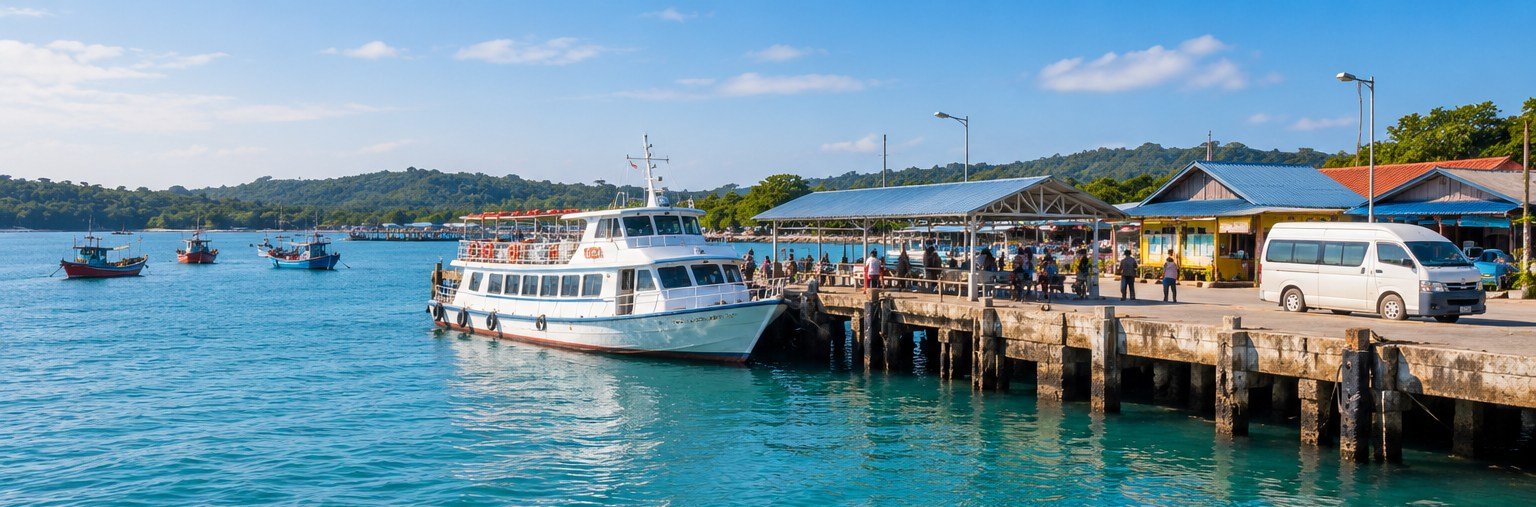
Original mainland-pier illustration inspired by the Ban Phe transfer process; not a counter map, vessel identification or exact photograph.
A practical place to begin
Bangkok to Koh Samet looks simple on a map: drive towards Rayong and take a short boat ride. In practice, the most important details are the ones between those stages. A bus may stop at one mainland pier while your boat uses another, and an island arrival at Na Dan may still be some way from the hotel.
This guide turns the journey into a sequence you can check before paying. It compares independent buses, combined tickets and private cars, then explains public boats, resort arrangements and the return to Bangkok. The aim is not to promise the fastest possible trip, but to make the booking match the journey you actually need.
You will also find dated timetable examples and a way to compare the complete cost. Keep the selected provider’s confirmation as the final instruction, because a useful published example is not a substitute for your own operating date and pickup address.
Coordinated through ticket
Check whether hotel pickup and the island ride are actually included.
Bus plus selected boat
Ban Phe and Rayong city are not interchangeable endpoints.
Private car to the right pier
Quote the exact counter, passengers and luggage.
Your hotel’s own instructions
A resort boat may use a different mainland meeting point.
A ten-minute crossing is not a ten-minute transfer. Road travel, check-in, the correct pier and the hotel ride are separate stages.
Bangkok to Koh Samet: understand the three-part journey
Bangkok to Koh Samet is normally a road journey to the Ban Phe area of Rayong, a passenger-boat crossing and a final transfer to your accommodation. The most useful ticket is the one whose endpoints match that complete plan. A bus to a mainland pier, a combined bus-and-boat service and a resort transfer are not interchangeable simply because every listing mentions Koh Samet. [1] [2]
This guide compares options by cost structure, number of handovers, luggage handling and resilience when something runs late. It is research-led planning advice, not a report of invented test journeys. Published transport information was checked on 4 October 2026, and any quoted timetable should be reconfirmed for the actual travel date.
Your hotel helps determine the route
Choose the accommodation, or at least the arrival area, before buying an independent boat ticket. A northern hotel reached through Na Dan needs a different final arrangement from a resort using its own mainland pier or boat. A seemingly cheaper ferry can be poor value if it leaves you with a separate transfer that the resort package already included.
For most first-time visitors, the decision is between a coordinated through ticket, an independent bus-and-boat combination and a private mainland transfer. The boat itself is only one part of that comparison. A fast crossing does not compensate for the wrong bus terminal, an unclear pier handover or a missed last useful departure.
Which option fits your starting point?
A central Bangkok hotel, Suvarnabhumi airport and Don Mueang airport create different journeys. Start by writing the actual pickup address beside the arrival point on Samet. Then compare the options in the table as complete chains, not just advertised driving or sailing times.
Choose a road-and-boat arrangement · On a narrow screen, scroll the table sideways.
| Option | Who coordinates the handover? | Best use | Check first |
|---|---|---|---|
| Independent bus + boat | You | Flexible travellers with manageable bags | Exact mainland counters and enough spare time. |
| Through bus + boat | The selected provider, within its stated terms | Fewer separate reservations | Pickup zone, last endpoint and delay policy. |
| Private car + selected boat | You or the agreed transfer organiser | Groups, airport starts or substantial luggage | All-in road quote plus the correct boat. |
| Resort-led arrival | The hotel or its nominated provider | A property with its own scheduled transfer | Room-rate inclusion and the designated pier. |
Research-led suitability comparison reviewed 4 October 2026. Coordination and protection depend on the booking terms.
Through ticket: fewer arrangements to coordinate
A combined ticket can be attractive when the pickup is convenient and the operator clearly explains the mainland handover. However, coordinated does not automatically mean protected against every delay. Read the conditions for a late arrival, missed boat or cancelled service. Confirm whether staff guide you between the road vehicle and the boat counter.
Independent bus and boat: more control, more responsibility
Separate tickets allow you to choose each stage, but you must build the connection time yourself. This works best with an early departure and a comfortable margin before the boat, not with an ambitious attempt to reach the last sailing. Keep enough flexibility to buy a later crossing or stay on the mainland if necessary.
Private road transfer: simplest mainland movement
A private car removes the Bangkok terminal journey and can take you to the precise pier your booking requires. It does not remove boat check-in, weather limitations or the need to reach the hotel after landing. For a family, the best package may be the one that resolves all three stages rather than merely providing an impressive vehicle for the first.
Ekkamai to Ban Phe: the independent bus approach
Cherdchai’s ThaiRoute timetable displayed Ekkamai–Ban Phe departures at 07:00, 09:00 and 11:00, with the Ban Phe endpoint identified as Nual Thip Pier. Checked 4 October 2026. This is a particular published route, not a complete list of every possible Bangkok–Rayong service. Confirm the date, terminal and final stop before purchase. [3]
Ban Phe and Rayong are not identical ticket endpoints
A bus to Rayong city may leave you needing another local journey to the coast. That can be workable, but it is not the same as a ticket to Ban Phe. Read the destination in full and check the map pin. A low fare can lose its attraction if the last part is an unexpected taxi ride.
Similarly, do not assume that a bus arrival beside one pier automatically places you at the check-in point for another boat company. Establish whether you can walk between the two counters, need a short transfer or should choose a different boat. The operator or accommodation should be able to explain this more clearly than a generic destination label.
Give yourself a proper morning departure
For an independent journey, travelling earlier creates options. You can absorb a delay, stop for lunch at the mainland and still have another departure available. A late start makes every stage more brittle, particularly when travelling on a busy weekend or with a resort boat that has limited scheduled trips.
Reach the bus terminal before the stated departure and locate the correct company counter. Check baggage arrangements, ticket presentation and the boarding point. Keep water and essential items with you, because the main suitcase may not be accessible while the bus is moving.
Combined bus-and-boat tickets from Bangkok
Boonsiri’s September 2026 information promotes Bangkok–Koh Samet connections, while a booking-partner timetable shows particular combinations through Ban Phe to Na Dan. Such products can make sense when they remove the need to organise the handover independently. Nevertheless, the pickup address and included destination must be read from the selected departure. [2] [4]
A dated timetable example
FerryAdvice displayed a Khao San departure at 09:00 reaching Na Dan at 14:25, and an Old Town hotel-pickup option beginning at 08:15 for the same island arrival. Checked 4 October 2026. Those examples demonstrate why pickup time and main vehicle departure time are different concepts. They are not a promise that every Bangkok hotel receives collection. [4]
For your own booking, verify the collection zone, waiting instructions and what happens if the hotel lies outside it. A meeting point a short taxi ride away may be perfectly convenient. It is less convenient when discovered on the morning of departure after expecting a vehicle at reception.
Read the responsibility for each handover
Ask whether the same booking covers the road journey and boat, whether a representative directs the transfer, and what happens when their vehicle reaches the mainland late. Also check whether the ticket ends at Na Dan or includes the hotel ride. A coordinated bus-and-boat ticket usually should not be described as door-to-door unless both ends are explicitly covered.
Keep the voucher and contact details accessible offline. Some bookings use separate confirmations for individual stages. Save all of them, not just the payment receipt, and check that passenger names, dates and numbers agree across the documents.
Private car or van to the mainland pier
A private transfer is worth comparing when several people share the cost, when luggage is substantial, or when the departure address makes a public terminal inconvenient. It can also allow a suitable child restraint and a planned comfort stop to be arranged in advance. Obtain a quote for the exact pier, not simply Rayong.
Ask for an all-in written quotation
Specify the pickup address, flight details where relevant, passengers, bags and any pushchair or mobility aid. Ask whether tolls, parking, waiting time and the requested child seat are included. Then confirm whether the driver meets a boat representative or simply drops you at the pier entrance.
A quote for a sedan may not suit four adults with large luggage. Describe the bags realistically rather than relying on the number of seats in a vehicle photograph. For a van, ask whether your group has the whole vehicle and whether it makes other pickups. A private booking and a shared van seat are different products.
Set the pickup from the boat backwards
Choose the intended boat first, note its check-in deadline and ask the road operator for an appropriate pickup with a traffic allowance. Do not use the shortest driving estimate on a map as the sole basis of a connection. Bangkok traffic, comfort stops and the process of reaching the correct counter all take time.
If your flight lands late enough that the last useful boat is doubtful, a fast car does not solve the underlying problem. Stay on the mainland or in Bangkok and cross the next day. Paying a premium to chase a departure with no margin can be more stressful than accepting a sensible overnight stop.
Starting from BKK or DMK airport
There is no advantage in travelling into central Bangkok merely because an old itinerary begins at Ekkamai. From an airport, compare a confirmed direct road transfer or an airport-specific combined service before adding a city detour. However, do not assume that a transport website mentioning an airport operates every Samet route from it every day. [2]
Scheduled landing is not pickup readiness
Immigration, baggage, customs and the walk to the meeting point come after landing. Delays can occur at any of those stages. A private driver may offer flight tracking and waiting, but the boat has its own timetable. Ask how the provider handles a landing that makes the intended crossing impossible.
For a fixed shared departure, read the missed-service terms carefully. The airline and an independently purchased ground ticket do not automatically compensate for one another. A more flexible booking or a next-day island arrival can be better value than losing a cheap but rigid connection.
Identify the airport in every message
BKK and DMK are separate airports. Include the code, flight number and date in the transfer request rather than writing Bangkok airport. An overnight flight can also make the local arrival date different from the date you left home. Check that the driver and accommodation are expecting you on the correct day.
After arrival, match the company’s instructions and booking details before leaving with a driver. If the meeting is unclear, contact the number in the confirmation. Do not allow an unsolicited offer to turn a prepaid transfer into a second booking while the correct driver is still waiting elsewhere.
Ban Phe piers and the names that cause confusion
Ban Phe is a coastal gateway with several boat operations, not a single universal ferry desk. Nual Thip may be the endpoint of a particular bus, while a resort may direct guests to a private mainland pier. Those arrangements must be connected deliberately. [3] [5]
Ao Prao Pier is on the mainland
The Samed Resorts group uses Ao Prao Pier in its mainland transfer information for several properties. Ao Prao beach is on Koh Samet. The shared name is a reason to use the full address and map pin, especially when communicating with a driver. A room reservation should provide enough detail to distinguish the two. [5]
Other resorts can have their own meeting points. Follow the instructions for the actual property and rate rather than assuming one group’s procedure applies to the whole island. If you have booked accommodation through an agent, ask the hotel directly to confirm the transport arrangement associated with that reservation.
What to do at the pier
Go to the counter named on your confirmation, show the ticket and confirm the destination. Ask where to wait and when boarding begins. Keep the whole party together, with one person responsible for the documents and another keeping track of children or luggage where helpful.
Before paying an additional charge, establish whether it is the boat fare, park admission, a local transfer or an optional upgrade. These can be separate legitimate costs, but the distinction should be clear. Avoid assuming that the first person approaching your vehicle represents the company on your voucher.
Boat choices and a current timetable example
Cost references and illustrative calculations reviewed 4 October 2026; reconfirm actual quotes and inclusions.
Public passenger services and resort boats can differ in speed, comfort, luggage handling and arrival point. The word ferry is sometimes used broadly in booking descriptions, so look at the actual vessel and boarding arrangement. A short speedboat trip can still be unsuitable for someone who needs predictable step-free access.
A service-specific schedule, not an island-wide rule
Boonsiri Sealine’s 14 September 2026 notice lists the following Ban Phe–Na Dan departures and a fare of 180 baht per person each way. Checked 4 October 2026. The advertised crossing is approximately ten minutes, but the complete process includes check-in, boarding and possible operational delays. [6]
One published Ban Phe-Na Dan service · On a narrow screen, scroll the table sideways.
| Direction | Published departure examples | Published fare |
|---|---|---|
| Ban Phe to Na Dan | 08:30, 10:00, 11:30, 14:15, 17:00 | 180 baht per person, one way |
| Na Dan to Ban Phe | 09:00, 10:30, 12:30, 15:45, 17:30 | 180 baht per person, one way |
Boonsiri Sealine notice dated 14 September 2026, checked 4 October 2026. Service-specific, weather-dependent, and not a guarantee for every travel date. [6]
Do not call the final departure in this table the last boat to all of Koh Samet. Other operators and resort services may use different schedules, while weather can change any of them. Reconfirm the selected service close to travel and avoid planning around the final possible crossing when an earlier one is available.
Comfort and assistance are worth checking
Ask about the size of the vessel, seating, weather cover and where bags are stored. Tell the operator about reduced mobility, young children or any boarding difficulty before purchase. A general assurance that the crossing is quick does not answer whether you can board safely.
Keep valuables and medication in a small protected bag you retain. Allow staff to direct luggage loading, but count your bags again before leaving the arrival area. Do not crowd an edge or step into a moving vessel before the crew indicates that boarding is safe.

Resort boats: when the hotel package changes the answer
Cost references and illustrative calculations reviewed 4 October 2026; reconfirm actual quotes and inclusions.
A resort transfer may be the easiest option even when its boat fare is not the lowest available. The important benefit is a coordinated route to the property you have booked. However, the included service can depend on the room category and rate, so confirm it in writing.
A concrete example from Sai Kaew Beach Resort
The resort’s transport page lists a boat schedule from mainland Ao Prao Pier at 11:00, 13:30 and 16:00 for specified room categories, with return departures shown from Na Dan. It also lists a separate speedboat schedule. Checked 4 October 2026. These are property-specific arrangements and should not be substituted for a public ferry timetable. [7]
The same page shows return-transfer prices of 320 baht for an adult on the listed boat service and 580 baht on the speedboat service, with child prices and conditions. Whether you pay separately depends on the reservation’s inclusions. Check the actual room package instead of assuming that every guest receives the same complimentary transfer. [7]
Compare the whole arrival experience
A resort rate that includes the appropriate boat and island handover can remove uncertainty from a secluded stay. On the other hand, an included departure that does not fit your flight has limited value. Ask about alternatives, private transfers and the consequences of a late arrival before selecting a non-refundable room.
For Ao Prao or a southern resort, get the property’s exact mainland meeting instructions before buying another ferry. The closer the hotel is to controlling the complete transfer, the more important it is that your independent booking does not duplicate or interrupt that arrangement.
Driving to Ban Phe and leaving the car
A self-drive mainland journey can be useful when Samet forms part of a wider road trip. However, plan the island stay as a passenger crossing with the car left in the Ban Phe area, not as the conventional car-ferry arrangement found at Koh Chang. Confirm parking with the chosen pier or a suitable provider before arrival. [6]
Ask about access as well as the daily charge
Establish the parking location, overnight arrangements, payment method and the hours during which you can collect the car. Ask whether keys remain with you and whether there is a shuttle or walk to the actual boat counter. A cheaper parking space is less useful when collecting the car after the return boat becomes complicated.
Photograph where you parked and save the provider’s contact details. Take valuables and essential documents with you rather than leaving them in the vehicle. Keep the parking receipt separately from the boat ticket so it is easy to retrieve after several island days.
A rental car needs its own checks
Read the rental agreement before leaving a vehicle unattended for several nights or taking it outside an agreed area. Verify insurance, licence requirements and any restrictions directly with the rental provider. A mainland drive can be convenient, but it does not become worthwhile simply because a car is available; factor in unused rental days and parking while you are on the island.
National park entry and the last ride to your hotel
Cost references and illustrative calculations reviewed 4 October 2026; reconfirm actual quotes and inclusions.
The boat ticket does not automatically cover every arrival cost. TAT’s April 2026 national park information lists foreign-visitor admission at 200 baht for adults and 100 baht for children. Checked 4 October 2026. Keep cash ready, retain the receipt and follow the current collection process rather than assuming the fee was included in a transport booking. [8]
Know where your ticket ends
Na Dan is an island arrival point, not the reception desk of every Samet hotel. Confirm whether your accommodation arranges pickup, whether a shared local ride is available for the route, or whether you need a private transfer. Ask if the price is per person or for the vehicle and whether it includes the luggage.
A north-island room may be relatively straightforward to reach, but walking with cases should still be a deliberate decision. A quiet southern bay needs a more explicit plan. Send the hotel’s own pin to the driver or transfer organiser to avoid confusion over similar property names.
Do the return planning while arrival is fresh
Before leaving the pier or hotel reception, establish how the return pickup is arranged. Ask who confirms the departure, where you wait and how early to leave the room. This is easier than trying to solve the reverse journey on the final morning when everyone is already packed.
Keep separate records of the park receipt, boat ticket and local transfer confirmation. They answer different questions if a charge is queried later. A phone album or offline note containing the three items can be more useful than a long email thread with no clear labels.
A worked travel-day plan with a sensible margin
Start early enough to preserve alternatives
For a Bangkok hotel departure, the strongest independent plan is usually an early road journey and a boat that is not the final service of the day. The exact departure depends on the selected bus or car and the pier. An earlier start gives you more flexibility if the road stage is slower than expected.
Rather than fixing a universal timetable, write the day as checkpoints: leave hotel, reach departure counter, arrive at the correct mainland pier, complete boat check-in, land on Samet and reach the hotel. Assign each checkpoint from the actual confirmations. Then look for any connection that only works when every stage runs at its shortest possible duration.
Use mainland waiting time constructively
A modest wait at Ban Phe can be an opportunity for lunch, toilets and reorganising small bags before boarding. It is usually less stressful than arriving during final loading. Keep the boat’s check-in instructions in view so a meal does not turn the comfortable margin into a missed departure.
For a group, agree where everyone will wait and who is watching the bags. One person disappearing to find cash or buy supplies can delay the whole party. Complete those tasks before boarding is called, and make sure the essential documents remain with the person managing the reservation.
Keep the first island evening simple
Allow the arrival afternoon to be flexible. Check in, orient yourself and eat near the accommodation. A prepaid tour, distant sunset reservation or complicated restaurant transfer immediately after arrival adds pressure without necessarily improving the holiday. The first complete island day is a better place for the main activity.
If arrival runs late, contact the hotel with the booking name and revised expectation. Ask whether reception or the kitchen has a cutoff that affects you. A clear message sent while still on the mainland can prevent an avoidable problem after landing.
What the journey really costs
There is no single honest Bangkok–Samet fare covering every pickup, boat and hotel. Public seats are charged per person, while a private vehicle may be priced for the group. Published examples can also omit park entry, local transfers or booking charges. Compare like with like using the table below.
Separate each cost before comparing tickets · On a narrow screen, scroll the table sideways.
| Cost item | Independent tickets | Through / resort / private booking |
|---|---|---|
| Bangkok pickup or terminal ride | Usually budget separately | Included only where stated. |
| Road journey | Per-person seat or agreed vehicle quote | Check vehicle, luggage and stop conditions. |
| Boat | One checked service is 180 baht each way. [6] | May be included; verify operator and direction. |
| Park admission | Foreign adult/child example: 200 / 100 baht. [8] | Do not assume inclusion. |
| Island hotel transfer | Confirm local or hotel arrangement | Only included if the booking ends at the property. |
| Return and flight buffer | Separate transport and possible overnight | Check the actual Bangkok arrival, not just mainland landing. |
Fee references checked 4 October 2026. Other entries describe cost categories, not quoted tariffs.
A simple comparison method
For independent travel, add the journey to the Bangkok terminal, the road ticket, any transfer between mainland counters, the boat and the final island ride. With a through ticket, mark which of those stages are included. For a private quote, check whether it covers only the mainland vehicle or also the boat and hotel transfer.
Then add park admission separately unless explicitly included. Do not double-count a return boat that the hotel package already covers. For a family, check child ages and baggage conditions rather than multiplying the adult price mechanically.
The cheap option can still be the right option
Extra coordination does not make independent public transport a poor choice. It can be excellent value when you have time, manageable luggage and clear connections. The mistake is pretending that its extra stages do not exist. Conversely, paying for a private vehicle is not automatically wasteful when it solves a specific family or accessibility problem.
Keep the final quote and inclusions in writing. If a supplier changes the amount, ask which part changed before accepting or declining. A transparent comparison gives you a better decision than a single lowest-price headline detached from the journey it buys.
Return boats, Bangkok traffic and onward flights
Book the return as a complete journey, not merely a boat back to the mainland. FerryAdvice’s checked example included a Na Dan departure at 12:30 reaching Khao San at 20:30. That eight-hour example shows why a short crossing does not imply a short island-to-Bangkok journey. Other products may differ; select the actual service for your date. [4]
Work backwards from the important deadline
For a flight, start with the airline’s required airport arrival time, then add the road journey, boat, local transfer and a disruption margin. The airport also matters: a service ending in Khao San does not deliver you to BKK or DMK. That final Bangkok journey must be added separately.
An early flight generally calls for leaving the island the previous day. For a later flight, consider how costly a missed connection would be and whether there is a realistic fallback. A ticket marketed as a transfer is not a guarantee that an independent flight is protected.
Reconfirm before checkout
Check the boat and road provider’s messages the day before leaving. Confirm your hotel pickup and where the bags will wait after checkout if needed. Keep enough cash for an unplanned local ride, but do not depend on paying more to make an unsafe or cancelled sailing happen.
A calm departure usually comes from making the conservative decision in advance. Waiting until the morning of the flight to decide whether the weather margin is sufficient gives you fewer alternatives and a greater temptation to take an unsuitable option.
Weather, missed boats and useful fallbacks
The FCDO advice checked on 4 October 2026 reported flooding in parts of Thailand, including Bangkok and neighbouring provinces. This does not establish that your specific Samet route is disrupted, but it does justify checking the road stage as well as the sea crossing. Ask the operator about the booked route and departure point. [9]
If the road journey is running late
Contact the boat or through-ticket provider before the departure is missed. Establish whether a later service is available and whether the ticket can be changed. Tell the hotel about the revised arrival, especially when it is arranging the island pickup.
Do not buy a second service from an unrelated seller without first understanding the status of the original booking. A combined operator may already be arranging the next connection, while an independent ticket may have a specific change procedure. Keep all messages and receipts in case you need to explain the sequence later.
If the sea service stops
Follow the operator and local authorities rather than looking for someone willing to ignore the conditions. A mainland overnight stay is a sensible fallback when the safe crossing is no longer available. Check availability in the Ban Phe or Rayong area and arrange the next day’s departure after the operator confirms it.
For insurance, read your own policy’s requirements for delays, missed departures and evidence. A general travel guide cannot determine whether a particular claim will be covered. Preserve the cancellation notice, receipts and booking details, and contact the insurer through its official channel when appropriate.
Luggage, children and practical boarding
Pack a smaller bag for the travelling day, with documents, medication, water, charging equipment and anything needed for children. Protect electronics from incidental spray and keep them with you. A large suitcase stored with other luggage may not be accessible until arrival.
Agree assistance before the journey
Describe mobility needs to both the road and boat operators. A comfortable private car does not resolve a difficult boat boarding, and a hotel with a ground-floor room may still require a stepped transfer. Ask about the actual vessel, landing point and assistance available on the booked departure.
For children, confirm a suitable restraint for the road vehicle where required and ask about boat safety equipment in an appropriate size. Do not assume that a small child travelling free has automatically been accounted for in every stage. Make the full party clear in the reservation.
Keep the pier handover unhurried
Wait for crew instructions, avoid standing near an unprotected edge and keep the party together during loading. Count cases before leaving the mainland vehicle and again before departing the island arrival area. Put the hotel address where it can be shown quickly without handing over an unlocked phone full of unrelated personal information.
A waterproof pouch can help with the travelling day, but check its closure and intended use before trusting it with a passport or phone. It is not a substitute for keeping essential items supervised. Pack so that a minor splash or a brief wait in rain does not become a major problem.
Pros, cons and mistakes to avoid
What the options do well
A combined ticket is attractive when it genuinely coordinates the stages you need. Independent tickets offer flexibility and can keep costs down. A private mainland vehicle makes pickup and pier access easier, particularly for a group, and can accommodate agreed luggage or child-seat requirements.
What each option still leaves to solve
Independent tickets place connection planning with you. A through service only covers the endpoints listed in its terms, while a private car still needs a confirmed boat and hotel handover. None removes the need to respond to unsafe sea conditions or allow enough time for a return flight.
The errors that cause avoidable trouble
The most important errors are buying a Rayong-city ticket while expecting Ban Phe, assuming all mainland piers share one counter, and booking a public ferry before checking the hotel’s own transfer. Another is using a ten-minute sailing time to justify an ambitious onward flight connection.
Finally, treat a sample timetable as information to verify, not a contract for every future date. Keep the actual voucher, current contact details and a realistic fallback. A well-organised journey is one with clear handovers and alternatives, not one that happens to work only when nothing goes wrong.
Frequently asked questions
Cost references and illustrative calculations reviewed 4 October 2026; reconfirm actual quotes and inclusions.
What is the easiest way from Bangkok to Koh Samet?
For many first-time visitors, a clearly specified through bus-and-boat ticket is the simplest public-transport option. A private car to the correct pier can be easier for a family or a group, especially with luggage. The easiest overall arrangement is the one that also resolves the island transfer to your hotel; a ticket ending at Na Dan is not automatically door-to-door.
Can I travel by train all the way to the ferry?
Do not plan this journey as a simple direct train-to-Samet connection. The standard practical options covered here use road transport to the Ban Phe area and a passenger boat. A rail-based detour would need separate research and onward transport, and is not a shortcut implied by the island’s proximity to Bangkok. Choose the road-and-boat chain that fits your starting address. [1]
Is the boat always only ten minutes?
No. That is the advertised crossing for the specific service in the checked Boonsiri Sealine timetable. Other vessels and routes can take longer, and all journeys include check-in, boarding and possible waiting. Weather can also affect operations. Use the time attached to your selected service and allow for the complete pier-to-hotel process. [6]
Should I buy a return boat ticket immediately?
A return can be convenient when the dates, operator and pier fit your plan. Check whether the return is fixed or flexible and whether a hotel package already includes it. Avoid buying a return simply because it is offered at the counter without confirming that its departure connects with the mainland transport you need.
Can I go straight from an international arrival to Samet?
Yes, when the landing time, immigration process, road journey and boat schedule leave a comfortable margin. It is less sensible when the plan depends on catching the last departure after an uncertain flight arrival. A private driver improves the mainland handover but cannot extend the safe operating window of a boat. An overnight stop can be the more reliable choice.
Does a transfer ticket include the national park fee?
Only when the inclusions explicitly say so. The checked TAT foreign-visitor fee was 200 baht per adult and 100 baht per child on 4 October 2026. Keep cash available and retain the receipt. Boat transport, park entry and the final hotel ride are separate items unless the reservation clearly combines them. [8]
What happens if I miss the last suitable boat?
Contact the operator and hotel, establish whether any safe confirmed alternative remains, and otherwise stay on the mainland. Do not accept an unsuitable crossing merely to avoid losing a room night. Keep the messages and receipts and follow the booking or insurance procedures that apply to your reservation.
Is a Samet day trip from Bangkok worthwhile?
It is possible with an early start, but road travel and handovers can dominate the day. A two-night stay gives you a full island day and reduces the pressure to catch a return immediately. A day trip is more attractive from nearby Rayong or when the short visit is a deliberate choice with a clearly arranged return.
The recommendation: book the handovers, not just the destination
Choose the hotel or beach area, obtain its arrival instructions and then select the road-and-boat combination that reaches the correct point. Prefer an early mainland departure, make luggage and child arrangements explicit and keep the first island evening uncomplicated.
For the return, allow the full journey back to the required Bangkok address or airport. A short crossing can be a pleasant part of the trip, but the quality of the plan comes from how well the stages connect. Clear endpoints, written inclusions and a usable fallback are the details that make Bangkok to Koh Samet feel straightforward.
Sources and fact-checking notes
Sources below were reviewed on 4 October 2026. Recheck operational details before travel. Illustrations are not used as evidence for routes, facilities or conditions.
- Tourism Authority of Thailand: Ko Samet
Destination geography, beach areas and broad seasonality. General descriptions do not establish daily swimming conditions.
- Boonsiri: Bangkok to Koh Samet connection
Provider announcement dated September 2026. Check the selected pickup and included destination; not every listed location implies a daily route.
- ThaiRoute: Cherdchai eastern-route timetable
Ticketing-partner listing for Ekkamai-Ban Phe/Nual Thip. Verify actual operating date and fare before purchase.
- FerryAdvice: Koh Samet connection timetable
Booking-partner schedule examples. Pickup, departure and arrival times are different milestones; seats and fares require a date-specific search.
- Samed Resorts: arrival and environmental information
Primary hotel-group source. Mainland private piers and resort transfers are property-specific, not universal public-boat arrangements.
- Boonsiri Sealine: Samet ferry notice
Operator notice dated 14 September 2026, checked 4 October. Describes one service only. Its sample review passages are not treated as genuine testimonials.
- Sai Kaew Beach Resort: transportation
Primary transfer schedule and listed return fares for specified room categories. Inclusion depends on the actual rate booked.
- TAT: Khao Laem Ya-Mu Ko Samet National Park
Thai-language article published April 2026; lists foreign adult/child entry at 200/100 baht. Follow current park collection and re-entry instructions.
- FCDO: Thailand travel advice
Official, changeable advice. The review-day flooding notice does not establish disruption to every route.
Illustrations in this article were created for Taylor’s Trailblazing Travels. Third-party photographs, where used, are credited beside the image or in the source list.