Bangkok to Hua Hin: Train, Bus or Private Transfer?
Choose a journey that fits your hotel, luggage and starting point, rather than the cheapest headline fare.
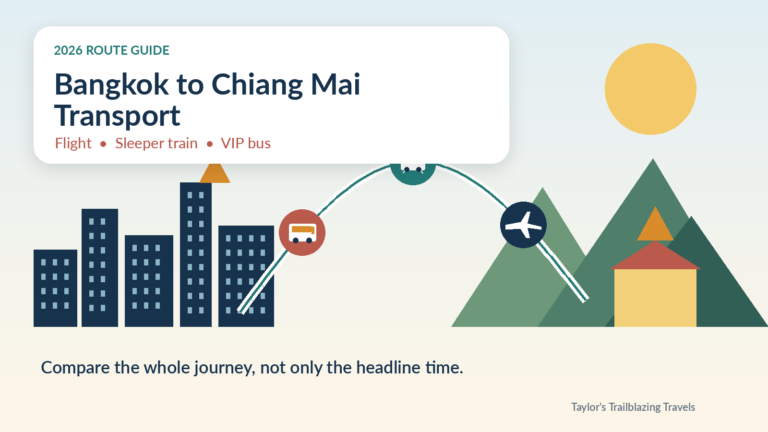
Original travel illustration inspired by the Bangkok-Hua Hin journey; not a photograph of a particular train service or station.
A practical place to begin
Bangkok to Hua Hin can be a pleasant daytime rail journey, an economical coach ride or a straightforward private transfer. The right choice depends less on the name of the vehicle than on where your day begins. A Bangkok hotel, Suvarnabhumi arrival and Don Mueang arrival each create a different set of practical decisions.
This guide works through those decisions in the order you need them: the real departure point, the ticket or vehicle, the luggage arrangement and the final ride to your accommodation. It also separates checked price examples from planning allowances, so an old fare or an attractive journey-time headline does not become a promise it cannot keep.
For the outward trip, you may want comfort or a worthwhile journey experience. For the return, a flight connection can make reliability and spare time more important. You can choose different options each way and build a better holiday as a result.
Reserved daytime train
Choose the exact station and class, then plan the short transfers.
Direct BKK coach
Useful only when the landing time and coach departure fit comfortably.
Private transfer
Compare an all-in vehicle quote with the whole group cost.
The final hotel ride
A Hua Hin station or terminal is not every resort reception.
Check the airport code and the actual railway station before booking a pickup. A familiar destination name is not a complete meeting instruction.
Bangkok to Hua Hin: choosing the right journey
A good Bangkok to Hua Hin journey starts with the address you are leaving, not a league table of transport types. From a central Bangkok hotel, the train can be an enjoyable part of the holiday. From Suvarnabhumi after a long flight, a direct airport coach or car avoids travelling into the city simply to come out again. With children, several cases or a resort outside central Hua Hin, a private transfer deserves a proper cost comparison rather than an automatic rejection as expensive.
The recommendations here are research-led planning judgements. They compare the number of handovers, likely comfort, luggage handling, flexibility and the consequences of a delay. They are not based on invented test rides. Published booking information was checked on 4 October 2026; exact seats, prices and operating times still need checking for your own date. [1] [2] [3]
Start with the least forgiving part
Ask which part of the day cannot move. A hotel check-in is usually flexible; an international flight is not. Therefore, a leisurely outward train journey and a more conservative return arrangement can be the right combination. There is no requirement to use the same mode in both directions.
Next, write down your actual departure point: a hotel, BKK airport or DMK airport. Add the full hotel address at the other end. A price advertised for Hua Hin may not cover Pranburi or Sam Roi Yot. Equally, a bus ticket ending at a northern terminal is not equivalent to being dropped at your reception. Those distinctions often matter more than a small difference in the headline fare.
Compare the whole trip, not just the ticket
The table gives deliberately broad planning allowances rather than a timetable. They include a realistic place in the day for the journey, but not a promise that traffic or trains will behave normally. Look up the particular service first, then add travel to its departure point, check-in and the final transfer.
Bangkok-Hua Hin options: a planning comparison · On a narrow screen, scroll the table sideways.
| Option | Time to set aside | Cost basis | Best fit / key check |
|---|---|---|---|
| Reserved train | Train 43 example: 3h 01m between stations; add both local transfers. [6] | Published second-class air-conditioned example: 330 baht on train 43; check your date and fees. [5] | A relaxed rail day with a manageable station journey. |
| City coach or van | Use the booked road duration plus terminal access, check-in and hotel transfer. | Per-person seat; baggage and local rides may be extra. | Budget-led travel from a convenient departure point. |
| BKK airport coach | Leave a generous landing-to-departure margin and add the northern-terminal hotel ride. | 381 baht was a dated September booking-partner example. [2] | An airport arrival that fits the actual timetable. |
| Private vehicle | A flexible road journey, still exposed to traffic and disruption. | Checked vehicle cards: 2,200 / 2,600 / 3,200 baht for sedan / SUV / minibus. [3] | Families or groups with a confirmed all-in quote and suitable luggage space. |
Prices checked 4 October 2026. The 381-baht coach reference is not a guaranteed future fare. Private-transfer exceptions and supplements are explained below. Time descriptions are planning guidance, not timetables.
How to read a low fare
For a solo traveller, a seat on public transport usually has an obvious financial attraction. However, the arithmetic changes when several people are paying for separate tickets and taxis at both ends. A family should compare the total travelling party, not multiply the cheapest adult fare while overlooking luggage and child-seat requirements.
Treat booking fees, optional insurance, luggage charges and hotel shuttles as separate lines until the supplier confirms they are included. Avoid comparing an air-conditioned reserved train seat with the lowest possible unreserved fare as though the products were identical. Similarly, an eight-seat van is not automatically comfortable for eight adults with eight large cases unless the operator confirms the actual layout.
Leave room for the arrival evening
A useful arrival-day plan contains one modest ambition: check in, eat nearby and perhaps walk on the beach. A prepaid activity immediately after the advertised arrival time removes the flexibility that makes an overland journey manageable. Although a fast transfer may get you there early, keeping the first evening uncommitted costs very little and protects it from becoming a sequence of rushed decisions.
Which Bangkok station should you use?
Do not choose a Bangkok station from an attractive photograph or an old blog headline. The State Railway of Thailand booking system identifies the departure station for the selected train. Bangkok has more than one railway departure point, and the name on the ticket is the one your driver needs. An old reference to Hua Lamphong should not override a current booking showing Krung Thep Aphiwat. [1]
Read all three identifiers
Check the station, train number and departure date together. Then check the arrival station is Hua Hin rather than a different stop on the southern line. Saving a screenshot of the complete ticket is more useful than remembering that you booked the morning train. Keep the original confirmation available offline as well, because a screenshot may omit ticket conditions or a barcode.
When arranging a taxi, send the full station name and specify that you need the passenger entrance for your train. At a large terminal, arriving at the building is not the same as being at the platform. Allow time to find the departure board, use the toilet, buy water and ask staff about boarding rather than arriving with the train already due.
The historic Hua Hin station is not the whole story
Hua Hin’s newer elevated passenger station opened beside the historic station in December 2023. Consequently, the familiar red-and-cream heritage building should not be treated as a guarantee of where you will board or leave a train. Follow current passenger signs and staff directions. Travellers needing lifts or step-free assistance should ask about the exact platform and working facilities before travel. [4]
For your arrival pickup, send your driver the current station meeting point rather than the location of a heritage photo stop. This small exchange is particularly worthwhile after dark, when two people can both believe they are waiting at the station while standing at different entrances.
Train classes, comfort and expectations
Cost references and illustrative calculations reviewed 4 October 2026; reconfirm actual quotes and inclusions.
A reserved daytime seat is the simplest starting point for most first-time visitors considering the train. Compare the accommodation description in the booking result, not just the train’s marketing label. Air conditioning, seating arrangement and reservation rules depend on the service selected; the official booking result is the place to establish what is actually available. [1]
A specific daytime train to investigate
Special Express 43 is a useful morning option to check. Richard Barrow’s Thai Train Guide identifies its Krung Thep Aphiwat departure, second-class air-conditioned seating and a Hua Hin fare of 330 baht. A separate Baolau-fed timetable displayed 07:30 to 10:31, a scheduled three hours and one minute, with the same starting fare when checked on 4 October 2026. These are corroborated published examples, not a confirmed seat or final checkout price for your date. [5] [6]
The same booking feed showed Rapid 171 at 15:10 to 18:44 with a starting fare of 94 baht. That lowest fare is not a like-for-like comparison with the air-conditioned seat on train 43. Compare the selected class and any agency charges before deciding that one departure is cheaper. A later train also changes your arrival evening, so check hotel pickup and dinner arrangements as part of the choice. [6]
Choose the experience you will enjoy
A train can offer a break from road traffic and the pleasure of watching the landscape change. Nevertheless, it is not a continuous beachfront ride, and a railway booking should not be sold to yourself as a scenic guarantee. Choose it because you are happy spending that part of the day on a train, including the possibility of stops or delay.
For a heat-sensitive traveller, confirmed air conditioning may be worth more than a low fare. For someone carrying a heavy suitcase, the decisive issue may be getting it through the station and onto the carriage. These are different priorities, so it is sensible for two travellers to choose different services without either making a poor decision.
Pack for your seat, not for an aircraft cabin
Keep a small bag with water, tissues, a light layer, charging equipment and anything needed during the journey. Place valuables where you can supervise them rather than relying on a distant luggage area. Before boarding, make sure you can lift or manoeuvre your own main bag; station assistance and carriage access should not be assumed.
Food availability and charging sockets should be treated as useful extras, not foundations of the plan. Eat beforehand or carry a simple snack that does not create mess or strong smells. Meanwhile, download the hotel address and pickup instructions so the final part of the journey does not depend on a working socket or a particular mobile signal.
Booking the train without creating a station mistake
Use the official SRT D-Ticket website to check the selected journey, or compare an agent’s offering while recognising that it may have different fees and ticket-delivery conditions. A booking agent is a convenience option, not proof that every train or fare is shown. Do not treat one sample fare as a tariff for every train: the class, service and booking charges matter. [1]
Before you pay
Check that the passenger names match the identity documents you will carry. Read how the ticket is delivered and what must be presented at boarding. Then review cancellation and change conditions before choosing a non-refundable ticket for a day that depends on an incoming flight.
A sensible booking order is to settle your arrival date and first night’s accommodation, select a train that fits the day, and only then organise the short transfers. Avoid building the day around a train copied from a year-old itinerary and discovering afterwards that its station, time or available class does not match the current result.
When the flight comes first
A scheduled landing time is not the moment you become available at a railway station. Immigration, baggage, customs, airport exit and the road or rail transfer all come afterwards. Because these stages vary, there is no honest single connection time that works for everyone.
When the flight arrives close to the last useful daytime train, choose between an airport-side onward option and an overnight stop rather than relying on every stage being quick. Paying for a reserved seat that you are unlikely to reach is not a saving. Conversely, spending a night in Bangkok can turn the train into a relaxed next-day departure rather than a race across the city.
Buses and vans from Bangkok city
City-departure buses and vans can be practical, particularly when their terminal is convenient for your accommodation. However, Bangkok is too large for the phrase city pickup to be meaningful on its own. Booking platforms list services with different departure points, arrival points and journey durations. Check the map attached to the actual product. [7]
Coach or minivan?
A full-size coach is worth considering when luggage space and a more substantial seat matter. A van may offer a convenient departure or shorter advertised journey, but its baggage arrangements deserve closer attention. Ask whether a large case needs a separate allowance or additional seat, and whether the published passenger capacity leaves room for your bags.
For either option, establish whether there is an onboard toilet or a scheduled comfort stop. Do not infer facilities from the word VIP. Vehicle substitutions can also happen, so any essential accessibility feature should be confirmed directly rather than assumed from a promotional picture.
Get the terminal right before leaving the hotel
Save the departure pin and the Thai-language terminal name where supplied. Show both to your driver. Arrive with enough time to find the company counter and confirm the platform; a large terminal can have several counters selling apparently similar journeys.
At the destination, ask where the coach actually stops before booking a hotel pickup. A cheap ticket followed by an unexpectedly long local transfer can still be a reasonable choice, but only when you have budgeted for it. For a late arrival, ask the hotel to confirm reception hours and how you will reach the property from that particular stop.
The Suvarnabhumi airport coach option
Cost references and illustrative calculations reviewed 4 October 2026; reconfirm actual quotes and inclusions.
For travellers landing at BKK, a direct Hua Hin coach can avoid a detour through central Bangkok. A recent Roong Reuang booking-partner listing showed airport departures and a fare of 381 baht for a dated September service. That is a useful price reference, not a guaranteed fare for your flight date. Earlier listings displayed different amounts and departure counts. Checked 4 October 2026. [2]
Budget sensibly, then check the live result
For initial planning, setting aside roughly 400–500 baht per adult for the airport coach gives more room than relying on an old lowest-price headline. This is an editorial allowance, not a published fixed tariff; booking charges and the onward hotel transfer may be additional. Recheck the current fare and the conditions for changing a missed departure before purchase.
The airport service’s departure instructions point passengers towards Level 1, Gate 8. Nevertheless, read your own confirmation in case the counter or operating arrangement changes. Do not wait on the international arrivals floor expecting the bus to appear outside it. [8]
Landing late changes the recommendation
Compare the coach departure with the time you realistically expect to be landside. When the last workable coach is doubtful, a pre-arranged car or an overnight stay is more robust than an optimistic non-refundable booking. Ask the coach provider what happens after a delayed flight; airlines and independent ground operators do not automatically protect one another’s bookings.
Also check the Hua Hin drop-off. The airport-coach terminal is north of the town centre, so the final hotel transfer matters, especially for accommodation farther south. A through ticket or hotel shuttle may solve that neatly, but it must be included explicitly rather than assumed from the destination name. [8]
When a private transfer earns its price
Cost references and illustrative calculations reviewed 4 October 2026; reconfirm actual quotes and inclusions.
A private car is most compelling when it removes several awkward tasks at once: finding a terminal, carrying bags through it, waiting for a fixed departure and arranging another taxi after arrival. It also allows a confirmed child seat and a sensible comfort stop to be discussed before travel. Those benefits may be worth more than the fastest advertised journey.
A dated real-world quotation
Hua Hin Cab’s vehicle cards displayed 2,200 baht for a sedan, 2,600 baht for an SUV and 3,200 baht for a minibus when checked on 4 October 2026. The page’s older introduction still contained lower figures, but a fuel-price notice and the vehicle cards showed the increase. The supplier describes the standard rate as including tolls, fuel, parking and VAT, with location and peak-period exceptions. Obtain a written final quote. [3]
For four people, a 2,600-baht vehicle works out at 650 baht each before any extras. That is simple division of the checked example, not a promise that four travellers and their luggage fit every SUV. The group comparison becomes meaningful only after the supplier confirms your cases, passengers and seat requirements.
Specify the service rather than just the car
Send the flight number, airport code, hotel address, passenger count and luggage description. Ask about waiting time after landing, how the driver tracks delays, where you meet and which number to contact if you cannot find each other. For a city pickup, give the hotel entrance rather than only a street name.
The same provider advertises a 200-baht child-seat supplement and location supplements including DMK and areas south of Hua Hin; these were checked on 4 October 2026. Confirm the appropriate restraint by the child’s age and size, not merely the phrase baby seat. A requested seat should appear in the written confirmation. [3]
Luggage, children and reduced mobility
Comfort is not a luxury detail when it determines whether the journey is workable. A traveller who can walk comfortably without luggage may still struggle with a heavy case, uneven boarding steps or a long platform approach. Similarly, a child who tolerates a short taxi ride may need a proper break during a longer transfer.
Ask questions that produce usable answers
Instead of asking whether a service is accessible, describe what you need: no steps, space for a folded wheelchair, assistance lifting a bag, a particular restraint or a toilet stop. Request an answer for the actual vehicle or train, not the route in general. An accessible station entrance does not by itself establish that the train carriage is accessible.
For families, carry the first few hours’ essentials separately from the main luggage. Water, spare clothing and a simple snack are more useful within reach than packed perfectly in a case underneath other passengers’ bags. Keep children’s travel documents with the adult responsible for checking in, and make sure everyone knows which bags must remain with the group.
Avoid an unnecessary rental commitment
Hiring a car solely to make the transfer can introduce paperwork, a deposit, parking decisions and unfamiliar driving at the very moment you are tired. A driver can remove those tasks while still allowing a door-to-door journey. Self-driving makes more sense when it is part of a considered wider itinerary, with the correct licence, insurance and confidence on Thai roads. Consult current official travel advice rather than assuming a vehicle rental proves you are properly covered. [9]
Match the arrival to your part of Hua Hin
The hotel pin is the final piece of the transport decision. Central Hua Hin, the southern beach corridor, Khao Takiab, Cha-am and Pranburi are not interchangeable drop-offs. Therefore, send the accommodation’s own location link to the supplier and ask whether the stated price covers it.
Central accommodation
For a central property, arriving by train can be convenient once you have arranged the short onward journey. Still, walking with luggage should be a choice based on the route, heat and pavement conditions, not a straight-line measurement on a map. A hotel can often tell you which entrance a driver should use and whether the property is easy to find after dark.
A city-centre base is also useful when you want meals and everyday errands close by. In that case, paying more for a remote beachfront resort simply to save a little on its advertised shuttle may be false economy. Compare your whole stay, not just the arrival ride.
Resorts beyond the centre
For Khao Takiab or a more distant resort, request the final transfer at the same time as the main ticket. Ask whether a hotel shuttle has fixed departures, requires advance notice or stops running before you arrive. A free shuttle that you cannot catch has no practical value.
When two hotels have similar room rates, one with a genuinely workable arrival arrangement may offer the better overall deal. However, do not assume a beachfront address includes airport transport. Check the room rate’s inclusions and keep the transport confirmation separate from the accommodation booking so both are easy to retrieve.
Three realistic booking examples
A couple already staying in central Bangkok
Imagine two adults with one medium case each, no flight that morning and a central Hua Hin hotel. They can choose a daytime train, organise the station transfer and leave the arrival evening free. Their comparison should include the cost and effort of reaching the correct Bangkok station, not only the rail fare. If the train’s available class or departure time is unattractive, a coach remains a sensible alternative rather than a second-rate substitute.
The practical question is whether they enjoy the journey they are buying. A very early departure may create an unnecessary hotel alarm and hurried breakfast; a later service may leave less beach time but produce a calmer day. Either can be right. A transfer is part of a holiday, so consider energy and preferences alongside the clock.
A family arriving from an overnight flight
Now consider two adults, a young child, a pushchair and several bags arriving at BKK. A direct coach could work if its departure is comfortably later than landing, the baggage policy fits and the final hotel journey is arranged. However, the family should also price a vehicle with a confirmed suitable child restraint. Avoid making the child-seat decision only after meeting the driver.
For this group, a moderate increase in total cost may eliminate several separate queues and luggage movements. That is a specific operational benefit, not a claim that private transport is always more luxurious. Conversely, a tired family should not be hurried into a car whose restraint or luggage arrangement is wrong merely because it is waiting outside.
A solo traveller protecting a flight home
A solo traveller may choose the coach for cost reasons, yet spend the last night near the required Bangkok airport. The extra overnight expense can be more useful than purchasing a more expensive vehicle on the morning of the flight and still having no disruption margin. Compare those two complete plans rather than comparing transport alone.
This does not mean every flight requires an overnight stop. It means deciding how much uncertainty you can tolerate and what missing the flight would cost. A flexible domestic connection and an infrequent long-haul departure deserve different levels of caution. Your return plan should reflect the consequence, not simply repeat the outward journey in reverse.
The final checks before departure
The evening before
Read the confirmation from beginning to end, including the meeting instructions and contact number. Check whether the time is in Thailand local time and whether it is a pickup, check-in or departure time. A hotel collection window is not the same as the vehicle’s main terminal departure. Put the full hotel address and booking reference in a note accessible without internet.
Next, look for any recent operator message. A platform email confirming payment may be followed by a separate message giving the actual boarding instructions. Save both. For a private transfer, confirm the number of passengers and bags once more if your plans have changed. An additional case or companion can affect which vehicle is appropriate.
At the counter or meeting point
Confirm the destination aloud and show the ticket before handing over luggage. Count your bags, keep valuables with you and note where the luggage is stored. With children or a group, nominate one person to manage the booking and another to keep the party together, rather than everybody leaving the bags to ask separate questions.
For a driver pickup, match the company and booking details rather than following the first person who offers a ride. When the agreed driver cannot be located, contact the number in the confirmation. Avoid sharing unnecessary identity-document images over an unfamiliar messaging account simply because someone claims they need them to find your booking.
When you reach Hua Hin
Check the seat area and luggage compartment before the vehicle or train leaves. Then open the hotel pickup instructions rather than accepting an alternative destination suggested by an unrelated seller. A saved hotel pin, a contact number and a clear pickup arrangement make the last few minutes considerably easier.
If there is a disagreement about a charge, refer to the written inclusions calmly and contact the provider. Keep the receipt and booking messages. The aim is to resolve the journey safely, not to negotiate while standing in traffic or holding up boarding. Good documentation helps most when it is available immediately, rather than buried in a suitcase.
Delays, weather and the return to Bangkok
The FCDO travel advice checked on 4 October 2026 reported severe flooding in parts of Thailand, including Bangkok and several neighbouring provinces. This is a reason to check route-specific conditions shortly before departure, not evidence that every Hua Hin service is cancelled. Ask the operator about your departure point and route rather than drawing conclusions from a national headline. [10]
Build a fallback before you need it
Keep the provider’s contact details, the hotel number and an alternative departure in your notes. When a train or coach is delayed, establish the revised arrival and whether your hotel pickup can move. Do not independently book a second non-refundable journey before checking whether the first one can still operate or be changed.
If a disruption makes a late arrival likely, tell the hotel while you still have a reliable connection. A message containing your name, booking date and approximate arrival is much more useful than simply saying you are delayed. Meanwhile, keep enough payment flexibility for an unexpected local transfer or overnight stop.
International flights need a different buffer
For the return, work backwards from your airline’s required airport arrival time, then add the full ground journey and a disruption margin. A three-hour road estimate is not permission to leave the beach three hours before departure. Traffic, a vehicle problem or a late train can consume the spare time quickly.
When missing the flight would be costly, returning to Bangkok the previous day is the strongest practical safeguard. Alternatively, choose an early departure and keep the rest of the day free. A private driver improves the number of handovers, but cannot make road closures or major congestion disappear.
Pros, cons and common mistakes
What each option does well
The train offers a distinct journey experience and can fit a central-Hua Hin stay well. A coach can keep the transport budget down while avoiding the need to drive. From BKK, a direct airport service is especially useful when it genuinely connects with your flight. A private transfer offers the fewest luggage handovers and the clearest door-to-door arrangement.
What you are trading away
Rail means working around a particular station and timetable. Coaches still need terminal access and may need a final taxi. Vans require close attention to bag space. Private transfers cost more for a solo traveller, and even a well-organised car remains exposed to road conditions. None is the best choice for every departure address and travelling party.
Errors worth preventing
The most avoidable mistakes are booking the wrong Bangkok station, treating BKK and DMK as interchangeable, assuming a Hua Hin terminal is your hotel, and comparing fares for different classes or vehicle sizes. Another common trap is committing to an onward activity or flight using the advertised arrival time with no margin.
Finally, do not let a lower number in an old introductory paragraph overrule a current booking screen or a more recent price notice. Where information conflicts, ask for a dated written confirmation. This takes a little effort before travel but can prevent an argument at a counter when your options are narrower.
Frequently asked questions
Is the train or bus better for Bangkok to Hua Hin?
The train suits travellers who want a rail journey and can conveniently reach the correct station. A bus may fit better when its departure terminal is close to the hotel or when the direct airport service saves a detour. Compare the entire route from your starting address to the hotel, including local transfers, rather than selecting a winner from the headline journey time alone.
Is a private transfer worth it for two people?
It can be, especially after a long flight or with a hotel outside central Hua Hin. Divide the confirmed vehicle quote by two, then compare it with two public-transport fares plus the necessary taxis. The extra money buys fewer handovers and more control over pickup, not immunity from traffic. A couple with light bags and a convenient train may reasonably prefer rail instead.
Can I travel directly from Suvarnabhumi without entering Bangkok?
A direct airport coach or pre-arranged car can make that possible. Check the coach’s exact departure time, counter instructions and Hua Hin drop-off for your date. Allow for immigration and baggage before choosing a bus. When your flight lands too late for a comfortable connection, use a confirmed car or stay overnight instead of depending on the last departure. [8]
What about Don Mueang airport?
Do not apply BKK coach instructions to DMK. Search specifically from Don Mueang, or arrange a private pickup with that airport named in the quote. A transfer between the two airports is an additional journey, not a minor terminal change. It may remove the savings of an otherwise attractive ticket and needs its own time allowance.
How far ahead should I book?
Book once your travel date is firm if a particular reserved seat, airport departure or suitable family vehicle matters. Weekends and holiday periods deserve more attention than a flexible midweek journey. However, booking early does not replace checking the final confirmation again before travel. Operators can adjust meeting points and schedules, so keep a contact number and review any messages.
Can I make Hua Hin a day trip from Bangkok?
It is possible, but the return transport can dominate the day. A very short beach visit is rarely a compelling reward for two long overland journeys. An overnight stay gives you an evening and a morning without repeating the same transfer immediately. For a specific appointment or event, a private return arrangement may be practical, provided waiting time is agreed beforehand.
Is it safe to rely on a taxi at the airport?
An official airport taxi arrangement is different from accepting an unsolicited offer. For a long-distance journey, establish the full price, destination, toll treatment and vehicle suitability before departure. A pre-booked transfer adds written meeting instructions and a contact point, which many first-time visitors find easier. Use current official safety advice and avoid making the decision solely because someone approaches you quickly. [9]
Do I need to book the same way back?
No. The outward journey can prioritise scenery or price, while the return prioritises reaching a flight reliably. It is sensible to use rail one way and a coach or car the other. What matters is that the return starts from a confirmed point, leaves enough spare time and fits the airport you actually need.
The recommendation: choose by starting point
For a central Bangkok stay with a relaxed departure day, compare a reserved daytime train first. When a BKK arrival comfortably fits the timetable, investigate the airport coach before paying to travel into town. For families, substantial luggage, late landings or distant resorts, get an all-in private quote and compare the whole group’s cost.
The most valuable booking detail is not a superlative such as fastest or cheapest. It is a complete chain: correct departure point, confirmed service, appropriate luggage space, realistic arrival time and a workable final transfer. Once those five pieces fit, Bangkok to Hua Hin becomes a straightforward part of the holiday rather than a collection of uncertain handovers.
Sources and fact-checking notes
Sources below were reviewed on 4 October 2026. Recheck operational details before travel. Illustrations are not used as evidence for routes, facilities or conditions.
- State Railway of Thailand: D-Ticket
Official booking portal. Select the actual train, departure station and class; no unverified fixed rail fare is assumed.
- Busaba / BusX: Roong Reuang Coach inventory
Booking-partner snapshot, not the coach operator. The 381-baht example was for a dated September departure; later availability can differ.
- Hua Hin Cab: vehicle rates and terms
Operator source. Vehicle cards show increased prices while the introductory paragraph retains older amounts; written final quotations take priority.
- Thai PBS: the new Hua Hin railway station
Contemporary Thai-language reporting on the elevated station opening in December 2023; not a present-day train timetable.
- Richard Barrow’s Thai Train Guide: Special Express 43
Independent rail specialist identifies the departure station, second-class air-conditioned train and 330-baht Hua Hin fare. Reconfirm the selected date with SRT.
- Thai Train Ticket: Baolau-fed Bangkok-Hua Hin timetable
Independent booking-feed page updated 4 October 2026, not an SRT-operated website. Sample times and starting fares exclude possible checkout fees and are not a seat reservation.
- 12Go: Bangkok-Hua Hin transport listings
Commercial comparison inventory. Some editorial text is older; use date-specific station, class and pickup information rather than legacy timings.
- Busaba / BusX: Suvarnabhumi to Hua Hin
Airport boarding and terminal information. Older price snapshots differ from more recent listings; use the live booking confirmation.
- FCDO: safety and security in Thailand
Official guidance on transport, personal safety and water activities. Check again before travel.
- FCDO: Thailand travel advice
Official, changeable advice. The review-day flooding notice does not establish disruption to every route.
Illustrations in this article were created for Taylor’s Trailblazing Travels. Third-party photographs, where used, are credited beside the image or in the source list.