Bangkok Layover Guide: 12 and 24-Hour Plans
Work backwards from the flight, then decide how much Bangkok genuinely fits.
A Bangkok layover guide should begin with the flight you must catch, not the attractions you hope to squeeze in. With twelve hours between flights, one compact city outing can sometimes fit. A twenty-four-hour stop can often support a meal, a short visit and a proper sleep. Neither automatically gives you twelve or twenty-four hours of sightseeing.
The decisive questions are whether you may enter Thailand, whether both flights use the same airport, what happens to your baggage, and how much usable daytime remains after airport and transport allowances. Suvarnabhumi uses the code BKK; Don Mueang uses DMK. They are separate airports, not two terminals connected by a quick walk. Check both codes before making any city reservation. [1][2]
The plans below use conservative editorial allowances and ordinary operating conditions. They are not minimum connection times approved by an airline. When disruption, immigration uncertainty or significant fatigue makes the calculation doubtful, staying at the airport or using a suitable nearby hotel is a successful layover plan, not a wasted opportunity.
Can you enter Thailand?
TDAC is not a visa, and an airside connection differs from a landside visit.
One small outing at most
Subtract every airport and transport block before choosing a sight.
Protect useful sleep
Flight timing can make the next morning entirely unavailable.
Fix the city departure time
Delays shorten sightseeing, not the return margin.
Bangkok layover guide: decide whether to leave first
Four conditions must all work
Consider a city outing only when entry permission is clear, luggage has a workable arrangement, the return journey has generous time and you are comfortable abandoning optional sightseeing. A long connection with unresolved visa eligibility is not a usable city day. Neither is a short daytime window surrounded by several hours of formalities and transfers.
Ask the operating airline how your actual ticket is handled. A single booking reference, checked-through baggage and an onward boarding pass can influence the process, but they should not be treated as interchangeable guarantees. Separate tickets require particular care because a delayed first flight may leave you responsible for the missed onward departure.
Choose the least complicated version
For a first layover outing, one district, one main stop and one meal are usually enough. A private car can reduce some decisions, but it cannot remove road traffic or immigration requirements. A guided excursion can provide structure, but it cannot guarantee your onward flight when the timetable is too tight.
Use the airport or hotel version when the numbers do not work. The purpose of a layover is to connect successfully and arrive at the next destination in reasonable condition. Sightseeing is a bonus that must fit around those objectives. A plan that remains pleasant after removing an attraction is more suitable than one that only feels worthwhile when every minute runs perfectly.
| Connection | Useful default | Reason |
|---|---|---|
| 12 hours, mostly daytime, same airport | One compact outing only after the time budget works | Entry, baggage and return conditions must all be clear. |
| 12 hours, mostly overnight | Eligible airside rest or an airport-area room | The clock gap contains little practical sightseeing time. |
| 24 hours, early next-day departure | One afternoon, early dinner and sleep | The next morning belongs to the airport transfer. |
| 24 hours, evening departure | Sleep, one morning visit and lunch | Keep the city departure fixed. |
| BKK-DMK change or active disruption | Prioritise transfer and a simple rest plan | Extra uncertainty reduces the case for sightseeing. |
Editorial decision guide reviewed 3 October 2026, not an airline-approved minimum connection standard.
Check entry permission before paying for anything
Leaving the transit area can mean entering Thailand
You need the appropriate permission to pass immigration and go landside. A transit itinerary does not automatically grant entry, and the Thailand Digital Arrival Card is not a visa. The Thai e-Visa service and the relevant embassy are the starting points for requirements tied to your nationality, travel document and purpose. Confirm the position before boarding your first flight. [4][5]
For British and Irish passport holders, the Thai Embassy in London states that the tourism visa-exemption scheme changed from 15 September 2026 to a maximum of thirty days and normally two entries per calendar year. This was checked 3 October 2026. A short layover visit can still be an entry, so a frequent visitor should not assume it is outside the count. [6]
Use the requirements for your own documents
The UK government's advice for British citizen passport holders specifies passport validity of at least six months on arrival and at least one blank page. Other travel documents or nationalities can have different requirements. Keep onward travel evidence and any other required documents available, and seek consular guidance when the situation is unclear. [7]
Do not plan to resolve a material eligibility problem at the airport counter during a short connection. An onward boarding pass, a hotel booking or a paid tour is not a substitute for entry permission. Travellers who cannot establish eligibility should use an authorised airside connection arrangement confirmed by the airline rather than treating sightseeing as the default.
Complete TDAC correctly for a landside visit
Airside transit and entry have different requirements
The Immigration Bureau's TDAC guidance says travellers who remain in transit without passing immigration do not need the arrival card, while those leaving the airport do. It also states that children and infants require their own traveller entries. Complete the official form within the stated three-day advance window, including the arrival date, when your plan involves entering Thailand. Checked 3 October 2026. [8]
Use the official government service rather than paying an intermediary for a form that is free. Keep the confirmation accessible offline. The card records arrival information; it does not approve a visa, guarantee admission or remove the time needed for passport control. [5]
Do not invent information to make the form work
Use your actual flight details and the truthful accommodation or same-day departure information requested by the current form. A short connection without a hotel can raise questions about which fields apply. Check the official guidance or contact the appropriate authority rather than entering a random hotel address supplied by a travel blog.
When travelling as a family, review each person's passport details and arrival date. A group submission can make the process more convenient, but it does not make the entries interchangeable. Keep the relevant confirmations with the traveller who will present them, and allow for a phone or email access problem rather than relying on a single live inbox at the immigration desk.
Build the time budget backwards
Start with the airport return target
First, record the scheduled departure time and the airline's actual check-in, bag-drop and boarding requirements. For the examples here, I use a target of being at the departure airport three hours before an international flight, plus separate journey and contingency allowances. This is an editorial planning choice, not a claim that every airline has the same rule or that three hours always suffices.
Next, subtract the journey back from the city, the time needed to retrieve any stored baggage and an additional margin for uncertainty. What remains is the latest city departure, not the time to start thinking about leaving. Set an alarm for that point before you begin sightseeing.
Then subtract the arrival side
Allow for leaving the aircraft, any terminal movement, immigration, baggage and finding transport. Use more time when you have bags to reclaim, assistance arrangements, children or an unfamiliar airport process. A flight's landing time does not tell you when you will be outside the terminal.
Finally, subtract the outward journey. Only the remaining block is city time. If that block is too short for the visit you had in mind, change the visit or stay near the airport. Do not recover the missing time by deleting the return buffer. That buffer is protecting the onward journey, while the sightseeing remains optional.
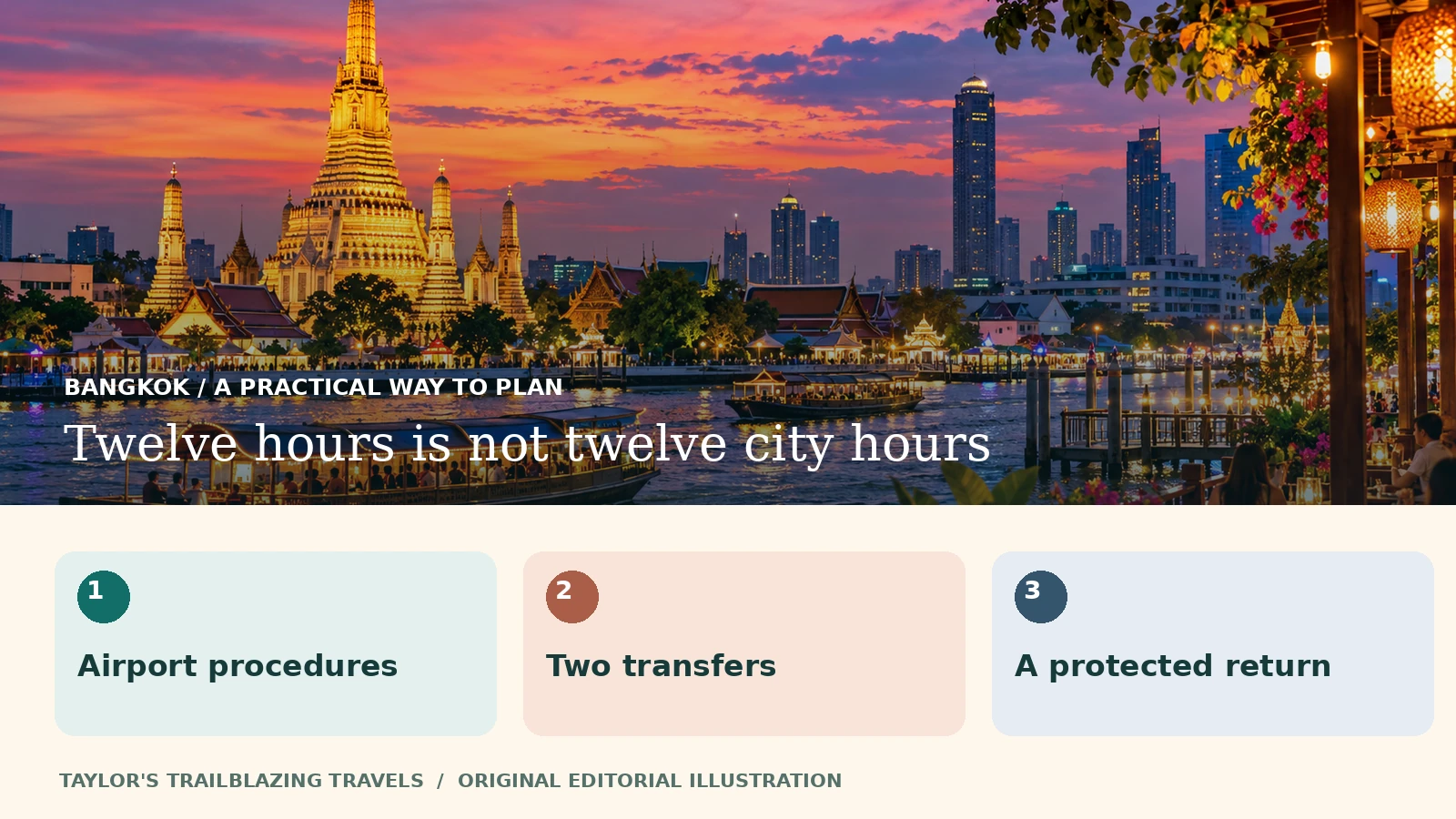
A twelve-hour BKK plan with a daytime connection
Worked example: landing 07:00, departing 19:00
For this example, allocate 07:00-09:00 to arrival procedures and sorting bags, then 09:00-10:30 to reaching the selected city area. Reserve 10:30-14:00 for one visit and lunch. Leave the city at 14:00, allow until 15:30 for the return, hold 15:30-16:00 as contingency and be at the airport by 16:00 for the 19:00 departure.
The arithmetic is deliberate: twelve hours minus two for arrival, ninety minutes each way, three for departure formalities and thirty minutes of contingency leaves three and a half hours in the city. These are example allowances under ordinary conditions, not measured journey guarantees. Increase them when your actual circumstances require it.
What fits inside three and a half hours
Choose a single anchor, such as Wat Pho with a nearby lunch, or a compact modern-city stop if the rail route is simpler. Do not attempt the Grand Palace, Wat Pho, Wat Arun and Chinatown together. Even a short boat crossing introduces another queue, boarding point and return dependency.
When the outbound journey runs late, shorten the city block while preserving the 14:00 departure. If you reach the area so late that lunch and a brief look around are all that fit, accept that version. The fact that you have already travelled into Bangkok is not a reason to risk the onward flight by extending the stay.
| Local time | Allocation | Hours |
|---|---|---|
| 07:00-09:00 | Arrival formalities, baggage and transport decision | 2.0 |
| 09:00-10:30 | Outward city transfer | 1.5 |
| 10:30-14:00 | One visit and lunch | 3.5 |
| 14:00-15:30 | Return to BKK | 1.5 |
| 15:30-16:00 | Separate contingency | 0.5 |
| 16:00-19:00 | Airport departure process | 3.0 |
Total 12 hours. Example allowances prepared 3 October 2026; not a forecast of immigration or traffic. Preserve 14:00 city departure when delays occur.
A simple city outing for that twelve-hour window
The old-city version
For the worked example, Wat Pho is a possible anchor because the visit can be kept to one site. Its official visitor information lists general hours of 08:00-19:30 and a THB 300 admission charge, checked 3 October 2026. Your layover does not require using the whole opening window; it requires a visit that ends early enough for the return plan. [9]
Have lunch nearby, then begin the journey back. Skip the river crossing and any second timed activity. A three-hour city experience can still feel worthwhile when it contains one place you actually want to see and time to eat without hurrying.
The easier-transport version
A stop around a useful rail connection may be preferable when the old-city transfer is awkward. A seated meal and a short walk can be enough, especially after an overnight flight. Choose a place you can leave easily rather than a venue with a lengthy internal route, fixed finishing time or unpredictable queue.
A guided visit is optional. Tell the operator the airport, flight time and the latest acceptable return, and ensure the proposed itinerary is genuinely shorter than your maximum window. Do not book a standard full-day excursion and assume the guide will make it fit. The operator's willingness to accept the booking is not proof that the connection is sensible.
Twelve hours overnight: treat sleep as the main activity
A long clock gap can contain little sightseeing time
A connection from 20:00 to 08:00 is twelve hours, but most of the usable interval falls at night. After arrival formalities and a transfer, a late city meal may be all that remains before a very early return. This is a different proposition from the 07:00-19:00 example, even though the flight schedule shows the same number of hours.
For many travellers, an eligible airside rest option or a suitable airport-area hotel is the better use of the gap. The benefit is sleep and a simpler morning, not proximity to a famous district. Confirm whether the hotel is landside or airside, whether you may reach it with your itinerary, and which terminal or concourse it serves.
Check the room's actual time window
An overnight booking, a day-use room and an hourly stay are different products. Confirm when you can enter the room, when you must leave and whether transfers operate at the hours you need. A hotel that is near the airport by distance may still require a shuttle wait or a road journey.
Also confirm the calendar date. A room needed just after midnight can be easily booked for the wrong night. Write the check-in and check-out times in full when contacting the property. Clear timing matters more than an attractive room description when the entire purpose of the booking is to preserve a few hours of useful rest.
Twenty-four hours: a city stay with an early next-day flight
Worked example: 09:00 arrival, 09:00 departure next day
Allocate the morning to arrival and the transfer, then have lunch and leave bags with a hotel that has confirmed storage. Do not assume a midday arrival guarantees room access; check the property's actual check-in time or purchase an agreed early arrangement. Once the room is available, take a short rest before one manageable afternoon visit.
Have an early dinner and return to the hotel with time to prepare the morning. For a 09:00 international departure, the example target is the airport by 06:00. If you allow ninety minutes for the transfer and thirty minutes of contingency, leave the hotel around 04:00. That early start should influence the previous evening's choices.
Do not count the next morning as sightseeing time
A twenty-four-hour connection with an early departure is mainly one afternoon, one evening and a shortened night. There is no sensible temple visit before the airport in this example. A 21:00 bedtime and 03:30 wake-up would provide only six and a half hours in bed, before accounting for how quickly you fall asleep.
Choose a hotel for a straightforward departure, not only for the view. A useful room, a confirmed early transfer and a simple dinner can produce a much better stopover than a late cruise followed by a rushed few hours of sleep. The city experience should support the onward trip rather than consume all the energy needed for it.
| Part of the stop | Practical plan | Check before booking |
|---|---|---|
| Arrival morning | Formalities, transfer and lunch | Do not assume immediate hotel room access. |
| Afternoon | Confirmed room time and one modest outing | Keep the attraction close enough to the hotel. |
| Early evening | Dinner, preparation and an early night | Avoid a late fixed-duration experience. |
| Around 04:00 next day | Leave hotel under the example allowance | 90-minute transfer plus 30-minute contingency. |
| By 06:00 | At departure airport for the 09:00 flight | Use actual airline requirements if more time is needed. |
Illustrative local times prepared 3 October 2026. Normal conditions only; the next morning is not a sightseeing block.
Twenty-four hours with an evening onward flight
More daylight does not require more bookings
For an 18:00 arrival followed by an 18:00 departure the next day, use the first evening for arrival, a meal and sleep. Then plan one morning outing, lunch and the return. Under the example allowance of ninety minutes to the airport, thirty minutes of contingency and three hours before departure, leave the city by 13:00.
That can provide a useful morning without sacrificing the night. However, the first flight must actually arrive close enough to schedule for the plan to remain comfortable. A late arrival that turns bedtime into the early hours should reduce the next morning's ambition, even when the clock still shows several free hours.
Keep the hotel and outing connected
Choose a morning visit that is easy to reach from the hotel and leaves a simple route back for luggage. Do not cross the city to begin a tour that ends in another district shortly before your return deadline. A shorter independent visit may offer more control than a group activity with a fixed finish.
If the hotel can hold bags, confirm when and how you will retrieve them. If you check out before the outing, keep documents, medicines and the items needed for the flight with you. A bag-store receipt and a pickup plan are small details, but they can become the final source of delay when the sightseeing itself has run smoothly.
Don Mueang: use a separate transport calculation
Do not reuse a BKK route unchanged
Don Mueang has its own road and public-transport connections. The Red Line links the airport area with Krung Thep Aphiwat, where onward city travel may require another connection. That is not the same route as the Airport Rail Link from Suvarnabhumi. Confirm the train, station access and final city destination rather than assuming any airport rail journey ends near your intended attraction. [2][10]
For a short layover, a simpler city stop may be more useful than insisting on the historic river area. The relevant question is how much comfortable time remains after the return plan, not whether a particular attraction is technically reachable.
Apply the same decision discipline
Use actual airline requirements, leave time for baggage handling and check whether the onward flight is domestic or international. Those details can change the airport process, but they are not a reason to assume the shortest possible buffer. An unfamiliar departure, separate tickets or a terminal change deserves additional care.
A booked transfer can reduce uncertainty about pickup, yet the driver cannot guarantee road conditions. Share the exact airport and terminal information and confirm waiting rules. When a twelve-hour gap is mostly overnight, choose the hotel or airport version just as you would at BKK. Don Mueang's position on a map does not convert every connection into a convenient city visit.
Changing between BKK and DMK
Airport transfer comes before sightseeing
An airport change requires leaving one airport and completing the onward process at another. It is not an airside connection. Establish entry eligibility, baggage arrangements and the ground journey before considering any attraction. A nominally long gap can shrink quickly when the transfer itself is the main task. [1][2]
AOT publishes an inter-airport shuttle for qualifying connecting passengers, with documentation and operating conditions that should be checked for the journey. Do not assume it is a sightseeing bus or that a seat is instantly available whenever you reach the stop. A road alternative may be necessary when timings or eligibility do not suit. [1]
Use the destination airport as the anchor
For a connection with substantial uncertainty, transfer to the departure airport area first and then decide whether any nearby meal or rest option fits. This reduces the risk of finishing a city outing on the wrong side of a long ground journey. The attraction you skip is less costly than a missed flight.
When booking private transport, spell out both airport codes and the flight details. Confirm passenger and luggage capacity, pickup instructions and whether waiting or tolls are included. Do not combine the transfer with several sightseeing stops unless the total schedule remains generous even after delays. The fact that a car passes through Bangkok does not make every district a free stop on the way.
Baggage, boarding passes and re-entry to departures
Check the bag tag rather than assuming
Ask the airline where your checked bag is tagged to and whether you must collect it. A bag checked through to the final destination may simplify the layover, but you should not plan to access it during the connection. Keep essential medicines, documents and what you need for the stop in permitted hand luggage.
With separate tickets, baggage collection and a fresh bag drop may be required. The onward counter may not accept bags many hours before departure. Confirm that timing before assuming you can leave everything at the airport and spend the day in town. A luggage-storage facility, where available, has its own location, hours and conditions.
Airside access is not unlimited
Leaving the secure area does not guarantee that you can return whenever you choose. Your boarding pass, flight timing, airline process and airport controls determine the next steps. If you plan to return early for a lounge or airside hotel, confirm that the itinerary actually permits access at the intended time.
Keep the distinction between arrival, transfer and departure services clear. A lounge in an international departure area may be irrelevant to someone waiting landside for check-in to open. Likewise, a hotel described as being at the airport may require entry into Thailand. Check the side of the border and the precise location before paying, not after arrival.
Lounge, airport hotel or city hotel?
Match the product to the problem
A lounge can provide seating, food and a quieter environment for a limited period, but it is not automatically a bedroom or an overnight stay. Confirm the permitted duration, opening hours, guest age rules and whether showers are included or subject to availability. Check that it is in the correct departure area for your flight.
An airport hotel is more suitable when uninterrupted sleep is the main objective. However, landside access, shuttle timing and room check-in rules still matter. A city hotel adds the possibility of a meal or a short outing nearby, but also adds travel in both directions. Compare the whole rest period rather than only the room price.
Calculate usable sleep
Subtract the transfer, check-in, shower, packing and morning preparation from the apparent overnight gap. An eight-hour interval between reaching a hotel and leaving it is not necessarily eight hours of sleep. The result may favour a closer property even when the nightly rate is higher.
For a family or a traveller who needs reliable rest, a private room can be more valuable than another attraction. For someone with a shorter airside wait, a lounge may be adequate. Neither choice needs to be justified by sightseeing. A layover plan should solve the problem you actually have: fatigue, hunger, a long wait or a manageable opportunity to see part of the city.
Booking transport without buying false certainty
Confirm the details that are under the operator's control
Ask for the meeting point, waiting period, vehicle size and how the driver is contacted after a delay. Confirm whether the booking is one-way or return and whether the return pickup has a separate time and location. A photograph of a vehicle is not evidence that your luggage fits or that an appropriate child seat is supplied.
State the latest acceptable airport arrival, not only the flight departure time. This helps the operator understand your requirement, although responsibility for choosing a sensible connection remains with you. Avoid a tour whose normal duration leaves almost no margin when your flight information is taken into account.
Keep timing claims in perspective
A transfer's advertised duration is usually not a guarantee for every road condition. A premium vehicle, a guide or a fast-track service cannot make an unsuitable connection suitable by removing all uncertainty. Do not purchase a service on the assumption that it replaces immigration permission or permits you to ignore the airline's deadlines.
Have a way to contact the provider without relying on a single messaging app. Save the address and booking details offline, and keep the phone charged. A mobile data plan can make coordination easier, but check device compatibility, activation rules and whether the plan provides only data rather than a local voice number. Buy only the connectivity you actually need.
Stress-test the plan before committing
What a ninety-minute delay actually changes
Return to the twelve-hour example with a 19:00 onward departure. The city departure remains 14:00, even if the inbound flight lands ninety minutes late. Assuming the same arrival and outward-transfer allowances, city arrival shifts from 10:30 to noon. The available outing becomes two hours rather than three and a half. A meal and a brief visit may still be comfortable; the original temple-and-lunch version may no longer fit.
Now add an unexpected baggage problem or a slower transfer. The city window can become too small to justify the journey at all. That is the point of setting a latest outbound decision time. It gives you a clear alternative before money already spent, excitement or frustration starts influencing the return deadline. The normal plan should have a smaller companion plan, and the smaller plan should have an airport-only fallback.
Ask whether both journeys depend on the same weak link
A route that relies on the last useful train, one particular shuttle or a tight boat connection has a single point of failure. Consider what happens when that service is unavailable. Can you take a car, and would the remaining time still be sufficient? If the answer depends on perfect traffic or an immediately available vehicle, the original outing needs a larger margin or a simpler destination.
This does not mean avoiding public transport. It means understanding the alternative before using a time-sensitive service. A train can be an excellent choice when the connection, operating hours and final destination fit. The problem is assuming that its published running time accounts for everything from the aircraft door to your attraction and back again.
Distinguish a protected itinerary from personal assumptions
Ask the airline what happens after a missed connection on your particular ticket and whether any voluntary landside outing affects assistance or arrangements. Do not infer the answer from the presence of a booking reference alone. An agent's description of a through journey is worth clarifying when you also have an airport change, separate baggage handling or flights operated under different conditions.
For independently purchased flights, compare the practical consequences of a missed departure before deciding how much sightseeing risk is acceptable. This guide does not promise that an airline or insurer will cover the result. Read the relevant conditions and ask the provider about the actual itinerary. Understanding the potential consequence can make an airport meal and a useful rest feel much more attractive than another short city stop.
Check the local date on every reservation
A flight departing shortly after midnight belongs to the next calendar date, even though you may think of it as the same evening. A hotel night, lounge booking and car pickup can therefore require different date entries. Write each event with its date, local time and airport code, then compare the sequence from beginning to end.
Do the same after a schedule change. Updating the flight in your calendar does not automatically update the hotel, driver or arrival-card information. Contact the relevant provider and confirm the revised details. A small date error can create a much larger problem than choosing a slightly less convenient sightseeing district, so resolve these basics before refining the city route.
Costs: separate the outing from the connection
List only what changes when you leave
The incremental cost of a city outing can include two transfers, luggage storage, admission, meals and possibly a room. Those costs should be compared with an airport meal, lounge or nearby hotel, not with zero. However, do not assume the city is automatically better value because some individual meals are cheaper.
For a Wat Pho-only outing, the published admission is THB 300 per adult, checked 3 October 2026. Transport and any hotel or lounge price require a live quote for your time and party. This guide deliberately does not invent one fixed layover total that would conceal those differences. [9]
Put the cancellation conditions beside the price
A flexible transfer or room can be worth more than a small saving when the first flight may be delayed. Read whether a missed pickup, changed flight number or late arrival is covered. A provider's general promise of free cancellation may have a deadline that passes before your incoming flight departs.
For a short stop, avoid buying several non-refundable activities. One modest booking that fits the confirmed window is easier to manage than a chain of commitments. Keep enough money available for an alternative return journey, and do not let the cost already spent on a tour persuade you to stay in the city after the planned departure time.
Delays, disruption and the point to abandon the outing
Decide the trigger before you land
Set a latest time for leaving the arrival airport and a latest time for reaching the city. If either passes, use the shorter plan or stay near the airport. This removes the pressure to renegotiate every lost minute after arrival. A delayed flight should reduce the sightseeing window, not reduce the protection around the onward flight.
Also decide which activity disappears first. A museum or second neighbourhood is easier to remove than lunch or the return journey. The simplest city plan may become a meal and a short walk. That is acceptable when it remains comfortable, but do not travel a long way merely to prove that you left the airport.
Current warnings override ordinary examples
At review on 3 October 2026, FCDO reported severe flooding affecting Bangkok. The normal-condition transfer allowances in this guide should not be relied on during active disruption without fresh confirmation. A short layover is a poor setting for experimenting with uncertain road or river access. [3]
When conditions are unclear, use the airport or nearby-hotel version and follow current airport and local instructions. Do not enter floodwater, and do not assume a return route remains usable because the outward journey succeeded. A layover has a fixed endpoint; that makes conservative decisions more valuable than they might be on a flexible multi-day city stay.
Families and travellers who need assistance
Every transition has a practical cost
Children, pushchairs, mobility equipment and assistance arrangements can make a short outing more complicated than a route map suggests. Add time for toilets, food, seating and boarding. The best family layover may be a private room, an easy meal and a brief local outing rather than a famous attraction across the city.
Confirm appropriate child restraints with a vehicle provider in advance. Do not assume a standard taxi or transfer supplies the equipment you need. For mobility assistance, contact the airline and relevant services before travel, and verify the full route to any hotel or lounge. An accessible room is not enough when the transfer or entrance remains unsuitable.
Keep the group together without overloading one person
Make sure more than one adult holds the key flight, hotel and contact details when possible. Keep children's documents and essential items accessible, but avoid a packing arrangement that requires unpacking every bag at each checkpoint. A clear division of responsibilities can reduce stress more effectively than adding another travel gadget.
Choose a shorter city window than the maximum arithmetic permits. The spare time is useful when a meal takes longer or a child needs rest. A plan that requires everyone to move at their fastest pace is not a realistic family plan, even when the adult version appears to fit the flight schedule.
Pros and cons of leaving the airport
Where this works well
Change of environment
One meaningful stop, a meal or a private room can improve a long connection.
Clear examples
Separate airport and transfer blocks make the usable window visible.
Trade-offs to allow for
More uncertainty
Entry, baggage, traffic and check-in rules can erode the city window.
Not always worth leaving
Overnight gaps, airport changes and flooding may favour staying nearby.
What makes the outing worthwhile
The benefit is a change of environment: a real meal, one place you wanted to see and perhaps a proper bed. A well-timed city stop can make a long connection feel like part of the holiday rather than a gap between flights. This is strongest when entry and transport are uncomplicated and the itinerary remains small.
The trade-off is additional uncertainty and effort. Immigration, baggage, traffic, hotel timing and the return process all need attention. A longer connection is not automatically a recommendation to leave. The outing becomes worthwhile only when the likely experience is better than the simpler airport or hotel alternative while leaving a comfortable margin for the next flight.
Common layover mistakes
Counting the same hour twice
A frequent error is allocating a full afternoon to sightseeing while also assuming that immigration, luggage and the city transfer happen inside no time at all. Another is treating the scheduled landing as the moment you step into a car. Write the sequence in order and give every stage a real block of time.
Do not count an airport buffer and then use part of it for luggage retrieval or a meal outside the terminal. Those are separate tasks. The return target should refer to the point at which you are ready to begin the required departure process, not to the moment you reach the edge of the airport area.
Booking first and checking eligibility later
Entry permission, airport codes and baggage handling come before activities. A hotel reservation does not resolve a visa issue, and an onward ticket does not make BKK and DMK the same airport. Confirm the fundamentals before paying for a city tour, especially when the first flight's timing is uncertain.
Finally, avoid the idea that leaving the airport is always the more adventurous or successful choice. A comfortable connection with enough sleep may improve the next several days of your trip. The best layover decision is the one that fits the actual travel conditions, not the one that produces the most photographs before boarding.
Frequently asked questions
Can I leave Bangkok airport during a twelve-hour layover?
Sometimes, provided entry eligibility, baggage arrangements, airport locations and usable daytime all support it. The worked BKK example leaves three and a half city hours after explicit airport, transport and contingency allowances. Your own window may be shorter. During disruption or significant uncertainty, stay at the airport or use a suitable nearby hotel instead. Twelve hours on a ticket is a starting point for calculation, not automatic permission or a guarantee of a city visit.
Is a twenty-four-hour layover enough for an overnight city stay?
It can be, but the flight times determine the experience. An early next-day departure may require leaving the hotel around 04:00, making a late evening unattractive. An evening departure can provide a more useful morning after sleep. Confirm the hotel's check-in and checkout rules, transfer arrangements and entry eligibility. Plan one modest outing around the rest period rather than treating the stay as a complete two-day Bangkok visit.
Do I need TDAC when I stay airside?
The Immigration Bureau states that transit passengers who do not pass immigration do not need TDAC, while travellers leaving the airport do. The card is separate from visa or entry eligibility. Confirm that your actual connection remains airside, particularly when tickets or baggage arrangements are separate. Airline instructions about your flights should take precedence over assumptions based only on the word transit in a booking description. [8]
Can I leave without collecting checked baggage?
Only when the airline's actual baggage arrangement allows it. Check the destination on the bag tag and ask whether collection is required. Do not assume that a long connection means your bag will be returned, or that separate bookings automatically share a through-check arrangement. Keep essentials in permitted hand luggage because a bag checked to the final destination may be inaccessible throughout the stop.
Is the Airport Rail Link useful for every Bangkok layover?
It can help with a BKK journey when its hours, connection and final destination fit, but it is not a direct service to every attraction or hotel. Don Mueang uses a different rail arrangement. Add the station walk, any interchange and the last part of the journey when calculating time. A train's running time alone is not a reliable measure of the airport-to-attraction transfer. [1][10]
Should I buy a fast-track service to make a tight outing work?
Do not use a paid service to justify a timetable that otherwise looks too tight. Such services have eligibility, availability and operational limits, and they do not replace entry permission or eliminate all airport procedures. Begin with a connection that is comfortable under ordinary conditions. Any assistance should improve convenience within that plan rather than being the only reason the onward flight remains reachable.
Can I sightsee while changing between BKK and DMK?
Only when the complete airport-change process leaves a genuinely generous margin after entry, baggage, road travel and departure requirements. The safer default is to complete the transfer towards the departure airport first. A cross-airport connection is not a free city tour simply because the road passes through Bangkok. When the margin is unclear, prioritise the flight and choose an easy meal or rest option instead.
What is the single most useful rule?
Set the city departure time before leaving the airport and keep it fixed. Any delay should shorten the outing, not shift that deadline later. Combine this with a simple route that still feels worthwhile after one stop is removed. The rule prevents the common temptation to recover lost sightseeing time from the very buffer intended to protect the onward flight.
Final recommendation: protect the flight, then add the city
For a twelve-hour daytime connection under normal conditions, consider one compact visit and lunch only after the entry, bag and return calculation works. For twenty-four hours, prioritise a useful room and a sensible sleep period, then add one outing around them. An overnight twelve-hour connection is usually a rest problem rather than a sightseeing opportunity.
During active disruption, uncertainty about entry or an awkward airport change, choose the simpler plan. Bangkok will still be worth visiting on a trip with more time. A successful layover leaves you at the correct airport, ready for the onward flight, without having spent the entire connection worrying about whether you will make it.
Sources and fact-checking notes
Research reviewed 3 October 2026. Venue charges and ordinary schedules are dated examples; current closures, weather and operator instructions take precedence. Suggested durations and spending allowances are editorial planning judgements, not guaranteed journey times or live quotes.
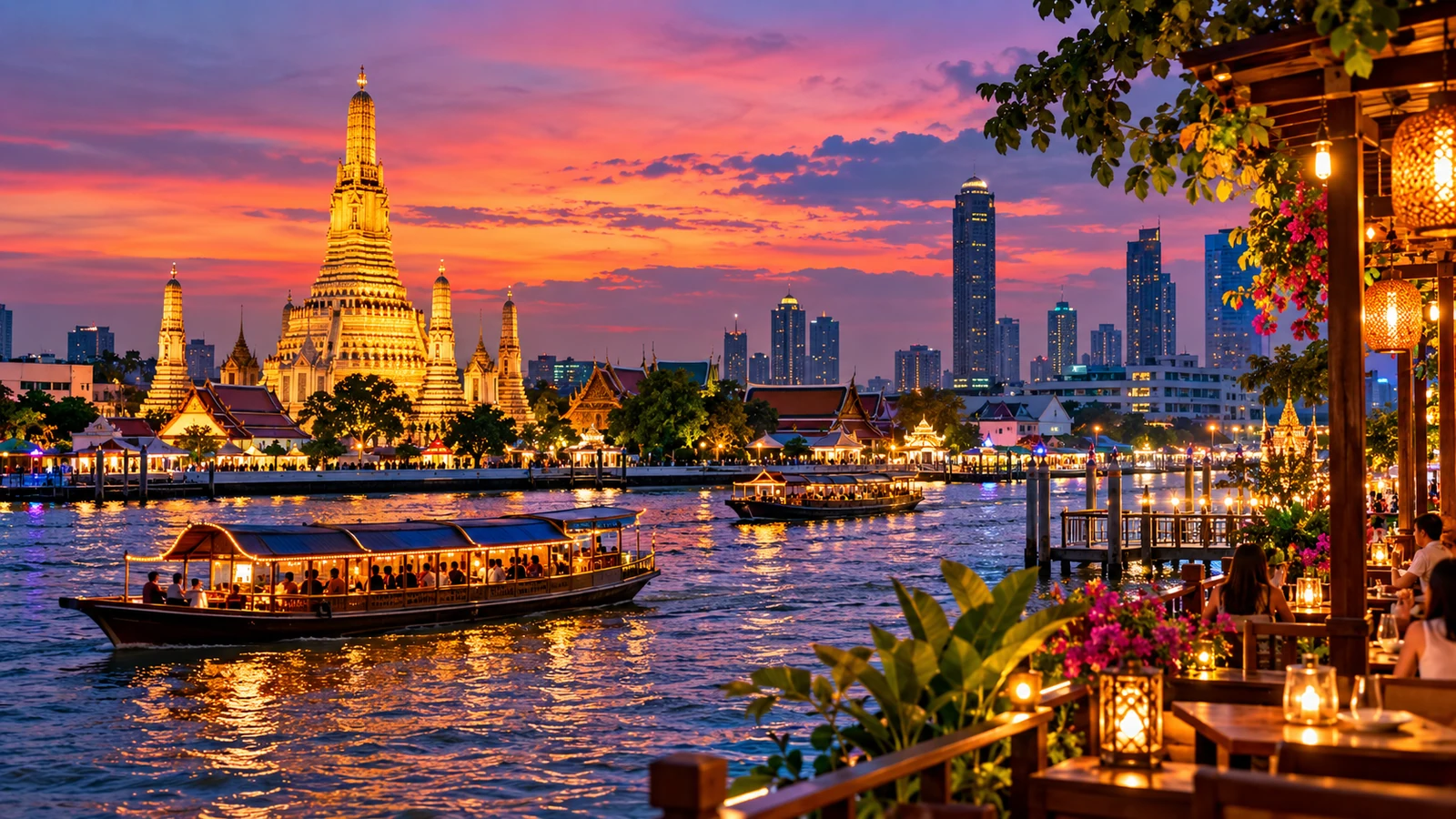
Illustrations are original, generated, Bangkok-inspired scenes. They are not documentary photographs, verified views from a named hotel or exact route maps.
- Airports of Thailand: BKK transport guide Airport Rail Link and landside transport. Times in the itinerary are separate editorial allowances.
- Airports of Thailand: Don Mueang Airport identity, facilities and onward-transport information.
- FCDO: Thailand travel warnings Flooding warning reviewed 3 October 2026. Check fresh advice before using normal-condition plans.
- Ministry of Foreign Affairs: Thai e-Visa Check nationality, travel document, purpose and applicable visa category.
- Royal Thai Embassy London: entry and TDAC announcement Official entry guidance; TDAC remains separate from permission to enter.
- Royal Thai Embassy London: September 2026 visa-exemption revision Announcement dated 8 September 2026, effective 15 September; British and Irish tourism exemptions and calendar-year entry limit.
- GOV.UK: Thailand entry requirements British-citizen passport guidance; not a substitute for requirements applying to another nationality.
- Thai Immigration Bureau: TDAC frequently asked questions Airside-transit distinction, children and submission timing.
- Wat Pho: official visit plan THB 300 admission, published visitor hours and under-120-cm child exemption. The contact page separately starts at 08:30; plan an 08:30 or later arrival.
- SRT Electrified Train: Red Line network Don Mueang and Krung Thep Aphiwat on the Red Line.
Illustrations in this article were created for Taylor’s Trailblazing Travels. Third-party photographs, where used, are credited beside the image or in the source list.