Bangkok with Kids: A Realistic 3-Day Itinerary
Three enjoyable mornings, predictable meals and enough flexibility for the whole family.
Bangkok with kids is easier when the itinerary is built around meals, rest and a few experiences that genuinely interest the children. Three days give you room for a temple and river outing, an indoor city day and a play-led morning. They do not require three full days of moving from one ticketed attraction to another.
The plan below is designed primarily for a family with children of roughly primary-school age, with separate adjustments for toddlers and teenagers. It assumes three full days in Bangkok rather than counting a late arrival as day one. Each morning has one main purpose, every afternoon can be shortened, and evening activities remain optional. The hotel is part of the plan because a usable rest break can make the following day much better.
This is a research-led itinerary, not a claim that the writer has personally tested every venue with children. Choices were made by considering travel between stops, opportunities to sit or play, weather alternatives and the practical needs of different ages. Current venue information is cited, while suggested visit lengths are editorial allowances rather than promises about how your family will feel.
A short historic-city visit
One temple is enough; the boat is optional and depends on boarding conditions.
Choose the right indoor stop
SEA LIFE is paid and optional; BACC is a different cultural alternative.
Let children lead some play
Check the Chatuchak museum schedule and which areas are operating.
Beds and an achievable break
The right room and midday return support the next morning.
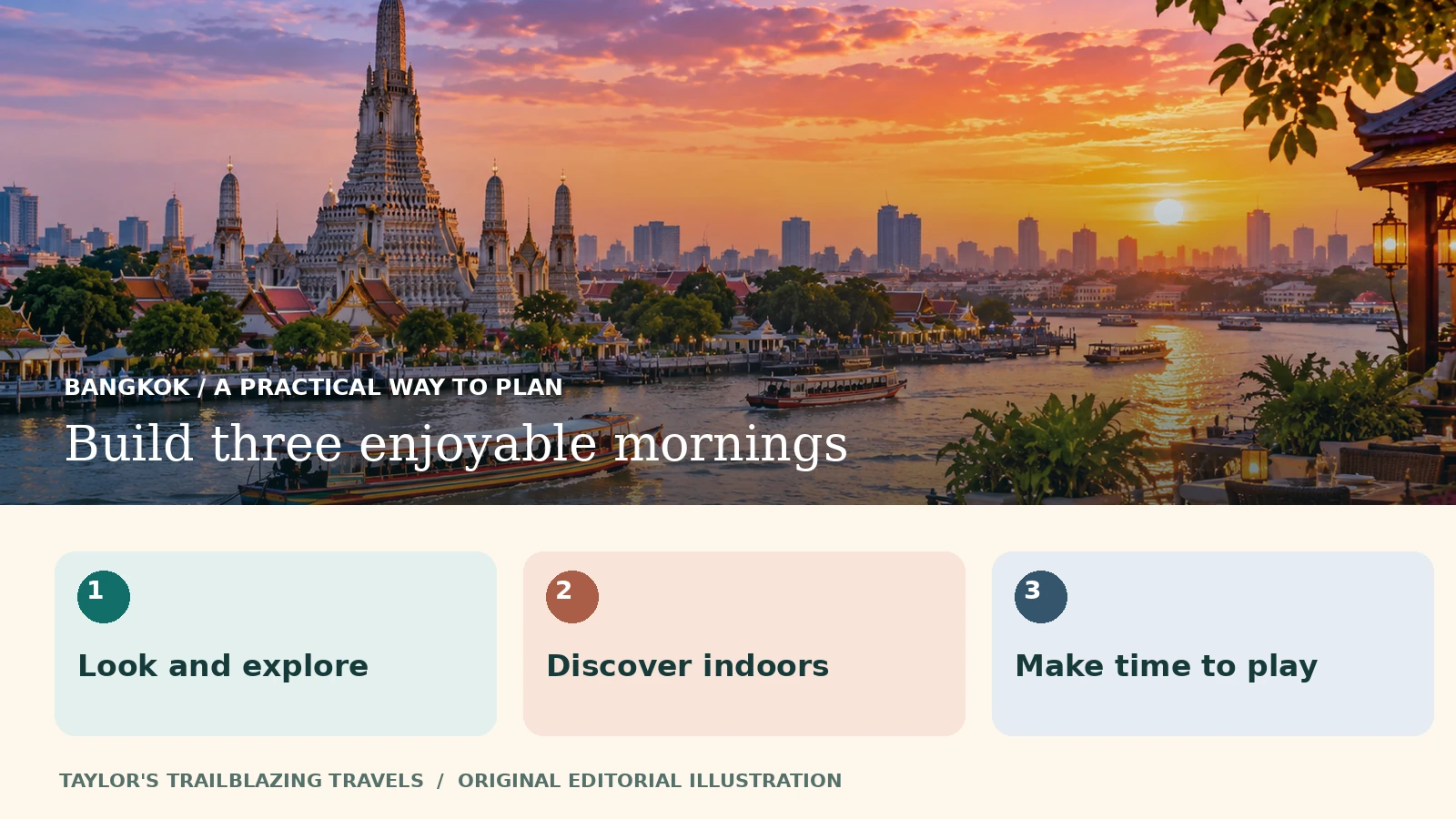
Bangkok with kids: the three-day shape
One main outing each morning
Day one introduces the historic city with Wat Pho and an optional short river journey, followed by a proper hotel break. For day two, choose an indoor experience around Siam, with SEA LIFE as a paid option and BACC as a cultural alternative. Day three gives children more control through a visit to the Children's Discovery Museum in Chatuchak when it is open. [1][2][3][4]
These are three different kinds of morning, not a ranking of attractions by importance. The variety is intentional: looking, discovering and playing ask different things of children. A family is more likely to enjoy the trip when every day does not repeat the same pattern of walking quietly through adult-selected sights.
The afternoon is a choice, not an unfinished morning
Use afternoons for the pool, a nap, a short local outing or a simple meal. Older children may want another activity; younger children may need a familiar room and less stimulation. Neither response makes the itinerary unsuccessful. Agree one optional afternoon idea in advance and drop it without debate when the morning has been enough.
The table assumes ordinary access and transport conditions. At review on 3 October 2026, FCDO reported flooding affecting Bangkok. Check current local conditions before following the outdoor or river elements, and use the shorter hotel-and-indoor version when routes are disrupted. [5]
| Day | Main morning | Later choices |
|---|---|---|
| Day 1 | Wat Pho; optional short river outing | Seated lunch, hotel break and an easy dinner. |
| Day 2 | SEA LIFE or BACC when suitable and open | Siam lunch, then hotel or one age-appropriate activity. |
| Day 3 | Chatuchak Children's Discovery Museum when open | Lunch, a short park pause or an early return. |
Suggested order reviewed 3 October 2026. Reorder for Monday closures, current weather and the family's ages. Arrival day is separate.
Choose accommodation for family routines
Confirm the beds, not the room label
A family room can mean several different sleeping arrangements. Ask how many separate beds there are, whether a sofa bed will be made up, and whether the booked category legally and comfortably accommodates everyone. Put children's ages into the reservation rather than searching only for two adults and assuming the rest can be added later.
Connecting rooms need particular care. A request is not the same as a guaranteed connection, and two rooms on the same floor may not solve your family's needs. Obtain written confirmation when the arrangement is essential. Also ask about a cot, lift access, breakfast conditions and whether the pool will be available during your dates.
Make the midday return achievable
A hotel close to useful transport can support short outings and predictable rest. A riverside property with more room and a pool can also work, but check how its shuttle or road connection fits your actual days. Chatrium's own information, for example, describes guest boat links to Sathon Pier and ICONSIAM; the timetable still needs to be checked for your stay. [6]
Do not choose solely by the lowest nightly rate. Add the cost and effort of repeated journeys, the need for extra beds and the value of a practical breakfast. A slightly less decorative room with the right layout and location may be a better family purchase than a striking hotel that makes every outing difficult.
Arrival day is not one of the three sightseeing days
Keep the first few hours uncomplicated
After a long flight, focus on reaching the hotel, eating and getting the room arrangement working. An early arrival may need an agreed early check-in or a luggage-storage plan; ordinary check-in time should not be confused with your flight's landing time. A bag store is useful, but it does not provide a shower, a bed or a private place for an overtired child.
Prepare one easy meal option near the hotel. Avoid making the first evening dependent on a distant restaurant reservation or a long boat excursion. A short walk and an early meal can be enough to begin the trip without consuming the energy needed for day one.
Arrange the transfer for the actual party
Specify the airport code, flight, passenger count, children's ages and luggage. BKK and DMK use different airport and rail arrangements, so a booking for Bangkok Airport is not sufficiently precise. Confirm an appropriate child restraint in writing with the provider; do not assume a standard car includes the equipment your family needs. [7][8]
A vehicle that seats the passengers may not fit all the suitcases and a pushchair. Ask about both. Keep essentials accessible during the journey and have the hotel's full address saved offline. The aim is to make arrival a controlled transition rather than the first test of how much discomfort the children can tolerate.
Day one, morning: Wat Pho in a child-sized visit
Give children something specific to notice
Begin with a short, clear purpose rather than a long lecture. Children might look for decorative patterns, compare the size of the reclining Buddha with familiar objects or choose one detail they want to remember. The task should help them look around, not turn the visit into another school worksheet with a required correct answer.
Wat Pho's official page lists general opening hours of 08:00-19:30 and foreign admission of THB 300, checked 3 October 2026. The same page lists free entry for children under 120 cm; reconfirm the applicable rule at the entrance rather than assuming it applies across all temples. Plan an earlier visit and follow the instructions for individual buildings. [1]
Stop before interest is completely exhausted
For many families, approximately an hour to ninety minutes is a useful planning block, but let the children's attention determine the actual pace. You do not have to see every corner. Leave enough energy for the meal and journey afterwards. A calm first temple visit can create curiosity; an overlong one can make the next cultural stop harder.
Explain respectful behaviour simply before entering: appropriate clothing, quiet voices where requested, no climbing on religious objects and care around people who are worshipping. Do not rely on repeated corrections once everyone is hot and distracted. A private guide can help when they genuinely adapt to children's ages, but confirm that the proposed visit is shorter and more interactive rather than an adult tour with a family label.
Day one, late morning: a short river experience
The boat can be the activity
A brief journey on the river can provide plenty of novelty without adding another full temple visit. Ask which service matches your intended trip and where you will get off. Public boats, cross-river ferries and sightseeing products have different tickets and stops. Avoid buying a long excursion simply because it is the first option offered at the pier. [9]
Check the boarding conditions with your children and equipment in mind. Moving boats, gaps and changes in level can make a short journey less simple than it appears. Ask about suitable lifejackets and follow crew instructions. If the conditions do not feel appropriate, stay on land and enjoy the river from a suitable public place instead.
Keep the exit simple
Choose a journey that leaves you near lunch or a practical route back to the hotel. The goal is not to maximise the distance covered on the water. A one-way adventure that finishes far from your next meal can become a problem precisely when everyone is ready to stop.
Wat Arun can replace, rather than automatically follow, Wat Pho for a family particularly interested in that setting. Its steps and current access need to suit the children, and the boat journey must still work. This guide does not make both temples compulsory. One visit and one transport experience are enough for a first family morning in the city.
Day one, afternoon: lunch, room and pool
Choose lunch before the morning starts
Have a seated option in the same broad area and an alternative nearby. The important qualities are suitable food, a manageable wait and somewhere the family can regroup. A meal does not have to be famous to be useful. Decide whether children need a familiar dish first, with tasting something new as an extra rather than a condition of eating.
Return to the hotel while the rest break still has value. If the hotel is too distant for a meaningful pause, shorten the whole outing and have a longer lunch instead. Travelling a long way back for twenty minutes in the room does not provide the benefit the itinerary is trying to create.
Pool time is not automatic childcare
Use the pool only when it is open and suitable for your children, and supervise actively. Check depth, access and the setting rather than relying on a family-friendly label. A pool can be the children's favourite part of the day, but it should not become another required activity when someone simply needs sleep.
Keep dinner close to the hotel on this first full day. Families with older children may choose an early Chinatown meal, but only when the return is easy and the morning has not been too tiring. The core itinerary is already complete. An optional evening should add enjoyment, not create pressure to prove that the day contained enough sightseeing.
Day two: choose one indoor anchor around Siam
SEA LIFE is an option, not a compulsory family expense
SEA LIFE Bangkok is located in Siam Paragon. Its official visitor page lists daily opening from 10:00 to 20:00 with last entry at 19:00, checked 3 October 2026. A general FAQ elsewhere on the operator site shows earlier closing, so use the dated opening-hours calendar and confirm the visit date. A morning visit avoids depending on the disputed final hour. [10] The aquarium can be a useful indoor choice, but some families may prefer a cultural or play-based alternative. [2]
Look at the standard admission product before buying a bundle. The operator offers packages with additional experiences and other attractions, yet those extras only have value when the children want them and the schedule has room. A discount on activities you will skip is not a saving.
Check the ticket category carefully
At review, the operator's ticket page used a child category of ages two to eleven and displayed date- and product-dependent pricing. Enter the actual party and visit date rather than copying a single advertised from-price into the family budget. Some add-on experiences have separate age and consent conditions. [11]
Consider your family's preferences about captive-animal attractions as well as budget and interest. This itinerary does not require an aquarium to work. You can choose the BACC alternative and a relaxed Siam lunch, then use the saved money or time elsewhere. The right indoor morning is the one that your family is comfortable choosing.
The BACC alternative: shorter, flexible and lower-cost
Make art a conversation rather than an endurance test
BACC can suit children who enjoy looking at pictures, discussing unusual objects or choosing favourites. Its official information lists Tuesday-Sunday opening, 10:00-20:00, with ordinary exhibition admission free and special events potentially charged, checked 3 October 2026. Check the current programme because the content varies, and not every exhibition is aimed at young visitors. [3]
Choose a limited area and let each child select something to talk about. A twenty-minute engaged visit is more useful than an hour of reluctant walking. Avoid promising interactive play unless the current activity actually provides it; an art centre is not automatically a children's discovery museum.
Practical facilities can influence the choice
The centre's visitor information lists lift access, accessible toilets and a changing room on the third floor. These details can make the visit easier, but confirm the current arrangement when a particular facility is essential to your family. Use the official visitor page rather than assuming every cultural venue offers the same amenities. [3]
On a Monday, swap this option for another verified indoor activity or simply keep the Siam visit shorter. Do not travel there hoping the normal closure might not apply. An itinerary with children benefits from deciding these alternatives before breakfast, when a disappointment at a locked entrance can still be avoided.
Day two, lunch and the afternoon choice
Keep the meal near the morning venue
The practical advantage of the Siam area is that your indoor morning and lunch can remain in one broad district. Choose the meal based on what the family needs at that point: familiar food, a quiet table, a quick service or a longer sit-down break. Do not turn the search for the perfect lunch into the afternoon's main activity.
Give each child a small amount of agency, such as choosing between two suitable meal options or selecting one thing to browse afterwards. Too many choices can be as tiring as no choice at all. Clear boundaries help the day remain manageable without making every decision feel imposed.
A class can replace the afternoon, not extend it
A family-appropriate cooking class can be an alternative for older children who enjoy hands-on activities. Confirm the minimum age, supervision, use of knives or heat, dietary handling and whether the advertised session includes a market visit. The total commitment includes travel and arrival time, not only the period in the kitchen.
Younger children may be better served by a hotel return and an easy dinner. There is no need to follow an aquarium with another major paid attraction to justify being in the city. Three days allow you to distribute experiences rather than stacking them into one demanding afternoon.
Day three: Children's Discovery Museum in Chatuchak
A morning designed around doing rather than looking
The Children's Discovery Museum gives the third day a different emphasis. Bangkok's municipal learning directory describes it as a venue for children up to twelve, with spaces for play and learning. The municipal Culture, Sports and Tourism Department lists ordinary opening Tuesday-Sunday, 10:00-16:00, closed Monday, and free admission, checked 3 October 2026. [4][12]
Use the Chatuchak location, not another similarly named children's venue elsewhere in Bangkok. Confirm current access, any registration requirements and which activity areas are operating before travelling. Individual sessions or facilities can change even when the building's general schedule remains the same.
Do not promise a specific activity without checking
Some descriptions mention water play, science, building and other activity zones. Treat these as an indication of the museum's character, not a guarantee that every feature will be available on your date. If water play is operating and suitable, you may need a change of clothes; ask the venue what is required rather than packing on the basis of an old visitor photograph. [4]
Plan the morning around what the children engage with. There is no requirement to complete the whole museum. A child who spends a long time on one activity is not falling behind the itinerary. Leave enough time for lunch and the journey back, especially when the museum is farther from your accommodation than the first two days' stops.
Day three, afternoon: park, hotel or an early finish
Choose one nearby extension at most
A short park visit can complement the museum when the weather and children's energy suit it. However, do not assume that proximity on a map makes every entrance easy to reach. Choose the specific park area and route before leaving the museum, and keep the walk short enough that it remains a change of scene rather than another major excursion.
If conditions are hot, wet or otherwise uncomfortable, return to the hotel after lunch. The museum has already provided the day's main activity. A three-day family itinerary is not improved by making the last afternoon the hardest simply because it is the final chance to add something.
Keep the weekend market optional
Chatuchak's market name may make adults tempted to add a long shopping visit. Consider whether the children actually want that experience and whether the route, crowds and timing suit them. A brief, purposeful browse is different from several hours of unstructured shopping. It should not displace food, rest or the agreed return time.
For an onward journey the next morning, use part of the afternoon to organise bags and confirm the transfer. Let children keep one familiar activity or meal in the evening. Finishing the Bangkok stay calmly can make the next travel day easier, which matters more than adding one final attraction that nobody has much energy left to enjoy.
Adjust the itinerary for toddlers and teenagers
Toddlers need a different success measure
For a toddler, a short boat viewed from shore, an hour in a suitable indoor space and a predictable nap can be a full day. Reduce the temple visit, choose the easiest meals and keep the room close enough to return when needed. Do not treat a child's refusal to continue as evidence that Bangkok is unsuitable; it may simply mean the adult version of the itinerary is too long.
A familiar bedtime routine can be more useful than another evening outing. Keep essential items available and check the room's safety features on arrival. Ask about a cot or bed arrangement before booking rather than relying on a request made at reception after a long flight.
Teenagers deserve a say in the priorities
Older children may prefer food, photography, shopping, contemporary art or a hands-on class to a play museum. Ask each teenager to choose one meaningful interest, then make room by replacing a block in the core plan. The route should change with age rather than carrying the same activities forward indefinitely.
Give them clear boundaries around time, meeting points and spending, while allowing some choice inside those limits. A teenager who helps select lunch or the afternoon activity is more likely to engage with the rest of the day. The aim is a shared trip, not a schedule in which adults choose everything and then wonder why enthusiasm is uneven.
When children want different things
Divide a block only when the logistics stay simple
Two adults travelling with children of different ages can sometimes split a short activity block, with one taking an older child to an exhibition while the other chooses a suitable quieter space. Agree the meeting point, time and communication method first. Keep both groups inside an area where reconnecting is straightforward, and do not create separate cross-city journeys merely to satisfy every preference at once.
A single adult should not feel obliged to reproduce that arrangement. Choose the activity that is manageable for the whole party and give the older child another small decision, such as lunch or a short browse afterwards. The itinerary needs to fit the adults who are actually travelling, not an imaginary version with unlimited supervision.
Agree a stop signal without making it a negotiation
Use a simple family rule that anyone can ask for a pause. The response can be a drink, a seat or a shorter visit rather than automatically ending the whole day. When a child knows a break is available, the outing may feel less overwhelming. Adults benefit from the same rule, particularly when heat, carrying equipment or poor sleep has made the morning harder than expected.
Pushchairs, trains, cars and river boarding
Choose equipment for the actual transitions
A compact pushchair can be useful for naps and indoor movement, but it does not make every pavement or pier easy. Think through the complete route: hotel entrance, vehicle, station, final walk and venue. A short journey with several awkward changes may be harder than a longer direct one. Ask about the details that matter rather than relying only on the word accessible.
Rail can avoid some road uncertainty, yet lifts may be at a different exit from the shortest mapped walk. Use official station information and leave time to find the appropriate route. Do not carry heavy equipment onto a moving escalator simply because another traveller makes it look routine. [13][14]
Use cars when they solve a genuine problem
A suitable booked vehicle can help with airport luggage or an awkward family transfer. Confirm the child restraint, vehicle size and the method of contact. A fare quote is incomplete when it does not address the equipment required to carry the children appropriately. Keep written confirmation with the booking.
For river travel, be prepared to change the plan if boarding is unsuitable. Hold children securely, keep bags manageable and follow crew instructions. A boat ride should remain an enjoyable optional experience, not something the family feels obliged to attempt because it appeared in the itinerary. There are plenty of ways to see Bangkok without making every form of transport part of the trip.
Food, allergies and predictable meal breaks
Introduce new food without making hunger a test
Offer unfamiliar food alongside something the child is likely to eat. A family trip is not the ideal setting for an argument about whether every meal must be adventurous. Simple dishes, fruit prepared appropriately and familiar restaurant options can coexist with trying Thai food. The objective is a well-fed family that has enough energy to enjoy the day.
Plan the next meal before the current activity runs long. Waiting until everyone is hungry can lead to a complicated restaurant search at exactly the wrong moment. Keep a suitable snack available, but do not let snacks continually postpone a proper seated break.
Specific dietary needs require specific communication
For an allergy, communicate the exact allergen and concern about cross-contact rather than relying on a broad English label. Use a professionally prepared translation or other reliable communication method where helpful, and confirm directly with the venue. No neighbourhood, price level or food-tour description can guarantee that every kitchen can meet a particular medical need.
Families managing serious allergies or other health conditions should plan with their clinician before travel, carry the prescribed essentials and know how to obtain help. Keep that information accessible to more than one responsible adult when possible. The itinerary can suggest convenient meal breaks, but it cannot replace individual medical preparation or a venue's confirmation about what it can safely provide.
Heat, rain and recognising when to stop
Reduce exposure through the timetable
The early-outing and afternoon-rest pattern is a practical way to avoid continuous time outside. Choose shade and indoor pauses, offer regular drinks and use clothing appropriate for the weather. NHS guidance notes that children are more vulnerable to heat-related illness and recommends reducing strenuous activity in hot conditions. This is general travel planning, not personalised medical advice. [15]
Do not describe a child's unusual tiredness or distress as bad behaviour without considering whether the conditions are unsuitable. Stop the activity and seek appropriate help when needed. Confusion, collapse or other signs of possible heatstroke require urgent medical attention; do not continue the itinerary or wait for a planned hotel break. [15]
Rain changes the route, not only the clothing
Keep an indoor alternative and avoid depending on a long outdoor queue. During flooding or significant disruption, follow local advice and stay out of floodwater. The fact that an attraction normally opens does not confirm that the journey to it is suitable for a family that day. Current conditions should determine whether the outdoor plan goes ahead. [5]
A spare change of clothes can be useful, but equipment cannot make every weather situation appropriate. The simplest response may be a shorter outing, a hotel meal and a different plan tomorrow. Three days provide some flexibility; use it rather than trying to preserve the original order regardless of conditions.
Budgeting for a family rather than multiplying adult prices
Enter the real ages and room occupancy
Children's admission categories vary by venue, and hotel pricing depends on the exact room and bedding. Do not take an adult-only estimate and multiply it by the number of travellers. Check each paid attraction separately, including whether a child ticket depends on age, height or another condition. For SEA LIFE, use the current ticket page and your actual visit date. [11]
Wat Pho's published child exemption is height-based: under 120 cm, checked 3 October 2026. Do not substitute an age estimate for that condition. The Children's Discovery Museum has free admission according to the municipal FAQ, while BACC's ordinary exhibitions are generally free with exceptions for special events. All were checked 3 October 2026. [1][12][3]
Reserve money for flexibility
A family budget should allow for a direct car when the children are exhausted, an extra seated meal or a replacement plan after a closure. That reserve may contribute more to the trip than another prepaid attraction. Keep airport transfers and accommodation separate from the activity budget so their costs remain visible.
Compare bundles only after deciding what the family will use. A package that adds a second attraction, photo product or experience can increase the day's length as well as its price. The budget table is a checklist of components, not a promise that one fixed amount covers every family. Use live quotes for the dates, ages and room configuration you actually need.
| Component | What to check | Budget treatment |
|---|---|---|
| Hotel | Confirmed beds, occupancy, breakfast and cancellation | Live quote for actual dates and all children. |
| Wat Pho | Published adult THB 300; free under 120 cm | Checked 3 October 2026; reconfirm at the entrance. |
| SEA LIFE | Actual child ages, date and chosen ticket product | Use the operator or retailer checkout total. |
| Children's Discovery Museum | Chatuchak location and current registration | Municipal FAQ says free admission; checked 3 October 2026. |
| BACC | Ordinary exhibition versus special event | Ordinary exhibitions free; checked 3 October 2026. |
| Transport | Seats, luggage, pushchair and child restraint | Quote the suitable vehicle, not an undersized headline offer. |
| Flexibility | Extra car, suitable meal or changed plan | Keep a reserve rather than prepaying every activity. |
Planning checklist dated 3 October 2026. No universal family total or promotional from-price is presented as a confirmed cost.
The small day-bag system
Pack for the next outing, not all three days
Keep the bag centred on water, appropriate snacks, a spare layer or change where needed, essential medicines and the information required for the journey. Add only the items that match that morning's activity. A museum morning and a river outing do not necessarily require the same load, and carrying everything every day can make the adult responsible for the bag unnecessarily tired.
Use separate, easily reachable places for documents, wipes and a change of clothes. The purpose is access, not a complicated organising system. You should be able to find what is needed without emptying the bag onto a station floor or restaurant table.
Make the phone useful without making it indispensable
Save the hotel address, transport details and any tickets offline. Keep emergency and provider contacts somewhere another adult can access. A local data plan can help with maps and messages, but confirm that the device is compatible and whether the plan includes calls or only data. [16]
Choose a clear meeting point when entering a busy place and tell children what to do if separated, in a way appropriate to their age. The plan should be simple enough to remember. A calm adult, a known location and accessible contact details are more useful than a complicated set of instructions that nobody can recall when needed.
Pros and cons of this family itinerary
Where this works well
Varied mornings
Architecture, an indoor experience and play avoid repeating one demanding format.
Room to adapt
Afternoons can become a nap, pool time or an early finish.
Trade-offs to allow for
Fewer adult highlights
Several major sights are deliberately left for another visit.
Individual needs differ
Toddlers, teenagers and access requirements need their own adjustments.
What the structure protects
The plan gives each day a different emphasis and avoids making every outing a full-day commitment. It also uses the hotel deliberately, rather than treating rest as time left over after sightseeing. That can make Bangkok more manageable for children who need predictable meals or a quiet pause between unfamiliar experiences.
The trade-off is that adults will leave some major attractions out. Families with very active teenagers may want more, while families with toddlers may still need less. The itinerary is not a claim that one schedule suits every child. Its strength is the clear structure and the permission to replace or remove a block without losing the purpose of the day.
Common family-planning mistakes
Buying too much before knowing the pace
Prepaying several attractions for each day can make the family feel obliged to continue after interest or energy has gone. Book the important, suitable experiences and keep the rest flexible. A discount does not create extra hours or change a child's tolerance for queues. Leave room to discover which kinds of outing work best after the first morning.
Another mistake is assuming that family-friendly means the same thing everywhere. It might describe a room's occupancy, an activity's marketing or the presence of a children's menu. Ask about the practical details you need: sleeping arrangements, toilets, access, supervision and age rules. Specific answers are more useful than a reassuring label.
Forgetting the adults' workload
A plan can look easy for the children while leaving one adult carrying everything, navigating every transfer and arranging every meal. Share the tasks where possible. Agree who checks the route, who holds tickets and who supervises children during transitions, then keep the arrangement simple enough to change when someone needs a break.
Finally, avoid using other families' highlight photographs as a measure of success. A short temple visit, a playful museum morning and a favourite hotel breakfast may be the memories your children keep. The best itinerary supports those experiences rather than demanding that they resemble someone else's much faster trip.
Frequently asked questions
Is Bangkok suitable for a first trip with children?
It can be, when the itinerary is paced around your family's ages and needs. Choose useful accommodation, limit each morning to one principal outing and make meals and rest predictable. The city does not require a full schedule of major attractions to be interesting. Families who need specific medical, dietary or accessibility arrangements should confirm those details in advance rather than relying on a general family-friendly description.
How many temples should we visit with kids?
For this three-day plan, one well-chosen temple visit is enough as a default. Add another only when the children remain interested and it replaces another activity rather than extending the day. A short visit with something specific to notice can be more rewarding than several long visits. The aim is to introduce a different place respectfully, not to complete an adult sightseeing circuit regardless of the children's response.
Should we stay in Siam or by the river?
Siam can be useful for indoor choices and a modern-city day, while a well-connected riverside hotel may offer a room-and-pool-focused stay. The exact entrance, room layout and transport connection matter more than the broad area name. Compare the midday return from your planned outings and the evening meal options. A riverside shuttle needs a current timetable; a station nearby on a map still needs a practical walk.
Is the Children's Discovery Museum free?
Bangkok's municipal Culture, Sports and Tourism Department states that the Chatuchak Children's Discovery Museum has free admission, checked 3 October 2026. Confirm current opening, registration and activity arrangements before visiting. General entry information does not guarantee that every individual area or session is operating. Use the correct Chatuchak location and contact details rather than assuming a similarly named venue elsewhere follows the same conditions. [12]
Is SEA LIFE essential for a family visit?
No. It is a paid indoor option for families who are interested and comfortable with an aquarium visit. The itinerary also works with BACC, another verified indoor activity or a shorter Siam visit. Check the actual ticket categories and date-specific total before buying, and do not assume a bundle offers value when the additional experiences do not suit your children or the time available.
Can we do a day trip during these three days?
You can replace a Bangkok day with a longer excursion, but that changes the pace and removes one of the city days. For a first family visit, I would usually keep the three-day structure and add a day trip only when there is more time. Consider the total vehicle time, meal stops and children's interests before choosing an excursion simply because it is frequently recommended for adults.
What changes if our visit includes a Monday?
Check each venue rather than assuming the same calendar rule applies everywhere. BACC and the Chatuchak Children's Discovery Museum ordinarily close on Monday, while SEA LIFE publishes daily hours. Reorder the days where possible, then choose an appropriate alternative for any remaining closure. Holiday changes and temporary arrangements still need checking. A written plan is easier to adjust before travel than after the family has reached a closed entrance. [3][12][2]
What should we remove when the children are tired?
Remove the optional afternoon or evening first. Preserve the meal, the rest break and the straightforward journey back. If the morning itself is too much, shorten the main visit rather than attempting to complete every part. A family itinerary works when it allows an early finish without a sense of failure. The next day's enjoyment is often improved by stopping before everyone has reached their limit.
Final recommendation: build three enjoyable mornings
Use one morning for the historic city, one for a suitable indoor experience and one for play or a child-selected alternative. Let the afternoons respond to how the family is actually feeling. Choose accommodation that makes this rhythm practical, and confirm room, ticket and transport details for the real ages and needs of your party.
Bangkok with children does not need to be a softened version of an overpacked adult itinerary. It can be a different, more observant trip in which a boat, a meal, a pattern on a temple wall or an hour of play becomes the highlight. Protect the conditions that make those moments enjoyable, and the three days will have done their job.
Sources and fact-checking notes
Research reviewed 3 October 2026. Venue charges and ordinary schedules are dated examples; current closures, weather and operator instructions take precedence. Suggested durations and spending allowances are editorial planning judgements, not guaranteed journey times or live quotes.
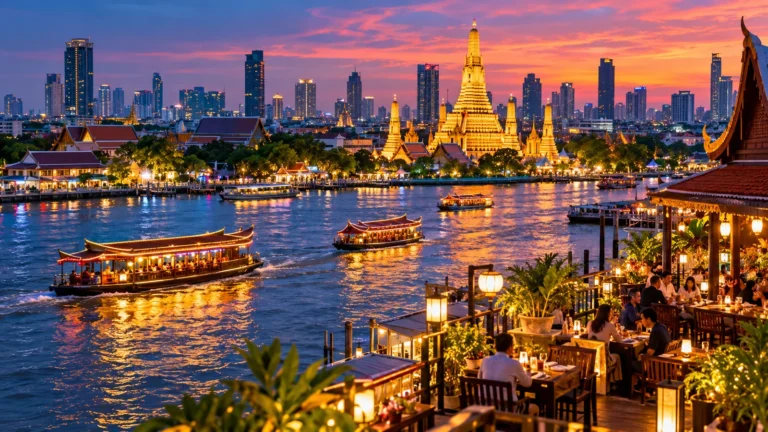
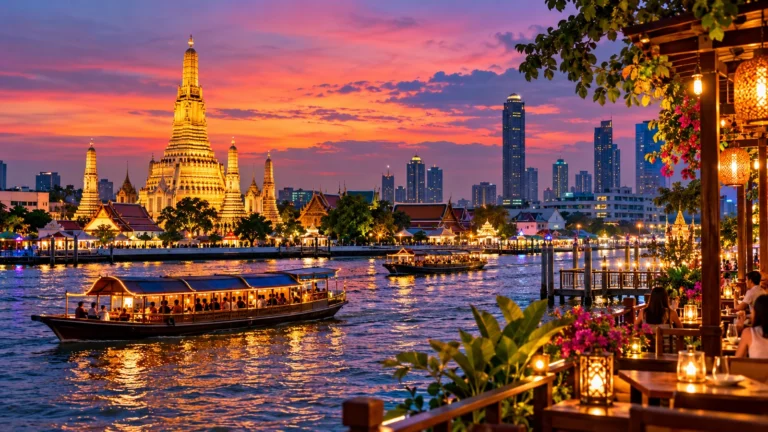
Illustrations are original, generated, Bangkok-inspired scenes. They are not documentary photographs, verified views from a named hotel or exact route maps.
- Wat Pho: official visit plan THB 300 admission, published visitor hours and under-120-cm child exemption. The contact page separately starts at 08:30; plan an 08:30 or later arrival.
- SEA LIFE Bangkok: dated opening-hours calendar Current calendar lists 10:00-20:00 and last entry 19:00; reconfirm the visit date.
- Bangkok Art and Culture Centre: plan your visit Tuesday-Sunday hours, ordinary free exhibitions and family/access facilities.
- Bangkok Learning City: Chatuchak Children's Discovery Museum Municipal listing: ages, activities and Tuesday-Sunday operating hours.
- FCDO: Thailand travel warnings Flooding warning reviewed 3 October 2026. Check fresh advice before using normal-condition plans.
- Chatrium Riverside: guest shuttle boat Advertised links to Sathon Pier and ICONSIAM; obtain the current timetable for your dates.
- Airports of Thailand: BKK transport guide Airport Rail Link and landside transport. Times in the itinerary are separate editorial allowances.
- Airports of Thailand: Don Mueang Airport identity, facilities and onward-transport information.
- Chao Phraya Tourist Boat: operator information Check current piers, ticket coverage and operating notices directly.
- SEA LIFE Bangkok: general planning FAQ The general FAQ lists earlier closing than the dated calendar; the article identifies that inconsistency.
- SEA LIFE Bangkok: tickets and age categories Date-specific prices, child categories and separate add-on restrictions; no promotional from-price used as a family total.
- Bangkok Culture, Sports and Tourism Department: museum FAQ Municipal confirmation of free admission and 10:00-16:00 Tuesday-Sunday opening.
- BTS: official route map BTS interchange and station planning.
- BEM: MRT system map Station locations and network connections; not a door-to-door journey guarantee.
- NHS: heat exhaustion and heatstroke General prevention and emergency warning signs; not individual medical advice.
- Airalo: Thailand eSIM options Device compatibility and the features of the selected plan need checking.
Illustrations in this article were created for Taylor’s Trailblazing Travels. Third-party photographs, where used, are credited beside the image or in the source list.