Koh Yao Noi Travel Guide
Choose between village access and seclusion, then make room for the bay and the slower pace.
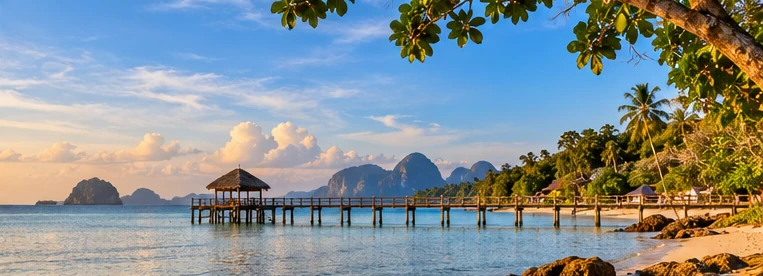
Original illustration inspired by Koh Yao Noi-inspired shoreline and views across Phang Nga Bay; not a photograph or a navigational map.
Koh Yao Noi is a good choice when the holiday you want includes village roads, a slower daily rhythm and views across Phang Nga Bay, rather than a new late-night venue every evening. It is less convincing when your only requirement is an uninterrupted stretch of deep swimming water directly outside any room. This Koh Yao Noi travel guide starts with that distinction, because expectations matter as much as the hotel budget.
TAT describes an island of fishing communities, agriculture, forested hills and tourism businesses, lying north of Koh Yao Yai. The two names are easy to confuse on a booking screen, but they are different islands. The correct island, arrival pier and final accommodation transfer should be confirmed together before you book a boat. [1]
For a first visit, my research-led recommendation is three or four nights, with one bay excursion, one day exploring locally and enough unplanned time to enjoy the setting. Choose a base that matches how you want to spend your evenings. A secluded resort and a guesthouse with easy access to local meals can both work well, but they create different holidays.
The comparisons below are based on access, location, room arrangements and realistic daily choices, not a claim of a recent personal stay. Named properties illustrate contrasting travel styles rather than a ranked list of the island's best hotels. Published charges are dated examples, and the budget model is an explicit planning exercise rather than a current market average.
This article contains affiliate links. When you book or buy through one, Taylor’s Trailblazing Travels may earn a commission at no extra cost to you. The comparisons focus on practical suitability, not the commission available.
Three or four nights
A bay day, a local day and room to slow down.
Access or seclusion
Choose the evening routine before the most dramatic room photograph.
Plan around the tide
Ask about the actual beach and consider a pool when daily swimming matters.
Noi is not Yai
Check the complete island name, departure pier and final hotel route.
Koh Yao Noi travel guide: decide what you want from the island
Landscape and everyday life are part of the appeal
The island's attraction is not limited to beaches. TAT identifies fishing, rubber growing, farming and community-based activities alongside the coastal scenery. That makes a slower itinerary more rewarding than one built only around collecting famous attractions. Leave room for an organised local experience, a short ride or walk where appropriate and a meal that is not squeezed between transfers. [1]
However, do not turn ordinary life into a performance you expect residents to provide. Fields, fishing equipment and village lanes are working places. Ask permission before entering private land or photographing people closely. Use local guides and businesses where they offer the experience you want, and pay the agreed price rather than treating access to people's time as an incidental free extra.
A resort escape and an independent stay are different products
A secluded resort can be the right choice when you mainly want its pool, meals, outlook and organised excursions. In that case, the isolation is part of the value. An independently minded visitor may prefer a location with easier access to several eating places and local transport. Neither version is automatically more authentic or more worthwhile.
Write down what you expect to do after sunset and during a wet afternoon. Those two questions quickly reveal whether the location suits you. A beautiful room is less useful when every evening requires a journey you dislike. Conversely, a quiet property can be ideal when its own setting is exactly where you want to spend the time.
Where to base yourself on Koh Yao Noi
East-coast stays: views with a tidal shoreline
The eastern side is a natural starting point for visitors interested in views towards the bay's islands. TAT identifies Ta Khao and Khlong Chak among the named coastal areas. Use those names to orient your search, then inspect the exact property location and shore access. A room with a sea view is not necessarily a room from which you can step straight into suitable swimming water. [1]
Ask the hotel what the beach is like at lower water and whether a pool is available. Request an ordinary recent shore photograph as well as the promotional view. Tides are part of the coastal landscape, not a fault that can be solved by finding a more expensive room. The useful question is whether the property's daily rhythm works for you.
Village access and secluded northern properties
A base connected conveniently to village services can suit visitors who enjoy choosing meals independently and making shorter local outings. Check the actual route rather than assuming every nearby map pin is walkable in heat or darkness. Ask about the surface, lighting and availability of transport when you would use it. A short distance can still be an awkward evening walk.
Northern or otherwise secluded properties need particular attention to access. Paradise Koh Yao describes its remote bay setting and recommends its organised boat transfer. Its own destination information cautions against treating the inland track as an ordinary road for casual car or scooter access. That is a property-specific limitation, not a statement that the whole island lacks roads. [3]
Which style of Koh Yao Noi base fits?
Editorial comparison of travel styles, not a ranking of hotels or a guarantee at every address.
Swipe this table sideways to read every column.
| Base style | Good match for | What to verify |
|---|---|---|
| Village-connected | Independent meals and shorter local outings | Actual walking routes, lighting and evening transport. |
| East-coast view | A shore-and-bay-focused stay | Tidal access, swimming conditions and room position. [1] |
| Secluded resort | Enjoying the property as the main destination | Complete transfer, meal options and the cost of leaving. [2][3] |
Getting there from Phuket or Krabi
Public routes and resort transfers use different piers
TAT lists a Phuket connection from Bang Rong and a Krabi approach from Tha Len. Those are useful orientation points, but current schedules, landing locations and ticket inclusions still need to be checked. Do not assume that any boat labelled Koh Yao will arrive at the right place on Koh Yao Noi rather than Koh Yao Yai. [1]
A resort transfer may use a different mainland marina and a direct landing at the property. Six Senses Yao Noi, for example, describes a Phuket Airport journey via Ao Po Grand Marina. Paradise Koh Yao publishes its own Phuket and Krabi transfer arrangements. The hotel name can therefore be as important as the island name when comparing the journey. [2][3]
Compare the whole chain from arrival to reception
Six Senses publishes an approximate 30-minute road transfer from Phuket Airport followed by around 40 minutes by speedboat. Those timings describe its own route before any waiting or airport procedures. They should not be applied to an independent Bang Rong departure or another hotel's transfer. Use the provider's current confirmation for your actual meeting point and boarding time. [2]
For an independent route, identify who provides the onward island transport and how much time to allow after the boat arrives. For a hotel-arranged route, ask whether the quote includes the airport pickup, sea leg and luggage handling. A higher total can be worthwhile when it removes uncertainty, but only when you understand what is being purchased.
Late arrivals and the last boat problem
Do not make a late flight fit by assumption
An evening landing on the mainland may not connect conveniently with the boat you want. Ask the property about its latest practical arrival arrangement before making the first island night non-refundable. Paradise's published transfer information describes daylight scheduling and advance-booking requirements. That is a reason to coordinate directly, not a reason to assume that a private boat can always solve a late arrival. [3]
A mainland overnight can be the calmer choice after a long flight. Select the hotel according to the next day's departure pier, while considering the extra road journey and your need for food and rest. An airport-area room is not automatically near every marina. Put the actual addresses on a map before deciding which overnight location is convenient.
Plan the return as deliberately as the arrival
On the final day, include checkout, island transport, boat check-in, the crossing, disembarkation and the road transfer before the airport process even begins. A nominal sea duration is only one component. Ask the provider about recommended margins for your flight and whether another practical departure exists if conditions change.
For a costly international flight booked separately, my conservative choice is to return to the relevant mainland base the previous day. That recommendation reflects the consequence of a missed flight, not a claim that same-day travel never works. Decide the margin according to the value and flexibility of the onward booking, rather than copying another traveller's narrowest successful connection.
Choosing accommodation for the way you travel
A village-connected base supports independent evenings
Start with the routes to breakfast, dinner and the places you expect to visit most often. A simpler room in a convenient location can be a better match than a more elaborate room that requires repeated paid transfers. Check air conditioning, bathroom arrangements, room access and cancellation conditions. Do not let a pool photograph substitute for reading the actual category description.
Ask whether the property can arrange transport without requiring you to hire a scooter. Find out how much notice it needs and whether evening journeys are available. For longer stays, laundry and nearby meal choices can matter more than an extra decorative room feature. A location that works easily on day one is more likely to remain comfortable on day four.
Resort examples illustrate different levels of seclusion
Six Senses Yao Noi is a higher-budget example with its own mainland transfer process and resort-based dining and activities. Paradise Koh Yao is another example where organised access and the property's setting are central to the stay. Investigate both through the room details and current conditions rather than treating their names as a guarantee of suitability. [2][3][4]
For families, ask about room steps, pool supervision, bed arrangements and meal flexibility. Couples seeking quiet should compare privacy with the effort of leaving the property. For anyone with restricted mobility, request the complete pier-to-room route. Luxury positioning does not establish step-free access, and a secluded beach is not necessarily an easy landing.
Beaches, tides and realistic swimming expectations
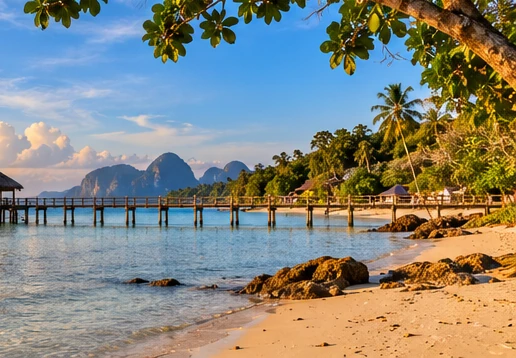
A changing shore can still be an attractive shore
The practical issue is not whether a beach looks good in one photograph, but how you will use it over several days. Ask about the preferred swimming periods, the seabed near the property and any local restrictions. Follow current advice on safe entry rather than walking farther out simply because the water has receded.
A pool can be particularly useful when the immediate shore does not suit the day's conditions. That is a sensible amenity choice, not an admission that the destination is unsuitable. If continuous easy sea swimming is your overriding priority, compare other destinations honestly before booking. Koh Yao Noi's views and village landscape should be part of the reason you choose it.
Do not assume a bay is automatically safe
Sheltered-looking water can still involve changing conditions, boat routes and unsuitable entry points. Ask locally before swimming or paddling and pay attention to the actual shoreline. The Foreign Office's Thailand guidance includes cautions about water activities and boat safety. A quiet setting does not remove the need for appropriate equipment and judgement. [7]
Keep beach plans flexible. A walk, a shaded meal or a pool session may fit one part of the day better than a swim. Use a different time for an organised outing when the operator recommends it. A holiday becomes easier when the tide and weather inform the plan instead of being treated as obstacles to a rigid timetable.
Exploring locally without assuming a scooter is essential
Start with short, purposeful journeys
Pick one small area to explore rather than trying to circle the island immediately. Ask your accommodation about a suitable route, current road conditions and a realistic return arrangement. Combine a viewpoint or coastal stop with a meal and leave time to enjoy both. A short outing can reveal more than a long ride spent concentrating on unfamiliar roads.
Bicycles may suit some routes and riders, but assess hills, traffic, heat and the condition of the bicycle before committing. Test brakes and fit and take appropriate precautions. A quiet-looking road is still a road. Do not choose a route solely because a map application describes it as shorter; an unsuitable track can erase the benefit of a small distance saving.
Use arranged transport when that is the better fit
A driver or guided local outing can be more useful than renting a vehicle for the entire stay. Agree the route, waiting time, pickup point and total charge before setting off. Confirm what happens if you change a stop or return later. This makes the comparison with a rental clearer and avoids an argument at the end of an otherwise pleasant day.
For motorbikes or scooters, resolve licensing, experience and insurance requirements before renting. The Foreign Office highlights road-safety and documentation issues in Thailand. Do not make a scooter the default solution to a hotel that is inconvenient for your needs. Choosing a different base can be both simpler and more comfortable. [7]
Local experiences, cooking and community visits
Choose an organised invitation rather than wandering into work
TAT describes community-related activities including fishing, agriculture and local crafts. Ask your accommodation or a local provider what is genuinely available during your dates, who hosts it and how the visit is arranged. A useful experience explains the work and compensates the host; it does not depend on visitors entering a private space uninvited. [1]
Keep the group's interests specific. Someone interested in food may value ingredients and preparation more than a general island circuit. A family may prefer a shorter hands-on session with clear breaks. Ask about language, group size and the level of participation. The word local in an advertisement does not tell you how the experience actually runs.
Cooking can be a good alternative to another boat day
Six Senses publishes cooking experiences at its Nithan venue, illustrating one structured option to investigate. Confirm whether an activity accepts outside guests, how reservations work and what dietary adjustments are possible. Do not assume that an advertised resort experience is automatically available to anyone staying elsewhere on the island. [4]
For a smaller independent class, ask similar practical questions: how much cooking you do yourself, whether ingredients can be adapted and how the session fits around transport. A class can add variety to a longer stay without demanding another full day on the water. Choose it because the subject interests you, not merely because rain has left a blank space in the schedule.
Koh Hong excursions: check which Hong you are booking
Similar names can describe different destinations
The name Hong appears in more than one place around the wider bay. TAT has a separate listing for Ko Hong in Phang Nga and another for Ko Hong, also called Ko Laopilae, in Krabi's Than Bok Khorani National Park area. Do not assume every tour using Hong in its title visits the same lagoon or beach. Check the full destination and route. [5][6]
For the Krabi island, TAT describes a beach, lagoon and elevated viewpoint, with lagoon access affected by the water level. That makes the timing and conditions part of the visit. Ask the operator which stops are planned, which are optional and how the route changes if access is unsuitable. A photograph of one attraction is not proof that every departure includes it. [5]
Compare time ashore with time in the boat
For an excursion comparison, include the actual start on Koh Yao Noi, the type of boat, group size, time at each stop and return arrangements. A mainland product may be irrelevant even when it visits the right island. Check whether hotel collection and the return to your accommodation are included rather than assuming all island departures operate the same way.
Ask separately about park charges, equipment, drinking water and lunch. Where a fee is payable locally, confirm the current amount and child rules with the operator or park. This guide does not turn an old tariff into a guaranteed current total. A transparent quote is more useful than a low headline price followed by unclear charges at each stop.
Kayaking and a closer look at the bay
Choose the scale that matches your experience
A guided paddle near a suitable shoreline is a different undertaking from travelling independently between distant-looking islands. Perspective across the bay can make distances difficult to judge. Ask about the launch point, route, conditions and the support available. A beginner should not treat an attractive view as an invitation to copy an experienced paddler's route.
Check buoyancy aids, communication arrangements and how the guide decides whether conditions are suitable. For cave or lagoon visits, follow the provider's and local authorities' instructions about access. Do not enter a confined tidal area independently on the assumption that the water will remain at the same level. A route's appearance in a photograph says nothing about the conditions at your visit.
Keep the outing enjoyable for everyone
Ask how long participants are expected to paddle and whether the trip includes rest stops. A couple with different fitness levels may prefer a shorter guided outing to an ambitious route that one person simply tolerates. Families should confirm the operator's age and ability requirements, as well as how children are seated and supervised.
Protect essentials from spray and leave unnecessary valuables at your accommodation. Take enough water and suitable sun protection. A dry bag is useful when it can be secured properly and does not obstruct paddling. The objective is a comfortable close-up experience of the bay, not carrying the entire contents of your room onto the water.
A four-night itinerary that leaves room to slow down
Arrival and the first full day
Make arrival day about completing the transfer and understanding the base you have chosen. Ask about meal times, local transport and the next day's weather. A short walk nearby is enough. For a secluded resort, check which activities need advance booking; for a village-connected stay, identify a convenient place for breakfast without planning every meal in advance.
Use the first full day for local exploration at a comfortable pace. Arrange one purposeful outing, such as a community activity or a short island circuit, and keep the afternoon flexible. This helps you understand the landscape without immediately adding another sea crossing. It also gives you a chance to decide whether a longer excursion suits everyone's energy.
One bay day and one day without a deadline
Use the best suitable day for the bay excursion you care about most. Keep the following day lighter: a cooking activity, a beach walk when conditions suit, a pool session or another short local visit. The balance matters more than the exact order. Swap days when the operator or forecast suggests a better sequence.
On the last full afternoon, reconfirm the departure route and any onward mainland transfer. Pack documents and the small travel bag before dinner. Avoid an ambitious outing on departure morning unless a substantial margin remains. Four nights should create time to enjoy the island, not four consecutive days of worrying about the next meeting point.
Four nights with time to slow down
Flexible itinerary suggestion, not a boat schedule or a promise of activity availability.
Swipe this table sideways to read every column.
| Day | Suggested focus | Practical priority |
|---|---|---|
| Arrival | Hotel and the immediate setting | Understand meals and the next transfer. |
| Full day 1 | A local outing or hosted experience | Keep the afternoon undecided. |
| Full day 2 | One suitable bay excursion | Follow the operating conditions and correct route. |
| Full day 3 | Cooking, pool, shore or another short outing | Reconfirm departure before the evening. |
| Departure | The agreed boat and mainland stage | Protect the onward-flight margin. |
Budgeting for independent and resort-led stays
Keep transfer products comparable
Six Senses lists a shared airport-and-speedboat transfer example at THB 2,200 per adult each way, with its published tariff valid until 19 December 2026. This was checked on 3 October 2026 and belongs to that resort's service. It is not a public ferry fare or evidence that every visitor must pay the same amount. Confirm the final quote and inclusions directly. [2]
Paradise publishes a different set of organised transfer options. Compare the full journey, passenger basis and destination before deciding that one figure is expensive or cheap. A public boat plus independent road travel and a hotel-arranged door-to-reception transfer are different products. Include the time and convenience trade-off in the decision rather than comparing the sea leg alone. [3]
Build a model around your own priorities
For an illustrative budget prepared on 3 October 2026, assume two adults sharing for four nights: THB 4,000 per room per night, THB 1,600 a day for meals and drinks across four days, THB 4,000 total for transport and THB 6,000 for activities. The worked total is THB 32,400. These are chosen planning inputs, not current average prices or a bookable offer.
A high-end resort stay could need very different room, meal and transfer allowances. An independent stay may shift spending towards local transport and meals outside the property. Change the assumptions visibly instead of expecting one destination-wide daily budget to fit both. Keep a separate contingency and record tax, service charges and cancellation conditions wherever they affect the comparison.
Two adults, four nights: an illustrative allowance
Hypothetical model prepared 3 October 2026. Not a quotation or average; resort-led stays may need substantially different inputs. Excludes flights.
Swipe this table sideways to read every column.
| Item | Calculation | Allowance (THB) |
|---|---|---|
| Shared room | 4,000 x 4 nights | 16,000 |
| Meals and drinks | 1,600 x 4 days | 6,400 |
| Transport | Chosen total allowance | 4,000 |
| Activities | Chosen total allowance | 6,000 |
| Worked total | Sum of the four allowances | 32,400 |
Food, cultural courtesy and practical preparation
Let the setting guide how you behave
TAT describes predominantly Muslim village communities on the island. Dress respectfully in village settings and religious spaces, ask before photographing people and do not assume that every business serves alcohol. Resort practices and village practices may differ. The useful response is to observe, ask courteously and avoid treating local customs as an inconvenience to be bypassed. [1]
For meals, ask about ingredients and preparation when you have dietary requirements. Do not infer that every restaurant follows the same rules or uses the same recipe. A cooking class or a conversation with a willing host can add context, but serious allergies still require clear communication and your own medical plan. Choose nearby reliable options as well as occasional special meals.
Prepare for ordinary small disruptions
Save transfer details, the hotel address and key contacts offline. Arrange a suitable data plan for a compatible phone, but keep enough battery for arrival and do not rely on a live map for every step. Carry practical payment options and ask about card acceptance before committing to a purchase or a meal.
Pack a compact dry bag for boat journeys, comfortable footwear and the personal items that would be awkward to replace during a short stay. Avoid buying specialist equipment for activities you have not booked. A lighter, well-organised travel bag is often more useful than a large collection of accessories that make every transfer harder.
Weather, children and access considerations
Have a worthwhile plan that does not require perfect sea conditions
Use the Thai Meteorological Department's southern west-coast forecast and current operator advice when arranging boat activities. A seasonal description cannot promise a particular day's conditions. Choose accommodation where an unplanned quiet afternoon would still be pleasant. That might mean a pool, a comfortable covered space, a good meal option or an activity available on land. [8]
Do not fill every remaining day with substitute excursions after one cancellation. A slower day can be part of the holiday rather than evidence that the itinerary has failed. However, understand refund and rescheduling terms before booking. Flexibility is most useful when both you and the provider know what was agreed.
Ask practical questions about the whole route
Families should consider room stairs, pool supervision, meal access and the boarding process, not only the presence of a family label. Travellers with limited mobility should request a detailed description of the mainland pier, boat, island landing and route to the room. A helpful provider should answer those specific questions or explain where uncertainty remains.
For anyone who strongly dislikes boat transfers, consider whether a mainland destination would better fit the holiday. Koh Yao Noi's relative proximity to Phuket or Krabi does not eliminate the sea stage. Choosing the destination that matches your comfort is more valuable than forcing a difficult journey to fit a particularly attractive room photograph.
Pros, cons and common planning mistakes
What works well
Bay scenery, local activities and a choice between more connected accommodation and a secluded resort escape.
The trade-offs
Tidal shore conditions, property-specific access and a quieter rhythm that does not suit every traveller.
The strongest fit is a slower, location-aware stay
Koh Yao Noi works well for visitors who enjoy scenery, local activities and time around a carefully chosen base. The variety between village-connected accommodation and secluded resorts gives it more than one travel style. Its appeal does not depend on recreating the nightlife or constant attraction-hopping of a larger destination.
The compromises are tidal shore conditions, location-dependent transport and the need to coordinate boat arrivals. Common mistakes include confusing Noi with Yai, assuming all hotels use the same pier, treating a secluded track as an ordinary scooter road and booking a mainland Hong excursion for an island stay. Resolve those points early and the rest of the planning becomes much simpler.
Detailed questions before you book
Are Koh Yao Noi and Koh Yao Yai the same place?
They are different islands. TAT places Koh Yao Noi north of Koh Yao Yai, so the final word in the name matters when choosing accommodation and transport. A search result shortened to Koh Yao is not enough to establish the destination. Match the island, pier and hotel on each confirmation, and ask the property to verify the route when anything is unclear. An attractive fare to the wrong island is not a useful saving once an unplanned onward journey is added. [1]
Is Koh Yao Noi mainly a swimming-beach destination?
It is better approached as a combination of coastal views, local life, accommodation and bay excursions rather than a guarantee of easy swimming outside every room at every hour. Ask your hotel about the shore, seabed and preferred swimming conditions, and consider a pool when regular swimming matters. The tidal landscape is part of the setting, not something a room upgrade removes. Visitors whose overriding priority is uninterrupted sea swimming should compare other destinations carefully instead of assuming all Thai island beaches work in the same way.
Which Phuket pier should I use?
Use the pier named by the actual service you book. TAT identifies Bang Rong for an independent Phuket approach, while Six Senses describes its own transfer through Ao Po Grand Marina and other resorts publish different arrangements. These are not conflicting names for one universal departure point. Confirm the mainland meeting location and the island landing with the hotel before arranging a taxi. Include enough time for the road journey and check-in rather than planning from the sea duration alone. [1][2][3]
Can I stay at a secluded resort and visit local restaurants whenever I like?
Possibly, but transport may require planning and may not be available on the spontaneous schedule you imagine. Ask about the actual route, evening arrangements, waiting time and return cost before reserving. Paradise's remote setting is an example where organised access is central to the stay, rather than a minor detail. A more connected base may be the better fit when independent dinners are a daily priority. Seclusion is valuable when you want to enjoy the property itself, not when you repeatedly need to overcome it. [3]
Do I need to rent a scooter to enjoy the island?
No. A suitable base, arranged transport and a few focused outings can create a satisfying stay without a rental vehicle. A bicycle may suit some riders and routes, but hills, heat, road conditions and equipment still matter. Resolve licensing, experience and insurance before considering a scooter; do not treat it as a harmless solution to an inconvenient hotel. Ask the property how guests manage meals and outings without driving. The answer can help you choose accommodation that fits your actual comfort level. [7]
Why should I check the full name on a Hong Island tour?
The wider region contains different places called Hong. TAT lists a Phang Nga Ko Hong separately from Ko Hong, also known as Ko Laopilae, in the Krabi park area. A tour title may not make the distinction obvious. Ask which beach or lagoon it visits, where it departs and what access depends on tide or conditions. Also confirm that the product collects from Koh Yao Noi rather than a mainland base. The correct destination with the wrong starting point is still the wrong booking. [5][6]
Is a cooking class a useful alternative to another boat day?
It can add variety when the subject genuinely interests you and the arrangements fit your stay. Check how much cooking you do, the group size, dietary adjustments and whether transport is included. Resort experiences may need advance booking or have restrictions on outside guests; Six Senses' published cooking offer is an example to enquire about, not a promise of universal access. A smaller local session may suit a different budget or style. Choose from the actual experience rather than assuming every class is interchangeable. [4]
What should I wear away from the beach?
Use respectful everyday clothing in villages and follow the instructions at religious or community spaces. TAT describes predominantly Muslim communities on the island, but individual businesses and settings can differ. Ask courteously when unsure, and do not assume that resort practices apply everywhere. Beachwear belongs in an appropriate beach or pool setting rather than being the default for every errand. Similar courtesy applies to photography: request permission before close photographs of people or entering a private working area. [1]
Are three nights enough for a first visit?
Three nights can give two full days, which works for one bay outing and one locally focused day when arrivals are straightforward. Four nights allow a more relaxed rhythm and a little more flexibility around conditions. The additional night is useful when you like your base and want time there, not simply to fill a destination list. Avoid adding several distant excursions that turn the stay into repeated transfers. Koh Yao Noi's appeal is easier to appreciate when the itinerary leaves room for its slower pace.
How can I check whether a hotel works for limited mobility?
Ask for the complete mainland-pier-to-room sequence, including boat steps, the island landing, paths and any internal transport. Request recent photographs or measurements where they would help you assess your own needs. A ground-floor room does not solve a difficult boarding process, and a luxury label does not establish step-free access. Describe the assistance you require rather than relying on a broad accessible filter. Book only when the important arrangements are clear enough for you to make an informed decision.
My recommended first Koh Yao Noi stay
Choose the right base and leave a day open
Book three or four nights, arrange a complete arrival route and choose one bay outing that genuinely starts from your base. Add a local experience or cooking session and leave time without a fixed departure. Select a pool or another comfortable alternative when constant beach swimming is not assured. This creates a holiday built around the island's strengths rather than an imported checklist.
Choose a secluded resort when staying there is the main pleasure, or a more connected location when independent meals and local exploration matter. Neither needs to be defended as the correct way to travel. The best fit is the one that lets you enjoy Koh Yao Noi's landscape and daily rhythm without repeatedly struggling against your own booking choices.
Sources and fact-checking notes
Editorial review: 3 October 2026. Tourism-authority pages establish destination context; operator and hotel pages describe their own services. Timetables, fees, access rules and room arrangements can change. Confirm time-sensitive details for your travel date. Suggested pacing, location fit and worked budgets are research-led planning judgements, not guaranteed outcomes.
- Tourism Authority of Thailand: Ko Yao NoiIsland identity, community and agricultural context, named coastal areas and general public-route orientation. Reviewed 3 October 2026.
- Six Senses Yao Noi: how to get hereIts own marina, travel estimates and transfer tariff valid to the stated date. Reviewed 3 October 2026.
- Paradise Koh Yao: destination and transfersRemote-property access, organised transfers and the caution about the inland track. Reviewed 3 October 2026.
- Six Senses Yao Noi: Nithan and cooking experiencesPublished resort dining and cooking options; outside-guest access needs confirmation. Reviewed 3 October 2026.
- Tourism Authority of Thailand: Ko Hong / Ko LaopilaeThe Krabi park island, beach, viewpoint and tide-dependent lagoon context. Reviewed 3 October 2026.
- Tourism Authority of Thailand: Ko Hong, Phang NgaA separately listed Hong destination; check the full tour route rather than the shared short name. Reviewed 3 October 2026.
- FCDO: Thailand safety and securityRoad, water and travel-safety context. Reviewed 3 October 2026.
- Thai Meteorological Department: southern west coastCurrent weather information for a bay and boat-dependent plan. Reviewed 3 October 2026.
Illustrations in this article were created for Taylor’s Trailblazing Travels. Third-party photographs, where used, are credited beside the image or in the source list.