A practical guide to the best things to do in Krabi, from beaches and islands to hikes, inland nature, food and quieter local experiences – with realistic timings, costs and decision help.
Krabi is easy to underestimate because the name describes several different trips at once. Ao Nang is the practical mainland base. Railay is reached by boat. Krabi Town is built around the river and local life. Offshore islands depend on sea conditions, while Emerald Pool, the hot springs and mountain trails sit well inland. As a result, a good visit is less about collecting famous names and more about choosing experiences that are genuinely different from one another.
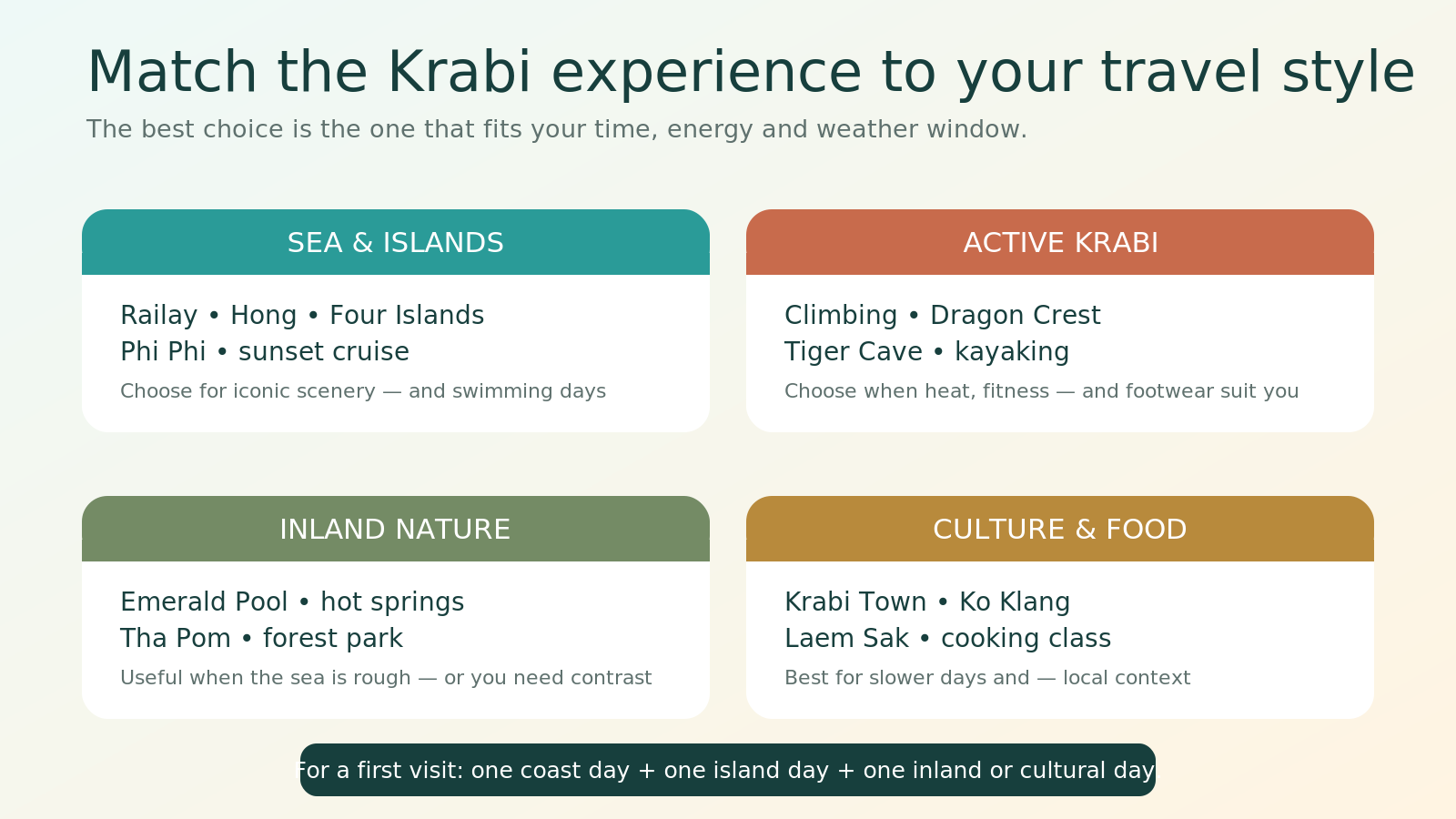
For most first-time visitors, the strongest combination is one coast day, one major island day and one inland or cultural day. That simple pattern gives you limestone cliffs, clear-water scenery and a side of Krabi that does not require another early boat pickup. It also leaves enough energy for dinner and enough flexibility to move the most weather-sensitive plan.
This guide compares 20 worthwhile things to do in Krabi by time, effort, location and weather sensitivity. The price bands are planning ranges checked for this 25 August 2026 edition, not promises. Boat type, hotel area, group size, season, park charges and live promotions can change the final amount. Therefore, use the figures to compare options, then confirm the full payable total before booking.
What are the best things to do in Krabi?
The best things to do in Krabi are Railay and Phra Nang for limestone scenery, Hong Islands or the Four Islands for one major boat day, Emerald Pool and the Khlong Thom hot springs for inland nature, and Krabi Town or Ko Klang for local food and culture. Allow at least three full days and keep the sea day movable around the official short-range forecast.
Quick answers
Railay and Phra Nang independently from Ao Nang.
Choose Hong Islands for lagoon and karst views.
Pick Four Islands for Poda, Chicken Island and Thale Waek.
Start early for Emerald Pool and the hot springs.
Try Railay climbing with a guide or Dragon Crest for a serious hike.
Three full days minimum; five to seven gives the better balance.
In this guide
How to choose the right Krabi experiences
The first decision should be about variety. Railay, Hong and the Four Islands all feature limestone coast and boat travel, yet they do not need to occupy three consecutive days. Likewise, Tiger Cave Temple and Dragon Crest are both demanding climbs. Pairing unlike experiences usually creates a better holiday than choosing every attraction from the same category.
Use the one-coast, one-island, one-inland formula
For three full days, use one day for Railay, one for Hong or the Four Islands and one for inland nature, Krabi Town or Ko Klang. When five days are available, add one active or specialist experience and one real buffer. The buffer is not wasted time: it protects the boat day, flight connection and your own energy.
Compare time and effort before comparing price
A nine-hour Phi Phi listing is not equivalent to a half-day Railay crossing simply because both include beaches. Count hotel pickup, pier waiting, return traffic and the need to shower or change before dinner. In addition, identify whether the activity is restful, exposed to sun, physically strenuous or likely to involve repeated wet boarding.
| Experience | Best for | Allow | Effort | Weather sensitivity | Planning range |
|---|---|---|---|---|---|
| Railay and Phra Nang | First-time limestone scenery | 6-8 hours | Easy-moderate | Medium | THB 200-1,000 |
| Hong Islands | Lagoon and karst scenery | 7-9 hours | Moderate | High | THB 1,100-2,200 + fees |
| Four Islands | Classic close-to-Ao-Nang circuit | 6-8 hours | Moderate | High | THB 900-1,800 + fees |
| Phi Phi | Maya Bay and a major island day | 9-12 hours | Moderate-tiring | High | THB 1,800-3,300 + fees |
| Dragon Crest | A serious viewpoint hike | 4-6 hours | Strenuous | High after rain/heat | Low entry + transport |
| Emerald Pool and hot springs | Inland nature and bathing | Full road day | Easy-moderate | Medium | THB 800-2,500 + entry |
| Krabi Town and Ko Klang | Food, culture and a flexible day | 4-7 hours | Easy | Low-medium | THB 300-2,000 |
| Ao Thalane kayaking | Mangroves and active quiet | 4-7 hours | Moderate | High tide/weather | THB 900-2,500 |
Put the weather-sensitive day first in the decision process
Boat trips, exposed hikes and mangrove routes can change with wind, waves, thunderstorms, tide or recent rain. The Thai Meteorological Department publishes both a Krabi forecast and a Southern West Coast marine forecast, so use those official pages close to travel rather than relying only on a generic weather-app icon.[13],[14]
That does not mean booking everything at the last minute. Peak dates, private boats and small-group products can sell out. Instead, understand the cancellation terms and keep the order of the days movable. A responsible operator that cancels for safety is preferable to one that promises to sail regardless of conditions.
Understand Krabi’s geography
Ao Nang, Krabi Town, Klong Muang, Khlong Thom and Ao Luek are not adjacent neighbourhoods. A listing may say “Krabi” while requiring a long pickup or charging extra outside its core zone. Railay has no road access, whereas Koh Lanta deserves a separate overnight stage. Check the map, the pickup area and the final drop-off before treating two prices as comparable.
Coast, islands and sea
Best sea and limestone experiences in Krabi
These activities create the photographs most people associate with Krabi. Because they are also the most weather-sensitive, avoid booking every one of them before you arrive. One excellent boat day is more valuable than three similar days that leave no recovery or flexibility.
1. Spend a full day at Railay and Phra Nang
Railay is the clearest answer when someone asks for the single most rewarding first experience in Krabi. The boat ride from Ao Nang is short, yet the scenery changes immediately: limestone walls replace the road, sandy paths connect the bays and Phra Nang adds the peninsula’s most recognisable beach. Tourism Authority of Thailand route planners repeatedly pair Railay, Phra Nang and nearby islands because the geography naturally belongs together.[1],[2],[3]
Go early enough to walk before the middle of the day, then choose the pace that actually suits you. A relaxed visit might include Railay West, Phra Nang, lunch and a swim. A more active version could add the viewpoint or a guided climbing session. However, do not arrive with a wheeled suitcase for a casual day out: long-tail boats commonly involve shallow-water boarding, wet feet and a short carry across sand.
Railay East is practical for paths, piers and some restaurants, whereas Railay West is the classic sunset-facing beach. Phra Nang can become crowded when excursion boats arrive, so an early independent crossing is often more pleasant than a tightly timed midday stop. If the sea is unsettled, follow local boat advice rather than assuming the short distance makes the crossing risk-free.
Advantages
- Delivers Krabi’s signature limestone scenery without a full offshore tour.
- Works independently, so you can control the length of the day.
Limitations
- Boat-access logistics are awkward for large luggage, pushchairs and some mobility needs.
- Popular beaches lose much of their calm through the busiest middle hours.
2. Choose the Hong Islands for lagoon and karst scenery
Hong is often the strongest all-round island choice for a first Krabi trip. The route combines open-water scenery, a sheltered lagoon and beach time without feeling like a list of almost identical stops. A current long-tail listing uses a roughly seven-hour format and identifies the park fee separately, which is a useful reminder to compare the complete payable total rather than the first advertised number.[2],[9],[20]
Shared long-tail boats suit travellers who value the traditional boat atmosphere and a lower price. Speedboats reduce transit time, while a private long-tail can make sense for a couple, family or small group that wants a slower pace. Nevertheless, private does not mean weather-proof. Ask how much shade the boat has, where it departs, whether the lagoon is entered, what happens when wind increases and whether food, drinking water, snorkelling equipment and park fees are included.
Hong can still feel busy at peak times, especially when multiple departures converge. An early start helps, but route quality also depends on the captain and the day’s tide. Treat any exact stop order as provisional because safe operators adjust to sea conditions instead of following a marketing page at all costs.
Advantages
- Excellent limestone scenery and a more coherent route than many stop-heavy tours.
- Private and shared formats allow different budgets and group styles.
Limitations
- A full day in sun and salt water can be tiring even when the itinerary sounds relaxed.
- Park-fee treatment, shade and group size vary significantly between listings.
3. Take the Four Islands route and time Thale Waek properly
The Four Islands circuit is the classic Ao Nang boat day. Although operators alter the order, Poda, Chicken Island, Phra Nang and the low-tide sandbar around Thale Waek are the familiar ingredients. The sand connection is a tide event, not a fixed attraction that looks the same at every hour, so ask how the day’s tide affects the route rather than trusting a generic photograph.[3],[4],[21]
A long-tail boat usually feels more atmospheric and can be good value. A speedboat covers the route faster but may feel more compressed at each stop. In either case, compare shade, passenger numbers, snorkelling gear, lunch, drinking water, hotel pickup and national-park charges. The cheapest listing can become poor value when every essential item is excluded or when the boat is filled to its legal maximum.
This route works especially well for travellers who want a first taste of several offshore landscapes. It is less suitable for someone who dislikes repeated boat boarding or wants a long, quiet beach stay. When your wider itinerary already includes Railay independently, check whether the tour spends too much time revisiting Phra Nang at the expense of the islands.
Advantages
- Usually shorter and cheaper than a Phi Phi day.
- Combines a sandbar, beaches and snorkelling in one familiar circuit.
Limitations
- Stop quality is tide- and crowd-dependent.
- Some itineraries overlap with an independent Railay day.
4. Book a Phi Phi day only when Phi Phi is a real priority
Phi Phi is visually famous, yet it is not automatically the best first boat day from Krabi. A current early-departure listing is roughly nine hours before hotel-transfer time is considered, so the day can begin very early and finish with tired passengers, wet clothing and a road journey back to the hotel. Maya Bay access, swimming rules and route order can also change under park management.[7],[9],[23]
Choose Phi Phi when it is one of the reasons you came to Krabi, not because every booking page places it first. An early departure may avoid some crowd pressure, while a smaller group can improve boarding and guide attention. However, no departure eliminates other boats. Read the live itinerary carefully, particularly the number of stops, time allocated on land, vessel capacity, toilet arrangements and whether the park fee is collected in cash.
Travellers who want evenings on Phi Phi, a slower beach day or diving should consider travelling there independently and staying overnight instead of compressing the islands into one long excursion. That approach costs another hotel move, but it also removes the pressure to experience everything between two speedboat transfers.
Advantages
- Provides access to one of southern Thailand’s most recognisable island landscapes.
- Early and small-group formats can improve an otherwise busy day.
Limitations
- Long transfers and multiple stops make it a tiring choice.
- Crowds, park rules and sea conditions can alter the experience materially.
5. Try a supervised rock-climbing session in Railay
Railay’s limestone walls make climbing one of the few Krabi activities that feels inseparable from the landscape. A current half-day listing uses a roughly four-hour format, which is normally enough for a beginner to learn basic movement, attempt several routes and discover whether the sport is enjoyable without sacrificing an entire day.[22]
Book a reputable instructor rather than treating equipment hire as sufficient. Ask about instructor-to-participant ratios, route grade, helmet use, harness inspection, insurance, footwear and the wet-weather policy. A good guide should be willing to change the route or stop when the rock is unsafe. Travellers with shoulder, hand or confidence limitations should say so before the first climb instead of waiting until they are on the wall.
Schedule the session when you are rested. Hands and forearms often tire before general fitness becomes the issue, so combining a first climbing session with the Tiger Cave summit or Dragon Crest hike is unnecessary. A quiet beach afternoon makes a better second half of the day.
Advantages
- A memorable, place-specific activity with beginner options.
- Half-day sessions leave room for Railay beach time.
Limitations
- Weather and rock condition can force route changes.
- Not suitable for every injury, mobility level or fear response.
6. Dive or snorkel around the Bida Islands with the right operator
The Bida Islands sit within the Hat Noppharat Thara-Mu Ko Phi Phi protected area and are known for reef life. In August 2026 the Department of National Parks again asked visitors not to touch or stand on coral, feed marine animals, drop rubbish or allow boats to anchor on reefs. Those rules are more useful than vague claims about being an eco-tour because they describe behaviour you can actually observe.[12]
Certified divers should compare the dive sites, maximum group size, guide ratio, equipment age, surface interval, insurance and the operator’s response to changing sea conditions. Beginners need to understand whether a programme is a formal course, a supervised introductory dive or snorkelling marketed with dive imagery. Meanwhile, snorkellers should check whether guides enter the water, whether flotation support is available and how the operator manages weaker swimmers.
Do not book solely for a promised animal sighting. Visibility, current and wildlife are variable, and responsible guides do not chase or feed animals to manufacture an encounter. A calm, well-briefed day with no dramatic sighting can still be a better experience than a crowded boat that treats the reef as a photo prop.
Advantages
- Adds a completely different underwater dimension to the limestone landscape.
- Qualified small-group operators can tailor sites to conditions and ability.
Limitations
- Quality, safety and environmental standards vary between operators.
- A sea day may be cancelled or rerouted even when conditions look acceptable from shore.
7. Kayak the mangroves and limestone channels at Ao Thalane
Ao Thalane replaces open-water speed with mangrove channels, limestone walls and a closer view of the coastal ecosystem. The route is strongly tide-dependent: the same departure time can create a broad, easy channel on one day and a shallower, more technical paddle on another. Ask what the tide will mean for the actual route rather than assuming every listed stop is guaranteed.[25]
A half-day outing suits most first-time paddlers. Full-day versions may add lunch, swimming or another bay, although they also increase time in sun and humidity. Check whether the kayak is single or double, whether a guide stays close to the group, and whether properly sized buoyancy aids are available for children and smaller adults. A dry bag for medication and essential electronics is useful, but it should not replace a secure operator storage system.
Monkeys sometimes appear near mangrove routes. Keep food packed away and do not encourage contact. In addition, choose an operator that briefs guests on distance from wildlife and does not treat feeding as entertainment. The calmest photograph is not worth altering animal behaviour.
Advantages
- Quieter and more participatory than a conventional island circuit.
- Can work as a half-day activity when a full boat tour feels excessive.
Limitations
- Tide, heat and paddling ability affect the experience substantially.
- Wildlife sightings are never guaranteed and should not be manufactured by feeding.
Hikes, temples and inland nature
Best inland and active things to do in Krabi
Krabi’s inland landscape is not a consolation prize for a cancelled boat. Forest, mineral pools, mountains, waterfalls and caves show why the province feels more varied than a simple beach destination. However, heat and rain matter just as much on land, so a poor sea day is not automatically a safe hiking day.
8. Hike Khao Ngon Nak for a serious viewpoint
Khao Ngon Nak, often called Dragon Crest, is a proper tropical hike rather than a short viewpoint walk. Tourism Authority of Thailand places the trail north of Ao Nang and highlights the mountain landscape as one of Krabi’s distinctive inland experiences. The reward is broad coastal and karst scenery; the price is heat, humidity, steep ground and a route that becomes slippery after rain.[5]
Begin early, register where required and carry more water than a beach day would suggest. Grippy trainers or trail shoes are far better than sandals. Although many fit travellers complete the return in several hours, pace varies with heat, mud and photography stops. Do not use another person’s fastest recorded time as your transport pickup plan.
Check current trail status on the day. Thunderstorms, recent heavy rain or official closure should move the hike to another date. Likewise, turn around when energy or water is falling faster than expected. Reaching a summit is optional; returning safely before the hottest part of the day is the actual objective.
Advantages
- One of Krabi’s strongest non-boat viewpoints.
- Low attraction cost compared with full-day tours.
Limitations
- Transport and an early start require planning.
- Heat, mud and steep sections make it inappropriate for some travellers.
9. Climb Tiger Cave Temple only when the staircase suits you
Wat Tham Suea is known for a summit staircase commonly described locally as about 1,260 steep steps. The lower temple area is accessible without completing the climb, while the summit offers a wide view across Krabi’s limestone landscape. That distinction matters: visiting the temple and climbing the summit are not the same physical activity.[1],[2]
Start soon after daylight, dress respectfully and carry water without leaving food exposed around monkeys. The steps vary in height and angle, so ordinary gym fitness does not make the climb effortless. Descending can also be hard on knees. Anyone experiencing dizziness, chest pain, unusual breathlessness or worsening weather should turn back rather than treating the final number of steps as a challenge to complete at any cost.
This is a poor activity to place after a late arrival or before a flight. It is also unnecessary to combine the summit with Dragon Crest on the same day. Visitors who dislike steep heights can still explore the lower complex and then use the remaining time for Krabi Town.
Advantages
- A memorable panoramic view and a meaningful temple visit.
- The lower complex allows a worthwhile visit without the summit.
Limitations
- The staircase is demanding in heat and can aggravate knee or heart problems.
- Monkeys, exposed sections and changing weather require attention.
10. Visit Emerald Pool early and respect the protected forest
Emerald Pool, or Sa Morakot, gives Krabi a different visual identity from its beaches. Forest paths lead to mineral-rich water whose colour changes with light and conditions. Tourism Authority of Thailand includes the pool among Krabi’s leading inland attractions, while official protected-area information should guide current access, swimming zones and closures.[2],[9],[10]
Arrive early because shared tours often converge through the middle of the day. Wear footwear that handles wet paths, carry drinking water and keep expectations realistic after heavy rain. The pool is a natural site, not a temperature-controlled resort lagoon. Some nearby water features are conservation areas rather than swimming pools, so barriers and staff instructions apply even when another visitor ignores them.
Emerald Pool pairs naturally with the Khlong Thom hot springs because both sit well away from Ao Nang. It does not pair naturally with a rushed late-afternoon boat departure. Give the road day its own purpose and return in time for an unplanned dinner rather than squeezing in another attraction.
Advantages
- Adds forest, freshwater and a slower walking experience to a coastal trip.
- Can be paired efficiently with the hot springs.
Limitations
- Road time is significant and midday crowds reduce the atmosphere.
- Wet paths, rain and temporary access controls can change the visit.
11. Use the Khlong Thom hot springs as the restorative part of an inland day
Khlong Thom has several hot-spring experiences, including natural-style cascades and more developed facilities. Tourism Authority of Thailand also highlights the area’s mineral-water attractions. Before paying, check exactly which site a driver or tour means, because “Krabi hot springs” is a broad label rather than one identical entrance.[2]
The natural cascade is atmospheric, but surfaces can be slippery and the water may feel too warm after a humid walk. Hydrate, enter gradually and avoid prolonged soaking if heat makes you light-headed. Travellers with relevant medical conditions should seek personal medical advice rather than assuming a natural spring is automatically therapeutic.
Pair the springs with Emerald Pool or another Khlong Thom stop. By contrast, combining them with a morning summit climb and a late airport transfer creates unnecessary pressure. The value is the slower pace, not the number of attractions listed on a day-tour page.
Advantages
- A relaxing counterpoint to hiking and boat days.
- Works efficiently within a Khlong Thom road route.
Limitations
- Facilities and atmosphere differ, so the exact destination matters.
- Heat and slippery surfaces may not suit every visitor.
12. Walk the clear-water mangrove paths at Tha Pom Khlong Song Nam
Tha Pom is known for unusually clear water moving through a forest and mangrove system. Its appeal is quiet observation rather than a long activity list. TAT route material pairs the area with other northern Krabi landscapes and notes that visitor behaviour matters because the water system is fragile.[3],[5]
Walk slowly and use only designated swimming areas when they are open. Water colour and level vary with tide, rainfall and season, so a photograph from another month is not a guarantee. A short visit can still be satisfying when the boardwalk is calm and the reflections are clear; adding noisy, prohibited swimming would not improve it.
Tha Pom works well for travellers based in Klong Muang or Tubkaek, or as part of a northern road loop. From central Ao Nang, a private driver gives more flexibility than trying to build the entire day around one short nature walk.
Advantages
- Gentle, visually distinctive and less physically demanding than a hike.
- Useful as a poor-sea-condition alternative.
Limitations
- The experience is sensitive to tide, rain and crowd behaviour.
- Transport cost can be high relative to the time on site.
13. See Huai To Waterfall in Khao Phanom Bencha National Park
Khao Phanom Bencha National Park protects forest and waterfalls inland from Krabi Town. Huai To is the most practical visitor focus, although water volume, trail condition and accessible tiers change with rainfall. The DNP fee dataset is useful for planning, but the current park office remains the final authority for entry charges, open routes and vehicle access.[9],[10]
Wear footwear with real grip and keep a dry change of clothes in the vehicle. After heavy rain, the waterfall can look powerful while the approach becomes slippery or temporarily unsuitable. Conversely, late in a dry period the cascade may be less dramatic. A good driver or guide should discuss conditions honestly instead of selling the same promise year-round.
This is a stronger choice for travellers who enjoy forest atmosphere than for someone expecting a manicured swimming attraction. Build in time for the road and a local lunch, then keep the evening simple.
Advantages
- Provides a genuine forest and waterfall day away from the coast.
- Can be quieter than the best-known Khlong Thom attractions.
Limitations
- Water level and trail safety are highly seasonal.
- Public transport is impractical for most short-stay visitors.
14. Explore Ao Luek, Than Bok Khorani or Bor Thor cave routes
Northern Krabi around Ao Luek offers limestone caves, sheltered waterways and Than Bok Khorani National Park. It is less instantly recognisable than Railay, which is precisely why it appeals to travellers who have time for a quieter landscape. TAT’s mountain and regional route material highlights Ao Luek as part of Krabi’s broader karst geography rather than an isolated excursion.[4],[5]
Cave kayaking around Bor Thor depends on tide, access and guide knowledge. Ask whether the route includes cave landings, how much paddling is required, and what footwear is appropriate. Archaeological or rock-art sites should be observed without touching surfaces. Meanwhile, anyone uncomfortable in confined spaces should describe that concern before booking rather than discovering the route inside a cave.
A private driver or locally based guide is often more practical than combining multiple unrelated stops from Ao Nang. This is not a substitute for Hong or Railay on a first two-day visit; it is an excellent expansion when five to seven days allow a slower northern day.
Advantages
- Quieter karst scenery and cave experiences beyond the standard resort circuit.
- Well suited to a second Krabi visit or a longer stay.
Limitations
- Long road transfers from Ao Nang require a full-day mindset.
- Tide, cave comfort and guide quality affect the route.
Town, food and slower travel
Best local, low-key and longer Krabi experiences
These choices add rhythm to the trip. They also suit arrival days, recovery days and travellers who want something more personal than another shared van. Use them deliberately rather than squeezing them into the small gaps left by major tours.
15. Explore Krabi Town and take a local boat to Khao Khanap Nam
Krabi Town gives the trip a different texture: riverside views, markets, cafés and daily life rather than a line of beach businesses. Khao Khanap Nam, the twin limestone formations beside the river, can be reached by local boat and adds cave scenery to a half-day. Official route planners place it naturally beside Ko Klang and town-based exploration.[3],[6]
Use the town on an arrival day, a rough-sea day or between physically demanding activities. Morning markets suit travellers interested in ingredients and local breakfast, while the weekend Walking Street is a separate evening experience whose schedule should be checked locally. Do not assume every market operates every night.
Krabi Town can also be a practical final-night base before an early flight, although it is not the best location for spontaneous beach time. The choice is not about one area being “better”; it is about whether your next morning begins at a pier, a beach or the airport.
Advantages
- Low-cost, flexible and genuinely different from the resort strip.
- Works well when marine weather changes a boat plan.
Limitations
- Not a beach base and less convenient for early Ao Nang departures.
- Some attractions and markets depend on day and time.
16. Slow down on Ko Klang with a community-led visit
Ko Klang sits close to Krabi Town yet feels far removed from the beach-tour rhythm. Community visits may include local transport, rice fields, crafts, boat building or meals, depending on the host and season. TAT’s responsible-travel material uses community context to show that Krabi is more than islands and viewpoints.[6]
Choose a locally organised experience that explains where the money goes and limits group size. Ask permission before photographing people, homes or work spaces. A genuine community visit should not feel like walking uninvited through someone else’s day; the host should shape the route and decide what is appropriate to share.
Ko Klang is particularly useful after several early starts because the pace is conversational rather than athletic. However, it deserves more than a ten-minute photo stop attached to a long shopping route. Allow time to eat, listen and understand what you are seeing.
Advantages
- Adds human context and local economic value to an attraction-heavy trip.
- Easy to combine with Krabi Town without another long road journey.
Limitations
- Quality depends on genuine community organisation and respectful visitor behaviour.
- Less suitable for travellers seeking a conventional beach or nightlife day.
17. Spend a quiet beach day at Klong Muang or Tubkaek
Klong Muang and Tubkaek sit north-west of Ao Nang and suit travellers who want a slower coast. The beaches are not a checklist attraction; their value is space, a long lunch, a swim when conditions allow and a sunset without immediately joining a busy shopping street.
Tubkaek also sits closer to the Dragon Crest trailhead, making it a sensible recovery stop after a morning hike. Klong Muang generally offers more casual eating choices, while resort-heavy stretches can be quieter and more expensive. Check the exact hotel or beach access point because the names cover a wider coastline than many first-time visitors expect.
A taxi or driver is normally easier than trying to improvise multiple local connections. Agree the return plan before sunset, especially outside a hotel. If nightlife and constant restaurant choice matter, stay in Ao Nang and use these beaches for a day rather than moving the entire trip.
Advantages
- A genuine rest day with less commercial pressure than central Ao Nang.
- Pairs well with Dragon Crest or a northern Krabi stay.
Limitations
- Transport needs planning and casual facilities vary by stretch.
- Too quiet for travellers who want dense nightlife and spontaneous tour shopping.
18. Keep one sunset evening simple in Ao Nang or Nopparat Thara
Not every Krabi experience needs a booking. Ao Nang is useful for restaurants, tour departures and people-watching, while parts of Nopparat Thara feel broader and less compressed. Official destination information identifies Ao Nang as the main visitor strip within Krabi’s coastal tourism area.[1]
Walk, eat and use the evening to confirm the next day’s pickup and official forecast. If the tide is low, the beach may look different from midday marketing photographs; that is part of the coast rather than a failure. Likewise, a cloudy sunset can still be a welcome low-effort evening after a full boat day.
The practical advantage is recovery. Travellers often enjoy Krabi more when at least one evening has no transfer, dress code or non-refundable start time. Stop adding activities once the plan already contains a swim, dinner and an early night.
Advantages
- Free, flexible and easy to fit around arrival or recovery days.
- Keeps energy for the experiences that genuinely need an early start.
Limitations
- Ao Nang can feel commercial and crowded.
- A simple evening may disappoint travellers who measure value by ticketed attractions.
19. Take a Thai cooking class that teaches transferable skills
A cooking class is most useful when it explains technique rather than racing through the largest possible menu. Look for small groups, clear dietary communication, individual workstations and recipes you can repeat at home. A market component can add context, although it should not consume most of the session.
Ask whether participants choose dishes or cook one fixed menu, whether curry paste is made from scratch, and how allergies are managed. “Vegetarian available” is not enough for a serious allergy unless the school also explains shared utensils, sauces and cross-contamination. Families should check the minimum age and whether younger children receive a safe role.
Schedule the class after several restaurant meals because you will have better questions about flavour and ingredients. It also works well when the sea forecast is poor, although popular small classes can fill in peak weeks.
Advantages
- Adds practical food knowledge and a social indoor activity.
- Useful as a flexible alternative to another boat day.
Limitations
- Class quality varies, especially around group size and dietary handling.
- A long menu can mean less individual teaching rather than better value.
20. Turn Koh Lanta into an overnight extension, not a rushed tick-box day
Koh Lanta belongs in a Krabi guide because it is part of the province and a natural onward destination. It does not belong in a frantic day trip from Ao Nang. Road, ferry and hotel-transfer time make an overnight stay far more rewarding, especially for travellers who want wider beaches, quieter evenings and a slower final stage.[8]
Two nights gives one useful full day; three or four feels more like a distinct island stay. Choose the beach according to season, transport and desired atmosphere rather than assuming every part of Lanta is interchangeable. In addition, confirm whether a transfer is hotel-to-hotel, pier-to-pier or requires a change of vehicle.
Lanta is a strong finish after busy Krabi boat days, but it is not automatically easy during every monsoon period. Some services reduce, sea conditions change and the southern end of the island adds road time. Recheck the live route before booking a non-refundable hotel.
Advantages
- Creates a genuinely slower island stage rather than another compressed excursion.
- Works well for families, couples and travellers continuing south.
Limitations
- Requires another hotel move and at least two nights to justify the transfer.
- Seasonal transport and island geography need closer planning.
Hong Islands vs Four Islands vs Phi Phi
These three names are often presented as direct competitors, although they create different days. Hong is the scenery-led choice. Four Islands is the familiar close circuit. Phi Phi is the longest and most ambitious. The best decision depends on what your itinerary lacks, not which operator uses the brightest photographs.
| Question | Hong Islands | Four Islands | Phi Phi |
|---|---|---|---|
| Choose it when… | You want the strongest lagoon-and-karst scenery. | You want a classic first circuit close to Ao Nang. | Maya Bay and Phi Phi are a major trip priority. |
| Typical day feel | Scenery-led, with lagoon and beach time. | More stops and repeated boarding. | Long, early and more ambitious. |
| Main compromise | Usually costs more than Four Islands. | Tide and crowds shape Thale Waek. | Longest day and greatest crowd pressure. |
| Better for families | Often yes, if the boat and shade are suitable. | Yes, when children tolerate repeated stops. | Only when children manage early starts and long transfers. |
| What to inspect | Boat shade, group size, lagoon access, fee. | Tide, route overlap with Railay, fee. | Vessel, park rules, time on land, fee. |
How to plan Krabi for two, three, five or seven full days
Count full usable days rather than hotel nights. A late arrival and an early departure do not create two sightseeing days. Furthermore, keep the final day light when a flight, ferry or long road transfer follows, because a delayed boat is harder to recover from than a delayed lunch.
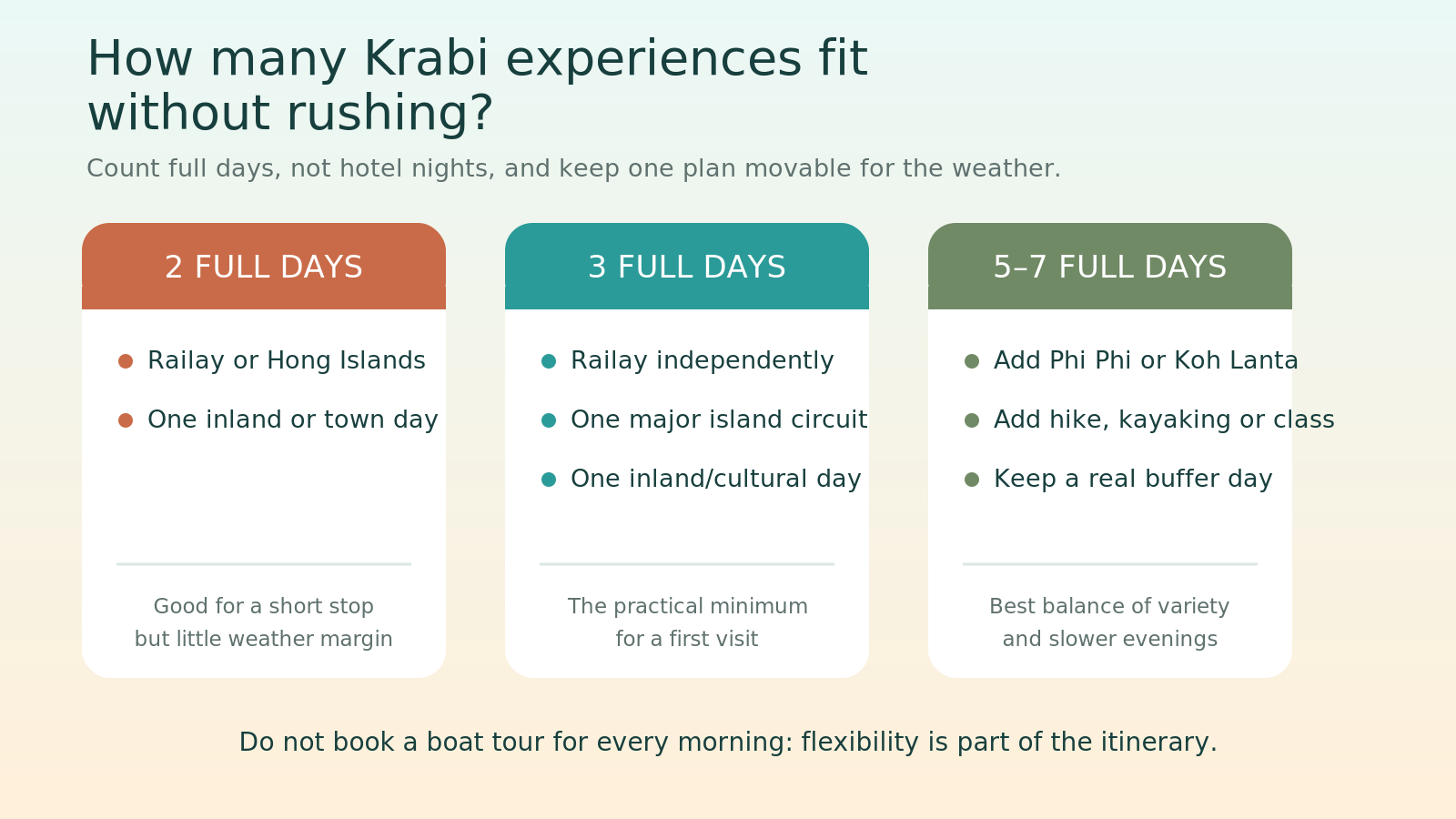
| Trip length | Day 1 | Day 2 | Day 3 | Extra days |
|---|---|---|---|---|
| 2 full days | Railay and Phra Nang | Hong or Four Islands | Not available | Use an arrival evening for Ao Nang or Krabi Town. |
| 3 full days | Railay and Phra Nang | Hong or Four Islands | Emerald Pool, hot springs, town or Ko Klang | Move the sea day to the best forecast. |
| 5 full days | Railay | Island circuit | Inland nature | Krabi Town/Ko Klang plus one active or buffer day |
| 7 full days | Use the five-day core | Add a second active or local day | Keep one unbooked buffer | Add 2-3 nights on Koh Lanta |
A realistic three-day first-visit plan
Use Day 1 for Railay and Phra Nang, Day 2 for Hong or the Four Islands and Day 3 for Emerald Pool with the hot springs, or Krabi Town with Ko Klang. Swap Days 2 and 3 when the marine forecast favours a different order. Keep the evenings simple and avoid adding Tiger Cave after a full boat day.
The five-day upgrade
Add one active or specialist choice such as climbing, Dragon Crest, kayaking, diving or a cooking class. Keep the fifth day movable until the short-range forecast becomes clearer. That space can become a second island day, a quiet beach day or the recovery time you did not realise you needed.
The seven-day version
Use the five-day core, then add a separate Koh Lanta stay or two slower northern-Krabi days. Seven nights does not require seven major activities. A better structure uses four substantial days, two light days and one buffer or transfer day.
Typical Krabi costs and booking choices
Krabi prices vary because apparently similar products are built differently. A shared long-tail, shared speedboat and private long-tail may all use the same destination name while offering different transfer times, shade, group sizes and fee treatment. Consequently, a useful comparison starts with the complete product rather than the crossed-out price.
| Experience or cost | Budget planning range | Mid-range planning range | What changes the price |
|---|---|---|---|
| Railay return boat and local day | THB 200-500 | THB 600-1,500 | Origin, private transfer, meals and activities. |
| Shared Hong or Four Islands day | THB 900-1,400 | THB 1,500-2,200 | Boat type, group size, pickup and park fee. |
| Phi Phi day trip | THB 1,800-2,300 | THB 2,400-3,300 | Vessel, early departure, group size and fee. |
| Private long-tail boat | THB 3,500-5,500 per boat | THB 6,000-10,000+ per boat | Route, hours, passengers, departure point and fees. |
| Inland shared day | THB 1,000-1,600 | THB 1,700-2,500 | Included entries, guide, pickup and number of stops. |
| Private driver for inland route | THB 2,000-3,000 per vehicle | THB 3,000-5,000+ per vehicle | Vehicle, distance, waiting time and guide service. |
| Climbing or cooking class | THB 1,300-1,800 | THB 1,900-2,800 | Group size, equipment, menu and transfers. |
| Food per person per day | THB 500-900 | THB 1,000-2,000 | Resort location, alcohol and hotel dining. |
What to check before paying for a tour
- Exact pickup zone and the earliest possible pickup time.
- Boat or vehicle type, passenger cap and shade.
- National-park and attraction fees, including child charges.
- Food, drinking water, equipment and insurance.
- Weather, tide and cancellation terms.
- Physical requirements, minimum age and accessibility.
- Final return time and whether it is safe before a flight or ferry.
National-park fees should be checked against the relevant park and zone because Krabi trips cross several protected areas. The DNP publishes an official dataset and park-services channel, while tour listings should explain whether the charge is included or collected separately.[9],[10]
Where to stay for the best Krabi activities
Ao Nang is the most practical base for a first trip because it links road transfers, long-tail boats, restaurants and many tour pickups. Railay is more atmospheric but less convenient. Krabi Town suits local food and airport access, while Klong Muang and Tubkaek suit quieter resort stays. The right base makes the least glamorous day easier: arrival, luggage, an early pickup or the final transfer.
| Area | Best for | Transport access | Advantages | Limitations |
|---|---|---|---|---|
| Ao Nang | First visits and mixed activities | Road transfer; many pickups and long-tails | Most practical dining, tours and day-trip base. | Busy, commercial and not Krabi’s most beautiful beach. |
| Railay | Scenery, climbing and romantic stays | Boat access only | Atmosphere improves after day visitors leave. | Wet landings, luggage and weather-dependent access. |
| Krabi Town | Food, local life and airport convenience | Road access; river boats | Good value and useful on rough-sea days. | Not a beach base; some tours charge extra pickup. |
| Klong Muang | Quieter couples and resorts | Road access; fewer walkable services | Calmer coast and closer to northern sights. | Less spontaneous transport and nightlife. |
| Tubkaek | Resort quiet and Dragon Crest | Road access; isolated stretches | Strong sunset views and trail proximity. | Higher dining/transport dependence. |
| Koh Lanta | A separate slow island stage | Road/ferry transfers | Wider choice of quiet beach environments. | Too far for a worthwhile Ao Nang day trip. |
What to pack and what is actually worth buying
Krabi does not require expedition equipment, but a few well-chosen items solve recurring problems. Buy for the real use: shallow-water boat landings, sudden rain, strong sun, wet paths and last-minute pickup messages. Avoid products that rely on dramatic claims without a clear manufacturer specification.
| Item | Useful when | What to inspect | Advantages | Limitations |
|---|---|---|---|---|
| 10-20 litre roll-top dry bag | Long-tail landings and boat days | Seams, closure, shoulder strap and realistic capacity | Keeps the small essentials together. | Not every product is built for submersion. |
| Waterproof phone pouch | Splashy transfers and beach landings | Manufacturer depth rating, seal and touchscreen response | Cheap, compact protection. | A failed seal can still damage a phone. |
| Water shoes | Rocky shores, mangroves and wet paths | Sole grip, secure heel and drainage | More stable than loose flip-flops. | Poor fit creates rubbing and blisters. |
| Reef-conscious sunscreen | Marine-park days | Full ingredient list, not only front-label marketing | Supports compliance and skin protection. | No sunscreen replaces shade and clothing. |
| Thailand eSIM | Pickup messages, maps and forecast checks | Compatible phone, data allowance and activation timing | Useful immediately after landing. | Coverage and speed still vary by location. |
Krabi weather, sea conditions and activity safety
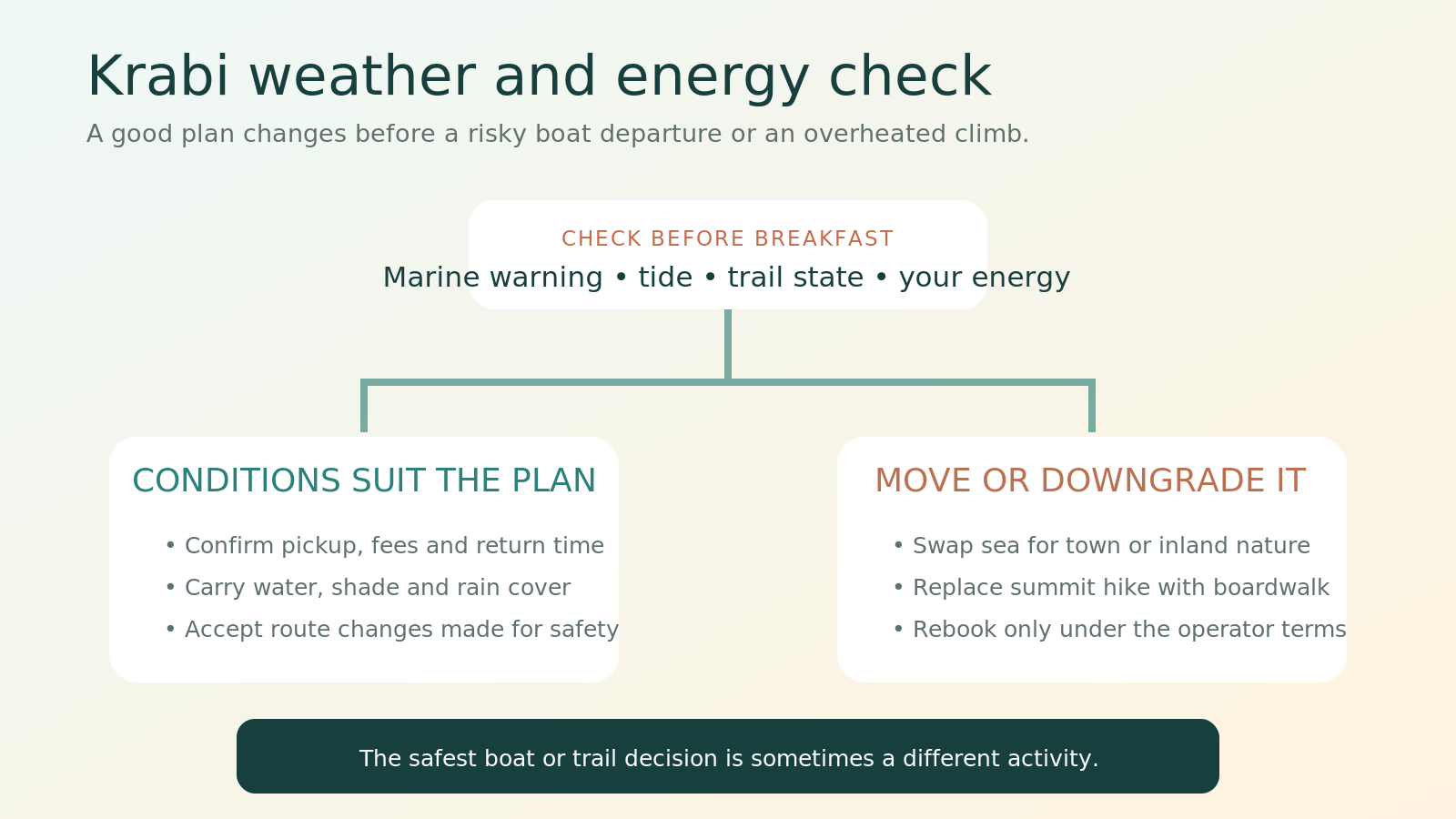
The Andaman coast is affected by the southwest monsoon, but season labels are not a substitute for a current forecast. At the time this edition was reviewed, the official Southern West Coast page was publishing location-specific rain, wind and wave information for Krabi and neighbouring provinces. Conditions and warnings change, so check again before every sea day.[13],[14]
Do not argue with a weather cancellation
A cancelled boat is frustrating, especially after an early pickup. Nevertheless, an operator that refuses to sail in unsafe conditions is doing the right thing. Ask for the rebooking or refund terms in writing, then switch to a suitable inland or town plan. Do not pressure a small-boat captain to copy the decision of a larger vessel.
Red flags, riptides and swimming judgement
FCDO safety guidance warns that beaches can have strong currents and that red flags should be obeyed. Swim where conditions and local advice support it, wear the supplied life jacket while a boat is moving and do not enter rough water merely because other people have done so.[16]
Heat matters on trails and temple stairs
Begin strenuous activities early, carry enough water and turn around before symptoms become severe. A cloudy morning can still be hot and humid. Meanwhile, heavy rain can make a waterfall impressive but a trail unsafe. Use the activity-specific conditions, not one general “good weather” label.
How to enjoy Krabi without damaging the reason you came
Responsible travel is practical rather than decorative. The Department of National Parks asks marine visitors not to touch or stand on coral, feed animals, litter or allow anchoring on reefs. It also restricts sunscreen containing oxybenzone, octinoxate, 4-MBC and butylparaben in marine national parks.[11],[12]
Choose observable standards
- Life jackets fit the passengers rather than merely being present.
- The captain uses mooring systems instead of dropping an anchor on reef.
- Guides stop guests from standing on coral or feeding wildlife.
- Refill water or reduced single-use plastic is offered where practical.
- Community visits are hosted and paid locally.
- Wildlife is observed without chasing, touching or staged feeding.
Marketing words such as “eco”, “ethical” and “local” are not enough by themselves. Ask how the operation behaves. A slightly smaller itinerary can create a better day when the group is managed carefully and the destination is not treated as an unlimited resource.
Best Krabi activities by traveller type
The headline “best” changes with age, mobility, interests and tolerance for early starts. A strenuous viewpoint can be a highlight for one reader and an unnecessary risk for another. Use the table as a filter rather than a rule.
| Traveller type | Prioritise | Treat cautiously | Practical adjustment |
|---|---|---|---|
| Families with younger children | Railay, a shaded island boat, easy beach time, cooking class | Tiger Cave summit, very long Phi Phi days | Ask about life-jacket sizing, toilets, shade and pickup length. |
| Couples | Hong, Railay sunset, Tubkaek, private long-tail if budget allows | Overbooking every evening | Protect one slow sunset and one flexible day. |
| Solo travellers | Shared small groups, cooking class, Railay, Krabi Town | Isolated trail starts without a transport plan | Share route details and keep enough data/credit for changes. |
| Active travellers | Climbing, Dragon Crest, kayaking, diving | Stacking hard days in heat | Alternate active and low-effort days. |
| Limited mobility | Krabi Town, selected resorts, private driver, accessible boat discussion | Beach landings and steep temple/hiking routes | Request exact step, transfer and boarding details before paying. |
| Rainy-season travellers | Town, food, cooking, flexible inland stops | Non-refundable consecutive boat tours | Keep bookings movable and check TMD daily. |
Common mistakes when choosing things to do in Krabi
- Booking a boat tour for every full day and leaving no weather buffer.
- Treating Railay as a road-access beach and arriving with luggage that cannot be lifted from a long-tail.
- Choosing the cheapest tour without checking park fees, shade, passenger numbers or pickup zone.
- Attempting Tiger Cave or Dragon Crest in midday heat with too little water.
- Ignoring tide when booking Thale Waek, Ao Thalane or a cave-kayak route.
- Scheduling a long boat day immediately before a flight.
- Calling Koh Lanta a quick day trip instead of allowing an overnight stay.
- Assuming every attraction is close to Ao Nang because the listing says “Krabi”.
- Buying a product because it says “waterproof” or “reef safe” without reading the specification or ingredients.
- Turning every sunset into another transfer instead of leaving time to enjoy the coast.
Entry, insurance, drone and emergency checks
British travellers should check the current FCDO Thailand page before travel and again shortly before departure. Its entry-requirement section covers passport validity and the Thailand Digital Arrival Card, while the main advice page explains current regional warnings and the need for insurance that covers the itinerary and planned activities.[16],[17]
Adventure activities need activity-specific insurance
Climbing, scuba diving, motorcycling and some trekking can sit outside basic policy wording or require additional conditions. Confirm the activity, depth or altitude limits, licensing requirements, equipment expectations and emergency-assistance process. Do not assume that “Thailand cover” means every paid activity is included.
Drones require current registration and location checks
Thailand uses official registration systems for unmanned aircraft and pilots. In addition, national parks and individual sites can restrict flying. Use the Civil Aviation Authority of Thailand UAS Portal and confirm local permission instead of relying on advice from an old forum post.[19]
Keep the Tourist Police route available
The Tourist Police contact page confirms hotline 1155. Save it before travel, keep a copy of your passport and insurance details, and know the name of your hotel in Thai or on a map. Those simple preparations are more useful during a problem than searching from scratch on weak data.[18]
Frequently asked questions
What are the best things to do in Krabi for a first visit?
Use three different types of day: Railay and Phra Nang for the limestone coast, Hong or the Four Islands for one major boat circuit, and an inland or cultural day such as Emerald Pool, the hot springs, Krabi Town or Ko Klang. That combination shows more of Krabi than three similar boat tours.
How many full days do you need in Krabi?
Three full days is the practical minimum. Five days is more comfortable because one activity can move around the short-range forecast, while seven days allows a hike, kayaking, a cooking class or a separate Koh Lanta extension without rushing.
Is Railay worth visiting if you are not staying there?
Yes. Railay is one of the easiest independent days from Ao Nang and delivers Krabi’s signature cliffs and beaches. Start early, travel light and expect a shallow-water boat landing rather than a conventional ferry terminal.
Which is better: Hong Islands or the Four Islands?
Hong is usually the stronger scenery-led choice, with lagoon and karst appeal. The Four Islands route is the classic, closer circuit and may cost less. The better day depends on tide, boat type, group size, park-fee treatment and whether you already plan to visit Railay independently.
Is Phi Phi worth a day trip from Krabi?
Yes when Maya Bay and Phi Phi are a genuine priority. Otherwise, Hong or the Four Islands may create a less exhausting first boat day. Compare early departure time, vessel capacity, park rules, fee treatment and the amount of time actually spent on land.
Can you visit Emerald Pool, hot springs and Tiger Cave Temple in one day?
Many tours do, but the day is long and the summit climb makes it physically demanding. A more comfortable plan pairs Emerald Pool with the hot springs, then visits Tiger Cave early on another morning or only explores the lower temple area.
Do you need to book Krabi boat tours in advance?
Book ahead for peak holidays, private boats, small groups and must-do activities. At other times, keeping at least one sea day flexible is valuable because wind and wave forecasts may make a different date safer.
Is Krabi worthwhile during the rainy season?
Yes, provided the itinerary is flexible. Rain does not fall continuously every day, but strong wind, waves, thunderstorms, flooding and slippery trails can disrupt individual plans. Keep town, cooking, food and gentle inland alternatives available.
Where should first-time visitors stay in Krabi?
Ao Nang is the easiest all-round base for transport, restaurants and mixed day trips. Railay is more atmospheric but boat-dependent. Krabi Town suits food and airport convenience, while Klong Muang and Tubkaek suit quieter resort stays.
Do you need a scooter in Krabi?
No. Most first-time visitors can use hotel transfers, shared tours, taxis, songthaews, boats and a private driver for an inland day. A scooter only makes sense for a properly licensed, insured and experienced rider who understands local road conditions and their policy exclusions.
What should you pack for Krabi activities?
Bring grippy footwear, a compact dry bag, tested phone protection, a rash vest or light sun layer, permitted sunscreen, insect repellent, a reusable water bottle, temple-appropriate clothing and a small amount of cash for fees and local transport.
What should you do when a Krabi boat tour is cancelled?
Accept the safety decision, confirm the refund or rebooking terms in writing, then switch to Krabi Town, Ko Klang, a cooking class, selected inland attractions or a rest day. Do not pressure a small-boat captain to copy the decision of a larger vessel.
Which Krabi experiences should you prioritise?
For a first trip, prioritise Railay, one well-chosen island day and one inland or cultural day. That route shows three genuinely different sides of Krabi and still leaves enough energy for weather changes, dinner and the unplanned beach hour that often becomes the best part of the visit.
With five days, add one active or specialist experience and keep one day movable. With seven days, slow down rather than doubling the booking list. The keyphrase “things to do in Krabi” covers a huge territory; your own itinerary should not.
Sources and verification notes
Research reviewed on 25 August 2026. Prices, schedules, access, rules and activity conditions can change. Recheck live details before booking and before travel.
- Tourism Authority of Thailand – Krabi destination guide – Destination overview, Ao Nang, coast, islands and inland attractions.
- Tourism Authority of Thailand – 10 things to do in Krabi – Railay, Hong, Emerald Pool, hot springs and wider attraction context.
- Tourism Authority of Thailand – Krabi two-day trip planner – Railay, Phra Nang, Thale Waek, Poda, Khao Khanap Nam and Tha Pom route context.
- Tourism Authority of Thailand – Krabi and Trang four-day planner – Regional route sequencing and island/inland combinations.
- Tourism Authority of Thailand – Krabi’s mythical mountains – Khao Ngon Nak, Ao Luek and mountain landscape context.
- Tourism Authority of Thailand – Krabi Travel With Care – Community, nature and responsible visitor context.
- Tourism Authority of Thailand – Ko Phi Phi – Phi Phi destination and access context.
- Tourism Authority of Thailand – Ko Lanta – Koh Lanta destination and route context.
- Department of National Parks – national park entrance-fee dataset – Official national-park fee reference; visitors should still verify the relevant zone and current collection method.
- Department of National Parks – e-National Park reservations and services – Official park services and current access channel.
- Department of National Parks – marine sunscreen and coral protection notice – Restricted sunscreen chemicals and responsible coral behaviour.
- Department of National Parks – Bida Islands conservation guidance – Do not touch coral, feed wildlife, litter or anchor on reefs.
- Thai Meteorological Department – Krabi forecast – Official provincial forecast and current observations.
- Thai Meteorological Department – Southern West Coast forecast – Official Andaman-side wind, wave and heavy-rain information.
- Department of Airports – Krabi International Airport – Official airport information and notices.
- UK Foreign, Commonwealth and Development Office – Thailand travel advice – Current warnings, insurance and general safety guidance for British travellers.
- UK Foreign, Commonwealth and Development Office – Thailand entry requirements – Passport and entry guidance for British travellers.
- Thailand Tourist Police – contact information – Tourist Police hotline 1155.
- Civil Aviation Authority of Thailand – UAS Portal – Official drone pilot and aircraft registration route.
- GetYourGuide – Hong Islands day tour listing – Current comparison example for duration, route and park-fee treatment.
- GetYourGuide – Four Islands long-tail tour listing – Current comparison example for route, duration and inclusions.
- GetYourGuide – Railay half-day climbing listing – Current comparison example for half-day climbing duration and requirements.
- GetYourGuide – Phi Phi early-bird day tour listing – Current comparison example for a long Phi Phi day and park-fee treatment.
- Viator – Krabi inland day-tour listing – Current comparison example for a combined inland day.
- Viator – Ao Thalane kayaking listing – Current comparison example for kayaking duration and inclusions.
Image credits
- Illustrations in this article were created for Taylor’s Trailblazing Travels. Third-party photographs, where used, are credited beside the image or in the source list.