A calm, practical guide to closed-attraction claims, taxi and transfer pressure, rental disputes, fake booking messages, payment traps and the steps that protect your money without making you suspicious of everyone.
The main Thailand scams to avoid include claims that an attraction is closed, tuk-tuk shopping detours, airport taxi touts, changed fares, rental damage disputes, requests to leave a passport, fake hotel payment messages, misleading currency conversion and inflated nightlife bills. Protect yourself by using official queues and websites, keeping documents and payment methods under your control, photographing rentals, confirming prices in writing and calling Tourist Police on 1155 when you need help.
Thailand scams: quick answers
Best first response
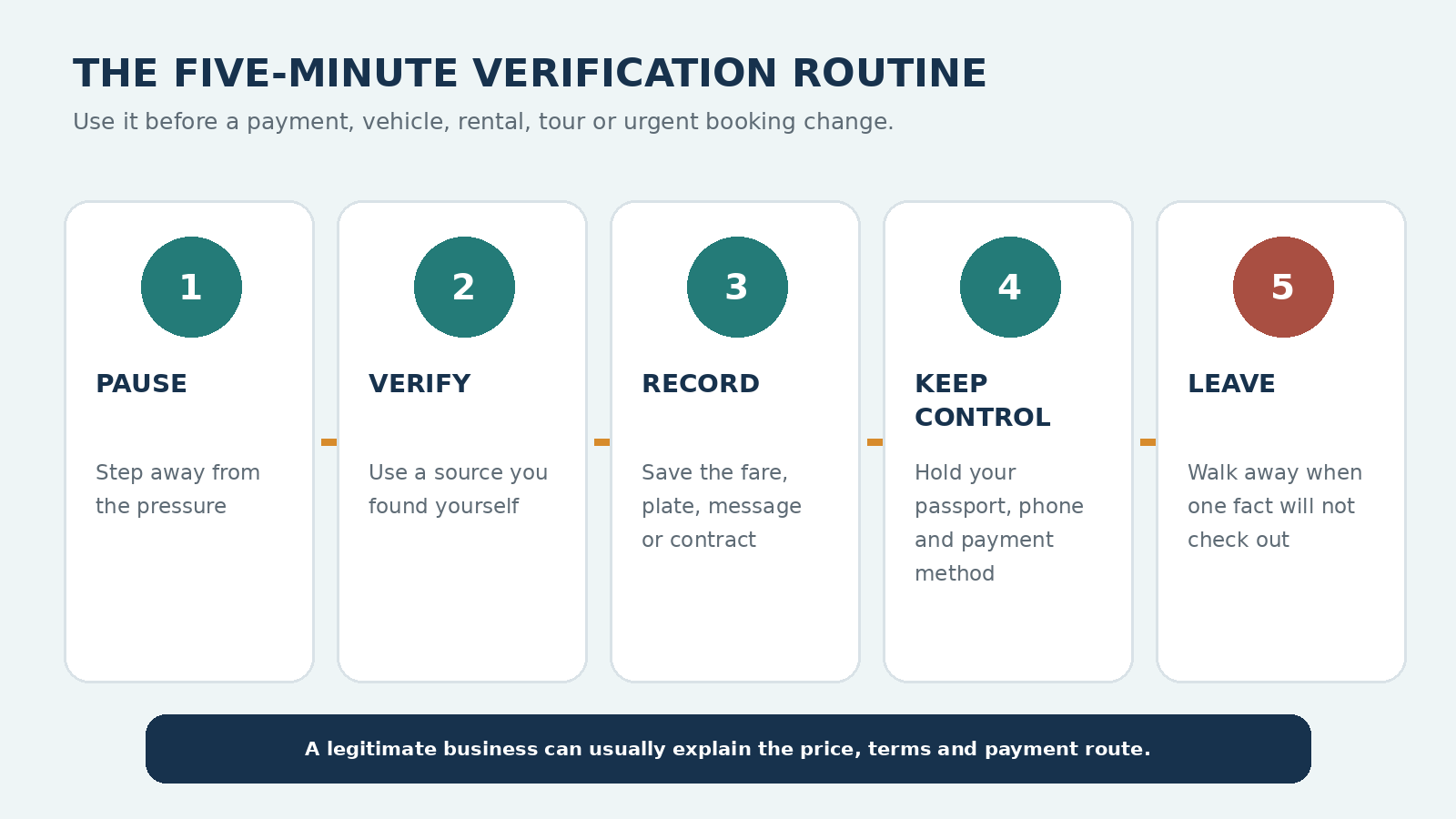
Pause the transaction, move away from pressure and verify one fact through a source you found yourself.
Tourist Police
Call 1155 for tourist assistance. Police are 191 and medical emergencies are 1669.
Airport taxi rule
At Suvarnabhumi, use the official Level 1 queue between Gates 4 and 7, not an unsolicited offer in arrivals.
Rental rule
Record every mark before leaving and avoid giving an original passport as an informal guarantee.
Booking-message rule
Do not use the message link. Open the original app or website independently and check the confirmed payment policy.
Payment rule
Check the amount, currency and recipient before approving. Decline an unclear home-currency conversion.
In this guide
Thailand is not a place where every driver, tour desk or friendly stranger is trying to cheat you. Most everyday transactions are ordinary, and many travellers complete a holiday without a serious problem. Tourist areas do, however, create predictable opportunities for pressure: a tired arrival, an unfamiliar price, the last ferry of the day, a damaged-looking scooter or a message that appears to know your hotel dates.
A long list of named scams can help, but it is not enough. The details change. One year the approach arrives beside a temple; the next it arrives through WhatsApp with a real booking number. The stronger defence is recognising when someone wants you to give up control of the route, the price, the payment channel, your passport, your phone or your ability to walk away.
This guide explains specific Thailand tourist scams, yet it also shows what legitimate charges can look like. That balance matters. A disclosed airport surcharge is not the same as a driver inventing a new fare halfway to the hotel, and a written damage deposit is not the same as handing over a passport to a business with no clear contract.
Before you travel: a 15-minute anti-scam setup
The easiest time to prevent a problem is before you are standing in an arrivals hall with poor reception and a low phone battery. A short setup gives you independent information, a way to contact help and evidence that does not disappear with one lost device.
Save the official numbers and websites
Store Tourist Police 1155, police 191, medical emergency 1669, fire and rescue 199, the cybercrime hotline 1441 and the Department of Land Transport complaint line 1584. Save them as contacts rather than relying on a search result during a stressful moment. Thailand’s official tourism information number is 1672.
For online crime reports, use the Royal Thai Police route at thaipoliceonline.go.th. Reach the portal directly rather than paying an intermediary simply to submit the report, and call the AOC hotline on 1441 when an online payment needs urgent attention.
Keep independent access to data
A working connection lets you check a map, call the hotel, compare the official price and open the booking platform without using a stranger’s phone or hotspot. A local SIM, roaming plan or eSIM can all work. The practical choice depends on handset compatibility, trip length and how much data you use.
Create a small evidence folder
- Save the first hotel address in English and Thai.
- Screenshot airport transfer instructions, ticket references and meeting points.
- Keep a cloud copy of the passport photo page, insurance certificate and emergency contacts.
- Turn on card transaction alerts and two-factor authentication.
- Write down the bank’s international lost-card number somewhere other than the phone.
- Store one backup card separately from the daily wallet.
The pattern behind most Thailand tourist scams
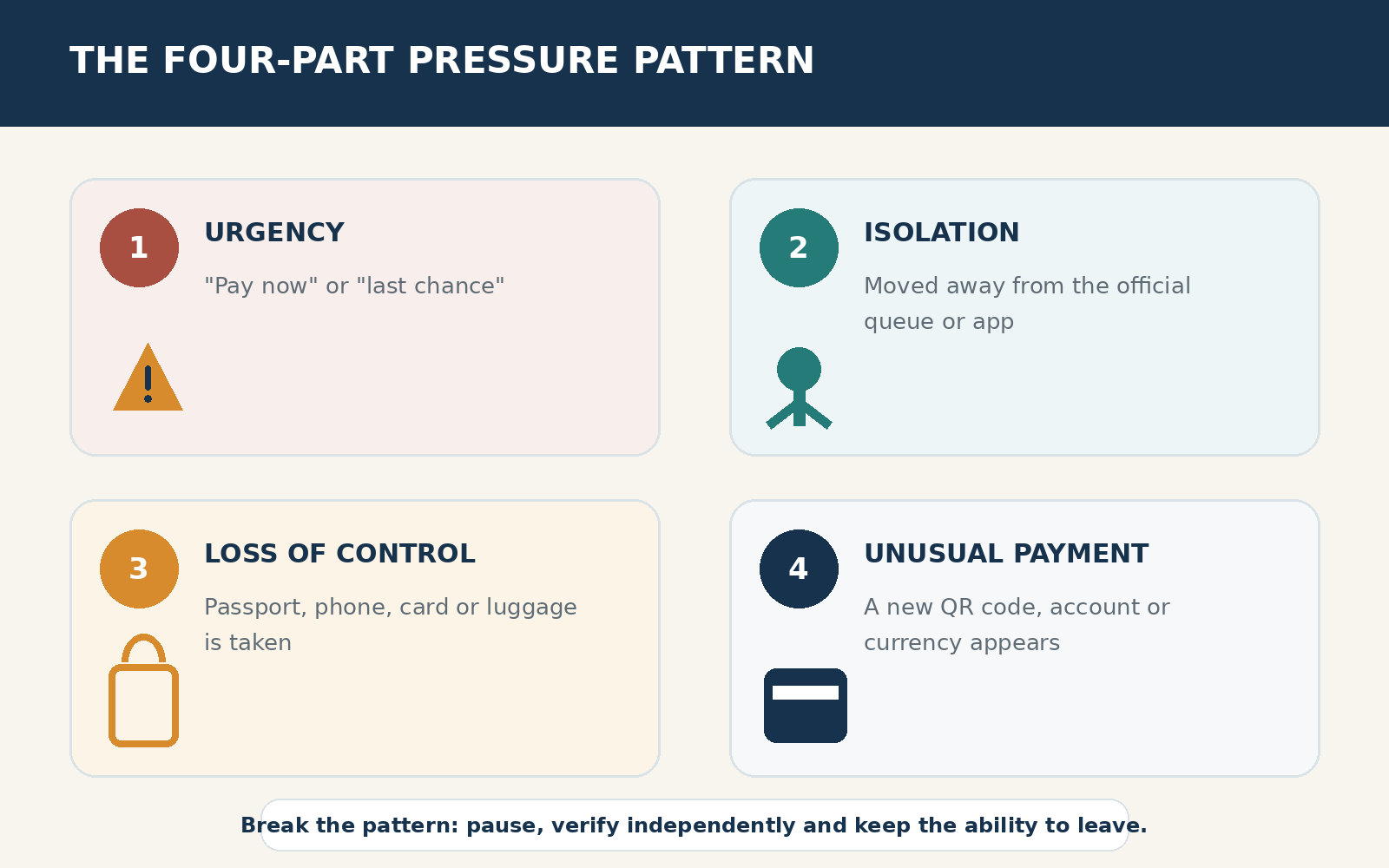
Scams do not always begin with an obvious lie. They often begin with a helpful fact, a friendly question or a genuine inconvenience. A driver may correctly say that traffic is heavy, a ticket seller may know the real departure time, or a message may contain the correct hotel name. The risk appears when that information is used to hurry you into a route you cannot independently check.
Four red flags that matter more than the story
Urgency
The attraction is closing, the last seat is disappearing, the booking will be cancelled in ten minutes or the police fine must be paid immediately. Genuine deadlines exist, but a legitimate business should still be able to explain the terms.
Isolation
You are moved away from the official entrance, taxi queue, staffed counter, platform message thread or busy public area. Isolation makes it harder to compare information or ask a neutral person.
Loss of control
Someone wants the original passport, unlocked phone, bank card, one-time code, luggage, drink or vehicle deposit without a clear process. Once control is lost, a small disagreement becomes harder to leave.
An unusual payment route
The confirmed card payment suddenly becomes a bank transfer, QR code to a personal name, gift card, cryptocurrency payment or cash handover with no receipt. A changed channel needs independent verification.
Reassuring signs
- Price and inclusions are clear before the service starts
- You can verify the business through an official channel
- A receipt, contract or platform record is available
- You keep your passport, phone and payment method
- The seller is comfortable while you compare options
Warning signs
- The price changes after you have committed
- The deal depends on secrecy or immediate action
- Questions are answered with more pressure
- You are told not to contact the original platform
- Leaving requires surrendering money or documents
The ten-minute test
Ask whether the offer would still make sense after ten quiet minutes. Then check one fact through a source chosen by you: the official attraction page, airport signage, original booking app, bank number printed on the card or hotel reception. A genuine option usually survives a short pause. A pressure tactic often becomes less convincing as soon as it loses control of the clock.
Paid TDAC, visa and immigration websites
The Thailand Digital Arrival Card creates an obvious search-engine trap because travellers know they must complete it but may not know that the official service is free. All non-Thai nationals arriving by air, land or sea should use the official Thailand Digital Arrival Card website. Thai government guidance states that the card can be submitted within the three days before arrival and no fee is charged.
A commercial intermediary may offer a real form-filling service for a fee. That is not automatically identity theft, but it is unnecessary for most travellers and can create confusion about where passport data has been sent. A fake page may go further by copying official colours, buying a prominent advert and charging for a service that never produces a valid record.
How to check the page
- Type the official address yourself rather than choosing the first sponsored result.
- Check that the domain is exactly tdac.immigration.go.th.
- Do not pay a fee for the official TDAC submission.
- Keep the confirmation email or screenshot after submission.
- For an e-visa, start at the official Ministry of Foreign Affairs portal at thaievisa.go.th.
The Grand Palace is closed: attraction and tuk-tuk detours
The familiar version begins near a major Bangkok sight. A helpful person says the Grand Palace, Wat Pho or another attraction is closed for a ceremony, lunch, cleaning or a special holiday. A cheap tuk-tuk tour is offered instead, often with stops at a tailor, gem shop, travel office or lesser-known temple.
Official schedules can genuinely change. The correct response is therefore not to assume that every closure claim is false. Walk to the official entrance, check the attraction website or ask uniformed staff at the ticket office. Do not accept a replacement itinerary from the same person who delivered the claim.
Current Grand Palace facts for a price check
The official Grand Palace website currently lists daily opening from 8:30 am to 4:30 pm, with ticket sales from 8:30 am to 3:30 pm. The stated foreign-visitor ticket is 500 THB and includes the Grand Palace compound, Wat Phra Kaew and the Queen Sirikit Museum of Textiles. Ceremonial schedules can still affect access, so check the official Grand Palace information on the day.
When a guided visit may help
A guided tour is not necessary to avoid the scam. However, some first-time visitors prefer a meeting point, a licensed guide and written inclusions. Compare the ticket policy, entrance-fee wording, meeting location, cancellation terms and recent reviews rather than choosing only by the headline price.
| Option | Useful for | Check before booking | Link |
|---|---|---|---|
| Independent visit | Maximum flexibility and the lowest organisational cost | Official opening schedule, dress rules, ticket price and entrance | Check the official Grand Palace page |
| GetYourGuide comparison | Small-group and guided options from multiple operators | Whether the 500 THB entry is included, exact meeting point and group size | Compare Grand Palace tours on GetYourGuide |
| Viator comparison | Private, half-day and multi-temple options | Entrance fees, hotel pickup, guide language and cancellation deadline | Compare Bangkok temple tours on Viator |
Not every tuk-tuk ride is dishonest
A normal ride can be enjoyable when the destination and total price are agreed before departure. The stronger warning sign is an implausibly cheap multi-stop tour that relies on shopping commissions or a claim that your original plan is impossible. If you want a simple ride, say the destination, confirm that there are no shop stops and pay only the agreed amount at the end.
Airport taxi and private-transfer pressure
Arrivals halls are ideal places for overcharging because passengers are tired, carrying luggage and unsure which floor they need. A person may claim that the official taxi queue is closed, the meter does not apply, ride-hailing is illegal or your pre-booked driver has sent a replacement. The safest response is to follow the airport’s published process rather than an unsolicited approach.
Suvarnabhumi Airport: what the official process looks like
Airports of Thailand states that regular taxis operate 24 hours from Level 1 of the main terminal between Gates 4 and 7. Passengers take a queue ticket. Fares start at 35 or 40 THB according to the vehicle and meter rules, and a 50 THB airport surcharge is paid to the driver. Tolls are separate, and regulated baggage charges may apply. The official airport page also identifies Grab pickup at Level 1, Gate 4 and the Airport Rail Link on Level B1, operating from 5:30 am to midnight.
Those legitimate extras explain why the final total may exceed the meter. However, they should not be used as an excuse for an unexplained cash demand. Keep the queue ticket, note the vehicle plate and ask about tolls before the journey begins.
| Arrival option | How it works | Main advantage | Main limitation |
|---|---|---|---|
| Official metered taxi | Level 1, Gates 4-7; take a queue ticket | 24-hour official process with a traceable ticket | Queue time, tolls, surcharge and possible baggage charge |
| Airport Rail Link | Level B1; current stated hours 5:30 am-midnight | Avoids road traffic for suitable city routes | May still require BTS, MRT, taxi or walking with luggage |
| Licensed ride-hailing | Follow the app and official pickup point; Grab uses Level 1, Gate 4 | Fare and vehicle details are recorded in the app | Pickup confusion and surge pricing can occur |
| Pre-booked private transfer | Confirm operator, sign name, meeting point, waiting time and inclusions | Useful after a late flight or with children and heavy bags | Usually costs more and requires careful meeting-point checks |
Compare a transfer without assuming it is safer by default
A pre-booked transfer can reduce negotiation, but it still needs verification. Match the driver’s message to the booking record, keep the operator contact and do not follow a person who cannot show the correct passenger name or reference.
| Marketplace | What to compare | Link |
|---|---|---|
| GetYourGuide | Meeting point, waiting time, tolls, luggage allowance and recent operator reviews | Compare Bangkok airport transfers on GetYourGuide |
| Viator | Vehicle size, flight monitoring, cancellation terms and whether the price is per person or per vehicle | Compare Bangkok airport transfers on Viator |
Taxi, tuk-tuk and ride-hailing fare disputes
Outside the airport, the common issue is less dramatic than a fake taxi. A driver may refuse the meter, quote an unclear amount, add a stop, change the destination or demand a different fare after departure. Ride-app problems can include a request to cancel the app booking and pay cash, a vehicle that does not match the registration or a driver claiming that the displayed price excludes a large unexplained fee.
Before the vehicle moves
- Match the plate, vehicle and driver to the app or queue record.
- Confirm whether the fare is metered, fixed or app-based.
- Ask whether tolls, airport surcharges or parking are additional.
- Keep the destination open on your own map.
- Do not hand over an unlocked phone so someone can cancel or alter the booking.
If the deal changes during the journey
Do not argue aggressively inside a moving vehicle. Ask to stop in a safe, busy place such as a hotel entrance, petrol station or staffed transport point. Save the plate, receipt, app screen and route. For complaints about taxis, motorcycle taxis, buses, minibuses and tuk-tuks, Thailand’s Department of Land Transport lists the complaint line 1584 and the official complaint portal at ins.dlt.go.th/cmpweb.
A fixed price is not automatically a scam
Private transfers, some local taxi routes and tuk-tuk journeys may use a fixed price. The question is whether the amount and service were clear before departure. A transparent fixed fare can be perfectly legitimate; a surprise fare after the luggage is loaded is the problem.
Train, bus and ferry ticket scams
Transport pressure appears around stations, piers and online search results. Someone may say the official counter is closed, your ticket is invalid, the bus is full or a compulsory transfer must be purchased from a different desk. Online, a copied timetable or fake agent may collect payment without issuing a usable ticket.
Use the operator, station or a traceable marketplace
For a simple local journey, buying at the official counter can be easiest. For a multi-part route, a recognised marketplace can help compare operators and keep the booking record in one account. It does not guarantee that every bus or boat will run exactly on time, so still read the operator name, boarding point, luggage rules and connection margin.
| Route example | Why travellers are vulnerable | What to verify | Optional comparison link |
|---|---|---|---|
| Bangkok to Chiang Mai | Sleeper classes, station names and sell-out dates can be confusing | Train number, station, berth class, departure date and ticket name | Compare Bangkok-Chiang Mai transport on 12Go |
| Bangkok to Pattaya | Airport, city and hotel pickup points are easily mixed up | Exact terminal, vehicle type, luggage and final drop-off | Compare Bangkok-Pattaya transport on 12Go |
| Bangkok to Krabi | Flight, bus and combined-ticket prices may look similar | Total duration, airport transfer, overnight arrival and included connections | Compare Bangkok-Krabi transport on 12Go |
Five checks before paying
- Confirm the operator and departure point, not just the city name.
- Read whether the ticket is direct or requires a minivan, ferry or station change.
- Check the local arrival time and onward transport options.
- Keep the ticket inside the original account or email, not only as a forwarded screenshot.
- Allow a buffer before an international flight; separate tickets rarely protect each other.
Scooter, car and jet-ski rental disputes
Rental disagreements can involve scratches, cracked mirrors, tyre damage, fuel, lost keys or equipment that was already worn. Some claims are genuine. The risk rises when there is no written condition record, the vehicle is collected in poor light, the business holds the original passport or the return happens after the staff who issued it have left.
UK travel advice specifically says not to hand over a passport as a guarantee to motorcycle or jet-ski rental businesses because a company may retain it during a damage claim. A reputable provider may ask to see identification or take a copy, but you should look for another option when the original passport is the only accepted leverage.
Record the vehicle properly
- Film one continuous walk around the vehicle while a staff member is present.
- Take close photographs of every existing mark, wheel, tyre, mirror, seat and control.
- Include the fuel gauge, odometer, registration and supplied helmets or life jackets.
- Ask the staff member to mark damage on the contract.
- Send the photographs to cloud storage or a travel companion before leaving.
- Return during staffed daylight hours and obtain a receipt or written return confirmation.
Insurance and licence matter more than the deposit
For scooters, the larger risk is often injury rather than a damage scam. Check whether your licence, international driving permit and insurance cover the engine size and activity. A rental shop handing over a key does not prove that you are legally licensed or insured. Wear a helmet and do not rent because the hotel is inconveniently located.
Jet-ski claims
If you choose to rent a jet ski, photograph the hull above and below the waterline as far as safely possible, controls and existing repairs. Ask who is responsible for collision, engine failure and beaching. When a dispute becomes threatening, move toward a busy staffed area, keep evidence and call Tourist Police rather than physically confronting staff.
Fake hotels, booking messages and off-platform payments
A modern hotel scam can look more convincing than a street approach because the message may include the correct property, dates, guest name and price. It may claim that the card failed, a new deposit is required or the reservation will be cancelled within hours. The link then leads to a copied payment page or the sender asks for a transfer outside the platform.
Booking.com’s current traveller-safety guidance warns about phishing through WhatsApp, phone and email. It says the company will not ask for card details by email, phone, text or WhatsApp and will not request a bank transfer that differs from the payment policy in the booking confirmation. Other platforms have their own procedures, but the same principle applies: open the original account independently and verify through the established message thread or customer-service route.
Do not use the link in the message
- Close the message and open the booking app or type the platform address yourself.
- Read the confirmed payment, deposit and cancellation policy.
- Contact the property through the original platform thread or a number already shown in the booking.
- Do not share a one-time passcode, full card number or account password.
- If you paid, freeze the card, call the issuer and report the message to the platform immediately.
Use accommodation platforms as a record, not a guarantee
A platform can provide reviews, written policies and a traceable payment history. It cannot remove every fake listing or compromised message. Compare the address on a map, look for a realistic review history, read the newest reviews and be wary when a newly listed property is dramatically cheaper than nearby alternatives.
| Base | Common booking pressure | Useful check | Optional hotel comparison |
|---|---|---|---|
| Bangkok | Wrong branch, unclear distance from BTS/MRT or urgent deposit message | Match the full address, station and payment policy | Compare Bangkok hotels on Agoda |
| Chiang Mai | Property described as Old City when it is well outside the moat | Check walking route, late-arrival reception and recent noise reviews | Compare Chiang Mai hotels on Agoda |
| Phuket | Beach name used loosely or a very cheap room far from the stated area | Confirm the exact beach, road access and transport costs | Compare Phuket hotels on Agoda |
| Pattaya | Unclear guest policy, nightlife noise or a location far from the advertised centre | Read house rules and map the route at the time you expect to return | Compare Pattaya hotels on Agoda |
Tour desks, gem shops, tailors and commission detours
Commission-based selling is common in tourism and is not automatically fraudulent. A hotel may earn money from a tour booking, and a tuk-tuk driver may receive fuel vouchers or commission for delivering customers to a shop. The problem is hidden pressure: a cheap ride that becomes a compulsory shopping circuit, jewellery sold as a risk-free investment, a tailor promising unrealistic delivery or a tour that omits major fees from the headline price.
Gem and investment claims
Do not buy jewellery because a stranger says a government promotion, export loophole or guaranteed resale profit ends today. A souvenir purchase and an investment purchase are different decisions. For a high-value item, leave the shop, compare an independent valuation and use a payment method with a clear record.
Tailor orders
A legitimate tailor should be willing to discuss fabric, construction, fittings, delivery date, alterations and the written total. Avoid paying the full amount before the fitting when the business has no established reputation. Photograph the order sheet and sample fabric, and leave enough time before departure for corrections.
Tour inclusions
Before paying, ask whether the price includes entrance fees, national-park fees, hotel pickup, boat transfers, meals, insurance and equipment. A low headline price may become reasonable once exclusions are added; equally, an agent who refuses to name the operator or provide a receipt is a poor choice.
Cards, ATMs, dynamic currency conversion, QR codes and cash
Payment problems range from deliberate card skimming to a traveller approving the wrong currency on a genuine terminal. The basic protection is visibility: keep the card in sight, read the screen, check the recipient and keep instant transaction alerts active.
ATMs and card handling
UK travel advice notes incidents of ATM skimming in Thailand and recommends using an ATM in a bank and protecting the PIN. Choose a machine attached to a bank branch or in a staffed, well-lit location where possible. Inspect the card slot, cover the keypad and take the card before counting cash.
A disclosed access fee is frustrating but is not automatically a scam. Read the screen and decide whether the withdrawal amount justifies the fee. If a machine retains the card, contact the bank through a verified number rather than accepting help from a bystander who wants your PIN.
Dynamic currency conversion
An ATM or card terminal may offer to charge your home currency instead of Thai baht. Visa explains that dynamic currency conversion includes the exchange rate and any additional fee or markup. The screen should show both currencies, the exchange rate and the extra cost, and you should be able to accept or decline. Paying in Thai baht often lets your own card provider perform the conversion, but compare your bank’s terms rather than following an automatic rule.
QR-code payments
QR payment is widely used in Thailand, although international visitors may not have a compatible account. Before approving, check the merchant or recipient name and amount on your own screen. A sticker placed over a genuine QR code can redirect payment, while a rushed seller may simply select the wrong amount. Ask for a receipt or confirmation when the payment is significant.
Cash exchange
- Compare the buy and sell columns carefully.
- Count cash at the counter without displaying the rest of your money.
- Keep the receipt until the amount is checked.
- Do not exchange with an unsolicited person in the street.
- Separate daily cash from emergency cash.
Nightlife bills, drink spiking, fake police and job offers
Nightlife problems may involve an open tab that becomes difficult to dispute, an unexpected charge for companions’ drinks, pressure to move to another venue, theft or drink spiking. UK government travel advice states that drink spiking and drug-assisted assault do occur in Thai tourist areas and advises travellers not to leave drinks unattended or accept drinks from strangers.
Reduce the ambiguity before ordering
- Check the menu price and whether taxes or service charges are included.
- Avoid an open tab in a venue that feels unclear.
- Keep the drink in view and do not accept an opened bottle from a stranger.
- Arrange the return route before becoming tired or intoxicated.
- Move to staff, a hotel or medical help if you feel unexpectedly unwell.
Fake police and instant fines
A person may claim to be police, display an unclear card and demand immediate cash for an invented offence. Do not physically resist. Ask to move to an official police station, call Tourist Police on 1155 and avoid handing over an unlocked phone or bank card. Thailand’s Police Care app also provides information about nearby stations and guidance for verifying or reporting concerns.
High-paying job offers
Government travel advice warns about job offers that have led people to Thailand and then into neighbouring countries, where passports were confiscated and victims were coerced into online scam activity. Treat a vague high-paying overseas role, paid travel and pressure to surrender documents as serious warning signs. Verify the employer, work permission, location and contract independently before travelling.
What is not automatically a scam?
Over-caution can create unnecessary conflict and make normal travel feel hostile. The examples below are situations that deserve checking, not automatic accusation.
| Situation | Why it may be legitimate | What to check |
|---|---|---|
| 50 THB Suvarnabhumi taxi surcharge | Airports of Thailand publishes this official passenger surcharge | Use the official queue and separate it from the metered fare and tolls |
| Road tolls added to a taxi journey | Expressway tolls are normally paid separately | Ask before departure and keep small notes or the receipt |
| Fixed tuk-tuk or private-transfer price | Not every service uses a meter | Agree the total, route and stops before moving |
| ATM access fee | The machine may clearly disclose a bank fee | Read the amount before accepting and compare withdrawal limits |
| Hotel damage deposit | A written deposit can be part of the confirmed property policy | Check the amount, method, refund timing and receipt |
| Cash-only small business | Many legitimate local vendors prefer cash | Confirm the price and receive change before leaving |
| Attraction schedule change | Royal ceremonies, weather and maintenance can change access | Verify through the official entrance or website |
Pressure points by destination
| Destination | Common pressure point | Best practical response |
|---|---|---|
| Bangkok | Closed-attraction claims, shopping detours and taxi negotiation | Use official attraction pages, public transport, apps or clearly agreed fares |
| Phuket | Transport prices, scooter or jet-ski damage disputes and beach-area distances | Document rentals, check the map and agree transport before departure |
| Pattaya | Nightlife bills, guest policies and transport negotiation | Read prices and house rules, avoid unclear tabs and plan the return |
| Chiang Mai | Tour inclusions, remote accommodation and seasonal activity changes | Check the operator, pickup zone, exact address and current conditions |
| Islands | Combined tickets, last boats, weather changes and limited cash access | Confirm the pier, operator and buffer; keep backup cash and data |
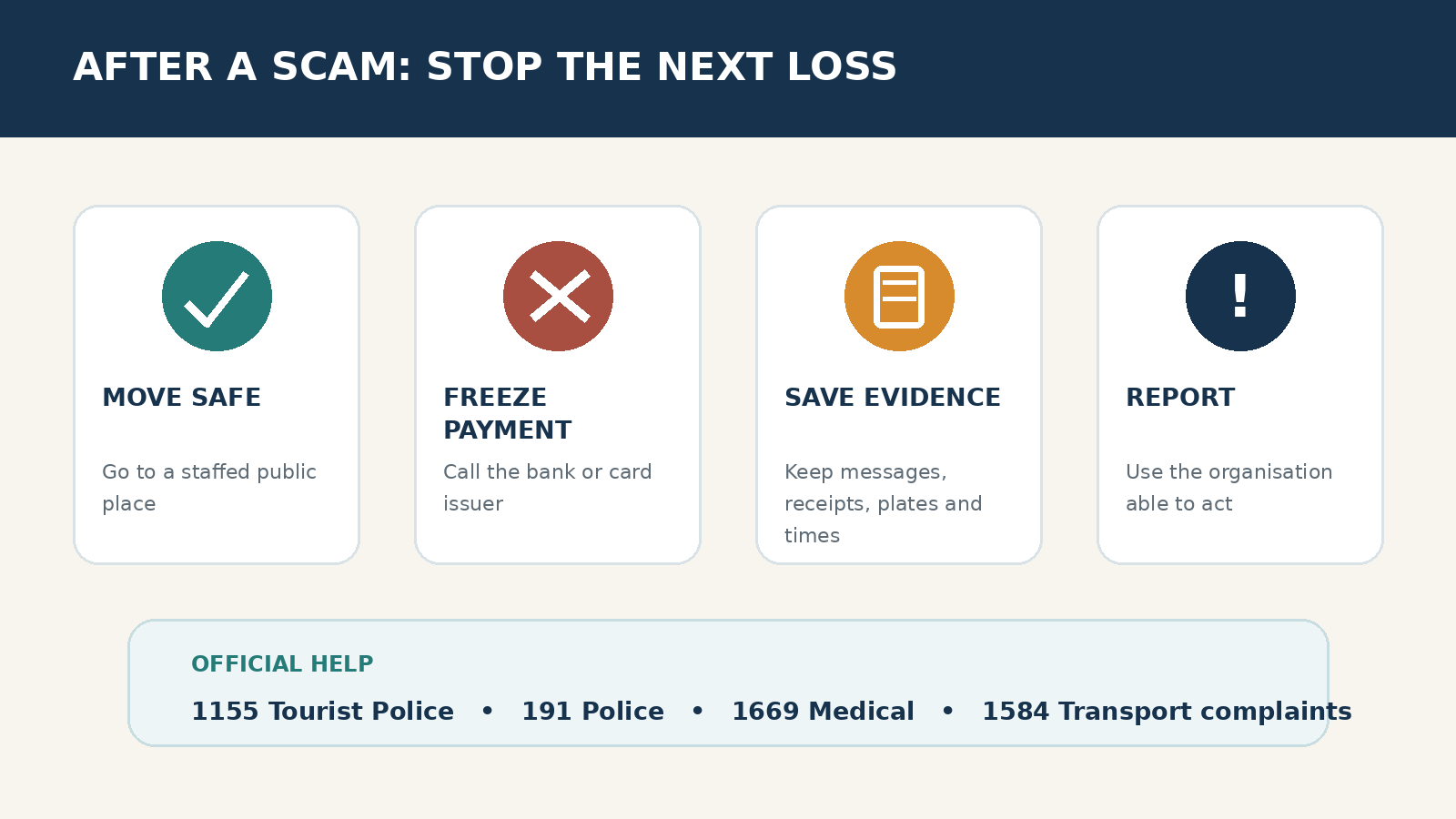
What to do if you think you have been scammed
The first ten minutes matter because they can stop a second payment, preserve a message before it disappears and move you away from confrontation. Recovering every baht may not be possible, but a calm sequence improves the chance of useful action.
1. Move to safety
Leave the immediate pressure when you can do so without escalating. Go to a staffed hotel, bank, airport counter, transport office, hospital or busy public place. Call 191 for police, 1669 for a medical emergency or 1155 for Tourist Police. Do not chase a vehicle or physically fight over a phone, passport or deposit.
2. Stop further financial loss
Freeze the card in the banking app, call the issuer and change a compromised password from a trusted device. If you shared a one-time code or account password, explain that clearly to the bank. For a bank transfer, contact the bank immediately; speed can matter when funds are still moving.
3. Preserve the evidence
- Screenshot the listing, profile, message thread and payment request.
- Save the exact URL, telephone number and account name.
- Photograph receipts, contracts, vehicle damage and the business frontage.
- Record the vehicle plate, driver name, time, route and location.
- Write a short timeline while details are fresh.
- Keep original files; do not rely only on cropped images sent through messaging apps.
4. Report to the organisation that can act
| Problem | First contact | Useful evidence |
|---|---|---|
| Immediate danger or theft | Police 191; Tourist Police 1155 | Location, description, plate, witnesses and photographs |
| Medical emergency or suspected drink spiking | Emergency medical service 1669 | Symptoms, time, drinks or substances involved and venue |
| Online payment or phishing | Bank or card issuer, platform, cybercrime hotline 1441 | URL, messages, payment reference and recipient details |
| Taxi, tuk-tuk, bus or minibus complaint | Department of Land Transport 1584 | Plate, queue ticket, receipt, route, time and agreed fare |
| Tourism-service complaint | Tourist Police 1155 or TAT information 1672 | Operator name, receipt, written inclusions and photographs |
| Fire or rescue | 199 | Exact location and immediate hazard |
5. Contact the insurer
Read the policy before replacing lost items or arranging major treatment where practical. The insurer may require a police report, proof of ownership, bank evidence or a report within a set period. Explain the facts in chronological order and keep reference numbers for every call.
Booking tools: what they help with and what they do not prove
Recognised booking sites can reduce uncertainty by providing written terms, account records and customer-service routes. They are not a substitute for reading the operator details. The table below shows where each affiliate partner may add value in this particular article.
| Service | Useful for | Protection it can add | What it does not guarantee |
|---|---|---|---|
| 12Go | Comparing trains, buses, ferries and combined routes | Written operator, schedule, boarding point and booking record | Perfect punctuality, protected self-connections or every local operator |
| GetYourGuide | Comparing guided attractions and transfers | Published inclusions, reviews, meeting point and cancellation terms | That every operator or activity suits your needs |
| Viator | Comparing transfers, private guides and tours | Operator details, booking trail and customer-service route | That entrance fees or pickup are included unless stated |
| Agoda | Comparing hotels and location options | Written property policy, account record and review history | That a message outside the platform is genuine |
| Airalo | Buying an eSIM before arrival | Independent data for maps, calls and verification | Coverage in every location or protection from fraudulent links |
Advantages of pre-booking
- Written price, meeting point and cancellation terms
- Less negotiation when tired or arriving late
- A traceable account and payment record
- Time to compare recent reviews and inclusions
Limitations of pre-booking
- Meeting points can still be misunderstood
- Operator changes and delays can occur
- The cheapest local option may not appear online
- Phishing may imitate a genuine reservation
Travel-security products: useful, limited and optional
No gadget replaces a careful payment routine, a documented rental or the decision to leave. A few simple products can, however, reduce common inconvenience. The right choice depends on how you travel and what you will actually use.
| Product category | Best use | Advantage | Limitation | Buying link |
|---|---|---|---|---|
| Luggage tracker | Checked luggage or a valuable day bag | Helps locate a misplaced item or show its last known position | Not a theft alarm and depends on the surrounding network | Compare luggage trackers on Amazon.co.uk |
| Portable travel safe | Separating a passport copy, spare card and small valuables | Adds a physical barrier when a room safe is unavailable | Only useful when secured to a solid fixture | Compare portable travel safes on Amazon.co.uk |
| Portable door lock | Compatible inward-opening hotel or apartment doors | Adds reassurance while inside the room | Compatibility varies and it must never block emergency escape | Compare portable door locks on Amazon.co.uk |
| Anti-theft crossbody bag | Phone, wallet and passport during crowded travel days | Keeps essentials close with controlled zip access | Can create false confidence and becomes uncomfortable if overloaded | Compare anti-theft crossbody bags on Amazon.co.uk |
| Travel power bank | Long transfer days and late arrivals | Keeps maps, tickets and emergency calls available | Airline capacity and hand-luggage rules must be checked | Compare travel power banks on Amazon.co.uk |
Amazon availability and specifications change, so the links lead to clearly labelled Amazon.co.uk category searches. Check the current dimensions, compatibility, airline rules and recent reviews. No fixed product price is quoted in this article.
Common mistakes that make pressure harder to resist
Following the first person who offers help
Read official signs and reach the staffed counter before accepting an unsolicited alternative.
Letting urgency choose the payment method
A deadline does not justify moving to an unverified bank account, QR code or link.
Handing over the original passport for a minor service
Use a provider that accepts a safer documented deposit where possible.
Photographing only the obvious rental scratch
Record tyres, underside, controls, fuel, odometer, helmet and every side in one continuous video.
Using the last connection with no backup
A traveller who cannot miss the final ferry or flight has less power to walk away from a poor offer.
Keeping every card and document together
One lost wallet should not remove every way to pay, identify yourself and contact help.
Assuming a familiar logo proves a message is genuine
Open the original app independently and compare the confirmed policy.
Arguing inside a moving vehicle
Prioritise a safe public stopping point, then record and report.
Buying because the offer is “government approved”
Verify the organisation and avoid high-value purchases based on a stranger’s resale promise.
Becoming suspicious of every fixed price or cash request
Ask clear questions and look for transparency rather than treating normal local practice as proof of fraud.
Frequently asked questions
What are the most common scams in Thailand?
Common tourist traps include closed-attraction claims, tuk-tuk shopping detours, airport taxi touts, changed fares, rental damage disputes, passport deposits, fake hotel payment messages, misleading currency conversion, gem-investment claims and inflated nightlife bills.
What should I do when someone says the Grand Palace is closed?
Continue to the official entrance or check the Grand Palace website. Do not accept a replacement tour from the same person who delivered the claim. The official site currently lists daily opening from 8:30 am to 4:30 pm, although ceremonies can change access.
How do I avoid Bangkok airport taxi scams?
At Suvarnabhumi, follow signs to the official Level 1 taxi queue between Gates 4 and 7 and take a queue ticket. Keep the ticket, note the plate and remember that the official 50 THB airport surcharge and road tolls are separate from the meter.
Are all tuk-tuks a scam?
No. Agree the destination, total price and whether there are shopping stops before departure. Be cautious when an unusually cheap tour depends on visits to tailors, gem shops or travel offices.
Should I leave my passport to rent a scooter?
Avoid leaving the original passport as an informal guarantee when a reputable alternative accepts a passport copy and documented cash or card deposit. UK travel advice specifically warns against handing a passport to motorcycle or jet-ski rental businesses as a guarantee.
How can I avoid a rental damage dispute?
Use a written contract and take a continuous video plus close photographs of every side, tyre, wheel, mirror, control, fuel level and existing mark. Return during staffed hours and obtain written confirmation.
Is the Thailand Digital Arrival Card free?
Yes. The official Thailand Digital Arrival Card is free and should be completed through tdac.immigration.go.th within the three days before arrival. Avoid paid lookalike websites unless you deliberately choose an intermediary service and understand what it does.
What should I do after a fake hotel payment message?
Do not use the message link. Open the booking platform independently, check the confirmed payment policy, contact the property through the original channel and call the card issuer immediately after an unauthorised payment.
Are Thai ATM fees a scam?
A clearly disclosed ATM access fee is generally a bank charge, not a scam. Read the screen before accepting. Dynamic currency conversion is a separate choice; compare the displayed exchange rate and markup and decline when the terms are unclear.
What is the Tourist Police number in Thailand?
The Tourist Police number is 1155. Police are 191, medical emergencies are 1669, fire and rescue are 199, the cybercrime hotline is 1441 and the Department of Land Transport complaint line is 1584.
Can I report an online scam in Thailand?
Yes. Contact the bank or card issuer first to stop further loss, then use the official Royal Thai Police cybercrime route at thaipoliceonline.go.th or call the AOC hotline on 1441. Do not pay a third party merely to reach the official reporting service.
How can I stay safe on a night out?
Read prices before ordering, avoid an unclear open tab, keep control of drinks, plan the return and move to staff or medical help if you feel unexpectedly unwell. Call 1669 for a medical emergency.
Travel confidently without becoming suspicious
The Thailand scams to avoid are easier to manage when you stop trying to memorise every story. Watch instead for urgency, isolation, loss of control and a payment route that does not match the original agreement. Pause the decision, verify one fact and keep your documents, phone and payment method under your control.
Most drivers, hotel staff, shopkeepers and tour operators are carrying out ordinary work. Good preparation should make you calmer, not hostile. It gives you the confidence to ask a clear question, recognise a legitimate charge and walk away when the answer does not make sense.
Sources and research notes
Official information was checked on 24 August 2026. Prices, schedules, platform rules, contact routes and operator terms can change, so readers should verify them again before travel or payment.
- UK Foreign, Commonwealth & Development Office: Thailand safety and security
- Thailand Tourist Police Bureau: traveller assistance and 1155
- Royal Thai Government: essential tourist assistance numbers
- Thailand Immigration Bureau: official Thailand Digital Arrival Card
- Ministry of Foreign Affairs: official Thailand e-Visa portal
- The Grand Palace: official ticket price and opening information
- Airports of Thailand: Suvarnabhumi transport information
- Tourism Authority of Thailand: transport complaint contacts
- Royal Thai Police: official cybercrime reporting portal
- Booking.com: traveller phishing and payment safety guidance
- Visa: dynamic currency conversion explanation
- UK Foreign, Commonwealth & Development Office: emergency services and getting help
- Royal Thai Government: AOC online-scam hotline 1441
- Thailand Tourist Police: 2026 warning about common travel, shopping and booking scams
- Thailand Tourist Police: Police Care app features
Image credits
Illustrations in this article were created for Taylor’s Trailblazing Travels. Third-party photographs, where used, are credited beside the image or in the source list.