A practical first-trip plan covering a realistic 14-day route, solo-friendly bases, transport choices, current entry checks, safety routines and a budget that does not depend on perfect luck.
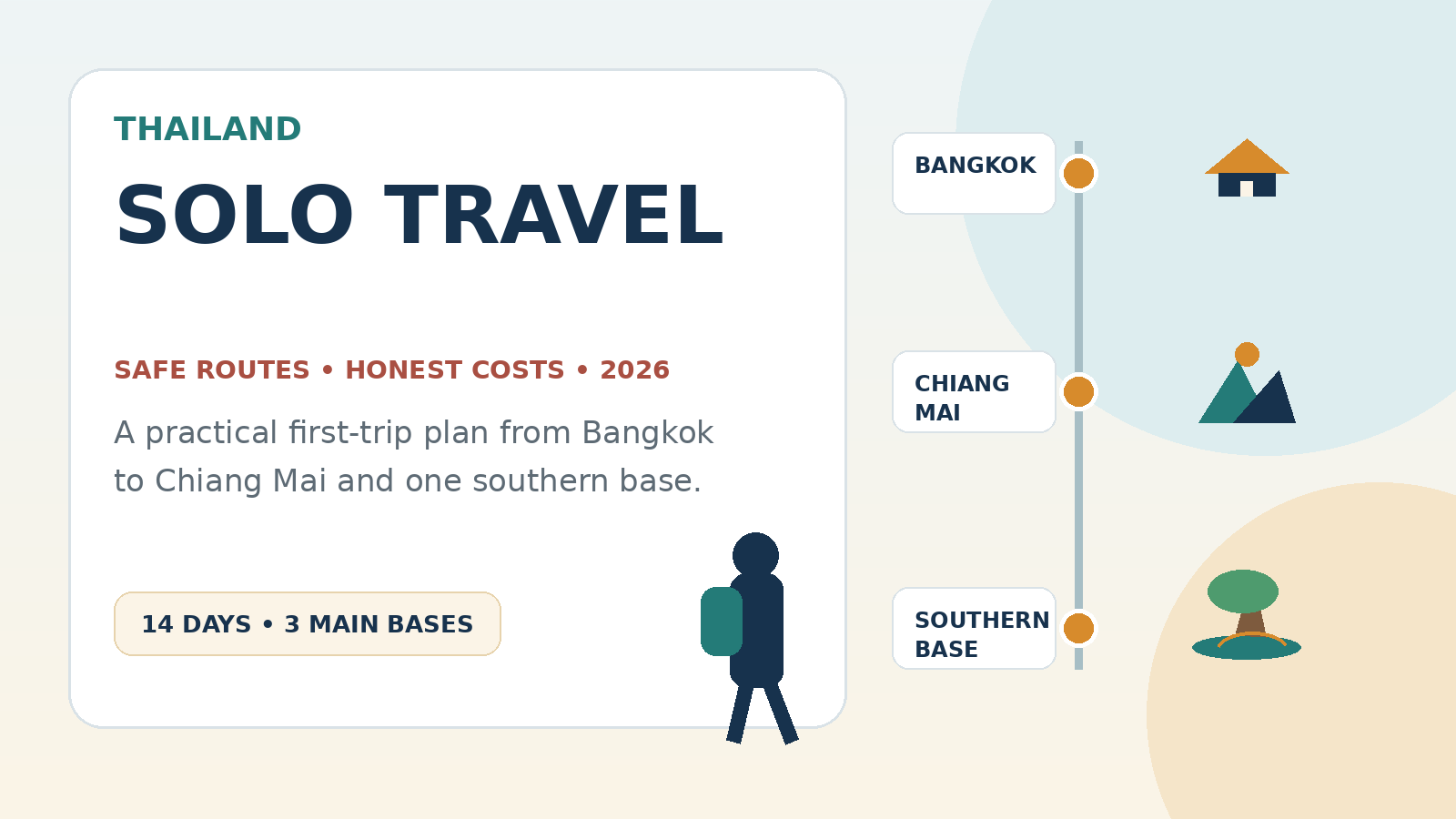
Thailand is a strong first solo destination because the main visitor route has frequent transport, accommodation at every price level and easy ways to meet people. For a 14-day trip, spend three nights in Bangkok, four in Chiang Mai, five in Ao Nang or Koh Samui, then keep one final buffer night. Budget roughly 2,500–4,500 baht a day for a comfortable independent trip, excluding international flights.
Thailand solo travel: quick answers
Best first route
Bangkok, Chiang Mai and one southern base over 14 days.
Realistic daily budget
About 2,500–4,500 baht for a private room, local meals and sensible transport.
Easiest place to meet people
Chiang Mai, especially through cooking classes, walking tours and social accommodation.
Safest arrival habit
Book a central first night, arrive in daylight where possible and have working mobile data before leaving the airport.
Emergency numbers
Tourist Police 1155, police 191, medical emergency 1669 and fire or rescue 199.
Book first
Your first hotel, the Bangkok–Chiang Mai transfer and any island connection tied to a flight.
In this guide
Thailand can feel remarkably easy one hour and surprisingly complicated the next. You might step off an airport train beside a modern shopping centre, then spend the evening working out which pier a minivan actually uses. That contrast is part of the appeal, although it rewards a little preparation.
For a first solo visit, the smartest plan is not the longest list of destinations. Instead, choose places that give you several ways to fill a day, several ways to leave and enough accommodation choice to change the mood of the trip. Bangkok, Chiang Mai and one southern base meet that test better than an ambitious island-hopping chain.
This guide is written for independent travellers who want freedom without turning every day into a logistics exercise. It uses British passport guidance where entry examples are needed, but travellers of every nationality should check the rules that apply to their own passport.
Is Thailand good for solo travel?
For most first-time solo travellers, yes. Thailand’s established visitor routes make it relatively simple to find transport, food, accommodation and organised activities. Eating alone also feels normal: food courts, markets, noodle shops and casual restaurants rarely make a solo diner stand out.
However, “popular” should not be confused with risk-free. Road traffic is a serious concern, island journeys can involve several handovers, and nightlife requires the same drink and transport caution you would use anywhere. The destination works well because you have choices, not because nothing can go wrong.
Why it works
- Frequent transport on the main visitor route
- Hostels, guesthouses and hotels across a wide price range
- Plenty of small-group activities that welcome one person
- Easy casual dining and inexpensive laundry services
- Enough English in tourist areas for routine travel tasks
What needs planning
- Late arrivals at unfamiliar piers or out-of-town bus stations
- Higher per-person room and taxi costs
- Pressure to hire a scooter in areas with limited public transport
- Noise and poor sleep in party-focused accommodation
- Weather disruption on boat days and ferry connections
Who will enjoy it most?
Thailand suits travellers who like a mixture of independent time and optional social contact. You can spend the morning alone at a temple, join a cooking class in the afternoon and have dinner with people you met two hours earlier. Consequently, the trip does not depend on finding a travel companion immediately.
Who may find it frustrating?
A tightly scheduled traveller may struggle with traffic, weather-dependent boats and flexible pickup times. Likewise, anyone who expects every beach area to be walkable can end up paying more for taxis than planned. A modest buffer and a carefully chosen neighbourhood solve much of that friction.
Before you fly: 2026 entry and safety checks
Entry rules and regional advice can change faster than a blog post. Therefore, use this section as a checklist and open the official links again shortly before departure.
Passport, visa and Thailand Digital Arrival Card
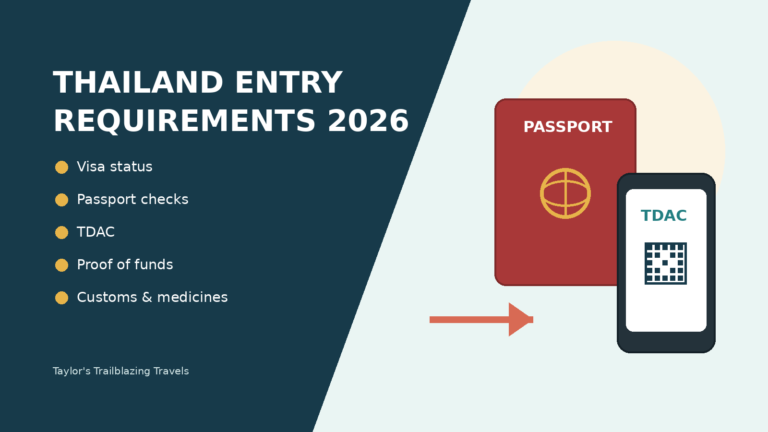
For travellers using a full British citizen passport, the UK Foreign, Commonwealth & Development Office states that the passport should expire at least six months after arrival and contain at least one blank page. It also currently describes a 60-day visit allowance for tourism, with possible extension, although the Thai authorities make the final decision. Check the latest Thailand entry requirements on GOV.UK rather than relying on a screenshot saved months earlier.
All foreign nationals arriving by air, land or sea must complete the free Thailand Digital Arrival Card. The form can be submitted within three days before arrival. Use only the official TDAC website; the official page explicitly says that no fee is required.
Current regional warnings matter to insurance
At the time this guide was checked, the FCDO advised against all but essential travel to Pattani, Yala, Narathiwat, specified districts of Songkhla, the Hat Yai–Padang Besar train line, and areas within 20 kilometres of the Thailand–Cambodia land border. It also reported that land borders and crossings between Thailand and Cambodia remained suspended. These warnings may change, so open the current FCDO Thailand travel advice before buying insurance and again before travelling.
Travel against official advice can affect insurance cover. In addition, the FCDO warns that carrying cannabis out of Thailand is illegal, including when transiting through another country. Do not treat products sold openly in one place as automatically legal to carry elsewhere.
A seven-minute pre-departure check
- Confirm passport validity, entry permission and the official TDAC submission window.
- Read the latest FCDO warnings and check every transit country.
- Buy insurance that covers the activities you actually plan to do.
- Save your first hotel address in English and Thai.
- Store a passport copy and policy number somewhere separate from the originals.
- Tell your bank you will travel, if it still asks for travel notifications.
- Keep one backup card apart from your main wallet.
A realistic 14-day Thailand solo travel route
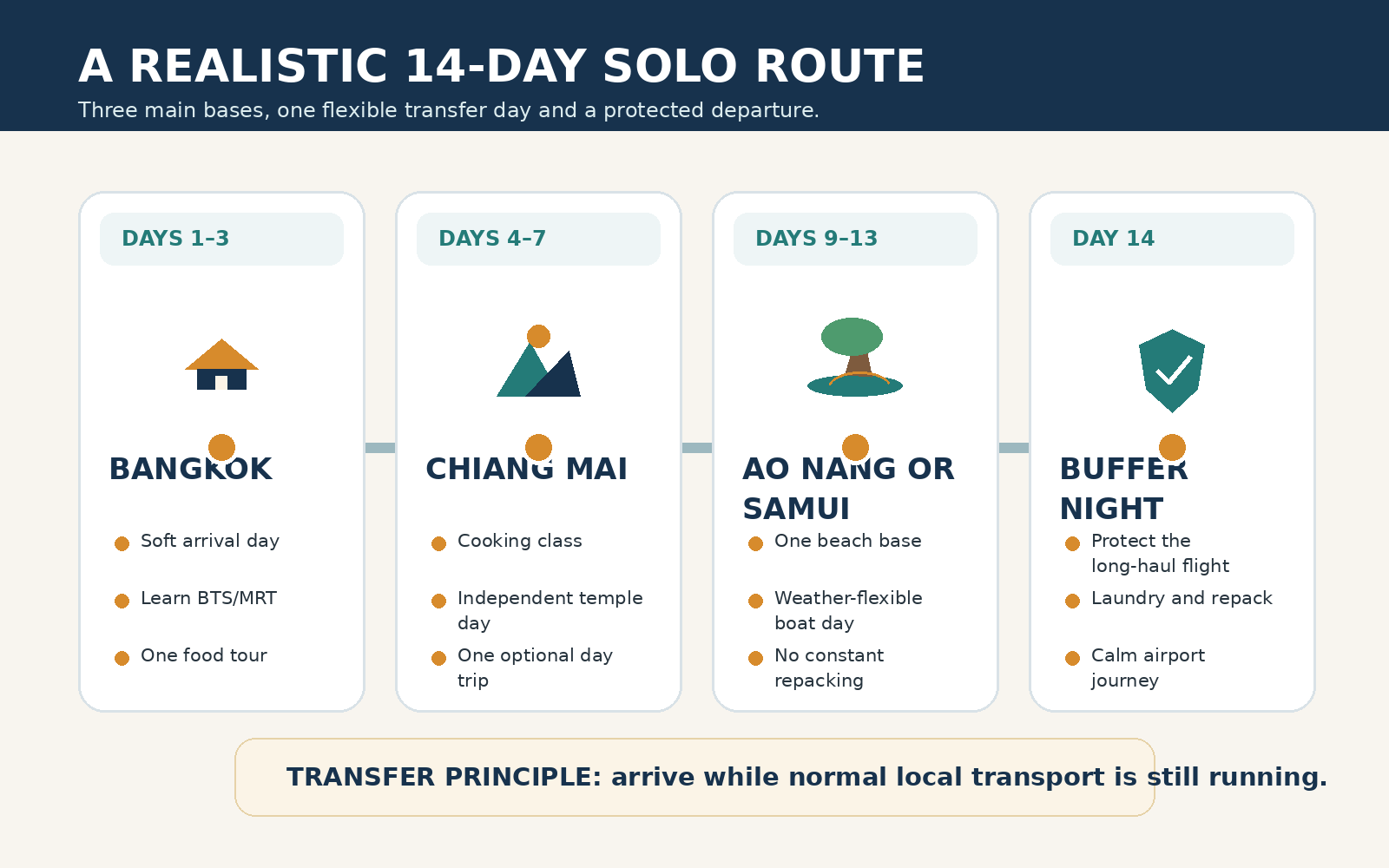
A strong first route gives each destination a purpose. Bangkok teaches you the transport system, Chiang Mai provides low-pressure social activities, and the south delivers beach time without a week of ferry changes.
| Days | Base | Why it works alone | Do not overbook |
|---|---|---|---|
| 1–3 | Bangkok | Airport links, public transport, food tours and several distinct neighbourhoods | Keep the arrival day light |
| 4–7 | Chiang Mai | Walkable areas, classes, cafés and easy small-group trips | Choose one full-day excursion, not three |
| 8 | Southbound transfer | A dedicated transfer day prevents a missed chain of bookings | Avoid landing after the last practical hotel transfer |
| 9–13 | Ao Nang or Koh Samui | One beach base plus optional boat days | Keep one weather-flexible day |
| 14 | Departure hub or buffer night | Protects the international flight from ferry or domestic disruption | Do not rely on a same-day island connection |
Days 1–3: Bangkok as a soft landing
Three nights give you one forgiving arrival day and two useful sightseeing days. On the first afternoon, learn the nearest BTS or MRT station, withdraw or exchange a small amount of cash and walk a short loop around the hotel. That simple exercise makes the city feel smaller.
For the second day, pair one major sight with one neighbourhood rather than crossing Bangkok repeatedly. A small-group food tour is especially useful alone because it solves dinner, conversation and navigation in one booking. Compare current Bangkok food tours on GetYourGuide, or check the Bangkok food-tour range on Viator if you want a second set of operators and departure times.
Days 4–7: Chiang Mai for easy social contact
Chiang Mai is often the easiest place to settle into solo travel. The Old City is compact, cafés provide low-pressure downtime, and cooking classes create natural conversation without the expectation of a night out. Four nights allow one class, one independent temple or neighbourhood day and one optional trip beyond the city.
A class with individual cooking stations works particularly well because everyone has something to do while conversation develops. Compare Chiang Mai cooking classes on GetYourGuide, then check pickup boundaries, dietary options and class size before booking.
Days 9–13: Ao Nang or Koh Samui?
| Choose | Best for | Advantages | Trade-offs |
|---|---|---|---|
| Ao Nang, Krabi | Simple mainland logistics and boat-day choice | Airport access, broad accommodation range, easy Railay and island trips | The centre is busy and the beach is more of a launch point than a secluded escape |
| Koh Samui | An island stay without a compulsory ferry on arrival | Direct airport, several resort areas, nightlife and quieter beaches | Flights and local taxis can make the total trip more expensive |
Ao Nang is the safer recommendation for a first two-week route because a flight into Krabi keeps the arrival straightforward. From there, you can join an island trip, visit Railay or spend a quiet day without changing hotels. Browse Krabi island tours on GetYourGuide, but check sea conditions, pickup location, national-park fees and the cancellation policy rather than choosing on photographs alone.
Koh Samui makes sense when the island itself is a priority and the airfare fits the budget. In either case, keep the final night near the airport or on the mainland if an international flight depends on a ferry or separate domestic booking.
Why the buffer night is not wasted
A buffer protects the most expensive ticket in the itinerary. It also creates space for laundry, a proper meal, repacking and a calm airport journey. That is a better final memory than watching a ferry clock while calculating the cost of a missed long-haul flight.
Best areas to stay in Thailand for solo travellers
The cheapest room is not always the cheapest stay. A remote bargain can add two taxi rides every day, while a central room lets you walk, use public transport and return independently after dinner. Recent reviews matter more than a historic average score, particularly for noise, locks, reception hours and street access after dark.
Bangkok and Chiang Mai neighbourhood comparison
| Place and area | Best for | Transport | Pros | Watch for | Hotel search |
|---|---|---|---|---|---|
| Bangkok: Asok or Phrom Phong | First visit and easy city movement | BTS, MRT at Asok and airport connections via interchange | Restaurants, malls, late-opening services and simple onward travel | Traffic, nightlife pockets and higher central prices | Compare Bangkok hotels on Agoda |
| Bangkok: Sathorn or near Saphan Taksin | River access with a calmer evening base | BTS and Chao Phraya boats | Useful for river sights and less intense than lower Sukhumvit | Check the walk from the station; some lanes are quiet late | See current Bangkok availability on Agoda |
| Chiang Mai: Old City east or south side | Walkability, temples and first-time convenience | Songthaews, ride apps and walking | Easy food, classes and pickup zones | Weekend street closures and variable room noise | Compare Chiang Mai hotels on Agoda |
| Chiang Mai: Nimman | Cafés, coworking and a modern neighbourhood feel | Ride apps; limited walkability to the Old City | Good solo dining and longer-stay services | Aircraft noise varies by building and room position | Check Nimman-area options on Agoda |
Krabi and Koh Samui neighbourhood comparison
| Place and area | Best for | Transport | Pros | Watch for | Hotel search |
|---|---|---|---|---|---|
| Krabi: central Ao Nang | Tours, restaurants and meeting other travellers | Shared pickups, longtail boats and local transport | The simplest base for a first Krabi stay | Busy roads, nightlife noise and varying distance to boat points | Compare Ao Nang and Krabi hotels on Agoda |
| Koh Samui: Bophut | A balanced island base with restaurants and evenings out | Taxis and ride services; some areas walkable | More relaxed than central Chaweng | Beach quality and walkability vary along the coast | Compare Koh Samui hotels on Agoda |
| Koh Samui: Chaweng | Convenience, nightlife and a large choice of rooms | Airport taxis and local transport | Easy to find food, tours and other travellers | Choose the exact street carefully if sleep matters | Search Chaweng accommodation on Agoda |
Best areas to stay in Chiang Mai: Old City or Nimman?
Choose the Old City for a first stay when you want temples, markets and many activity pickups within a short distance. Nimman suits travellers who prefer cafés, modern restaurants and a longer-stay rhythm. However, it is not automatically quieter because aircraft routes and nightlife can affect particular buildings.
Ao Nang vs Railay for a solo base
Ao Nang wins on practical choice: more accommodation, easier airport transfers, pharmacies, convenience stores and a wider range of tour pickups. Railay wins on scenery and the feeling of being away from the road network. Nevertheless, every arrival and departure involves a boat, so a first-time solo traveller may prefer to stay in Ao Nang and visit Railay by day or for one planned night.
Hostel dorm, private hostel room or hotel?
| Room type | Best when | Main advantage | Main disadvantage |
|---|---|---|---|
| Dorm bed | You actively want social contact and can sleep with some noise | Low cost and easy conversation | Less privacy, variable sleep and shared security |
| Private room in a hostel | You want communal areas but need a door and better rest | Strong balance for many solo travellers | Can cost as much as a simple hotel |
| Guesthouse or small hotel | You value local scale and a staffed desk | Often quieter and more personal | Social opportunities depend on the property |
| Full-service hotel | You arrive late, work remotely or need predictable facilities | Reception, luggage storage and easier problem-solving | Higher cost and less natural interaction |
Whatever the room type, read the newest reviews for secure lockers, key control, noise, cleanliness and staff response. Also check the walking route from the station or drop-off point; a map’s straight-line distance can hide an unpleasant road crossing or an unlit lane.
Solo-friendly transport: trains, flights, vans and ferries
Compare door-to-door time, not just the advertised journey. A cheap flight can become less attractive after baggage, two airport transfers and a five-hour wait. Conversely, an overnight train saves a hotel night but may leave you too tired to enjoy the next day.
Long-distance route comparison
| Route | Practical options | Planning time | Planning price | Solo advice |
|---|---|---|---|---|
| Bangkok to Chiang Mai | Day train, sleeper train, flight or long-distance bus | Official 2026 rail examples run about 10 hours 20 minutes to 13 hours 45 minutes | SRT examples range from about 230 to 2,446 baht by train and class | Book a lower sleeper early if that is your preference; keep valuables in your personal bag |
| Chiang Mai to Krabi | Direct flight when scheduled, or connection through Bangkok | Roughly two hours flying when direct, plus airport time | Often 1,500–4,500+ baht with baggage, but dates matter | A daytime arrival is worth paying for if the alternative reaches Ao Nang late |
| Bangkok to Krabi | Flight, bus, or train plus road transfer | About 1 hour 25 minutes in the air; far longer overland | Flights commonly vary from low promotional fares to several thousand baht plus bags | Compare the total rather than choosing the lowest headline fare |
| Krabi to Koh Lanta | Shared van, ferry combination or private transfer | Usually around 2–4 hours depending on pickup and season | Several hundred baht for shared services; private transfers cost more | Confirm whether hotel pickup and car-ferry fees are included |
How to compare and book the ticket
The State Railway of Thailand’s 2026 timetable shows multiple daily Bangkok–Chiang Mai services, including daytime and overnight options. Use the official SRT timetable for the latest schedule, then compare bookable combinations on 12Go’s Bangkok to Chiang Mai route page.
For southern travel, compare the Bangkok to Krabi options on 12Go or the Krabi to Koh Lanta transfer choices. Schedules and operators change, so read the exact meeting point, baggage allowance and transfer notes before paying.
A solo transfer routine that prevents most problems
- Screenshot the ticket, meeting point and operator contact.
- Save the destination in Thai as well as English.
- Keep your passport, phone, cards and medication in the bag that stays with you.
- Arrive early enough to find the correct counter without rushing.
- Check that a van or taxi driver knows the precise hotel, not only the neighbourhood.
- Share the booking or vehicle details when travelling late.
How to meet people without depending on nightlife
The easiest conversations start around a shared task. A food tour, cooking class, walking tour or snorkelling trip gives everyone something to discuss, so you do not need to manufacture confidence at a hostel bar.
| Activity | Why it works alone | Check before booking | Useful comparison |
|---|---|---|---|
| Bangkok food tour | Small groups, a fixed meeting point and dinner taken care of | Dietary limits, walking distance, group size and end point | GetYourGuide Bangkok food tours |
| Chiang Mai cooking class | Individual stations make participation easy and conversation natural | Pickup radius, menu choice, class length and dietary adaptation | GetYourGuide Chiang Mai cooking classes |
| Krabi island day | A full shared day without committing to a new travel companion | Sea conditions, boat type, national-park fees, insurance and hotel pickup | GetYourGuide Krabi island tours |
| Alternative Bangkok tour inventory | Useful when one platform lacks a suitable time or cancellation term | Recent reviews, operator name and exact inclusions | Viator Bangkok food tours |
A low-pressure social plan
Book one activity within the first two days of each new base, then leave the rest flexible. At breakfast or in a common area, ask a practical question such as whether someone has used a particular pier or night market. If the conversation is easy, suggest a specific plan with a clear end point: dinner at 7pm, a market for an hour or a sunset walk.
Meanwhile, protect some solo time. A quiet half-day is not evidence that the trip has failed; it is often what makes the next social day enjoyable. The aim is choice, not constant company.
Best Thailand SIM cards and eSIM choices for solo travel
Working data is a safety tool as much as a convenience. It helps you check a driver’s route, translate an address, receive booking messages and change plans without searching for public Wi-Fi. Set it up before the moment you need it.
| Option | Best for | Advantages | Limitations |
|---|---|---|---|
| Travel eSIM | Arriving with data ready and keeping the home SIM in place | Install before departure, no airport queue, easy top-up on compatible phones | Phone must support eSIM and be unlocked; some plans are data-only |
| Thai physical tourist SIM | Travellers who want a local number or do not have eSIM support | Staff can often install it; local packages may be good value | Airport counters can cost more; swapping SIMs risks misplacing the home card |
| UK roaming add-on | Very short trips or travellers who prioritise simplicity | Keep the existing number and setup | Usually more expensive and subject to fair-use limits |
eSIM packages and prices change frequently. Compare the live data allowance, validity, hotspot rules and total price before buying. Airalo Thailand eSIM plans, and confirm that your exact phone model is compatible before purchase.
Set up mobile data without locking yourself out
- Install the eSIM over reliable Wi-Fi before departure, but follow the provider’s activation timing.
- Label the home and travel lines clearly in phone settings.
- Keep the home line available for bank messages, but disable expensive data roaming on it.
- Download an offline map of the first city and save the hotel address.
- Carry a charging cable and a power bank in cabin baggage, subject to airline rules.
A practical Thailand solo travel safety routine
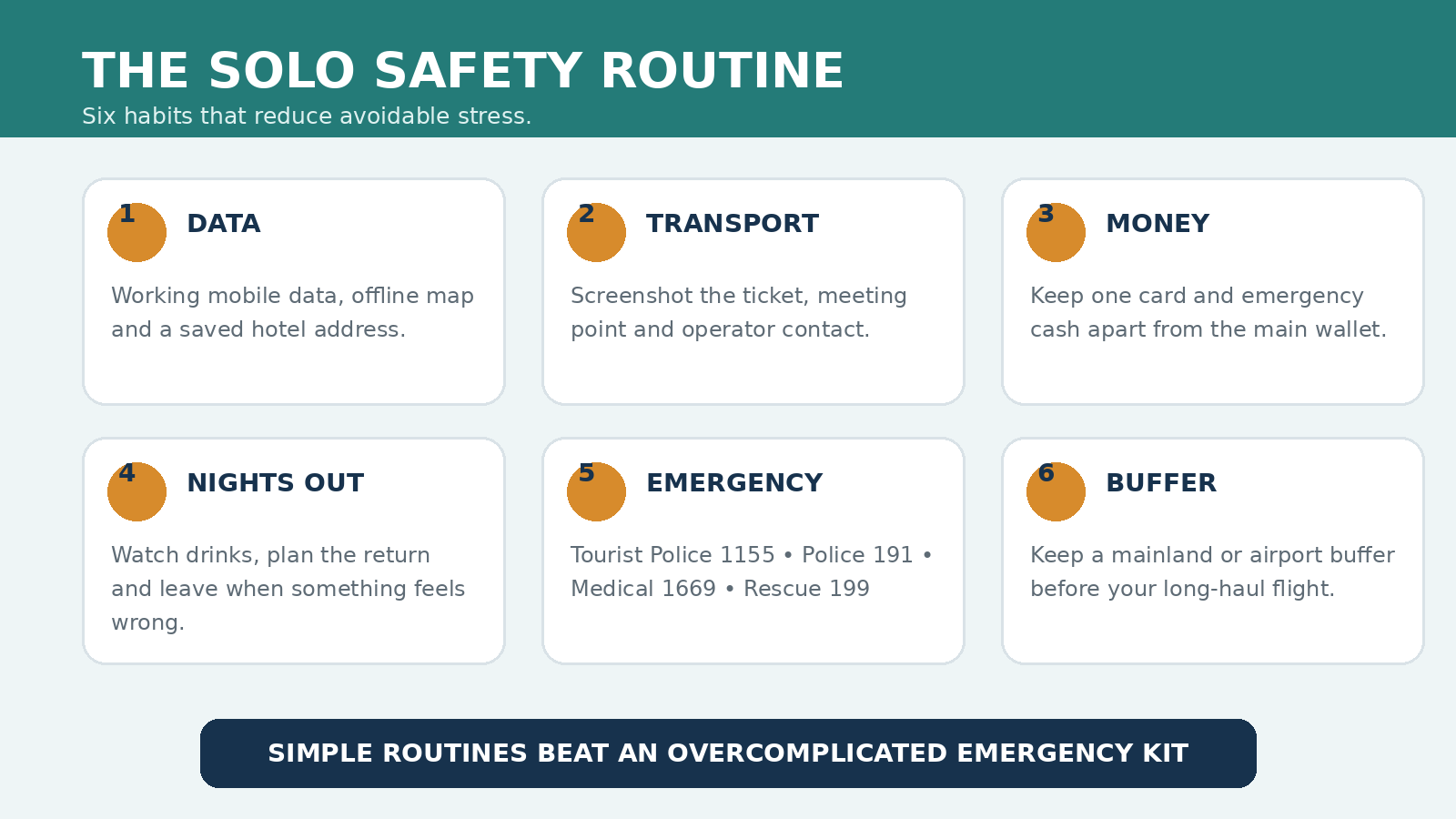
No checklist removes every risk. Even so, repeating a few habits makes mistakes less likely and gives you a clear response when a plan changes.
Before leaving the hotel
- Charge the phone and confirm that mobile data works away from Wi-Fi.
- Save the destination and return route, including the final train or boat time.
- Carry only the cash and cards needed for the day.
- Leave one backup payment method secured separately.
- Take a hotel card or screenshot showing the address in Thai.
On nights out
Watch drinks being prepared and do not leave them unattended. Arrange the return journey before you become tired, and use a recognised ride service or official taxi system. If a person or place feels wrong, leave; politeness is not a reason to stay in an uncomfortable situation.
Scooters, boats and adventure activities
Road accidents are a much larger practical concern than many headline-grabbing travel fears. Do not hire a scooter unless you have the appropriate licence, experience, helmet and insurance cover. For boat or water activities, check weather, life jackets, operator reviews and what the stated insurance actually covers.
Solo women and LGBTQ+ travellers
Women travelling alone generally use the same core precautions: a well-reviewed base, planned transport after dark, control of drinks and a willingness to move away from unwanted attention. Temple clothing rules apply regardless of gender; carry a light layer that covers shoulders and knees.
LGBTQ+ travellers will find visible communities and nightlife in major visitor areas. Nevertheless, research the specific neighbourhood, hotel and venue rather than assuming a national reputation applies identically everywhere. Personal comfort can vary by context, especially outside established tourism centres.
If something goes wrong
Move to a staffed public place, contact the accommodation and preserve screenshots, booking records or receipts. Then call the appropriate service. If a passport is lost, report it and contact your embassy or consulate; do not wait until the next transfer day.
Thailand solo travel budget for 2026
Solo travel costs more per person for rooms and private transfers, although you control where to compensate. A central private room can be better value than a remote dorm if it removes daily taxis, while one carefully chosen group trip may provide more value than several improvised transfers.
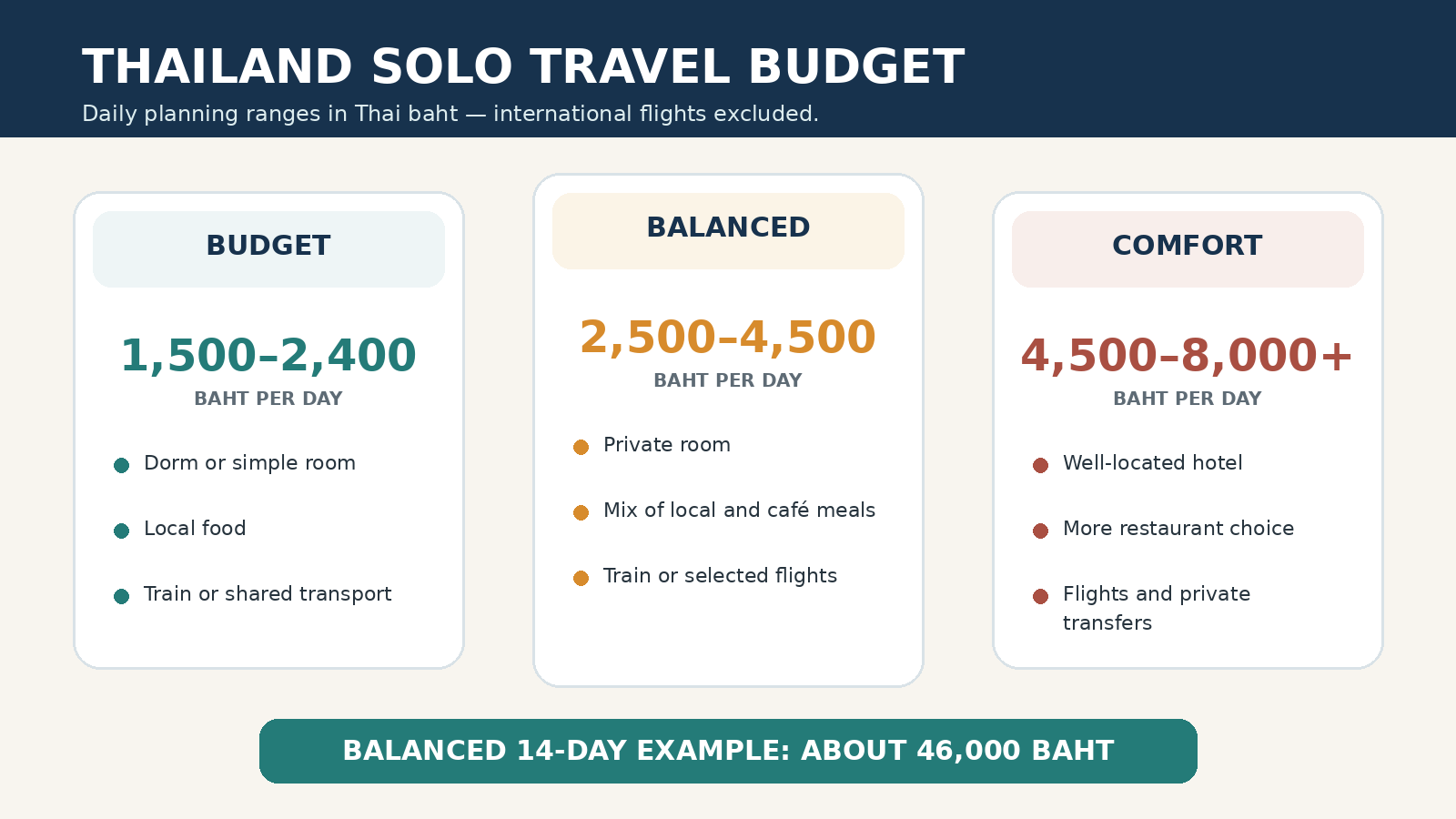
| Travel style | Typical room | Food and local travel | Daily planning total | Two-week planning total |
|---|---|---|---|---|
| Budget | Dorm or simple room: 450–1,000 baht | 900–1,400 baht | 1,500–2,400 baht | About 28,000–52,000 baht after adding intercity travel and a few activities |
| Balanced | Private room: 1,100–2,200 baht | 1,200–2,000 baht | 2,500–4,500 baht | About 45,000–90,000 baht depending on flights, room dates and tours |
| Comfort | Well-located hotel: 2,500–5,000+ baht | 1,800–3,000+ baht | 4,500–8,000+ baht | About 80,000 baht upward, especially in peak beach periods |
A balanced 14-day example
| Category | Example allowance | What it covers |
|---|---|---|
| Accommodation | 18,000 baht | Mostly private rooms, with rates higher in the south |
| Food and drinks | 9,000 baht | Local meals, cafés and several nicer dinners |
| Local transport | 3,500 baht | Urban rail, ride services and shared transfers |
| Intercity transport | 7,000 baht | Train or flight north plus one southern flight or combined transfer |
| Activities | 6,000 baht | Two or three paid group experiences |
| Laundry and contingency | 2,500 baht | Small purchases and price variation |
| Total | 46,000 baht | Excludes international flights, insurance and major shopping |
High-season beach rooms, last-minute flights and private transfers can push the total up quickly. On the other hand, dorms, trains and fewer paid tours can reduce it. Build your own total with live prices, then add a contingency instead of assuming every lowest fare will remain available.
Cash and cards
Carry more than one payment method and keep them apart. Thai ATMs commonly display a fixed local operator fee before withdrawal, so fewer sensible withdrawals may cost less than many small ones. Always decline or examine an ATM’s offered home-currency conversion carefully; your own bank’s rate may be better.
Useful products for a Thailand solo trip
A product deserves space only when it solves a clear problem. None of the items below replaces judgement, insurance or a sensible room choice, and there is no reason to buy a specialist gadget for every possible worry.
| Item | Useful for | Advantages | Limitations and buying advice | Optional link |
|---|---|---|---|---|
| Portable travel door lock or door wedge | Extra reassurance in compatible private rooms | Small, simple and independent of the room lock | Not suitable for every door; never obstruct an emergency exit | View portable travel door locks on Amazon.co.uk |
| 20,000 mAh power bank | Long transfer days, maps and booking messages | Several phone charges from one unit | Check capacity, weight and airline cabin-baggage rules; do not place it in checked luggage | Compare travel power banks on Amazon.co.uk |
| TSA-style combination padlock | Hostel lockers and zipped luggage | No key to lose and easy to reuse | Confirm the shackle fits the locker; it deters casual access rather than determined theft | See combination travel padlocks on Amazon.co.uk |
| Compact crossbody bag | Phone, day cash, passport on transfer days | Keeps essentials visible and close | Choose secure zips and a comfortable strap; do not overload it | Compare travel crossbody bags on Amazon.co.uk |
| Universal travel adapter with USB | Mixed socket types and several devices | One compact charging point | Check wattage and device voltage; an adapter does not convert voltage | View travel adapters for Thailand on Amazon.co.uk |
Amazon availability, specifications and prices change. Therefore, the links lead to clearly labelled Amazon.co.uk searches rather than implying that one product is permanently the best. Read the current specification and recent reviews before choosing.
Common Thailand solo travel mistakes
Changing base every two nights
Frequent check-outs create more lonely arrival periods and less time to build confidence. Three main bases are enough for a first fortnight.
Booking the final ferry and international flight on the same day
Weather, loading and road traffic can break the connection. Protect the long-haul ticket with a mainland or airport-area buffer.
Choosing a party hostel when sleep matters
Popularity does not guarantee suitability. Read recent comments about noise, quiet hours and room location.
Arriving without working mobile data
Airport Wi-Fi does not help once you are in a taxi. Set up an eSIM, SIM or roaming plan before leaving the terminal.
Keeping every card and all cash together
One lost wallet should not remove every payment option. Separate a backup card and emergency cash.
Hiring a scooter because everyone else does
Convenience is not a substitute for licence, experience, helmet and insurance cover.
Buying a boat trip without reading the inclusions
National-park fees, hotel pickup, lunch and insurance vary. Compare the exact package rather than the headline price.
Ignoring the difference between Ao Nang and Railay
Railay is beautiful but boat-dependent. Ao Nang is the easier transport base, especially with luggage or an early flight.
Assuming every land border is open
Regional closures and warnings can change. Check official advice before building an overland route.
Treating solo travel as a test of constant bravery
Booking a transfer, choosing a private room or leaving an uncomfortable place is sensible travel, not failure.
Frequently asked questions
Is Thailand safe for solo travellers?
Thailand is manageable for many solo travellers who use well-reviewed accommodation, recognised transport and normal precautions around roads, drinks and valuables. Safety varies by activity and location, so check current government advice and avoid travelling against official warnings.
Is Thailand suitable for a first solo trip?
Yes, particularly on the Bangkok–Chiang Mai–south route. The main bases have plenty of accommodation, tours and transport alternatives, which means one mistake rarely ruins the whole itinerary.
How much money do I need for two weeks alone?
A balanced private-room trip often needs roughly 45,000–90,000 baht before international flights and insurance. The biggest variables are southern room rates, domestic flights, private transfers and the number of paid tours.
Should a solo traveller stay in a hostel or hotel?
Choose a dorm when social contact and cost matter most, a private hostel room for a useful balance, or a hotel after late arrivals and before early departures. Mixing room types is often better than forcing one style across the entire trip.
What is the best month for Thailand solo travel?
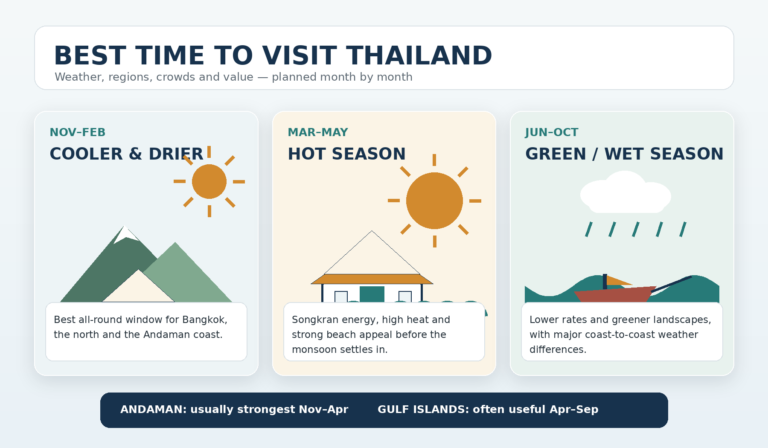
There is no single perfect month for every region. November to February is often cooler and drier in many popular areas, although prices rise. The Andaman and Gulf coasts have different rainfall patterns, while northern haze can affect Chiang Mai during parts of the hotter season. Check the forecast and local conditions for the exact route.
Do I need to speak Thai?
No for a standard visitor route, although a few phrases are appreciated. Save addresses in Thai, learn polite greetings and use a translation app for detailed questions. Clear screenshots often work better than repeated English.
Can women travel alone in Thailand?
Many women travel independently in Thailand. Practical precautions include central accommodation, planned transport after dark, control of drinks, suitable clothing for temples and a willingness to move away from unwanted attention.
How do I meet people if I do not drink?
Book an activity with a shared purpose, such as a cooking class, food tour, dive course or small-group day trip. Social hostels with cafés, tours and communal breakfasts are more useful than properties built entirely around a late-night bar.
Is Bangkok too overwhelming for a solo arrival?
Bangkok becomes easier when the first day has only three tasks: reach the hotel, learn the nearest transport station and eat nearby. A central room and a light schedule are more effective than trying to “make the most” of a tired arrival.
Do I need to book every transfer in advance?
No. Book the first arrival, popular sleeper trains, flights with limited schedules and any connection that protects an international ticket. Leave ordinary day buses and flexible local travel until the route is clearer, unless travelling in a peak holiday period.
A final solo-trip checklist
- Three main bases rather than an exhausting collection of pins
- A central first hotel with a clear arrival route
- TDAC, passport and visa requirements checked on official sources
- Current FCDO regional advice and insurance terms reviewed
- Working mobile data and offline copies of the first bookings
- One backup card stored separately
- One social activity in each new base
- A final mainland or airport buffer before the international flight
Thailand is not rewarding because every day is effortless. It is rewarding because you can recover from a wrong turn, change the mood of the trip and choose how social or independent to be. Give the route enough space, spend money where it reduces arrival stress and let the rest remain flexible.
Sources and research notes
Entry rules, regional warnings, emergency contacts and rail examples were checked against official sources on 24 August 2026. Rules, schedules, prices and operator inclusions can change, so readers should verify them before booking.
- UK Foreign, Commonwealth & Development Office: Thailand travel advice
- UK Foreign, Commonwealth & Development Office: Thailand entry requirements
- Thailand Immigration Bureau: official Thailand Digital Arrival Card
- Thailand Tourist Police Bureau: emergency and traveller assistance information
- State Railway of Thailand: 2026 Bangkok–Chiang Mai timetable
- Airalo: current Thailand eSIM plan page used for the stated comparison point
Image credits
Illustrations in this article were created for Taylor’s Trailblazing Travels. Third-party photographs, where used, are credited beside the image or in the source list.