A practical guide to choosing the right Bangkok base by transport, atmosphere, hotel value, airport access and the journeys you will actually make.
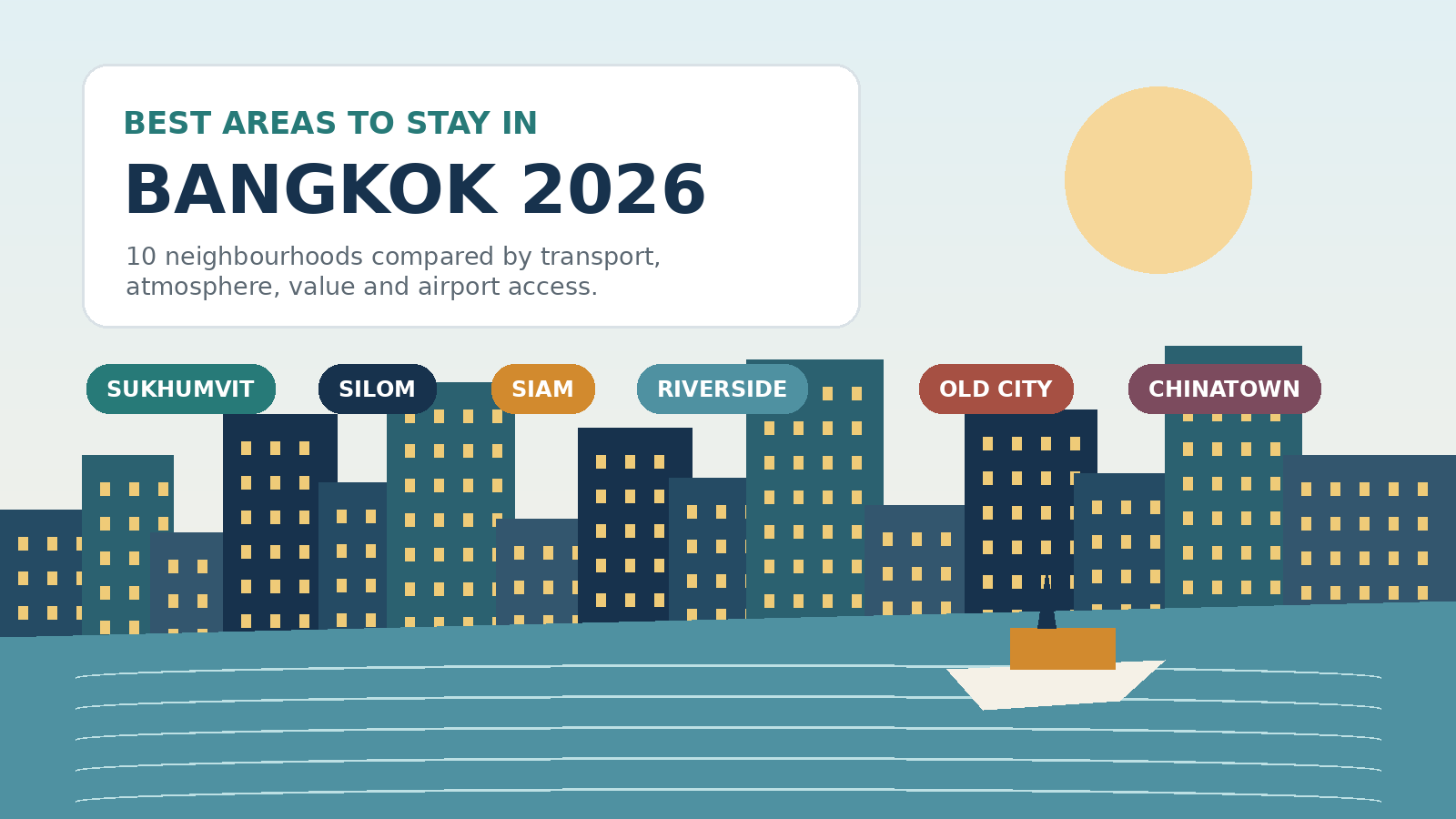
Bangkok hotel searches usually begin with a room, a star rating and a tempting rooftop-pool photo. That order is backwards. In a city this spread out, the neighbourhood affects almost every hour outside the room: how easily you reach a temple before the heat builds, whether dinner is a five-minute walk or a traffic-heavy taxi ride, and how awkward the airport transfer feels with luggage.
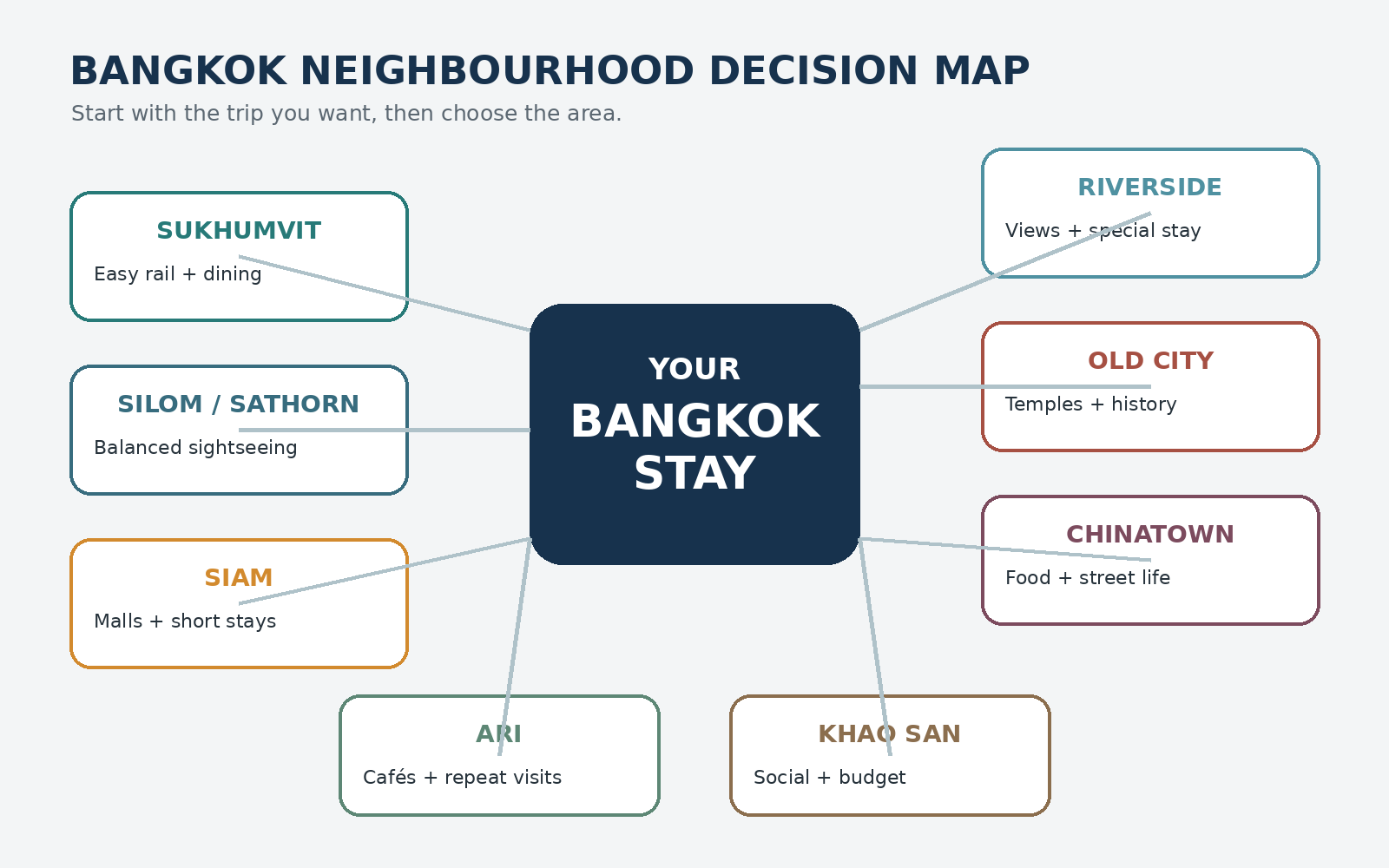
The strongest first-time bases are usually Sukhumvit around Asok or Phrom Phong, Silom or Sathorn near rail, Siam for a short shopping-led stay, and Riverside when atmosphere matters more than speed. Old City works better for temple-focused plans, while Chinatown rewards travellers who want food and street character. None is universally “best”; each removes a different kind of friction.
Rail access is especially valuable because it gives you a predictable alternative to road traffic. BTS currently lists service from 05:00 to 01:00, with ticket offices generally open from 06:00 to midnight, while the MRT Blue Line lists daily operation from 06:00 to midnight and peak headways of no more than four minutes.[1][2] Those hours are useful, but the final train is not a substitute for checking your exact late-night route.
The best areas to stay in Bangkok for first-time visitors are Asok or Phrom Phong in Sukhumvit, Silom or Sathorn, Siam, and Riverside. Choose Sukhumvit for maximum dining and BTS/MRT convenience, Silom for the best all-round balance, Siam for shopping and short family stays, and Riverside for views and a slower special stay. Old City is better when temples are the main priority, while Chinatown is strongest for food and atmosphere.
Quick answers
Asok for the BTS/MRT interchange, or Phrom Phong for similar convenience with a more polished evening feel.
Silom or Sathorn for BTS, MRT, the river, local food, parks and calmer evenings than central Sukhumvit.
Riverside, provided the hotel has a useful shuttle boat or a straightforward connection to Saphan Taksin.
Siam, Chit Lom or Phloen Chit for major malls, indoor dining and simple BTS movement.
Old City or the river edge of Rattanakosin when early access to the Grand Palace and Wat Pho matters most.
Pay slightly more for an easy station walk before choosing a cheaper room that creates taxi costs every day.
In this guide
Bangkok area comparison
At-a-glance neighbourhood guide
Bangkok behaves more like several connected centres than one compact downtown. Modern shopping and nightlife run along the BTS corridor; the royal sights sit farther west; the Chao Phraya creates a north-south river route; and the airports pull travellers in different directions. Therefore, the best neighbourhood is the one that makes your most important journeys simple.
Central and river areas
| Area | Best for | Transport strength | Planning price band | Main trade-off |
|---|---|---|---|---|
| Asok / Phrom Phong | First trips, food, nightlife and easy movement | Excellent BTS; MRT interchange at Asok | 1,800-7,000+ baht | Busy roads and a modern rather than historic feel |
| Silom / Sathorn | Couples, parks, food and mixed sightseeing | BTS, MRT and river access | 1,500-6,500 baht | Some streets feel business-led outside working hours |
| Siam / Chit Lom | Shopping, families and short stays | Excellent BTS interchange | 2,500-9,000+ baht | Commercial atmosphere and higher central rates |
| Riverside | Views, families, special occasions and slower evenings | Boats; selected BTS links | 3,500-20,000+ baht | Slower cross-city travel and wide variation in shuttle quality |
| Old City | Grand Palace, Wat Pho and historic Bangkok | MRT helps; boats and taxis remain useful | 1,200-5,000 baht | Less convenient for modern districts and late evenings |
Alternative and airport areas
| Area | Best for | Transport strength | Planning price band | Main trade-off |
|---|---|---|---|---|
| Chinatown | Food, photography and evening energy | MRT Wat Mangkon | 1,200-4,500 baht | Crowded pavements and a smaller resort-style hotel choice |
| Ari | Cafés, longer stays and repeat visitors | BTS Ari | 1,300-4,500 baht | Farther from many first-trip highlights |
| Khao San / Banglamphu | Backpackers, nightlife and low-cost guesthouses | Boats, buses and taxis | 400-2,500 baht | No direct BTS/MRT and noise varies sharply by street |
| Pratunam / Ratchathewi | Value shopping, market access and Airport Rail Link | BTS and Airport Rail Link nearby | 1,000-4,500 baht | Busy pavements and uneven station walks |
| Lat Krabang / Don Mueang | Late arrivals, early departures and airport overnights | Airport-focused road or rail access | 900-3,500 baht | Poor choice for a proper Bangkok sightseeing stay |
Price bands are broad editorial planning ranges for a standard room, not live quotes. Dates, taxes, breakfast, room type, cancellation rules and major events can change the total substantially.
Compare the exact hotel, not just the neighbourhood
Once you have narrowed the choice to two areas, compare the final price, station walk, recent room reviews and cancellation terms for your real dates. A district label can cover several very different streets.
How to choose where to stay in Bangkok
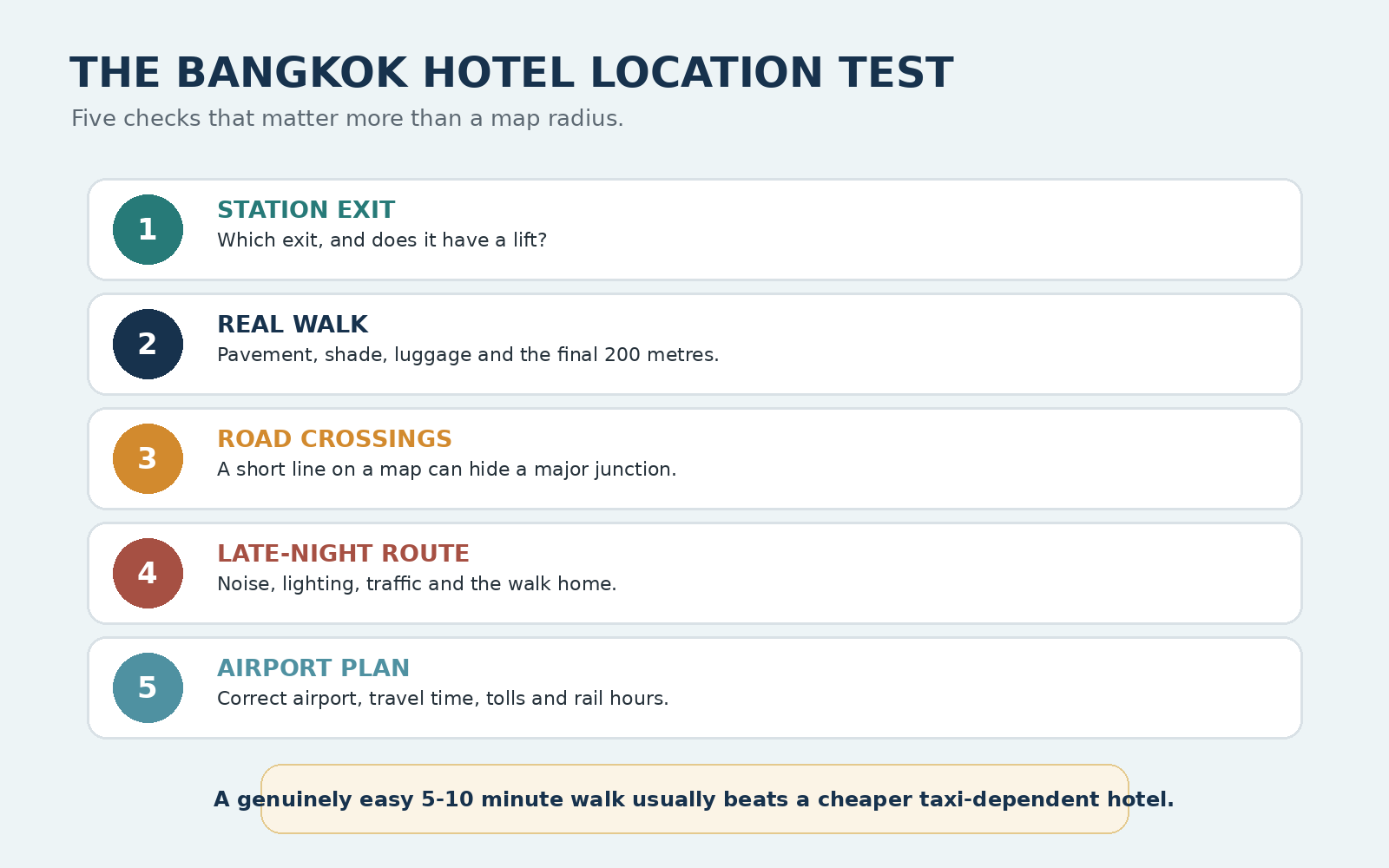
A good hotel choice starts with the itinerary rather than the room. The following six-step test takes longer than sorting by “guest rating”, yet it prevents the expensive mistake of booking a beautiful property in an inconvenient location.
Step 1: count real nights, not calendar dates
A 22:30 arrival followed by an early flight two mornings later is not a relaxed two-day Bangkok stay. It is one usable day with two transfer-heavy edges. For that pattern, choose a rail-connected area, avoid a complicated river shuttle, and keep the first evening simple.
By contrast, four or five nights create room for a slower base. Riverside becomes more realistic, Chinatown can be enjoyed beyond dinner, and a split stay may make sense. The number of usable mornings and evenings matters more than the dates shown on the booking.
Step 2: mark the three journeys that matter most
Write down your airport arrival, the most important sightseeing day and the evening you care about most. Then test each area against those routes. A traveller planning the Grand Palace, Wat Pho and a river dinner needs a different base from someone planning Siam malls, a Thong Lor restaurant and an early train north.
Next, add the onward journey. A hotel that is convenient for sightseeing can still be awkward for a 06:00 domestic flight or a train from Krung Thep Aphiwat. This final leg often decides between two otherwise similar neighbourhoods.
Step 3: inspect the exact station exit and walking route
“Near BTS” can mean 250 metres along a wide pavement or 900 metres down a narrow side street with traffic, broken surfaces and little shade. Open the map at walking level, identify the correct station exit, note major road crossings, and look at the final 200 metres to the hotel entrance.
For most visitors, a genuinely easy five-to-ten-minute walk is a useful target. Families with a pushchair, travellers with limited mobility and anyone arriving with heavy luggage should apply a stricter test. Also check whether an elevated station has a lift at the exit you need rather than somewhere on the opposite side of a large road.
Step 4: run the late-evening and noise test
A street can be convenient at 14:00 and unpleasant at midnight. Read recent reviews for traffic noise, bar music, corridor sound, construction and the exact room category. Hotel-wide scores often hide a split between quiet rear rooms and noisy street-facing rooms.
Then check the route home after your likely dinner. A lively district may be a benefit when you want to walk to restaurants, but a disadvantage when the hotel entrance sits inside the busiest nightlife strip. One or two streets can change the experience completely.
Step 5: check the airport and departure plan
Suvarnabhumi Airport and Don Mueang Airport are on different sides of the city and should not be treated as interchangeable. For Suvarnabhumi, the Airport Rail Link can make Phaya Thai, Ratchathewi and Makkasan-adjacent areas attractive for light travellers. AOT currently lists the rail service at airport level B1 from 05:30 to midnight.[3]
For an early flight, work backwards from check-in time and allow for traffic, tolls, luggage and the time needed to reach the vehicle. A cheap room becomes poor value if it creates a stressful pre-dawn transfer.
Step 6: choose the accommodation product
Only after the location works should you choose between a standard hotel, serviced apartment, hostel, riverside resort or airport hotel. A family may gain more from a washing machine, kitchen and separate sleeping area than from a rooftop bar. Conversely, a couple ending a long trip may value a river view and full-service pool enough to accept slower transport.
Karen’s planning rule
I would choose a slightly plainer hotel with a comfortable station walk over a more impressive room that turns every outing into a taxi decision. The difference is small when booking and obvious by the third day.
1. Sukhumvit: best for maximum convenience
Sukhumvit is not one neighbourhood. It is a long corridor of districts connected by the BTS Sukhumvit Line, with very different micro-areas around each station. Asok is the practical interchange, Phrom Phong feels polished and convenient, Thong Lor and Ekkamai lean toward restaurants and nightlife, and Nana has a stronger adult-nightlife presence that will not suit every traveller.
Asok: the easiest all-round interchange
BTS Asok meets MRT Sukhumvit, which gives direct rail choices in several directions. That makes Asok one of the safest bases for a first trip with a mixed itinerary. Food, pharmacies, malls and a wide range of hotels sit close together, while Makkasan is reachable for an Airport Rail Link connection.
The drawback is intensity. Sukhumvit Road is busy, large junctions can feel overwhelming, and some side streets are dominated by traffic or nightlife. Choose the exact soi rather than assuming every Asok hotel offers the same experience.
Phrom Phong: polished convenience for couples and families
Phrom Phong offers the same straightforward BTS movement with upscale malls, restaurants and a generally calmer evening feel than the busiest parts of Asok. It is particularly useful for families who want reliable indoor options in hot or wet weather and for couples who prefer dinner close to the hotel.
Rates can be higher, and properties deeper inside the sois may depend on a shuttle or motorbike taxi. Confirm the hotel’s shuttle timetable rather than assuming it runs whenever you need it.
Thong Lor and Ekkamai: dining and nightlife for repeat visitors
These areas work well when restaurants, bars and neighbourhood life are the point of the stay. Ekkamai also helps with some eastern bus routes. However, the most interesting venues are not always beside the BTS, so short road journeys may still be necessary.
Sukhumvit pros and cons
| Pros | Cons |
|---|---|
| Strong BTS access and MRT at Asok; food and services at most budgets; easy evenings without long travel; large hotel range. | Heavy road traffic; some adult-nightlife zones; modern rather than historic atmosphere; “near BTS” claims can hide deep side streets. |
2. Silom and Sathorn: the best balanced Bangkok base
Silom and Sathorn combine modern transport, local food, business-district order, green space and practical river access. Sala Daeng BTS and Si Lom MRT form a useful interchange, while Saphan Taksin connects the BTS with Chao Phraya boats. For many travellers, this is the most balanced alternative to Sukhumvit.
Who should stay here?
Choose Silom or Sathorn when the itinerary includes one temple day, one modern-city day, several good dinners and perhaps a river trip. Couples often appreciate the calmer evening atmosphere, while repeat visitors gain access to neighbourhood restaurants without giving up rail.
Sathorn can feel quieter and more residential, whereas Silom has more street activity. The exact block matters because office-led areas may be subdued at weekends, and some hotels still involve a warm walk to the nearest station.
What to check before booking
Identify whether the useful station is BTS, MRT or Saphan Taksin. A hotel marketed as “Sathorn” may be convenient for one line and awkward for another. If the river is important, test the route to the pier. If Lumphini Park is important, check which entrance is practical from the hotel.
| Pros | Cons |
|---|---|
| BTS, MRT and river choices; strong restaurant range; Lumphini Park nearby; usually calmer than central Sukhumvit. | Hotel quality varies by block; some roads are difficult to cross; business streets can lack weekend atmosphere. |
3. Siam, Chit Lom and Phloen Chit: best for shopping and short stays
Siam is Bangkok’s practical shopping base and a major BTS interchange. Large malls provide air-conditioning, food courts, cinemas and indoor options when the heat or rain is tiring. Chit Lom and Phloen Chit sit nearby and often feel slightly calmer and more polished.
Why families and short-stay visitors choose Siam
Predictability is the main advantage. Families can return to the hotel easily, find food without crossing the city, and fill a wet afternoon without changing plans. The BTS makes Sukhumvit and riverside connections manageable, while central shopping is on the doorstep.
The compromise is atmosphere. Siam can feel highly commercial after the malls close, and central hotels may cost more than similarly sized rooms elsewhere. Travellers who want market lanes, street-level nightlife or historic surroundings may prefer Chinatown, Silom or Old City.
Chit Lom or Phloen Chit instead of Siam?
Choose Chit Lom for upscale shopping and walkable central convenience. Phloen Chit suits business travellers, embassy visits and short luxury stays. Both keep direct BTS access while avoiding the busiest part of the Siam interchange.
4. Riverside: best for views and a slower special stay
Riverside hotels offer the Bangkok many travellers picture before arrival: boats moving across the Chao Phraya, temple silhouettes, sunset light and breakfast beside the water. The best properties feel like part of the holiday rather than simply a place to sleep.
The shuttle-boat test
Riverside convenience depends on the hotel’s transport. Ask where the shuttle arrives, how often it runs, whether it is free, how luggage is handled and when the final service leaves. A reliable link to Saphan Taksin is particularly useful. A beautiful hotel with an irregular boat can create more waiting than expected.
Also check which side of the river the property occupies. Crossing by boat can be enjoyable, yet it adds another step to every journey. Hotels near ICONSIAM provide a different experience from secluded resorts farther south.
When Riverside is worth the extra cost
Riverside works well for the final two or three nights of a longer Thailand trip, a family stay with pool time, a honeymoon, or a birthday or anniversary. It is less persuasive for a one-night stop or a packed schedule that crosses the city repeatedly.
Families should check pool shade, room occupancy limits and whether breakfast is included for children. Couples may value a balcony or river-facing room, but should confirm that the booked category actually guarantees the view shown in promotional images.
| Pros | Cons |
|---|---|
| Memorable views; resort-style pools; useful boat access to river sights; calmer atmosphere than central roads. | Higher rates; slower cross-city journeys; transport quality differs by hotel; some room categories lack the promised view. |
5. Old City and Rattanakosin: best for temples and historic Bangkok
Old City places the Grand Palace, Wat Pho and several historic sights close to the hotel. That matters when you want to arrive early, before the strongest heat and the largest visitor groups. MRT Sanam Chai has improved access, although the area still lacks the all-direction rail flexibility of Asok or Silom.
The strongest reason to stay here
Choose Old City when temples and historic streets are the centre of the trip rather than one sightseeing day within a broader Bangkok stay. Photographers and early risers gain the most. The Grand Palace currently lists visitor hours of 08:30 to 16:30, ticket sales until 15:30 and a 500-baht foreign visitor ticket; royal events can change access, and the official dress code should be checked before setting out.[4]
Where Old City is less convenient
Evenings require more planning, especially when restaurants or bars are in Sukhumvit, Silom or Thong Lor. Taxis and boats remain useful, and late returns may be less straightforward than in a rail-led district. The area also varies sharply: a quiet boutique hotel beside a canal feels very different from a room close to the Khao San nightlife zone.
6. Chinatown: best for food and street character
Chinatown is a compelling base for travellers who care about food, photography and evening energy. MRT Wat Mangkon makes the district more practical than it once was, and Yaowarat changes character through the day as shops, markets, restaurants and street stalls take turns dominating the streets.
Who will enjoy staying in Chinatown?
Food-focused visitors, couples who prefer character to resort polish, and photographers who want to step outside into visual activity will find plenty to like. It also connects reasonably well to Old City and the river.
However, pavements can be crowded, traffic feels close, and hotel stock is smaller than in Sukhumvit. Travellers who need a large pool, expansive lobby or very quiet surroundings should inspect the property carefully. A two- or three-night stay often captures the best of the area without making every Bangkok journey start there.
What to check on the hotel map
Look for the route to MRT Wat Mangkon, the position relative to Yaowarat Road and whether the entrance is accessible by car. Some atmospheric lanes are excellent for exploring but awkward for luggage. If sleep matters, search recent reviews for market noise and late-night street activity.
7. Ari: best for cafés, longer stays and repeat visits
Ari offers a neighbourhood rhythm that is harder to find in the most visitor-heavy districts. Cafés, restaurants, small bars and residential streets sit around BTS Ari, making it attractive to repeat visitors, remote workers and travellers who want more ordinary city life between sightseeing days.
Why Ari is not the automatic first-trip choice
The BTS connection is useful, but many major sights still require changes or additional road travel. A two-night highlights trip can feel inefficient from Ari. On a five- or seven-night stay, however, the calmer base may be worth the extra journey time.
Accommodation choice is narrower, so compare room size and facilities carefully. Serviced apartments can offer better value than standard hotels for longer stays, especially when laundry and work space matter.
8. Khao San and Banglamphu: best for social budget travel
Khao San Road remains a practical choice for hostels, nightlife, inexpensive guesthouses and meeting other travellers. Banglamphu is the broader district, and the experience changes quickly once you move away from the loudest strip. A quieter side street can provide access to the social scene without placing music outside the bedroom window.
Transport and noise are the deciding factors
There is no direct BTS or MRT station at Khao San. Boats, buses and taxis fill the gap, which is manageable for a relaxed budget trip but less convenient for daily travel to Sukhumvit or Siam. Read recent reviews for the specific street and room position because noise varies far more than the area name suggests.
This is also an area where the cheapest room can create hidden costs. A slightly dearer hotel near an easy boat or taxi pickup point may be better value than a bargain room inside a difficult lane.
9. Pratunam and Ratchathewi: best for value shopping and Airport Rail Link access
Pratunam is busy, commercial and often good value. It suits travellers who want clothing markets, central shopping and easy access to the Airport Rail Link at Ratchaprarop or Phaya Thai. Ratchathewi can provide a more balanced base when a hotel sits close to BTS.
Why the map needs close inspection
Short distances can be deceptive here. Large roads, market crowds and uneven pavements may make a seemingly central hotel awkward with luggage. Check whether the useful station is Ratchaprarop Airport Rail Link, Phaya Thai, Ratchathewi BTS or none of them in practice.
Pratunam works best for shoppers who accept bustle and for light travellers arriving at Suvarnabhumi during rail operating hours. It is less appealing when quiet evenings, riverside atmosphere or elegant public space are priorities.
10. Lat Krabang or Don Mueang: best for an airport overnight
An airport-area hotel is a logistics tool, not a substitute for staying in Bangkok. It makes sense after a very late arrival, before a very early departure, or between flights when there is not enough usable time to justify crossing the city.
Suvarnabhumi: Lat Krabang and nearby airport hotels
Look for a clearly described shuttle, 24-hour reception and a realistic transfer time. “Airport hotel” can still mean a road journey, so confirm whether the shuttle is free, scheduled or on request. Light travellers may prefer a city hotel near the Airport Rail Link when arrival is before the final service.
Don Mueang: convenience for low-cost and domestic departures
For DMK, proximity is more valuable than city atmosphere. Check whether the hotel is walkable by a protected route or depends on a shuttle. Do not book near Suvarnabhumi for a Don Mueang flight simply because both properties are labelled “Bangkok airport”.
Use an airport hotel only when it solves a real timing problem
For a normal two- or three-night visit, a central rail-connected base usually creates a better trip. Moving to an airport hotel can consume more time than an early transfer would save.
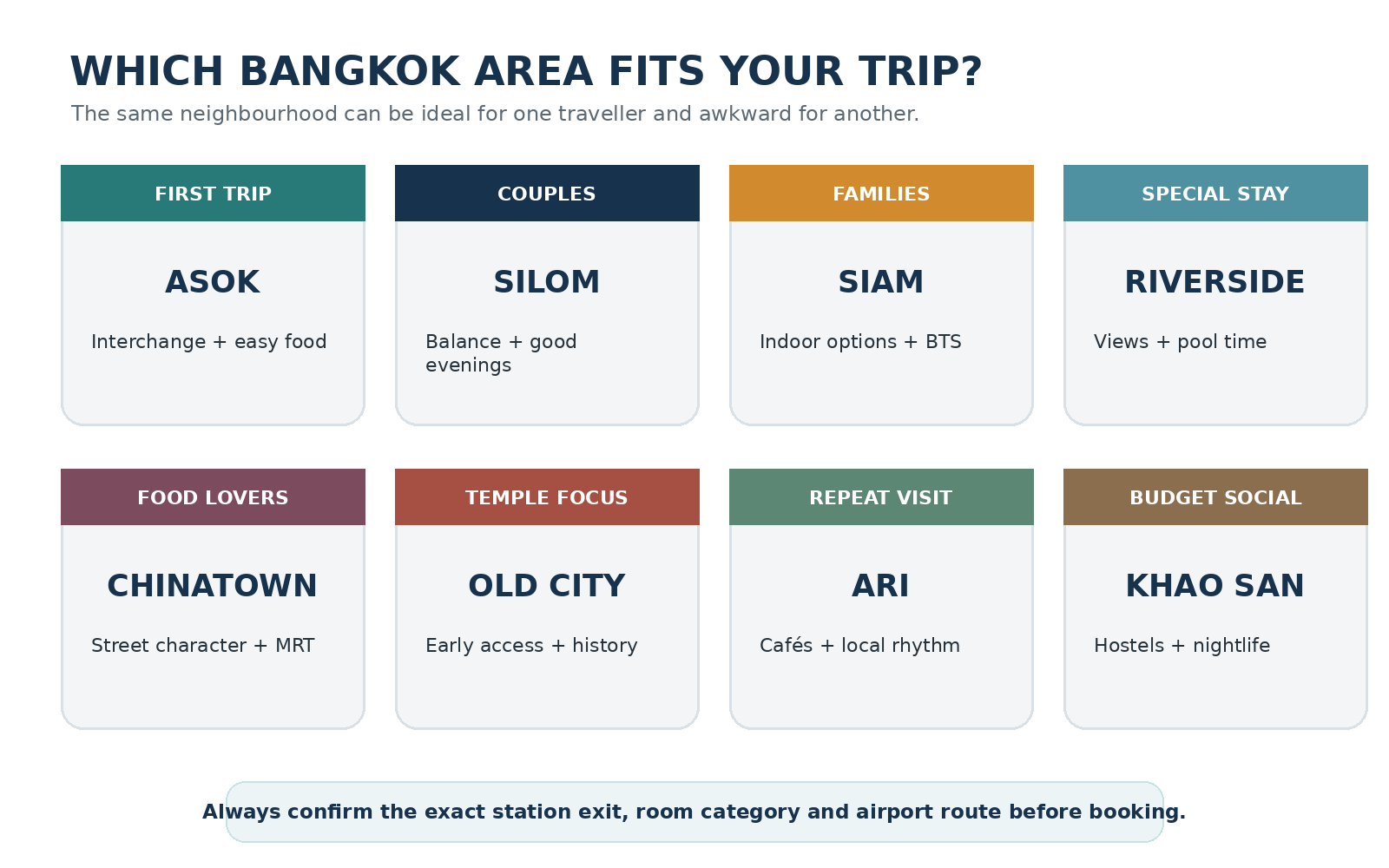
Best Bangkok area by traveller type
The following recommendations assume the hotel has an easy route to the transport named. A poor station walk can overturn an otherwise sensible area choice.
| Traveller | Best starting choice | Strong alternative | Why |
|---|---|---|---|
| First-time visitor | Asok | Silom/Sathorn | Broad transport choices and simple food options |
| Couple | Silom/Sathorn | Riverside | Good dinners and balanced sightseeing, or a special slower stay |
| Family | Siam or Phrom Phong | Riverside | Indoor options and easy returns, or space and pool time |
| Nightlife-focused | Asok or Thong Lor | Khao San | Modern bars and restaurants, or social backpacker nightlife |
| Food-focused | Chinatown | Silom | Street character and markets, or a wider restaurant mix |
| Temple-focused | Old City | Riverside | Early access and historic setting, or boat-based sightseeing |
| Shopping-focused | Siam/Chit Lom | Pratunam | Major malls and BTS, or value markets and central access |
| Budget backpacker | Khao San/Banglamphu | Chinatown | Hostels and social life, or character with MRT access |
| Repeat visitor | Ari | Thong Lor/Ekkamai | Neighbourhood rhythm and dining beyond the first-trip checklist |
| One-night stop | Airport hotel | Phaya Thai/Ratchathewi | Transfer simplicity, or Airport Rail Link plus a city evening |
Best area for a three-night first visit
Asok is the most forgiving choice when the itinerary is still flexible. Silom is better when the river and Old City matter almost as much as modern Bangkok. Avoid splitting hotels during only three nights unless one of the nights is purely an airport stop.
Best area for families
Siam, Phrom Phong and Riverside are the strongest starting points. Check connecting-room wording, maximum occupancy, breakfast charges for children, pool hours and whether the station route works with a pushchair. A serviced apartment may offer more practical value than a conventional hotel.
Best area for couples
Silom/Sathorn is the versatile choice; Riverside is the atmospheric choice. Couples who plan late dinners and bars may prefer Phrom Phong or Thong Lor, while food-focused couples may enjoy a shorter Chinatown stay.
Best area for budget travellers
Khao San offers the deepest social-hostel choice, but the cheapest useful base may be a small hotel near MRT in Chinatown or a rail-connected Sukhumvit side street. Daily transport costs and time should be included in the comparison.
Bangkok hotel prices in 2026: realistic planning bands
Bangkok accommodation moves sharply by date, room size, refund terms and major events. The ranges below are planning figures from sample market checks rather than promises. New Year, large exhibitions, concerts and peak holiday periods can lift rates quickly.
| Accommodation type | Broad nightly range | What usually changes the price | Best use |
|---|---|---|---|
| Hostel bed or very simple room | 350-1,200 baht | Shared facilities, noise, air-conditioning and rail distance | Social budget trips |
| Budget private hotel room | 1,000-2,200 baht | Windows, room size, breakfast, lift and station walk | Short value-focused stays |
| Reliable mid-range hotel | 2,200-4,800 baht | Pool, breakfast, newer rooms and flexible cancellation | Most first-time visitors |
| Serviced apartment or upscale hotel | 4,500-9,000 baht | Kitchen, laundry, space, club facilities and neighbourhood | Families and longer stays |
| Luxury Riverside stay | 8,000-25,000+ baht | View, brand, room category, club access and season | Special occasions and resort-style breaks |
Compare the full stay price
A room that appears 500 baht cheaper may lose its advantage after breakfast, taxes, a non-refundable condition, airport transport and daily taxis are added. Compare the complete stay for the same room type and cancellation terms. Also check whether the quoted occupancy covers every guest.
Do not pay for a feature you will not use
A rooftop pool has little value during a two-night sightseeing sprint. A kitchen is unnecessary when every meal will be outside. Likewise, the cheapest room is not good value when its station walk causes four taxi journeys each day. Match the hotel feature to the likely routine.
Hotel, serviced apartment, hostel or Riverside resort?
| Product | Best for | Main advantages | Main limitations |
|---|---|---|---|
| Standard city hotel | Short first trips | Reception, housekeeping and simple check-in | Small rooms and variable soundproofing |
| Serviced apartment | Families and longer stays | Space, kitchen, laundry and living area | Fewer hotel services; deposits may apply |
| Hostel private room | Social budget trips | Shared spaces and useful local advice | Noise, shared bathrooms and less privacy |
| Riverside resort | Special occasions | Views, pools and a destination feel | Higher rates and slower transport |
| Airport hotel | Early or late flights | Reduced transfer risk and 24-hour logistics | Weak base for sightseeing |
A useful value calculation
Take the price difference between two hotels and divide it by the number of usable days. Then ask whether the better location, breakfast, laundry or room space is worth that daily amount. This produces a clearer decision than comparing total prices in isolation.
Bangkok airport to hotel area: practical comparison
Suvarnabhumi Airport’s official transport page currently lists metered taxis 24 hours a day from Level 1, Gates 4-7, with a 50-baht airport surcharge plus applicable tolls and regulated luggage charges. It also lists app-based pickup at Gate 4 and Airport Rail Link service from Level B1 between 05:30 and midnight.[3] These details can change, so recheck shortly before travel.
| Hotel area | Rail-friendly arrival from BKK | Road-transfer reality | Best for |
|---|---|---|---|
| Asok | Airport Rail Link to Makkasan, then connect or continue by road | Traffic-sensitive but straightforward by taxi or private transfer | Light travellers and first visits |
| Phrom Phong | Rail plus BTS or a short final road journey | Simple door-to-door transfer; allow for Sukhumvit traffic | Families and couples |
| Silom/Sathorn | Rail plus MRT/BTS changes | Door-to-door transfer is often easier with luggage | Mixed itineraries |
| Siam/Chit Lom | Airport Rail Link to Phaya Thai, then BTS | Central traffic can slow road transfers | Shoppers and short stays |
| Riverside | Multiple changes; less convenient with luggage | Private transfer or taxi is usually simplest | Special stays |
| Old City | Rail plus MRT/road connection | Road transfer is often easier, especially late | Temple-focused trips |
| Pratunam/Ratchathewi | Strong Airport Rail Link access | Final walking route can be awkward | Light travellers and shoppers |
| Lat Krabang | Short local rail or hotel-shuttle strategy | Designed for airport access rather than sightseeing | Airport overnights |
When a private airport transfer is worth it
A private transfer can be sensible after a long-haul flight, for a family with several bags, for a Riverside hotel, or when arrival is after rail hours. Compare the meeting instructions, luggage allowance, waiting time and cancellation policy rather than buying solely on the lowest headline price.
Should you split the Bangkok stay?
A split stay can work during five nights or more. One useful pattern is three nights in Asok or Silom for active sightseeing followed by two Riverside nights for a slower finish. Another is Old City first for temples, then Siam or Sukhumvit for shopping and dining.
During a three-night visit, moving hotels usually wastes more time than it saves. Packing, checkout, traffic, luggage storage and another check-in can consume half a day. Split only when the second hotel creates a genuinely different experience.
What to check before booking a Bangkok hotel
Hotel listings are designed to make comparison feel simple. In practice, several details can change the value of the stay. Work through this checklist before paying.
1. The real walking route
Check station exit, lift access, road crossings, pavement width, shade and the final approach. Straight-line distance is not enough. A hotel on the opposite side of a large junction may be much less convenient than the map suggests.
2. The exact room category
Confirm window type, bed configuration, floor, room size and view. Promotional photos may combine several categories. If the river or skyline view matters, the booked room description should guarantee it.
3. Taxes, breakfast and cancellation
Compare the final total for identical dates and occupancy. Check whether breakfast is included for every guest, whether cancellation is genuinely free until a stated time, and whether payment is taken now or at the property.
4. Deposits and payment method
Serviced apartments and some hotels may request a security deposit. Check the amount, accepted payment method and refund process. Travellers relying on one card should also confirm that the property accepts it at check-in.
5. Noise and construction
Search recent reviews for road noise, bars, neighbouring buildings, corridor sound and renovation work. Give more weight to comments from the last few months and to reviews naming the same room category.
6. Family and accessibility details
“Family room” does not always mean separate sleeping space. Confirm bed layout, occupancy, connecting-room guarantees, cot charges and child breakfast rules. For accessibility, ask about step-free access from street to room, bathroom layout and the practical station route.
7. Pool, gym and rooftop hours
A facility is valuable only when it is open during the hours you can use it. Some rooftops host private events or have age restrictions, while pools may close earlier than expected. Check before paying a premium.
8. Shuttle or boat timetable
Do not rely on “complimentary shuttle” without details. Ask where it stops, how frequently it runs, whether reservations are required and when the final departure leaves. This is particularly important for Riverside and deep-soi properties.
Save evidence of the important promise
If the view, connecting room, late check-in, airport pickup or shuttle is essential, keep the written confirmation. A vague note in the booking request box is not the same as a confirmed arrangement.
Useful bookings after choosing your area
Accommodation should be chosen first. Then add only the services that remove a specific problem. The following links are deliberately separated from the neighbourhood recommendations so that the guide does not turn into a page of sales buttons.
Book onward transport after the hotel location is fixed
The departure station or pickup point may influence your final night. Compare train, coach, flight and transfer options before deciding whether to move hotels. For example, a very early onward journey can make one side of Bangkok more practical than another.
Choose tours by meeting point and return time
A tour that begins across the city at 07:00 may be less convenient than a slightly dearer option with hotel pickup or a meeting point near rail. Check the exact meeting instructions, cancellation deadline, inclusions and expected return before booking.
Arrange data before arrival when it simplifies the transfer
Mobile data is useful for hotel messages, map checks and app-based transport. An eSIM can be convenient for a compatible unlocked phone, although a local physical SIM may suit travellers who need a Thai number or prefer in-person setup.
Two small hotel-room items that can be genuinely useful
| Item | Useful when | Buying advice | Limitations |
|---|---|---|---|
| Universal travel adapter | You travel with several UK devices or continue to other countries | Choose a fused, safety-certified model with the wattage clearly stated | An adapter does not convert voltage |
| Digital luggage scale | You plan domestic flights or shop in Bangkok | Choose a compact model with an easy-to-read display | Airline scales and allowances remain the final authority |
Common Bangkok accommodation mistakes
| Mistake | Why it causes trouble | Better plan |
|---|---|---|
| Choosing by district name alone | Large districts hide very different station walks and nightlife levels | Check the exact pin, exit, road crossings and final 200 metres |
| Using straight-line distance | Elevated roads, junctions and deep sois add effort | Test the full walking route at street level |
| Ignoring late-night noise | Bars, traffic, corridors and construction can affect sleep | Read recent reviews for the exact room category |
| Assuming Riverside means easy boats | Not every hotel has a frequent or useful shuttle | Confirm pier, timetable, booking rules and final departure |
| Booking the wrong airport side | BKK and DMK are far apart and serve different route patterns | Check the airport code before choosing an airport hotel |
| Paying for breakfast automatically | Bangkok has extensive nearby food and café options | Compare the real breakfast price with the local routine you want |
| Moving hotels during a short stay | Packing, traffic and another check-in consume sightseeing time | Split only when the second area creates a distinct experience |
| Buying a non-refundable room too early | Flights and itineraries can change | Compare the saving with the value of flexibility |
| Assuming every “family room” is spacious | Some simply add a rollaway bed to a standard room | Check floor plan, room size and bed arrangement |
| Trusting old reviews | Management, construction and local streets change | Prioritise recent, detailed reviews with photos |
A final booking checklist
- Confirm that the area matches the three most important journeys.
- Check the station exit and full walking route.
- Verify the airport code and transfer plan.
- Make sure the exact room category includes the promised bed, window and view.
- Compare a final total that includes taxes, breakfast and every guest.
- Record the cancellation and payment deadlines.
- Read recent reviews for noise and construction.
- Get family, accessibility or connecting-room needs confirmed in writing.
- Ask for shuttle or boat details where relevant.
- Avoid choosing the hotel solely for a feature you will not use.
Frequently asked questions
What is the best area to stay in Bangkok for first-time visitors?
Asok is the easiest general answer because BTS, MRT, food and a wide hotel range sit close together. Silom or Sathorn is a calmer alternative with rail, park and river access. Phrom Phong suits travellers who want Sukhumvit convenience with a more polished evening atmosphere.
Is Sukhumvit or Silom better?
Choose Sukhumvit for maximum hotel, restaurant and nightlife choice. Choose Silom or Sathorn for a more balanced base with Lumphini Park, MRT, BTS and easier river connections. The best answer depends on whether modern dining or mixed sightseeing has priority.
Is Riverside Bangkok worth the extra cost?
Riverside is worth it when views, pool time and atmosphere are part of the holiday. It is less convincing for a short stay built around repeated cross-city sightseeing. Confirm the shuttle boat before paying a premium.
Should I stay near the Grand Palace?
Stay near the Grand Palace when temples are the main purpose of the visit or when early access matters. For a broader first trip, Asok, Silom or Siam usually provides more flexible transport and evening choices.
Is Chinatown a good place to stay in Bangkok?
Yes, particularly for food lovers, photographers and travellers who enjoy busy street atmosphere. MRT Wat Mangkon improves access. However, pavements and traffic can feel intense, and the area offers fewer resort-style hotels than Sukhumvit or Riverside.
Is Khao San Road a good base?
Khao San suits social backpacking, hostels and budget nightlife. It is weaker for quiet sleep and direct BTS or MRT access. Choose one or two streets away from the loudest section when rest matters.
How close should a Bangkok hotel be to BTS or MRT?
A comfortable five-to-ten-minute walk is a useful target for most visitors. Check road crossings, shade, station lifts, the correct exit and the depth of the side street. Travellers with mobility needs or young children should use a stricter standard.
Which Bangkok area is best for shopping?
Siam, Chit Lom and Phloen Chit are strongest for major malls and easy BTS movement. Pratunam is better for value markets, while Phrom Phong combines upscale shopping with restaurants and hotels.
Where should families stay in Bangkok?
Families often do well in Siam, Phrom Phong, Riverside or Sathorn. Prioritise room layout, pool practicality, breakfast rules, lift access and an easy return route. A serviced apartment may be better than a standard hotel for longer stays.
What is the cheapest useful Bangkok area?
Khao San and parts of Chinatown, Pratunam and Sukhumvit can be inexpensive. However, value depends on transport. A slightly dearer room near rail may reduce daily taxi costs and save several hours across the stay.
How much should I budget for a Bangkok hotel?
A reliable mid-range room often falls around 2,200-4,800 baht per night, while a simple private room may start around 1,000 baht. Dates, room size, location, breakfast and cancellation terms create large swings.
Can I split my Bangkok stay between two areas?
Yes, particularly during five nights or more. A practical combination is a transport-led base at the start and two Riverside nights at the end. Avoid moving during a short three-night stay unless one night is purely for the airport.
Which area is easiest from Suvarnabhumi Airport?
Phaya Thai, Ratchathewi and Pratunam are convenient for Airport Rail Link users. Asok can work via Makkasan, while Riverside and Old City are usually simpler by taxi or private transfer when travelling with luggage.
Should I stay near Don Mueang Airport?
Stay near DMK only for a late arrival, early departure or short connection. For a normal sightseeing visit, choose a central area and allow enough transfer time. Always check that the flight is actually using Don Mueang rather than Suvarnabhumi.
Final recommendation
The simple answer
For a first Bangkok trip, choose Asok when convenience is the clear priority and Silom or Sathorn when the itinerary mixes temples, food, parks and the river. Siam is the easiest short-stay shopping and family base. Riverside is the strongest emotional choice for a slower or special stay, while Old City and Chinatown are better for travellers with a clear historic or food-led focus.
The final decision should happen at street level. Check the station exit, pavement, road crossings, late-evening atmosphere, room category and airport route. Once those practical details work, choose the hotel you actually like. That order produces a better stay than chasing a bigger room in the wrong part of Bangkok.
Written and researched for Taylor’s Trailblazing Travels by Karen Taylor.
Sources and methodology
Transport and attraction details were fact-checked against official sources on 24 August 2026. Hotel prices are broad editorial planning ranges based on sampled market checks and must be verified for the actual dates, room type and cancellation conditions.
- BTS Skytrain: train timetable and frequency. Official service and ticket-office information effective from January 2026.
- Bangkok MRT: system map and service information. Official Blue Line operating hours, station and frequency information.
- Airports of Thailand: Suvarnabhumi transport guide. Official taxi, app pickup, Airport Rail Link and airport transfer information.
- The Grand Palace: practical visitor information. Official opening hours, ticket sales, price, access and dress guidance.
- Tourism Authority of Thailand: Bangkok destination guide. Official destination context and visitor planning information.
- Taylor’s Trailblazing Travels: Bangkok travel guide. Related planning guide for attractions, transport and itinerary structure.
- Taylor’s Trailblazing Travels: transport in Thailand. Related guide for onward planning.
- Taylor’s Trailblazing Travels: Thailand SIM cards and eSIMs. Related connectivity guide.
Image credits
All four illustrations in this article are original editorial graphics created for Karen Taylor and Taylor’s Trailblazing Travels. No third-party stock photography has been used, and no external attribution is required.