10 Best National Parks in Thailand for 2026
Rainforest, waterfalls, wild elephants and island scenery, with the practical choices that turn a wish list into a workable trip.
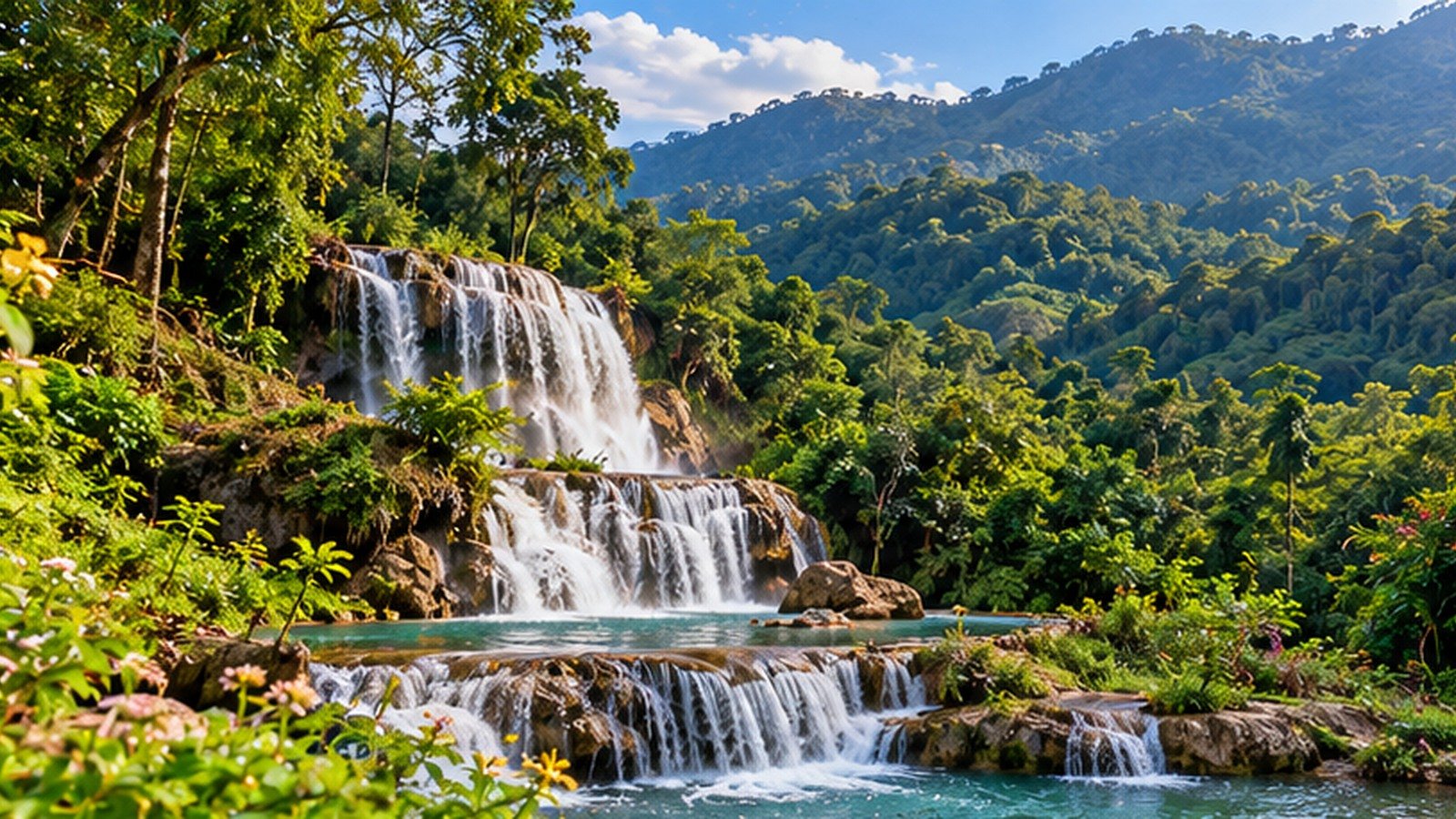
Original generated nature illustration; not a record of conditions at a named waterfall.
The best national parks in Thailand are not all trying to deliver the same day out. A forest walk near Khao Yai, a boat journey across Cheow Lan Lake and an offshore snorkelling trip require different bases, different budgets and different expectations. Choosing by the photograph alone is how a relaxed holiday acquires an exhausting transfer.
This shortlist covers ten contrasting parks that can make sense within common Thailand routes. The order favours a useful spread of experiences rather than claiming that one landscape is objectively better than another. Official park and tourism information supports the descriptions; the suggested durations and combinations are research-led planning judgements, not accounts of personal visits.
Start with your route and your least flexible traveller. Then decide whether you want wildlife, walking, waterfalls or time on the water. A park that fits comfortably into your holiday will usually be more rewarding than a famous alternative reached after hours of avoidable driving.
Khao Yai
Choose time in the forest, not a guaranteed-animal promise.
Khao Sok
Keep village access and the lake pier separate in the plan.
Erawan
A Kanchanaburi base allows a less hurried park day.
Your actual attraction
An open park does not mean every trail or island is open.
Compare the best national parks in Thailand
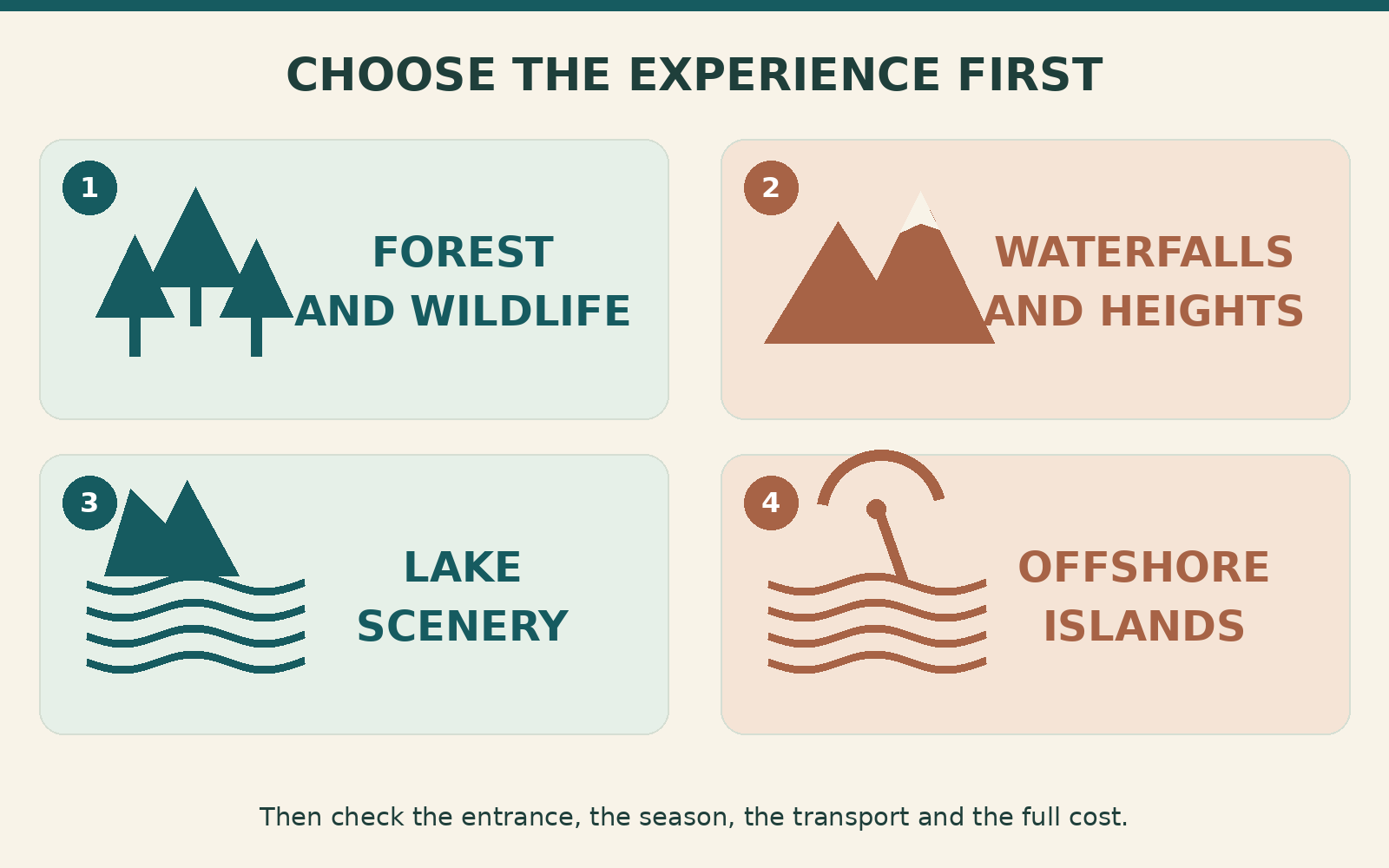
Choose an experience before choosing a ticket
These are ten recommendations for different journeys, not ten stops for one holiday. The suggested visit lengths below assume you are already staying in a sensible nearby base. They do not include a flight across Thailand, a long hotel transfer or every optional activity inside the park.
| Park | Useful base | Main reason to choose it | Suggested time | Important trade-off |
|---|---|---|---|---|
| Khao Yai | Pak Chong or Mu Si | Forest walks and wildlife interest | One full day; two is better | Transport inside the park matters |
| Khao Sok | Khlong Sok village or lake-side access | Rainforest and Cheow Lan scenery | Two or three nights | Village and lake are different booking zones |
| Doi Inthanon | Chiang Mai | Highland scenery and waterfalls | A full day | A mountain day can involve much driving |
| Erawan | Kanchanaburi | Tiered waterfall landscape | Most of a day | Swimming and upper access depend on conditions |
| Kui Buri | Hua Hin, Pranburi or nearby | Wild-elephant observation | An afternoon plus transfers | Wildlife cannot be promised |
| Kaeng Krachan | A suitable local lodge | Forest, birds and patient nature watching | Two nights or more | Specialist access needs planning |
| Khao Sam Roi Yot | Pranburi or Sam Roi Yot | Coastal mountains, caves and wetlands | One or two days | Attractions are spread out |
| Ang Thong | Koh Samui or Koh Phangan | Island views and a varied boat day | A full day | Crossings and viewpoint climbs differ |
| Similan | Khao Lak area | Granite scenery and snorkelling | A full day | Seasonal access and a substantial sea journey |
| Surin | Khura Buri or an included pickup base | A snorkelling-focused island visit | One day or a permitted longer stay | Remote does not mean effortless |
On a narrow screen, swipe within the table to see every column.
What the numbering means
Khao Yai leads because it is a strong introduction to land-based nature on a Bangkok-linked route. The later marine parks are not lesser choices: they simply answer a different question. This selection considers access, contrast and usefulness to visitors, without inventing a score for wildlife sightings, water visibility or crowd levels.
Khao Yai: the strongest first forest choice
Why it belongs on the shortlist
Khao Yai combines forest trails, waterfalls and wildlife interest without requiring an offshore journey. Its official visitor information makes an important practical point: there is no ordinary public transport network operating around the park. Reaching Pak Chong therefore does not solve the final journey between the gate, trailheads and viewpoints. [2]
A nearby overnight base is a better starting point than treating the park as a small attraction outside Bangkok. With two nights, you can arrive without rushing, devote the next day to nature and leave after breakfast. This also makes it easier to change the order of activities when rain interrupts the morning.
Choose the walking rather than a generic label
The park describes routes ranging from a short visitor-centre circuit to a much longer walk to Haew Suwat. Guide requirements differ, and some routes must be started early. Ask which route is intended and how much actual walking is included rather than assuming that every wildlife tour is a long trek. [3]
For a mixed-age group, a shorter approved walk plus observation stops may be more enjoyable than spending the day trying to keep up. Meanwhile, anyone chiefly interested in birds should ask about the guide’s focus before booking. Do not choose a visit solely because an advertisement promises elephants: sightings are not a timetable.
Khao Sok: dramatic scenery with two separate access plans
The village is not the lake pier
Khao Sok protects a large rainforest landscape in Surat Thani, including the area around the reservoir commonly called Cheow Lan Lake. Forest scenery and limestone peaks are central to its appeal. However, a room near the village and a floating lake stay are not interchangeable products. [4]
Before paying, identify the first meeting point, the overnight location and the final drop-off. A village lodge may suit a flexible combination of local meals and guided walks. A lake package suits travellers who want the boat journey and a night away from the road, but it creates more dependence on organised transfers.
Read the raft-house detail
Compare the room and bathroom arrangement, power availability, included meals and the amount of time on boats. A dramatic photograph does not explain whether a room has a private bathroom or what happens when weather changes the proposed activities. Ask those questions explicitly instead of relying on the word luxury.
Two or three nights in the wider area can be useful, although not all of them need to be on the lake. Keep a generous departure buffer before a flight or distant ferry. In particular, avoid accepting a cave or water activity simply because it was mentioned in an original itinerary; the guide’s assessment of that day’s conditions takes priority.
Doi Inthanon: a mountain day from Chiang Mai
Pick the version of the day you actually want
Doi Inthanon is Thailand’s highest mountain, and its national park includes different forest environments, waterfalls and well-known nature trails. TAT highlights Ang Ka, Kew Mae Pan and the surrounding highland attractions. Those names describe different stops, not a promise that every route is open or appropriate on your date. [5]
A sightseeing-focused trip can suit someone who wants changing scenery with relatively modest walking. A walking-focused trip should protect time for the intended trail rather than squeezing in every viewpoint, market and waterfall. Ask the operator to describe the walking surface and elevation changes, not only the distance.
Allow the mountain its own day
From Chiang Mai, treat this as the main event rather than something to combine with an ambitious evening reservation. Start with breakfast and a realistic pickup arrangement, then leave the return flexible. This makes a late lunch or a rain-delayed stop less disruptive.
Pack a layer that is useful in wind or cool conditions as well as rain protection. A warm afternoon in the city is not a reliable guide to comfort on the mountain. If low cloud removes the distant views, a forest-focused visit may still be worthwhile; someone travelling mainly for panoramic photographs should keep more flexibility. [5]

Erawan: waterfalls without a race to every tier
Make Kanchanaburi the practical starting point
Erawan is best known for its seven-tier waterfall, and TAT places the park around 65 kilometres from Kanchanaburi. That makes the town a useful base, but it still leaves a road journey before the walking begins. Starting in Bangkok adds another substantial layer of travel. [6]
For the most relaxed visit, keep the waterfall as the day’s priority. Combining it with several railway and historical stops can work as an overview, yet that is a different product from spending unhurried time in the park. Check how many hours remain at Erawan after every transfer is counted.
The top is not compulsory
Choose a turnaround point according to conditions, time and the group’s energy. Reaching every tier is not the only way to enjoy the landscape, and a shorter visit should not be described as a failed hike. It can be the more sensible choice when paths are wet or somebody is tiring.
Swimming must depend on local permission and current water conditions. Do not interpret an older photograph of swimmers, or even an attraction description, as clearance to enter a pool on the day. Keep valuables protected and allow enough time to change before the return vehicle. A wet swimsuit and a hurried departure are avoidable inconveniences.
Kui Buri: observe wild elephants on their terms
Choose observation, not interaction
Kui Buri’s appeal is the possibility of seeing free-ranging elephants and other wildlife in a protected landscape. Official tourism information identifies a dedicated wildlife-observation area. This is fundamentally different from booking an activity involving touching, bathing or performing elephants. [7]
Ask for the precise wildlife-area meeting point, because a general park address may not be where your visit begins. Then establish how the local vehicle arrangement works and whether the journey from your hotel is included. Those details matter more than choosing the most exciting animal photograph on a booking page.
Give the afternoon room to breathe
A planned observation session plus hotel transfers can be a sensible addition to a Hua Hin or Pranburi stay. Nevertheless, do not arrange an inflexible dinner immediately afterwards. Wildlife watching can involve long quiet periods, and the return journey deserves its own allowance.
Take binoculars when you already have them and use a zoom rather than expecting close contact. The park’s role is to protect animals, not to deliver a guaranteed sighting to order. A worthwhile operator explains this without embarrassment. For children, describe the outing as a search in a real habitat so that an empty clearing is not automatically a disappointment.
Kaeng Krachan: a park for patient nature travellers
A stronger choice when the interest is specific
Kaeng Krachan offers a large forest landscape, with recognised areas such as Ban Krang and the higher Phanoen Thung zone. TAT also lists the reservoir and a range of natural attractions. However, the reservoir edge and the deeper forest are different experiences with different access needs. [8]
This is the park to consider when you would happily spend time watching, listening and revisiting a promising area. Someone expecting a simple sequence of signposted photo stops may prefer Erawan or a more general Khao Yai outing. A specialist visit benefits from a guide who understands the wildlife interest that brought you there.
Choose the lodge around the entrance
Before booking accommodation, ask which park zone the lodge normally supports and how it organises vehicles and guides. A property with the park’s name in its description is not necessarily beside the entrance you need. Likewise, a room booking does not automatically include permission to use every forest road.
Two nights help create a more useful window than a rushed arrival followed by immediate departure. They also allow a quiet afternoon after an early start. Meanwhile, confirm route restrictions close to the visit: an open reservoir or headquarters does not establish that an upper road, trail or campsite is available. [1]
Khao Sam Roi Yot: coastal variety rather than one attraction
Think in separate outings
Khao Sam Roi Yot is useful for travellers who want coastal mountains, cave scenery and wetland interest within the same broader area. Its famous Phraya Nakhon Cave is only one reason to visit. The park is not a single compact garden that can be covered by walking from one entrance. [9]
A nearby base gives you the option of separating a more demanding cave outing from a gentler beach or wetland visit. That is especially helpful when travelling with different energy levels. Instead of promising everyone the same activity, agree which parts are essential and which can be skipped without spoiling the day.
Match the cave plan to the group
Ask how the selected route reaches the cave, whether any boat connection is involved and how much climbing remains afterwards. A boat can reduce one part of an approach without removing every difficult step. Avoid choosing a route on the assumption that a transfer means no walking.
If a member of the party needs step-free access, request detailed confirmation for the specific attraction rather than a general assurance about the park. A coastal drive with selected stops may be a better shared plan. Keep a little spare time for weather, changing water conditions and a meal instead of using every minute for another pinned location.
Ang Thong: a varied island day from the Gulf
Scenery, water and optional effort
Ang Thong is an island group reached on organised boat trips from the Koh Samui and Koh Phangan area. TAT highlights beaches, island viewpoints and the enclosed lagoon scenery. A standard excursion may combine several activities, so the right choice depends on what you want to do rather than only the headline number of islands. [10]
For some travellers, the best day is mostly scenery from the boat, a beach stop and a modest amount of walking. Others want kayaking and a viewpoint climb. Check whether each activity is optional and whether staying behind at an appropriate stop is possible when part of the group opts out.
Compare the crossing and the climb separately
Ask about the boat type, seating and boarding method, then ask separately about the viewpoint route. Neither a fast crossing nor an attractive photograph explains how strenuous the land section will feel. Keep expectations flexible when the sea is unsettled or the operator changes the order of stops.
The official tourism page displays conflicting entry-fee figures. Rather than choosing whichever looks cheapest, ask for the current amount applicable to your party and whether it is already included. That simple question is more useful than treating an old fee table as a guaranteed total. [10]
Similan: granite islands and a substantial boat day
Choose it for the marine landscape
The Similan Islands are known for granite formations, beaches and underwater scenery. They are an offshore national-park visit, not a casual beach transfer from a town promenade. TAT identifies the Thap Lamu area as a main departure connection, although an individual excursion may use its own specified pier. [11]
A Khao Lak-area stay usually makes the logistics easier to understand than selecting a distant hotel pickup without studying the total journey. Ask when the first transfer begins, how long you are on the boat and how much time is allocated to each water stop. A long day can be worthwhile, but it should be a conscious choice.
Check the season before buying
Once trips are operating, compare snorkelling supervision, lifejackets, boarding and weather cancellation. Keep your expectations about visibility and marine life realistic. A booking secures a service under its conditions; it cannot secure a particular colour of water or an encounter with a turtle.
Surin: make snorkelling the purpose of the journey
A different emphasis from a scenic beach circuit
The Surin Islands suit travellers who want their island day to revolve around the water. Official tourism information describes shallow reef environments and the islands’ location off the Khura Buri coast. That is a useful reason to consider Surin, but it does not make the crossing, boarding or swimming effortless. [12]
Compare the departure arrangement carefully, particularly when a tour includes a road pickup from farther south. A seemingly similar ticket can have a very different start time and amount of travel. For a longer permitted stay, ask exactly where you sleep, how meals work and what facilities are available, rather than imagining a conventional beach resort.
Respect both conditions and communities
Water confidence should shape the day. Ask how beginners are supervised, whether there are suitable flotation aids and how somebody returns to the boat early. A traveller who prefers looking at the sea to entering it may get more from a different excursion.
Where an itinerary includes a community visit, treat it as a visit to people’s home environment, not a performance. Follow the local guidance on access and photography, and do not make contact compulsory for the sake of a picture. Seasonal closure checks are the same priority here as at Similan. [12][13]
Choose the season, then check the exact attraction
A regional pattern is not an opening notice
TAT’s 2026 advice explains that national parks close individual attractions or wider areas for safety and ecological recovery. The dates vary. Therefore, a general statement that a park is open cannot confirm a cave, upper trail, island landing or campsite. [1]
Make two checks: one while choosing the route, and another close to the actual visit. The first prevents obviously unsuitable seasonal bookings. The second catches short-notice weather restrictions. An operator’s willingness to take payment is not a substitute for a clear answer about the attraction you are expecting to visit.
Keep one alternative in the same area
Choose a substitute that works from the hotel you already have. In Chiang Mai, that may be a shorter city day rather than another mountain journey. Around Kanchanaburi, it may be a town-based activity instead of forcing a waterfall visit in poor conditions. A marine cancellation should not automatically become a rushed transfer to a different coast.
Check the Thai Meteorological Department’s current warnings before water-based or exposed activities. A seasonal summary helps with broad planning, whereas a warning helps with the immediate decision. Those are different tools, and neither should be used to overrule instructions from the people managing the site. [14]
Getting to the right gate and back again
Write down the complete journey
Your plan needs more than the name of the nearest town. Record the hotel pickup, the park entrance or pier, the internal transport and the final drop-off. This is particularly useful at Khao Sok, Kui Buri and Kaeng Krachan, where a broad destination name can hide different visitor areas.
For a hired driver, agree the waiting arrangement and return destination before departure. For a group excursion, check whether your accommodation lies inside the included pickup zone. A cheap ticket with an inconvenient meeting point can become less attractive once separate transfers are added.
Leave space after the visit
Avoid putting a distant flight or ferry immediately after a nature excursion. Rain, traffic, a slow group or a changed boat itinerary can consume a buffer quickly. The cost of an extra nearby night may be easier to justify than the risk of compressing several dependent journeys into one day.
Independent travel works best when somebody takes responsibility for the practical details. An organised trip works best when those details are actually included and clearly explained. Neither format is automatically superior; choose the one that removes the uncertainty you would otherwise find stressful.
Park costs: the entrance fee is only one line
Use published fees as references, not complete quotes
TAT’s published foreign-adult references include 300 baht for Khao Sok and 500 baht for each of Similan and Surin, checked on 7 October 2026. These are admission references, not all-inclusive trip prices. Boat journeys, guides, vehicles, accommodation and equipment can sit outside them. [4][11][12]
The same review found conflicting or apparently reversed fee fields on other official attraction pages. That is why this guide does not present a falsely precise ten-park tariff. Ask the park or operator for the current amount, the applicable age band and the payment method.
| Budget component | What to establish before payment |
|---|---|
| Park admission | Included or paid separately; correct category for each traveller |
| Road transfers | Exact hotel or meeting point, waiting and final drop-off |
| Internal transport | Park vehicle, lake boat or any separate local transfer |
| Guiding | Whole-day guide, local trail guide or only a driver |
| Food and water | Included meals, dietary arrangements and extra purchases |
| Equipment | Lifejacket, kayak, snorkelling kit or other activity-specific items |
| Changes | Weather cancellation, closure alternatives and refund conditions |
On a narrow screen, swipe within the table to see every column.
Compare totals with the same assumptions
As a planning exercise dated 7 October 2026, allow a separate 500-1,000 baht per person reserve for unbundled admission and incidental costs until the quotation makes each line clear. This is a contingency allowance, not a prediction that every visitor will spend it.
Private transport can look expensive for one traveller and more reasonable when shared by a family. Conversely, a group ticket may be economical but limit time at the activity you care about most. The better value is the arrangement that delivers your intended day without surprise extras or an unsuitable pace.
Two practical ways to include parks in a holiday
Bangkok, Kanchanaburi and a forest extension
For a land-focused trip, spend several nights in Bangkok, move to Kanchanaburi for Erawan and then choose whether a separate Khao Yai stay genuinely fits. Do not imply that Kanchanaburi and Khao Yai are neighbouring stops with a trivial transfer. Each deserves its own transport plan.
On a shorter holiday, select one of them. Erawan suits a waterfall-led day; Khao Yai suits a broader forest visit. Keeping the other for another trip can improve this one, especially when an international arrival has already taken away the first morning’s energy.
Chiang Mai plus a southern nature stop
A northern and southern combination might pair Doi Inthanon from Chiang Mai with Khao Sok between established southern bases. Alternatively, stay on the Gulf side and choose Ang Thong from an island base. These are route alternatives, not instructions to add every famous park.
For a two-week first visit, one demanding nature excursion and one gentler scenic day can be enough. Build the remaining time around meals, local exploration and rest. A schedule with breathing room also gives a cancelled trip somewhere to move without dismantling the entire holiday.
Prepare for the activity, not the promotional photograph
Ask practical questions before buying equipment
Footwear should suit the actual surface, while a small bag should protect the items you cannot afford to soak. Carry the contact details, tickets and meeting instructions offline. Before taking a large camera, ask how it will be stored during a boat transfer, water entry or wet walk.
For an island trip, check what equipment is included and how it is fitted. For a forest visit, ask about route difficulty, shade, breaks and whether a guide is required. You do not need to arrive with specialist gear for a simple outing, but you do need an honest description of what that outing involves.
Plan around the least flexible requirement
A child who tires quickly, a traveller who cannot climb uneven steps or somebody uncomfortable in deep water should influence the plan before the booking is made. Ask about an appropriate alternative, not only whether the activity is theoretically possible.
Finally, leave wildlife undisturbed, keep food secured and follow instructions at every viewing stop. A better photograph is not a reason to move closer to an animal, step beyond a barrier or separate from the group. Good nature travel includes knowing when to stop trying to improve the itinerary.
Read a park excursion like a timetable, not a brochure
Work out the time left for the activity
Take a hypothetical eight-hour excursion with four hours of road travel, an hour for lunch and an hour at another attraction. Only two hours remain for the park, including entry, toilets and moving between stops. That may be a perfectly good overview, but it is not the same as an unhurried waterfall day.
Apply the same calculation to your own shortlist. Ask for approximate time at each major stop and distinguish time inside the boundary from time actually walking, swimming or observing. A description can honestly say that it visits a park while still allowing much less activity time than you imagined.
Identify who handles each connection
For a Khao Sok overnight arrangement, draw a simple chain: hotel to meeting point, meeting point to pier, pier to accommodation, and the reverse journey. Write the responsible company or contact beside each part. If one connection is not included, establish its price and timing before choosing the package.
This also exposes a common misunderstanding about lake stays. The room can be confirmed while the first road transfer remains your responsibility. A traveller who notices that only after arriving late may have fewer choices than someone who asked before booking. Keep every essential connection in the same set of notes.
Check whether the alternative still suits you
When a tour says that its itinerary is subject to weather, ask what the usual substitute involves. Replacing a viewpoint climb with more beach time may be acceptable to one person and remove the main reason another person booked. A changed route is not automatically bad, but it should remain a day you would reasonably choose.
Likewise, ask how a mixed group handles optional activities. If some people kayak while others do not, where does the second group wait and what facilities are available? Clear answers help non-swimmers, older relatives and parents assess the whole day rather than only the advertised highlights.
Keep the confirmation practical
Before departure, save the operator’s contact, pickup instructions, inclusion list and cancellation terms together. Add any written answer about a mobility requirement, child equipment or dietary arrangement. Do not rely on a screenshot of the main photograph or an automatically translated short title.
Finally, check that the confirmation names the park and departure base you intended. Similar tour titles can start from different towns, and a low price may refer to a meeting-point-only ticket. Resolving that before travelling is easier than trying to negotiate a new transfer while the group is already waiting.
Pros and cons of this shortlist
The advantages
These parks provide useful variety across common travel regions. You can choose forest, waterfall, wildlife or marine experiences without making every holiday follow the same route. Several work from established visitor bases, which helps people who prefer a familiar hotel and a single organised day out.
The limitations
No shortlist can remove the effects of weather, access restrictions or individual fitness. Remote scenery often comes with more transport, while wildlife and snorkelling remain unpredictable. The most photogenic choice is therefore not always the most suitable one, especially on a short visit or with a mixed-ability group.
Common mistakes that make a park visit harder
Booking the name rather than the place
A hotel labelled Khao Sok may not be your lake meeting point, and a general park entrance may not be the wildlife departure area. Save the exact location and confirm it with the organiser. This is a small administrative task that can prevent a large practical problem.
Counting transfers as spare time
A full-day tour is not a half-day activity with an optional drive attached. Protect the whole period from pickup to return, including changing clothes and eating afterwards. Similarly, never assume a final ferry or flight will wait because your excursion was delayed.
Treating conditions as a challenge to overcome
Closed paths, rough water and ranger instructions are reasons to change a plan. They are not obstacles that a more determined visitor should push through. A nearby alternative and a flexible attitude usually protect more of the holiday than insisting on one exact photograph.
Frequently asked questions
Which national park should a first-time visitor choose?
Start with the park that fits your existing route and the activity you enjoy. Khao Yai is a strong forest choice, while Erawan is easier to frame as a focused waterfall day from Kanchanaburi. From Chiang Mai, Doi Inthanon is the natural mountain comparison. For a southern holiday, decide between rainforest or lake time at Khao Sok and a marine excursion from the coast where you are already staying.
Can I visit all ten parks in two weeks?
It would create a transfer-heavy trip with little room for the cities, local food or weather changes. These parks are alternatives across several regions rather than a compact circuit. Select one or two priorities and build around them. A specialist nature trip can reasonably include more parks, but it should still protect meaningful time in each location instead of using most daylight for transport.
Are national parks open throughout the year?
Some remain broadly accessible while particular attractions close. Others, especially offshore destinations, have seasonal restrictions that can rule out the main visit altogether. TAT’s 2026 overview explicitly describes varied closures. Check your named trail, cave, island or campsite separately, then reconfirm close to departure. Do not rely on a booking calendar alone as proof that every part of the advertised itinerary will operate. [1]
Will I see elephants at Khao Yai or Kui Buri?
There is no honest guarantee of seeing free-ranging wildlife. Kui Buri is a more focused elephant-observation choice, whereas Khao Yai can offer a broader forest day with wildlife as one part of it. Decide whether you would still value the outing without a sighting. That question is especially useful for families before committing money and a long transfer to an animal-focused afternoon. [2][7]
Is an organised excursion better than hiring a driver?
A driver can provide flexibility, but transport is not automatically guiding, park access or activity supervision. An organised excursion may combine those services, although its route and pace can be less flexible. Compare the exact inclusions and responsibilities. For a specialist walk, wildlife visit or marine activity, establish who provides the relevant expertise rather than assuming that everyone accompanying the vehicle has the same role.
Can non-swimmers enjoy a marine park?
Possibly, but the answer depends on the boat, boarding method, itinerary and supervision. Ask what a non-swimmer can do comfortably, whether water activities are optional and where they wait when others enter the sea. Do not accept a vague promise that everybody manages. A scenery-led boat day may suit better than a snorkelling-led itinerary, and some travellers will prefer a land-based alternative altogether.
Should I book directly with the park or through a tour company?
The park may be the best authority on its own access and facilities, while an operator can be useful for the journey, guiding and a combined itinerary. Those are different services. Read what each booking actually provides and keep the confirmations together. A park admission payment alone does not reserve a driver, lake room, snorkelling boat or guide unless that service is explicitly included.
What should I do if a park activity is cancelled?
Use the cancellation terms you checked before purchase, then choose the nearby alternative you kept in reserve. Avoid replacing one cancelled outing with an expensive last-minute transfer across the country. When weather is the cause, another boat trip in the same conditions may not solve anything. Protect the rest of the holiday, keep the final travel buffer and return to the original idea on a future visit.
Final recommendation
Choose one park that matches your main interest and one that adds something different. For many first trips, that means a forest or waterfall visit plus a southern lake or island experience. Then spend your effort on the correct entrance, suitable activity, current opening and complete cost. A realistic day in the right park is a better result than an impressive list that leaves no time to enjoy any of them.
Sources and fact-checking notes
Park descriptions are checked against official tourism and park information. The order reflects usefulness across different first-trip routes, not a scientific biodiversity ranking. Gate fees, route openings, weather, wildlife and boat access are separate matters. Any suggested duration is an editorial allowance, not an operator timetable. Conflicting published fee fields are identified below instead of silently corrected.
- 01TAT: national-park seasonal closures, 20262026 overview; attraction-level closures and weather restrictions can change independently of the park gate.
- 02Khao Yai National Park: plan your visitPublished information reviewed on 7 October 2026; reconfirm changeable details before travelling.
- 03Khao Yai National Park: nature trailsPublished information reviewed on 7 October 2026; reconfirm changeable details before travelling.
- 04Tourism Authority of Thailand: Khao SokPublished information reviewed on 7 October 2026; reconfirm changeable details before travelling.
- 05Tourism Authority of Thailand: Doi InthanonThe displayed adult and child fee fields appear reversed; they are not repeated here as a reliable current tariff.
- 06Tourism Authority of Thailand: ErawanGeography and main attraction checked. Swimming remains subject to ranger permission and water conditions.
- 07Tourism Authority of Thailand: Kui BuriPublished information reviewed on 7 October 2026; reconfirm changeable details before travelling.
- 08Tourism Authority of Thailand: Kaeng KrachanPublished information reviewed on 7 October 2026; reconfirm changeable details before travelling.
- 09Tourism Authority of Thailand: Khao Sam Roi YotPublished information reviewed on 7 October 2026; reconfirm changeable details before travelling.
- 10Tourism Authority of Thailand: Ang ThongThe page contains conflicting entrance-fee figures; obtain the applicable fee from the park or operator.
- 11Tourism Authority of Thailand: Similan IslandsPublished information reviewed on 7 October 2026; reconfirm changeable details before travelling.
- 12Tourism Authority of Thailand: Surin IslandsPublished information reviewed on 7 October 2026; reconfirm changeable details before travelling.
- 13The Nation: Similan and Surin closure in 2026Published 26 May 2026; reports the 15 May-15 October closure. Confirm the actual reopening and boat operation for the travel date.
- 14Thai Meteorological Department: warningsUse the current warning and marine forecast near departure, not a seasonal summary.
Illustrations in this article were created for Taylor’s Trailblazing Travels. Third-party photographs, where used, are credited beside the image or in the source list.