Thailand itineraries / family travel
Thailand Family Itinerary: 2 Weeks
Three bases, manageable travel days and space for children to enjoy the holiday at their own pace.
A Thailand Family Itinerary needs to work on the day when somebody sleeps badly, refuses breakfast or has simply had enough of another temple. The most useful route is therefore not the one with the most pins on a map. It is the one with interesting mornings, manageable transfers and enough familiar routines to keep the holiday enjoyable for everyone.
This two-week plan combines Bangkok, Chiang Mai and Phuket. The first two stops provide different kinds of city and cultural experiences, while the final six nights give you a proper coastal stay rather than a beach afternoon squeezed between flights. Arrival and departure count within the fourteen days, so there are thirteen accommodation nights, not fourteen.
I would use this version mainly for school-age children who can manage two domestic travel days. Families with babies, toddlers or particularly travel-sensitive children have a simpler two-base alternative below. The recommendations are research-led planning judgements, not claims of personal hotel testing or promises that a named beach will be suitable for swimming on your dates.
The route
3 + 4 + 6 nights
City discoveries, northern activities and a longer beach finish.
Daily rhythm
One main outing
Keep afternoons or mornings genuinely flexible.
Best upgrade
A workable room
Sleeping layout and shade matter more than a star rating.
Non-negotiable
A departure buffer
Return to Bangkok the day before a separate-ticket flight home.
Your Thailand Family Itinerary at a glance
Three bases, with the longest stay last
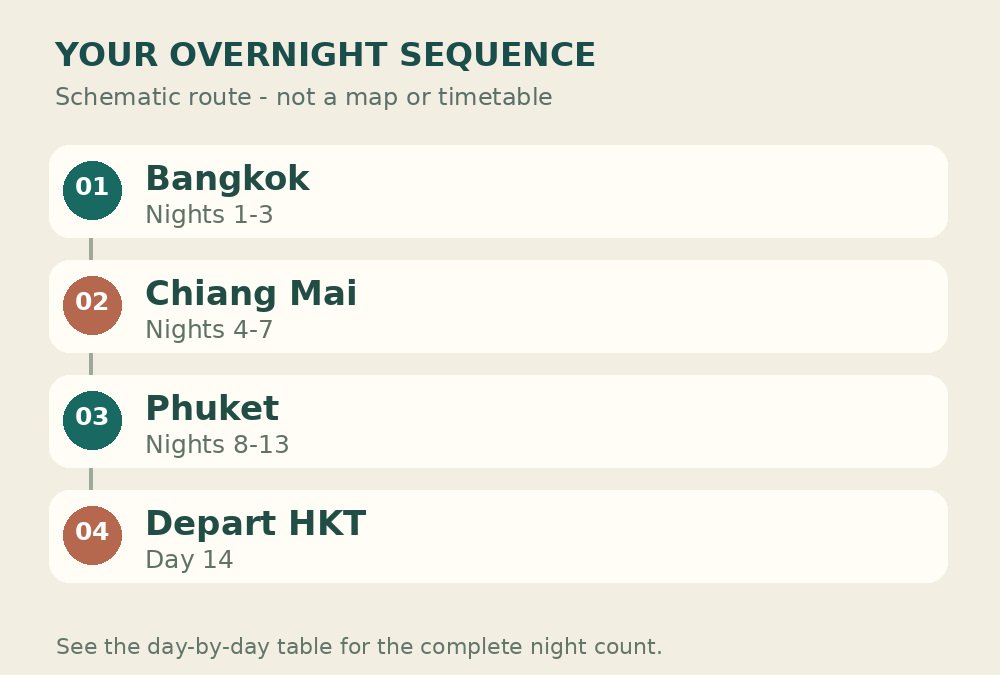
Start with three Bangkok nights, continue with four in Chiang Mai and finish with six on Phuket. Ideally, book the international ticket into Bangkok and out of Phuket. That avoids retracing the country solely to catch the flight home. However, an attractive return fare to Bangkok can still work with the final-night adjustment explained later.
The route is deliberately arranged around overnight bases rather than a list of excursions. Once those bases are settled, each day gets one main commitment. A cooking class, a cultural morning or a beach outing can be the centre of the day without needing a second major activity to make it worthwhile. Children often remember an unhurried shared experience more clearly than the fourth stop of a long tour.
| Days | Sleep in | Nights | Main plan |
|---|---|---|---|
| 1-3 | Bangkok | 3 | Arrive; one cultural morning; one relaxed city day. |
| 4-7 | Chiang Mai | 4 | Fly north; old city; one hands-on activity; flexible day. |
| 8-13 | Phuket | 6 | Fly south; one beach base with optional short outings. |
| 14 | Depart Phuket | 0 | International departure from HKT. |
Decide what the family actually enjoys
Before booking, ask each traveller to choose one priority. A child might want a pool, another might want to cook, and an adult might care most about northern food. Give those priorities protected space, then treat everything else as optional. This is a better selection method than choosing attractions solely because they appear on several online lists.
Also agree the maximum acceptable travel day. A family comfortable with a full airport-to-hotel move can use the three-base plan. Someone who finds packing and unfamiliar beds difficult may enjoy two destinations more. Changing the route is not a lesser holiday; it is a way of spending the same days on experiences rather than recovery.
Choose the season before choosing the beach
School dates do not produce identical conditions
Phuket is an Andaman-coast choice, so do not assume its seasonal pattern matches Koh Samui. Broadly, southwest-monsoon conditions affect the Andaman side, while the southern east coast can have a later wet period. Use those patterns to shortlist regions, then use the actual forecast for the decisions that matter on the ground. [1]
For a school-holiday trip, compare the complete experience rather than chasing a promise of sunshine. A hotel with useful indoor space, food nearby and a pool that suits your children may work well through changeable weather. Conversely, a remote property chosen entirely for a boat excursion can feel restrictive when that excursion is cancelled. Rain need not ruin the trip, but it should influence the design.
Keep a northern alternative
Chiang Mai is included for cultural variety, not because every month is equally suitable for outdoor activity. Before committing to the northern stay, check current weather and air-quality conditions. Where conditions are poor, removing Chiang Mai and adding those four nights to the coast can be more sensible than arriving with a full programme that nobody can comfortably enjoy.
As a result, reserve changeable accommodation where the additional flexibility is worth the cost to your family. Avoid paying for several non-refundable day trips before the regional transport is settled. The most useful weather insurance within an itinerary is often an uncommitted day and a practical room, not a longer list of attractions.
Get the sleeping arrangement right
A family room is not a complete description
For two adults and two children, confirm the actual beds, maximum occupancy and ages used in the quotation. A large room may still have only one double bed. Meanwhile, two rooms described as adjacent may be on different sides of a corridor, whereas connecting rooms have an internal door. Do not assume either arrangement from photographs or a booking filter.
Write a short message giving the children's ages, preferred bed arrangement and any non-negotiable requirements. Ask for confirmation before the cancellation deadline, then keep the reply with the booking. This is particularly useful when a platform accepts four guests but shows an ambiguous room description. The goal is to resolve the question at home rather than at reception after a long journey.
| Question | Why it matters | Ask the hotel |
|---|---|---|
| Who sleeps where? | A sofa may not make a room suitable for four. | Written bed configuration and maximum occupancy. |
| Are rooms connected? | Adjacent and connecting are different. | Whether the connecting door is guaranteed. |
| Is there a safe pool boundary? | Ground-floor access can be a risk. | Door locks, fencing, depths and supervision. |
| How far are meals? | Every restaurant taxi uses time and money. | Practical walking route, crossings and opening times. |
Look beyond the room itself
A pool-access room can look appealing, but it may be unsuitable for a child who can open the terrace door. Similarly, a balcony, steep stairs or a long exposed walk to breakfast can matter more than an upgraded bathroom. Ask specific questions about the features your family will use instead of requesting a general assurance that the hotel is child-friendly.
For Bangkok, prioritise a workable route to public transport or an easy pickup point. In Chiang Mai, consider how far you will be from the old city. On Phuket, check the ordinary evening walk to food. A lovely room loses some of its value when every snack requires a taxi and everybody must leave together.
Day 1: make arrival the only appointment
Leave the first afternoon uncommitted
After landing in Bangkok, collect luggage, sort the arrival formalities and travel to the hotel. Do not attach a prepaid sightseeing programme to an uncertain arrival time. Even an on-time flight can be followed by a slow immigration queue or traffic, so the first day's success can simply be reaching the room, eating something familiar and understanding the neighbourhood.
Check the hotel's normal room-access time. An early flight arrival does not automatically provide early check-in, and a tired child may not enjoy several hours in the lobby. Where immediate room access is essential, arrange it explicitly and compare the cost with booking the previous night. Tell the hotel about a very late or early arrival so the reservation is handled correctly.
Set up one small routine
Once settled, find the nearest useful shop and choose an uncomplicated dinner. Let children unpack a small familiar item, charge devices and identify where tomorrow's clothes will be. These ordinary tasks reduce the repeated decisions that make the first few days tiring. A short walk is enough; there is no need to turn it into a formal neighbourhood tour.
For the airport transfer, request the appropriate child restraint and a vehicle that can hold the family and luggage together. Obtain written confirmation rather than relying on an unchecked request box. If the provider cannot supply what you need, arrange a different vehicle or bring a suitable seat after checking airline carriage arrangements.
Day 2: one cultural morning, then recover
Choose a compact visit
Use the first full morning for a carefully limited cultural outing. The Grand Palace can be a strong choice for an interested family, but it deserves preparation rather than being treated as a quick photo stop. Check the official visitor information, dress requirements and any access changes before leaving. Describe what children will see in simple terms and give them one or two details to look for. [3]
An alternative is a shorter temple visit followed by lunch and a return to the hotel. Do not feel obliged to combine several major religious sites simply because they are close on a map. Heat, queues and getting between entrances all add to the effort. A private guide is useful when they can genuinely adapt the visit, not merely lead the same long programme at a higher price.
Make the afternoon deliberately easy
Return before everyone becomes exhausted, then leave the afternoon open. Depending on the room and facilities, this might mean a nap, reading, supervised pool time or an indoor activity. Avoid describing that period as spare time to be filled. It is part of the plan that makes another good morning possible tomorrow.
For dinner, choose somewhere with several manageable dishes and a clear way to explain dietary needs. Order gradually rather than putting a large unfamiliar meal in front of a hungry child. A mix of familiar food and one new shared dish can be a gentler introduction than turning every meal into a challenge.
Day 3: let the children help choose
A different kind of city day
Make the final Bangkok day noticeably different from the cultural morning. Choose a short neighbourhood outing, a carefully selected indoor attraction or a simple food-focused walk. A river journey can also be enjoyable when services and local conditions are suitable, but it should not become compulsory during flooding or when boarding arrangements are awkward for your family.
Give children a choice between two realistic options rather than an open-ended question about the whole city. For example, offer a short indoor visit followed by lunch or a small market walk followed by time at the hotel. Both options should fit the same manageable time window. This allows genuine participation without creating a new planning problem.
Prepare for the northern move
Later, check the next day's airport, baggage allowance and pickup time. Bangkok has more than one airport, so read the actual booking rather than using the airport you arrived at by habit. Put medication, documents, one change of clothes and essential comfort items in the hand luggage. Keep enough accessible food and water for the ground portions of the journey.
Also settle any laundry or hotel charges before the final rush. A small amount of preparation the evening before makes the departure calmer, particularly when different adults are handling different bags. Assign responsibility for documents and transfers clearly, while making sure both adults can access the important details.
A useful indoor alternative for the Bangkok stay
Museum Siam is worth investigating for children interested in interactive cultural displays. Its approach is designed around learning and participation, which may suit a family better than another long outdoor circuit. Check the current exhibition, opening day and age suitability, then decide whether to use it on day 3 or as a weather alternative rather than adding it automatically to an already full day. [4]
For any indoor attraction, consider the journey as well as the activity. A comfortable visit near your existing route is usually more useful than crossing the city solely because somewhere is described as child-friendly. Agree a clear finish, leave room for lunch and avoid promising a particular display before confirming it is currently available. The backup should reduce effort, not replace a cancelled outing with an equally complicated one.
Day 4: fly north and stop there
Count the whole travel day
Treat Bangkok to Chiang Mai as a transfer day, even when the airborne portion looks short. The real commitment includes checkout, the airport journey, check-in, security, waiting, luggage collection and another transfer. Choose a departure that works with sleep and breakfast rather than buying the earliest service simply to claim an extra sightseeing afternoon.
On arrival, go to the hotel, have lunch or a snack and keep the rest of the day local. A gentle first look at the surroundings is enough. If everybody feels good, take a short walk; if not, the schedule should still feel successful. Avoid booking an out-of-town activity that evening because the family will have little control over the day's accumulated delays.
Choose the northern base carefully
An old-city or nearby base makes short independent outings easier. A countryside resort can be lovely for a longer hotel-focused stay, but it creates more driving when you want to visit the centre. Chiang Mai's destination appeal includes temples, local culture and surrounding landscapes, so choose the setting that supports the activities you actually intend to do. [5]
Four nights allow three usable full days after the arrival day. That is enough for variety without expecting a major excursion every morning. Pick the most demanding activity for the middle of the stay, leaving a lighter day before the flight south. The family will benefit more from a balanced rhythm than from completing every northern highlight.
Days 5 and 6: culture and something hands-on
Day 5: explore a small part of the old city
Start with one area and keep the walk short enough to reverse easily. A temple courtyard, a cafe break and a simple lunch can form a satisfying morning. Explain respectful behaviour before arriving rather than repeatedly correcting children inside a religious site. Shoes, clothing and photography expectations should be treated as ordinary parts of visiting, not as an inconvenience.
For an older child, introduce one small observation task: look for different roof shapes, compare market ingredients or sketch a detail. Younger children may prefer simply choosing the next snack. The purpose is engagement, not a lesson with a test at the end. Return to the room before the outing becomes a negotiation about how much farther everyone has to walk.
Day 6: choose a suitable practical activity
A family cooking class can work particularly well because there is a clear shared outcome. However, check the minimum age, session length and arrangements around knives, flames and hot oil. Ask whether children participate at a separate station, alongside an adult or only by watching. Also confirm how allergies and dietary restrictions are handled before paying.
Keep the rest of the day free around the class. A market visit, transfer and meal may already be included, so do not accidentally book a second food outing immediately afterwards. For children uninterested in cooking, substitute a craft-based activity or another short experience with an obvious finish. The best choice is the one that fits your family, not the most photographed option.

Day 7: nature without a compulsory long excursion
Keep wildlife decisions separate from sales language
An elephant experience is optional, not an essential part of a family holiday. For any wildlife visit, examine the actual activities rather than accepting a sanctuary label. World Animal Protection's guidance favours observation without riding, bathing or touching. Use that as a starting point for questions, then check the current programme and the travel time involved. [6]
If the available experience does not suit your standards, budget or children's stamina, choose a different day. A garden, a short countryside outing with a responsible driver or a relaxed local morning can be rewarding without wildlife contact. Children do not need a close-up animal photograph to have a meaningful northern stay.
Leave room for an ordinary afternoon
Keep the afternoon available for laundry, the pool or revisiting a favourite food stop. This is also the point to notice whether the family is becoming tired rather than waiting until the airport morning. Reduce the next few days if necessary. Six nights on Phuket provide plenty of space to recover, but only if you have not already filled every day with excursions.
Check the southbound flight routing again. A search result may involve a connection, and the connection may change the practical shape of the day. Where a suitable nonstop flight is available, compare the total cost including luggage and seats with the longer alternative. The cheapest ticket is not always the least costly family decision.
Day 8: travel to Phuket and settle into one base
Choose the hotel area before arranging the pickup
Phuket is large enough that hotel location matters to the arrival transfer and every subsequent outing. Decide whether your priority is a quieter resort setting, easier access to meals or a particular beach area. Kata, Kamala and Bang Tao are starting points to investigate, not interchangeable recommendations or guarantees of calm water. Use the official destination overview alongside the hotel's exact location. [7]
For the arrival day, confirm who is meeting you, how long they wait and how to contact them if baggage is delayed. Pack a small arrival bag so swimwear or a change of clothes is accessible without opening every suitcase. Then spend the evening near the accommodation and learn the everyday route to food.
Do not move hotels for a second beach
The default uses one Phuket base for all six nights. Moving midway can consume a surprising part of a day once checkout, transport, waiting and unpacking are included. A different beach can usually be considered as an outing when conditions suit, without moving everybody's belongings to a new room.
There are exceptions, such as a deliberate final airport-area night for a very early departure. However, make that move because it solves a real logistical problem, not because six nights in one place sounds insufficiently adventurous. Familiarity is useful on a family trip: knowing breakfast, the room and the nearby shop saves energy for the enjoyable parts.
Days 9 to 11: alternate beach time and short outings
Day 9: learn the beach before planning around it
Use the first full coastal morning to understand access, shade, toilets and the nearest food. Look at the conditions and local warnings before deciding whether swimming is appropriate. Red flags and local restrictions take priority over the appearance of the water. A family itinerary should include enjoyable non-swimming options rather than depending on the sea every day. [8]
Even on a suitable day, keep water time actively supervised. Agree which adult is watching rather than assuming the other person is doing it. A hotel pool is not automatically a safer substitute merely because it is smaller. Review depth changes, slippery edges and access from the room, then organise supervision in the same deliberate way.
Day 10: a short Old Town visit
Phuket Old Town offers a contrast to the beach, but approach it as a limited outing rather than an all-day tour. Choose a few streets, a meal and perhaps one small stop that interests the children. Travel early enough to avoid turning the whole visit into a hot afternoon walk, then return before fatigue removes the enjoyment.
A short guided visit may help families interested in the area's stories and food. Nevertheless, confirm how much walking is involved and whether the guide can shorten the route. A private car collecting you from the hotel does not necessarily mean the sightseeing programme is private or flexible. Read both parts of the description.
Day 11: leave the decision until you are there
Keep this day for the best available combination of weather and energy. That may be another beach morning, a pool day, a small indoor attraction or no formal outing at all. Because nothing essential depends on it, you can respond to the actual conditions rather than defending an old booking against the evidence outside the window.
A boat trip should be an optional addition only after checking suitability, operator standards, child-sized safety equipment and the forecast. Do not book a long excursion simply because the family has reached the coast. A child who dislikes boats is unlikely to enjoy several hours offshore just because the scenery is impressive.
Days 12 and 13: repeat what worked
Day 12: a favourite rather than another novelty
By now you will know which parts of the coastal stay suit everybody. Repeat a successful breakfast place, return to a comfortable beach area or let children choose a familiar low-effort activity. Repetition is not wasted travel time. It can be the point when the family relaxes enough to enjoy a place without continually learning how it works.
For adults wanting a separate activity, agree a fair arrangement rather than automatically taking the whole family. One person might have a quiet afternoon while the other stays with the children, then swap later. This can provide more genuine enjoyment than booking an activity nobody particularly wants simply to keep everyone together all day.
Day 13: protect the departure arrangement
With an international flight from Phuket, leave the last full day light and check the airport transfer. For a separate-ticket international departure from Bangkok, fly back today and stay there overnight. In that version, Phuket has five nights, not six, and the final Bangkok hotel replaces night 13. Keep the total at thirteen nights.
The extra Bangkok night reduces the risk of a domestic delay spoiling the flight home, but it does not guarantee a connection. Check whether the two flights use the same airport and choose the final hotel accordingly. Avoid spending the last evening travelling across the city for one more attraction when the family needs a straightforward morning.
Day 14: leave without adding another outing
Build the morning around the airline
Use the airline's check-in requirement and the hotel's location to set the pickup time, then allow additional room for traffic and family stops. An itinerary planning range is not a substitute for that calculation. Pack the most important items the previous evening and keep passports, medication and essential clothing within reach.
If the flight is late, ask about luggage storage and a place to change rather than assuming a room remains available after checkout. A paid late checkout can be worthwhile when it turns several awkward hours into a comfortable final afternoon. However, get it confirmed; a casual request at booking is not the same as an allocated room until evening.
Budget for the whole family, not four headline fares
A worked model with visible assumptions
The example below is a constructed planning exercise for two adults and two children, designed on 05 October 2026. It is not a survey of current prices or a quotation for a particular holiday. Replace each allowance with the family's actual room, flight and activity choices. School-holiday dates, occupancy rules and room availability can change the result substantially.
The model includes thirteen accommodation nights and two domestic flight allowances. It excludes international flights, travel insurance, passport or visa costs where applicable, shopping and unusually expensive activities. The reserve is separate because it should remain available for disruption or a necessary change, rather than being allocated to another excursion before departure.
| Item | Calculation or allowance | THB |
|---|---|---|
| Accommodation | 13 nights x 5,500 per family room | 71,500 |
| Meals and drinks | 14 days x 1,800 for four | 25,200 |
| Two domestic flights | Family allowance, including bags/seats | 20,000 |
| Local and airport transfers | Family allowance | 9,000 |
| Activities | Selective paid outings | 10,000 |
| Laundry, data and small extras | Allowance | 4,000 |
| Subtotal | Sum of the above | 139,700 |
| Reserve | 15% of subtotal | 20,955 |
| Total example | Family of four | 160,655 |
Make savings where they reduce friction
A two-base route can save both a domestic journey and the surrounding transfers. Similarly, a hotel near ordinary restaurants may be more economical than a cheaper remote room with repeated taxi journeys. Compare the complete stay rather than treating room rate, transport and food as unrelated decisions.
Spend selectively on reliable sleep, suitable transfers and an activity the children genuinely want. Then reduce the number of paid outings rather than trying to make every day equally expensive. A family budget works better when a few priorities are funded properly and the remaining days can be simple without feeling like compromises.
Health, food and the small daily essentials
Prepare the information you might actually need
Arrange individual travel-health advice in good time, especially for young children or anyone with an existing condition. Destination guidance from TravelHealthPro is a starting point, not a replacement for advice about your own family. Keep essential medicines in original packaging and check relevant carriage and import requirements with the appropriate official sources. [9]
For allergies, prepare a clear written explanation and discuss cross-contact directly rather than relying on a translated menu name. Carry familiar snacks for the occasions when an appropriate meal is not immediately available. Also keep the insurer's emergency contact and a copy of the family's important documents accessible to both adults.
Keep the day bag small but useful
The everyday bag needs less than the main suitcase: water, sun protection, suitable clothing, essential medication and one useful spare layer or change. Divide critical items so one missing bag does not remove everything important. A small wet bag can separate damp swimwear, while an ordinary laundry routine reduces how much clothing the family needs to carry.
Mobile data helps with maps and contacting transfers, but save the hotel address and booking details offline too. Check whether a chosen plan includes voice calls or only data. A parent handling a delayed pickup should not discover at that moment that the phone can browse but cannot make the call they expected.
Adapt the route to the children's ages
Toddlers: remove the northern move
For a simpler version, use four Bangkok nights and nine Phuket nights, departing Phuket on day 14. Keep Bangkok very light and choose a coastal hotel with a workable sleep arrangement and easy food access. This removes one domestic flight and one complete cycle of packing, checkout, transfer and settling in.
That alternative sacrifices northern variety, but it gives more reliable routine. It also makes it easier to have shorter outings without worrying that you are running out of time in a destination. The choice is especially sensible when nap schedules, early bedtimes or a child's response to unfamiliar rooms strongly affect the whole family's day.
Older children: add independence, not more bases
Teenagers may appreciate having a say in food, photography or an activity, but that does not require adding another destination. Give them responsibility for a small part of a day, such as selecting a lunch place within a defined area or researching a short visit. Agree meeting points and communication before allowing independent time.
For mixed ages, alternate who gets first choice instead of trying to make every activity equally appealing. A short visit followed by a familiar meal can be a reasonable compromise. Keep at least one part of each day easy for the youngest traveller, since the most tired person often determines how enjoyable the evening becomes.
Where this family route works well
Strengths
The long Phuket finish gives the family time to settle rather than arriving at the beach just before leaving Thailand. Meanwhile, the Bangkok and Chiang Mai stays provide different experiences without requiring a new bed every other night. The route also makes it possible to replace activities with rest while preserving the overall shape of the holiday.
Limitations
Two domestic travel days remain a significant commitment, and the three-base version may still be too much for very young children. Seasonal conditions can affect both the northern stay and the coast. In addition, families needing two rooms or guaranteed connecting accommodation should expect fewer suitable options than a simple two-adult hotel search suggests.
Family planning mistakes that are easy to avoid
Do not confuse available hours with usable energy
A flight landing before lunch does not create a free afternoon for a major attraction. Likewise, a child who copes happily with one long day may need a quieter following day. Plan from the family's ordinary rhythm, then make occasional exceptions, rather than making every day an exception and hoping everyone adapts.
Another common mistake is booking an excursion before understanding its transfer. A two-hour activity can become a much longer commitment with hotel collection, other pickups and a distant meeting point. Ask for the expected door-to-door duration. That is the number that belongs in the family calendar.
Do not let a booking filter answer a safety question
A family-friendly label cannot confirm a suitable bed, restraint, pool boundary or allergy procedure. Ask about the precise feature you need and keep the reply. Finally, resist using the last day as a catch-all for missed experiences. A calm departure is worth protecting even when the holiday has left a few things unseen.
Thailand family itinerary FAQs
Is two weeks enough for a family trip to Thailand?
Yes, provided you limit the number of bases and count arrival and departure as part of the trip. This plan has thirteen nights across three destinations. Families needing a slower rhythm can remove Chiang Mai and use two bases instead. The number of full sightseeing days matters more than the number of places listed.
Should we use Chiang Mai or a second beach destination?
Choose Chiang Mai for cultural variety and a different setting, subject to conditions on your dates. A second beach destination is not automatically easier because it can add road or boat transfers. For children who mainly want water and downtime, staying longer at one suitable coastal hotel is often the simpler choice.
Can we use public transport with children?
Often, yes, but suitability depends on luggage, walking distances, crowding and the children's needs. Use public transport where it makes the day easier rather than as a rule for every journey. A properly arranged private transfer can be valuable on arrival or between an airport and a distant hotel, especially with younger children.
Do we need to book every attraction before travelling?
No. Secure genuinely important, capacity-limited experiences after confirming transport, but leave flexible days around them. Weather-sensitive outings should not define the entire holiday. For ordinary city visits, check official access information close to the date and decide according to the family's energy instead of treating an unused morning as a problem.
What should we check before entering Thailand?
Check the rules for each traveller's passport with the Thai authorities, including the permitted stay and any visa requirement. The official Thailand Digital Arrival Card is separate from a visa. Keep the first accommodation details ready and inspect the admission stamp on arrival rather than assuming an allowance from an older article. [10] [11]
Is Phuket guaranteed to be suitable for swimming?
No beach is guaranteed suitable on every date. Conditions, flags and local instructions matter more than a general description of a bay. Choose accommodation with alternative activities and supervise children actively around both pools and the sea. A successful coastal stay does not need to include swimming every day.
Choose the route the family can enjoy repeatedly
The strongest version of this holiday is not the busiest one. It is three Bangkok nights with a gentle opening, four Chiang Mai nights with one or two meaningful activities, and six Phuket nights in a hotel that makes ordinary days easy. Book the sleeping arrangement and the transfers carefully, then allow the daily programme to remain flexible.
For younger children, the four-plus-nine-night alternative is a sound choice rather than a fallback to apologise for. Either way, protect meals, sleep and departure arrangements before adding another excursion. That leaves the family with enough energy to enjoy the places you have chosen instead of continually preparing to leave them.
Sources and fact-checking
This is a research-led route, not a report of personal stays or visits. Official sources support the factual checks; the route order, pace, trade-offs and budget models are editorial planning judgements. Transport searches are not confirmations of availability. Recheck access, entry rules, conditions and prices for your own travel dates.
- Thai Meteorological Department: seasons of Thailand. Seasonal pattern, including later rain on the southern east coast; not a trip-date forecast. Reviewed 05 October 2026.
- FCDO: Thailand warnings and insurance. Current disruption and regional advice; review again before travel. Reviewed 05 October 2026.
- The Grand Palace: practical visitor information. Official visit planning and dress requirements. Reviewed 05 October 2026.
- Tourism Authority of Thailand: Museum Siam. Interactive culture-focused museum context; confirm current programme and access. Reviewed 05 October 2026.
- Tourism Authority of Thailand: Chiang Mai. Northern destination context and attractions. Reviewed 05 October 2026.
- World Animal Protection: elephant-friendly tourist guide. Observation-led selection criteria and current venue guidance. Reviewed 05 October 2026.
- Tourism Authority of Thailand: Phuket. Phuket destination overview and the distinction between town and coastal bases. Reviewed 05 October 2026.
- FCDO: safety and security in Thailand. Road, water and severe-weather precautions. Reviewed 05 October 2026.
- NaTHNaC TravelHealthPro: Thailand. Destination health information and pre-travel consultation. Reviewed 05 October 2026.
- Royal Thai Embassy London: visa exemption rules. Entry eligibility, the September 2026 change and admission-stamp checks. Reviewed 05 October 2026.
- Thai Immigration Bureau: digital arrival card. Official arrival-card instructions; this form is not a visa. Reviewed 05 October 2026.
Illustrations in this article were created for Taylor’s Trailblazing Travels. Third-party photographs, where used, are credited beside the image or in the source list.