Practical Thailand / Passport problems
What to Do If You Lose Your Passport in Thailand
A replacement document is only part of the solution: your Thai stay record and onward journey need attention too.
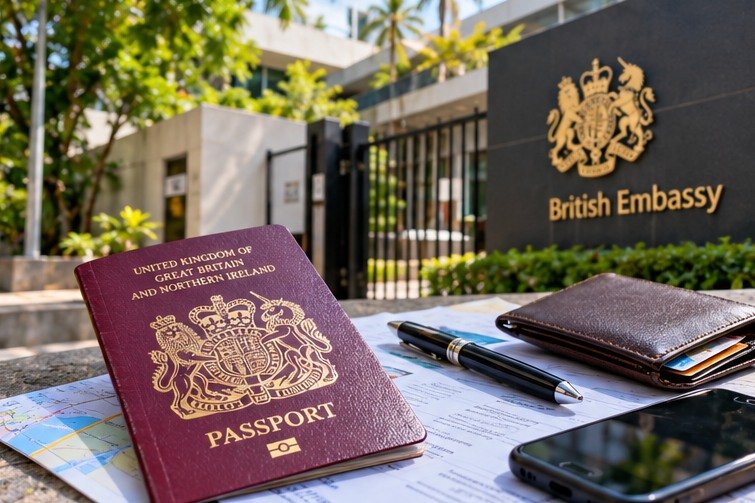
Original conceptual illustration. Illustration only: this is not the British Embassy entrance, address or a genuine travel-document sample.
If you lose your passport in Thailand, two separate problems need attention. You need a valid document from the country that issued it, and you need to establish what Thai Immigration requires for your existing entry and permission to stay. Solving only the first problem can leave you with a new document but an unfinished departure process.
Start by securing yourself, your remaining belongings and a way to communicate. Then work through the police report, the issuing authority’s instructions, the Thai immigration position and the airline or transit requirements. Do not assume that a photograph of the passport, a police report or an embassy appointment receipt will let you board an international flight.
The detailed replacement route below is for British travellers, with separate signposts for other nationalities. That distinction matters: the forms, fees, appointment systems and emergency documents are not interchangeable. Official requirements are linked beside the relevant points, while the checklists and examples show how to organise the work without inventing a guaranteed recovery time.
First task
Secure yourself and report
Protect the remaining documents, money and account access.
British route
GOV.UK, not a paid shortcut
Choose between a full passport and an emergency travel document.
Separate requirement
Thai immigration records
Check entry stamps, permission to stay and any extension.
Before rebooking
Confirm the whole route
Acceptance by one airline or country does not settle every connection.
Lose your passport in Thailand? Follow the right order
Separate the four organisations involved
Thai police record the loss or theft. Your passport authority decides what replacement document you can obtain. Thai Immigration deals with the entry and stay records, while airlines and destination or transit authorities determine whether the proposed journey is acceptable. One organisation’s approval does not automatically settle the others. [1] [4] [5]
On a small screen, swipe the table sideways to read every column.
| Stage | Main contact | What you are trying to establish |
|---|---|---|
| Report the incident | Thai police | A clear record of what was lost or stolen and where. |
| Replace the document | Your passport authority | The appropriate full passport or emergency document and its issue process. |
| Resolve the Thai record | Thai Immigration | Entry details, permission to stay and any stamp or record transfer needed. |
| Confirm departure | Airline and relevant border authorities | Acceptance of the new document throughout the actual route. |
Run practical tasks alongside the official ones
While you deal with the document, someone else can retrieve copies, speak to the insurer or ask accommodation about extending the stay. However, avoid letting several people submit applications independently. Keep one record of the case reference, the contact used and the next step.
This is an organisational sequence, not a claim that every office will finish on the same day. Staff may ask for additional evidence, holidays may affect appointments and a route may need changing. Build the plan around confirmed instructions rather than the most optimistic story you find online.
First, check safely and protect what remains
Make a short, organised search
Check the place where you last used the passport, the document pocket, hotel safe and any reception desk that handled it. Ask the transport operator or property through an established contact. A focused check can distinguish a misplaced document from a loss, but do not spend hours pursuing uncertain leads once it is clearly missing.
If theft is suspected, do not confront someone or follow a tracker into an unfamiliar address. Move to a staffed place, secure your remaining money and contact local police as appropriate. Tourist Police on 1155 can assist visitors with communication and the correct reporting route. [13]
Treat a missing phone or wallet as a separate task
List exactly what disappeared. A passport, bank card, phone and house key each require different action. Contact the bank through a trusted number if cards are missing, and recover your communication channel without giving passwords or verification codes to a person who claims to have found the bag.
Ask a trusted companion to help organise rather than take over every account. If you use a borrowed device, sign out afterwards and avoid leaving downloaded identity documents behind. Keep a private note of which services have been contacted so the next conversation starts with facts, not guesswork.
Report the loss to Thai police
Explain loss and theft accurately
Tell the police what you know: the last place you used the passport, when you discovered it missing and whether there is evidence of theft. Do not describe a theft simply because you think an insurer prefers that wording. Equally, do not minimise a threatening incident or leave out other items that were taken.
The Thai government’s published lost-passport process includes a police report in the documents used for immigration record transfer. US and Australian consular guidance also explicitly refer to police reporting for lost or stolen passports. The report is therefore worth organising promptly even when your own online application does not initially ask you to upload it. [1] [8] [9]
Check the details before leaving
Ask for the report reference and an appropriate copy. Check your name, nationality, passport number if known, incident date and description of the loss. Where language is a barrier, request help understanding what has been recorded rather than signing an account you cannot read.
Keep the original protected and make a separate digital copy. Ask whether additional certified copies or a translation will be needed for a particular authority, rather than paying for several versions pre-emptively. Requirements can differ, and the organisation asking for the document should explain what it will accept.
British passports: cancellation and recovery are different
Use the official cancellation route
HM Passport Office says a lost or stolen passport should be cancelled as soon as possible to reduce the risk of misuse. A copy can help answer questions, and the service requires a phone number. When applying for an emergency travel document, cancellation is normally handled as part of that application rather than requiring a separate duplicate cancellation step. [2]
Follow the route that matches your circumstances and save the confirmation. Once the passport has been reported lost or stolen and cancelled, finding it later does not make it valid again. Do not try to travel on it or allow someone to assure you that a familiar-looking cover will be sufficient at check-in. [5]
Avoid unofficial shortcuts
Type or follow the official GOV.UK route rather than choosing a sponsored result simply because it promises urgent help. A commercial form-filling service does not control passport checks, Thai immigration requirements or airline acceptance. Never send a complete document copy and payment details to an unsolicited messaging account.
If a hotel or agent is helping translate instructions, keep control of the application account and email. Read the information being submitted in your name. Assistance with practical tasks can be useful, but you remain responsible for accurate personal details and the travel plans supplied.
Choose a full replacement or an emergency travel document
A full passport may suit a longer stay
A full replacement can be the more suitable route when you are staying abroad long enough and need a normal passport for continuing travel. Start with the official overseas British passport application service and select the correct country and circumstances. Do not import a UK domestic processing estimate into an overseas replacement case. [7]
Consider the whole remaining trip: future visas, work or residence arrangements, the length of your Thai permission to stay and whether you can remain in one place for delivery or collection. A document that solves tomorrow’s flight may not be the best solution for several months of travel.
An emergency document is for a defined urgent journey
The British emergency travel document route covers eligible nationals abroad who need to travel within six weeks and cannot obtain a replacement in time. The usual criteria include a previous valid UK passport issued on or after 1 January 2006; exceptional cases follow different assessment. An emergency document is normally for a single or return journey, through no more than five countries. [3]
Do not interpret that maximum as encouragement to keep a complicated itinerary. Fewer changes and transit points make acceptance easier to verify. Ask about the actual route you intend to use, including an overnight connection or a change that requires passing immigration.
Assemble the information before applying
Gather useful evidence, not an invented checklist
Find a copy of the passport identity page, previous passport details, Thai entry stamp, visa or extension records and the arrival flight information. Add the police report, current contact details and the proposed onward route. Some items help identify your case even if they are not required in the first online screen.
For the British emergency-document application, GOV.UK asks for a suitable digital passport photo, a telephone contact, email access and payment. Use a current photo meeting the published requirements, not a cropped holiday photograph or a picture of the lost passport’s printed portrait. Follow any later request for additional evidence. [4]
Keep the contact channel reliable
Use an email account you can actually access from Thailand. Check spam folders and ensure a trusted person can reach you if the phone is lost or charging. A message requesting more information can change the collection timeline, so the contact details are part of the process rather than a minor formality.
For ordinary online forms, maps and messages, compare Airalo connectivity options only after checking device compatibility. A data-only plan does not necessarily supply ordinary voice or SMS service; keep a separate way to receive the calls or codes your case needs. Do not purchase a plan merely because a form asks for a phone number. [11]
Understand the fee and the timing without making promises
The official fee is only one part of the expense
The British emergency travel document application fee is £125, checked on 05 October 2026, and GOV.UK states that it is non-refundable. A relative or friend can pay through the official service if you cannot. That fee does not include new flights, extra accommodation, local transport or other trip changes. [4]
On a small screen, swipe the table sideways to read every column.
| Expense | How to plan it | What not to assume |
|---|---|---|
| British emergency document | £125 official application fee, checked 05 October 2026. | It is not the total cost of the disruption. |
| Extra accommodation | Ask for the actual dates and cancellation terms. | A room extension is not automatically available. |
| Transport and copying | Obtain the real quote or official charge where applicable. | Every administrative expense is not a government fee. |
| Changed flights | Ask the airline about fare rules and document acceptance. | A replacement document does not guarantee a refund or free change. |
A usual collection estimate is not a guaranteed flight connection
GOV.UK says an emergency document will usually be ready to collect two working days after applying, but some cases can take several weeks. Children, expired documents, appointments or additional information can affect the process. Wait for the email explaining collection rather than treating an application receipt as permission to book a fixed departure. [4]
Contact the embassy before travelling to it
Confirm the correct appointment and office
The British Embassy Bangkok contact published in current FCDO guidance is +66 2 305 8333. Use official contact instructions and explain that the passport is missing, your nationality and the travel deadline. Do not assume an old consulate address or a walk-in visit will produce the document faster. [6]
Record the purpose of any appointment. Submitting evidence, attending an interview and collecting a finished document are different tasks. Confirm what to bring and whether the traveller must attend in person before arranging a long journey from an island or another city.
Plan the day around the confirmed task
Allow room for finding the correct building entrance, security procedures and copying documents if instructed. Carry the appointment confirmation and a contact number offline. A companion can help with transport and belongings, but check whether they may accompany you inside rather than assuming access.

If your travel deadline changes, tell the official contact handling the case. Do not repeatedly submit fresh applications to different offices in the hope that one will be quicker. Duplicate records can make it harder to know which document and itinerary are being processed.
Thai Immigration: restore the entry and stay record
A replacement passport does not recreate the old stamps
The Thai government’s published process describes checking the original arrival and transferring the entry stamp into the new passport or accepted replacement document. It lists the police report, copies of the old passport if available, the new document, an application and an embassy cooperation letter. Treat this as a starting reference, then confirm the current office-specific requirements. [1]
Explain whether you entered as a short-stay visitor, hold an extension or have another residence arrangement. Those circumstances can affect which record needs attention and which office should handle it. Do not ask only for “a visa” when the issue is actually an entry stamp or existing permission to stay.
Ask about your particular document and nationality
The US Embassy explains that it stopped issuing routine passport linkage letters in April 2023, while the older Thai government page lists an embassy letter. That difference is why a generic checklist must not become a claim that every nationality receives the same document. Ask your embassy what it provides and Thai Immigration what they require for your case. [1] [10]
Keep arrival flight details and any old stamp copies accessible, but do not assume their absence makes the situation impossible. Tell the officer what you have and what is missing. The authority must determine how the entry can be verified; a travel blog cannot promise a particular workaround.
Protect your permitted stay while the document is replaced
A loss does not pause immigration deadlines
Check the date you were permitted to remain, including any extension already granted. Report the missing passport and seek immigration advice before that date is reached. The FCDO warns that overstaying can lead to fines and more serious consequences; a pending passport application should not be treated as an automatic extension. [5]
Explain the problem with evidence: police report, application confirmation and any collection instructions. Ask which lawful step is available while replacement is underway. Record the answer and the office that gave it, particularly when your circumstances involve a visa extension or residence status rather than a short holiday.
Do not solve the problem with an unverified border run
Leaving Thailand and returning is not a universal reset button. You still need acceptable travel documents, permission for the route and valid entry arrangements. An agent’s promise that a photograph or report will be enough should not replace confirmation from the relevant authorities.
Likewise, do not assume that a new document grants a fresh period of stay from the issue date. The question is your existing immigration record and what the authorities authorise. Keep document replacement, extension of stay and a future new entry as separate decisions.
Confirm the whole onward journey
Ask about the exact document, not just the destination
Tell the airline that you will use an emergency travel document or a replacement passport, and name every transit point. Ask whether a connection requires entering the transit country, changing airports or collecting and rechecking baggage. The document must be accepted for the actual route, not an imaginary direct flight. [4]
Use the destination and transit authorities’ official information as well as the airline’s guidance. Save written confirmation where possible. A call-centre answer about an ordinary full passport may not address the limitations of an emergency document, so make the document type explicit.
Recheck the details after the document arrives
Compare the name, dates and route recorded on the new document with the bookings. GOV.UK warns that changed travel plans can require a new emergency-document application and another fee. Therefore, do not change countries or dates casually after the document has been approved. [4]
If the journey cannot be completed as issued, contact the issuing authority before attempting departure. It is less disruptive to ask the question from accommodation than to discover the mismatch at a border or midway through a connection.
Domestic travel while you are without the original
Ask the operator before buying a ticket
Domestic flights, trains, hotels and other services may have their own identification requirements. Ask the actual provider what it will accept in your circumstances, giving the document type and whether you have the police report. Do not turn another traveller’s experience into a nationwide rule about passport copies.
Avoid creating a second deadline
A long road journey can arrive too late for an appointment even when the advertised travel time looks possible. Plan from the required arrival time backwards, including the station or airport transfer and a reasonable overnight buffer. The appropriate margin is an editorial planning choice, not a promised delay allowance.
If there is no confirmed appointment or collection instruction, staying in a stable base may be more useful than travelling immediately. Keep the issuing authority informed of your location. Moving between hotels can make communication, delivery and record-keeping harder while the case is still being assessed.
Choose temporary accommodation for practical reasons
Location and flexibility matter more than appearance
A room near a useful transport connection can be worth more than a discounted resort far from the confirmed office. Compare Bangkok accommodation by the area you actually need and check another Bangkok room search for flexible dates, reception hours and a place to work through documents.
Ask the property about identification requirements before arriving without the original passport. Explain which replacement paperwork you have rather than assuming the booking platform has already approved it. The hotel’s answer is separate from the airline’s answer and from Thai Immigration’s requirements.
Keep daily living costs visible
Make a small budget for the extra stay, including meals, local journeys, copying and communications. Record spending as it occurs instead of reconstructing it later from several cards. For insurance, keep receipts and the reason the expense was necessary, without assuming every cost will be reimbursed.
Avoid moving daily to chase a minor room saving while official steps are unresolved. The time and transport needed to move can outweigh that saving. A predictable base also gives relatives and case handlers a clear place to reach you.
A child, family group or dual national needs extra checks
Do not assume the adult process covers a child
A child’s emergency-document application can involve attendance, parental consent and additional evidence. GOV.UK explains that an under-16 appointment normally requires both parents or legal guardians, or the specified written consent when one cannot attend. Follow the actual case instructions rather than improvising permission through a casual message. [4]
Keep the child’s needs separate from the administrative rush. Plan food, medication, rest and supervision around appointments, with one adult responsible for the child while another handles documents where possible. A family need not all queue at every office unless attendance is required.
Multiple passports do not automatically remove the Thai record issue
A dual national may have another valid passport, but the Thai entry was recorded against a particular document. Ask Thai Immigration how to connect that entry with the proposed departure document. The FCDO advises dual nationals that leaving on the same passport used to enter avoids immigration problems; losing it requires case-specific advice. [5]
Do not buy a ticket on the second passport and assume the computer records will resolve themselves. Explain the loss, the original entry and both nationalities where relevant. Keep the names used in every document and booking consistent with official instructions.
Other nationalities: use your own official process
US and Australian examples show why details cannot be borrowed
The US Embassy’s adult lost-passport page specifies its own application forms, police report and appointment process. It also provides a contact route for imminent travel. These are US requirements, not an alternative application system for a British traveller or a universal checklist for all visitors. [8]
The Australian Embassy describes emergency passports through its Bangkok and Phuket offices in appropriate urgent circumstances, with appointment instructions and a police report. Its guidance stresses waiting for the issue decision before making firm travel plans. Again, the document’s acceptance must be checked for the intended destination. [9]
Start from the official embassy or passport authority
For another nationality, follow your government’s official overseas-passport guidance. Identify the office responsible for your location and explain the travel date, loss and any missing evidence. Fees, photographs, identity checks and emergency document names can differ substantially.
The Thai immigration step still needs attention after the new document is obtained. Ask the relevant Thai office about your entry record, rather than assuming that a different nationality means no transfer is necessary. Keep a copy of the guidance you receive and the case contact who supplied it.
When the passport reappears or is damaged rather than lost
A found document may already be invalid
If the passport turns up after cancellation, do not use it. Contact the issuing authority about the appropriate handling of the recovered document and continue with the valid replacement arrangements. A hotel finding it under a drawer does not reverse the cancellation or remove the identity-security issue. [2] [5]
Be equally cautious about a stranger requesting a recovery payment. Verify the claim through a known hotel, police station or official contact and avoid meeting alone at an unfamiliar address. Do not send further personal information to prove that the document is yours without understanding who is asking.
Damage needs an official judgement
A soaked or torn passport may require replacement even when some details remain readable. Contact the issuing authority and airline rather than applying glue, removing pages or editing a scan. Tell them which part is affected, but do not assume a travel forum can decide whether the document is acceptable.
If you still possess the damaged document, keep it secure for the application and any immigration checks. The evidence available differs from a complete loss, and the authority may give different instructions. Accurately describe the situation instead of selecting the fastest-sounding category on a form.
Reduce the chance of repeating the problem
Give the passport a consistent place
A travel document organiser is useful only when it has a specific role and returns to the same secure place. An inner waterproof passport pouch can add protection from spills or rain, but check its closure and keep documents away from damp clothing. Neither product prevents theft by itself.
A compatible luggage tracker may help locate a bag, while a small luggage padlock can discourage casual opening. Treat them as optional aids, not a reason to leave documents unattended or pursue a stolen bag personally. The examples here are functional comparisons, not tested product recommendations.
Keep access separate from the missing bag
A compact power bank and a spare charging cable can support forms, maps and calls during a disrupted day. Check that they work with your phone and meet the rules for the journey. Buying equipment after losing everything is not a substitute for arranging a trusted communication route.
Store document copies securely and separately from the original, with access that does not depend entirely on one device. Include the entry stamp and visa or extension information, not just the passport cover. Share only what a trusted person needs, and avoid placing full identity details in a public photo album.
Work through a realistic disruption plan
Example: a passport disappears before an island departure
Imagine discovering the loss before leaving an island, with an international flight several days away. The immediate tasks are to report the loss, contact the issuing authority and establish what document route is possible. Ask about the appointment before buying a mainland transfer, and tell the airline that the position is unresolved.
A companion can retrieve copies and ask the current hotel about an extension. Meanwhile, check the Thai permitted-stay date and seek immigration advice if it is approaching. This keeps the important deadlines visible without pretending that the original holiday timetable still controls the process.
Example: the document is ready but the connection changes
Suppose an emergency document has been approved for a particular journey, then the airline offers a different transit country. Do not accept the reroute solely because it departs earlier. Ask the issuing authority and relevant carrier whether the document and border arrangements still work, including any need to pass immigration during transit. [4]
When the route is finally confirmed, update accommodation, transport and the trusted contact helping from home. Keep a compact folder with the new document, police report, immigration paperwork and acceptance correspondence. That is a more useful departure pack than an inbox containing several contradictory itineraries.
When you have no copies and cannot access accounts
Tell the issuing authority what is missing
A passport photograph is useful evidence, but not having one is a reason to explain the situation rather than invent details. Tell the official case handler whether the passport, phone and other identification disappeared together. They decide what alternative identity checks or evidence are acceptable; a hotel employee or online agent cannot make that decision for them.
Search records you already control: an earlier visa application, a secure document folder or a travel booking that contains passport details. A trusted person at home may be able to retrieve a copy from your own files. However, do not send that person on a broad search through unrelated accounts or encourage them to guess passwords repeatedly.
If you remember only part of a document number or are unsure of an issue date, identify the uncertainty. Entering a plausible-looking answer as fact may create discrepancies later. Keep a note of where each recovered detail came from so you can distinguish an old passport from the one that was actually lost.
Recover communication through a trusted route
Start with a way to receive official messages, then address access to the remaining accounts. A companion’s phone or a reception call may be enough to begin, even before a replacement handset is available. Ask the authority how to update the contact details already attached to an application rather than creating a second application under another email address.
Be particularly cautious when an unfamiliar person offers to recover a cloud account in exchange for a verification code. The code may give access to far more than the passport copy. Use the account provider’s official recovery process and ask a trusted person for practical help, not an unknown intermediary for control of your identity.
Keep a useful evidence file for insurance and travel changes
Separate the official record from the expense record
For each extra expense, note why it was needed and which instruction or delay led to it. For example, an additional hotel night may relate to a confirmed collection date, while a transport receipt may relate to the immigration visit. The purpose is an accurate account, not a promise that the insurer will cover every item. Policy conditions and limits still apply. [12]
Ask before paying for an expensive alternative
Contact the insurer’s established assistance channel and ask about approval, evidence, excesses and limits relevant to lost documents or disrupted travel. Ask the airline separately about the ticket’s change conditions. Document cover, unused holiday costs and a new premium-class flight are different requests and should not be bundled into a vague question about being “covered”.
Retain the original booking and any offered alternatives before accepting a change. Record whom you spoke to and the case reference, especially when the conversation is by telephone. Afterwards, summarise the agreed next step in a message where the provider allows it, so the person handling the case later can see the same information.
Finally, keep the evidence accurate and private. Do not alter a date, describe a loss as theft without evidence or submit the same expense twice. Once the trip is resolved, review where copies were shared and remove unnecessary identity documents from borrowed devices or temporary folders.
Pros and cons of the main recovery approaches
A focused emergency-document route
This can suit an eligible traveller who needs to complete a defined journey before a full passport can be replaced. It keeps attention on departure, official acceptance and the Thai immigration record rather than rebuilding the entire holiday.
The advantage is focus, not certainty. Collection, document limitations and onward acceptance still need confirmation, and the journey may have to become simpler than originally planned.
Waiting for a full replacement
A full passport may better support a longer stay or several future journeys, but the overseas process can require more time and a stable contact or delivery arrangement. It must also fit your lawful permission to remain in Thailand.
Neither approach should be chosen from a fee comparison alone. The suitable answer depends on nationality, urgency, remaining travel, immigration status and the issuing authority’s advice.
Common mistakes to avoid
Treating the police report as a replacement passport
The report records the incident; it does not itself create an internationally accepted travel document. Keep it for the organisations that require it, but confirm what the airline and border authorities need before attempting a journey. A readable passport photograph is supporting information, not the same thing as the original.
Leaving the immigration question until the airport
Ask about entry and stay records after the replacement route is established, and complete the required process before departure. Do not plan on a check-in agent fixing Thai immigration records or an embassy deciding an extension of stay. Each organisation has a separate role.
Rebooking from the earliest possible issue estimate
An application is not approval, and approval is not always immediate collection. Keep travel changes flexible until you receive the relevant instructions. A cheaper non-refundable flight can become an expensive distraction if the document, route or stay record is not ready.
Frequently asked questions
What should I do first after losing my passport in Thailand?
Secure yourself and the remaining belongings, make a focused check of the last place it was used, and report a confirmed loss or theft promptly. Contact the passport authority for your nationality, then organise Thai immigration and travel-provider checks. If you are in danger or were assaulted, emergency help and medical care take priority over document administration.
Do I need a Thai police report for a British emergency document?
The British online application has its own evidence requirements, which can change or expand during assessment. Separately, the Thai government lists a police report in its lost-passport immigration process. Obtain the report and keep it available rather than assuming the first online screen describes every document needed before departure. [1] [4]
How much does a British emergency travel document cost?
The official fee is £125, checked on 05 October 2026, and is non-refundable. Other expenses may include extra nights, transport, photos or copying and changed flights. Ask the insurer about the policy’s cover and approval requirements instead of assuming the application fee or every related expense will be repaid. [4] [12]
Can I collect it in two days and fly immediately?
Do not build a fixed itinerary around the usual processing estimate. GOV.UK says collection is usually possible after two working days, but cases can take longer and some take several weeks. You also need to resolve Thai immigration and route acceptance. Wait for the actual collection instructions and confirm the remaining steps. [4]
What happens to my Thai entry stamp or extension?
Ask Thai Immigration to verify and transfer the relevant entry and stay records into the accepted replacement document. Bring the police report, new document and any old passport or stamp copies available. Requirements depend on your circumstances, including whether an extension or residence arrangement is involved; follow the office handling your case. [1]
Can I fly domestically with a copy or police report?
Ask the actual airline before buying or changing the ticket. Explain the identification you possess and the circumstances of the loss. Do not assume that a hotel accepting a copy means an airline will do the same, or that an experience reported for a different carrier establishes a national rule.
What if I find my passport after reporting it lost?
A cancelled passport must not be used for travel. Contact the issuing authority about the recovered document and continue with valid replacement arrangements. Trying it at check-in because the document looks intact can create further problems, including refusal of travel. Finding the original does not undo the official cancellation. [2] [5]
Does waiting for a replacement extend my stay in Thailand?
No automatic extension should be assumed. Check the existing permitted-stay date and contact Thai Immigration before it expires. Explain the loss and replacement process with the evidence available. The passport authority issues your document; Thai authorities decide your permission to remain and any steps needed to avoid overstaying. [5]
Final recommendation: complete the chain, not just the application
Use one clear record to track the police report, passport application, Thai immigration instructions and confirmed onward route. Keep copies of the relevant correspondence, but let the actual authority decide what evidence is acceptable. This prevents an apparently finished passport application from hiding another unfinished step.
For British travellers, the safest starting point is the official GOV.UK route, followed by direct confirmation of collection, Thai stay records and airline acceptance. Other nationalities should use their own passport authority from the outset. Once those pieces agree, reorganise the journey around the valid document rather than forcing the document to fit the original holiday plan.
Sources and fact-checking notes
British procedures are explained separately from Thai immigration requirements and other nationalities. Fees and stated processing guidance were checked on 05 October 2026. The Thai government process page dates from 2023; office-specific requirements must be reconfirmed. This is research-led information, not individual legal advice.
Official pages and provider information were checked on 05 October 2026. Examples, priorities and suggested itineraries are editorial planning judgements, not quotations, guarantees or personal inspection reports.
- Thailand government: Lost passport process – Police report, replacement documents and immigration-record transfer; published 2023 and checked again for this review.
- HM Passport Office: Cancel a lost or stolen passport – Cancellation and its interaction with an emergency-document application.
- GOV.UK: Emergency travel document eligibility – Who can apply; nationality and urgency criteria.
- GOV.UK: Apply for an emergency travel document – Application evidence, current fee and collection timing; checked 05 October 2026.
- FCDO: Thailand entry requirements – Passport status, permitted stay, overstay and current arrival requirements.
- FCDO: Healthcare and medical services in Thailand – Medical support, insurer liaison and British Embassy contact details.
- GOV.UK: Overseas British passport applications – Country-specific route for a full replacement passport.
- US Embassy Thailand: Lost or stolen adult passport – US-specific process; not interchangeable with the British route.
- Australian Embassy Thailand: Australian passports – Australian emergency passports and appointment guidance.
- US Embassy Thailand: Transfer Thai stamps – Immigration transfer and US-specific linkage-letter policy.
- Airalo: Data-only eSIMs, calls and messages – Data access is separate from a normal voice and SMS line.
- FCDO: Foreign travel insurance – Activities, existing conditions, emergency costs and policy exclusions.
- Thailand Tourist Police – 1155 and the official Tourist Police application; linked immigration contact.
Illustrations in this article were created for Taylor’s Trailblazing Travels. Third-party photographs, where used, are credited beside the image or in the source list.