Practical Thailand / Emergency planning
Thailand Emergency Numbers and What to Do
Know the first call to make, the information to give and the next step once help is on its way.
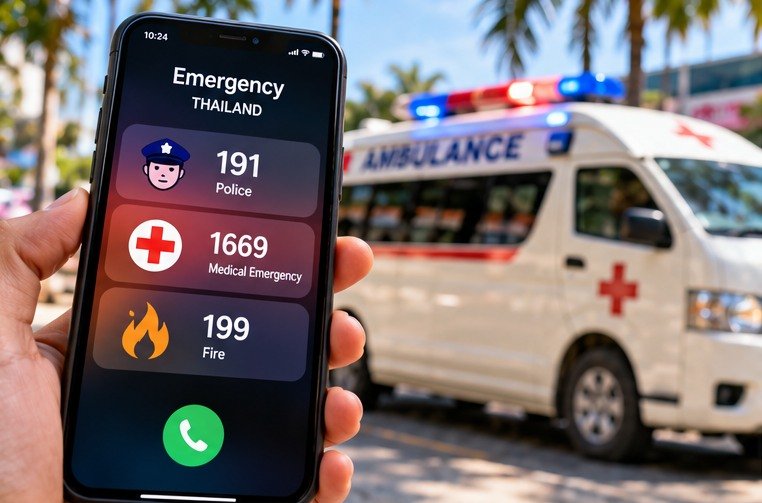
Original conceptual illustration. Illustrated call-planning scene, not a real dispatch application or response-time promise.
Thailand emergency numbers are useful only when you can choose the right service and explain where help is needed. Save the core contacts before travelling, but also save your accommodation address and a practical way for someone else to make a call. A phone full of apps is less helpful when its battery is empty or the only connection is hotel Wi-Fi.
This guide separates an immediate emergency from the paperwork and travel changes that follow. The first job is to get yourself and others out of immediate danger where possible, then contact the appropriate service. Insurance approval, a police report and a replacement booking come afterwards, not before an urgent call.
The contacts below come from official Thai and UK government sources. Their order reflects what a visitor may need to do, rather than a ranking of service quality. The call examples and preparation routines are practical planning suggestions. They cannot predict response times, guarantee English-speaking staff or replace instructions from the person handling your emergency.
Medical emergency
1669
Tell the operator whether the person is conscious and breathing normally.
Immediate police help
191
Move out of danger when you can do so safely.
Visitor assistance
1155
Tourist Police can help with communication; they are not a replacement for medical dispatch.
Best preparation
An offline contact card
Save the address, insurer and a second way to contact someone.
Thailand emergency numbers: save the right contacts
The short list to keep offline
The core numbers are 1669 for emergency medical help, 191 for police, 199 for fire and 1155 for Tourist Police. These are Thai short codes, not ordinary international telephone numbers. Save them with a clear service label rather than as four unexplained strings of digits. The FCDO and Tourist Police publish these roles. [1] [3]
On a small screen, swipe the table sideways to read every column.
| Service | Number | When the contact is useful |
|---|---|---|
| Emergency medical services | 1669 | Serious illness or injury requiring urgent medical assessment and an ambulance response. |
| Police | 191 | Immediate danger, violence, crime in progress or police emergency coordination. |
| Fire | 199 | Fire and an urgent need for fire-service assistance. |
| Tourist Police | 1155 | Visitor assistance, communication support and help finding the appropriate police service. |
| Marine Department | 1199 | Marine incidents and waterway safety assistance. |
| Disaster Prevention and Mitigation | 1784 | Disaster reporting and coordination, including flooding-related assistance. |
The Marine Department publishes 1199, while the Department of Disaster Prevention and Mitigation uses 1784. Neither replaces 1669 when somebody needs urgent medical help. In a mixed incident, explain the whole situation to the first operator rather than assuming you must finish a series of separate calls before anyone can act. [4] [5]
Numbers are not a promise about the service
A saved contact does not guarantee that your particular handset or mobile plan will connect. Likewise, a published emergency number does not promise a response within a fixed number of minutes. Prepare a second calling route, such as reception or a companion’s phone, without making test calls to emergency services.
The first minute: danger, location, help
Make the scene safer without becoming another casualty
Before moving towards someone, look for traffic, fire, electricity, unstable structures or moving water. Do not enter a dangerous place simply because you have a first-aid kit. From a safer position, call the relevant emergency number and describe any hazard that could also affect the responders. Follow the operator’s instructions about moving or helping an injured person. [2] [9]
If several people are present, give one person the calling task rather than assuming somebody has already done it. Another can meet responders at an entrance or keep a route clear, provided this is safe. Simple responsibilities are easier to carry out than a general shout for somebody to help.
Describe what you can actually observe
Say what happened and what you can see: a fall, a collision, difficulty breathing, someone who will not respond, or smoke entering a corridor. Avoid diagnosing a condition from a phone search. An operator can ask the questions needed to assess the incident; a confident but incorrect label may hide useful information.
Tell the operator when you do not know an answer. For example, not knowing the person’s age or medical history is not a reason to postpone calling. Estimate only when asked, identify it as an estimate and keep listening. The aim is a usable account, not a perfectly completed form.
What to say when the call connects
Put location near the beginning
Give the property name, town or district, street where known, and the entrance responders should use. A hotel chain may have several branches, while a beach name can cover a long stretch of coast. Therefore, add something that distinguishes your position: the northern entrance, the reception building or the marked pier beside a named business.
Explain the patient and the hazards
NIEMS guidance asks callers for the incident, location, approximate age and number of patients, level of consciousness, continuing hazards and a callback contact. It also emphasises following instructions while waiting. These are the details to prepare, not a checklist that must be complete before placing the call. [2]
When the call is difficult to hear, use short sentences and pause. A local staff member may help explain the address in Thai while you stay available to describe the person. However, do not hand away the only phone without making clear who will remain with the patient and who can answer further questions.
Make your location easier to find
A map pin needs a practical entrance
A pin can identify a large resort without showing the correct vehicle access. Compare the pin with the property name and describe where a responder can actually reach you. In a shopping centre, railway station or airport, contact staff and name the floor, entrance, platform or nearby permanent landmark.
Do not send a location through an app unless the operator or responsible service tells you how to do so. A message sent to the wrong social-media account is not confirmation that help has been dispatched. Instead, keep the voice conversation or the official communication channel active until instructed otherwise.
Update the location when it changes
Moving to reception can be sensible, but make sure the person coordinating help knows you have moved. Similarly, tell the operator if a vehicle takes the patient elsewhere or if another service has arrived. Keeping one person responsible for updates reduces the chance of different callers giving conflicting locations.
At a remote beach or trail, describe the last identifiable access point and any route information you know. Do not invent a road name to sound precise. Ask a guide or nearby business for the local place name while another person maintains contact with the service handling the incident.
When your phone cannot make the call
Data and ordinary calls are different
A travel eSIM may provide internet access without a normal voice or SMS line. Airalo’s own help explains that a separate line can be used for calls and messages, subject to the home provider’s settings and charges. Consequently, an app working over mobile data does not establish that every Thai short code will work from the dialler. [8]
Before departure, understand the plan already on your phone. For normal maps and messages, compare Airalo data options, but do not buy or install a plan during an emergency instead of seeking immediate help. Ask reception, a nearby staffed business, the crew or a companion to make the call when your own connection fails.
Keep an offline alternative
The Tourist Police link to their official application, and the FCDO notes that it can be used without a Thai SIM. Nevertheless, an internet-based option should be an additional route rather than your only preparation. Follow official download links, check permissions in advance and do not assume app chat provides the same response as medical dispatch. [1] [3]
Save an image or paper copy of essential contacts. Keep the hotel address outside an account that needs a fresh login, and tell your companion where the information is stored. During a network problem, those small choices are more useful than trying several unfamiliar applications at once.
A medical emergency: use 1669 promptly
Let the service assess urgency
Call 1669 for a serious medical emergency rather than trying to choose a hospital through reviews while somebody deteriorates. Explain breathing, responsiveness, bleeding or the incident you witnessed. NIEMS describes assessment by the call handler before the appropriate response is arranged; the caller does not have to diagnose the condition independently. [2]
A patient already inside a hospital should alert the hospital’s own staff immediately. Do not leave a ward or reception to hunt for another service without telling them that the person’s condition has changed. Clinical staff on site need to know about new symptoms as soon as possible. [2]
Do not make payment the first conversation
An urgent need for help should not wait while somebody searches for an insurance policy number. Once the emergency call is underway, a companion can retrieve the insurer’s assistance details. The FCDO advises contacting the insurer promptly, but insurance coordination is not a substitute for getting emergency care started. [6]
For a problem that is not an immediate emergency, ask your insurer or accommodation for help finding an appropriate medical facility. Describe any worsening symptoms to a healthcare professional rather than deciding that every illness can wait until the flight home. This guide cannot assess an individual person’s condition.
What to do while waiting for responders
Follow instructions and watch for changes
Stay available on the callback number. Tell the operator about a change in breathing, consciousness or the surrounding danger, and follow the advice given. Do not improvise treatment from somebody else’s prescription or give food or drink to a person whose condition makes swallowing unsafe. Professional instructions take priority over a travel checklist. [2] [9]
Prepare access, not a crowd
Where safe, send someone to the main entrance and keep other guests out of the access route. Gather essential medication information, identification and a contact for the next of kin, but do not leave the patient alone merely to collect belongings. A companion can bring a small bag later.
Avoid photographing or publicly identifying the injured person. If records are needed for insurance, they can usually be organised after immediate care and with appropriate respect for privacy. Keep your attention on the operator, the person needing help and any change in the situation.
Hospital care, insurance and communication
Ask clear questions once immediate treatment is underway
The FCDO’s Thailand healthcare guidance explains that UK GHIC arrangements do not cover Thailand and that the embassy cannot pay medical bills. Appropriate insurance is therefore a preparation issue, not a guarantee that a particular hospital will charge nothing at reception. Ask the insurer how payment arrangements and authorisation work. [6]
Keep the insurer’s case reference alongside the hospital name, treating department and a contact number. Ask who will communicate with the insurer and whether any documents are still required. A short written log can prevent repeated explanations when shifts change or relatives call from home.
Do not confuse discharge with readiness to travel
Before resuming a journey, ask the treating clinician about transport, follow-up and any fitness-to-fly requirements. Tell the insurer about the proposed next destination rather than assuming a previous approval covers every new plan. Medical transfer and an ordinary taxi booking are different decisions. [6] [12]
For companions, identify somewhere to charge a phone, obtain drinking water and communicate privately. Nominate one family contact to pass on agreed updates. This reduces pressure on the patient and avoids the same person having to retell a distressing event to several callers.
Police help, theft and threatening situations
Immediate danger is different from a later report
For an immediate police emergency, call 191. Tourist Police on 1155 can help visitors with communication and finding the appropriate police route. When the incident is over and you are safe, ask where to make the report and which documents or evidence to bring. [1] [3] [10]
Do not confront a suspected thief or follow a stolen phone into an unfamiliar building. Preserve booking details, vehicle information, messages and transaction records that you already have. Explain what you witnessed separately from what you suspect; accuracy matters more than producing a dramatic account.
Request a record you can understand
Ask for the report reference, the station name and guidance on obtaining a copy. Check names, dates and the description of missing property. If you cannot understand a document, request interpretation rather than signing simply to finish quickly. A hotel can help with practical communication, but it is not your legal adviser.
After a serious assault, medical care and personal safety come first. Ask the police, a healthcare professional or your consular service about specialist support and evidence options. Decisions about reporting can be sensitive; do not let a travel companion pressure the affected person into a public account or social-media post. [10]
Fire, flooding and wider disruption
Leave immediate danger rather than collecting possessions
In a fire, alert people responsible for the building and call 199 when you can do so safely. Follow evacuation instructions and do not re-enter to retrieve a passport or suitcase. Your accommodation’s escape information should be checked at arrival, not discovered for the first time through smoke. [1] [9]
For flooding or another wider disaster, use local official instructions and the disaster-coordination route on 1784. Avoid turning an emergency helpline into a general enquiry about whether a sightseeing trip will run. Tour operators and hotels should handle routine booking questions, leaving emergency channels for urgent needs. [5]
Check information that matches your place and date
A warning for one province does not establish the situation on every island, while an old photograph does not prove that a road is open today. The FCDO advice available at this review includes regional restrictions and disruption information. Read its current version alongside Thai local instructions before moving. [11]
When communications are busy, send one brief update to a nominated contact and conserve battery. Tell them your location and whether you need practical help. Do not promise to travel through a closed road just to keep a flight or hotel booking that can be discussed later.
Emergencies at a beach, pier or on a boat
Alert the people closest to the operation
Call out to a lifeguard or crew member immediately when someone is in difficulty. Describe the last visible position and keep pointing it out. Do not enter hazardous water for an improvised rescue; seek trained help and use available rescue equipment from a safe position when instructed. [9]
For medical help call 1669, with 191 available for police coordination. The Marine Department lists 1199 for marine assistance. On a vessel, crew need to know the vessel name and position; a passenger’s description of “near an island” may not be enough to identify it. [1] [4]
Know when moving comes before calling
Natural tsunami warnings include strong or prolonged shaking, an unusual rapid sea change or a loud ocean roar. NOAA advises moving promptly away from a hazardous coastal area rather than waiting for an official message. In Thailand, follow local evacuation signs and instructions towards higher ground or inland. [13]
A warning is not a reason to walk onto exposed seabed or film the water. Once you are in a safer place, seek official information and tell your contact where you are. Do not return simply because the first visible disturbance has passed. [13]
Losing a passport, wallet or phone
Protect access without distracting from personal safety
After reaching a safe place, report missing documents through the appropriate police and passport-authority routes. If a phone and wallet disappear together, use a trusted device to contact the bank and recover communication. Avoid logging into sensitive accounts on a stranger’s unattended device or sharing one-time security codes with a supposed helper.
Keep a small separate record of account-recovery contacts before travel. A passport copy helps you supply details, but does not replace the original for international travel. Tourist Police can help direct visitors, while the issuing authority determines the passport replacement process. [3] [7]
Prioritise today’s practical needs
Work out where you can stay, how you can contact a trusted person and how essential medication will remain available. A missing suitcase and a missing passport create different problems, so report exactly what is absent. Do not cancel unrelated documents or accounts simply because you are overwhelmed.
Once the immediate tasks are allocated, write down what has been completed. This is particularly useful when two people are making calls: one can handle the bank while another speaks to accommodation, without both assuming the other has contacted the passport authority.
When a companion is missing or vulnerable
Act on the circumstances, not an arbitrary waiting period
If a child is missing, or someone may be in immediate danger, contact local staff and police promptly. Give the last known place and time, clothing, a recent photograph and relevant medical or support needs. Do not delay merely because somebody claims that all missing-person reports require a fixed waiting period. [7]
Allocate tasks carefully. One adult can remain at the agreed meeting place while another speaks to staff, but avoid sending several people searching independently without a communication plan. At a station or shopping centre, security staff can help coordinate locally while the police are contacted.
Protect privacy during the search
Share necessary identifying information with the authorities, not every person who messages claiming to help. Keep a record of who has been contacted and what information they requested. For an adult travelling independently, distinguish a delayed reply from specific evidence of danger when explaining the concern.
A person experiencing a serious mental-health crisis may need urgent medical support. Stay with them where it is safe, reduce immediate hazards without putting yourself at risk, and contact emergency services when there is imminent danger. The insurer and consular service can assist with later coordination, not replace urgent assessment. [6] [7]
What an embassy can and cannot do
Consular help is a separate layer of support
British travellers can reach the British Embassy Bangkok through +66 2 305 8333, or the FCDO’s round-the-clock consular contact route on +44 20 7008 5000. These contacts were checked on 05 October 2026. Other nationalities should save their own embassy or consulate rather than assuming the British service covers everyone. [6] [7]
Consular staff can explain relevant assistance and local professional-service routes. They are not the ambulance dispatcher, insurer or a substitute for Thai authorities. Therefore, contact local emergency services first when somebody is in immediate danger, then involve the consular team according to the circumstances. [7]
Call before travelling to an office
An embassy telephone route being available around the clock does not mean that every counter accepts unannounced visits at any hour. Follow appointment instructions and confirm the correct office. Do not spend the last available cash crossing a city towards an address found in an old forum post. [7]
Keep the case reference and agreed next step. When relatives call on your behalf, provide consent and the details they need where possible. Clear coordination is more helpful than several people repeatedly asking different offices for the same information.
Prepare a small kit that supports communication
Power, light and a readable contact card
Preparation does not require an expensive emergency suitcase. Start with the phone and charger you already own, then check whether a compact power bank and a spare compatible cable solve a real weakness. Check airline battery restrictions before packing; a shopping description alone does not establish permission to fly with an item.
A water-resistant document pouch can protect paper contacts from ordinary rain, while a small torch is useful when a phone should be reserved for calls. Test closures and batteries before travel. Neither item makes floodwater, a dark trail or an unsafe building suitable to enter.
Carry information you have chosen to disclose
A simple whistle may help attract nearby attention, but it does not summon a particular rescue service. A medical information card holder can keep essential details readable. Include relevant information agreed with your clinician, a contact name and any communication needs, rather than filling it with unverified medical abbreviations.
Use these shopping links only as optional comparisons. The list is organised by communication needs, not ranked by product testing. Most travellers can assemble the important parts from existing belongings: a charged phone, a paper address, a useful contact and a companion who knows the plan.
Reorganise travel only after the urgent problem is managed
Choose a practical place to wait
After professional advice makes ordinary travel appropriate, choose accommodation for access and support rather than the lowest nightly headline. Compare Bangkok rooms for the actual area you need, then cross-check Bangkok accommodation for cancellation terms, reception hours and room access. Neither site guarantees a room is suitable for a medical recovery.
Ask the property about the particular requirement: lift access, a quiet room, step-free entry or space for a companion. Keep the answer in writing. A vague “accessible” label is not enough when a specific doorway, shower or vehicle transfer determines whether the stay will work.
Keep transport and care decisions separate
Before cancelling or buying anything, ask the insurer about approval and the travel provider about change conditions. Retain receipts and messages. A short delay in shopping for a replacement itinerary is often preferable to creating several non-refundable bookings based on an uncertain discharge or appointment time.
Build a contact card and rehearse the handover
Make it useful to someone other than you
Record your accommodation’s full name, address in Thai and English where available, room number, insurer assistance number, policy reference and a trusted contact. Add the four core Thai emergency numbers. Store copies in places that will not all disappear with one phone or bag.
For a family, nominate who takes charge of children, who makes calls and who keeps the documents. For a solo traveller, tell a trusted person the current base and when a missed check-in should prompt concern. These are arrangements you choose together, not a universal timetable for every holiday.
Include access and communication needs
Tell companions about important communication preferences, mobility needs or equipment that must stay with you. A short written explanation may be easier to use under pressure than a long medical history. Obtain professional advice about any condition-specific emergency plan before departure.
At each new hotel, update the address rather than keeping only the first arrival booking. At a station or ferry pier, identify the staffed point before separating. The most useful rehearsal is simple: can the other person find the address, make a call and explain the situation without unlocking your phone?
Helping someone in Thailand while you are abroad
Establish what is happening before arranging travel
When a relative contacts you about an incident, first ask where they are, whether they are safe and which local service has been contacted. Keep the exact hotel, hospital or police-station name and a number that can be called back. A message saying only that someone is “in Bangkok hospital” can refer to a place, a business name or an assumption made by another traveller.
Ask permission to share an update with one agreed family contact. Then keep a simple timeline using the local date and time in Thailand as well as your own time zone. This is particularly helpful when an overnight call is followed by office enquiries the next morning. Note who supplied each piece of information rather than combining confirmed facts and guesses into one account.
Do not try to solve a Thai emergency by dialling an altered short code from your home country. Ask the person on the ground to contact local emergency services, or use the official consular contact route for guidance when you cannot reach them. Give the consular team the person’s nationality and circumstances so they can explain the appropriate support. [7]
Verify payment requests without delaying medical help
An unexpected request for money deserves a separate verification step. Call the traveller through a number you already know, or contact the named institution using an independently obtained official contact. A convincing photograph, urgent voice message or copied passport page does not by itself establish who is asking for payment.
Meanwhile, avoid directing the person to leave care merely because a payment request is confusing. Contact the insurer’s established assistance number and ask what evidence and authorisation are needed. Record payment instructions and the identity of the recipient before transferring money, and preserve receipts for the legitimate expenses that follow.
There may also be ordinary tasks you can remove from the traveller’s day: informing an employer, checking a booking’s change terms, retrieving a document copy or notifying a pet sitter. Ask which task is actually helpful rather than making several independent arrangements. Booking a replacement flight without knowing the medical or document position can create another deadline at exactly the wrong moment.
Finally, agree when the next update will come and what to do if it does not. A clinician may be speaking to the patient, a phone may need charging or the traveller may simply need rest. Keep urgent concerns distinct from routine check-ins, while acting promptly when there is specific evidence of danger.
Pros and cons of an emergency plan
What preparation improves
A short plan reduces avoidable confusion. Someone can call the correct service, another can explain the location, and the insurer or family can be contacted without searching through luggage. Offline copies also protect against a drained battery or a missing phone.
Preparation lets you make ordinary choices calmly: which contact to notify, where documents are stored and how to describe access needs. That leaves more attention for the person and the instructions being given.
What preparation cannot promise
No card or app guarantees a response time, treatment outcome, insurance payment or English-speaking operator. A plan also becomes less useful when it is too long, out of date or known only to one traveller.
Keep it proportionate. Equipment should support communication and basic readiness, not encourage untrained rescue attempts or replace professional medical, legal or emergency advice.
Common mistakes that create extra delays
Calling the insurer before the emergency service
An insurer can help coordinate costs and later arrangements, but it does not replace the first call for urgent medical help. Similarly, a hotel review search is not a medical assessment. Place the emergency call, follow instructions and delegate the administrative tasks where possible.
Giving only a hotel name or beach name
Add the town, correct branch and usable access point. When you change position, update the person coordinating help. A map pin, a reception address and a room number are complementary details, not interchangeable descriptions of the same place.
Depending on one device and one person
Separate the backup contact information from the phone that holds everything else. Show companions where it is, and check your calling arrangements before departure. Do not make test emergency calls, buy unnecessary equipment or assume that an internet connection guarantees normal voice service.
Frequently asked questions
Which number should I call for an ambulance in Thailand?
Call 1669 for emergency medical help. Explain the location, incident and the person’s condition, then answer the operator’s questions. If your own phone cannot connect, ask a nearby staffed business, hotel or companion to call immediately. Do not wait to find a policy number before requesting urgent help. [1] [2]
Is 1155 the same as the main police emergency number?
No. The core police emergency number is 191, while 1155 is the Tourist Police contact for visitor assistance. Tourist Police can help with communication and the appropriate police route, but a serious medical emergency should be directed to 1669 rather than treated as a general tourism enquiry. [1] [3]
Can I use a data-only eSIM to call these numbers?
Do not assume so. Data service and a normal voice line are different features, and the combination of handset, plan and network matters. Check your arrangements beforehand and keep another calling route available. A hotel phone or a nearby person making the call can be the practical answer when your own dialler fails. [8]
Should I put +66 in front of 1669 or 1155?
Do not turn a Thai short code into an invented international number. Keep the official short code as published for use in Thailand. Ordinary contacts, such as an embassy’s international telephone number, are different. From abroad, contact the relevant embassy or an established local person who can coordinate, rather than guessing how a short code will route.
Are emergency treatment and ambulance services free for tourists?
Do not make that assumption. Calling for urgent help and determining payment are separate matters, and the eventual costs depend on the services and circumstances. The FCDO explains that Thailand is not covered by UK GHIC arrangements. Use appropriate insurance, contact its assistance team promptly and retain the relevant records. [6] [12]
What should I do when I cannot explain the address in Thai?
Say the service needed, the town and the property or landmark as clearly as you can. Ask a staff member to help with the Thai address while you remain available to describe the incident. Keep the callback number active. Avoid sending unrequested messages to unofficial accounts and assuming that somebody has received a dispatch request.
Should I take an injured person to hospital myself?
Ask the emergency operator or treating clinician. The safest transport depends on the injury, the immediate hazards and the available response. Do not assume an ordinary taxi is suitable simply because it is nearby. Conversely, do not ignore an instruction to move away from an immediate danger; describe the scene and follow professional guidance. [2] [9]
Can the British Embassy organise everything for me?
Consular staff can explain the assistance available, but they do not replace Thai emergency services, pay ordinary medical bills or remove the need to contact an insurer. Call the local service first for immediate danger. Afterwards, use the official consular route and keep a record of the next step they advise. [6] [7]
Final recommendation: make the first call easy
Save the core contacts, write down the address of your current base and establish a backup calling route. Then show the plan to the person travelling with you, or share the relevant details with a trusted contact at home. A short, current plan is easier to use than an impressive document nobody can find.
During an incident, concentrate on safety, location and clear communication. State what you observe, answer the operator’s questions and update them when the situation changes. Once immediate help is underway, assign insurance, family updates and travel changes to somebody else where possible. The aim is not to manage every consequence at once; it is to make the next necessary action easier.
Sources and fact-checking notes
This is practical emergency preparation, not clinical training. Telephone roles were checked against official sources. No emergency line was test-called. Response times, language availability and treatment costs are not guaranteed. Health-related wording has not had independent clinical review.
Official pages and provider information were checked on 05 October 2026. Examples, priorities and suggested itineraries are editorial planning judgements, not quotations, guarantees or personal inspection reports.
- FCDO: Getting help in Thailand – Core ambulance, police, fire and Tourist Police contacts.
- Thai government / NIEMS: Calling 1669 – Information callers should give and the role of emergency assessment.
- Thailand Tourist Police – 1155 and the official Tourist Police application; linked immigration contact.
- Marine Department: Search and rescue – Marine Department hotline 1199.
- Department of Disaster Prevention and Mitigation – Disaster coordination and hotline 1784.
- FCDO: Healthcare and medical services in Thailand – Medical support, insurer liaison and British Embassy contact details.
- FCDO: Support for British nationals abroad – Consular assistance, appointments and 24-hour UK contact route.
- Airalo: Data-only eSIMs, calls and messages – Data access is separate from a normal voice and SMS line.
- St John Ambulance: First aid and CPR – Unresponsive people who are not breathing normally; use Thai emergency numbers in Thailand.
- FCDO: Reporting a crime abroad – Local police reporting and consular support.
- FCDO: Thailand travel advice – Current regional and disruption warnings; recheck immediately before travel.
- FCDO: Foreign travel insurance – Activities, existing conditions, emergency costs and policy exclusions.
- NOAA / National Weather Service: During a tsunami – Natural warnings and moving inland or to higher ground; follow Thai local evacuation instructions.
Illustrations in this article were created for Taylor’s Trailblazing Travels. Third-party photographs, where used, are credited beside the image or in the source list.