Suvarnabhumi to Don Mueang Airport Transfer Guide
Choose the shuttle, taxi or rail around a realistic connection – not around the fastest driving time you have seen.
Original conceptual illustration of an inter-airport road transfer; it does not show an exact route or real shuttle vehicle.
The Suvarnabhumi to Don Mueang airport transfer is a journey between two separate airports, not a quick change of terminal. You must get out of the first airport, travel across the metropolitan area and complete the next airline's departure process. The transport itself is only one part of the connection.
For an eligible connecting passenger, the free airport shuttle can be the simplest low-cost choice. A taxi or prebooked vehicle can make the meeting process easier, especially with children or several cases. Rail provides another option during operating hours, but it requires changes and walking. None of those choices turns a short independently booked connection into a protected one.
This guide compares the actual transfer steps, documents, costs and timing decisions. Official airport and rail information was checked on 4 October 2026. The suggested buffers are research-led planning judgements, not airport minimum connecting times, traffic predictions or promises that a particular flight can be caught.
The eligible-passenger shuttle
AOT lists a free service for flight-connecting passengers with the required documents.
Is the flight gap workable?
Include arrival formalities and the next airline's reporting time.
A suitable booked vehicle
Confirm people, bags, meeting instructions and waiting conditions.
A deliberate overnight stop
Useful when an expensive onward flight needs more recovery room.
Suvarnabhumi to Don Mueang: choose the transfer around the connection
Start with the second airline's reporting time
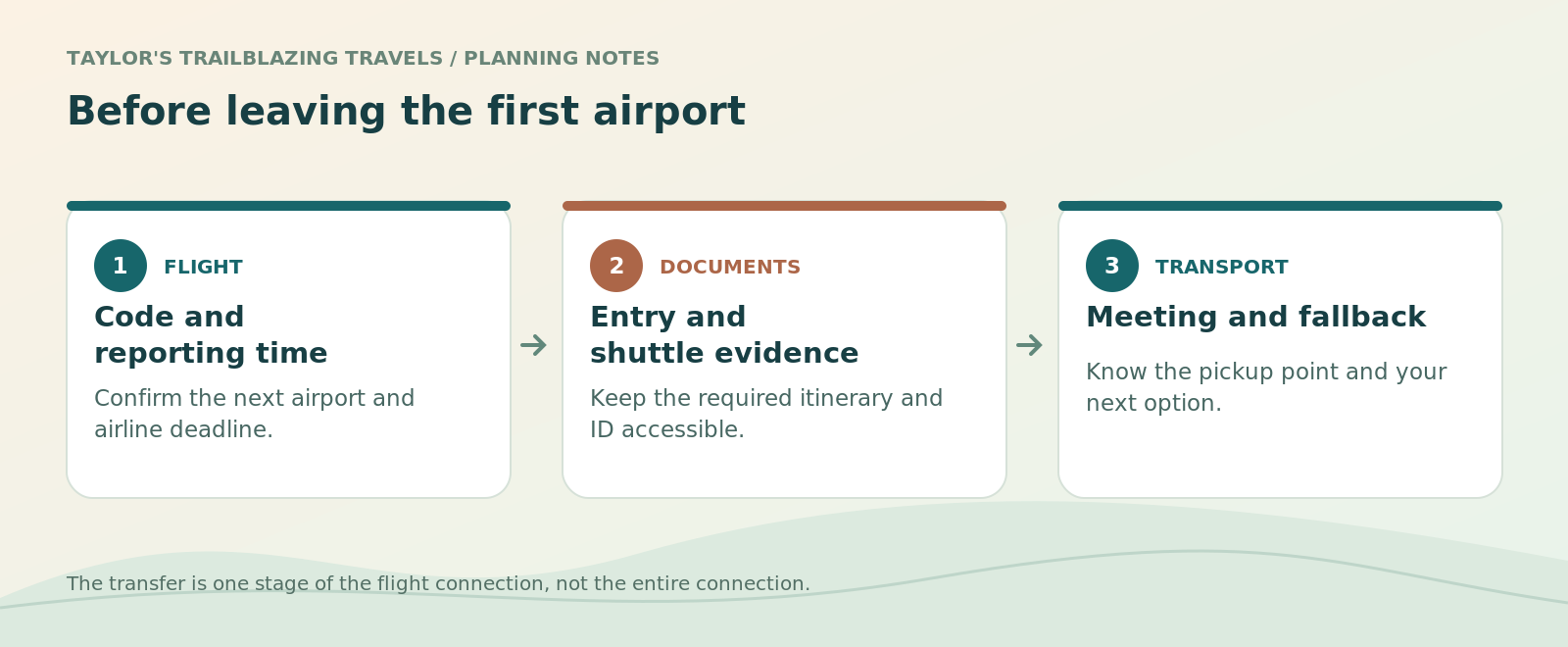
Write down the second flight's airport code, terminal, check-in deadline and departure time. Then work backwards through the ground transfer and the first airport's arrival process. A transport comparison is useful only after you know how much time is actually available between those tasks.
BKK is Suvarnabhumi and DMK is Don Mueang. Check the codes on both tickets before making any booking. If both flights use the same airport, you may need a different connection procedure rather than this inter-airport journey. If the airport codes differ, a ground transfer must be part of the plan. [2]
Compare four practical options
The table uses editorial planning allowances checked against the available service information on 4 October 2026. Road times are margins for planning, not observed averages or guarantees. A traffic incident can make them longer, while the total flight connection also includes arrival and departure formalities.
On a small screen, swipe the table sideways to see every column.
| Option | Best suited to | Cost approach | Time to budget for the ground stage |
|---|---|---|---|
| Free airport shuttle | Eligible connecting passengers with a generous gap | Free under AOT's stated conditions | Roughly 1-2 hours on the road, plus waiting and finding the stop |
| Metered taxi | Direct travel without a prearranged booking | Meter, airport surcharge and applicable extras | Roughly 1-2 hours, plus the taxi queue |
| Prebooked vehicle | Groups, specific luggage or a clear meeting arrangement | Date-specific vehicle quote | Roughly 1-2 hours, plus meeting and loading |
| Airport Rail Link, MRT and Red Line | Travellers comfortable with multiple rail systems | Separate current rail fares | Around 2-3 hours including changes and terminal walks |
How much time should you leave between flights?
Separate tickets need more than the driving time
For an international arrival at BKK followed by a separately booked domestic departure from DMK, six hours is a conservative starting point for discussion, not a guaranteed minimum. Consider more time when you have checked bags, assistance needs, young children or the final onward flight of the day. An overnight connection can be more sensible when replacement travel would be expensive.
A three-hour gap is not a connection I would recommend arranging independently. You could use much of it getting off the first aircraft, completing entry formalities and travelling between airports, before the next airline's check-in deadline is considered. A fast road journey in somebody else's account does not establish a reliable plan for your arrival.
Use an arrival-delay test
Add two hours to the incoming flight's scheduled arrival. Would you still reach the next airline in time without relying on an unusually quick queue and an empty road? If the answer is no, choose a later onward flight or an overnight stop before you start comparing transfer prices.
A worked six-hour connection, with the assumptions visible
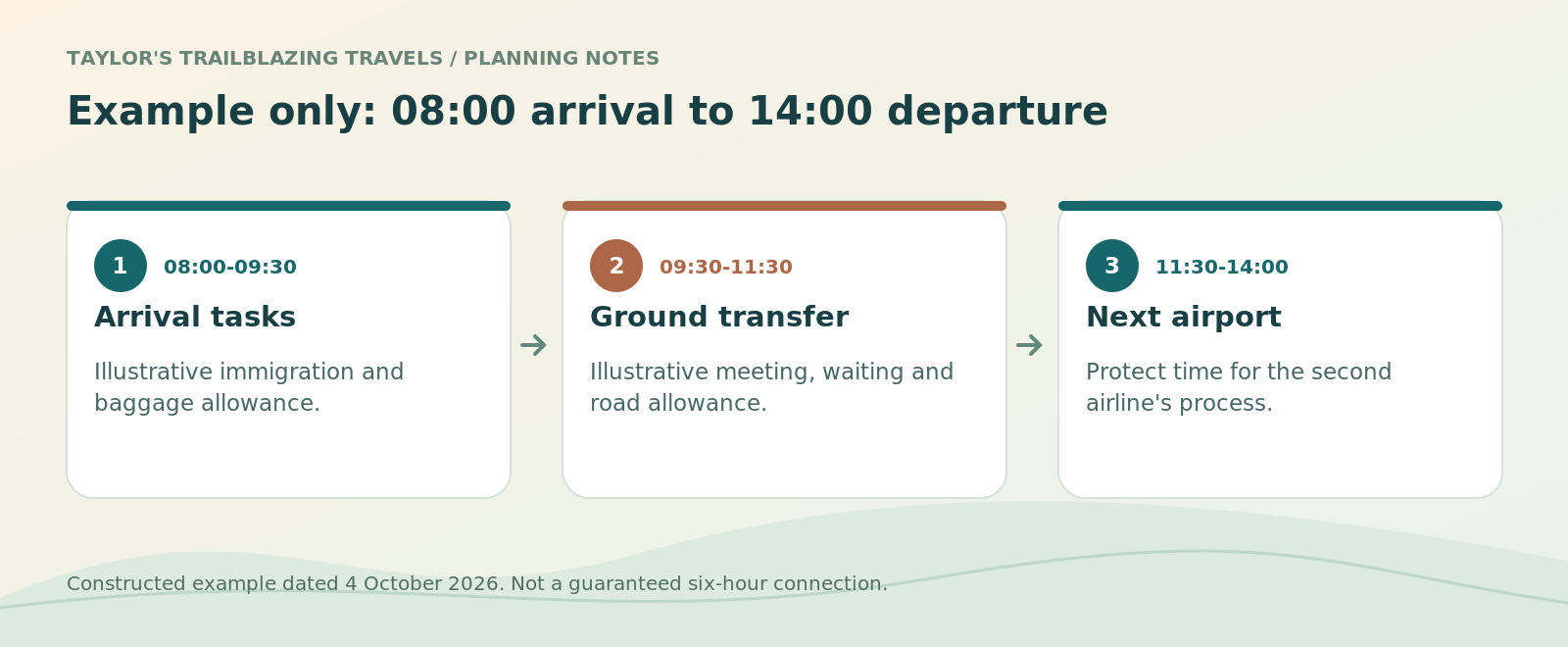
Example: land at 08:00, depart at 14:00
Suppose the incoming aircraft is scheduled to land at 08:00 and you allow until 09:30 to reach landside with bags. You then allow half an hour to find and board transport, followed by up to ninety minutes on the road. That puts you at DMK around 11:30, two and a half hours before the next flight.
This is an illustrative schedule constructed on 4 October 2026, not a prediction of BKK queues or Bangkok traffic. The value of the example is that it shows each assumption. If the first flight lands late, the shuttle is full or the road takes longer, the margin at DMK shrinks quickly.
Do not count the same spare time twice
A common error is to call the airport's recommended early arrival a contingency and then spend it on the ground journey. It is not spare time: it is the period for check-in, baggage, security and reaching the gate. Keep a separate allowance for disruption rather than using one buffer to cover three different risks.
If your incoming flight is domestic, the first airport's arrival process may be simpler, but baggage collection and ground travel remain. If your next flight is international, its departure requirements can be more involved. Rebuild the calculation for your actual passenger journey instead of copying a six-hour example without changing its assumptions.
Your BKK arrival path changes the starting point
International arrival with checked luggage
Allow time to leave the aircraft, follow the relevant arrival route, complete immigration where required and collect the checked bags. Only after those tasks can you begin the landside meeting process. A gate arrival at a satellite area can involve additional movement through the airport before you reach immigration or baggage collection. [3]
Keep the next flight's details accessible throughout. If a bag does not arrive, ask the airline's baggage staff about the report and delivery arrangements before leaving the controlled arrivals area. An inter-airport connection does not remove the need to deal with a missing case properly, and that unexpected task can consume a substantial part of a tight gap.
International arrival with cabin baggage only
Travelling without a checked case removes the carousel wait, but not every other arrival task. You may still need to enter Thailand and follow the airport's passenger route before finding the shuttle or driver. Do not subtract the entire arrival allowance simply because the suitcase is with you.
Use any time saved as a margin rather than immediately spending it on shopping or another stop. Once you know the actual next transfer departure and your remaining airport journey, you can judge what time is genuinely available. At the planning stage, an assumed exceptionally quick entry should not be what makes the connection possible.
Domestic arrival at BKK
A domestic passenger does not repeat international entry formalities merely to change Bangkok airports. However, disembarkation, baggage if checked, finding transport and reaching the next check-in still take time. Confirm the correct arrival route and proceed to the meeting point specified for the chosen transfer.
Build your calculation around the passenger process you actually face. Copying a domestic-to-domestic example for an international arrival is too optimistic, while copying an international example without understanding it can obscure which part of the margin you are relying on. Clear assumptions are more useful than one transfer-time number repeated for everyone.
The free shuttle: who can use it?
Bring proof of the onward flight
AOT describes the inter-airport shuttle as exclusively for passengers transferring between flights at Suvarnabhumi and Don Mueang. Its published requirements are a flight ticket or proof of onward travel plus a passport or national ID card. General travellers who are not connecting between flights are not eligible. The service is listed as free of charge, checked on 4 October 2026. [1]
Keep the onward itinerary available offline so you can show the flight, date and airport even if the phone has no data connection. A hotel reservation near DMK is not, by itself, the onward-flight evidence described by AOT. Ask the counter about unusual arrangements instead of assuming that any future booking qualifies.
Do not build a plan around an uncertain exception
If you have an overnight gap, an unusual itinerary or accompanying people who are not taking the onward flight, confirm eligibility before relying on the free service. This guide does not invent a universal same-day or next-day rule that the published page does not clearly state.
Have a paid alternative in mind. That does not mean booking two transfers simultaneously; it means knowing where the official taxi service or a suitable supplier can be found. The saving from a free bus is worthwhile only when it remains compatible with your documents, available time and the passengers travelling with you.
Finding the shuttle at Suvarnabhumi
Main terminal, Level 2, Gate 3
AOT lists the BKK boarding point at the inner curb by Level 2, Gate 3 of the main terminal. After completing the arrival process appropriate to your journey, follow the airport signs and check with the counter that you are joining the Don Mueang service. Do not board an internal airport bus solely because it also says shuttle. [1]
The same airport publishes separate internal circulator routes. Those are not the inter-airport journey. If a bus's destination is unclear, ask before loading luggage rather than discovering later that you are travelling around Suvarnabhumi instead of leaving for DMK.
Keep the next reporting deadline visible
AOT lists the inter-airport service from 05:00 to midnight at thirty-minute intervals. Treat that as the published service description, checked on 4 October 2026, and verify the next departure with staff. Your actual wait can depend on when you reach the stop and the conditions on the day. [1]
Once you know the next departure, reassess your remaining time honestly. A taxi can remove a scheduled wait, but it cannot guarantee a faster road once both vehicles are in traffic. If the connection is already unreasonably tight, contact the next airline rather than spending more money on an assumption that the city will suddenly become predictable.
After reaching Don Mueang: the transfer is not finished
Identify the correct terminal and check-in area
For the current terminal arrangement, domestic departures use Terminal 2 and international departures use Terminal 1. Confirm the operating airline and the latest airport instructions before the driver drops you off. A domestic airline check-in reference can be checked against the carrier's own DMK information. [4][2]
If the shuttle's stopping point is not immediately beside your required check-in area, allow time to move through the connected airport buildings. Ask staff when uncertain rather than following a queue whose airline or destination looks vaguely familiar. Keep the flight number visible so they can identify the right departure.
Reach the desk before the deadline, not the gate after it
Online check-in does not necessarily remove bag-drop or document checks. Follow the next airline's process and reporting deadline. If time is becoming tight, ask a member of the airline's staff promptly, but do not assume a boarding pass on your phone means every remaining airport step can be skipped.
After completing the required checks, find the gate and monitor the screens for changes. Then decide whether there is time for food or another stop. A successful airport-to-airport journey still ends badly if the group disperses for shopping and misses the boarding call after reaching DMK with a workable margin.
Update anyone waiting at the final destination
When the connection is secure, confirm the onward flight details with a later transfer supplier if they have changed. This is particularly useful after rebooking, when a driver at the next airport may still be watching the original flight. Keep the updated itinerary separate from the superseded version to avoid another mismatch at arrival.
Reverse direction: Don Mueang to Suvarnabhumi
Check the appropriate DMK pickup
AOT's Don Mueang shuttle page lists Terminal 1, Level 1, Gate 3 and Terminal 2, Level 1, Gate 14 for the inter-airport service. Its main service description also gives 05:00 to midnight and thirty-minute intervals. Confirm the active boarding point with the airport, particularly for the first or last departure. [5]
AOT's broader airport overview also mentions Gate 6, while the dedicated shuttle page lists Gates 3 and 14 and contains inconsistent status-widget hours. These official pages do not fully agree. Confirm the active DMK stop and next departure with airport staff rather than treating an old gate number or the widget as definitive. [6]
International departures need their own margin
A DMK to BKK vehicle comparison is useful when the free service is unsuitable or when you prefer a prearranged meeting. Recalculate the connection around the international airline's reporting requirement, not around the time you previously needed for a domestic flight.
If a domestic delay would jeopardise a long-haul ticket bought separately, returning to BKK the previous day can be the more proportionate choice. A longer stop is not wasted time when it gives you a realistic recovery option and avoids depending on the final feeder flight of the day.
Metered taxis: understand the price components
Use the airport's official taxi process
Suvarnabhumi's official transport guide places regular taxis on Level 1 between Gates 4 and 7 and describes a queue-ticket process. It also lists a THB 50 airport surcharge, checked on 4 October 2026, on top of the metered fare. Other permitted charges and the chosen road route can affect the final payment. [1]
Keep the queue ticket and confirm that the destination is Don Mueang Airport, including the terminal if known. Ask how tolls and any luggage charges are handled before starting. A fare discussed without those components can be misunderstood even when nobody is trying to mislead you.
Do not invent one fixed inter-airport taxi fare
The meter reflects the journey, so a single figure cannot guarantee the same total in all traffic conditions. Ask for the current expected cost, carry a workable payment method and allow room in the budget for variation. A paid private-transfer quote is a different product from a regular metered taxi.
When comparing, use the final per-vehicle amount and passenger capacity. For an illustrative quote of THB 1,200, prepared as a calculation example on 4 October 2026, two passengers share THB 600 each and four share THB 300 each. That arithmetic explains cost-sharing only; THB 1,200 is not presented as a verified taxi tariff or supplier offer.
Prebooked cars and vans: the details to confirm
Book the actual airport-to-airport route
Select Suvarnabhumi as the pickup and Don Mueang as the destination, not a generic Bangkok hotel transfer. Include the incoming flight number, passenger count and luggage. Then read the meeting-point instructions carefully: a name-board meeting inside arrivals is different from walking to an outdoor pickup zone.
Ask about waiting and a delayed incoming flight
Find out when waiting time begins, how long it lasts, whether the supplier tracks the flight and what happens if arrival is substantially delayed. Confirm that the contact method works for you. A driver having your flight number is helpful, but it is not the same as an unlimited-waiting promise.
For larger groups, check bags as well as seats. A vehicle advertised for several passengers may not hold the same number of large cases comfortably. Specify child seats, mobility needs and unusual equipment before payment. The right vehicle is the one that fits your party safely, not simply the cheapest class with a sufficiently large passenger number.
Rail alternative: Airport Rail Link, MRT and Red Line
There is no single direct airport-to-airport train on this route
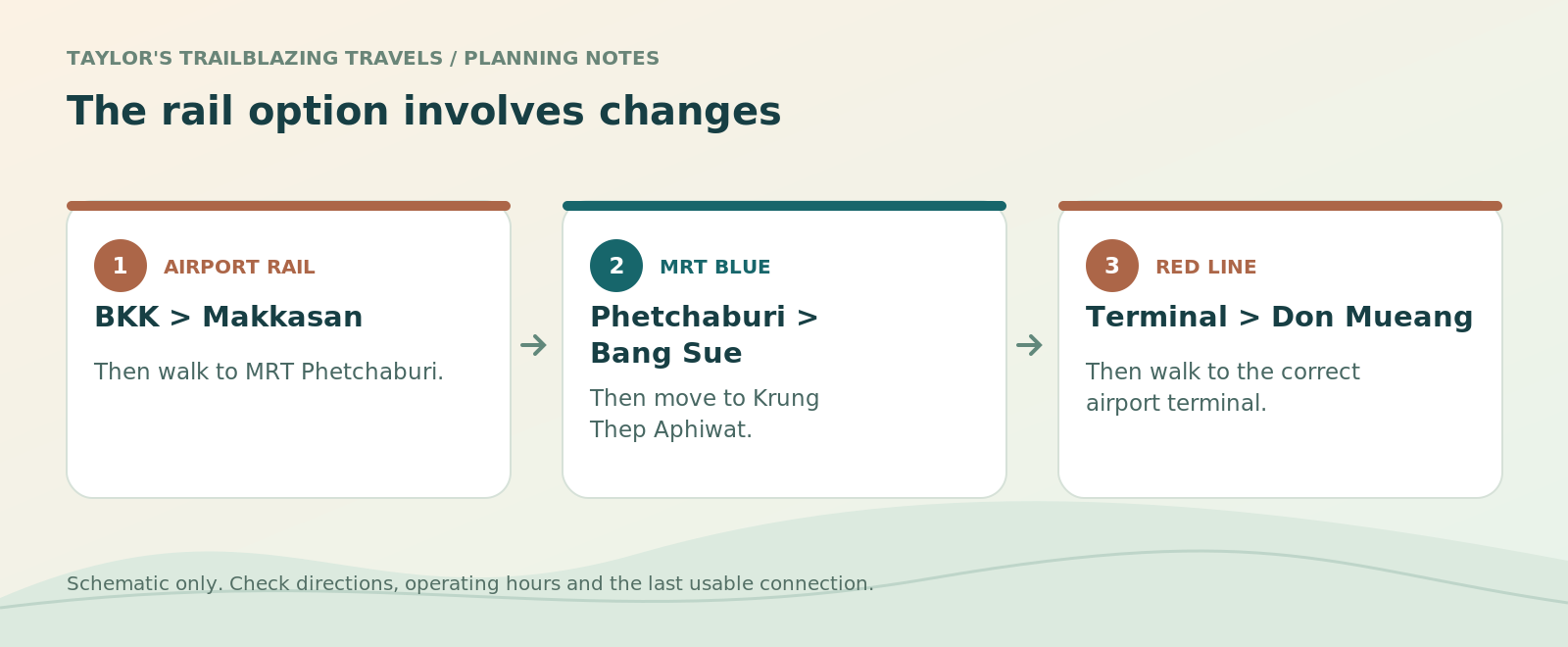
A practical rail route to investigate is BKK Airport Rail Link to Makkasan, the connection to MRT Phetchaburi, the Blue Line towards Bang Sue, and the Red Line from Krung Thep Aphiwat to Don Mueang. Follow the current operator maps and the signs at each interchange. [1][8][9][10][11]
At Don Mueang, allow for the walk from the railway station to the terminal. The Red Line operator describes the connection towards the domestic terminal. Check which terminal your flight uses before deciding you have reached the end of the transfer. [10]
Count interchanges as work, not empty space
Allow time to leave one system, find the next entrance, buy or validate the appropriate ticket and reach the correct platform. With a small backpack, this may be manageable. With several cases, a pushchair or a traveller who cannot manage long walks, the number of changes can outweigh the benefit of avoiding road traffic.
A two-to-three-hour allowance for the complete ground journey is an editorial planning range, not an operator timetable. Check the actual service hours and last usable connection before travelling late. Reaching the first train before it closes does not guarantee that every later system will still provide the connection you need.
Why the cheapest public-bus answer is not always the best answer
A route number can describe a different service
Airport transport pages list public buses, public vans, internal shuttles and the inter-airport connecting-passenger service separately. Do not assume that an old reference to a numbered public bus describes the same product as the free airport shuttle. Pickups, stops, eligibility and operating arrangements can differ. [1]
For someone connecting to an important flight, an unfamiliar stopping service introduces questions that should be answered before boarding: where exactly does it stop, how much walking remains and what timetable applies today? A low fare is useful, but not when you have misunderstood the destination or departure point.
Keep complicated alternatives for journeys that can absorb them
Local public transport can be a reasonable choice for a flexible traveller who has researched the actual route. It is a poorer default for a tired first-time arrival carrying luggage with a fixed reporting deadline. This guide prioritises the dedicated shuttle, suitable vehicles and a clearly described rail route because their role is easier to understand.
If you are not an eligible connecting passenger, do not plan to negotiate your way onto the free bus. Choose another published option. The right comparison is between services you can actually use, not between a paid transfer and a free service whose stated conditions do not cover your journey.
First departures, last departures and the overnight gap
A published operating window is not a midnight rescue plan
The inter-airport shuttle's published end time should not be interpreted as a guarantee that a passenger landing shortly beforehand can catch it. Arrival formalities happen first. A flight landing at 23:15 can reach landside after the last suitable service, even without an unusually long road journey. [1]
For a late arrival, decide in advance whether you will use a paid vehicle or stop overnight. Check the supplier's late-arrival conditions and hotel reception arrangements. A plan made while rested is usually clearer than one assembled outside arrivals after discovering that the bus you expected is no longer available.
The first bus may still be too late for an early flight
Work backwards from the next airline's reporting time before choosing a morning shuttle. Even if the first published departure operates as expected, you still need the road journey and movement through DMK. An early onward flight can therefore require moving airports the previous evening or using a different transfer arrangement.
Do the same calculation for rail. Each system has its own operating window, and the first usable sequence matters more than the opening time of the first station. Avoid assuming that because one airport train is running, a complete chain to the other airport is already available.
Ask one precise question when confirming edge-of-day travel
Instead of asking whether the shuttle runs late, give the date, direction and the actual departure you intend to use. Confirm the boarding point and what evidence staff need. For a booked vehicle, ask what happens if the incoming flight slips past midnight or the hotel date changes.
That specificity gives you an answer that can be put into the itinerary. A general statement that transport is available does not establish whether the particular service, room or check-in counter you need will still be usable when you arrive.
Overnight connections: choose which airport to sleep near
Moving to DMK the evening before can simplify an early departure
If your onward flight leaves Don Mueang early, consider completing the airport change before sleeping. Then check Don Mueang-area accommodation for the actual property location and transfer arrangements. A hotel described as near the airport may still need a car, and a shuttle may run only at specified times.
Confirm the room date carefully when you land after midnight. Immediate access at 01:00 generally needs a room held from the previous evening unless the hotel agrees another arrangement. Tell the property your flight and expected arrival so that a late check-in is understood rather than treated as an unexplained no-show.
Staying at BKK can suit a late arrival and a later onward flight
For a very late BKK arrival followed by a DMK departure well into the next day, Suvarnabhumi-area hotels may provide a simpler first night. However, put the cross-city journey back into the following day's schedule; an airport hotel does not remove the need to reach the other airport.
Choose based on the difficult part of the itinerary. If the next morning's time pressure is the main concern, sleeping nearer DMK can help. If you are arriving extremely late and the next flight has a generous margin, getting to a nearby room first may be more practical.
A long stop in Bangkok: split the transfer deliberately
Enter the city only when the gap genuinely supports it
With a long overnight stop, you can treat Bangkok as a visit rather than spending the entire interval near an airport. Compare BKK to your Bangkok accommodation first, then arrange Bangkok to Don Mueang transport as a separate journey timed around the next flight.
Those are two transfers, so include both in the cost and time comparison. A cheaper city room may stop being cheaper once the extra transport is included. Equally, a useful evening in Bangkok may be worth the difference when you have enough time to enjoy it without watching the clock constantly.
Apply the same logic in reverse
For a DMK arrival and next-day BKK departure, investigate Don Mueang to Bangkok options and Bangkok to Suvarnabhumi options. Do not reuse the first airport's pickup instructions for the second journey. Save the new airport code and hotel departure time in the calendar.
Keep any sightseeing compact and near your accommodation. A distant excursion, uncertain return traffic and another airport transfer create too many dependent stages for a short stop. The point of entering the city is to make the time pleasant, not to convert a generous connection into a stressful one.
Booking the transfer without duplicating the risk
Read cancellation and waiting as different conditions
A transfer can allow cancellation before a deadline while charging for waiting once the pickup begins. Those are different rules. Check both, especially when the incoming flight is the uncertain part of the journey. Save the applicable conditions with the booking confirmation rather than relying on a general free-cancellation badge.
If you are comparing two suppliers, match the vehicle, route, passenger count and included waiting time. A cheaper quote with a short waiting allowance may become more expensive after a delayed arrival. Equally, paying for an expensive vehicle does not necessarily buy better delay protection unless that is explicitly included.
Do not book multiple vehicles as an informal backup
Holding two payable pickups without understanding their cancellation terms can leave you paying for both. A fallback plan is better expressed as the location of the official taxi service, the number to call or a later flight option. Confirm one booking, then know how you would replace it if the supplier could not deliver the agreed service.
When changing the pickup time, obtain confirmation rather than assuming a sent message has been accepted. Keep the revised time and meeting point together so you do not show a driver the superseded instruction. If your flight number changes after rebooking, update that as well as the expected arrival.
Share only the information needed for the journey
A supplier normally needs enough detail to identify the flight, party and meeting arrangement. Use its stated booking and contact channels, and avoid sending unnecessary payment-card images or unrelated travel documents. Keep the supplier's confirmation available to another adult in the party when possible.
These checks are not a reason to make a simple transfer complicated. They give the booking a clear scope: one route, one suitable vehicle, one meeting arrangement and an understood response to delay. Once those details are settled, the remaining task is to preserve a realistic flight-connection margin.
Documents and immigration: changing airports is not staying airside
Check entry eligibility for the actual itinerary
An international passenger who must pass immigration to change airports needs the documentation and permission required to enter Thailand. A connection between two overseas flights does not create an exemption merely because the traveller intends to stay briefly. Check the official rules relevant to your nationality and ticket before booking the journey.
Thailand's official Digital Arrival Card guidance explains its requirements and exemptions. A TDAC is not a visa or a substitute for permission to enter. Use the immigration authority's official service when required, rather than an unofficial paid site that presents the form as something different. [12]
Keep the next itinerary ready at the first airport
Have your onward booking, accommodation or stopover details where required, and travel documents accessible. Do not put the only working copy of the next flight in a bag you must collect later. If your itinerary has an unusual entry or visa issue, obtain a clear answer from the relevant authority or airline before travel.
Domestic passengers have a different arrival process, but they still need the identification accepted by their next carrier. Do not assume an image of a passport replaces the original document. Check the airline's travel-document instructions and resolve name discrepancies before reaching the check-in desk. [2]
Children, large bags and reduced mobility
Choose the transfer around the least flexible traveller
A rail route that looks efficient to one person can be exhausting with a pushchair, several suitcases or difficulty walking. Count every lift, interchange and terminal approach. A direct vehicle may be better value when it removes repeated loading and unloading, even if the free bus or rail fare is lower.
When booking assistance, describe the needs precisely. Ask about vehicle access, luggage space, child seats and any mobility equipment rather than relying on a general accessibility label. Airport assistance and a ground-transfer vehicle are separate arrangements; confirm both when necessary.
Reduce the work at each change
Keep documents, medication, drinks where permitted and essential child supplies in an accessible bag. Put luggage tags on all cases and count bags whenever you change vehicles. In a family group, agree who manages tickets and who checks the luggage so that both tasks are covered.
Avoid adding a shopping or meal detour just because the connection initially looks generous. With a group, small tasks take longer and the useful margin can disappear quietly. Find the next reporting point first, then decide what time remains. Comfort comes from a manageable sequence, not from filling every spare minute.
Delays, missed pickups and a connection that is deteriorating
Contact the right party early
If the incoming flight is delayed, notify a prebooked transfer supplier using the stated channel. Then check the next flight's status and reporting deadline. Do not assume one company communicates with the other: your airline, transfer provider and second airline may be entirely separate bookings.
If the connection is no longer realistic, ask the next airline or ticket issuer about your options before the departure is missed where possible. Keep the response and relevant receipts. The available remedy depends on the ticket and booking conditions; this guide does not promise compensation for an independently assembled transfer. [13]
Connectivity helps, but offline information remains essential
An Airalo eSIM for a compatible unlocked phone is one way to stay in touch, but check activation, coverage and whether the plan provides ordinary calling. A data-only plan may require an internet-based contact method. Save the transfer instructions before travelling so a signal problem does not hide the meeting point.
If a driver is missing, stay at a clearly identified place and send the terminal, level and door rather than repeatedly moving between exits. Match the booking name and vehicle information before boarding another vehicle. A rushed airport connection is a reason to be more deliberate about who you travel with, not less.
Compare the cost of avoiding the airport change
Price a same-airport alternative before paying for the transfer
When booking the flights, compare an onward departure from BKK with the cheaper-looking one from DMK. Add the transfer, any hotel night and the value of a workable margin. A higher airfare can be the better complete purchase if it removes several separate arrangements and the risk of crossing the city.
Use an explicit example rather than a vague feeling. If the alternative flight costs THB 700 more and the transfer you would otherwise buy costs THB 1,200 for two travellers, the flight difference for the pair is THB 1,400 against THB 1,200 of avoided transport. In that constructed example, prepared on 4 October 2026, the same-airport choice costs THB 200 more overall before considering convenience.
A free transfer does not make the risk free
For shuttle-eligible passengers, the cash comparison can favour the airport change more strongly. Nevertheless, think about the cost of the onward booking if it is missed and whether you have enough flexibility to recover. That risk cannot honestly be reduced to a universal percentage for every flight and day.
Choose the arrangement you can afford both in money and in consequences. Some travellers will reasonably accept a long, relaxed cross-airport stop to save on tickets. Others should pay for a simpler itinerary because an onward appointment, family needs or expensive separate flight makes failure much harder to absorb.
Shuttle, taxi or rail: the advantages and limitations
The free shuttle’s clear advantage
For an eligible connecting passenger with sufficient time, the dedicated shuttle removes the fare and much of the route-planning work. Its limitation is that you must fit the eligibility rules, published operating window and the next actual departure. It still shares the road network with other traffic. [1]
Trade-offs to weigh
A prebooked car can simplify meeting and luggage arrangements, while a taxi avoids booking in advance. Rail offers a way to avoid road congestion but adds interchanges. None is universally best: your documents, party, luggage and available time should decide.
Common mistakes that create an impossible flight connection
The major mistakes are confusing BKK with DMK, measuring the gap only by driving time, assuming checked bags transfer automatically and arriving at the next airport at the advertised departure time rather than before its reporting deadline.
Another mistake is applying a same-airport airline minimum connecting time to a different-airport journey on separate tickets. Finally, do not treat a free bus, a paid transfer or a premium vehicle as protection against a missed flight. Protection is a booking-condition question, not a transport-price question.
Frequently asked questions
Is the Suvarnabhumi to Don Mueang shuttle free?
Yes, AOT lists it as free for eligible connecting-flight passengers. Bring the required onward-flight evidence and identity document. Travellers who are not connecting between flights are outside the stated eligibility. Check unusual itineraries with the counter rather than assuming a general airport visit qualifies. Checked 4 October 2026. [1]
Where do I board at Suvarnabhumi?
The published BKK boarding point is the main terminal’s Level 2, Gate 3, inner curb. Confirm that the bus is going to Don Mueang rather than circulating within Suvarnabhumi. Keep your onward itinerary ready so you can show the relevant flight information without relying on a live internet connection. [1]
What are the shuttle operating hours?
AOT’s main service descriptions list 05:00 to midnight with departures every thirty minutes, checked on 4 October 2026. Confirm the next actual departure, particularly near the start or end of service. The Don Mueang page has separate status-widget text that should not override a direct airport check for a critical journey. [1][5]
Can I make the transfer with only three hours between flights?
It is not a separate-ticket connection I recommend planning. You must allow for the first arrival process, ground travel and the next airline’s reporting deadline. A short road journey alone does not solve those tasks. Contact the airline or change the itinerary rather than treating a faster vehicle as a guarantee.
Is six hours always enough?
No. Six hours is a planning starting point for the example discussed here, not a guaranteed connection. Delays, entry queues, baggage, traffic and the next flight’s requirements can change the answer. Allow more time or stay overnight when the onward ticket is expensive or there is no useful later departure.
Is there a direct train between the airports?
The rail alternative described here uses the Airport Rail Link, MRT Blue Line and Red Line with changes and terminal walks. It is not one direct through service. Check each operator’s current route and last usable connection, and budget for the interchange work as well as time inside trains. [1][8][10]
Will my airline move my checked luggage between BKK and DMK?
Do not assume that. Establish the baggage arrangement with the airline for your exact tickets. An independently arranged airport change normally needs a plan for collecting and carrying your luggage, then meeting the next carrier’s bag-drop requirements. The presence of both flights in one search result does not answer the question.
Can I use the shuttle to reach a hotel near DMK?
AOT describes the service for connecting-flight passengers, not as a general hotel shuttle. An onward flight and the airport’s eligibility decision are what matter. For an overnight gap or other unusual arrangement, ask before relying on it and keep an alternative transport plan. [1]
How much does a taxi cost?
There is no single fixed meter total for every journey. Compare the current estimate with the airport surcharge, tolls and any applicable extras. AOT lists a THB 50 surcharge for its regular Suvarnabhumi taxi service, checked on 4 October 2026. A private-transfer quote should be compared as a separate per-vehicle product. [1]
What is the safest planning choice for an important long-haul departure?
The most conservative itinerary is usually to complete the feeder journey and airport change well before the departure, often the previous day when tickets are separate. That gives you more recovery options. The appropriate decision depends on your flights, documents and ability to absorb a missed connection, not merely on the transfer fare.
Give the connection room, then choose the vehicle
For an eligible passenger with a generous gap, the free inter-airport shuttle is a sensible first option to investigate. Choose a suitable car when luggage, a group or a specific meeting arrangement makes that more practical. Use rail when the changes fit your abilities and the operating window, not because a train symbol automatically promises a simpler trip.
Before travelling, confirm both airport codes, the next reporting deadline, the shuttle or driver meeting point and the documents required to enter Thailand where relevant. Keep an alternative in mind without pretending that any vehicle can compensate for an unrealistic flight gap.
The most effective improvement is often made before you arrive: a later onward departure, a flight from the same airport or a deliberately planned overnight stay. Once those choices give you room, the journey between BKK and DMK becomes a transport decision rather than a race against several unrelated deadlines.
Sources and fact-checking notes
Last editorial source check: 04 October 2026. Official airport, railway, government and airline pages support operational facts; booking-platform and operator pages support their own product information. Timings described as planning allowances are editorial judgements, not guaranteed connections. Constructed price examples are labelled and are not live offers.
Availability, pickup instructions, baggage conditions and operating details can change. Recheck the actual ticket and current operator guidance before travel. The original scene artwork is illustrative and should not be used as a map or evidence of a specific terminal layout.
- Airports of Thailand: Suvarnabhumi ground transport.
- Bangkok Airways: airport check-in, airport codes and counter deadlines.
- Airports of Thailand: SAT-1 connecting-flight procedures.
- Airports of Thailand: Don Mueang departure procedures.
- Airports of Thailand: Don Mueang inter-airport shuttle.
- Airports of Thailand: Don Mueang passenger information.
- GetYourGuide: specific Suvarnabhumi-Don Mueang transfer listing and conditions.
- Bangkok Expressway and Metro: Phetchaburi and Makkasan interchange.
- Bangkok Expressway and Metro: Bang Sue interchange.
- SRT Red Line: Don Mueang station, terminal connection and facilities.
- SRT Red Line: Krung Thep Aphiwat station and MRT connection.
- Thai Immigration Bureau: official Thailand Digital Arrival Card guidance.
- 12Go: terms of use and supplier-specific product conditions.
Illustrations in this article were created for Taylor’s Trailblazing Travels. Third-party photographs, where used, are credited beside the image or in the source list.