Bangkok to Ayutthaya: Train, Van or Taxi?
Compare the whole trip, not a train ticket against a taxi's best-case driving time.
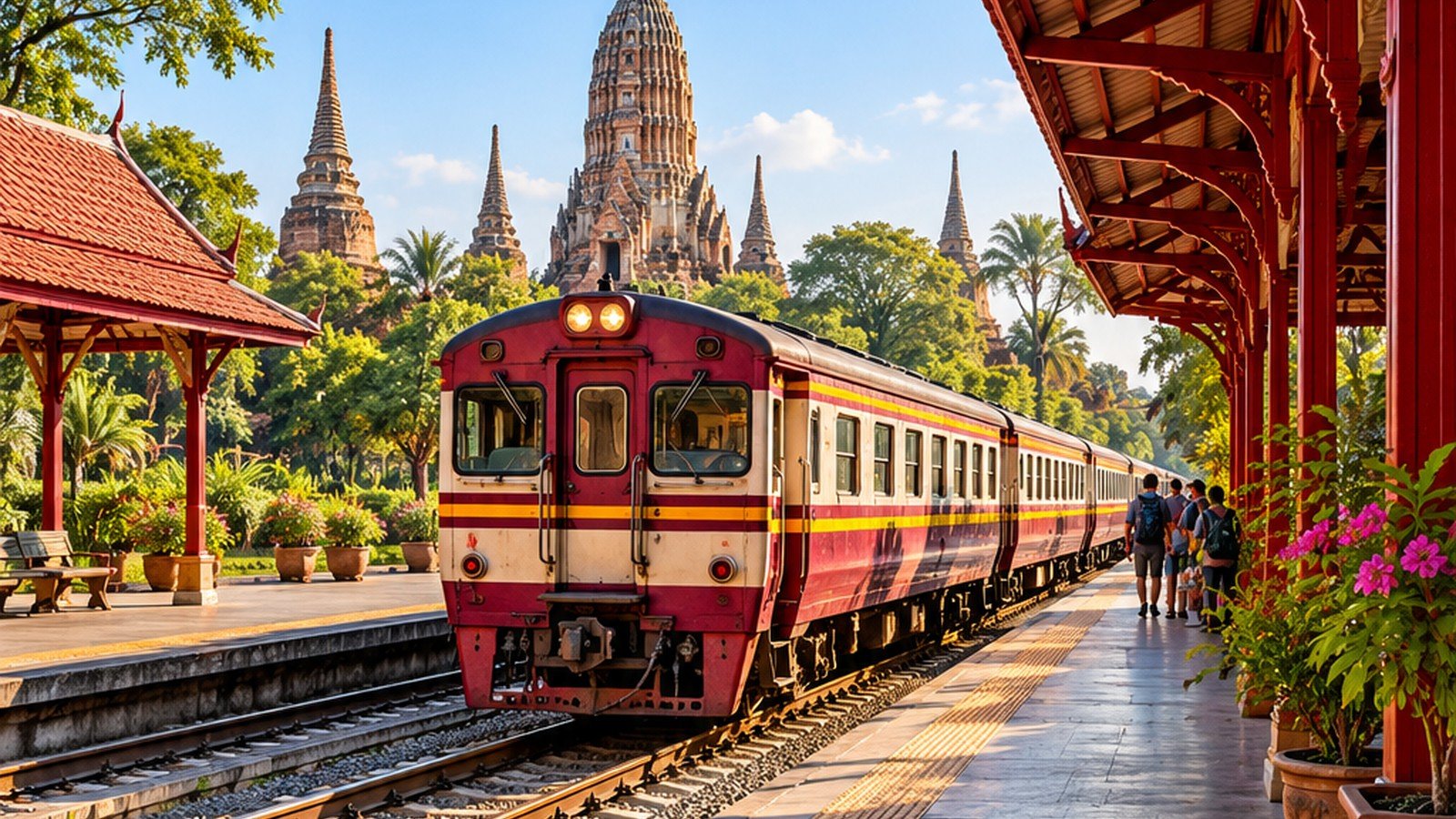
Conceptual travel illustration, not a station photograph. The temple forms do not show the real distance or layout from Ayutthaya railway station.
Make the trip work for you
Getting from Bangkok to Ayutthaya is straightforward once the first and last parts of the journey are clear. The difficult comparison is not simply train versus van versus taxi: it is your Bangkok hotel to the correct departure point, the main journey, and the final transfer to the ruins or your accommodation. A low fare can be excellent value, but it does not automatically make the whole day easier.
This guide explains the terminal distinction, ordinary and Connex services, van meeting points, private-vehicle quotes and the difference between a transfer and a guided tour. It also covers luggage, airport arrivals, return journeys and the point at which staying overnight makes more sense. Timetable examples and fares are dated, while worked budgets and journey calculations are labelled as illustrations. The aim is a transport decision you can follow from one door to the next.
This guide contains affiliate links. If you book through one, Taylor’s Trailblazing Travels may earn a commission at no extra cost to you. Choose the option that suits your trip; paid bookings are not required to use this guide.
Selected ordinary trains
Check the service; a low local fare is not a universal rail tariff.
Bangkok Connex
The full-route promotion ends on 31 October 2026.
A specified private vehicle
Compare per-person totals only after checking capacity and extras.
The wrong Bangkok terminal
Hua Lamphong and Krung Thep Aphiwat are distinct departure points.
Planning note Fare check, 4 October 2026: the reported full-route Connex promotion is THB 50 through 31 October 2026. Confirm later fares, services and current disruption before travel. [1]
Bangkok to Ayutthaya: train, van or taxi at a glance
Choose the complete journey
Take the train when you value a low-cost journey, can reach the correct Bangkok station without difficulty and are comfortable arranging the final transfer in Ayutthaya. Choose a van when its actual meeting point is convenient and you are travelling light. Choose a private taxi or transfer when door-to-door simplicity, luggage or a small group’s needs justify paying for the vehicle.
That comparison is about the whole trip, not a race between vehicles. A train can be quick between stations but slower from your hotel once access and waiting are included. Meanwhile, a van can look cheap until you add a cross-city ride to its departure office. A taxi removes changes, but it does not remove road congestion.
| Option | Planning time for the main leg | Price basis | Main check before paying |
|---|---|---|---|
| Ordinary/local train | Often around 1.5-2 hours; service-specific | Per passenger; some low ordinary fares | Exact terminal, operating day and seating arrangement |
| Faster train or Connex | Some journeys around 1-1.5 hours | Per passenger; class and service matter | Do not assume every service can be reserved online |
| Shared van | Allow roughly 1.5-2.5 hours plus check-in | Per passenger, sometimes extra for bags | Both pickup and drop-off pins |
| Private taxi/transfer | Allow roughly 1.5-2.5 hours; traffic-sensitive | Usually per vehicle for an agreed route | Vehicle size, luggage, tolls and final address |
| Guided day trip | Usually most of the day | Commonly per participant or private group | Guide, admissions, stops and return location |
These are editorial planning ranges reviewed on 4 October 2026, not published guarantees. The rail timetable, booking listings and selected vehicle provide the details for your date. [2] [3] [4]
Important changes and conditions for this journey
The newer Connex option needs a dated explanation
SRT Bangkok Connex now links Krung Thep Aphiwat and Ayutthaya, according to reporting of the railway’s announcement. The full-route promotional fare is THB 50 through 31 October 2026, checked 4 October 2026. The often-advertised THB 30 applies to shorter parts of the route, not automatically the complete journey to Ayutthaya. Weekday and weekend service counts also differ. [1]
Do not carry that promotional price into a trip after the stated end date without checking again. Nor should you assume Connex is the only train available: ordinary and other intercity services create different departure choices. The right comparison uses the service that fits your actual day.
Check disruption before leaving the hotel
At this review date, the FCDO warns of severe flooding affecting parts of Thailand, including Bangkok and surrounding provinces, while the Thai Meteorological Department’s current outlook includes heavy-rain cautions. Those notices do not establish that this entire route is suspended, but they make a fresh service and road check essential. [5] [6]
For later travel, use the latest information. A static article cannot confirm the condition of your hotel access road, a particular train or the local river crossing at the hour you arrive. Check the operator first and keep a workable alternative rather than assuming the original booking will function regardless of conditions.
The Bangkok station question: do not skip it
Hua Lamphong and Krung Thep Aphiwat are different places
Ayutthaya-bound services can use Bangkok’s older Hua Lamphong station or Krung Thep Aphiwat Central Terminal. SRT maintains separate route searches for those origins. A ticket saying Bangkok should prompt you to read the exact station field, not to choose the terminal you recognise from another journey. [2] [7]
This matters because the local journey across Bangkok can outweigh a small difference in the rail fare. A traveller already near Hua Lamphong may reasonably choose a suitable ordinary service there; someone near the northern rail hub may prefer a departure from Krung Thep Aphiwat. Compare the departure times and access route together.
Use the train number as your anchor
Write down the train number, departure station, departure time and destination before setting off. A screenshot of a general search result is less useful than the details of the chosen service. At the station, check the current display or ask staff rather than relying entirely on the platform number you saw earlier.
Leave time for ticket purchase or collection, locating the correct waiting area and boarding. For a first visit to an unfamiliar large terminal, arriving with only a few minutes to spare is an avoidable source of stress. The station access period belongs inside your journey estimate, even though it is not printed as train travel time.
Ordinary trains: low fares with a different comfort level
Good value when the service fits
SRT’s Hua Lamphong-Ayutthaya route snapshot lists some ordinary/suburban fares from THB 15, with service-specific ranges including THB 15-35, checked 4 October 2026. That establishes that inexpensive local options exist; it does not mean every Ayutthaya train costs the same amount or that every departure runs daily. [2]
Ordinary services can appeal to travellers who enjoy an open-window journey and do not need a guaranteed premium seat. However, inspect the actual class and service rather than treating third class as one identical product. Heat, crowding, seating availability and the number of intermediate stops can affect the experience.
Know what you are not buying
An inexpensive local ticket should not be confused with an air-conditioned, reserved-seat intercity booking. Some services are unreserved and purchased at the station rather than through an online travel platform. A booking website displaying no result is therefore not proof that no train operates. Use SRT’s timetable as well as the seller’s inventory. [3] [8]
Pack a small amount of water and keep your bag manageable. Ordinary travel works particularly well for a day trip with a light bag; it is less attractive when you have several large suitcases and limited ability to lift them. Decide on comfort and logistics before celebrating the lowest fare.
Connex and other faster departures
A practical morning example, not a universal timetable
Thai Tracks’ current specialist listing shows Connex train 9003 leaving Krung Thep Aphiwat at 09:05 and reaching Ayutthaya at 10:20. The listing describes daily operation and station purchase without reserved seats, checked 4 October 2026. It is an independent timetable source, so confirm the service with SRT for your date before building the day around it. [9]
The attraction is a reasonably compact rail journey with air conditioning, but the timing still produces a late-morning sightseeing start once you leave Ayutthaya station. Someone wanting to be at the ruins much earlier should compare other departures rather than assuming the new service is automatically the best one.
Reservation rules depend on the train
Other rapid or express services may offer reservable seats and different fare structures. Search the precise route and class on SRT’s D-Ticket system or a recognised seller. A reservation for one kind of train does not establish the procedure for Connex or an ordinary local train. [8]
Read the ticket instructions carefully: whether you receive an electronic ticket, need to collect anything, must show identification, or have a particular boarding cutoff. Do not buy a third-party service merely because it appears easier if the train you really want is a straightforward station-purchase option. The purpose of a booking platform is convenience and comparison, not access to every departure.
Buying a train ticket without creating another problem
Search direct before comparing convenience
Begin with SRT for the timetable and eligible reservations. Check that the origin is the terminal you intend to use and that the destination is Ayutthaya, not a nearby stop selected by autocomplete. The price, class and operating day should all correspond to the same service. [8] [10]
A third-party platform may be useful when it presents a reservable option clearly or offers payment methods you can use. However, it can display only part of the rail market, charge a service fee or apply different change procedures. Compare the complete checkout amount and instructions rather than the first price on a search page. [4]
Keep the booking simple
Use the passenger details requested by the operator and review them before payment. Save the confirmation offline, including the carriage and seat where assigned. For an unreserved service, understand that your ticket does not promise a particular view or a row of seats together.
If a site fails to accept a payment, check whether a booking was created before repeating the transaction. Avoid making several overlapping reservations out of impatience. A clear record of one chosen train, one purchase and one set of boarding instructions is preferable to several uncertain confirmations on different apps.
What happens when you arrive at Ayutthaya station?
The station is across the river from the historical island
Ayutthaya station is on the eastern mainland, not in the middle of the ruins. From there, you need a local crossing and onward movement or a road transfer to your first stop. The independent Thai Train Guide station page is useful for understanding the layout, but current crossing availability must be checked locally. [11]
Travelling light, you may be comfortable using local options and deciding the next stage on arrival. With large bags, children or reduced mobility, an agreed vehicle pickup can be more straightforward. Do not assume that a short map distance is a pleasant luggage walk in heat or rain.
Choose the first stop before negotiating transport
Decide whether you are going to a hotel, a temple entrance or a meeting point for a local tour. Give the driver the full name and a saved pin. A broad request for the historical park can produce a drop-off that does not match your intended starting point.
For an overnight stay, leave luggage at the accommodation before beginning a long outdoor circuit if the property has agreed to store it. For a day trip, carry only what you can comfortably manage. Do not build the day around an assumed station locker or baggage service that you have not confirmed.
Van luggage, seating and comfort
A small vehicle has limited spare space
Before booking, ask how much luggage the chosen van accepts and whether a large suitcase needs an extra seat or a separate charge. Do not assume airline-style baggage rules apply. A vehicle can have enough passenger seats while still having insufficient usable luggage space for the whole group.
A day bag is usually easier to manage than a large hard suitcase, but the operator’s specific policy is what matters. Keep valuables and essential documents with you. If you cannot comfortably lift the bag or use a cramped entrance, consider a larger vehicle or a private transfer rather than relying on someone to improvise assistance.
Road travel has a different pattern of delays
A van may make intermediate stops or wait as part of its normal service pattern. Check the description instead of assuming a nonstop journey. Air conditioning is useful, but it does not establish legroom, seat arrangement or the presence of a toilet; ask about any feature that is essential.
For travellers who feel unwell on road journeys, choose the mode and seating arrangement that usually works for them and avoid scheduling an immediate strenuous activity on arrival. Build a short break into the first Ayutthaya stop. The best transfer is one that leaves you ready to enjoy the day, not simply the one with the shortest advertised duration.
Private taxi or transfer: easiest with a clear agreement
Pay for the specific journey you need
A private vehicle makes most sense when several people share the cost, luggage is substantial, the origin is awkward for public transport, or you want a direct arrival at your accommodation. Commercial booking listings offer different vehicle types and pickup arrangements, so the exact route and capacity must be part of the comparison. [4]
Provide the full Bangkok pickup address, Ayutthaya drop-off address, passenger count and luggage details. Ask whether tolls, parking, waiting and any airport meeting service are included. A quote for two adults with small bags should not be assumed to cover four adults and several large suitcases in the same vehicle.
One-way transfer is not an all-day driver
Be explicit about whether you are buying a direct journey, a return transfer or a sightseeing vehicle that waits between stops. Those are different services with different costs and responsibilities. A taxi delivering you to Ayutthaya does not automatically remain available while you visit temples.
If you need a child seat or specific access arrangement, obtain written confirmation of the actual equipment and vehicle. Use a reputable provider, wear seat belts and agree how to contact the driver. Door-to-door convenience is valuable, but it should come from a properly specified booking rather than an assumption that everything can be settled on the road.
A tour may solve a different problem from transport
Decide whether you need interpretation
A guided day trip can combine the intercity journey, local transport and explanations at the ruins. That is useful when you would otherwise spend time organising several stages or when historical interpretation matters to you. It is not directly comparable with the price of a train ticket alone.
Read the list of included sites, admission fees, meals and return arrangements. A commercial private-tour example includes both transport and a guide, illustrating the distinction, but each offer must be checked on its own terms. Do not assume that all products described as an Ayutthaya tour include the same temples or amount of time. [12]
Protect the part of the visit you care about
If your priority is photography, a small selection of temples or an accessible pace, ask whether the itinerary can accommodate that. A crowded schedule may give you more names but less useful time. A private tour can provide flexibility, but only when the provider actually agrees to the requested changes.
Check the group size, language and pickup zone before paying. Also ask what happens in heavy rain and whether the return is to your hotel or a central meeting point. Those details determine whether the tour genuinely removes work or simply replaces one set of decisions with another.
Which option suits your Bangkok base?
Near the older station or old-town side
When staying near Hua Lamphong, compare a suitable train there before arranging a long trip north to another terminal. A lower-frequency departure that fits your day can be preferable to a theoretically faster service reached through an inconvenient city transfer. Equally, do not choose a much later train solely to avoid a manageable connection if early sightseeing is the priority.
From Khao San or another old-town location, inspect actual van pickup offices and private-transfer quotes as well as rail access. The useful option is the one with a clear, reasonable first stage. A tour with a nearby confirmed meeting point can also be competitive once all the local journeys are counted.
Near the northern rail hub or farther east
From accommodation with easy access to Krung Thep Aphiwat, the modern terminal’s departures deserve an early look. From farther east in Bangkok, calculate the transfer rather than guessing from the distance on a city map. Morning traffic, rail connections and station access all contribute to the total.
A private car becomes more attractive when the public-transport route would require several changes with luggage. However, compare the actual road journey and pickup time, not an optimistic minimum. The same Bangkok-Ayutthaya headline route can describe very different door-to-door experiences from different hotels.
Travelling from Don Mueang or Suvarnabhumi
Don Mueang can change the starting point
Some northbound rail services call at Don Mueang, including the Connex example in the specialist timetable. A passenger arriving there may be able to avoid travelling into central Bangkok first, but must check the actual service, station access and connection time. The airport’s arrival process and the train departure are separate bookings. [9]
Do not buy an inflexible onward departure based on the aircraft’s scheduled landing time alone. You still need to leave the aircraft, complete any entry formalities, collect bags and reach the appropriate station area. A missed train may be manageable on a flexible day, but not when another tightly timed booking depends on it.
Suvarnabhumi requires a different calculation
Suvarnabhumi is not beside the Ayutthaya rail corridor. Compare the full urban connection to a suitable train with a direct road transfer. For several travellers after a long flight, the reduction in changes may justify the car even when its cash cost is higher.
For either airport, provide the flight details and understand the waiting policy if booking a private transfer. Keep the airport name and code clear: BKK and DMK are not interchangeable. If the onward journey follows an overnight flight, consider whether a recovery night in Bangkok would make the first Ayutthaya day more enjoyable.
Compare costs without mixing per-person and per-vehicle prices
Start with the genuine rail examples
The ordinary-train fare examples and Connex promotion above are dated service information, not an all-inclusive day-trip budget. A THB 15 local ticket or THB 50 promotional Connex ticket, checked 4 October 2026, still leaves any Bangkok station access, Ayutthaya local transport, meals and admissions to pay. [2] [1]
For vans and taxis, use the checkout quote for your exact route and date. Automated route-summary text can be inconsistent, and a platform may show only a limited set of departures. This guide therefore does not turn a fluctuating headline fare into a universal tariff. [4]
A worked group example
Suppose four adults receive a hypothetical private-car quote of THB 2,000 one way. That is THB 500 each, assuming the vehicle fits everyone and their bags. If each public-transport traveller instead budgets THB 200 for the main leg and the group adds THB 600 in combined local access rides, the comparable group total is THB 1,400, or THB 350 each. These are illustrative inputs dated 4 October 2026, not current operator offers.
The difference is then THB 150 per person for the assumed direct journey, before any other exclusions. Replace those inputs with real quotes and decide whether the saved changes and waiting are worth it. This is a better comparison than declaring a taxi expensive because its vehicle price is larger than one person’s rail fare.
Calculate door-to-door time honestly
Add the stages nobody advertises
Consider an example train journey with 35 minutes to the Bangkok station, 30 minutes for ticketing and waiting, 75 minutes on the train and 25 minutes to the first Ayutthaya stop. The total is 165 minutes, or two hours and 45 minutes. The arithmetic is illustrative; only the selected train’s actual timetable supplies a scheduled rail duration.
A van comparison should include travel to the office, required check-in, possible intermediate stops and the final local journey. A taxi comparison should include pickup coordination, traffic and any planned stop. Do not compare the train’s hotel-to-hotel time with the taxi’s best-case motorway segment.
Build a margin around the fragile stage
The stage most likely to cause stress is often a connection rather than the longest leg. That might be reaching an unfamiliar platform, finding a van office down a side street or meeting a driver at an airport. Add a buffer there instead of scattering arbitrary spare minutes evenly through the whole day.
For a first visit, a slightly later start with clear arrangements may be better than an extremely early departure assembled from several uncertain connections. Conversely, an early direct train can be excellent when the station access is straightforward. The right answer comes from the chain of journeys, not the mode alone.
A realistic day trip once you arrive
Limit the first circuit
Choose a small group of temples or historical sites rather than treating transport to Ayutthaya as the hard part and everything afterwards as effortless. The historical city covers a broad landscape with separate sites, so local movement, heat and meals remain part of the day. UNESCO’s description gives the historical context, not an instruction to see the entire area in one visit. [13]
A sensible first circuit might focus on the central ruins, lunch and one additional site chosen for a specific interest. A guide can help with interpretation; a driver can simplify movement. Confirm which service you have bought rather than expecting every local transport provider to supply both.
Decide the return before the final temple
Set a latest departure from the last sight that leaves time to reach the station or meeting point. Keep the ticket and contact details accessible, and avoid adding an extra stop because it appears nearby on the map. The distance from a temple entrance to a vehicle pickup can itself consume time.
If a sunset visit is central to the plan, choose a return service that accommodates it or stay overnight. Do not assume there will always be a convenient late train or van. A day trip is more enjoyable when the finish has been planned as carefully as the outward journey.
Returning to Bangkok and travelling onwards
Check the return terminal, not just the destination city
On the return, a train back to Bangkok may finish at a different terminal from the one most convenient for your hotel. A van may return to a travel office or transport station rather than the place where you began. Read the actual arrival field and allow for the final urban journey before making an evening reservation. [10] [4]
Book the return early enough when your day depends on a specific departure, but understand the fare’s change rules. For an unreserved local train, confirm the station-purchase procedure and the current timetable. A booking platform’s last visible departure is not necessarily the last service operated by every provider.
An onward northern train needs its own plan
Ayutthaya can be a stop before travelling farther north, but luggage storage, timing and reserved seats must be resolved independently. Do not assume the onward train is available merely because trains pass through the station. Search the exact destination, date and class, and leave enough time to collect bags and reach the platform.
Avoid attaching a tight flight connection to the return from Ayutthaya. A missed dinner reservation is inconvenient; a missed flight is a different level of consequence. Where the flight is important, an overnight in Bangkok or a much wider margin is the more resilient arrangement.
When staying overnight is the better transport decision
Compare usable hours, not only room cost
An overnight stay can replace a rushed late return with a calmer evening and another morning among the ruins. That is especially useful when the outward journey begins late, you want a sunset visit, or the next leg of the trip continues north rather than back to Bangkok.
Choose the accommodation area according to the arrival and departure. A central island base supports sightseeing; a station-side property may simplify an early train; a riverside hotel can make the evening part of the experience. Check the exact address and the last local transfer instead of assuming all Ayutthaya hotels serve the same purpose.
Do not move luggage without a benefit
For some travellers, a selective day trip remains the easier choice. Keeping the Bangkok room avoids packing, checkout and another arrival procedure, particularly during a short holiday. The overnight option is worthwhile when it gives you useful time or an experience you actually want, not simply because a longer itinerary sounds more thorough.
If you stay, confirm luggage storage before and after room access. That small service can be the difference between enjoying a final morning and carrying bags through the heat. Compare the whole overnight cost with the transport flexibility it creates rather than treating the room as an unrelated purchase.
Two example day plans, with different priorities
The early ruins-first day
This version suits someone willing to leave their Bangkok accommodation early and whose chosen train or transfer can deliver them to Ayutthaya with a useful morning ahead. Decide the first temple cluster before departure, arrange the station-to-site journey and leave the largest exposed walking block before the hottest part of the day. The exact departure must come from the live timetable, not from this example.
After lunch, choose one further site and begin the return with time to spare. Do not keep extending the route until the only remaining departure is inconvenient. A compact day can still feel full when the visits are chosen for different reasons: architecture, historical interpretation and a quieter place to pause, rather than several nearly identical photo stops.
This arrangement works best with a light bag and a clear return plan. If you need to carry luggage for an onward journey, solve storage before setting off. Otherwise, the apparent simplicity of a direct train can be lost to an unplanned search for somewhere to leave your belongings.
The slower start with an overnight
A later departure is more comfortable when you are not trying to complete every visit and return to Bangkok that same evening. Travel to the accommodation first, leave bags if permitted, have lunch and use the afternoon for a selective introduction. The following morning then provides another sightseeing period before departure.
A southern riverside stay can make the evening part of the experience, while a central island room can simplify an early start among the ruins. Choose by how you will use the hours, not by a general claim that one area is the best. If you continue north afterwards, check the onward train and luggage arrangements before committing to the room.
Compare the cost of the extra night with what it removes: a rushed final transfer, an inconvenient late arrival in Bangkok or repeated travel back over the same route. Sometimes the day trip remains the simpler answer. Sometimes one well-placed overnight makes the entire journey more coherent.
What to do when a connection does not go to plan
A late train, missed van or changed pickup
First establish the facts with the operator or station staff. A delayed service, cancelled departure and missed booking are different problems with different options. Keep the booking reference ready and ask what is actually available next, rather than buying a second ticket immediately from the first person who offers help.
If a third-party seller made the booking, use its support channel where the terms require it, while also checking local operating information. Keep records of cancellation messages and receipts for any replacement travel. Do not assume a refund or reimbursement is automatic; the fare conditions and any insurance terms determine that separately.
Where the problem only reduces sightseeing time, remove a stop before you remove lunch or the return buffer. The transport delay has already made the day more tiring. Responding by rushing every remaining stage often produces a second avoidable problem, such as missing the return because the final local journey was underestimated.
A practical fallback in Ayutthaya
Keep enough accessible money for a local ride, food and a reasonable unexpected change, and retain a way to contact the accommodation or onward provider. If returning late becomes difficult, compare an overnight stay with a properly arranged private transfer. Do not accept an unclear vehicle arrangement solely because you feel pressured to leave immediately.
For a journey linked to an important flight, the sensible fallback may be abandoning the remaining sightseeing and returning much earlier. That decision should be made while alternatives still exist. A resilient plan gives you choices; a plan that depends on the last possible service gives you very few.
Common mistakes, strengths and compromises
What each mode does well
The train provides a clear scheduled journey and access to inexpensive fares on suitable services. The van can work well from a convenient office for a traveller with a light bag. A private transfer removes changes and accommodates a specified route. A guided tour adds local organisation and interpretation when those are wanted.
Each has a compromise. Rail requires the correct terminal and a final local journey, vans require close attention to luggage and meeting points, and taxis remain traffic-dependent. Tours follow a structure that may not match every interest. Recognising those limits is more useful than searching for a transport choice with no disadvantages.
The preventable errors
Do not go to Hua Lamphong with a Krung Thep Aphiwat booking, confuse Mo Chit station with an operator’s van terminal, or assume Ayutthaya station is beside every ruin. Do not compare a per-vehicle quote with a per-person ticket without adjusting the numbers. Finally, do not assume a promotional fare continues beyond its stated dates.
Keep one clear record of the route: origin pin, departure, arrival point, local transfer and return. Save it offline and share the important details with travelling companions. A working phone connection helps, but it should support a plan that remains understandable without an app.
Frequently asked questions
Is the train the cheapest way from Bangkok to Ayutthaya?
Some ordinary services have very low fares, so the train can be the least expensive main leg. However, include the cost of reaching the station and leaving Ayutthaya station. A cheap ticket from a distant terminal may not produce the cheapest complete trip. The official fare examples in this guide were checked on 4 October 2026 and are service-specific, not a flat price for every train. [2]
Does every train leave from Krung Thep Aphiwat now?
No. SRT’s route information still distinguishes services from Hua Lamphong and Krung Thep Aphiwat. Read the exact departure station on your selected service. Do not use a general statement about Bangkok’s main railway terminal to override the details of the train you have actually chosen. [2] [7]
Can I reserve Connex online?
The current independent train-9003 listing describes station purchase and unreserved seating. Check that procedure with SRT before travel, particularly after timetable or fare changes. Connex should not be confused with other reservable rapid or express services. The absence of Connex from an online seller’s results does not by itself mean the service is cancelled. [9]
Is the full Bangkok-Connex journey THB 30?
The reported promotion distinguishes shorter journeys from the full route to Ayutthaya. For the complete route, the promotion is THB 50 through 31 October 2026, checked 4 October 2026. Recheck the fare for later travel and confirm that you are selecting Connex rather than another train with a different tariff. A promotional headline is not a substitute for the chosen journey’s fare. [1]
Is a taxi sensible for four people?
It can be, especially with luggage or an inconvenient public-transport start. Divide the complete vehicle quote by the passenger count only after confirming that the car fits the group and bags. Ask about tolls, parking and waiting. A larger vehicle may change the price, but the reduction in connections can still make it worthwhile for the group.
Can I take a large suitcase in a shared van?
Possibly, but obtain the chosen operator’s baggage policy before paying. Some vehicles have limited storage or require an additional seat or charge. Do not assume that a passenger booking automatically includes a large suitcase. A train or appropriately sized private vehicle may be easier when the luggage arrangement is uncertain.
Is Ayutthaya an easy day trip from Bangkok?
It can be a straightforward selective day trip when you plan both ends of the transport and do not overfill the sightseeing. Choose a manageable cluster of sites, allow for lunch and heat, and settle the return arrangements before the final stop. Stay overnight when you want a slower evening, another morning or an onward northern journey that makes returning to Bangkok unnecessary.
Final recommendation: choose the route with the fewest awkward stages
For an independent traveller with a light bag, a suitable train from the more convenient Bangkok terminal is the strongest starting point. A van is worth considering when its real meeting point and drop-off simplify the journey. A private transfer earns its higher cost when it removes several difficult stages for a group, family or traveller with luggage.
Before booking, write the complete chain from your Bangkok door to your first Ayutthaya stop and back again. Confirm the service, price, luggage and current conditions, then choose the option that leaves enough energy for the visit itself. The best transport decision is not always the cheapest ticket or shortest advertised ride; it is the journey that works from beginning to end.
Sources and fact-checking notes
Source checks were completed on 4 October 2026. Official operators and public bodies are prioritised; independent specialists and commercial listings are identified below. Suggested visit lengths, budget exercises and route choices are planning judgements, not live availability or a record of personal visits. Recheck time-sensitive details for your date.
- The Nation: SRT Bangkok Connex route and promotion
Report dated 2 August 2026 on the SRT announcement. Full-route promotional fare THB 50 through 31 October 2026; weekday and weekend service counts differ. Checked 4 October 2026.
- State Railway of Thailand: Hua Lamphong to Ayutthaya
Official route result lists ordinary/suburban services and fares starting at THB 15. Search snapshot checked 4 October 2026; recheck individual trains and operating days.
- Thai Tracks: Bangkok to Ayutthaya by train
Independent rail specialist for terminal distinctions and train-specific journey examples. Checked 4 October 2026; use SRT for final confirmation.
- 12Go: Bangkok-Ayutthaya transport listings
Commercial booking inventory checked 4 October 2026 for available vehicle types. Headline prices, journey counts and automated explanatory text can be inconsistent; use the dated checkout quote, not the summary, when booking.
- FCDO: Thailand travel advice
Official advice including the severe-flooding notice. Checked 4 October 2026; a national notice is not evidence that every local attraction is closed.
- Thai Meteorological Department: seven-day outlook
Official forecast published 4 October 2026. Weather, water levels and local restrictions must be rechecked for the travel date.
- State Railway of Thailand: Krung Thep Aphiwat to Ayutthaya
Official route search for the newer terminal. Checked 4 October 2026; availability and train-specific prices need a fresh travel-date search.
- State Railway of Thailand: D-Ticket
Official booking system for eligible services. Not every unreserved local service can be booked here. Checked 4 October 2026.
- Thai Tracks: Bangkok Connex train 9003
Independent specialist timetable, not an SRT website. Lists 09:05-10:20 daily and station purchase without seat reservations. Checked 4 October 2026; confirm directly with SRT.
- State Railway of Thailand: official timetable search
Use exact origin, destination and travel date; includes service notices. Checked 4 October 2026. Live search availability was intermittent.
- Thai Train Guide: Ayutthaya railway station
Independent specialist source on station geography and onward access. Checked 4 October 2026.
- GetYourGuide: private Ayutthaya touring example
Illustrates the distinction between a guided tour and a one-way transfer. Commercial listing checked 4 October 2026; not a promise of accessibility or availability.
- UNESCO: Historic City of Ayutthaya
Primary source for the historic city and river-island setting. Checked 4 October 2026.
Illustrations in this article were created for Taylor’s Trailblazing Travels. Third-party photographs, where used, are credited beside the image or in the source list.