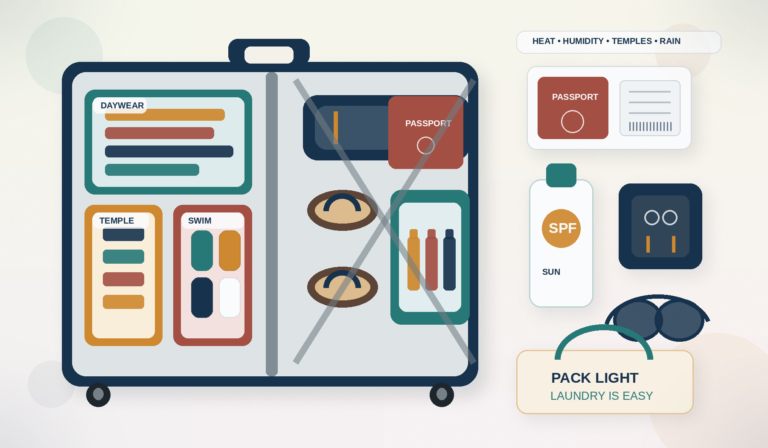
Thailand Train Travel Guide 2026: Routes, Sleeper Trains and Booking
Choose the journeys where rail improves the trip, book the right berth and avoid the station and connection mistakes that cost travellers time.
Seven useful rail routes
Sleeper and station advice
Thailand train travel works best when the journey is part of the holiday rather than simply the slowest way to reach the next hotel. A Bangkok–Chiang Mai sleeper can replace a night’s accommodation and deliver a memorable change of pace. The short ride to Ayutthaya is an easy first rail trip, while the daytime western line towards Kanchanaburi and Nam Tok offers scenery and historical context that a flight cannot.
Rail becomes less attractive when the itinerary depends on a tightly timed ferry, a separate flight or a destination with no station. Phuket, Krabi and the Gulf islands all require road or sea transfers after the train. Likewise, Bangkok has several active stations, so a ticket that merely says “Bangkok” in a journey-planning app is not enough information for a taxi driver.
This guide focuses on the decisions that make the largest practical difference: route choice, the correct Bangkok terminal, the current State Railway of Thailand booking window, berth type, realistic fare examples and safe connection buffers. Schedules and rolling stock can change, so every example should be checked against the official SRT timetable for the exact travel date.
Bangkok to Chiang Mai
The classic sleeper route, with several current daily services and the widest choice of seat and berth styles.
Thonburi to Nam Tok
A simple daytime train through Kanchanaburi’s river and cliff landscape, best paired with time to understand the railway’s history.
Bangkok to Ayutthaya
A short, inexpensive introduction to Thai rail, although the ruins still require a bicycle, tuk-tuk or driver after arrival.
The exact station
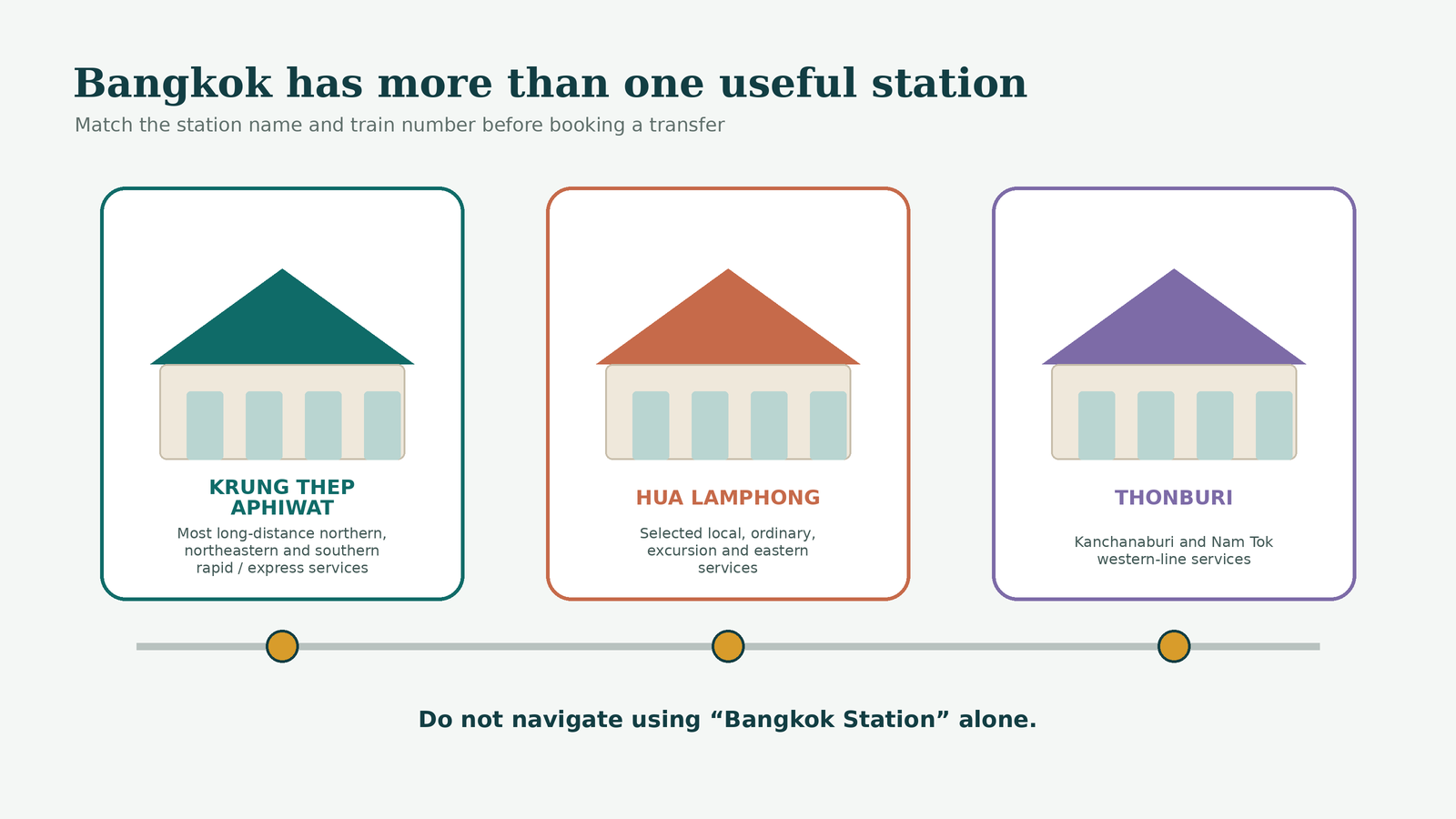
Krung Thep Aphiwat, Hua Lamphong and Thonburi are not interchangeable. Match the ticket, train number and station name.
Rail is not automatically the cheapest, fastest or most convenient choice. It becomes valuable when the route is direct, the timetable fits naturally and the journey itself earns its place in the itinerary.
| Choose the train when | Choose another method when |
|---|---|
| An overnight sleeper replaces a hotel night and arrival morning can remain flexible. | A separate flight, tour or ferry cannot tolerate a late arrival. |
| The destination lies naturally on the rail corridor, such as Ayutthaya, Chiang Mai, Nong Khai or Surat Thani. | The station is followed by several awkward road transfers or substantial backtracking. |
| You value room to move, changing scenery and a slower travel experience. | You have only a few days and the journey would consume a full sightseeing day. |
| Your luggage is light enough to lift through stations, carriage doors and sleeper aisles. | Mobility needs, a pushchair or large cases make unassisted boarding difficult. |
| You are comfortable with simple facilities and equipment that varies by train. | You expect a hotel-sized private cabin, silence or airline-style punctuality. |
The flexible-morning rule
Plan an overnight train only when the following morning has breathing room. Even a service that arrives close to schedule leaves time for getting off the train, finding a taxi, reaching the hotel and waiting for a room. A sleeper followed immediately by a fixed island transfer turns an enjoyable journey into a chain of risks.
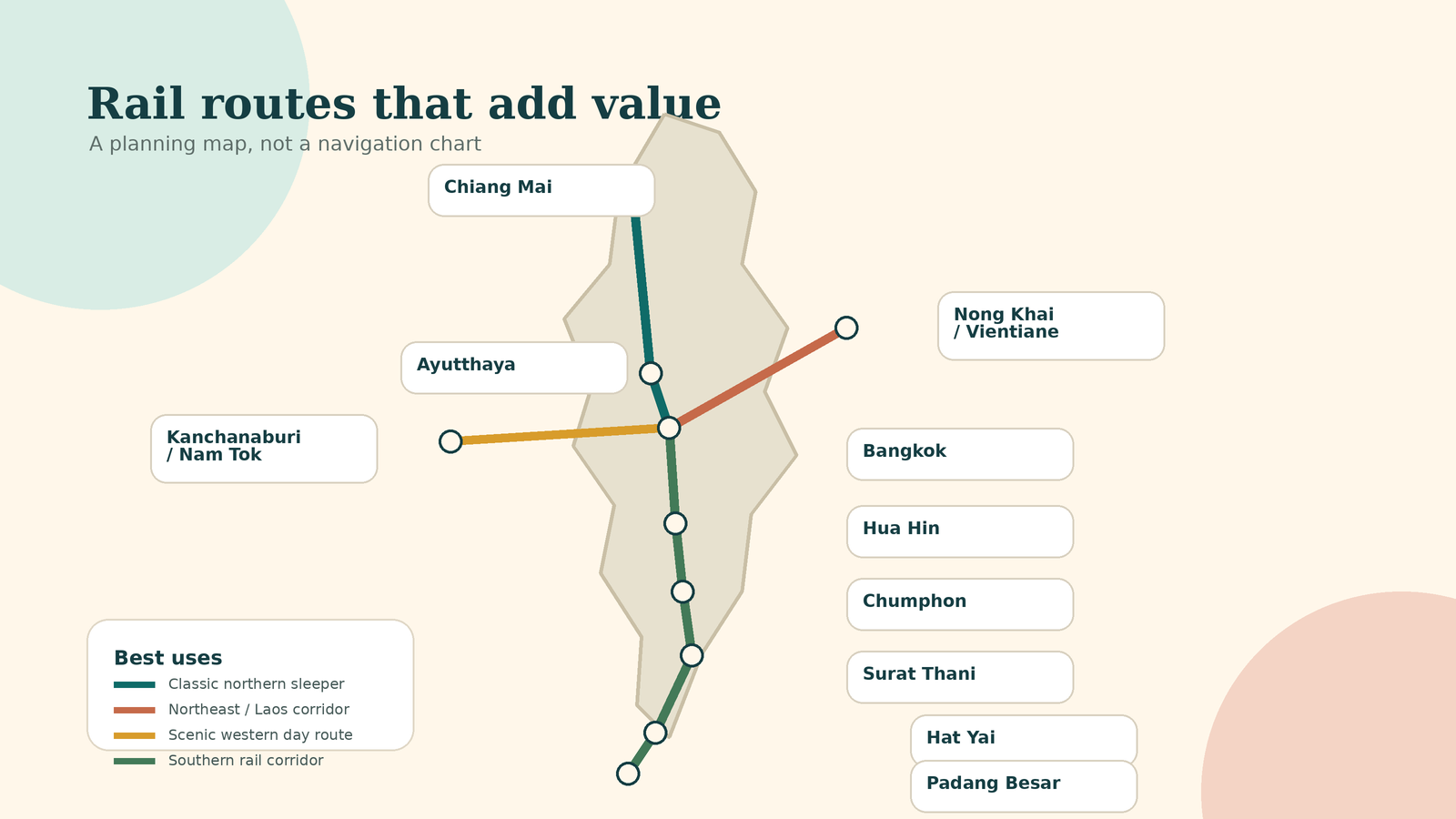
These are the routes where rail normally contributes more than transport alone. Current departure times differ by train and date, so the table describes the travel decision rather than promising a fixed timetable.
| Route | Typical style | Why take it | Best for | Watch for |
|---|---|---|---|---|
| Bangkok–Chiang Mai | Overnight or full-day | The classic Thai sleeper experience and a direct link into the north. | First-time sleeper travellers | Popular lower berths and cabins sell first. |
| Bangkok–Ayutthaya | Short daytime trip | An easy, inexpensive introduction to Thai rail and a major heritage city. | Day trips and budget travel | The ruins are spread beyond the station. |
| Bangkok–Surat Thani | Day or overnight | A practical rail gateway for Khao Sok and Gulf-island transport chains. | Southbound sleeper users | Road and ferry connections add risk. |
| Bangkok–Nong Khai / Vientiane | Overnight | A slower route to the Mekong and, on selected services, Vientiane Khamsavath. | Northeast and Laos itineraries | Immigration and onward transport remain separate checks. |
| Bangkok–Hua Hin / Chumphon | Day or overnight | A shorter coastal rail experience or a break in the journey south. | Hua Hin stays and some Koh Tao routes | Confirm the pier transfer and its operator. |
| Thonburi–Kanchanaburi–Nam Tok | Basic daytime service | River, cliff and railway scenery combined with significant wartime history. | Scenic travel and longer Kanchanaburi stays | It uses Thonburi, not Aphiwat. |
| Bangkok–Hat Yai / Padang Besar | Long overnight | An overland route into Thailand’s deep south and towards Malaysia. | Slow regional travel | Long duration and border timing. |
Bangkok to Chiang Mai: the classic first sleeper
The northern line is the most recognisable visitor rail journey. It links Bangkok with Ayutthaya and Phitsanulok before reaching Chiang Mai, making it easy to combine a sleeper with a culture-led northern itinerary. The current SRT timetable shows several daily options, including a daytime service and multiple overnight trains, with journey times of roughly ten to fourteen hours depending on the stopping pattern.5
Choose a sleeper when the overnight experience matters and the next morning is light. A day train reveals more of the landscape, although it also uses most of a sightseeing day. For many travellers, a second-class lower berth gives the strongest balance of comfort, price and practicality.
Bangkok to Ayutthaya: the simplest first journey
Ayutthaya is close enough for a day trip yet far enough to feel like a real rail journey. Ordinary and local trains can be extremely inexpensive, while reserved rapid or express services cost more. Online availability also varies by train type, so a service visible in the timetable may not always be sold through D‑Ticket.
Arrival at the station is only the first step. The historical park covers a broad area across the river, so include a bicycle, tuk-tuk or private driver in the day’s budget. Starting early provides cooler conditions and more margin for a later train back to Bangkok.12
Bangkok to Surat Thani: useful for Khao Sok and Gulf islands
Surat Thani is the main rail gateway for Khao Sok and combinations towards Koh Samui, Koh Phangan and Koh Tao. It is not an island station: the railway stop is outside the city centre, and onward travel requires a road transfer plus a ferry for island destinations. Current official timetable examples include both a daytime special express and several evening or overnight services.6
For Khao Sok, confirm where the accommodation pickup starts and whether it waits for delayed trains. For the islands, compare the full transfer chain rather than the rail fare alone. An overnight in Surat Thani or near the pier can be the wiser choice during wet or windy periods.
Bangkok to Nong Khai or Vientiane: the northeast corridor
Nong Khai provides access to the Mekong and northeastern Thailand. In addition, the current SRT timetable includes Train 133 from Bangkok towards Vientiane (Khamsavath), although service details, border procedures and eligibility must be checked for the actual date.4 A railway ticket never replaces passport, visa or immigration requirements.
This route suits travellers who want a slower overland transition. It is a poor fit for anyone trying to connect directly into another operator’s fixed departure without margin. Lao rail or road tickets should be treated as a separate planning task.
Bangkok to Hua Hin or Chumphon: a shorter taste of the south line
Hua Hin offers a manageable rail journey and a central historic station close to the resort area. Chumphon is more functional: it can support some Koh Tao itineraries, but the station-to-pier transfer and ferry time determine whether the combination is sensible. An attractive train departure is not useful when it produces a rushed or unprotected sea connection.
Thonburi to Kanchanaburi and Nam Tok: scenery with context
The western line is a daytime, basic-service journey rather than a polished sleeper experience. It follows the Kanchanaburi railway landscape towards Nam Tok, with river and cliff sections that reward a window seat. However, the route’s wartime history should not be reduced to a scenic photograph. Allow time for the cemetery, museum and—when the wider itinerary permits—Hellfire Pass.
The key logistical detail is departure from Thonburi. It is across the river from central Bangkok and cannot be substituted with Krung Thep Aphiwat at the last minute.
Bangkok to Hat Yai and Padang Besar: a long overland option
The far-south line works for travellers who deliberately want an overland journey through Hat Yai or towards Malaysia. It is long, and the international portion needs separate checks with SRT, Thai immigration and Malaysia’s KTM. Build in a night near Hat Yai or the border when the onward connection is not protected.910
“Bangkok station” is not a safe instruction. The city has several active terminals and stops, and the correct choice depends on the exact train number.
| Station | Common use | Practical planning point |
|---|---|---|
| Krung Thep Aphiwat Central Terminal | Most long-distance rapid, express and special express services on the northern, northeastern and southern lines. | It is a large terminal. Arrive early enough to find the entrance, gate and platform. |
| Hua Lamphong | Selected ordinary, local, excursion and other services. | It remains active; the opening of Aphiwat did not move every train. |
| Thonburi | Kanchanaburi and Nam Tok western-line services. | It is on the west side of the river. Road traffic can make the final transfer slower than expected. |
| Don Mueang | Some north and northeast trains call near the airport corridor. | Use it only when the official timetable confirms that the exact train stops there. |
| Other local stops | Suburban and commuter journeys. | Similar English names can cause confusion, so retain the Thai station name and train number. |
A three-part station check
- Read the departure station printed on the ticket or official result, not a generic map label.
- Match the train number as well as the departure time; two services can leave in the same direction from different stations.
- Show the booking to hotel staff or the driver before setting off, ideally with the Thai station name visible.
Use the official timetable to identify the train, then book through an SRT channel. Third-party platforms can be useful for comparison or combined transfers, but they should not replace checking the operator’s live information.
The current advance-booking window
SRT announced on 24 April 2026 that advance reservations for eligible rapid, express and special express trains would be limited to 90 days rather than 180 days. The system applies distance-based opening rules automatically, so shorter journeys on the same train can become available later than long-distance journeys.1
One public-facing part of the D‑Ticket website may still display older 180-day wording. Because the 90-day notice is later and specifically announces the reduction, this guide uses 90 days as the controlling rule. Search the actual journey before relying on a calendar calculation.
- Search the exact origin, destination and date in the official SRT timetable.
- Record the train number, full departure station and scheduled arrival.
- Open the official SRT D‑Ticket website or app for eligible reserved services.
- Enter each passenger’s name and passport or identity details accurately.
- Choose the carriage, class and berth where seat selection is offered.
- Read the change and cancellation conditions before payment.
- Save the original PDF and retain the booking inside the app when possible.
- Recheck the service and platform on the travel day.
Which trains may not appear online?
Ordinary, local, commuter and some special-fare services may not be available through the internet system even when they appear in a timetable. In that situation, use a staffed station or contact SRT on 1690 for current guidance. Online absence does not necessarily mean the train has stopped running.
Passenger names and identification
SRT’s passenger guidance says reserved seats must carry the correct passenger name and identity details, and ticket information cannot simply be transferred to another person.2 Type the name as it appears on the travel document and carry that document to the station. This is especially important for international routes and tickets bought for several people in one transaction.
Phone tickets and offline access
Current SRT guidance accepts the emailed PDF ticket or the ticket displayed in the D‑Ticket application on a device.2 Keep the original PDF rather than relying on a cropped image, download it before leaving reliable Wi-Fi and carry enough battery to show it at the gate. A printed copy is a sensible backup for a long overland journey, even when it is not the required format.
Comparing rail with combined transfers
Check SRT first for the official railway schedule. A comparison platform becomes useful when the real decision is train versus bus, van or a combined southbound transfer rather than the train alone.
The class name only tells part of the story. Train type, carriage age, air-conditioning, berth position and whether the journey is daytime or overnight all affect comfort.
| Type | What to expect | Best for | Main compromise |
|---|---|---|---|
| Third-class seat | Basic open or fan-cooled seating on many ordinary and local services. | Short journeys and very low budgets | Heat, crowding and variable reservability. |
| Second-class seat | Reserved seating, sometimes air-conditioned, with more structure than third class. | Day trains and medium journeys | Sitting through a full night is tiring. |
| Second-class sleeper | Facing seats converted by staff into curtained upper and lower berths. | Best-value overnight travel | Shared carriage, corridor light and variable temperature. |
| First-class sleeper | A small lockable cabin, commonly arranged with two berths on selected trains. | Couples, privacy and some families | Limited supply and a much higher fare. |
| Newer CNR sleeper | Modern air-conditioned rolling stock on selected services. | Travellers prioritising the newest equipment | Not every route or departure uses it. |
Lower berth or upper berth?
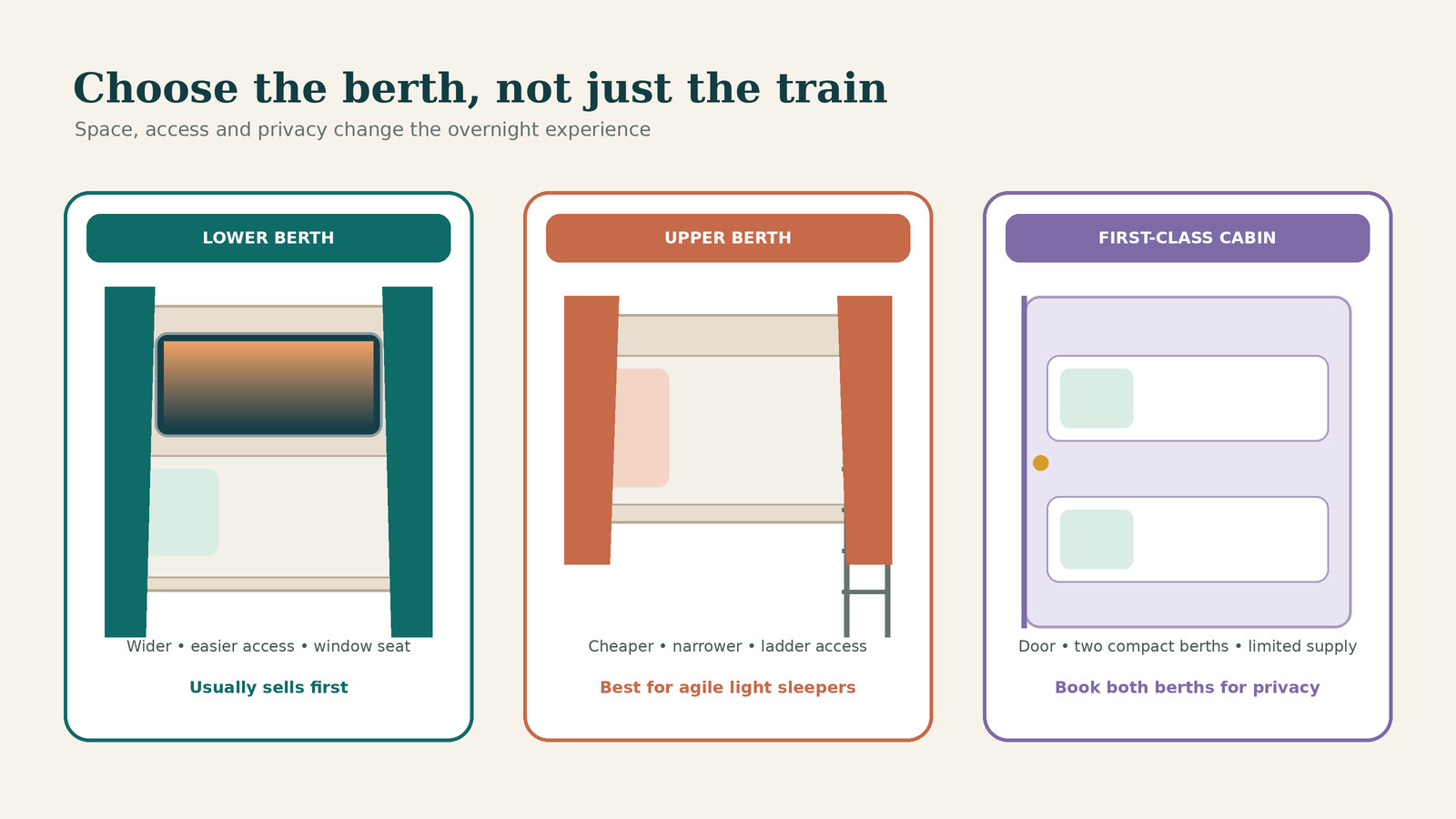
A lower berth is generally wider, easier to enter and less enclosed. During the daytime seating arrangement, it also provides the window-side position. Consequently, it usually costs more and sells before the upper berths. Taller travellers, people with restricted mobility and adults travelling with young children normally gain the most from paying the difference.
An upper berth can be good value for an agile solo traveller. Nevertheless, it is narrower, reached by a ladder and often feels colder in an air-conditioned carriage. Check the exact berth designation during booking rather than assuming adjacent numbers mean the same level.
First-class cabin or second-class sleeper?
First class adds a door and a greater degree of privacy, but the space remains a compact railway cabin. When two people want exclusive use, confirm that both berths have been booked; on some sales arrangements, an unbooked berth can be allocated separately. Second class is more social, less expensive and often perfectly adequate for one night.
Fan or air-conditioning?
Air-conditioned carriages can become surprisingly cold after the beds are made, particularly near vents and on upper berths. Fan carriages feel more open but may be hot, noisy or dusty. A thin long-sleeved layer is useful in either case, while heavy bedding from home is unnecessary.
The figures below are planning examples checked against official SRT results on 10 September 2026. They are not fixed quotes: date, train, passenger category, carriage and berth can all change the price.
| Journey | Current examples | Indicative duration | Observed fare span | How to use the figure |
|---|---|---|---|---|
| Krung Thep Aphiwat–Chiang Mai | Day train plus several overnight services | About 10 hr 20 min to 13 hr 45 min | Roughly THB 230–2,446 across listed trains and classes | Compare the actual berth and arrival time, not only the lowest fare. |
| Krung Thep Aphiwat–Surat Thani | Daytime and multiple evening departures | About 8 hr 50 min to around 11 hours | Roughly THB 216–2,372 across listed trains and classes | Add the road or ferry cost before comparing with a flight. |
| Bangkok–Ayutthaya | Frequent mix of ordinary, local and reserved services | Often around 1–2 hours | Very low local fares through to higher reserved-service prices | Choose by station and arrival time; the cheapest train may be slower or station-only. |
| Bangkok–Nong Khai / Vientiane | Overnight northeast services, including selected cross-border operation | Usually an overnight journey | Class and final destination make a substantial difference | Confirm passport rules and the precise terminus before payment. |
| Thonburi–Kanchanaburi / Nam Tok | Basic daytime services | Allow much of the day for the full line | Generally inexpensive local-style rail travel | Build the itinerary around the historical sites, not a rushed return. |
Official Chiang Mai and Surat Thani route results support the stated examples.56 Search again immediately before booking because fares and availability are live.
Why a very wide fare range is normal
A third-class seat and a first-class sleeper cabin are fundamentally different products, even when they use the same route. Lower and upper berths may also price differently. Therefore, the lowest number shown in a search result should never be described as the sleeper fare unless the selected class actually includes a bed.
Calculate the door-to-door cost
For a fair comparison, add the taxi to the departure station, food for the journey, local transport on arrival and any bus, van or ferry that follows. A sleeper may save a hotel night; conversely, a daytime train may cost an entire day that a short flight would preserve. The best-value answer changes with the itinerary rather than the ticket alone.
A sleeper is comfortable enough for many travellers, but it is still a moving shared space. Setting realistic expectations matters more than trying to recreate a hotel room.
Bedding and sleep
On sleeper services, staff normally convert facing seats into berths and provide the bedding carried for that train. The timing depends on the service and the carriage. Movement, station stops, corridor lighting and other passengers mean sleep is usually lighter than it would be in a hotel. An eye mask and reusable earplugs make a greater difference than an elaborate sleep kit.
Toilets and washing
Facilities vary with carriage age and class. Carry tissue, hand sanitiser and a small wash bag, and wear shoes when walking through the carriage. Shared basins are for quick use, so keep toiletries together and avoid leaving belongings in the wash area.
Food and drink
Do not assume every service has a restaurant car or reliable trolley service. Availability differs by train, and some departures explicitly operate without onboard food. Carry drinking water and a simple meal or snack that can be eaten neatly. Strong-smelling food and excessive alcohol make a shared sleeper uncomfortable for everyone.
Luggage and security
A bag that can be lifted without help is far easier on platforms and inside narrow aisles. Keep passports, payment cards, medication and the phone in a small pouch at the berth. A light cable lock can deter casual movement of a larger bag, provided it never blocks an aisle, doorway or emergency access.
- Label the main bag and retain a photograph of it.
- Keep one warm layer, water and medication outside the large case.
- Do not leave valuables charging unattended.
- Check overhead and under-seat areas before leaving the carriage.
- Allow time to gather belongings before the destination stop.
A scheduled train arrival is not a promise that a separate operator will wait. The financial risk normally sits in the next booking, so protect that booking rather than planning to the theoretical minimum.
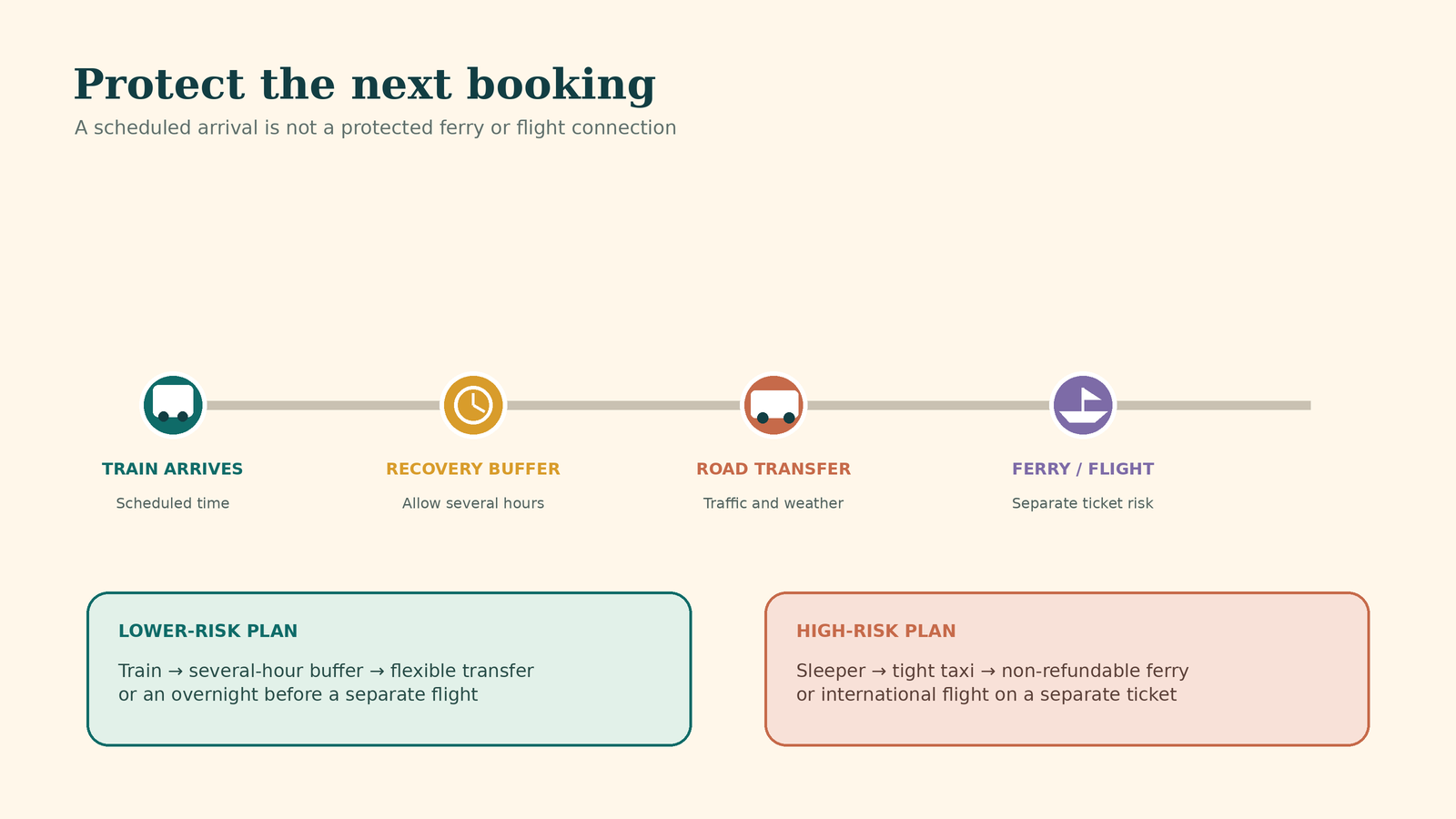
| Connection | Lower-risk approach |
|---|---|
| Train to domestic flight | Use a very generous same-day margin only for a flexible ticket; otherwise stay overnight near the airport. |
| Train to international flight | Arrive in the airport city the previous day. Separate international tickets are too expensive to place behind a sleeper. |
| Train to ferry | Choose a protected through arrangement or leave several hours. In unsettled weather, an overnight can be more sensible. |
| Train to Khao Sok | Confirm the pickup point, road duration and the accommodation’s late-arrival procedure before selecting the train. |
| Train to Laos or Malaysia | Check immigration rules, operating station and the onward operator separately. Carry the required original travel documents. |
| Journey during heavy weather | Review SRT and Thai Meteorological Department updates before leaving the hotel.8 |
When a through ticket helps
A combined ticket can reduce the work of matching departure times and may give the seller clearer responsibility for the transfer. Even so, read the missed-connection terms. “Train plus ferry” does not always mean a ferry is legally held for an indefinitely delayed train, and weather disruption may sit outside the guarantee.
Cross-border journeys need a separate checklist
Rail service and immigration permission are different matters. Verify passport validity, visa or entry status, arrival cards, border opening times and the station used for formalities through official sources for the traveller’s nationality.9 Avoid building a cross-border plan from an old timetable screenshot or a journey report without a publication date.
The most useful items are small, quiet and easy to reach. Keep the overnight essentials together so the main case can stay closed after the berth is prepared.
Contoured eye mask
Useful for corridor lights and early station stops. Choose a washable mask that does not press directly on the eyes.
Reusable earplugs
They soften rail noise and conversations without taking space. Retain enough awareness to hear alarms and staff instructions.
Compact cable lock
A light lock can secure a main bag against casual movement. It must never obstruct an aisle, door or another passenger’s luggage.
The small overnight pouch
- Passport or identification and the original ticket PDF.
- Phone, charging cable and a compliant power bank.
- Water, a simple snack and any essential medication.
- Eye mask, earplugs and a thin warm layer.
- Tissue, hand sanitiser, toothbrush and a small face cloth.
- Slip-on footwear for moving around the carriage.
Connectivity for digital tickets
Download the ticket before travel even when a Thai data connection is available. An eSIM can still be useful for checking platforms, messaging accommodation and arranging the onward transfer, but it should not be the only way to retrieve the booking.
Set up data before the journey
Check handset compatibility, activation timing and the amount of data needed. Keep the SRT ticket stored offline regardless of the mobile plan.
Advantages
- A sleeper can replace one hotel night.
- Stations often place the traveller closer to a city than an airport does.
- Rail offers more movement and changing scenery than a coach.
- Ayutthaya and Kanchanaburi routes can become part of the sightseeing.
- Several classes allow a trade-off between budget and privacy.
- Overland journeys reduce repeated airport security and baggage procedures.
Limitations
- Journey times are long and punctuality is not guaranteed.
- Not every service or class is sold online.
- Bangkok station choice can confuse first-time visitors.
- Shared sleepers are not quiet hotel rooms.
- Phuket, Krabi and islands require onward transfers.
- Large luggage and restricted mobility can make boarding harder.
Who is likely to enjoy it?
Rail suits travellers who accept a slower pace, pack reasonably lightly and value the journey. It is particularly strong for a first sleeper to Chiang Mai, a short heritage trip to Ayutthaya or a longer itinerary with enough days to absorb delays.
Who should probably fly or use a private transfer?
A flight is usually the safer decision when holiday time is short or an expensive onward booking is fixed. A private road transfer may be better for a group, substantial luggage, mobility needs or a route that finishes far from the station.
- Travelling to the wrong Bangkok station because a map result was treated as the ticket.
- Booking a separate flight or ferry too close to the scheduled train arrival.
- Assuming every train in the timetable can be purchased through D‑Ticket.
- Using the outdated 180-day wording instead of the later 90-day reservation notice.
- Choosing an upper berth without considering ladder access, width and cold air.
- Expecting food service on every departure and boarding without water.
- Taking luggage that cannot be lifted through the carriage doorway.
- Saving only a cropped image instead of the original PDF or app ticket.
- Treating the scheduled arrival as a connection guarantee.
- Expecting a direct train to Phuket, Krabi or an island.
- Ignoring immigration checks on a Nong Khai, Vientiane or Padang Besar itinerary.
- Buying from an unfamiliar seller without confirming the operator, station and train number.
How do you book train tickets in Thailand?
Search the official SRT timetable, then use the SRT D‑Ticket website or app for eligible reserved services. Tickets can also be bought at stations, and SRT’s call centre is 1690. Confirm the full station name before paying.
How far ahead can you book Thailand trains?
SRT’s later 2026 notice limits advance reservations for eligible rapid, express and special express trains to 90 days. Shorter-distance sectors can open later under the operator’s distance-based rules.
What is the best sleeper train in Thailand?
Bangkok–Chiang Mai is the strongest first sleeper for most visitors. Bangkok–Surat Thani is useful for a carefully buffered southern itinerary, while the northeast route suits Nong Khai or selected Vientiane plans.
Is a lower berth worth the extra cost?
Usually, yes. It is wider, easier to access and less enclosed. Taller travellers, people with mobility concerns and adults with young children benefit most. An upper berth remains a reasonable budget choice for an agile solo traveller.
Which Bangkok station do long-distance trains use?
Many northern, northeastern and southern rapid, express and special express trains use Krung Thep Aphiwat. However, western-line trains commonly use Thonburi, and selected services still use Hua Lamphong or other stops.
Can you take a train directly to Phuket or Krabi?
No. Neither destination has a railway station. The usual rail plan involves a southern station such as Surat Thani followed by a bus, van or car. Compare the full journey with a direct flight before booking.
Can you travel by train from Bangkok to Vientiane?
The current SRT timetable includes selected cross-border operation towards Vientiane Khamsavath. Check the exact date, terminus, passport and immigration requirements because these are separate from buying the rail ticket.
Are Thailand sleeper trains safe?
They are widely used, but ordinary travel precautions still apply. Keep valuables with you, secure the larger bag without blocking access, wear shoes in shared areas and use official booking channels and stations.
Do sleeper trains have food?
Food availability varies by service. Some trains have catering or vendors, while others do not. Carry water and a simple meal or snack, then check the exact train rather than assuming a restaurant carriage.
Can children use sleeper trains?
Yes, but families should check fare rules, identity requirements, berth layout and ladder access. A complete first-class cabin can be practical when available, although the space is compact and the supply limited.
Can a train ticket be shown on a phone?
SRT passenger guidance accepts the emailed PDF or the ticket displayed in the D‑Ticket app. Save the original document offline, keep the phone charged and carry the identification used for the booking.
How much buffer should follow a sleeper train?
Leave several hours for a flexible local transfer and preferably stay overnight before a separate international flight. Ferries and domestic flights also need substantial margin unless a single provider clearly protects the connection.
Is Thailand train travel better than flying?
It is better when the journey adds interest, the sleeper replaces a hotel night and the destination lies on the line. Flying is normally better when time, punctuality or a fixed onward connection matters most.
How much luggage can you manage comfortably?
Use a bag you can lift through the station and carriage without assistance. Even where a larger allowance exists, bulky cases are awkward around berths and shared aisles. Keep the overnight pouch separate and accessible.
For a first overnight rail experience, choose Bangkok to Chiang Mai and book a lower second-class berth unless privacy justifies first class. Keep the arrival morning gentle, and avoid placing an expensive tour immediately after the scheduled arrival.
For a straightforward first train, use Ayutthaya. It is short enough to recover from a minor mistake and inexpensive enough to compare several departures. However, organise local transport around the historical park rather than expecting the station to sit beside every ruin.
Choose Surat Thani only when the road or ferry chain has been planned as carefully as the rail leg. Choose Nong Khai or Vientiane when slow overland travel is a deliberate part of the itinerary. For scenery and railway history, build a Kanchanaburi stay around the Thonburi–Nam Tok line instead of squeezing it into a hurried out-and-back ride.
Core transport information was checked on 10 September 2026. Train times, fares, rolling stock, platform arrangements and cross-border procedures can change. Recheck the official operator and immigration sources for the exact date before committing to a non-refundable connection.
- State Railway of Thailand: 90-day advance-reservation notice — published 24 April 2026.
- State Railway of Thailand: tickets and waiting-list guidance — passenger identity, ticket formats and sales channels.
- State Railway of Thailand D‑Ticket — official online booking portal.
- State Railway of Thailand timetable — live route and train-number checking.
- SRT timetable: Krung Thep Aphiwat to Chiang Mai — current service, duration and fare examples.
- SRT timetable: Krung Thep Aphiwat to Surat Thani — current service, duration and fare examples.
- State Railway of Thailand — official notices and service information.
- Thai Meteorological Department — weather warnings and forecasts.
- Thai Immigration Bureau — official entry and border information.
- KTM Berhad — official Malaysian rail information for onward journeys.
- Tourism Authority of Thailand: Chiang Mai — destination context.
- Tourism Authority of Thailand: Ayutthaya — heritage destination context.
- Tourism Authority of Thailand: Surat Thani — destination and onward-planning context.
- Tourism Authority of Thailand: Nong Khai — destination context.
Illustrations in this article were created for Taylor’s Trailblazing Travels. Third-party photographs, where used, are credited beside the image or in the source list.