A practical month-by-month guide to Bangkok, Chiang Mai, Phuket, Krabi, Koh Samui and Thailand’s islands.
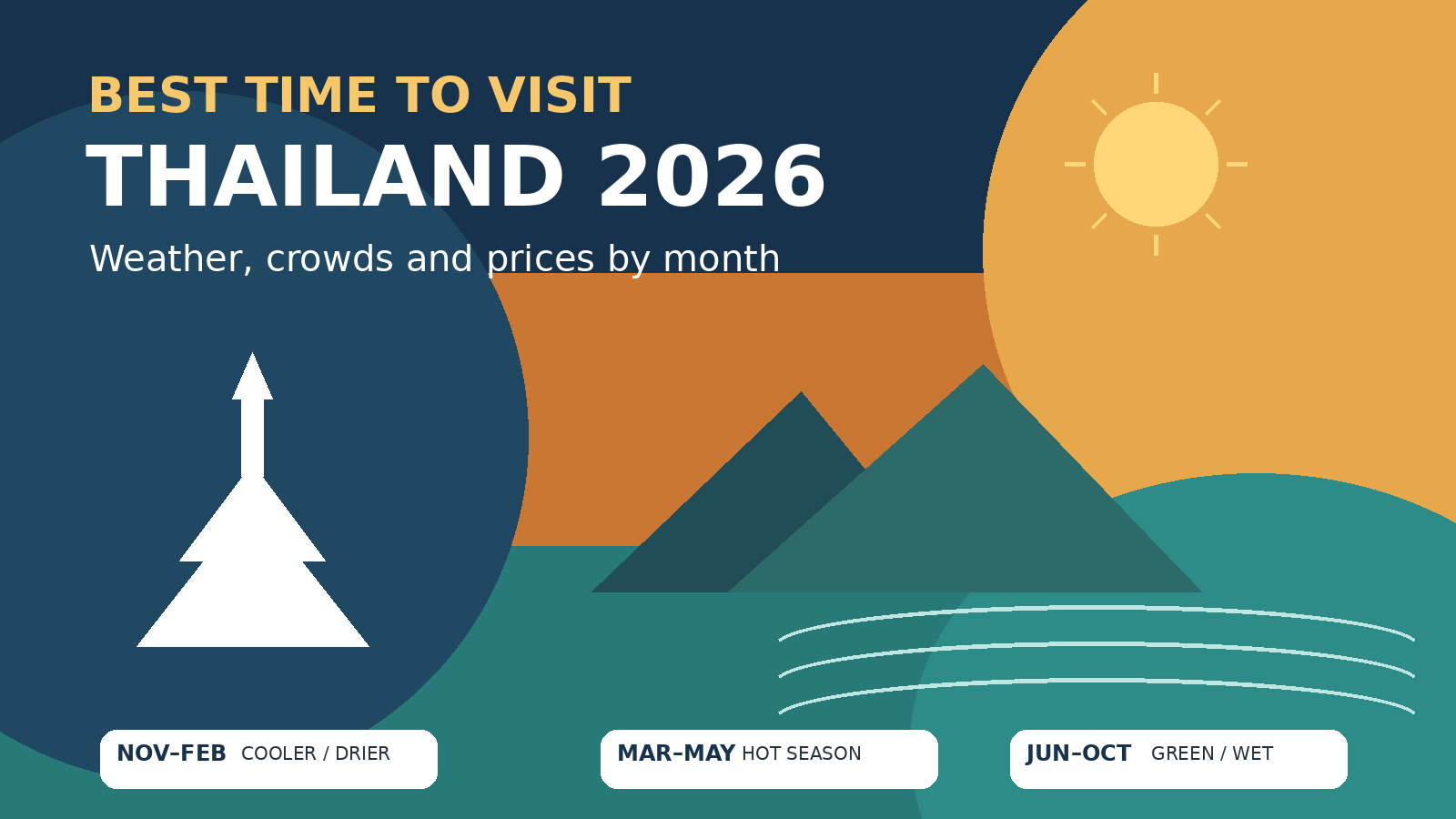
Ask three travellers for the best month to visit Thailand and you may get three perfectly reasonable answers. A city-and-temples trip, an Andaman beach holiday and a Koh Samui escape do not share the same ideal calendar.
However, the national shorthand—cool season, hot season, rainy season—is useful, but it hides the detail that matters most. The southwest monsoon usually affects Thailand from around mid-May to mid-October, while the northeast monsoon brings drier, cooler air to much of the country but can make the southern Gulf coast wetter. [2]
For example, November can be superb for Chiang Mai, Bangkok and Krabi while Koh Samui is still unsettled. July can be damp on the Andaman coast yet workable on the Gulf islands. April is brutally hot in the north, but it also brings Songkran and often good beach conditions.
Therefore, my planning rule is simple: decide what you want from the trip, choose the region that best matches the month, and only then book the beach. This guide follows that order, using official weather, tourism, environmental and hotel-market information rather than pretending one forecast fits the whole country.
This 2026 guide is built as a decision tree rather than a weather promise. It compares the month, region, coast, likely crowd level and practical booking risk, then shows where a transport, activity, eSIM or weather-proofing link genuinely helps. Prices and timetables change, so live booking pages are used for comparison instead of pretending that one quoted fare will remain fixed.
Best time to visit Thailand at a glance
November to February for Bangkok, northern Thailand and a multi-stop first trip.
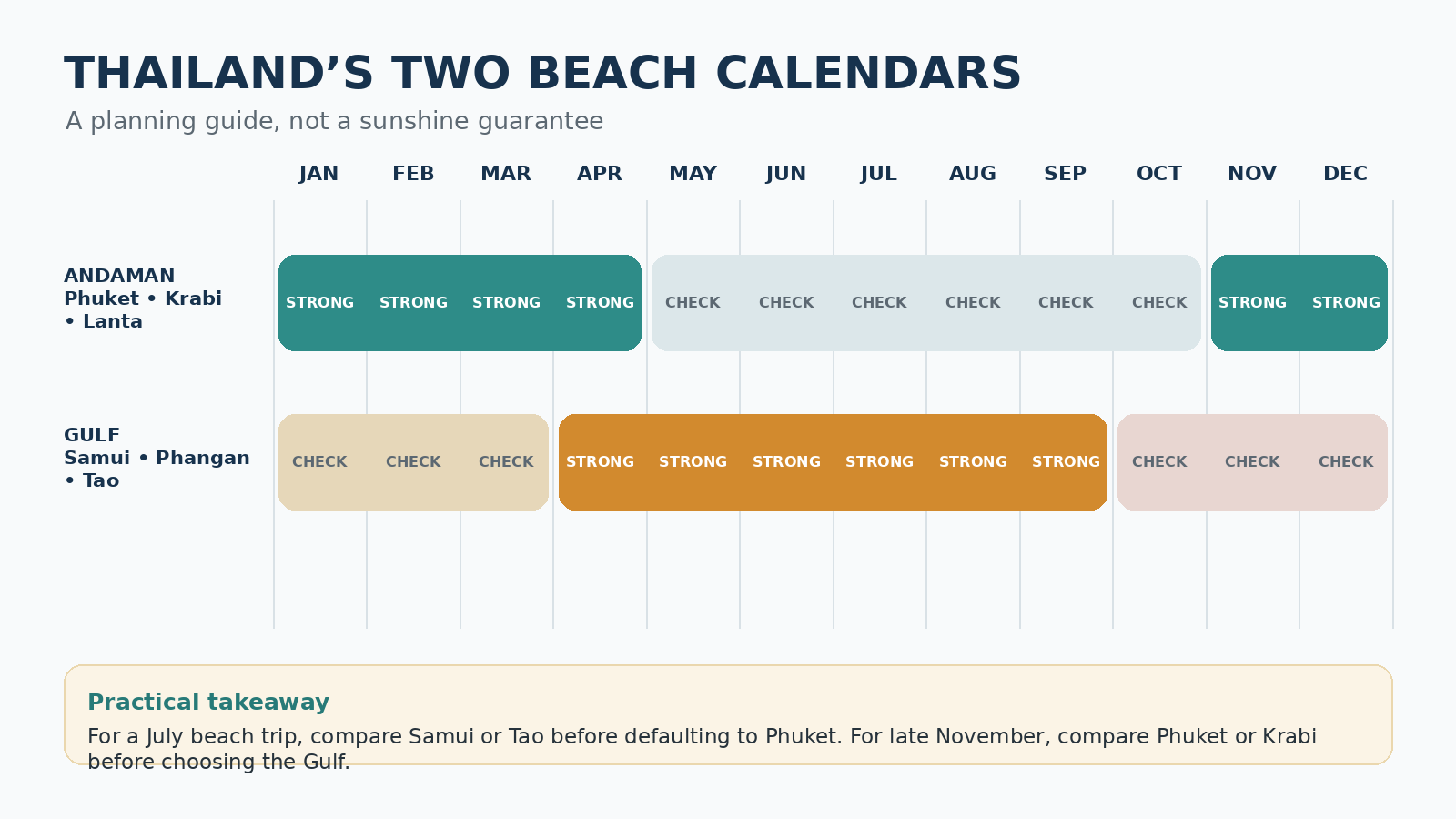
November to April for Phuket, Krabi, Khao Lak, Koh Lanta and Phi Phi.
April to September is often the easier window for Koh Samui, Koh Phangan and Koh Tao.
May–June and September–October can be cheaper, provided the route stays flexible.
November to January for cooler mornings and clearer hiking conditions.
April for Songkran; November for Loy Krathong and Yi Peng season.
Check northern air quality from late February into April and marine forecasts in monsoon months.
Choose the month, match the coast, then price-check your exact dates before booking.
In this guide
Best time to visit Thailand at a glance
For a first Thailand trip that combines Bangkok, Chiang Mai and an Andaman beach, late November through February is the easiest all-round window. The weather is usually more comfortable in the cities and north, and the Andaman sea season is established. It is also the busiest and often the most expensive period.
Quick decision table
| Trip plan | Best window | Why it works | Main trade-off |
|---|---|---|---|
| First multi-stop trip | Late Nov–Feb | Comfortable cities and north; strong Andaman weather | Highest demand around Christmas, New Year and February |
| Phuket, Krabi or Khao Lak | Nov–Apr | Calmer seas and less frequent rain | Peak pricing in late December and January [5] |
| Koh Samui, Koh Phangan or Koh Tao | Apr–Sep | Useful alternative when the Andaman is wetter | Heat in April–May; weather can still vary [6] |
| Chiang Mai, Pai or Chiang Rai | Nov–Jan | Cooler mornings, clearer hiking conditions | Busy festive period; cool nights at elevation |
| Lower-cost flexible trip | May–Jun or Sep–Oct | Greener scenery and often softer hotel rates | Rain, rough seas and schedule changes are more likely |
| Festival-led trip | Apr or Nov | Songkran in April; Loy Krathong season in November | Book earlier and expect local crowd surges |
There is no weather guarantee. Thailand’s official tourism overview describes a broad national pattern of roughly six wetter months, three cooler/drier months and three hot months, with an average range of 18–38°C. Local temperatures, rainfall and sea conditions can sit well outside that summary. [1][19]
Thailand’s three travel seasons
Think of the seasons as a starting point, not a booking decision. Elevation, coast and monsoon exposure matter more than the colour of a generic weather icon.
November to February: cooler and drier for most classic routes
This is the easiest period for Bangkok, Ayutthaya, Chiang Mai and much of the Andaman coast. Humidity is often lower, daytime sightseeing is less punishing and northern mornings can feel genuinely cool. TAT treats November as the start of the cool season and notes that Andaman sea trips resume as the monsoon retreats. [1][2]
- Best for first-time multi-stop itineraries, temples, hiking and Andaman islands.
- Pack a light layer for northern mornings, mountain areas and strong air-conditioning.
- Book Christmas, New Year and popular February dates well ahead.
- Do not assume the Gulf is equally dry: the northeast monsoon can keep the southern east coast wetter into this period. [2]
March to May: hot season, beaches and Songkran
March is full hot season, with TAT describing roughly 30–40°C across the country. In April, temperatures can reach 42°C in northern and northeastern Thailand. That changes the pace of a trip: early starts, long lunches, pool time and evening sightseeing become practical rather than indulgent. [3][4]
- Best for travellers who tolerate heat and want Songkran, warm seas and lively evenings.
- Strong Andaman beach conditions often continue through April.
- The Gulf islands become increasingly attractive as the season moves toward May.
- Northern smoke and PM2.5 can be a serious planning issue from late February into April.
Mid-May to October: green season and lower-demand travel
The southwest monsoon normally arrives around mid-May and lasts into mid-October. Rain does not automatically mean twelve hours of downpour; many days have usable dry periods. It does mean that downpours, local flooding, rougher seas and weather-related timetable changes become more plausible. [2]
Meanwhile, this season rewards flexible travellers. Temples can be quieter, rice fields and waterfalls look greener, and accommodation can be better value. The trade-off is uncertainty, especially for speedboats and small-island transfers.
Best time to visit Thailand by region
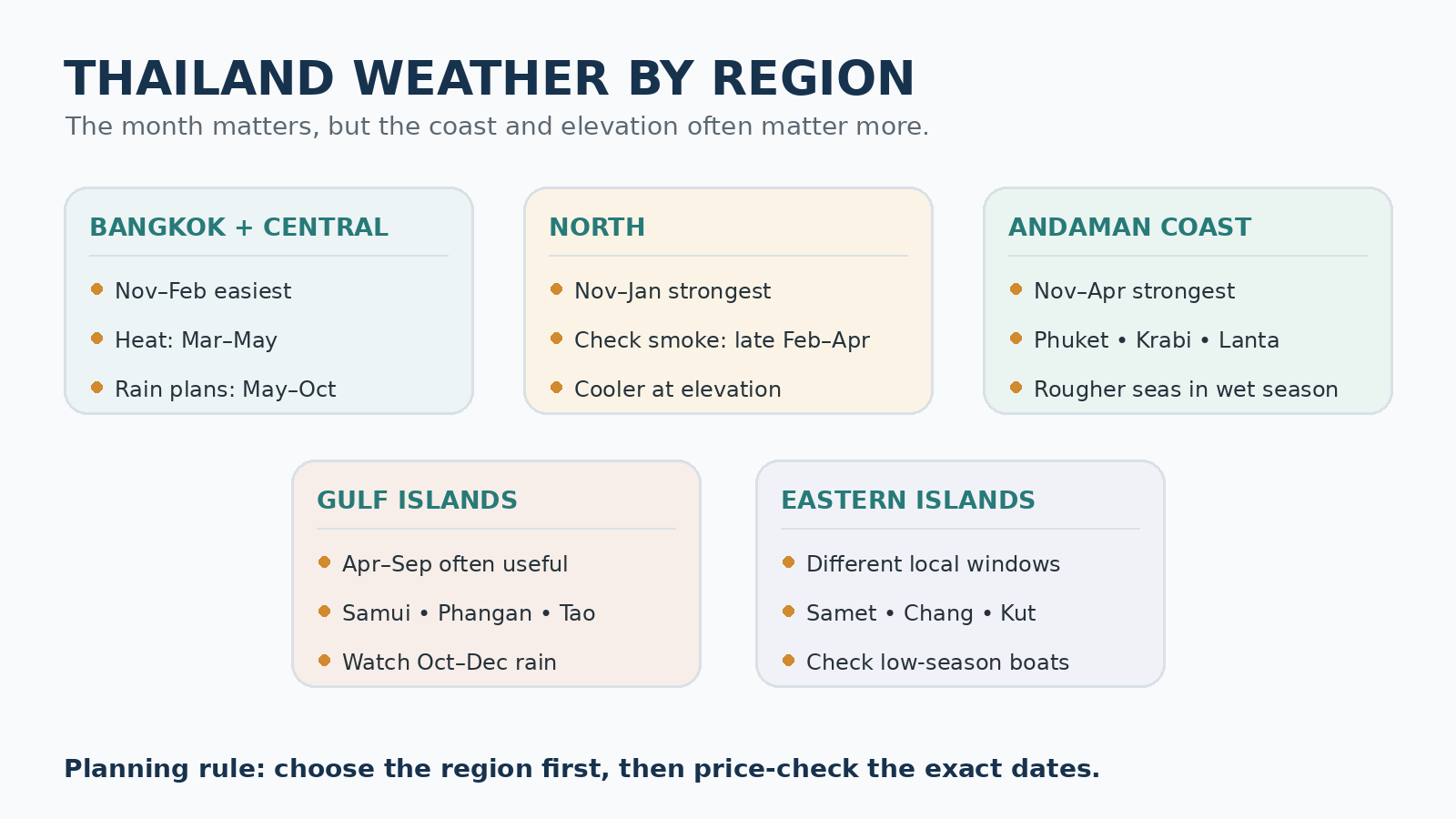
Thailand becomes much easier to plan when you stop treating it as one weather zone. The two-coast split is the most important distinction.
Bangkok and central Thailand
November to February is the most comfortable window for temples, markets and day trips. March to May is hotter, so a realistic day might be the Grand Palace early, a long indoor lunch, a hotel break and Chinatown after sunset. From May into October, build in rain cover and avoid stacking non-refundable outdoor activities back-to-back.
Chiang Mai, Chiang Rai, Pai and the north
November to January is the strongest combination of cooler weather and outdoor comfort. February can still be pleasant, but air quality becomes a bigger consideration as the dry season progresses. By March and April, heat and smoke can change the trip completely.
One official northern Thailand bulletin on 24 March 2025 reported PM2.5 readings of 29.0–116.1 micrograms per cubic metre across monitored locations, against a 24-hour standard of 37.5. That is a snapshot, not a forecast for every year, but it shows why “cool season” is not the only factor to check. Use Air4Thai for real-time readings before committing to a hiking-heavy northern route. [11]
Phuket, Krabi, Khao Lak, Koh Lanta and the Andaman coast
November to April is the classic Andaman window. TAT specifically recommends November to April for Phi Phi and notes that low-season room discounts are common, while Christmas and New Year rooms should be booked in advance. [5]
The Similan Islands show how strongly season affects access. Official information lists the park as open from 15 October to 15 May each year. Foreign entrance fees are 500 baht for adults and 250 baht for children; indicative one-day tour packages start around 1,700–2,500 baht, boats commonly leave around 09:00 and return by 17:00, and Phuket transfers may add around 300–400 baht. Check the current season and operator inclusions before paying. [10]
Koh Samui, Koh Phangan and Koh Tao
By contrast, the Gulf islands run later than the Andaman. TAT gives April to November as a useful island window for Surat Thani, but the northeast monsoon can make the southern east coast wetter later in the year, especially around October to December. [6][2]
As a result, for a summer school-holiday trip, Koh Samui or Koh Tao can make more sense than Phuket. For a late-November honeymoon, Phuket or Krabi usually offers the simpler weather bet.
Koh Samet, Koh Chang and Koh Kut
Eastern island comparison
| Island | Stronger window | Lower-demand period | Watch |
|---|---|---|---|
| Koh Samet | Oct–Apr | Mar–Oct can have lower room rates | Close to Bangkok, but weekend demand can still be high. [7] |
| Koh Kut | Nov–Feb | Apr–Nov | Boat services can be limited in low season. [8] |
| Koh Chang | Nov–Feb for cooler weather | Jun–Sep often quieter and cheaper | Rainy season generally May–Oct; check ferries and local conditions. [9] |
Best time to visit Thailand month by month
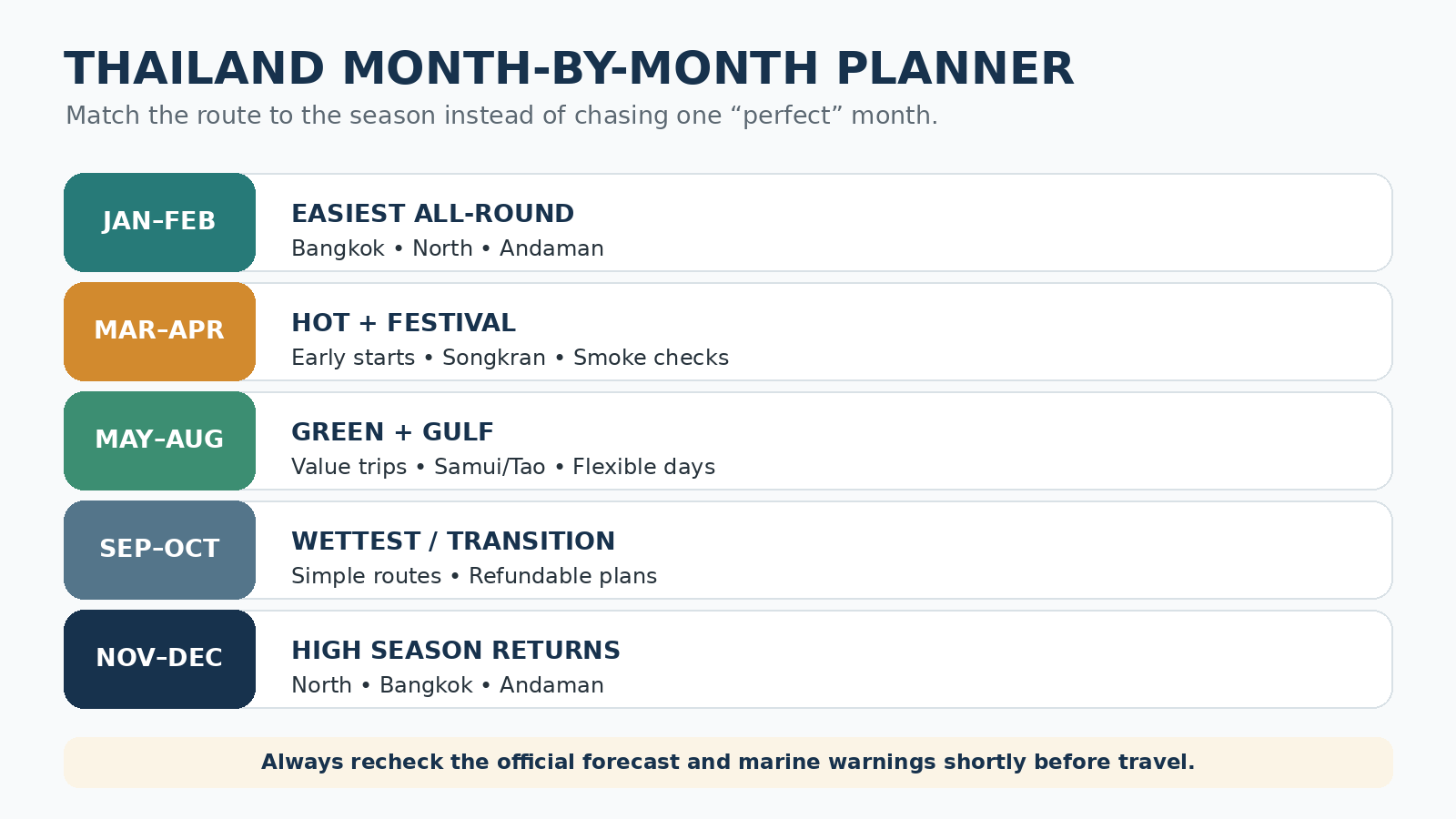
Use this as a route-planning table rather than a promise of sunshine. Monsoon timing can shift, and tropical weather is local.
Thailand month-by-month planner
| Month | Best fit | Weather and regional notes | Crowds and booking |
|---|---|---|---|
| January | First trips, north, Andaman | Cooler upper Thailand; strong Phuket/Krabi weather. Gulf conditions usually improve but can still vary. | Peak demand. Book popular beach and northern stays early. |
| February | Best all-round month | Dry, comfortable cities; excellent Andaman odds. Heat rises later in the month. | High season. Watch late-month northern air quality. |
| March | Andaman beaches, shorter city stays | Hot nationwide—TAT describes around 30–40°C. North becomes hotter and hazier. [3] | Still busy on beaches; cities can feel less crowded at midday for a reason. |
| April | Songkran, beaches, Gulf transition | Hottest month; north and northeast can reach 42°C. Andaman remains appealing, Gulf improves. [4] | Festival surges around Songkran. Reserve transport and central hotels early. |
| May | Value trips, Gulf islands, green landscapes | Southwest monsoon transition. Andaman seas become less reliable; Gulf can work well. | Rates often soften after holidays; keep boat plans flexible. |
| June | Budget city trips, Samui/Tao | Showers and humid weather; Andaman rougher, Gulf often more usable. | Lower national demand. Good month for flexible travellers. |
| July | Gulf islands, family summer trips | Wet spells in many regions; Koh Samui and Koh Tao are often better beach bets than Phuket. | School holidays can lift flight and resort prices. |
| August | Gulf beaches, green north and central | Humid with frequent showers; waterfalls and countryside are lush. | Mixed demand. Build rain alternatives into every destination. |
| September | Lowest-crowd flexible travel | Often one of the wetter, less predictable months for Bangkok and the Andaman. | Good value, but avoid rigid island-hopping schedules. |
| October | Transition trips, Bangkok, later Andaman | Southwest monsoon fades; Andaman improves later. Gulf wet spell can intensify. | Shoulder season. Check openings and ferry frequency. |
| November | North, Bangkok, Andaman | Cool season begins; Andaman sea trips return. Gulf islands may still be wet. [2] | High season starts; festival dates create local spikes. |
| December | Classic first trip, Andaman, north | Cooler/drier upper Thailand and strong Andaman conditions. Southern Gulf can remain unsettled. | Christmas/New Year peak. Book months ahead for specific hotels. |
Best time to visit Thailand by trip style
For a first-time multi-stop holiday
Choose late November to February. A 12-night route of Bangkok, Chiang Mai and Krabi is much easier to manage in this window than in September, when each stop introduces a different weather risk. For a route that already balances these regions, use the Thailand two-week itinerary as a starting point and adjust the beach coast to your month.
For beaches and island hopping
Choose the coast before the hotel. Use November to April for the Andaman; look at April to September for the central Gulf islands. When a trip crosses both coasts, allow a buffer day before international flights and avoid non-refundable boat connections. The Thailand islands guide compares the main island choices in more detail.
For diving and snorkelling
Calmer seas, park opening schedules and visibility matter more than air temperature. The Similans are a clear example: the official tourism season runs only from 15 October to 15 May, and visits are day trips rather than island overnights. [10]
For families
December to February offers the easiest heat level, but prices are higher. July and August can work well for Koh Samui-based trips, especially when a resort pool and flexible indoor time matter more than a perfect forecast.
For budget travel
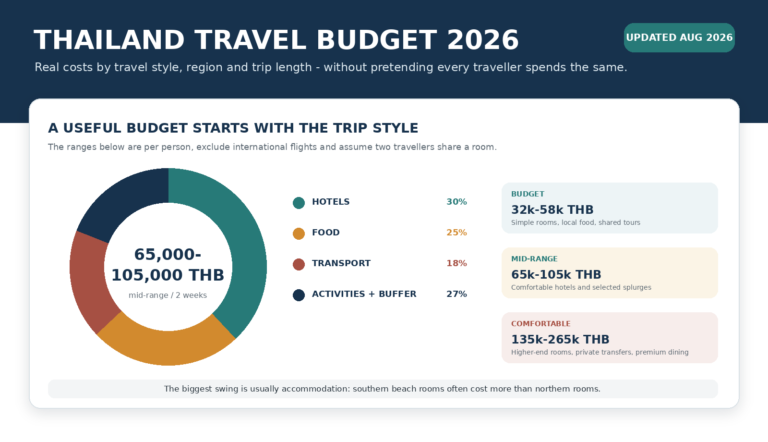
May, June, September and early October often provide the best balance of lower demand and usable travel days. Budget trips work best when the itinerary is simple: a city plus one beach base is safer than four ferry-dependent islands. Use the Thailand travel budget guide to test the total cost rather than judging value from the hotel rate alone.
For festivals
Songkran turns April heat into part of the experience. One official Bangkok programme in 2026 ran at Lumpini Park from 11–15 April, 10:00–20:00. Dates and venues change, so verify the programme for the year you travel. [14]
For November travel, Sukhothai’s official 2026 Loy Krathong programme listed shows from 15–24 November at 19:00, with an additional 20:30 show on 24 November. Tickets were 500, 900 and 1,200 baht. That level of detail is exactly why festival travel should be booked around official dates, not a generic lunar-calendar estimate. [15]
Weather-smart Thailand route ideas
In addition, a good seasonal route reduces the number of weather bets you are making at the same time. Instead of adding destinations because they are famous, choose one city or cultural base, one weather-compatible beach base and a realistic transfer pattern.
February: classic first trip
Three nights in Bangkok, three in Chiang Mai and four or five in Krabi or Khao Lak. This route uses the strongest all-round month, although late-February northern air quality still deserves checking.
July: Gulf-focused summer trip
Three nights in Bangkok, five on Koh Samui, three on Koh Tao and one buffer night before the international flight. The route accepts mainland showers while avoiding an Andaman-heavy beach plan.
November: north plus Andaman
Two or three nights in Bangkok, four in Chiang Mai and four in Phuket, Krabi or Khao Lak. The Andaman season is returning, while Samui may still be unsettled.
How weather changes transport and booking decisions
However, weather planning is not just about choosing the sunniest beach. It affects whether a ferry is sensible, whether an overnight train arrives with enough margin, and whether a fixed day tour should be booked before or after arrival. Therefore, the safest approach is to secure the hard-to-replace parts early and leave the weather-sensitive parts flexible.
Book the fixed backbone first
International flights, specific family rooms and popular festive dates are the backbone. Next come long-distance trains or domestic flights that connect the route. Small-boat day trips are usually lower priority because their value depends on the short-range marine forecast.
Build a buffer before expensive flights
A ferry arriving at 15:00 does not make a 17:00 international departure a safe plan, even when the timetable looks possible. Sea conditions, pier transfers and road traffic can all change the real journey time. For small islands, return to the mainland or the departure island at least one night before a long-haul flight.
Season-aware transport comparison
| Route | Season issue | Practical buffer | Comparison link |
|---|---|---|---|
| Bangkok–Chiang Mai | High demand in cool season and around Songkran; air quality can alter a hiking-heavy plan late in the dry season. | Choose a refundable or changeable onward activity for the first northern morning. | Compare train, bus and flight options |
| Bangkok–Surat Thani | Useful gateway for Samui, Phangan and Tao; the late-year Gulf wet spell can disrupt the final sea leg. | Allow several hours between a late train or flight and a fixed ferry. | Compare Bangkok–Surat Thani |
| Surat Thani–Koh Samui | Combined tickets simplify bus and ferry handoffs, but the final arrival still depends on sea and road conditions. | Do not connect directly to a long-haul flight on the same day. | Compare bus-and-ferry tickets |
| Phuket–Koh Phi Phi | November–April is the stronger window; monsoon seas increase cancellation and discomfort risk. | Keep one spare night before leaving southern Thailand. | Compare ferry and speedboat options |
| Cross-coast transfer | Krabi or Phuket to Samui is a long mixed road-and-ferry day, even in good weather. | Avoid adding another fixed tour that evening. | Compare Thailand transport |
Thailand prices, crowds and booking windows
“High season costs more” is directionally true but too vague to plan a budget. Location, festival dates and booking lead time can matter more than the month label.
A current official price snapshot
The Bank of Thailand’s provisional June 2026 tourism indicators show the following regional averages. These are market-level figures, not quotes for a particular hotel, but they give useful scale. [12]
June 2026 accommodation indicators
| Region | Occupancy rate | Average room rate | Planning takeaway |
|---|---|---|---|
| Thailand total | 63.33% | 1,824.99 baht | A lower-demand month nationally, with room to compare dates. |
| Central incl. Bangkok | 67.72% | 2,097.00 baht | City demand remains meaningful even in wetter months. |
| South | 67.05% | 2,309.65 baht | Island and resort pricing varies sharply by coast. |
| North | 57.96% | 1,331.99 baht | Lower June demand can produce value, with rain as the trade-off. |
Festival demand can override the season
SiteMinder’s 2025 Songkran data found average booking lead times of 109 days for Koh Samui, 100 days for Phuket and 81 days for Bangkok. It reported a national average daily rate of 6,586 baht for the festival period, with Koh Samui at 11,073 baht and Phuket at 5,889 baht. Those figures come from a hotel-platform dataset rather than an official national survey, but they show how sharply a fixed event can change booking behaviour. [13]
Practical booking windows
| Travel period | When to start looking | What to secure first |
|---|---|---|
| Christmas, New Year, February beach dates | 3–6 months ahead | Specific resorts, family rooms, direct flights and island transfers |
| Songkran or major Loy Krathong destinations | 3–4 months ahead | Central hotel, intercity transport and official ticketed events |
| Normal Nov–Feb travel | 8–12 weeks ahead | Best-located accommodation and internal flights |
| Shoulder season | 4–8 weeks ahead | Flights first; compare hotels after the route is settled |
| Wet/green season | 1–4 weeks if flexible | Refundable room, transport buffer and weather-dependent tours |
Season pros and cons
| Season | Pros | Cons | Best suited to |
|---|---|---|---|
| Cooler/drier | Comfortable sightseeing; strong north and Andaman conditions | Higher prices and busier headline destinations | First trips, active routes, families |
| Hot | Songkran, warm seas, long evenings | Severe heat; northern smoke risk | Festival travellers and heat-tolerant beach trips |
| Green/wet | Lower demand, lush scenery, better-value rooms | Rain, rough seas and timetable disruption | Flexible travellers and slower single-base trips |
Seasonal gear comparison: what is actually worth buying
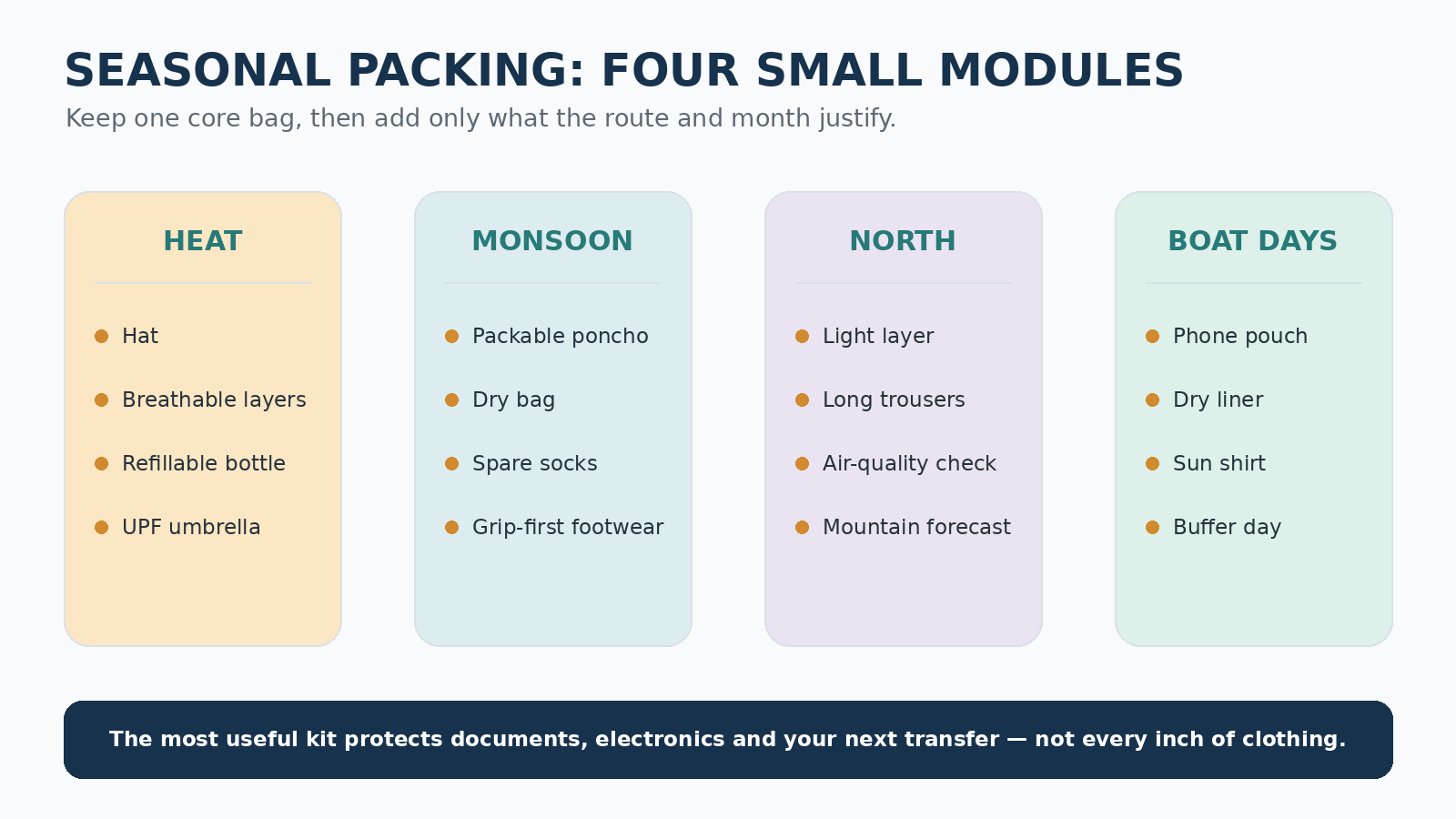
Most Thailand trips do not need specialist expedition gear. A compact weather kit is enough when it matches the route. The manufacturer examples below were checked on 23 August 2026; prices and availability can change, so treat them as comparison points rather than permanent promises.
Compact weather gear comparison
| Product type | Example and checked price | Pros | Cons | Best for |
|---|---|---|---|---|
| Compact UPF umbrella | Decathlon Micro UPF50+, £7.99; 160 g; 26 cm closed [16] | Sun shade plus light-rain cover; easy in a day bag | Awkward in crowds and less useful in strong wind | Bangkok, temples, hot season |
| Pack-covering poncho | Forclaz MT50, £9.99; sized for a 10 L pack [17] | Covers torso and small backpack; inexpensive | Can feel hot and clammy; not elegant for city evenings | Scooters, hikes, sudden showers |
| Small dry bag | Sea to Summit Lightweight, from £12; 34 g for 1.5 L [18] | Protects phone, documents and chargers on boats | Waterproof when not submerged; not a substitute for a hard waterproof case | Islands, ferries, monsoon routes |
Thailand eSIM, local SIM or roaming?
Weather changes plans quickly, so reliable data is more than a convenience. It helps with radar, transport messages, hotel contact, maps and last-minute changes. The right option depends on phone compatibility, trip length and how soon you need to be online after landing.
Connectivity comparison
| Option | Advantages | Limitations | Best for |
|---|---|---|---|
| Travel eSIM | Can be installed before departure; keeps the physical SIM slot free; useful for immediate maps and messages. | The phone must support eSIM and be unlocked; data-only plans may not provide a Thai voice number. | Short trips, late arrivals and travellers who want connectivity before leaving the airport. |
| Local Thai SIM | Often includes a local number and can suit longer stays or heavy data use. | Requires a shop or airport counter and identity checks; packages and fair-use limits vary. | Longer trips, local calling and travellers comfortable changing the physical SIM. |
| UK roaming | No installation or SIM swap; familiar billing relationship. | Can be expensive and may have daily caps or fair-use limits. | Very short trips or an emergency backup. |
| Offline-first backup | Downloaded maps, booking screenshots and hotel details keep working during outages. | Does not replace live updates, calls or transport messages. | Every traveller, regardless of the main connection. |
Check compatibility before buying
Confirm that the phone is unlocked and supports eSIM, then check the plan’s country coverage, validity period, data allowance and activation instructions. Install while connected to reliable Wi-Fi, but follow the provider’s instructions about when to activate the plan.
For the full packing and phone-protection checklist, see the Thailand packing list.
How to choose your Thailand dates in six practical steps
Best time to visit Thailand FAQs
What is the best month to visit Thailand?
February is the best single month for many first-time visitors. Bangkok and northern Thailand are usually comfortable, and the Andaman coast is in season. Late February can bring poorer air quality in the north, so check current readings.
What is the cheapest month to visit Thailand?
There is no universal cheapest month, but June and September often have softer demand. The Bank of Thailand’s June 2026 snapshot showed a national average room rate of 1,824.99 baht and 63.33% occupancy. Your actual price will depend on destination, room type and booking day. [12]
Does it rain all day in Thailand’s rainy season?
Not necessarily. Short, intense showers are common, but multi-hour rain and several unsettled days can happen. City trips are easier to adapt than ferry-heavy island routes.
Is Phuket or Koh Samui better in July?
Koh Samui is usually the stronger July weather choice. Phuket sits on the Andaman coast, where the southwest monsoon makes rougher seas and heavier rain more likely.
Is November a good time for Koh Samui?
November can be wet and unsettled on Koh Samui because the northeast monsoon affects the southern Gulf coast. For November beach travel, Phuket, Krabi or Khao Lak is often the safer first comparison.
When should I avoid Chiang Mai because of smoke?
Risk generally rises from late February through April, but there is no fixed safe or unsafe date. Check Air4Thai readings and the forecast close to travel, especially when asthma, pregnancy, young children or other respiratory concerns are involved.
Is Songkran a good time to visit?
Yes, when the festival is a reason for the trip. Expect heat, water fights, crowded transport and higher demand in popular celebration areas. Protect phones and documents and book central accommodation earlier than usual.
How far ahead should I book Christmas and New Year?
Start three to six months ahead for a specific island resort, family room or direct flight. TAT explicitly advises advance booking around Christmas and New Year for Phi Phi. [5]
What is the worst month to visit Thailand?
Ultimately, there is no single worst month. April is hardest for heat, September is risky for an Andaman-heavy itinerary, and November can be poor for a Gulf-island beach holiday. The wrong route matters more than the wrong month.
Should I book island tours before arriving?
Book early for a specific premium small-group tour in peak season, but keep ordinary weather-dependent boat trips flexible when the marine forecast is uncertain. Read the cancellation policy and confirm whether park fees, transfers and equipment are included.
Is an eSIM worth arranging before Thailand?
An eSIM is useful when you want maps and messages immediately after landing and the phone is compatible. A local SIM may offer better value for a long stay or when a Thai number matters. Keep offline copies of essential details either way.
The final recommendation
Choose November to February for the easiest first trip. Choose November to April for Phuket, Krabi and the Andaman. Choose April to September when Koh Samui, Koh Phangan or Koh Tao is the beach priority. Travel in the green season for value only when the itinerary can absorb rain and schedule changes.
The best date is not the month with the prettiest national weather chart. It is the month that fits your route, your tolerance for heat and rain, and the experience you actually want. Match the coast to the calendar, keep one buffer day around boats and check the official forecast again before departure.
Written and researched by Karen Taylor for Taylor’s Trailblazing Travels.
Sources and methodology
This guide was checked against official Thai weather, tourism, environmental and economic sources, plus current manufacturer specifications for the product examples. Seasonal windows are planning ranges, not guarantees. Live transport, activity and eSIM pages should always be rechecked before purchase.
- Thailand Climate & Weather — Tourism Authority of Thailand. National overview of Thailand’s hot, wet and cooler periods and its broad 18–38°C average range.
- Monsoon systems affecting Thailand — Thai Meteorological Department. Official explanation of the southwest and northeast monsoons, including the later wet spell on the southern Gulf coast.
- Thailand in March — Tourism Authority of Thailand. TAT’s March planning guide, including typical 30–40°C heat.
- Thailand in April — Tourism Authority of Thailand. TAT’s April guide, including temperatures that can reach 42°C in northern and northeastern Thailand.
- Ko Phi Phi visitor information — Tourism Authority of Thailand. Official November–April recommendation, low-season room-rate note and Christmas/New Year booking advice.
- Surat Thani visitor information — Tourism Authority of Thailand. TAT identifies April–November as a useful period for the islands of Surat Thani, including Koh Samui, Koh Phangan and Koh Tao.
- Ko Samet visitor information — Tourism Authority of Thailand. Official October–April calm-sea guidance and lower low-season room-rate note.
- Ko Kut visitor information — Tourism Authority of Thailand. Official November–February recommendation and warning about reduced low-season boat services.
- Koh Chang seasonal visitor guide — Tourism Authority of Thailand. Seasonal comparison for Koh Chang, including lower accommodation prices and fewer visitors from June to September.
- Mu Ko Similan National Park visitor information — Tourism Authority of Thailand. Official opening season, entrance fees, day-trip timings and indicative tour prices.
- Northern Thailand PM2.5 bulletin, 24 March 2025 — Pollution Control Department regional office. Official regional bulletin illustrating why late dry-season air quality should be checked; real-time readings are available through Air4Thai.
- Tourism Indicators — Bank of Thailand. Official provisional June 2026 accommodation occupancy and average room-rate data.
- Songkran hotel booking trends — SiteMinder. Hotel-platform data on 2025 Songkran booking lead times and average daily rates.
- Saneh Art by Songkran Festival 2026 — Tourism Authority of Thailand. Official Bangkok event information for 11–15 April 2026, 10:00–20:00.
- Sukhothai Loy Krathong Festival 2026 — Thailand.go.th. Official 2026 show dates, times and ticket prices for Sukhothai Historical Park.
- Anti-UV UPF50+ Micro Umbrella — Decathlon. Current £7.99 price and 160 g / 26 cm specifications checked 23 August 2026.
- Forclaz MT50 rain poncho — Decathlon. Current £9.99 price and coverage for a 0–10 L backpack checked 23 August 2026.
- Lightweight Dry Bag — Sea to Summit. Manufacturer specifications and UK price checked 10 August 2026.
- Thailand Climate Chart — Thai Meteorological Department. Official long-term rainfall and temperature chart resources.
Image credits
Illustrations in this article were created for Taylor’s Trailblazing Travels. Third-party photographs, where used, are credited beside the image or in the source list.