
Seasons / Smoke and air quality
Thailand Smoke Season Guide
Read the air-quality information clearly and keep the northern itinerary flexible when it needs to be.
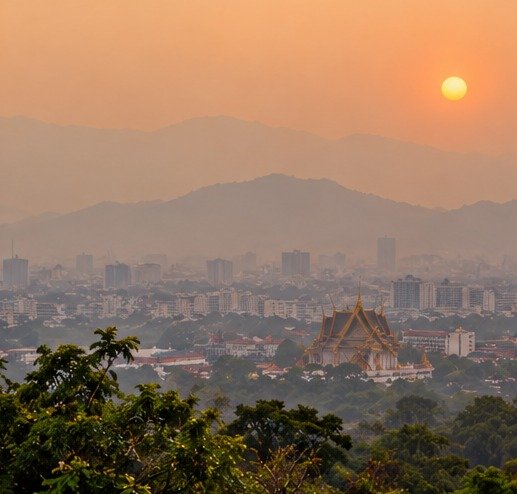
Original haze illustration. Appearance is not an air-quality measurement, an exact place record or evidence of current local conditions.
A Thailand smoke season guide should help you make a calm decision before a beautiful northern itinerary becomes an obligation to spend days in air you would rather avoid. The problem is not simply a disappointing mountain view. Air quality can change what activities are sensible, how much time you spend outside and whether the accommodation offers a genuinely useful place to retreat.
There is no single date when smoke begins everywhere or disappears for the year. Northern dry-season haze, pollution in a large city and smoke transported across borders can overlap, while a clearer-looking sky does not provide a personal safety assessment. The useful approach is to combine seasonal context with current local measurements and your own health needs.
This guide uses official monitoring, regional haze reports and public-health advice. Its itinerary choices and booking priorities are research-led planning judgements, not medical clearance or a claim to have tested air inside individual hotels. Anyone with a condition that changes their response to pollution should discuss the trip with a qualified clinician. A respirator, purifier or more expensive room should never be sold as a way to make every itinerary acceptable regardless of conditions.
Planning priority
Keep the north modular
Preserve a realistic change of route or dates.
Reading check
Name the AQI scale
Index values and PM2.5 concentrations differ.
Hotel question
Ask about actual filtration
Air conditioning alone is not an air-quality test.
First response
Reduce avoidable exposure
Equipment cannot guarantee a safe outdoor day.
Thailand smoke season: start with a decision, not a gadget
Decide what would change the holiday
Before paying for a northern stay, ask what you would do if the outdoor conditions were unsuitable for several days. A trip built around strenuous walks and viewpoints is more dependent on clean outdoor air than one with flexible destinations and comfortable indoor options. Acknowledge that dependence before choosing a non-refundable itinerary.
The objective is not to find a product that lets you ignore the problem. It is to reduce avoidable exposure and preserve an enjoyable holiday. Sometimes that means changing the date or region rather than adjusting the daily timetable.
Separate personal risk from disappointment
Poor visibility and an unpleasant smell may affect enjoyment, but health decisions should not rely only on what the sky looks like. Equally, someone else’s symptom-free visit does not establish that the same conditions are suitable for you. Use public-health guidance and appropriate clinical advice alongside the practical travel information.
This guide ranks options by how directly they reduce exposure and how feasible they are for an ordinary traveller. Avoiding an unsuitable period or location comes before equipment purchases. A clearer alternative route, when verified, is more useful than an elaborate kit supporting a holiday that no longer fits your needs.
What smoke, haze and PM2.5 actually mean
Haze is a description, not a diagnosis
A hazy view can have several contributing causes, and a photograph cannot tell you the concentration or composition of pollution. Fine particles are part of the concern during smoke events, but visibility is not a substitute for a measurement. Do not assume a grey-looking mountain is simply harmless mist, or a blue patch of sky means exposure has ended.
The FCDO identifies air pollution in cities including Bangkok and Chiang Mai, alongside seasonal regional smoke from burning. It warns that pollution can reach dangerous levels and worsen some respiratory conditions. That is a reason to prepare, not a basis for declaring every day in a particular city equally hazardous. [1]
Local and cross-border sources can overlap
ASMC’s March and April 2026 reviews describe persistent hotspots and transboundary smoke across the Mekong subregion, including northern Thailand. These are dated regional observations, not proof that every neighbourhood had identical conditions or that the following year will repeat the pattern. [2] [3]
For a traveller, the practical implication is that moving a few streets away may not remove a regional problem. Look at the broader situation as well as the nearest monitor, then assess whether the proposed alternative actually changes the relevant exposure.
When should northern visitors pay particular attention?
Use a broad season, then look at the current evidence
A WHO-hosted Thailand community report describes the upper north’s dry-season air-pollution problem across roughly December to April. That is a broad context rather than a reliable start-and-finish calendar. ASMC documented smoke activity in January 2026 and more extensive regional haze in its March and April reviews. [4] [5] [2] [3]
For planning, give late dry-season northern bookings particular scrutiny, but do not treat an earlier month as automatically clear. Weather, fires and transported pollution vary between years. Historical patterns should influence flexibility; they should not be presented as a forecast for an individual holiday.
Rain does not provide a fixed end date
A shower may change local conditions without resolving every nearby or regional source. Rather than deciding that the season has finished after one wet afternoon, look for current measurements and the broader trend. The important question is whether conditions have improved where you intend to spend time.
Chiang Mai, Chiang Rai, Pai and mountain escapes
Do not assume a higher viewpoint is a cleaner refuge
A mountain location can be beautiful without offering reliable protection from regional smoke. Likewise, travelling from one northern town to another does not automatically move beyond the affected air mass. Compare current measurements near the actual destination rather than selecting a place because it sounds rural, elevated or remote.
Ask what the new base changes in practical terms: indoor-air arrangements, medical access, transport and the outdoor activities you intend to do. A long road transfer to another hazy valley can consume time without solving the reason you wanted to move.
Keep the northern component modular
For a multi-region holiday, avoid making every subsequent booking depend on completing the north first. A route with clear change points is easier to adapt than one with consecutive fixed tours, private transfers and non-refundable rooms. Keep the international flights separate from optional local activities wherever the booking arrangements allow.
If northern culture is the main reason for the trip, changing the travel period may be preferable to replacing it with a beach stay you never wanted. Flexibility is useful only when the alternative still delivers something you value, not merely a different pin on the map.
Bangkok and southern alternatives need their own checks
A change of region is not a clean-air certificate
Bangkok has its own pollution concerns, while southern destinations can also be affected by local emissions or transported haze. Therefore, do not describe any city or island as permanently smoke-free. Compare current conditions and the actual accommodation before paying to relocate. [1] [5]
For a possible urban alternative, review Bangkok accommodation options with access to suitable indoor facilities and practical transport. The listing is a way to explore a route, not evidence that the neighbourhood or room has clean air.
Choose a workable alternative, not the longest journey
A coastal stay might suit the holiday better, but the change still needs sensible connections, rooms and activity options. Compare Phuket stays and Koh Samui stays only after reviewing the relevant air quality and weather. Replacing haze with an unsuitable sea-dependent itinerary is not an improvement.
Keep arrival logistics modest. A reachable property with clear communication can be more useful than a remote bargain requiring several additional transfers. The purpose of moving is to improve the overall situation, so assess the full journey and stay rather than only the destination’s reputation.
Choose the right information source for each question
Local measurements answer a different question from regional maps
Air4Thai is Thailand’s Pollution Control Department monitoring interface. Use it to identify a relevant station and read its current information, including the timestamp and pollutant. Do not assume the nearest available reading describes every street, room or mountain path perfectly. [6]
ASMC’s regional reports and hotspot information provide wider context about fires and transported haze. They are not interchangeable with a local PM2.5 reading. A hotspot map is not an air-quality meter, and the absence of a marked fire beside your hotel does not establish clean air there.
Keep a small, understandable monitoring routine
Choose one primary local source and a relevant secondary source for context. Record what each number means rather than collecting several app colours that use different scales. A compatible Thailand data plan from Airalo may help with access, but save the official pages and essential contact details beforehand.
Look at the information before a decision: committing to a region, leaving for a long outdoor excursion or extending accommodation. Repeatedly refreshing a map without a plan for acting on it can add worry without improving the holiday.
AQI numbers are not interchangeable
Identify the scale before reading the colour
An AQI is an index, while PM2.5 can also be shown as a concentration in micrograms per cubic metre. Those are not the same unit. Different national systems can translate pollution into index values differently, so an unlabeled number or colour is insufficient for a useful comparison.
The table below uses the US AQI categories published by AirNow. It is not the Thai AQI scale and should not be used to convert a raw PM2.5 concentration by guesswork. Read the health advice attached to the actual source you use. [7]
| US AQI | AirNow category | Meaning for interpreting the index |
|---|---|---|
| 0-50 | Good | Lower concern on this index, not a personal guarantee |
| 51-100 | Moderate | Some unusually sensitive people may still be affected |
| 101-150 | Unhealthy for sensitive groups | Increased concern for sensitive groups |
| 151-200 | Unhealthy | Concern extends to the general population |
| 201-300 | Very unhealthy | Health alert with greater risk for everyone |
| 301 and above | Hazardous | Emergency-level health warning in this scale |
Do not invent a universal personal cut-off
Read the timestamp, averaging period and trend
A stale reassuring number is not current evidence
Check when the monitor last updated and whether the value is an hourly observation, a longer average or a forecast. A screenshot shared yesterday can be accurate for its original time while being irrelevant to today’s departure. Missing data should be treated as uncertainty, not as a zero reading.
Compare like with like when judging a trend. Switching between an hourly concentration, a daily average and a differently calculated index can create an apparent improvement that is only a change in presentation. Keep the source and measure consistent where possible.
Match the observation to the activity
A short necessary transfer and a long strenuous hike involve different exposure patterns. When outdoor conditions are poor, reducing time and exertion outside is more meaningful than searching for a convenient-looking reading somewhere else in the province. CDC advice emphasises reducing smoke exposure and following local instructions. [8]
For a longer stay, look at repeated recent information rather than making a permanent decision from a single unusually good or bad moment. However, do not delay action during significant symptoms or official emergency instructions merely because you are still collecting a trend.
Higher-risk travellers and family decisions
Discuss individual needs before booking
Children, pregnant travellers and people with conditions including heart or lung disease may need particular caution around smoke. CDC guidance identifies several higher-risk groups and advises medical attention for new or worsening symptoms. A qualified clinician can help translate that general advice into a plan for the individual. [8]
Bring the medication and documentation you have been advised to carry, and keep access to appropriate care in the itinerary. Do not change doses or begin a new treatment simply because an air-quality app has changed colour. A packing list is not a clinical management plan.
Children need more than a small-looking mask
CDC notes that respirator sizing and proper use can be difficult for younger children, and that many products were designed for adult workplaces. Do not assume a product labelled for children provides reliable protection or that a child will keep an uncomfortable item fitted correctly. [9]
For family planning, prioritise suitable indoor air, reduced outdoor exposure and the ability to leave or avoid an unsuitable location. These decisions should not depend on persuading a young child to tolerate equipment throughout the holiday. Ask the child’s clinician about relevant personal concerns before travel.
Ask better questions about hotel air
Air conditioning and filtration are different functions
An air-conditioned room may be cooler without adequately filtering fine particles. Outdoor smoke can also enter through openings and ventilation. Therefore, a generic air-conditioning amenity should not be treated as evidence that a property provides a cleaner-air room. [10]
Ask whether a particle-filtering air cleaner is available in the actual room, its model and room-size suitability, and whether it can run during your stay. Request a clear answer about window and door closure, smoke-free rules and maintenance rather than accepting an unexplained claim of purified air.
Inspect the ordinary practical details too
A room that is difficult to spend time in may undermine the plan to reduce outdoor exposure. Consider seating, food access, noise, daylight and safe cooling. A family should also think about how everyone will manage several indoor hours without needing constant trips outside.
When comparing Krabi accommodation on Agoda, use those questions with the shortlisted properties. This is not a claim that Krabi is always an appropriate escape. First assess current regional conditions, then check whether the particular room can support the routine you are planning.
Air cleaners: useful specifications, modest claims
Choose by the room and the pollutant
EPA guidance recommends an appropriately sized portable air cleaner and cautions against products that produce ozone. For particle pollution, consider suitable filtration and the clean-air delivery rate for the room, not merely a device’s decorative appearance or the word smart. The filter condition and operating setting also matter. [11]
A small personal gadget should not be assumed to clean an entire hotel room. Nor does a particle filter remove every gas or eliminate all health risk. Keep claims proportional to the actual equipment and conditions rather than treating the purchase as permission to remain anywhere indefinitely.
Buying one is not always the first solution
For a short holiday, accommodation with verified suitable equipment may be more practical than transporting a purifier. For a longer stay, compare room-sized particle-filtering air cleaners only after checking specifications, safe electrical use, replacement filters and whether the accommodation permits the arrangement.
Make the indoor retreat genuinely useful
Reduce sources and uncontrolled entry
EPA’s cleaner-room guidance emphasises limiting smoke entry, using appropriate filtration and avoiding indoor activities that add particles, such as burning candles or incense. Keep essential exits usable and do not cover equipment or alter ventilation systems in unsafe ways. Ask the property to help with any changes. [12]
Cooling remains necessary. A room that becomes dangerously hot is not a suitable refuge simply because its windows are closed. Where heat and smoke conflict, seek a better-equipped space rather than accepting one serious exposure to avoid another.
Plan an ordinary indoor day
Keep meals, water, necessary medicines and communication practical. Choose activities that make the room or suitable common area comfortable for more than sleeping. For working travellers, confirm internet and a usable desk; for families, carry a few familiar indoor activities without turning the luggage into a toy shop.
Do not assume that every indoor venue has better air. Open-front cafes, large unfiltered halls or smoky cooking spaces may not deliver the change you intended. The relevant question is how the environment is managed, not merely whether there is a roof.

Respirators: fit first, not an absolute promise
Understand what the equipment can do
A properly fitted particle respirator can reduce inhaled particles when going outside is necessary, but it does not remove every smoke hazard or replace exposure reduction. Loose cloth coverings and ordinary surgical-style masks should not be treated as equivalent protection against fine smoke particles. [13]
Look for legitimate product information and an appropriate standard, such as a genuine NIOSH-approved N95 or a suitable correctly marked FFP2 product. Avoid assuming that a marketplace title proves certification. The exact item, source and user instructions matter more than a familiar-looking label.
Fit affects the benefit
HSE explains that gaps and facial hair can undermine the seal of a tight-fitting respirator. Follow the manufacturer’s fitting and seal-check instructions; a user check is not the same as professional fit testing. People with relevant medical concerns should ask a clinician about suitability rather than forcing an uncomfortable device into use. [14]
Outdoor activities, exercise and sightseeing
Change the activity rather than only its start time
Moving a demanding walk to sunrise does not automatically solve pollution. Check current local conditions and the relevant health advice, then adjust intensity, duration or the activity itself. A long strenuous outing remains different from a necessary brief transfer, even when both take place outdoors.
Do not preserve a hike merely because the equipment is booked. Ask the operator about alternatives and changes, and keep the day replaceable within the stay. An honest cancellation or change can be a better service than encouragement to continue regardless of conditions.
Indoor alternatives still need verification
Suitable museums, galleries or classes can provide another way to spend the day, but the venue and travel involved matter. When exploring Bangkok indoor and museum activities, confirm the actual format and air arrangements rather than assuming every listing is fully enclosed and appropriately filtered.
Keep travel to the alternative straightforward. Spending hours in exposed waiting areas to reach a nominally indoor attraction can defeat the intended benefit. Sometimes a genuinely suitable room and a quiet day are more practical than replacing every cancelled outdoor activity with another distant booking.
Moving on: make the transport decision manageable
Keep the route simple when changing plans
Identify a realistic departure option, a suitable arrival base and a room before committing to a hurried move. For example, compare Chiang Mai to Bangkok transport by the actual mode, duration and conditions rather than simply selecting the cheapest available result. A long journey can be tiring and may not reduce exposure immediately.
For a possible onward route, review Bangkok to Hua Hin transport options only after checking current local conditions and whether the destination fits the holiday. These are logistical alternatives, not clean-air endorsements of either endpoint.
Do not turn a move into another fragile itinerary
Leave room for delays, clear check-in instructions and access to food and necessary medication. Inform the accommodation you are leaving and the one you will use next. Keep confirmations offline so the change does not depend on continuous phone reception.
Budget for change without assuming refunds
A flexibility premium can have a practical job
Compare the exact cancellation terms, deadline and penalties before choosing a room or local ticket. A slightly dearer flexible arrangement may be useful when the northern stay is optional, but only if its deadline leaves a meaningful opportunity to act. Pay-later wording alone does not establish free cancellation.
Consider a constructed planning example dated 5 October 2026: three nights at THB1,500 total THB4,500, while a flexible alternative at THB1,700 totals THB5,100. The THB600 difference buys only the flexibility stated in the terms. These figures are illustrative arithmetic, not checked hotel prices.
Understand what remains at risk
Transport, replacement accommodation and lost activities may have separate conditions. Insurance is policy-specific, and deciding that you dislike the forecast is not automatically an insured cancellation event. Ask the provider or insurer about uncertainties before relying on repayment.
Keep written communication and receipts when a disruption occurs. However, avoid allowing an unresolved refund discussion to trap you in an unsuitable situation. The purpose of the budget reserve is to preserve a workable choice, not to guarantee that every change will cost nothing.
Symptoms and the decision to get help
Do not diagnose every problem as ordinary irritation
New or worsening breathing problems, chest symptoms or persistent illness deserve medical advice, particularly for people with existing conditions. Smoke exposure can aggravate health problems, but symptoms can also have other causes. An app reading cannot diagnose the person standing beside you. [8]
Follow any individual plan agreed with a clinician and keep prescribed treatment accessible. Do not experiment with medication, oxygen equipment or an improvised detox routine because a social-media post claims it counteracts pollution.
Serious symptoms need prompt action
For severe breathing difficulty, chest pain, collapse, confusion or another serious emergency, seek urgent medical help. Thailand’s local emergency medical number is 1669. Ask hotel staff or a responsible nearby person to help describe the location, and do not delay the call while searching for a better pollution reading. [1]
Move away from the exposure when it is safe to do so and follow the emergency service’s instructions. Contact insurance assistance as appropriate once urgent help is arranged. Administrative details matter, but they should not be the first obstacle between an unwell traveller and necessary care.
Long stays and remote work need a different booking test
Test the room before extending the commitment
Use Chiang Mai room listings to compare suitable initial-stay options, then confirm the equipment directly with the property. For a longer stay, consider an initial booking that allows you to assess the actual room, subject to availability and the terms. Check cooling, filtration arrangements, noise and whether you can comfortably spend substantial time indoors. A promising description does not establish that the setting suits several working weeks.
Combine those practical observations with current local air information. A good room may support an appropriate routine, but it does not automatically make every outdoor activity suitable. Avoid allowing a convenient desk or an attractive monthly discount to decide a health-sensitive question by itself.
Keep an exit budget separate from ordinary spending
Identify what leaving would involve: transport, a new room, any lost prepaid nights and the practical work of moving equipment. You do not have to buy all those alternatives in advance. The useful preparation is knowing which are realistic and reserving enough flexibility to act when needed.
Do not assume a property can refund a long non-refundable stay because the conditions disappoint you. Clarify the agreement before paying, and compare it with a shorter commitment. The cheapest apparent nightly rate may be a poor fit when it removes the only useful route-change option.
A hotel message that asks for evidence rather than reassurance
Describe the need in plain language
A useful enquiry might say: I am considering this room category and may need to spend much of the day indoors during poor air quality. Is there a particle-filtering air cleaner in that room, what model is it, and can it run throughout my stay? Can the windows and doors close properly, and is effective cooling available?
This is an example message to adapt, not a quotation from a property. Add any practical accessibility or care requirements you need to establish, without sharing unnecessary private medical details. Ask for clarification when the answer mentions only air conditioning or a purifier somewhere in a communal area.
Keep the response in the booking record
Save the answer beside the room details and cancellation terms. When arriving, check that the described equipment and room are actually available. Raise a discrepancy promptly and politely, while the property has an opportunity to address it or explain a workable alternative.
A practical decision before the cancellation deadline
Gather information while the booking can still change
Imagine a five-night northern stay with a cancellation deadline approaching. Check current local readings, recent regional information and the room arrangements you have actually confirmed. Next, look at the alternative route and what cancelling would affect. This is an example of a decision process, not a recommendation to use any particular number as medical clearance.
If the evidence remains uncertain, recognise that uncertainty before the deadline rather than assuming tomorrow will provide the answer you want. The value of a flexible booking is the ability to choose while the choice still exists. A forecast of possible improvement does not guarantee the activities on which the holiday depends.
Make one clear decision and record the next check
Choose the arrangement that fits the people travelling and the information available, then preserve the booking confirmation and relevant messages. Agree when the next useful review will happen, such as before the journey or a demanding excursion. That is more manageable than repeatedly changing direction in response to every isolated reading.
Symptoms, official instructions or a significant change in conditions can of course require immediate action. The routine is there to make ordinary planning calmer, not to prevent an urgent response when the situation changes.
Benefits and limitations of a flexible smoke-season plan
What flexibility gives you
A modular itinerary makes it easier to replace a region, shorten a stay or move an outdoor activity without rebuilding the entire holiday. Suitable accommodation and understandable monitoring reduce the pressure to make rushed decisions. The benefit is not certainty; it is having practical choices when information changes.
A short preparation conversation with travelling companions also helps. Agree how decisions will be made, which health needs take priority and how much budget is reserved for change. That is more constructive than arguing about whether one person is worrying too much once everyone is tired.
What preparation cannot guarantee
Current readings do not forecast every future hour, and neither a purifier nor a respirator eliminates all exposure. Relocation can cost time and money, and a different region may introduce a separate weather issue. Treat these limitations honestly rather than presenting a perfect escape route.
For some travellers, different dates or a different initial itinerary will be the more suitable choice. A successful plan does not have to include every destination originally imagined; it should deliver a trip that remains enjoyable and appropriate for the people taking it.
Common mistakes during smoke season
Choosing evidence that supports a fixed plan
Do not use a single clear photograph, a hotel’s reassurance or another traveller’s lack of symptoms as a substitute for relevant information. Similarly, avoid comparing an unlabeled AQI number with a raw concentration or reading missing data as clean air. First establish what the source is actually reporting.
A mountain or rural address is not automatically a refuge from regional smoke. Before making a long move within the same affected area, identify the practical improvement you expect and whether current evidence supports it.
Shopping instead of reducing exposure
Buying a mask or small purifier can feel decisive, but it may not solve the main problem. Check whether avoiding the location, shortening outdoor activity or choosing a suitable room would reduce exposure more directly. Equipment should support a sensible plan, not make an unsuitable plan easier to justify.
Finally, do not remain outside to finish a prepaid activity when symptoms or instructions indicate that you should stop. The money already spent does not change the conditions. Keep necessary health decisions separate from the disappointment of changing the itinerary.
Frequently asked questions
When is Thailand’s smoke season?
There is no universal nationwide start or finish. The upper north’s dry-season problem is described broadly across December to April in a WHO-hosted Thailand report, while regional monitoring shows that the severity and extent vary. Give northern dry-season bookings extra flexibility and use current local evidence rather than assuming the calendar alone tells you whether a visit is suitable. [4]
Should I avoid Chiang Mai completely in March?
That depends on current conditions, the purpose of the trip and personal health considerations. March deserves particular scrutiny because regional haze has been documented then, but a blanket statement about every date would be misleading. For an outdoor-focused or higher-risk trip, changing the travel period may be more useful than hoping equipment will make the original itinerary acceptable.
Is Pai or a mountain hotel guaranteed to have cleaner air?
No. Regional smoke can affect rural and elevated locations too. Check relevant local measurements and the broader situation, then consider the actual room and activities. A long transfer to another northern base is only useful when it changes the circumstances that matter to you, not simply because the name sounds more remote or scenic.
Is the Thai AQI the same as the US AQI?
No universal equivalence should be assumed. Different systems use their own definitions and breakpoints, while PM2.5 concentrations may be displayed separately in micrograms per cubic metre. Identify the scale, pollutant and averaging period before comparing values. Use the advice attached to the actual source rather than applying the US table to an unlabeled Thai reading.
Does air conditioning remove smoke particles?
Not automatically. Cooling and particle filtration are different functions, and outdoor air can enter buildings in several ways. Ask about the exact filtration equipment and room arrangements instead of relying on an air-conditioning amenity label. A usable cleaner-air space also needs safe cooling, so closing windows in an overheating room is not a complete solution. [10]
Can an N95 or FFP2 make a full day outdoors safe?
A properly fitted particle respirator can reduce some exposure, but it does not eliminate every hazard or provide a universal safe duration outdoors. Fit, use and personal circumstances matter. Prioritise reducing exposure and follow appropriate health advice; do not use the mask as permission to continue a demanding itinerary regardless of conditions or symptoms.
Is southern Thailand always a good escape?
No destination should be described as permanently pollution-free. Compare current local readings, weather, access and accommodation before relocating. A southern route may fit the holiday well, but it should solve the practical problem rather than exchange it for a difficult sea-dependent itinerary or an unsuitable room. Keep the journey and arrival arrangements manageable.
What should I ask a hotel about an air purifier?
Ask for the actual model, its suitability for the room, filter maintenance and whether it can operate during your stay. Also ask about windows, doors, smoke-free rules and safe cooling. A vague purified-air claim is less useful than a specific answer. For a longer booking, clarify these details before paying a non-refundable rate.
Final recommendation: make the northern stay optional when it needs to be
Use seasonal context to decide how much flexibility to buy, then use current local information to make the actual travel and activity decisions. Keep the north modular, compare any alternative honestly and choose accommodation for the time you may need to spend indoors. A useful plan starts with reduced exposure, not with the assumption that an accessory can solve every condition.
For travellers with relevant health concerns, obtain individual advice before booking and keep appropriate care accessible. For everyone, take serious symptoms and official instructions more seriously than a prepaid tour or an attractive photograph. Read measurements with their scale and timestamp, and treat uncertainty as something to manage rather than erase.
The best outcome may be a shorter northern stay, a different region or different dates. That is not a lesser holiday when it better suits the people travelling. Preserve those choices early and you are less likely to spend the trip defending an itinerary that no longer works.
Sources and fact-checking notes
- UK Foreign, Commonwealth & Development Office: Thailand health advice
Emergency medical number 1669, destination healthcare planning and regional air-pollution concerns.
Reviewed 5 October 2026. - ASEAN Specialised Meteorological Centre: Regional haze review: March 2026
Dated regional observations of smoke plumes and hotspots, not forecasts of an individual future visit.
Reviewed 5 October 2026. - ASEAN Specialised Meteorological Centre: Regional haze review: April 2026
Dated observations of persistent hotspots and transboundary smoke in the Mekong subregion, including northern and western Thailand. Historical context, not a future prediction.
Reviewed 5 October 2026. - WHO Thailand / community air-pollution research: Resilient communities and air-pollution lessons from Thailand
WHO-hosted community report describes the upper northern dry-season problem broadly from December to April. The report is not a live air-quality measurement.
Reviewed 5 October 2026. - ASEAN Specialised Meteorological Centre: Regional haze review: January 2026
Dry-season hotspot and smoke context; haze is not restricted to one month or one country.
Reviewed 5 October 2026. - Thailand Pollution Control Department: Air4Thai
Official monitoring interface. Read the station, pollutant, averaging period and timestamp; no current reading is frozen into this guide.
Reviewed 5 October 2026. - US Environmental Protection Agency / AirNow: US Air Quality Index basics
The table in this guide explicitly uses US AQI categories, not Thai AQI or raw PM2.5 concentrations.
Reviewed 5 October 2026. - US Centers for Disease Control and Prevention: Wildfires and wildfire smoke: safety guidelines
Exposure reduction, higher-risk groups and responding to new or worsening symptoms. Thailand-specific contact details are taken from FCDO.
Reviewed 5 October 2026. - US Centers for Disease Control and Prevention: Wildfire smoke and children
Child-specific vulnerability and limitations of respirator fit and use; individual concerns belong with a clinician.
Reviewed 5 October 2026. - US Environmental Protection Agency: Wildfires and indoor air quality
Outdoor smoke can enter buildings; air conditioning and particle filtration are different functions.
Reviewed 5 October 2026. - US Environmental Protection Agency: Air cleaners and air filters in the home
Room sizing, particle filtration and caution around ozone-producing equipment. A product-search link does not verify any particular listing.
Reviewed 5 October 2026. - US Environmental Protection Agency: Creating a cleaner-air room
Room-sized particle filtration, reducing infiltration and avoiding indoor particle sources; cooling remains necessary.
Reviewed 5 October 2026. - CDC / NIOSH: Protecting the public from wildfire smoke
Exposure reduction and properly fitting particle respirators; ordinary loose masks and particle filters do not solve every smoke hazard.
Reviewed 5 October 2026. - UK Health and Safety Executive: Respirator fit-testing basics
A tight-fitting respirator needs a seal; facial hair and poor fit can undermine protection. Occupational fit testing and a user seal check are not the same.
Reviewed 5 October 2026.
Illustrations in this article were created for Taylor’s Trailblazing Travels. Third-party photographs, where used, are credited beside the image or in the source list.