Bangkok to Kanchanaburi: Train, Bus or Private Transfer?
Choose the right departure point, the right arrival stop and a journey that fits the rest of your holiday.
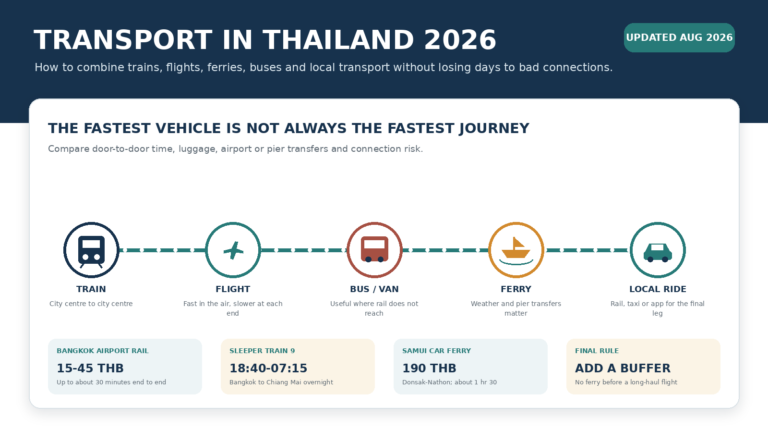
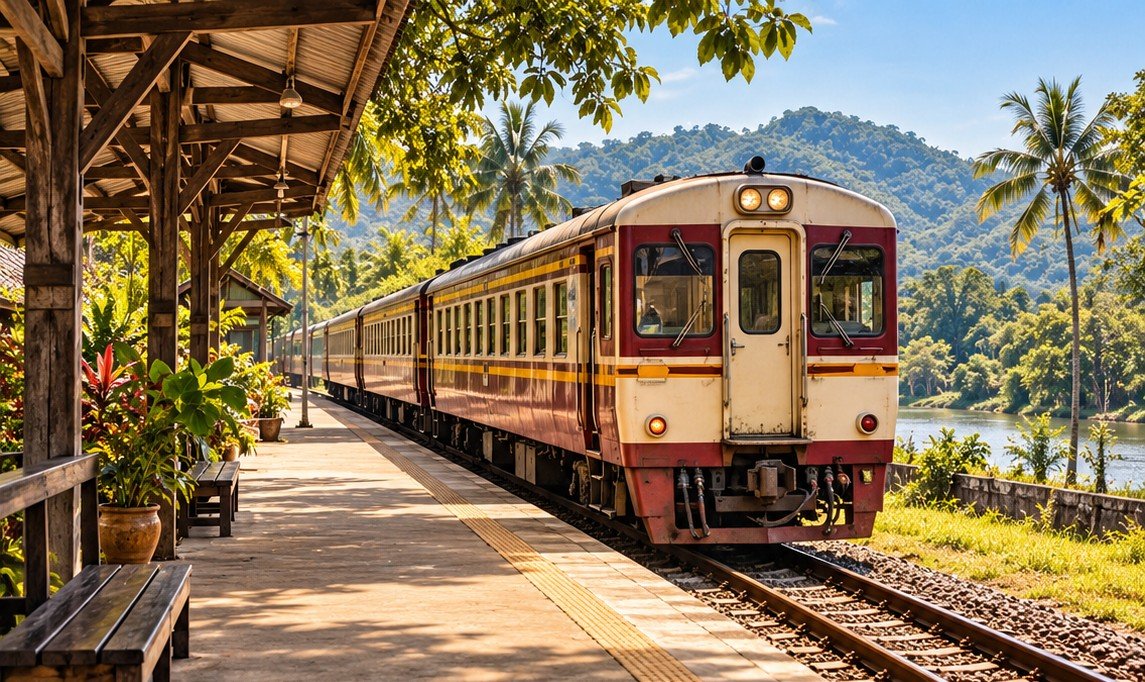
Original transport illustration, not a photograph of Thon Buri station or a guaranteed train carriage.
Bangkok to Kanchanaburi looks like an easy westward hop until you compare tickets that finish in completely different places. A train to the town, a van to a travel office and a car to a remote river resort are not equivalent purchases. Start with your actual hotel address, then work backwards to the departure point that makes sense from your Bangkok base.
The train is a worthwhile choice when the ride is part of the holiday. However, a bus or shared van often gives a simpler balance of cost and timing, while a private transfer can remove two awkward local journeys. None is automatically best for every traveller.
This comparison ranks options by the complete journey: access to the departure point, time on board, luggage, arrival transfer and the effect of a delay. It is research-led planning advice, not a claim that every vehicle or operator has been personally tested. Railway times and supplier information were checked on 4 October 2026; the generous door-to-door windows are planning estimates, not promises.
Some links below are affiliate links. If you book through them, Taylor’s Trailblazing Travels may earn a commission at no additional cost to you. Compare the provider’s current terms before booking.
Bus or shared van
Compare the exact terminal and town drop-off before comparing prices.
Train plus time
A relaxed schedule matters more than shaving minutes off arrival.
Private transfer
Useful for luggage, children and a resort outside the town centre.
Town versus province
An inexpensive town ticket can leave a substantial onward journey.
Bangkok to Kanchanaburi: compare the complete journey
Start with the last mile
Choose the destination before the vehicle. Kanchanaburi railway station, the bus terminal, the bridge area and a resort towards Sai Yok are separate arrival points. A booking labelled simply "Kanchanaburi" can also cover somewhere much farther away within the province. The marketplace results reviewed for this guide included distant provincial destinations alongside town services, making the detailed arrival pin more useful than the headline route name. [4]
For a town guesthouse, an ordinary public-transport arrival followed by a short local transfer may work well. Conversely, a secluded river stay can make a through car attractive even when the headline fare is higher. Ask the accommodation to describe the actual arrival process, including any pier connection, before buying the intercity ticket.
Compare time you can actually use
Treat the following as planning windows assessed on 4 October 2026, not guaranteed running times. The road allowances assume ordinary conditions; serious rain or traffic can extend them substantially.
On a small screen, swipe within the table to see all columns.
| Option | Main journey to town | Add at either end | Best fit |
|---|---|---|---|
| Ordinary train | Roughly 2.5 hours on the published town timetable | Travel to Thon Buri, ticket purchase and hotel transfer | Travellers who enjoy rail travel |
| Bus or shared van | Usually budget around 3-4 hours, service dependent | Terminal access, check-in and local arrival | Cost-conscious town stays |
| Private vehicle | Allow roughly 3-4 hours from a Bangkok city address | Stops, congestion and any remote resort extension | Groups, luggage and door-to-door travel |
Train timing is grounded in SRT's published service; road windows are deliberately broader than the fastest individual advertisements. A transfer that reaches the wrong end of the province quickly is not a useful shortcut. [1] [4]
The railway departure point: Thon Buri
Do not head to the main terminal by habit
The regular ordinary service for this route starts at Thon Buri on Bangkok's western side. It is not the same journey as turning up at Krung Thep Aphiwat for a reserved long-distance train. SRT identifies train 257 as a Thon Buri-Nam Tok ordinary service passing through Kanchanaburi. Put the complete station name into your navigation rather than searching only for "Bangkok station". [1]
A hotel on the western riverbank and a hotel deep along Sukhumvit will have different access journeys. Check that journey the previous evening, not when the taxi has already arrived. Likewise, distinguish a map pin for the railway station from a similarly named pier or neighbourhood.
Make the early start manageable
Prepare your day bag, breakfast and small cash beforehand. A practical target is to reach the station around 30-45 minutes before departure, adding more margin when local roads are disrupted. That buffer is editorial advice; it is not an official check-in deadline.
Ask staff to confirm the service and your intended stop before boarding. A train terminating at Nam Tok can still be correct for Kanchanaburi town. However, the terminus printed on a sign does not mean you must ride to the end. Keep the destination written down so that a tired early-morning conversation does not turn into a mistaken onward journey.
What buying and using the ordinary train involves
Tickets and seats are different from express services
The specialist railway guidance describes these ordinary trains as station-purchase services with unreserved third-class seating, fans and open windows. Do not interpret their absence from a booking website as proof that the route has stopped operating. Equally, an online offer for a guided railway excursion is not automatically a ticket for the ordinary train. [2]
Buy the ticket for the journey you intend to make, then find a suitable seat while keeping the aisle clear. Travelling together does not guarantee adjacent seats on an unreserved service. Arrive with a plan for where larger bags will go and keep passports, payment cards and medication with you rather than in an unattended overhead bag.
Set realistic comfort expectations
This is an ordinary local train, not a climate-controlled sightseeing carriage. Dress for warm conditions and protect anything that should not get wet near an open window. Bring drinking water and a modest snack rather than relying on an onboard purchase at exactly the time you need it.
Someone who struggles with steps, heat or a moving train's facilities should ask for service-specific information before choosing this option. A cheap ticket loses its appeal when the physical journey does not fit the traveller. Meanwhile, railway enthusiasts may happily accept those compromises because the ordinary carriage is part of the experience, not an inconvenience to be eliminated.
Before the train starts moving
Use the waiting time to check the toilet location, agree where your party will get off and put heavy bags somewhere secure. Keep the ticket accessible rather than buried in a zipped suitcase. If you change seats, make sure everyone in your group knows where the bags have moved. Near your stop, gather belongings early without blocking the aisle or standing in a doorway. A calm exit is easier when the destination has already been confirmed and your hotel pickup does not depend on making an immediate dash from the platform.
Timetable examples and how to read them
Arrival is not the same as departure
The morning SRT listing gives 07:45 from Thon Buri and 10:20 arrival at Kanchanaburi, with departure onwards at 10:30. An afternoon cross-check gives 13:55 from Thon Buri and 16:19 arrival in town. These are timetable examples checked on 4 October 2026; confirm with SRT before travel, particularly during disruption. [1] [2]
On a small screen, swipe within the table to see all columns.
| Ordinary service | Thon Buri departure | Kanchanaburi arrival | Planning implication |
|---|---|---|---|
| 257 | 07:45 | 10:20 | Leaves a useful part of the day in town |
| 259 | 13:55 | 16:19 | Better treated as an arrival afternoon, not a full sightseeing day |
The difference between arrival and onward departure explains why two apparently credible tables can show different times for the same station. Check the column heading before deciding one is wrong. Furthermore, a timetable gives a scheduled movement, not protection for an independently booked connection.
Reconfirm the day before
Keep SRT's information and your accommodation contact available. Ask whether the train is operating normally and whether there are changes affecting your stop. A screenshot is handy offline, but it should preserve the date you checked it rather than becoming a permanent timetable in your phone.
The scenic railway is beyond the town stop
Separate transport from the attraction
Kanchanaburi town is not the end of the line. SRT lists Saphan Kwae Yai, the bridge stop, after Kanchanaburi, followed by stations farther west including Saphan Tham Krasae and eventually Nam Tok. Therefore, getting off in town does not include the full cliffside railway experience associated with photographs of the route. [1]
Decide whether you want to reach your hotel first or make the railway part of the arrival day. The latter means carrying your luggage farther, arranging a different pickup and accepting a later check-in. The former makes it easier to take a smaller bag on a separate scenic outing.
Choose the segment deliberately
For many overnight visitors, a road transfer to town followed by a shorter railway excursion is a sensible combination. It avoids treating the entire Bangkok approach as compulsory simply because one section is especially photogenic. However, someone who enjoys ordinary trains may prefer to travel the whole line in stages.
Check whether an advertised railway activity includes time on the train, a bridge photograph, a museum or several separate stops. Those are different experiences. Also remember the railway's wartime context: the line is associated with the suffering of Allied prisoners of war and Asian labourers, not just a picturesque ride. [5]
Bus and shared-van choices
Read the operator details, not just the vehicle icon
Bangkok departures can involve major bus terminals or private travel offices. The 12Go route page shows both terminal-based and tourist-office services. Each has its own check-in instructions, baggage rules and arrival arrangement, so do not assume that every ticket uses the Southern Bus Terminal or that every vehicle leaves from a hotel pickup. [4]
A service from a nearby office can be worth more than a marginally cheaper ticket across the city. On the other hand, a large coach with suitable luggage storage may be a better fit than a van even when reaching the terminal takes longer. Compare the entire sequence before selecting the cheapest line in a search result.
Ask about the bag, not only its weight
A suitcase can create a problem because of its shape rather than its kilograms. Send the operator the number and approximate size of your bags, plus any pushchair or mobility equipment. Confirm whether these are included, need an additional seat, or cannot be accepted on that departure.
Keep the confirmation with your voucher. Moreover, check whether the stated journey time begins at the advertised office departure or after any collection process. A vehicle waiting for passengers and a coach leaving on a scheduled terminal departure can feel very different when you are trying to reach an afternoon appointment.
When a private transfer is worth the premium
Pay to remove specific difficulties
A private car is easiest to justify when it solves a concrete problem: several bags, small children, an airport arrival, limited tolerance for heat, or a hotel outside town. It is less compelling when a solo traveller with one bag is staying beside a convenient public-transport arrival point.
Request the full itinerary in writing. That means the pickup address, destination address, date, passenger count, luggage count and any planned stop. A quote for "Kanchanaburi" should not be treated as a quote for every resort in the province. Likewise, a car sized for three passengers may not have room for three large cases as well.
Understand the waiting and stopping rules
For an airport pickup, establish when the waiting allowance starts and how delays are handled. For a city pickup, clarify how the driver will contact you and whether the hotel entrance is accessible to the booked vehicle. Ask about tolls, parking, a child seat if needed, and charges for an extra stop.
A transfer is primarily transport. Do not assume the driver is also a licensed guide or that attraction admission is included. If sightseeing is central to the day, compare a properly described tour instead. Conversely, a direct transfer should not quietly acquire unwanted shopping stops simply because it passes tourist attractions.
Cancellation terms deserve attention too
A good quotation explains what happens if you cancel, change hotels or arrive later than planned. Look for the deadline in the local time zone and whether the operator treats a flight delay differently from a missed city pickup. Do not assume a message saying "no problem" changes the written terms. When plans are still uncertain, compare flexibility as part of the price rather than accepting a non-refundable booking and hoping that a later change will be accommodated. Save the final confirmation, including the agreed destination, before leaving home.

Budget the whole transfer, not just the fare
Published prices need the right context
For foreign visitors, specialist railway guidance lists a 100-baht ordinary-line fare; SRT's route page displays a lower standard fare but explicitly excludes special fares. Use the foreign-visitor figure only as a checked planning reference, then confirm the applicable fare at the station. Both sources were reviewed on 4 October 2026. [2] [1]
The road figures below are editorial planning allowances assessed on the same date, informed by marketplace listings rather than guaranteed quotes. Airport collections, larger vehicles, peak demand and remote resorts can cost more. [4]
On a small screen, swipe within the table to see all columns.
| Cost item | Planning allowance | Unit | Check before purchase |
|---|---|---|---|
| Ordinary train for a foreign visitor | Around THB 100 | Per person, one way | Applicable station fare and service |
| Bus or shared van | Around THB 200-500 | Per person, one way | Booking fees, baggage and arrival point |
| Private city-to-town transfer | Around THB 2,000-4,500 | Per vehicle, one way | Vehicle, tolls, waiting and exact hotel |
| Local travel at each end | Get a separate quote | Per ride or person | Whether the intercity booking includes it |
Use a simple group comparison
Add all public-transport fares, the journey to the terminal, the final hotel ride and any baggage charge. Compare that total with the complete private quote for the same destination. Divide only after checking that both options carry everyone and everything.
For example, four travellers may prefer paying more for a direct journey because it avoids handling luggage twice. A solo traveller may reach the opposite conclusion. Neither needs an invented universal "break-even" group size; the actual addresses and baggage determine the answer.
Luggage, children and access requirements
Keep the travel-day essentials together
Carry a small bag containing tickets, identification, water, medication, phone power and whatever you need during the journey. Keep a light layer for air-conditioned road vehicles and separate anything wet before placing it beside documents. This is more useful than filling the day bag with every item from the suitcase.
With children, build in a toilet stop before boarding and carry a change of clothes within reach. Do not assume a shared van can stop whenever requested. For a private vehicle, agree the likely break rather than adding it unexpectedly to a tightly timed airport collection afterwards.
Confirm equipment rather than guessing
Ask a private operator about an appropriate child seat and its actual availability. A vague promise that children can travel is not a confirmation that the required restraint will be fitted. Similarly, ask about vehicle steps, wheelchair storage and assistance using specific dimensions and needs.
Accessible transport cannot be inferred from an air-conditioning symbol or a modern-looking vehicle photograph. Get confirmation from the actual operator. For rail, consider boarding steps and the facilities of that ordinary service, not the accessibility of another Thai train you have used before. FCDO's road-travel guidance also makes seatbelts and careful operator selection relevant to the decision. [6]
Travelling with someone who needs regular breaks
Choose the schedule around the person's needs rather than expecting them to adapt to the cheapest vehicle. A private transfer can allow a planned comfort stop, but its suitability still depends on the actual car, boarding height and restraint arrangements. For rail or shared road transport, ask how long the uninterrupted segment lasts and what facilities are available. Leave a relaxed meal or rest period on arrival rather than moving straight into an excursion. This is particularly useful after poor sleep, when an otherwise manageable journey can feel much longer.
Arriving at either Bangkok airport
A city timetable is not an airport connection
Landing time is not the time you can meet a driver or reach Thon Buri. Immigration, baggage, walking through the terminal and the onward road journey all sit between those events. Therefore, do not choose the morning ordinary train merely because the aircraft is scheduled to land an hour or two earlier.
The correct airport matters as well. Suvarnabhumi and Don Mueang are distinct places with different approaches to the city. Use the airport code from the flight confirmation and check that the transfer quote names that airport, rather than a generic Bangkok pickup.
Make the first day recoverable
After an overnight flight, a direct car or a Bangkok overnight stop may be a better choice than chaining together unfamiliar terminals. That is a comfort and resilience judgement, not a statement that public transport cannot work. Travellers arriving early, with light bags and no fixed arrival deadline, may be happy to take their time.
For any prebooked airport pickup, check the meeting instructions and the delayed-flight policy before departure from home. Then save the driver's or dispatcher's contact somewhere available without a mobile signal. A booking that depends on finding a particular message after landing should not rely on airport Wi-Fi working immediately.
Where you arrive in Kanchanaburi
Town arrival keeps the first afternoon simple
Ask the hotel which stop is most practical for its entrance. A railway station may look close on a map but still involve heat, a luggage-unfriendly pavement or a busy crossing. Conversely, a modest local ride can turn a cheap intercity ticket into a comfortable arrival without requiring a private car all the way from Bangkok.
Check-in time should also inform the plan. Arriving before your room is ready is manageable when there is luggage storage and somewhere to sit. It is less appealing when the next activity requires carrying the suitcase around in the sun. Obtain the storage arrangement in advance rather than assuming it exists.
River-resort arrival needs another conversation
For a property farther west, request the precise road entrance or meeting pier. Ask whether a hotel transfer is included, needs booking, or operates only within a particular window. An isolated setting can be exactly what you want, but it should be a deliberate choice rather than a surprise after the bus terminates in town.
Avoid transferring to a remote property and then immediately travelling back into town for dinner or an early departure. Either enjoy the setting for sufficient time or choose a more practical first-night base. The extra distance is not necessarily a flaw in the hotel; it is a mismatch between the hotel and that day's route.
Returning to Bangkok without a fragile connection
Match the arrival point to the next task
On the return, decide whether you need central Bangkok, a particular bus terminal or an airport. A ticket to the city does not automatically finish near your next booking. Add the final urban journey before deciding that an advertised arrival time leaves enough margin.
Avoid relying on the final possible departure when a missed connection would be costly. Earlier travel gives you alternatives if a vehicle is full, a service changes or weather affects the route. That principle is especially useful when the return follows a long excursion outside Kanchanaburi town.
An international flight deserves its own buffer
Use your airline's airport-arrival requirement, then work backwards through the road journey, congestion allowance and local pickup. Do not present a nominal three-hour drive as a three-hour flight buffer. Those are separate blocks of time, and both must fit.
For an early or expensive flight, a Bangkok airport-area overnight stop is often the calmer planning choice. An extra night has a visible cost, but a missed flight has a much less predictable one. Travellers with a late flight can still compare a same-day transfer, provided the departure is deliberately conservative and the route is operating normally.
What to do when the planned return slips
Contact the onward provider early, explain the situation and ask which changes are actually possible. Keep a list of reasonable alternatives: a later road departure, a direct vehicle or an extra night. Avoid chasing an already impossible connection by pressuring a driver to go faster. If an attraction day has run long, drop the remaining stop and move towards your departure point. That decision is easier when everyone agreed beforehand that the return journey takes priority over one final photograph or an unplanned meal across town.
Day trip, one night or a longer stay?
A day trip requires a small attraction list
A return visit from Bangkok should revolve around one main purpose. A bridge-and-history day is not the same as a waterfall day or a full railway outing. Trying to add all three makes the transfer dominate and encourages rushed decisions when something runs late.
Compare organised itineraries by what they actually include and how much time remains at each stop. A short train segment may be enough for one traveller, while another wants a more substantial railway ride. Neither can be inferred from a dramatic bridge photograph in an advertisement.
Staying overnight buys flexibility, not limitless time
One night lets you separate arrival from the next morning's activity, but the return still needs protecting. Two nights make it easier to choose one major outing and retain a slower town afternoon. The right duration depends on whether you want Kanchanaburi as a brief stop or as a destination in its own right.
Be cautious about making Hellfire Pass the fixed centre of a near-term plan. The official notice checked on 4 October 2026 says the interpretive centre and walking trail are temporarily closed until further notice after heavy rainfall. Reopening must be confirmed independently; do not assume it will happen by a particular holiday date. [5]
Weather, disruption and sensible alternatives
Keep temporary notices separate from the normal route
The FCDO page reviewed for this guide reports severe flooding affecting parts of Thailand, including Bangkok and surrounding provinces. That is a reason to reconfirm road and railway operation, not evidence that every journey in this article is cancelled. Ask the operator about your precise date and route rather than extrapolating from a broad warning. [7]
If the normal route is disrupted, compare delaying departure, changing transport or spending another night in Bangkok. A privately booked car is not automatically able to bypass a flooded road safely. Likewise, a timetable still visible online is not proof that a train is running normally today.
Keep the communication chain short
Have the accommodation, operator and one backup contact saved before setting off. Share changes promptly rather than making multiple overlapping bookings that cannot be cancelled. Where possible, obtain revised instructions in writing so that everyone is working from the same pickup point and time.
Keep valuables close, avoid pressure to board an unconfirmed substitute, and use recognised transport arrangements. Do not lean out of train windows for a photograph or treat an active track as a walking route. Choosing a good view is never a reason to ignore staff instructions or physical barriers.
Do not mistake a backup for a second itinerary
A useful backup is simple enough to act on while tired: a different departure, a flexible town hotel or a later activity. It should not require coordinating several new bookings from the roadside. Keep any cancellation deadline visible and check which payment method the alternative accepts. Most importantly, distinguish inconvenience from danger. A longer wait can be frustrating, but it is preferable to entering a flooded route or accepting a vehicle that cannot safely carry the group and luggage. Build the plan so that postponing remains a real option.
Worked choices for different travellers
Two people travelling lightly from central Bangkok
Suppose you have two small bags, a town hotel and no timed activity on arrival. Compare the actual van or bus office closest to your base against reaching Thon Buri. If the railway ride appeals, the morning train can be a pleasant part of the trip. If not, a convenient road departure may preserve a more relaxed breakfast and still deliver a useful afternoon.
Do not buy an excursion solely because you cannot find the ordinary train online. They solve different problems. A simple intercity transfer followed by independent sightseeing may suit you better than a tightly structured tour.
A family heading to a riverside retreat
Now consider two adults, children and several cases going beyond town. First obtain the hotel's arrival instructions; then compare one through private vehicle against public transport plus the hotel's transfer. The relevant comparison includes luggage handling, waiting, child-seat provision and the time you reach the actual room.
Finally, imagine a solo traveller returning for an early flight. Even an economical bus fare may not justify a risky same-day connection. Moving to Bangkok the previous afternoon can be the sensible choice despite adding accommodation. These examples are decision methods, not fixed recommendations based only on party size.
Pros and cons of the three main options
Where each option earns its place
The train avoids road congestion during the rail segment and gives the journey a distinct character. It works particularly well when you are flexible, happy with an ordinary carriage and interested in the line itself. A bus or shared van can offer a practical middle ground when its departure and arrival points fit your hotels. Meanwhile, a private vehicle reduces changes and can accommodate a more specific itinerary.
The advantages are not interchangeable. A car's directness is not the same as the train's experience, and a cheap van is not necessarily the most comfortable choice with bulky luggage. Decide which problem you need solved before attaching a value to each feature.
Where the compromises show
Ordinary rail means limited departure choices and basic seating rather than reserved, air-conditioned comfort. Shared road travel can bring luggage limits, terminal transfers and less control over breaks. A private car costs more and remains exposed to road disruption, even when the pickup is convenient. [1] [2] [4]
An overnight stay outside town adds another layer: beautiful surroundings can be offset by costly or slow local transfers when most activities are elsewhere. Therefore, assess the accommodation and transport together. Buying each independently on headline price is an easy way to create a combination that looks economical but feels awkward throughout the visit.
Common mistakes to avoid
Mistaking names for exact locations
The most expensive small mistake is choosing a plausible name without checking its map pin. Thon Buri is not Krung Thep Aphiwat, a bridge-area stop is not automatically the town station, and a provincial destination is not necessarily Kanchanaburi town. Save screenshots of the actual boarding and arrival instructions, not just the booking headline. [1] [4]
Another common error is assuming the scenic cliffside section lies between Bangkok and the town station. It is farther along the line. Plan the desired segment explicitly so that the train journey you buy matches the experience you expect. [1]
Comparing incomplete prices and impossible days
Do not compare a per-seat van fare with a per-vehicle private quote, or overlook local transfers when deciding which is cheaper. Read the luggage policy before payment rather than negotiating beside a full vehicle. Keep a separate allowance for the transfer to a remote hotel.
Also resist adding an attraction simply because it lies somewhere in the same province. A full day trip, a resort transfer and a flight connection have different priorities. When those priorities clash, shorten the attraction list first. The destination will still be there on a future visit; your booked departure may not wait.
Frequently asked questions
Is the train the cheapest way from Bangkok to Kanchanaburi?
The ordinary-line fare for foreign visitors is listed by specialist railway guidance at around THB 100, checked on 4 October 2026. However, the total cost includes reaching Thon Buri and getting from the station to your accommodation. A bus or van departing near your hotel can sometimes narrow the difference. Confirm the applicable station fare rather than relying on SRT's lower standard-fare display, which excludes special fares. [2] [1]
Can I book the ordinary train online?
The railway guidance used here describes ordinary Thon Buri-Nam Tok tickets as bought at the station, with unreserved seating. Do not confuse them with a bookable excursion or a tour that includes a short train ride. Reconfirm current ticketing arrangements with SRT when planning, particularly if you see an online product whose description is unclear. The important question is which service is being sold, not whether a website displays the words "Death Railway". [2]
Does the train cross the famous bridge before Kanchanaburi station?
On the westbound journey from Bangkok, SRT lists Kanchanaburi before Saphan Kwae Yai, the bridge stop. Continuing farther brings other sections associated with the scenic railway. Therefore, a town arrival does not automatically include crossing the bridge or riding the cliffside section. Tell the ticket seller your intended stop and arrange your onward pickup accordingly, especially when carrying luggage to a hotel. [1]
Is a shared van suitable with a large suitcase?
It depends on the actual operator and vehicle. Ask before booking and provide the number and approximate size of the cases. Some services may charge for additional space or have restrictions that make another option more practical. A generic van photograph is not enough to establish capacity. Instead, consider a larger coach, luggage-friendly transfer or private vehicle when the bag would otherwise make boarding uncertain. [4]
Can I go directly from Suvarnabhumi Airport?
A prearranged road transfer is worth comparing, but verify the airport, meeting point, waiting allowance and exact Kanchanaburi destination. Landing time alone is not a reliable pickup time because immigration and baggage intervene. For public transport, allow for the separate journey to the relevant departure point. An overnight stop in Bangkok may be preferable after a late arrival or when the onward route is disrupted.
Can I visit Kanchanaburi and return to Bangkok in one day?
Yes, provided the day is built around a realistic number of stops and an agreed return. Compare a focused organised tour against independent transport rather than trying to fit the entire province into one outing. A bridge visit, a substantial railway ride and a waterfall excursion are not interchangeable short stops. For Hellfire Pass, check the official reopening status before including it: the closure notice was still present at the 4 October 2026 review. [5]
Which option is best before an international flight?
Choose the option that delivers a generous, recoverable connection to the correct airport. A direct car may remove terminal changes, but it cannot guarantee that roads are clear. For an early flight, moving to Bangkok the previous day is the safer planning structure. For a later departure, work backwards from the airline's check-in requirement, add travel and disruption margins, and leave an alternative rather than relying on the last feasible service.
The practical recommendation
Choose your accommodation's real arrival point first. Then use a convenient bus or van for a straightforward budget transfer, the ordinary train when the journey itself appeals, or a private vehicle when it removes meaningful luggage and connection difficulties.
For a first visit, avoid mixing a long arrival journey, the full scenic railway and several distant attractions into the same day. Reach the right place, settle in and give the main experience adequate time. Finally, protect the return to Bangkok just as carefully as the outward ticket: the best transport choice is the one that works with the entire holiday, not merely the cheapest fare on the screen.
Sources and fact-checking notes
Research reviewed on 4 October 2026. Official pages are prioritised; conflicting information is identified rather than silently reconciled. Timings described as planning windows and hypothetical budgets are editorial assumptions, not supplier guarantees. Recheck details that affect your own dates.
- State Railway of Thailand: ordinary train 257Primary timetable and carriage details. The displayed standard fare excludes special fares; it is not automatically the overseas visitor fare.
- Richard Barrow's Thai Train Guide: Bangkok to KanchanaburiSpecialist explanation of station purchase, third-class seating and the foreign-visitor fare. Reconfirm service and fare with SRT.
- Thai Tracks: ordinary train 259Supplementary ordinary-train ticketing guidance and timetable browser; detailed train tables may require JavaScript. This is not a railway operator.
- 12Go: Bangkok to KanchanaburiDated marketplace inventory, not a universal timetable. Check the actual departure and arrival pins; some results cover distant parts of the province.
- Australian Department of Veterans' Affairs: Hellfire PassThe notice reviewed on 4 October 2026 says the centre and walking trail are temporarily closed until further notice after heavy rain.
- FCDO: Thailand safety and securityOfficial guidance on road travel, swimming, boats, valuables and emergencies. Read the complete current advice before departure.
- FCDO: Thailand travel adviceThe version checked on 4 October 2026 includes severe-flooding disruption advice. This is a dated notice, not a permanent description of conditions.
Illustrations in this article were created for Taylor’s Trailblazing Travels. Third-party photographs, where used, are credited beside the image or in the source list.