Pai 3-Day Itinerary: A Realistic First-Visit Plan
Three balanced days for Pai town, mountain viewpoints, the valley’s best-known sights and one rewarding cave excursion—without turning the trip into a race.
Pai looks compact on a map, yet the experiences that justify the journey are scattered across a mountain valley. Walking Street, Wat Phra That Mae Yen and the riverside are close to town; Yun Lai, Santichon, the bamboo bridge, hot springs and Pai Canyon sit in different directions; Tham Lod is a separate road excursion. A useful Pai 3-day itinerary therefore needs more than a list of attractions.
This research-led plan gives the town an easy first day, groups the valley sights into one practical circuit and reserves the final day for Tham Lod Cave. It also includes a slower local substitute when the cave route, weather or energy level is a poor fit. The order was created by comparing geography, heat, light, opening patterns, road time and recovery time—not by ranking places according to social-media popularity.
Published hours, fees, road conditions and tour inventory can change. Attraction and commercial examples were checked on 18 September 2026, but the ticket, sign or operator confirmation for your date remains the final authority.
Town, valley, cave
Keep each day geographically distinct so the route feels spacious rather than repetitive.
Central Pai
Stay within a short walk of Walking Street and the minivan drop-off, then book transport for the outer valley.
Pai Canyon sunset
Arrive before the last rush, stay off exposed ridges in poor weather and do not treat the unguarded paths casually.
Using a transfer day
The mountain journey from Chiang Mai can consume most of a day and should not be counted as full sightseeing time.
This is a first-visit plan for travellers who want Pai’s atmosphere and scenery without relying on an overloaded scooter loop.
| Day | Main area | Core plan | Pace and best finish |
|---|---|---|---|
| Day 1 | Pai town and Mae Yen | Arrival or easy morning, town orientation, riverside, Wat Phra That Mae Yen, Walking Street | Light to moderate; finish with an unhurried evening in town |
| Day 2 | Western and southern valley | Yun Lai sunrise, Santichon, hotel break, one countryside stop, Pai Canyon sunset | Full day with a proper midday pause |
| Day 3 | Route 1095 towards Pang Mapha | Tham Lod Cave excursion with Doi Kiew Lom viewpoint when conditions permit | Road-heavy; return for a quiet final evening |
Times in this guide are planning windows rather than promises. Weather, water levels, roadworks and pickup routes can move the day.
The itinerary-selection method
Stops were compared against five practical criteria: geographic fit, opening or seasonal pattern, heat and light, transfer time, and whether the experience adds something genuinely different. That method favours one focused cave day over adding another viewpoint, and it gives the centre enough time to feel like a place rather than a dinner stop.
Three full days work; two fragments do not
Three full sightseeing days are enough for Pai town, one valley circuit and a substantial excursion. However, the plan becomes rushed when “three days” means arriving from Chiang Mai after lunch on Day 1 and leaving before midday on Day 3. The mountain transfer is currently sold as roughly three-and-a-half to four-and-a-half hours before hotel transfers, waiting and comfort stops are added. [10]
For that reason, four nights is the comfortable arrangement: arrive on the first afternoon or evening, sleep, use the next three days properly, then leave on the fifth morning. Three nights can work when the first minivan reaches Pai before midday and the final departure is late enough, but the itinerary should then drop either the sunrise or the cave day rather than compressing both.
Who should add a fourth day?
Add one more day when you dislike early starts, want long café or pool breaks, plan to work remotely, have young children, need step-free sightseeing, or are travelling during the rainy or haze-prone periods. A fourth day also makes room for Tha Pai Hot Spring, Kho Ku So Bridge and a massage without treating every meal as a transfer.
Four early choices determine whether this itinerary feels easy or becomes a chain of last-minute negotiations.
1. Decide whether you will ride
Do not assume Pai requires a scooter. Central stays, shared tours, songthaews, local taxis and private drivers can cover the itinerary. A scooter only improves the plan when the rider already has the correct motorcycle entitlement, suitable insurance, mountain-road experience and confidence in changing weather. FCDO guidance highlights Thailand’s high road-traffic risk, particularly for motorcycles, and warns that driving without a valid licence can invalidate insurance. [12]
2. Choose one sunrise, not every sunrise
Yun Lai Viewpoint is the strongest first-visit sunrise because it overlooks Pai and sits beside Santichon. The Tourism Authority of Thailand currently lists opening from 05:30 to 18:00 and a 20 THB entry charge; both were checked on 18 September 2026. [3] Ban Jabo is a separate, longer excursion and should not be added to the same morning merely because a tour title includes both.
3. Protect Pai Canyon for dry visibility
Pai Canyon has narrow, elevated and unguarded paths over loose ground. The official tourism description specifically tells visitors to take care on the steep ridges. [5] Keep the sunset pencilled in rather than prepaid when heavy rain or poor visibility is possible.
4. Confirm the Walking Street pattern
TAT’s current page says the pedestrian market is generally daily in the winter season but may run only on Friday and Saturday during the hot and rainy seasons. [2] Therefore, a September Tuesday should not be planned as though the full high-season market is guaranteed.
Chiang Mai to Pai by minivan
Most visitors approach Pai from Chiang Mai on Route 1095. Prempracha’s current route page confirms the corridor and tells passengers to verify the live timetable, fare and boarding point because those details can change. [9] A dated 12Go search checked on 18 September 2026 showed Prempracha examples taking about four hours twenty minutes and current inventory beginning around 240 THB, with other shared and private options priced separately. [10]
Choose a morning departure when the first afternoon matters. Even then, do not schedule a non-refundable sunset tour immediately after the advertised arrival. Curves, traffic, rain, rest stops and hotel transfer time can all move the clock.
Check the actual terminal and arrival point
Compare the live Chiang Mai–Pai departures for your date, then read the operator, luggage and boarding details before paying.
Private transfer
A private car or van can leave from a Chiang Mai hotel or airport and stop when needed. It is useful for families, larger luggage, anxious travellers and groups dividing one vehicle cost. The premium does not remove the bends or the road time, so a private car should still use daylight and sensible breaks.
Motion-sickness preparation
Eat lightly, keep water accessible, look towards the road and choose a forward-facing seat near the front when available. Medication is a personal medical decision; a pharmacist or clinician can advise on a suitable option. Acupressure bands help some travellers but should not be presented as a guaranteed treatment.
Travel-sickness bands
A low-bulk option some travellers prefer for winding minivan journeys. Check suitability and do not rely on them as the only plan.
Offline confirmations
Save the ticket, accommodation pin and operator contact before departure in case mobile coverage becomes weak.
Working mobile data
Useful for pickup messages and route changes, although a local SIM may suit longer stays better.
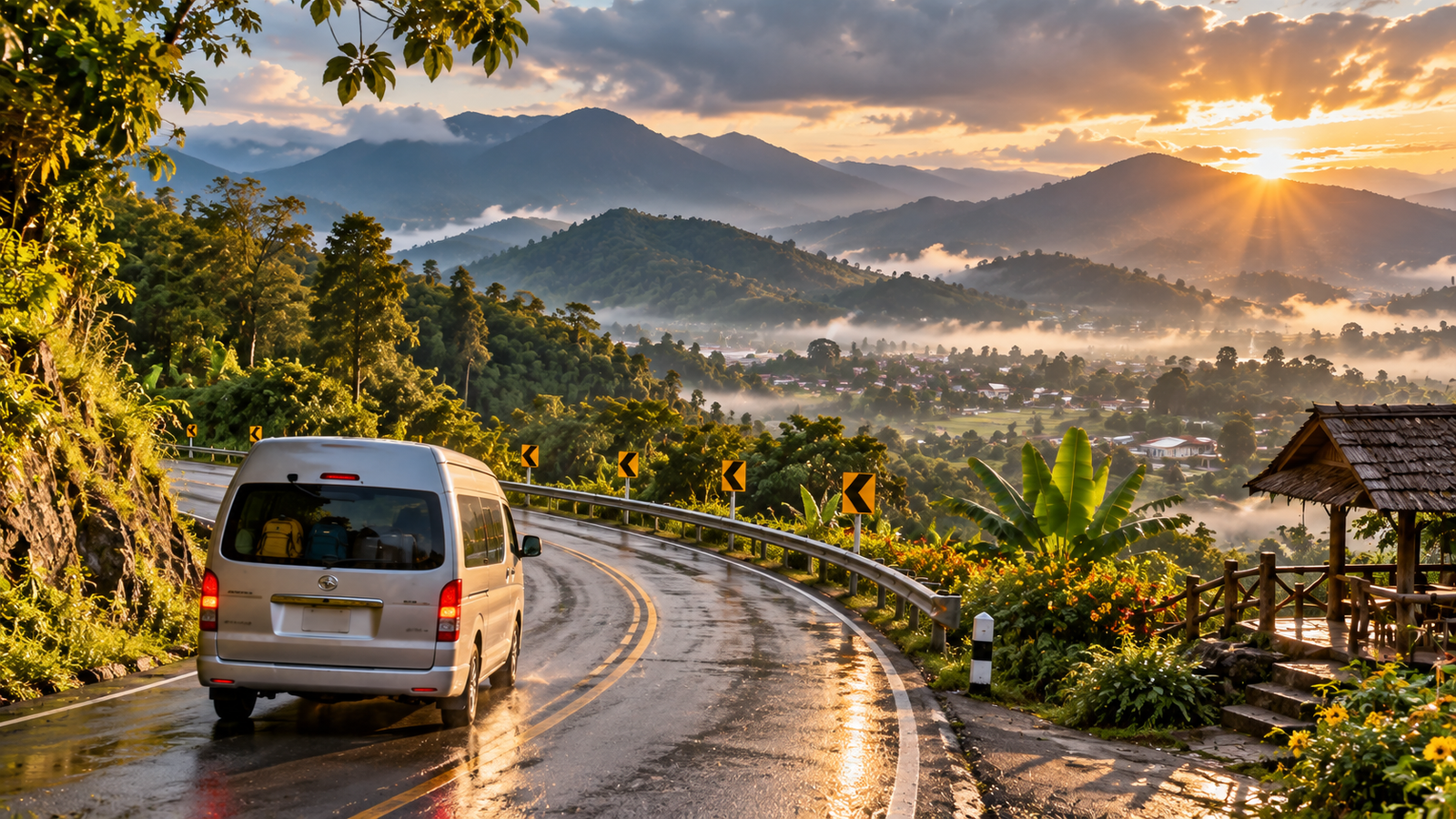
Town centre and Walking Street edge
For a first visit without a scooter, central Pai is the simplest base. You can walk to evening food, cafés, the minivan arrival area and many tour meeting points. The trade-off is noise, particularly around bars and late-night foot traffic. Read the most recent room reviews for the exact building rather than assuming every central lane is loud.
East of the Pai River
Riverside and east-bank stays can feel calmer while remaining close enough to walk into town across a bridge. However, distance on a map does not reveal steep approaches, dark lanes or seasonal bridge access. Check the actual walking route and whether the property offers pickup with luggage.
Mae Yen and countryside resorts
Mae Yen, the hot-spring side and rural valley properties suit couples, drivers and travellers who value views or pools above evening convenience. They are weaker for anyone depending on walking. A free shuttle is only useful when its hours align with dinner, sunrise departures and the final minivan.
| Base | Best for | Practical advantage | Main trade-off |
|---|---|---|---|
| Walking Street / town centre | First visits, no scooter, solo travellers | Food, tour desks and evening walking | Noise and smaller rooms in some lanes |
| East bank / riverside | Couples and a calmer atmosphere | Scenic setting near town | Bridge and walking route need checking |
| Mae Yen | Sunrise temple access and quieter stays | More space and views | Short rides usually needed |
| Outer valley resort | Pool time, drivers, slower trips | Landscape and retreat atmosphere | Poor fit for spontaneous evenings without transport |
The centre is walkable; the itinerary is not. Choose transport day by day instead of treating one mode as a personality test.
| Mode | Best use | Strength | Check before committing |
|---|---|---|---|
| Shared valley tour | Day 2 highlights | Low planning burden and fixed circuit | Stop duration, entrance fees, group size and sunset policy |
| Private driver | Couples, families, mobility needs | Flexible pace and hotel pickup | Vehicle, waiting time, overtime, guiding and child seats |
| Local taxi / songthaew | One or two nearby stops | Useful without a full-day booking | Return availability and agreed full price |
| Bicycle | Town and gentle valley lanes | Slow, scenic and inexpensive | Heat, gradients, traffic and darkness |
| Scooter | Experienced, correctly licensed riders | Maximum flexibility | Licence, insurance, helmet, tyres, brakes, weather and road skill |
Compare tours by route, not by stop count
Current Pai listings include half-day sunset circuits, full-day valley tours, hot-spring trips and Tham Lod excursions. On 18 September 2026, GetYourGuide examples began at roughly £7 for some half-day group products, around £10–£29 for many longer shared options and about £85 per group for a private highlights car. Dynamic prices and inclusions vary, so the useful comparison is the actual route, vehicle, tickets and return time. [11]
Check what the tour really includes
Look for hotel pickup, entry charges, lunch, cave guide, raft, vehicle type and the number of hours actually spent at the stops.
Day 1 stays close because the transfer can leave travellers tired, hungry and less enthusiastic about another vehicle.
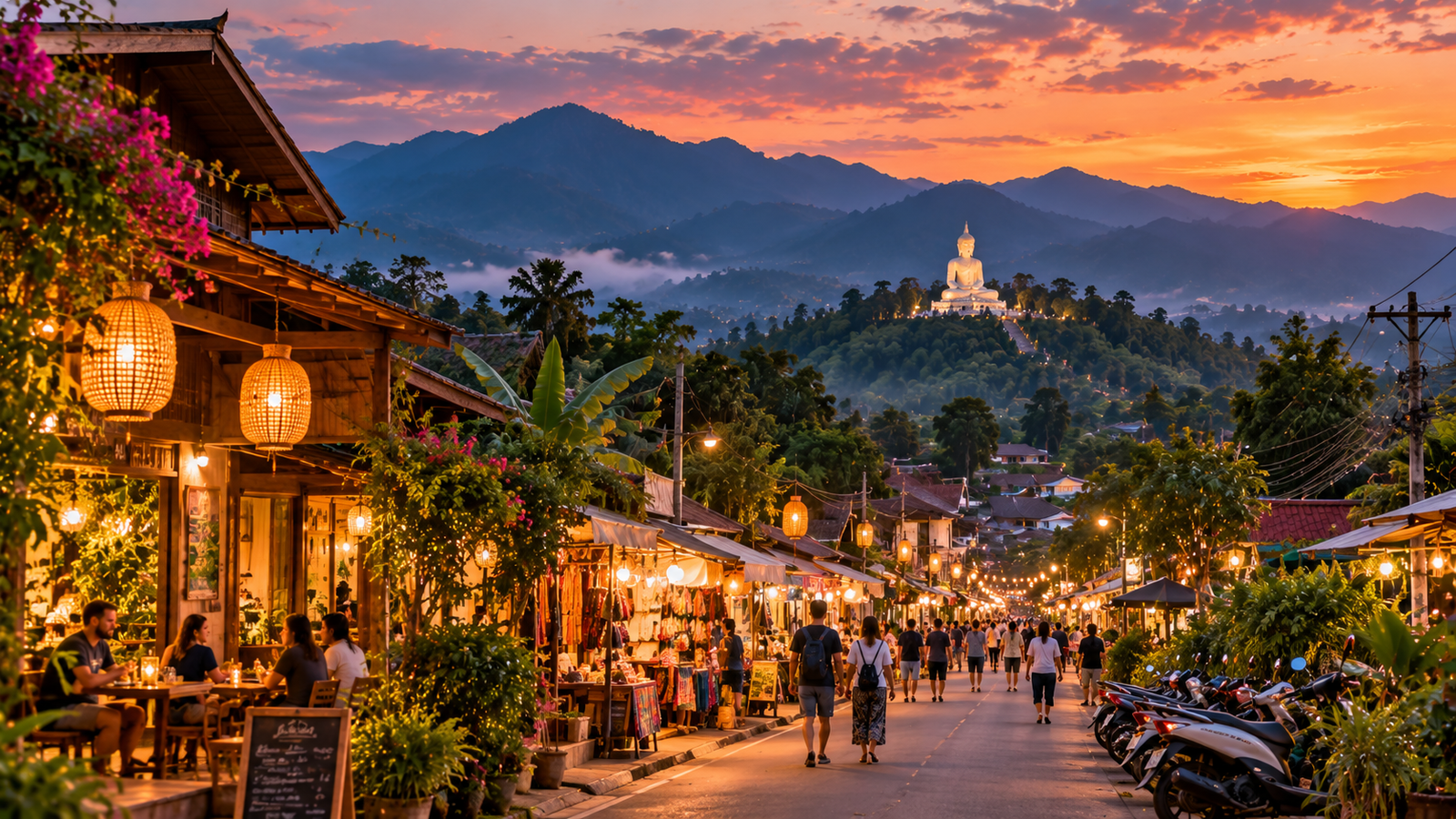
10:00–13:30: arrival, check-in and lunch
When arriving from Chiang Mai, allow time to collect luggage, reach the accommodation and settle. Ask the property to store bags if the room is not ready. Choose lunch within walking distance rather than beginning the trip with a cross-valley café.
14:00–16:00: gentle town orientation
Walk Chai Songkhram Road, locate the market area, note the minivan or tour meeting point and cross towards the river only when the route feels comfortable. Pai’s official tourism overview emphasises the town’s combination of local daily life, creative scene and outdoor access rather than one monumental sight. [1]
Use the warmest part of the afternoon for a café, massage, pool or nap. This is deliberate recovery, not missing out. The following two days contain early starts and longer roads.
16:30–18:30: Wat Phra That Mae Yen
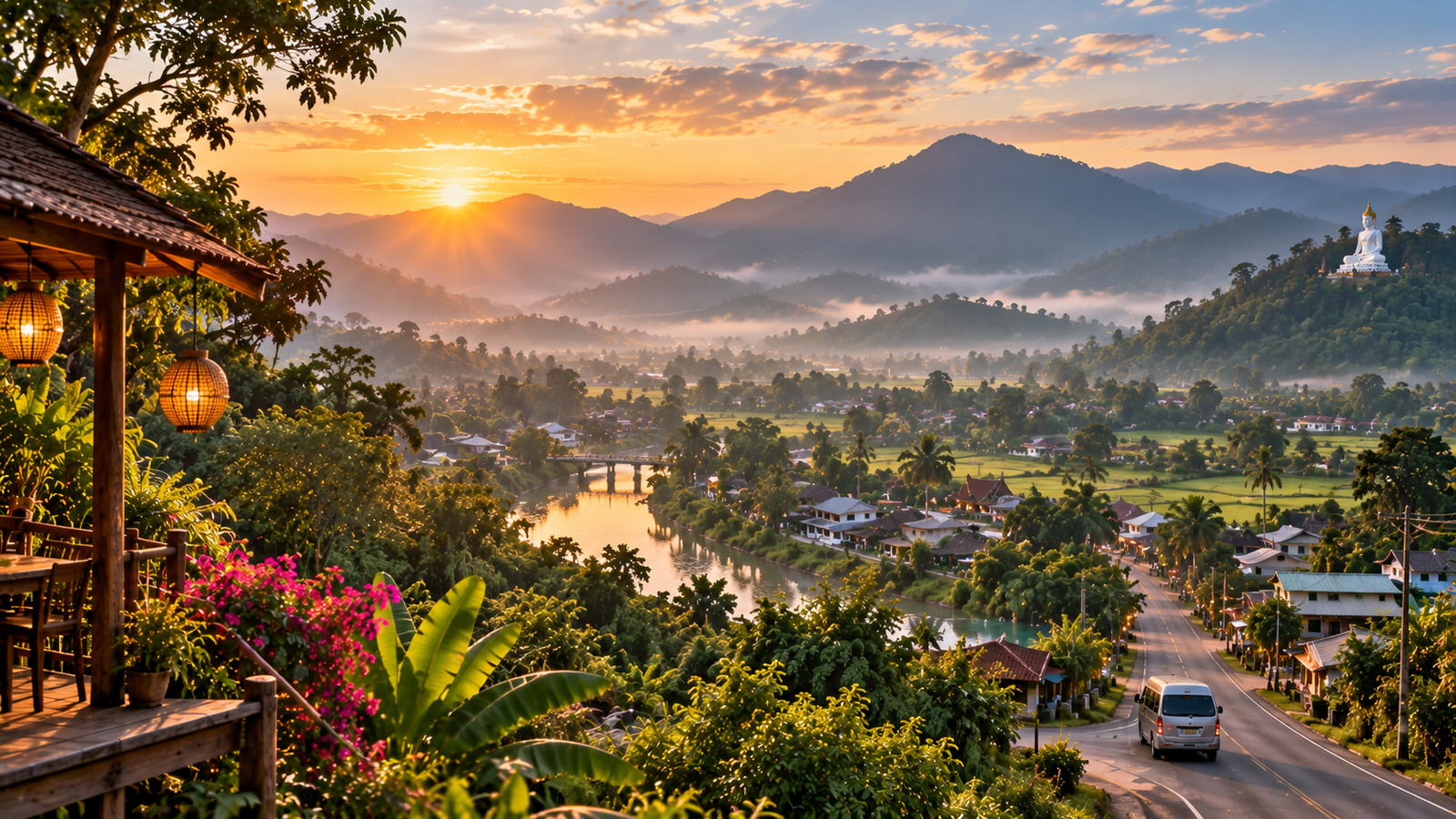
The hillside White Buddha is a strong first sunset when visibility is clear. Reaching the main viewpoint involves a long flight of steps, so travellers with knee, balance or heat concerns should ask a driver about the highest practical drop-off and decide whether the climb is appropriate. Dress respectfully, carry water and keep the visit quiet because it remains a religious site.
Sunset timing changes across the year. Arrive early enough to see the landscape before the light disappears, and leave before paths and steps become difficult to judge.
19:00 onwards: Walking Street and dinner
Pai Walking Street follows Chai Songkhram Road near the district office. TAT describes a pedestrian section extending towards the river and notes a seasonal pattern: daily operation in winter, but commonly Friday and Saturday in the hot and rainy seasons. [2] When the full market is not running, the centre still has restaurants and smaller clusters of stalls, but the atmosphere can be different from a peak-season evening.
Day 2 uses one early viewpoint, one cultural stop, a long midday pause and one sunset. The plan is full without pretending the valley is a theme park.
05:30–08:00: Yun Lai Viewpoint
Leave before sunrise and bring a light layer. The official tourism page describes Yun Lai as a year-round viewpoint over Pai, with the best chance of morning mist commonly from September to February. It currently lists daily opening from 05:30 to 18:00 and a 20 THB entrance charge; these details were checked on 18 September 2026. [3]
Mist is weather, not an attraction guarantee. A clear morning still provides a broad valley view, while dense cloud can hide it completely. Ask the driver to wait because return transport at sunrise should not be improvised.
08:10–10:00: Santichon Village
Santichon lies close to Yun Lai and is associated with Yunnan Chinese culture, food, language and community tourism. TAT places it about five kilometres from Pai and notes the cultural centre, accommodation, souvenirs and Yunnan food. [4] Treat it as a living community and commercial visitor site rather than a costume backdrop. Buy breakfast or tea only when it genuinely appeals; paid activities are optional.
10:30–14:30: return, rest and early lunch
Return to the hotel for sleep, a swim or shade. This four-hour gap prevents the sunrise from making the sunset miserable. It also avoids the exposed canyon and bamboo walk during the strongest heat.
15:00–16:30: choose one countryside stop
Choose Kho Ku So Bamboo Bridge when rice-field scenery and a long, mostly level walk are the priority. The Tourism Authority of Thailand describes the bridge as roughly 815 metres long and around ten kilometres from Pai, linking the monastic community with Pam Bok village. [6] The fields change by season, while the walkway can be slippery after rain. A local contribution may be requested, so carry cash and follow the current sign.
Alternatively, choose Tha Pai Hot Spring for a shorter, quieter afternoon. TAT lists the site within Huai Nam Dang National Park, opening from 08:00 to 18:00, while the Thai-language page currently shows a 40 THB charge; access arrangements and visitor categories may change, so confirm at the gate. [7] Do not enter the hottest source pools, and follow medical advice if heat exposure is unsuitable.
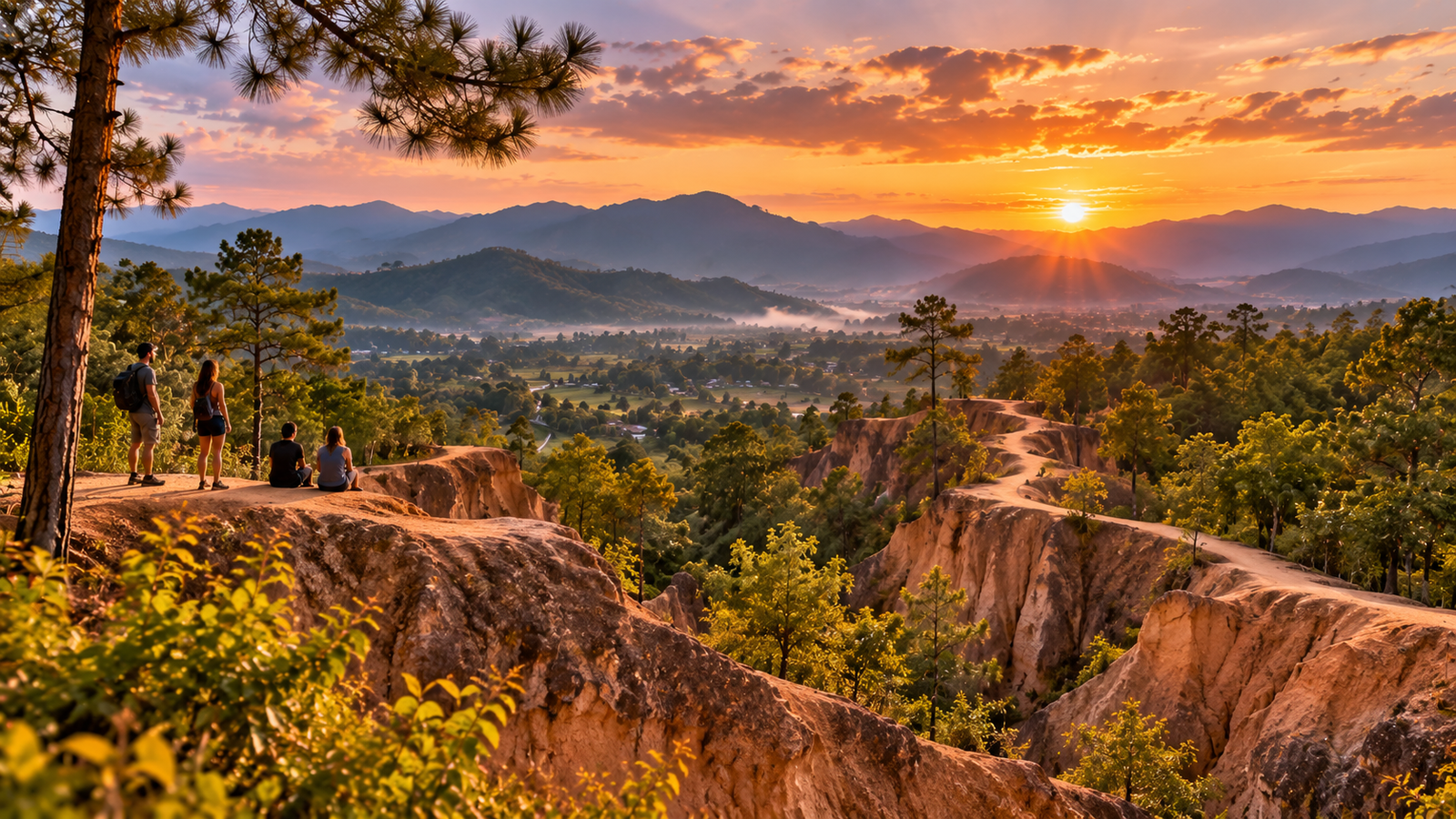
17:00–18:45: Pai Canyon sunset
Pai Canyon sits around seven kilometres from town and requires a short uphill approach. Its eroded ridges are narrow, exposed and unguarded. TAT’s description warns that dry, loose soil can be slippery and that the paths need caution. [5] The safest plan is to enjoy the main viewpoints rather than copying people balancing on the narrowest spine for a photograph.
| Time | Stop | Allow | Planning note |
|---|---|---|---|
| 05:30 | Leave town | 30–45 min transfer | Book the return journey before sunrise. |
| 06:00 | Yun Lai | 60–90 min | 20 THB official listed fee checked 18 September 2026. |
| 08:10 | Santichon | 60–90 min | Breakfast, tea and optional visitor activities. |
| 10:30 | Hotel break | 3–4 hours | Protect energy and avoid midday exposure. |
| 15:00 | Bridge or hot spring | 60–90 min | Choose one according to weather and mobility. |
| 17:00 | Pai Canyon | 75–105 min | Stay on secure ground and leave before darkness. |
Tham Lod earns a separate day because the road, cave access, local guide and water level are the experience—not a quick tick between cafés.
07:30–09:30: drive towards Pang Mapha
Travel north-west on Route 1095 with an organised tour, private driver or experienced, correctly licensed driver. The journey is winding and can take around one-and-a-half to two hours each way depending on the pickup, stops and conditions. Pause at Doi Kiew Lom Viewpoint only when visibility and parking are suitable.
09:30–12:30: cave visit
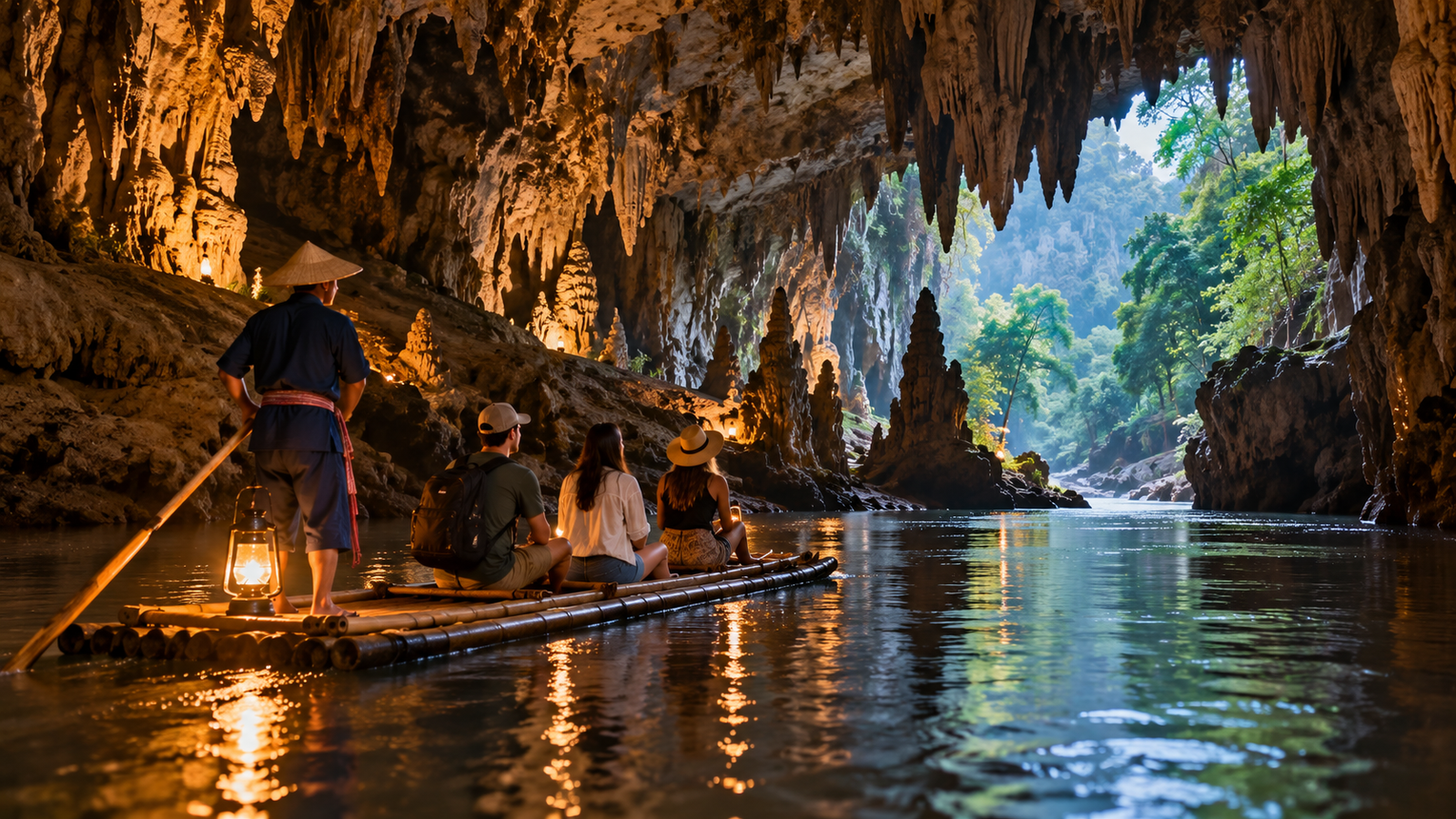
The official TAT page describes Tham Lod as a river cave with major chambers, stalactites, stalagmites, prehistoric material and ancient wooden coffins. It also states that visitors cannot enter independently and need a local guide with a lantern. [8] Water level affects how much of the cave can be reached and whether raft sections operate, so a tour title should never be treated as a guarantee that all chambers will open.
Wear secure shoes, expect darkness, steps, uneven surfaces and the possibility of bat or swift activity. Travellers with severe mobility, balance, respiratory or enclosed-space concerns should ask the operator for a precise access description before booking.
12:30–14:00: lunch near the cave or Soppong
Eat before the return road and keep the meal moderate if motion sickness is a concern. A tour may include lunch, but “included” can mean a fixed simple menu rather than a free choice. Confirm dietary needs in writing before the morning pickup.
14:00–16:30: return to Pai
Leave the evening deliberately empty. The road can feel longer on the return, especially after a dark cave visit and an early start. A shower, massage, pool or familiar restaurant is a better final night than another distant sunset.
A good itinerary survives a wet road, poor air or a traveller who wakes up and does not want another six hours in a vehicle.
Local slow Day 3
Start with a late breakfast, then visit Tha Pai Hot Spring when it is open and conditions are comfortable. Afterwards, stop at the Pai Memorial Bridge or a riverside viewpoint, return for lunch and use the afternoon for a massage, café, pool or gentle town walk. This replacement preserves the valley atmosphere while removing the long cave road.
Rainy-day version
During active heavy-rain or landslide warnings, remove exposed ridges, waterfalls, slippery bamboo and unnecessary mountain driving. Use cafés, cooking classes, massage, sheltered cultural stops and short town walks between showers. The Thai Meteorological Department is the correct live source for warnings; the forecast for Mae Hong Son Province should be checked again shortly before departure. [13]
Haze-day version
When air quality is poor, Yun Lai and Pai Canyon may offer little visual reward while adding outdoor exposure. Check Air4Thai, then replace the view-led day with shorter indoor or low-exertion activities. [14] A mask can reduce particulate exposure when properly selected and fitted, but changing the plan is often more useful than forcing a sunrise.
Two-day compressed version
Keep Day 1 and Day 2, then remove Tham Lod. Pai’s identity is better understood through the town and valley than through a hurried cave return immediately before a minivan to Chiang Mai.
| Constraint | Best replacement | What you retain | What you lose |
|---|---|---|---|
| Heavy rain | Town, cooking class, massage and sheltered stops | Food, culture and rest | Exposed views and bridge walks |
| Poor air quality | Short indoor-focused day | Local atmosphere | Mountain panoramas |
| Low energy | Hot spring and riverside slow day | Valley experience without long road time | Tham Lod |
| Only two full days | Town day plus valley day | Pai’s core first-visit experiences | Long excursion |
Use the centre for variety, not a checklist
Pai’s evening appeal comes from choice: northern Thai dishes, simple curries, grilled food, vegetarian cafés, bakeries and international menus sit close together. One evening should include local food rather than only smoothie bowls, but the itinerary does not need a rigid restaurant ranking. Opening days, queues and kitchen consistency move too quickly for a list to remain reliable.
What to try
Look for khao soi, sai ua sausage, nam prik noom with vegetables, grilled mushrooms, rice dishes, roti and seasonal fruit. Ask about spice, peanuts, fish sauce and shared frying oil when allergies or dietary restrictions matter. “Vegetarian” can still include fish sauce or shrimp paste unless clarified.
Manage the early starts
Walking Street can become the night’s entertainment without adding a separate bar crawl. On the evening before Yun Lai, eat early, buy water and leave enough time to sleep. On the cave-return night, choose somewhere close to the accommodation because another cross-town ride rarely improves the trip.
Accommodation can be inexpensive, but transport choices create the largest difference between a budget and comfortable visit.
| Travel style | Three-day local spend per person | Typical approach | Main caveat |
|---|---|---|---|
| Budget independent | About 2,400–4,500 THB | Central guesthouse, walking, one shared tour, market meals | Outer sights still need paid transport |
| Comfortable mid-range | About 4,500–8,500 THB | Boutique stay, two organised days, mixed cafés and restaurants | Check which entry fees and meals are included |
| Private and flexible | About 7,500–15,000+ THB | Private driver, resort, flexible stops and meals | Per-person cost depends heavily on group size |
Planning ranges were checked on 18 September 2026 and exclude the journey to Pai, alcohol, nightlife, shopping and specialist adventure activities. They are estimates rather than quotes.
Useful dated price references
- Chiang Mai–Pai shared transport: current examples beginning around 240 THB on the 18 September 2026 search.
- Yun Lai Viewpoint: official listing of 20 THB, checked 18 September 2026.
- Tha Pai Hot Spring: TAT’s Thai page currently lists 40 THB, but national-park or visitor categories may change the amount.
- Group Pai tours: current marketplace examples commonly starting around £7–£29 depending on duration and inclusions.
- Private highlights car: current examples around £85 per group for two, with larger vehicles and custom routes costing more.
Cool season: easier mornings, greater demand
November to February generally provides the easiest first-visit conditions for northern Thailand, with cooler mornings and stronger odds for viewpoint days. It is also the busiest period, particularly around New Year. Pack a light layer for sunrise and book central accommodation and popular transport earlier. TAT describes Thailand’s broader pattern as a wet season, a cooler dry period and a hot season, while local conditions vary by province and elevation. [15]
Hot and haze-prone months
Late February through April can become hot and smoky in the north. Air quality is not a cosmetic issue because the itinerary relies on exposed viewpoints and long outdoor periods. Use Air4Thai for the official reading and be willing to replace Yun Lai or the canyon with lower-exertion plans. [14]
Green season
Rain can make the valley vivid and accommodation better value, yet it also affects cave water levels, bamboo surfaces, canyon ridges and the mountain road. The current TMD forecast for Mae Hong Son should be checked shortly before each outdoor day. [13] A rain icon is not an automatic cancellation, but an active warning or visibly unsafe path is.
A cheap rental is not permission to learn in Pai
Small automatic scooters are widely advertised in town, but price and availability are the least important checks. The route to attractions includes bends, gradients, loose edges, rain, sand, animals and traffic that may not behave as a new rider expects. FCDO advice highlights Thailand’s high number of road accidents and specifically notes motorcycle risk. [12]
Licence and insurance
A UK car licence does not automatically authorise a motorcycle abroad. Riders need the correct motorcycle entitlement, the relevant International Driving Permit where required, a compliant helmet, rental permission and insurance that covers the engine size and activity. Other nationalities should check their own government and insurer guidance. A shop handing over a key is not evidence that the rider is legally or financially protected.
Safer alternatives
Use a shared tour for the standard valley loop, a private driver for flexibility, or a taxi for one nearby stop. Travellers who want two wheels without motorbike risk can cycle the flatter town and river lanes, although heat, darkness and road positioning still matter.
The useful kit is small: grip, rain protection, a sunrise layer and a day bag that works in vans and caves.
| Situation | Pack | Why it matters |
|---|---|---|
| Mountain transfer | Water, light snack, personal travel-sickness plan | The road is winding and luggage may be inaccessible during the journey. |
| Sunrise | Light jumper or overshirt | Pai mornings can feel cool, especially at exposed viewpoints. |
| Canyon and bridge | Secure walking shoes with grip | Loose soil, bamboo and rain can make poor footwear unsafe. |
| Tham Lod | Closed shoes, small day bag, water, light layer | The cave is dark, uneven and cooler than the road outside. |
| Rain | Compact shell, waterproof phone pouch, dry socks | Quick recovery is more useful than carrying a heavy waterproof outfit. |
| Temple | Shoulders and knees covered | Wat Phra That Mae Yen remains an active religious site. |
The full Thailand packing guide covers medication, electronics, batteries and climate modules in more detail. Use the Thailand packing list and add only the items this mountain itinerary genuinely needs. [16]
For couples
Choose an east-bank or Mae Yen stay, use a private driver for Day 2 and keep the cave excursion shared unless privacy changes the pace enough to justify the price. Replace one sunrise with breakfast when relaxation matters more than completing the list.
For solo travellers
Central accommodation and shared tours reduce transport negotiations and create easy social contact without requiring nightlife. Save pickup details offline, tell the accommodation about very early departures and do not accept an unsafe scooter merely because other travellers are riding.
For families
Use a private vehicle with confirmed child seats when needed. Shorten Yun Lai, choose either the bridge or hot spring, and ask Tham Lod operators about steps, railings, darkness, raft stability and toilets before booking. A hotel pool and early dinner can be the most valuable part of the schedule.
For limited mobility
Central Pai, the market area and some vehicle viewpoints are the strongest fit. Pai Canyon’s unguarded ridges, the White Buddha steps, long bamboo walkway and Tham Lod’s uneven cave access can be unsuitable. Request exact access information rather than relying on the word “easy” in a tour listing.
For remote workers
Add a fourth or fifth day, check desk and Wi-Fi reviews for the specific room, and avoid booking every sunrise. Mobile data is useful as a backup, although valley and mountain coverage can vary.
Pros
- Separates town, valley and cave travel into coherent days.
- Works without renting a scooter.
- Includes sunrise and sunset without scheduling both every day.
- Leaves a midday recovery block after Yun Lai.
- Provides a local alternative when Tham Lod is a poor fit.
- Keeps the Chiang Mai transfer outside the three core days.
Cons
- Three full days usually require four nights for comfortable arrival and departure.
- Tham Lod adds a long winding-road day.
- Sunrise and canyon views depend on weather and air quality.
- Outer-valley sightseeing still needs paid transport.
- The plan may be too active for travellers seeking a café-and-pool retreat.
The route is strongest for first-time visitors who value clear structure but still want free evenings. Travellers visiting mainly to rest should keep Day 1, choose only one half-day valley trip and use the remaining time for the accommodation and town.
- Counting the Chiang Mai minivan as a full sightseeing morning.
- Renting a scooter to learn rather than because the rider is already qualified and experienced.
- Booking Yun Lai, Ban Jabo and Tham Lod before understanding the road time between them.
- Assuming Walking Street has the full winter market every night of the year.
- Crossing Pai Canyon’s narrowest ridges for a photograph despite loose ground or rain.
- Adding the bamboo bridge and hot spring to Day 2 without removing anything else.
- Choosing a remote resort because it looks close on a map, then paying for every meal transfer.
- Comparing tours by attraction count instead of pickup, tickets, guide, vehicle and time at each stop.
- Taking the last minivan back to Chiang Mai immediately before a flight or train.
- Ignoring haze because the weather app shows sunshine.
Are three days enough for Pai?
Yes, when they are three full days. Use one day for town, one for the valley and one for Tham Lod or a slower local alternative.
How many nights should I book?
Four nights is the comfortable choice because it protects three full sightseeing days from the Chiang Mai transfer.
Where should a first-time visitor stay?
Central Pai or the Walking Street edge is simplest without a scooter. East-bank stays can be calmer when the walking route is practical.
Do I need a scooter in Pai?
No. Shared tours, private drivers, local taxis and walking in the centre can cover this itinerary.
How long does Chiang Mai to Pai take?
Plan roughly three-and-a-half to four-and-a-half hours for the scheduled road journey, then add terminal and hotel transfers.
How can I reduce motion sickness?
Choose a front-facing seat where possible, eat lightly, look ahead, keep water available and seek personal medical advice about medication.
Is Pai Walking Street open every night?
TAT says it is commonly daily in winter but may run only on Friday and Saturday in hot and rainy seasons. Check locally for your date.
What time should I visit Yun Lai?
Arrive before sunrise. The official page currently lists opening from 05:30, but weather determines whether mist or a clear view appears.
Is Pai Canyon free?
The official tourism page does not list a compulsory admission fee. Carry cash for local parking or services and follow the current signs.
Is Pai Canyon difficult?
The main viewpoint is easier than the narrow ridges. Paths are exposed, unguarded and can be loose or slippery, so stop where you feel secure.
Is Tham Lod worth the long drive?
It is worthwhile for travellers interested in caves, local guiding and mountain scenery. Skip it when long winding roads or cave access are a poor fit.
Can I enter Tham Lod without a guide?
No. The official tourism information says a local lantern guide is required, and water levels affect the route available.
Should I visit the bamboo bridge or hot spring?
Choose the bridge for a long scenic walk and the hot spring for a shorter, more restful stop. Do not force both into a hot afternoon.
What is the best month for Pai?
November to February is usually the easiest first-visit window, while green season offers lush scenery with more rain and path disruption.
Is Pai good during the rainy season?
Yes for flexible travellers. Keep exposed ridges, bamboo walks and cave plans changeable and monitor official weather warnings.
How much spending money is needed?
Roughly 2,400–4,500 THB can cover a budget three-day local plan excluding accommodation and travel to Pai; private transport raises the total.
Can families follow this itinerary?
Yes, with a private vehicle, fewer stops and a careful check of cave, stair and child-seat arrangements.
What should I remove if I only have two days?
Remove Tham Lod. Keep the town day and valley day because they provide the clearest first impression of Pai itself.
For a first visit, I would book four nights near central Pai, arrive from Chiang Mai before the first full day and keep the opening afternoon light. The first day would combine the centre, a proper hotel break, Wat Phra That Mae Yen and whichever version of Walking Street is operating. Meanwhile, the second day would use a booked driver or well-described small-group route for Yun Lai, Santichon, one countryside stop and Pai Canyon. For Day 3, Tham Lod would remain the plan only while the road, weather and cave access look sensible.
That recommendation is a research-led planning judgement, not a claim of personal travel. Its strength is not the number of attractions. It is the space between them: enough time to notice the valley, eat properly, recover from the curves and let weather change the order without ruining the trip.
Pai does not need to be conquered by scooter or completed before sunset. Three coherent days are enough to understand why the town works: a small, social centre surrounded by scenery that rewards early starts, cautious roads and a willingness to slow down.
Research was checked on 18 September 2026. Official tourism, weather, environmental and government-safety sources were prioritised. Dynamic booking pages were used only for dated planning examples, not permanent promises. Opening hours, charges, road conditions, cave access and market schedules should be checked again shortly before travel.
- Pai — Tourism Authority of Thailand. Destination overview and contact details.
- Pai Walking Street — Tourism Authority of Thailand. Location and seasonal operating pattern.
- Yun Lai Viewpoint — Tourism Authority of Thailand. Viewpoint hours, current listed fee and seasonal mist guidance.
- Santichon Village — Tourism Authority of Thailand. Location and Yunnan cultural context.
- Kong Lan / Pai Canyon — Tourism Authority of Thailand. Geology, distance, access and ridge-safety warning.
- Boon Kho Ku Sui Bridge — Tourism Authority of Thailand. Location, purpose and 815-metre length.
- Tha Pai Hot Spring — Tourism Authority of Thailand. National-park setting, access and listed hours.
- Tham Lod Nature and Wildlife Education Centre — Tourism Authority of Thailand. Cave chambers, archaeology and local guide requirement.
- Chiang Mai–Pai route — Prempracha Transport. Official corridor and advice to confirm current timetable, fare and stop.
- Chiang Mai to Pai inventory — 12Go. Dated schedule, duration and price examples checked 18 September 2026.
- Pai tours — GetYourGuide. Dated group and private activity examples checked 18 September 2026.
- Thailand safety and security — GOV.UK. Road and motorcycle risk, licensing and insurance warning.
- Mae Hong Son weather — Thai Meteorological Department. Official provincial forecast.
- Air4Thai — Pollution Control Department. Official air-quality monitoring.
- Thailand climate and weather — Tourism Authority of Thailand. National seasonal overview.
- Thailand packing list — Taylor’s Trailblazing Travels. Route-led packing, northern layers, rain and hand luggage.
- Best time to visit Thailand — Taylor’s Trailblazing Travels. Month-by-month route planning and northern season trade-offs.
- Chiang Mai itinerary — Taylor’s Trailblazing Travels. Planning the city before or after Pai.
Illustrations in this article were created for Taylor’s Trailblazing Travels. Third-party photographs, where used, are credited beside the image or in the source list.