Thailand transport guide
A practical, door-to-door comparison of flights, overnight trains and premium buses, with current 2026 rail times, realistic costs, booking advice and Chiang Mai arrival options.
Bangkok to Chiang Mai looks simple on a map. The flight is short, the sleeper train is famous and buses leave every day. Yet the wrong choice can still waste half a day, add an unwanted airport transfer or leave you arriving before sunrise with nowhere to check in.
The useful comparison is not “one-hour flight versus twelve-hour train”. It is hotel door to hotel door: packing, terminal transfer, check-in, luggage, delays, arrival transport and how you feel when the journey ends. A cheap flight from the wrong Bangkok airport can be less convenient than a lower sleeper berth. Likewise, an overnight train only saves a hotel night when you can actually rest on it.
This guide separates advertised journey time from real travel time. It also uses current State Railway of Thailand and Transport Company information as dated 2026 examples, while treating airline prices and third-party inventory as live products that must be checked for your exact day.
What is the best Bangkok to Chiang Mai transport for most short trips?
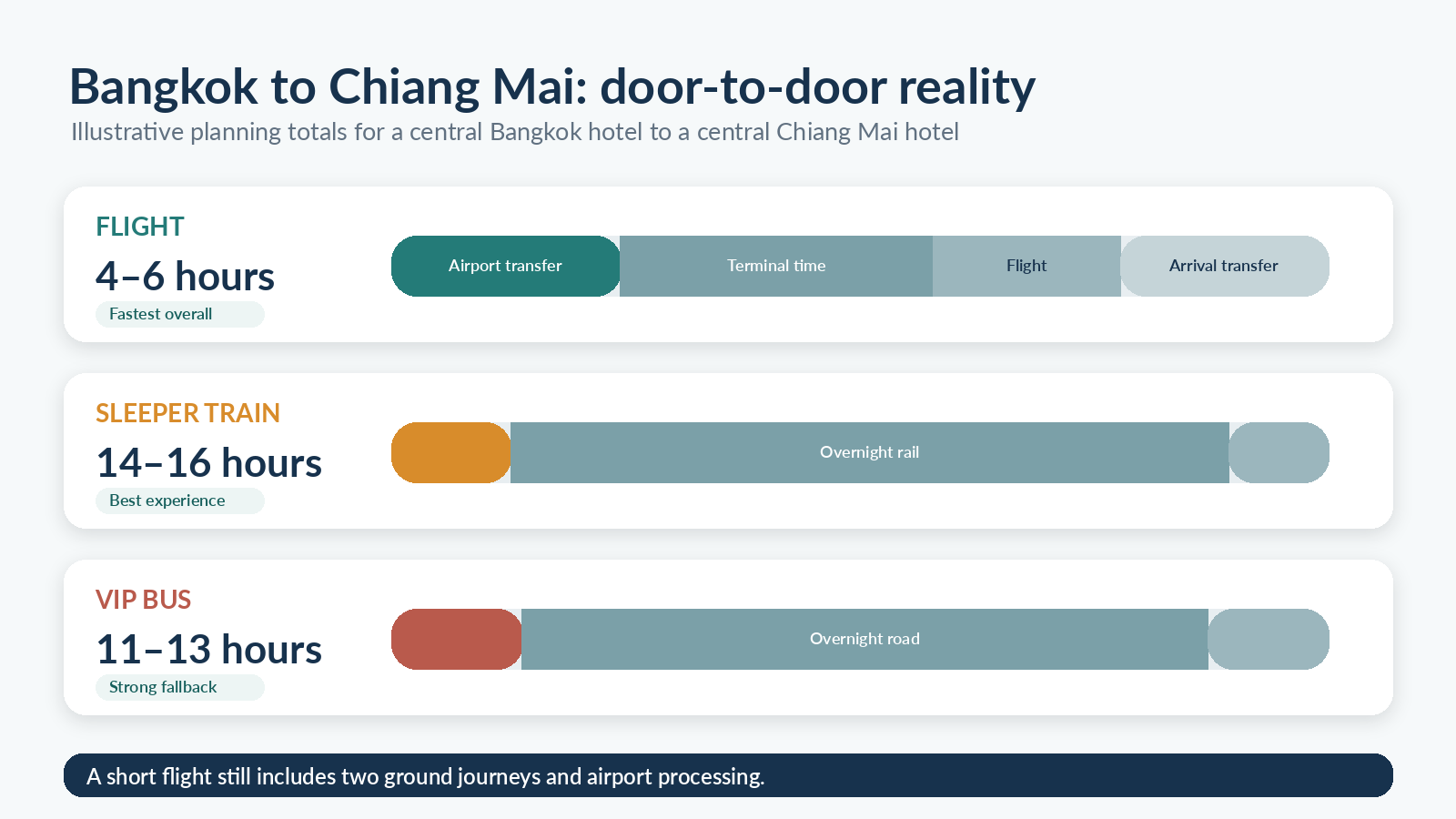
The best Bangkok to Chiang Mai transport for most short trips is a flight, because the airborne time is about 70 to 80 minutes and the full journey is usually around four to six hours. Choose the overnight sleeper train for the experience and a saved hotel night, preferably a lower second-class berth. A premium overnight bus is the strongest backup when trains are sold out or its timetable and price suit you better.
Fastest overall
A well-timed nonstop flight, especially when your Bangkok hotel is convenient for the departure airport.
Overnight experience
Train 9 or another overnight sleeper, provided you value the journey and can keep the first morning flexible.
Rail value sweet spot
A lower second-class sleeper: more space and easier access than an upper berth without first-class pricing.
Strongest backup
A reputable VIP or first-class overnight bus with a confirmed terminal, seat layout and arrival time.
Book first
Lower train berths and first-class cabins for weekends, festivals and Thai public-holiday periods.
Avoid this mistake
Do not compare only the headline fare. Add bags, airport travel, meals, transfers and the value of lost time.
Bangkok to Chiang Mai flight, train and bus compared
The route is approximately 744 kilometres by rail. Current SRT information lists five through trains, ranging from a 10-hour-20-minute daytime service to overnight journeys of roughly 12½ to 13¾ hours. The state bus company’s 2026 express example is scheduled for about 9½ hours, while a flight needs far less time in the air but much more time on the ground. [1] [4]
| Option | Scheduled journey | Realistic door-to-door total | Planning cost per adult | Best for | Main compromise |
|---|---|---|---|---|---|
| Nonstop flight | About 70-80 minutes in the air | Usually 4-6 hours | About 1,200-3,500 baht after a bag and transfers; peak dates can be higher | Short itineraries, families and reliable sleep | Airport time, baggage charges and two possible Bangkok airports |
| Overnight sleeper train | About 12½-13¾ hours on current services | Usually 14-16 hours including station travel | Official examples range from about 938 to 2,446 baht on Train 9, depending on class | Experience, central-to-central travel and saving a hotel night | Imperfect sleep and popular berths selling out |
| Day train | Train 7 is currently 10h20 | About 12-13 hours | Current official example about 558 baht | Scenery, daytime travel and a lower fare | Uses almost an entire day |
| Premium overnight bus | About 9½-11 hours | About 11-13 hours | Official 2026 BKS VIP express example: 924 baht | Late booking and rail fallback | Road movement, variable sleep and terminal quality |
| Private car with driver | Often 9-11 hours plus stops | Similar | Usually several thousand baht for the vehicle | Groups wanting custom stops | Long road day and much higher solo cost |
Choose your transport in 30 seconds
Fly when time and sleep matter most
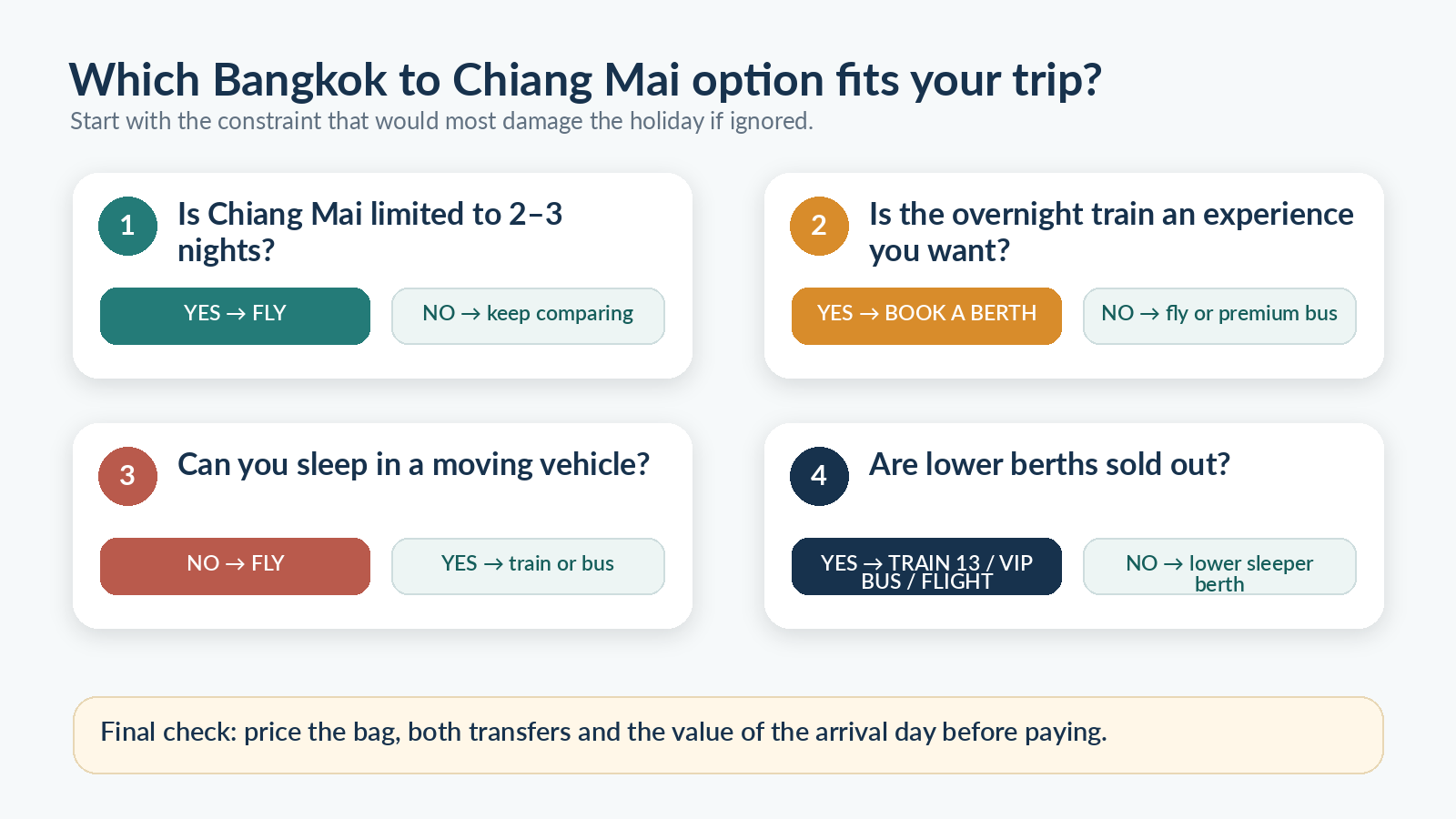
Choose a flight when Chiang Mai has only two or three nights in the itinerary, you are travelling with young children, you sleep badly in moving vehicles or you have a fixed activity on arrival day. A mid-morning flight is often easier than the absolute earliest departure because it avoids a punishing predawn airport transfer.
Take the sleeper when the journey is part of the holiday
The train works best when you are curious about overnight rail, can secure a berth rather than an upright seat and do not need to perform at full speed at 08:00. Lower berths are usually the sweet spot. First class buys privacy, but the total for two people can approach or exceed a flight plus a modest hotel room.
Use the bus as a deliberate choice, not a desperate one
A premium bus can be comfortable and efficient. It becomes attractive when trains are full, the bus departs nearer your preferred time or the official seat layout looks better than the remaining rail inventory. Confirm whether the listing is VIP 24-seat, VIP 32-seat, first class or a more basic service, because the word “VIP” is not a universal specification.
Do not switch Bangkok airports casually
If you arrive internationally at Suvarnabhumi and book a domestic flight from Don Mueang, the transfer can erase much of the fare saving. The free airport shuttle is intended only for passengers transferring between flights and requires proof of onward travel; it is not a general cross-city bus. [5]
Bangkok to Chiang Mai by flight
Flying is the practical default because there are frequent nonstop services and Chiang Mai Airport is close to the city. The airborne part is commonly around 70 to 80 minutes. Nevertheless, a realistic plan includes the trip to the airport, a check-in buffer, security, boarding, possible baggage reclaim and the final ride into Chiang Mai.
How long does flying really take?
- Allow 45-90 minutes from a central Bangkok hotel to the correct airport, depending on location, traffic and rail access.
- Arrive with the buffer specified by the airline. For a domestic flight with checked baggage, 90 minutes is a sensible working minimum rather than a promise.
- Add 70-80 minutes in the air and around 20-50 minutes for disembarkation and baggage.
- Allow another 15-35 minutes from Chiang Mai Airport to many central areas, plus waiting time at busy periods.
A smooth door-to-door journey can therefore be around four hours. Five to six hours is a safer planning figure, especially when travelling at rush hour, checking bags or moving between airport terminals.
What a cheap flight actually costs
Low headline fares may exclude a checked bag, seat selection, card fees, food and flexible changes. Before comparing with a sleeper berth, price the exact luggage you will carry and include both airport transfers. A 1,000-baht fare can become a 2,000-baht journey surprisingly quickly; conversely, a hand-luggage-only traveller near an airport rail line can keep the total low.
| Flight cost | Budget example | Comfort example | What to verify |
|---|---|---|---|
| Base fare | 700-1,500 baht on a quieter date | 1,500-3,000+ baht for a better time or peak period | Airport, date, flight number and refund rules |
| Checked baggage | 0 baht if genuinely cabin-only | Several hundred baht or more | Weight, dimensions and whether booked in advance |
| Bangkok airport transfer | Rail and local connection | Taxi or app ride | Traffic, tolls, airport surcharge and pickup point |
| Chiang Mai transfer | 40-60 baht airport shuttle | Private or app-based transfer | Hotel area, group size and luggage |
| Food and extras | Bring a refillable bottle after security | Meal, seat and priority options | What is actually included |
Best flight timing
A flight between roughly 09:00 and 14:00 often balances convenience and reliability. Very early flights may be cheap but require leaving the hotel before public transport starts. Late-evening arrivals can work well, although they offer little recovery time if the flight is delayed and your hotel reception is limited.
Who should fly?
- Travellers with fewer than three full days in Chiang Mai.
- Families with toddlers or several large bags.
- Anyone with back, knee or sleep problems.
- People connecting from an international flight at the same airport with a generous buffer.
- Travellers who need to work, drive or join a full-day tour soon after arrival.
When flying is not the obvious winner
The flight advantage narrows when the departure airport is across Bangkok, the cheapest ticket has expensive baggage, or you need a hotel room on both sides of an awkward schedule. It also loses appeal when the sleeper experience is one of the reasons you came to Thailand.
Bangkok airport choice: Suvarnabhumi or Don Mueang?
Bangkok to Chiang Mai flights can leave from Suvarnabhumi Airport, shown as BKK, or Don Mueang Airport, shown as DMK. Never assume the airport from the airline name or a previous booking. Read the three-letter code before paying, again before arranging a transfer and once more on travel day.
Suvarnabhumi Airport: when BKK is easier
BKK is usually the better choice when you are connecting from an international flight there, staying near the Airport Rail Link or using an airline whose schedule suits you. Airports of Thailand lists the Airport Rail Link on basement level B1, operating from 05:30 to midnight. It also lists legal Grab pickup at Level 1, Gate 4 and metered taxis at Level 1 between Gates 4 and 7, with a 50-baht airport surcharge. [5]
Don Mueang Airport: when DMK is easier
DMK often has a strong choice of low-cost domestic flights. It can be convenient from northern Bangkok and from the Red Line. The current Red Line adult fare between Don Mueang and Krung Thep Aphiwat is 33 baht, providing a useful connection between the airport and the main long-distance railway station. [6]
Connecting BKK to DMK
Airports of Thailand lists a free shuttle between the airports from 05:00 to midnight, every 30 minutes. However, it is restricted to passengers making an air connection and requires a flight ticket or onward-travel proof plus a passport or national ID. Leave a large buffer: the road distance, traffic, immigration, baggage collection and a terminal change make tight separate tickets risky. [5]
Bangkok to Chiang Mai by train
The train is not merely a slower substitute for flying. It is a different type of travel day: central Bangkok to central Chiang Mai, a bed instead of an airport seat and the chance to watch the landscape change. The strongest version is an air-conditioned sleeper with a confirmed berth. An upright overnight seat is far less appealing.
Why travellers choose the sleeper train
- It can replace one hotel night.
- There is no airport baggage carousel or liquid restriction.
- You can move around more than on a bus or aircraft.
- Arrival at Chiang Mai railway station puts you a short road transfer from the Old City and riverside areas.
- The journey itself becomes a memorable part of the itinerary.
Why travellers regret it
Noise, movement, cold air-conditioning, station announcements and early-morning activity can interrupt sleep. The journey is long, toilets are shared in most classes and a delayed arrival can compress the first day. People who need a quiet room and a firm timetable should not romanticise it.
Official Bangkok to Chiang Mai train times for 2026
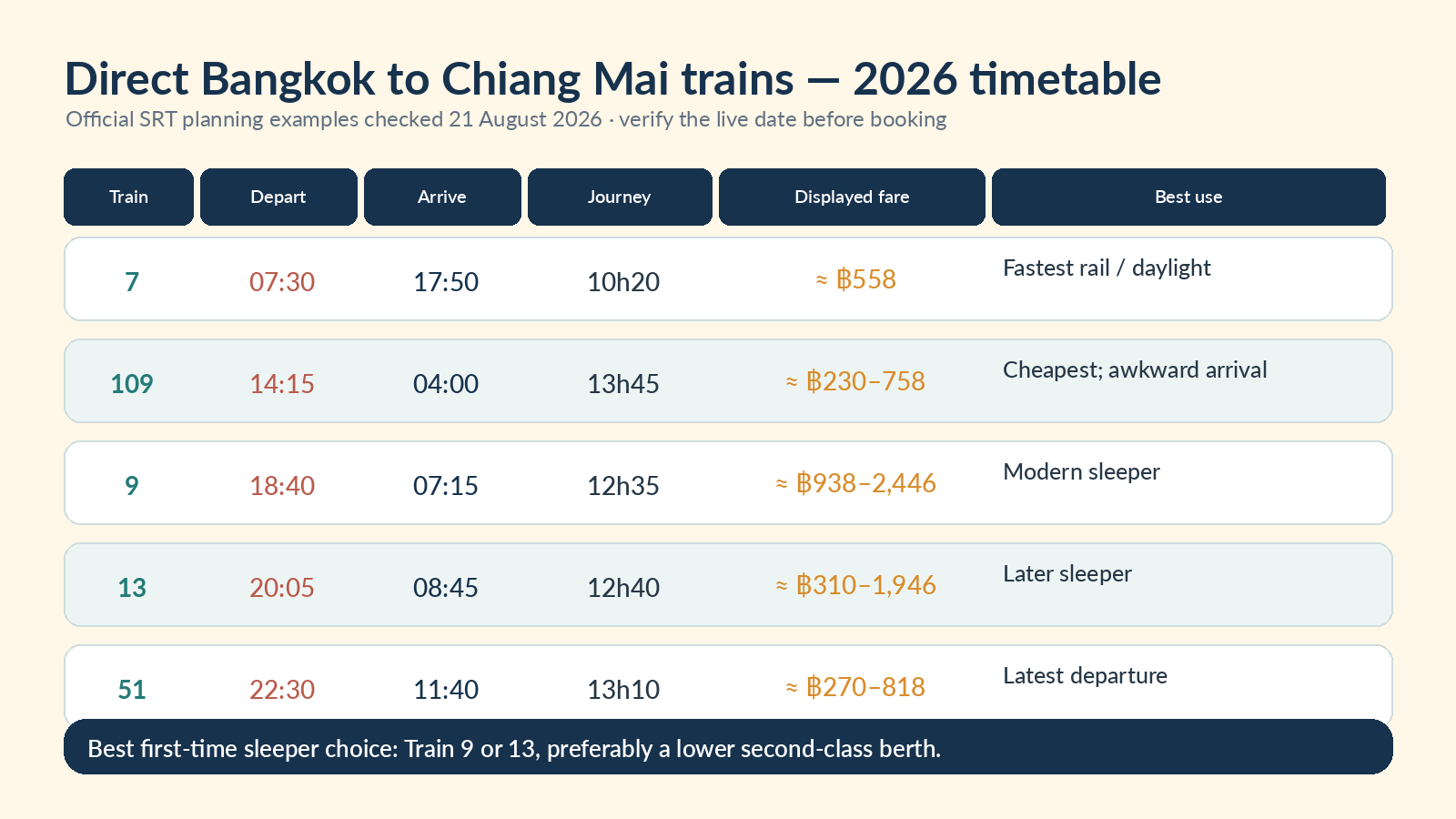
The State Railway of Thailand’s 2026 timetable currently lists five direct services from Krung Thep Aphiwat Central Terminal to Chiang Mai. Times and displayed fare ranges below were checked on 21 August 2026. They are planning anchors, not a guarantee for every travel date, carriage or passenger type. [1]
| Train | Type | Bangkok departure | Chiang Mai arrival | Journey | Official displayed fare range | Best use |
|---|---|---|---|---|---|---|
| 7 | Special Express day train | 07:30 | 17:50 | 10h20 | About 558 baht | Fastest rail option and full daylight scenery |
| 109 | Rapid | 14:15 | 04:00 | 13h45 | About 230-758 baht | Lower budget, but the 04:00 arrival is awkward |
| 9 | Special Express sleeper | 18:40 | 07:15 | 12h35 | About 938-2,446 baht | Modern overnight experience and useful arrival time |
| 13 | Special Express sleeper | 20:05 | 08:45 | 12h40 | About 310-1,946 baht | Later departure and comfortable morning arrival |
| 51 | Express | 22:30 | 11:40 | 13h10 | About 270-818 baht | Latest departure and no dawn arrival |
Train 9: the popular modern sleeper
SRT describes Train 9/10 as an all-air-conditioned 12-car trainset with first- and second-class accommodation plus a dining car. Its current northbound departure is 18:40. At Krung Thep Aphiwat, Don Mueang and Rangsit, SRT says passengers must scan the original ticket, PDF or D-Ticket app; a photograph of the ticket is not accepted. [3]
Train 13: often the practical alternative
Train 13 leaves later and reaches Chiang Mai at a civilised 08:45 on the current schedule. It can be a sensible backup when Train 9’s lower berths are gone. Compare the actual carriage and class rather than assuming two “special express” services are identical.
Train 51: useful for late starters
A 22:30 departure gives you almost a full day in Bangkok and an 11:40 arrival avoids the problem of reaching Chiang Mai before the hotel is ready. On the other hand, a midday arrival uses more of the next day, so it suits a flexible itinerary better than a short one.
Train 109: cheap but difficult at 04:00
The low displayed fare can be attractive, but a 04:00 arrival creates practical costs. You may need a private transfer, a hotel that accepts luggage before dawn or an extra night’s room booked for immediate access. A cheap ticket is not automatically a cheap journey.
Train 7: the best day train
Train 7 is the fastest current rail option and lets you see the route in daylight. It is a good choice for travellers who dislike sleeping on transport. However, it consumes most of the day, so it makes sense when the train scenery matters more than maximising destination time.
Which sleeper class and berth should you book?
Second-class lower berth
For many first-time travellers, this is the best balance. The lower berth is generally wider, easier to enter and less exposed to the cold air near the ceiling. During the evening it begins as the lower seat; staff later convert it into a bed and add bedding and curtains.
Second-class upper berth
The upper berth costs less and is perfectly usable for a confident, mobile traveller. It is usually narrower, reached by a ladder and can feel colder or more enclosed. Keep essentials in a small bag that can stay with you rather than climbing repeatedly during the night.
First-class sleeper
First class offers a private compartment, usually for two passengers, and is the strongest choice for couples who value privacy. Yet limited inventory sells quickly, and the combined price for two can be close to a flight plus a hotel. Confirm whether you are buying one berth or the entire compartment and whether a solo traveller may be paired or charged for sole occupancy.
Seat-only options
A day seat can be good value. An overnight seat is a different proposition. Before accepting a substitute after sleepers sell out, imagine sitting upright for twelve or thirteen hours, then starting a sightseeing day. For most holiday travellers, changing the date or transport mode is better.
| Rail choice | Comfort | Privacy | Ease of access | Best for | Watch for |
|---|---|---|---|---|---|
| Lower second-class berth | Good | Curtain only | Easiest sleeper option | Most adults and first-time sleeper users | Sells before upper berths |
| Upper second-class berth | Fair to good | Curtain only | Ladder required | Budget-conscious, mobile travellers | Narrower and often colder |
| First-class compartment | Best rail privacy | Private cabin | Generally easy | Couples and light sleepers who still want rail | Limited supply and high total cost |
| Day seat | Reasonable | None | Easy | Scenery and daytime travel | Whole day spent in transit |
| Overnight seat | Low for most people | None | Easy | Emergency budget travel | Very poor sleep |
What to pack for the sleeper train
- A light layer or thin blanket for strong air-conditioning.
- Earplugs and an eye mask.
- Water and a modest snack, even when food service is expected.
- Toilet paper or tissues and hand sanitiser.
- A small overnight bag so the main case can stay stored.
- A power bank, because sockets and USB points may be shared or unavailable in some carriages.
- Slip-on footwear for short trips along the carriage.
Luggage and valuables
Keep your passport, wallet, phone, medication and camera with you. The FCDO specifically advises travellers to protect belongings and notes that items have been taken from bags while people sleep on buses and trains. A small zipped bag inside the berth is more sensible than leaving valuables in a large suitcase. [9]
How and when to book the Bangkok to Chiang Mai train
SRT’s current D-Ticket conditions allow eligible express, special express, rapid and tourist trains to be reserved from three hours up to 180 days before departure. The system requires the actual passenger’s name, identification or passport number and phone number. Names cannot simply be transferred to another traveller later. [2]
Best booking strategy
- Set a calendar reminder for the earliest likely booking date when travelling during Songkran, New Year, Loy Krathong, a long weekend or school holiday.
- Search the preferred train and at least one backup service before payment.
- Choose the berth, not only the train number. A lower second-class berth is materially different from an upper berth or seat.
- Enter names exactly as shown on passports and check every date before paying.
- Save the ticket PDF offline and keep the original accessible; do not rely only on a screenshot or photograph.
- Recheck the live departure station and time shortly before travel.
Official booking versus comparison sites
The official SRT channel gives the operator’s inventory and conditions directly. A comparison platform can be easier when you are weighing rail, bus and flight alternatives or using an overseas payment method. Whichever route you use, verify the exact train, class, berth, station and refund terms before payment.
Refund and change reality
SRT’s current conditions include timing-based fees and restrictions, and some payment methods require station handling for refunds. Read the live rule for the ticket you are buying rather than assuming a flexible fare. A cheap non-flexible booking is poor value when the rest of the itinerary is uncertain. [2]
Getting to Krung Thep Aphiwat
Most current long-distance services use Krung Thep Aphiwat Central Terminal, not the old Hua Lamphong station. The station connects with the Red Line and the MRT Blue Line via Bang Sue. Allow time for the building’s scale, ticket checks and finding the correct platform area; arriving at the station entrance is not the same as being beside the train.
Bangkok to Chiang Mai by bus
The bus is often described as the budget option, but the best premium services are better understood as flexible overnight transport. They can be comfortable, bookable later than a popular sleeper and quicker on paper than the train. Quality varies, so the operator, vehicle layout and terminal matter more than the generic word “bus”.
A useful 2026 official example
In March 2026, Thailand’s state Transport Company promoted a Bangkok-Chiang Mai express using a 24-seat VIP bus. The official example departs Bangkok’s Mo Chit 2 terminal at 20:20, calls at Rangsit, runs without intermediate passenger stops, includes meal service and is scheduled for approximately 9½ hours over 713 kilometres. The listed fare is 924 baht. [4]
What premium bus classes may include
- A wider reclining seat and fewer rows.
- Air-conditioning, a blanket and an onboard toilet.
- Water, snacks or a meal arrangement.
- USB or power access on some vehicles.
- Assigned seating and stored luggage.
These features are not identical across every operator. Check the actual seat map, vehicle photos, luggage conditions and pickup point. A 24-seat layout is meaningfully different from a denser coach.
Mo Chit 2 is not the BTS station
Bangkok Bus Terminal (Chatuchak), often called Mo Chit 2, is not beside BTS Mo Chit in the way the name suggests. Build in a road transfer or local connection and arrive early enough to find the operator’s counter and platform. Similar terminal names are a common source of missed departures.
Chiang Mai bus arrival
Long-distance services generally use Chiang Mai’s Arcade bus terminal complex east of the Old City. Confirm which building or terminal the operator uses. Songthaews, taxis and app rides are normally available, although a predawn arrival can mean less choice and more waiting.
Who should take the bus?
- Travellers booking after the best train berths have gone.
- People who can sleep reasonably well in a reclining seat.
- Budget travellers who still want a reputable premium class.
- Those whose hotel location makes the terminals convenient.
- Flexible travellers who can keep the first morning light.
Who should avoid it?
People with severe motion sickness, back pain, limited mobility or a strong need for uninterrupted sleep should usually fly. Families with babies may also find a plane easier, despite the airport procedure.
Real Bangkok to Chiang Mai cost comparison
The cheapest advertised fare rarely equals the cheapest complete trip. The table below uses illustrative mid-range planning budgets for one adult. It is not a live quotation, and peak dates can be much higher. Its purpose is to expose the costs people forget.
| Cost item | Flight | Lower sleeper berth | VIP bus |
|---|---|---|---|
| Main ticket | 1,200-2,800 baht | About 938-1,300 baht on many second-class choices; exact fare varies | About 700-1,000 baht; official BKS example 924 baht |
| Checked bag | 0-900+ baht | Usually included within operator rules | Usually included within operator rules |
| Bangkok transfer | 50-500+ baht | 40-300+ baht | 50-350+ baht |
| Chiang Mai transfer | 40-400+ baht | 50-250+ baht | 50-250+ baht |
| Food | 100-400 baht | 150-400 baht | Often partly included; allow 100-250 baht |
| Hotel-night effect | Usually none | May save one night | May save one night |
| Likely complete total | 1,500-4,500+ baht | 1,200-2,300+ baht | 1,000-1,700+ baht |
Solo traveller
A lower sleeper berth can be excellent value because one ticket replaces both transport and accommodation. A solo flight becomes competitive when you travel with cabin baggage only and use public transport at each end.
Couple
Two first-class rail berths can cost more than two promotional flights, particularly after a modest Bangkok hotel night is considered. On the other hand, a private cabin may be worth paying for when the train experience is a shared highlight.
Family of four
Flight baggage and seat fees multiply quickly, yet the time saving can still justify the price. For rail, check whether the available berths keep the family close together. A scattered group across upper and lower berths is less convenient than the initial total suggests.
Value the arrival day
If an overnight journey leaves you exhausted, the “saved hotel night” can be partly lost to a slow first day. Add the value of the morning you want, not merely the room you avoided paying for.
What to do when the sleeper train or best flight is sold out
Use a simple fallback order
- Check the neighbouring train times, especially Train 13 and Train 51 rather than only Train 9.
- Move the journey by one day if the itinerary has slack.
- Compare a premium bus with a sensible arrival time.
- Price flights from both Bangkok airports, including baggage and transfers.
- Split the journey only when there is a genuine stop you want to make, such as Ayutthaya, Phitsanulok or Sukhothai via road connection.
Do not accept an overnight seat by accident
When the desired sleeper is unavailable, a booking engine may still show seats on the same train. Read the class and accommodation carefully. A seat is not a berth, and the low price can conceal a very different night.
Peak periods need earlier action
Songkran in April, New Year, Loy Krathong and Yi Peng periods, Thai long weekends and school holidays can tighten inventory. Airfares may also rise sharply. Book the scarce component once dates are firm, then build flexible hotel and activity arrangements around it.
Keep separate tickets survivable
Do not schedule the last flight north immediately after an international arrival on a separate ticket. Immigration queues, baggage delays and an airport change can break the plan. An overnight in Bangkok is often cheaper than replacing a missed domestic ticket at the airport.
Best Bangkok to Chiang Mai transport by traveller type
| Traveller | Best general choice | Why | Alternative |
|---|---|---|---|
| First-time visitor with two weeks | Flight | Protects destination time and sleep | Lower sleeper berth when rail is a priority experience |
| Backpacker with flexible dates | Second-class sleeper or premium bus | Combines transport with an overnight stay | Day train for scenery and lowest rail fare |
| Couple | Flight or private first-class cabin | Choose between time and privacy | Two lower berths near each other |
| Family with young children | Flight | Shortest confinement and easiest routine | Private rail compartment for older children |
| Older traveller | Daytime flight | Less climbing, movement and sleep disruption | Lower berth only, after checking station assistance |
| Light sleeper | Flight plus hotel | Most predictable rest | First-class rail cabin with a light arrival day |
| Rail enthusiast | Train 9 or 13 sleeper | The journey is part of the purpose | Train 7 for full daylight scenery |
| Last-minute traveller | Premium bus or available flight | More likely to have inventory than lower berths | Move the travel date |
Travellers with limited mobility
Flying generally reduces journey duration, but airport distances can be long. Ask the airline for assistance in advance. On trains, a lower berth avoids a ladder, yet the platform gap, carriage steps and shared facilities may still be difficult. Confirm assistance with the operator rather than assuming a modern station makes every carriage accessible.
Travellers with medication or medical equipment
Keep medicine, prescriptions and essential devices in hand luggage. Do not place them in a bus luggage hold or checked airline bag. Carry enough for disruption and check airline battery rules for powered equipment.
Travellers carrying large luggage
The train and bus can be simpler than a low-cost flight with strict baggage pricing, but large cases remain awkward in stations and terminals. Pack so one person can manage their own bag over steps and through crowds. A smaller suitcase plus day bag is often easier than a heavy case at the maximum allowance.
Arriving in Chiang Mai: airport, railway station and bus terminal
Arrival time should influence the booking as much as departure time. Chiang Mai is compact compared with Bangkok, but a 04:00 arrival, a 07:15 arrival and an 11:40 arrival create three very different first days.
From Chiang Mai Airport
Airports of Thailand currently lists three airport shuttle routes. A1 serves Nimman, Huay Kaew and the City Moat for 40 baht; A2 serves Mahidol Road, the Night Bazaar and Chang Klan hotel area for 40 baht; A3 follows a wider route including the 700th Anniversary Stadium for 60 baht. Routes and fares should be rechecked on arrival. [7]
The airport also lists designated Grab pickup and dropoff points, with service available 24 hours. Confirm the current pickup zone in the app and follow airport signage rather than accepting an unsolicited ride in the arrivals hall. [8]
From Chiang Mai railway station
The railway station sits east of the Old City. Songthaews, taxis and app rides are common. Agree the fare before using a non-metered vehicle, or check the app price. At a 07:15 or 08:45 arrival, ask the hotel to hold luggage and plan breakfast nearby rather than assuming the room will be ready.
From Arcade bus terminal
The Arcade complex is also east of the Old City and has multiple terminal buildings. Check the operator’s arrival point. During normal hours, onward transport is straightforward; before dawn, pre-arranged pickup may remove uncertainty.
Should you book the previous hotel night?
Book the previous night only when immediate room access is worth the cost and the hotel confirms late-night or early-morning entry. Otherwise, choose a property with reliable luggage storage, send the arrival time in advance and build a light first morning around breakfast, a café and a neighbourhood walk.
Stay connected for tickets and transfers
Offline copies of tickets are essential, but mobile data makes live platform changes, app rides and hotel messages easier. An eSIM installed before departure can be useful when you want a connection as soon as you land, although a local Thai SIM may offer better value for a longer stay.
Safety, valuables and disruption planning
Choose licensed operators
Use official rail and bus channels or a reputable comparison platform that clearly names the operator. On road services, wear the seat belt whenever one is fitted. The FCDO highlights Thailand’s high road-traffic risk, particularly for motorcycles, so a professional intercity service is preferable to improvising a long road journey with an unknown driver. [9]
Protect valuables while sleeping
Keep passports, money, cards and electronics in a closed bag beside you. Do not leave them in an overhead bag or luggage hold. Use a luggage tag without displaying a full home address and keep a photograph of the bag in case it is misplaced.
Allow for weather and delays
Heavy rain can disrupt roads, rail and flights. Avoid booking an expensive non-refundable activity immediately after arrival. A two- or three-hour cushion is not enough for a separate onward flight; build a much larger buffer or stay overnight.
Save useful contacts
SRT lists hotline 1690. Thailand’s Tourist Police Bureau lists hotline 1155. Save both, plus the transport operator and hotel, somewhere accessible offline. [2] [10]
Travel insurance and missed connections
Read the policy definition of a covered delay and the minimum connection time. Separate tickets, self-transfers and known schedule changes may be treated differently. Keep receipts, delay notices and screenshots when disruption creates an extra cost.
Common Bangkok to Chiang Mai transport mistakes
| Mistake | Why it causes trouble | Better plan |
|---|---|---|
| Comparing only scheduled travel time | Airport and terminal transfers change the real total. | Compare hotel door to hotel door. |
| Booking BKK when you expected DMK, or vice versa | The airports are far apart and not interchangeable. | Check the three-letter airport code before payment. |
| Assuming the free airport shuttle is public transport | It is for passengers connecting between flights with proof. | Use a normal rail, bus, taxi or app route when not connecting. |
| Buying a train seat instead of a berth | An overnight upright seat is a different journey. | Confirm lower, upper, cabin or seat before payment. |
| Going to Hua Lamphong automatically | Most current northern long-distance trains use Krung Thep Aphiwat. | Verify the departure station shown on the ticket. |
| Choosing first class without pricing two people | The cabin total can approach a flight and hotel. | Compare the complete party cost. |
| Assuming every VIP bus is the same | Seat density and service differ. | Check operator, layout, terminal and arrival time. |
| Booking a full tour immediately after overnight travel | Poor sleep can ruin an expensive day. | Keep arrival morning flexible. |
| Leaving train booking until arrival in Thailand | Lower berths and first class may be gone. | Book once dates are firm, especially for peak periods. |
| Keeping the only ticket copy online | Signal or battery failure can block access. | Save a PDF offline and carry the required original format. |
Pros and cons of each option
Flight
Pros
- Fastest complete journey
- Best for short trips
- Easy for families
- Many departure times
Cons
- Baggage can raise the fare
- Two Bangkok airports
- Security and check-in time
- Delay risk on separate connections
Sleeper train
Pros
- Memorable experience
- Can replace a hotel night
- Central station arrival
- More freedom to move
Cons
- Sleep is unpredictable
- Good berths sell out
- Shared facilities in most classes
- Long journey if delayed
Premium bus
Pros
- Strong last-minute backup
- Often competitive price
- Overnight timing
- Premium layouts can be comfortable
Cons
- Road movement and traffic
- Variable operator standards
- Less space than a train berth
- Terminal details can confuse
Frequently asked questions
What is the best way to get from Bangkok to Chiang Mai?
A flight is best for most short itineraries because it preserves time and sleep. The overnight sleeper is best when the rail experience matters and you can secure a berth. A premium bus is a useful backup when trains are full.
How long does Bangkok to Chiang Mai take?
A nonstop flight is about 70 to 80 minutes in the air but usually four to six hours door to door. Current direct trains take about 10 hours 20 minutes to 13 hours 45 minutes. Premium buses commonly take around 9½ to 11 hours before terminal transfers.
How far is Bangkok to Chiang Mai by train?
The current SRT timetable lists the journey as 744 kilometres. [1]
Is the Bangkok to Chiang Mai sleeper train worth it?
Yes, when the journey is part of the holiday and you can keep the first morning light. It is less attractive when you are a poor sleeper, have only two days in Chiang Mai or can only obtain an upright seat.
Which train is best from Bangkok to Chiang Mai?
Train 9 is the popular modern sleeper with a useful 07:15 arrival. For a later departure, Train 13 is a strong alternative with an 08:45 arrival. Travellers wanting daylight get the fastest rail journey on Train 7. The best choice depends on berth availability and arrival plans.
Should I book a lower or upper sleeper berth?
Book a lower berth when comfort and easy access matter. It is generally wider and warmer. Choose an upper berth when price matters more and you are comfortable using a ladder.
How early can I book a Thailand train ticket?
SRT’s current online terms allow eligible express, special express, rapid and tourist trains to be reserved from three hours up to 180 days ahead. [2]
Where does the train leave Bangkok?
Current direct northern services generally leave Krung Thep Aphiwat Central Terminal. Verify the station printed on the ticket because travellers still sometimes assume the old Hua Lamphong terminal.
How much is Train 9 from Bangkok to Chiang Mai?
The official 2026 timetable currently displays a broad range of about 938 to 2,446 baht, reflecting different classes and accommodation. Check the live booking result for the exact date and berth. [1]
How much is the VIP bus?
The Transport Company’s March 2026 express example lists 924 baht for a 24-seat VIP coach. Other operators, classes and dates may differ. [4]
Is it better to fly from BKK or DMK?
Choose the airport that minimises your total transfer and fits the flight time. BKK is often easier for an international connection at Suvarnabhumi; DMK can suit low-cost domestic travel and northern Bangkok. Do not switch airports for a small fare saving without pricing the transfer.
Can I use the free shuttle between BKK and DMK?
Only when transferring between flights and carrying the required onward-flight proof and identification. Airports of Thailand says the service runs 05:00 to midnight every 30 minutes. [5]
How do I get from Chiang Mai Airport to the Old City?
Use the A1 airport shuttle for 40 baht where its route suits, take a designated app ride or arrange a private transfer. Recheck the current route and pickup point after landing. [7] [8]
Is the overnight bus safe?
No road journey is risk-free. Choose a licensed reputable operator, wear the seat belt, keep valuables with you and avoid unknown private offers. Travellers who cannot sleep in a moving coach should fly rather than arrive exhausted.
Can I take large luggage on the train or bus?
Usually, but operator limits and storage differ. Keep essentials and valuables in a small personal bag. Confirm oversized or unusual items before booking rather than assuming they will be accepted.
My practical recommendation
For most first-time visitors on a two-week Thailand itinerary, I would choose a mid-morning or early-afternoon flight from the airport that best fits the Bangkok stay. It is not as romantic, but it creates the cleanest chance of arriving rested and using the next day well.
On a longer itinerary, I would deliberately take Train 9 or Train 13 once, ideally in a lower second-class berth. The sleeper earns its place when the journey itself matters and the morning remains flexible. First class is a comfort purchase rather than an automatic value winner.
The premium bus is not a poor relation. A reputable 24-seat or similarly spacious service can rescue a sold-out date and may provide a better timetable than the remaining train choices. Still, check the exact operator and keep the first morning light.
Whichever option wins, book the scarce element first, save the ticket offline, verify the terminal and compare the whole door-to-door cost. Those four steps prevent most of the avoidable problems on this route.
Sources and methodology
Official transport information was checked on 21 August 2026. Train times and displayed fares can change by date, timetable revision and class. Airline fares are dynamic. Every traveller should confirm the final operator, terminal, baggage, cancellation and arrival details before payment.
- State Railway of Thailand 2026 Bangkok-Chiang Mai timetable. Current direct trains, times, journey durations, distance and displayed fare ranges.
- State Railway of Thailand D-Ticket terms. Booking window, passenger details, payment, refund and change conditions.
- State Railway of Thailand Train 9/10 details. Trainset, classes, dining car, departure time and ticket-scanning guidance.
- The Transport Company Bangkok-Chiang Mai express announcement, 17 March 2026. Official 24-seat VIP example, departure, fare, distance and journey time.
- Airports of Thailand: Suvarnabhumi transport. Taxi, Grab, Airport Rail Link and BKK-DMK shuttle details.
- SRT Red Line fare information. Current adult fare between Don Mueang and Krung Thep Aphiwat.
- Airports of Thailand: Chiang Mai Airport shuttle bus. A1, A2 and A3 routes and listed fares.
- Airports of Thailand: Grab at Chiang Mai Airport. Designated pickup and 24-hour service information.
- UK Foreign, Commonwealth & Development Office: Thailand safety and security. Road risk and valuables guidance.
- Thailand Tourist Police Bureau. Official contact details and hotline 1155.
- GetYourGuide Chiang Mai airport transfer category. Live service comparison page; individual vehicle, luggage and cancellation terms vary.
Image credits
Illustrations in this article were created for Taylor’s Trailblazing Travels. Third-party photographs, where used, are credited beside the image or in the source list.